Inheritance of Resistance to Races 69 and 453 of
Colletotrichum lindemuthianum in the Common Bean
Juliana P. Poletine, M.C. Gonçalves-Vidigal
*, Pedro S. Vidigal Filho, Carlos Alberto
Scapim, Lucas Silvério and Cláudia Thomazella.
Departamento de Agronomi a, Universidade Estadual de Maringá. Av. Colombo 5790, 87020-900 Maringá - PR, Brasil
ABSTRACT
The cultivars, AB 136 and G 2333 both resistant to Colletotrichum lindemuthianum races 69 and 453, were crossed with the cultivars Michelite and Perry Marrow (susceptible to both races), with Dark Red Kidney and Cornell 49242 (resistant to both races) and F1 and F2 generations were obtained. Plants were inoculated using a spore
suspension at 1.2 x 10⁶ concentration. The reaction of F1 and F2 populations showed that Dark Red Kidney, Cornell
49242 and AB 136 cultivars had the dominant genes A (Co-1), Are (Co-2)and Co-6, respectively, was conferring resistance to races 69 and 453. The segregation data obtained from F2 populations indicated that G 2333 carried
two dominant resistance genes Co-5gene and another oneCo-7 for 69 and 453 races. The dominant genes in G 2333 and its resistance to C. lindemuthianum race could be transferred to provide anthracnose resistance to susceptible cultivars relatively easy.
Key Words: Phaseolus vulgaris, Colletotrichum lindemuthianum, anthracnose, resistance
*
Author for correspondence
INTRODUCTION
Common bean (Phaseolus vulgaris L.) anthracnose, caused by the Colletotrichum lindemuthianum (Sacc. et Magn.) Scrib. fungus is one of the most damaging seed-borne diseases. The use of resistant cultivars is considered to be the most efficient and economic control method for the disease. It is widely used in Brazil where a considerable proportion of bean producers are small farmers who use low technology level, including the use of their own seeds, no crop rotation and no fungicide treatment. Sources of resistance for the different races have been sought in breeding programs (Paradela Filho et al., 1981; Menezes and Dianese, 1988), but the development of resistant cultivars is hindered because there are various physiological races of the agent which causes the disease. Later studies concluded that the genetic base for resistance to anthracnose in common bean varied from simple to complex, depending on the varieties involved and the physiological races considered (Del Peloso et al., 1989). There are some sources of resistance such
as Dark Red Kidney, Cornell 49242, Mexico 222, TO, TU, AB 136 and G 2333, which carry the genes A (Co-1), Are (Co-2), Mexique 1 (Co-3),
Mexique 2 (Co-4), Mexique 3 (Co-5), Q (Co-6) and Co-5, Co-7, respectively.
McRostie (1919) reported the first gene (named A) for resistance to anthracnose, present in the Dark Red Kidney variety and expressing resistance to the alpha race. Mastenbroek (1960) found a dominant resistant gene in the Venezuelan variety Cornell 49242 and several breeding programs have been based on this gene. The Are (Co-2) gene gives resistance to alpha, beta, gama, delta, epsilon and lambda races. The kappa, iota and alpha-brazil races, however, break this resistance (Fouilloux, 1979; Menezes, 1985). Three dominant resistant
conferred by a single gene and could be easily broken by the appearance of a new race.
The dominant resistance gene present in the AB 136 variety was first described by Schwartz et al.
(1982). Inheritance studies showed that only the Q
(Co-6) gene, which was independent of others previously characterized, was present in this cultivar (Vidigal 1994; Gonçalves-Vidigal et al., 1997; Young and Kelly, 1996a). Pastor-Corrales et al. (1994) showed that only the G 2333 line was resistant to 380 isolates of C. lindemuthianum. This line was resistant to all the Brazilian isolates and all the European and North American races (Balardin and Pastor-Corrales, 1990; Balardin et al., 1990; CIAT, 1990; Pastor-Corrales and Tu, 1989). Thus, line G 2333, which has wide adaptation, high seed yield in many environments and tolerance to low fertility soils, can positively contribute to breeding programs, especially those for areas where C. lindemuthianum is highly variable. Resistance in G 2333 is controlled by two independent dominant genes with equivale nt effects (Pastor-Corrales et al. 1994). Young and Kelly (1996b) showed that G 2333 also carries the Co-5 gene, which was not detected by the Pastor-Corrales et al. (1994) since race 521 is virulent to the Co-5 gene. According to Young et al. (1998), the presence of more than one gene in G 2333 may account for its broad resistance to all known races of C. lindemuthianum (Balardin et al. 1997; Pastor-Corrales et al. 1994; Schwartz et al. 1982). If resistance in G 2333 is conditioned by three resistance genes (Young and Kelly, 1996b), one of which has been previously described (Co-5), the two other genes need to be characterized, one of them, named Co-7, in this present study and according to Young et al. (1998). In view of this, the inheritance of common bean resistance to the physiological races 69 and 453 of C. lindemuthianum (Sacc. and Magn.) was studied in crosses using the AB 136 and G 2333 cultivars.
MATERIAL AND METHODS
Plant Material: The seeds of the cultivars were supplied by Embrapa-CNPAF (Brazilian
Agricultural Research Corporation - National Research Center for Bean and Rice at Goiania). The crosses were obtained in March, 1997, with the related avaliations being conducted in the same year in a green house and at a phytopatolgy laboratory of the Universidade Estadual de Maringá, respectively. Table 1 shows the characterization of the cultivars. Nine F1 hybrids derived from a partial diallel among the AB 136 and G 2333 lines and the Michelite, Perry Marrow, Dark Red Kidney and Cornell 49242 cultivars were obtained. The F1 plants were left in the greenhouse to obtain the F2 generation. Fifteen days old seedlings of the parents and F1 and F2 generations were tested and assessed for their resistance/susceptibility reaction to the physiological races 69 and 453 of C. lindemuthianum.
Preparation of C. lindemuthianum isolates: The physiological races 69 and 453 were supplied by the fungi collection at the Federal University of Viçosa and Embrapa-CNPAF. These races were chosen because of their most frequent presence in Paraná State but more information on the inheritance of resistance is needed. The numeric designation of each race, followed the binary system proposed by Habgood’s specifications (1970) in the case of C. lindemuthianum, 12 differentiating varieties were recommended by the Centro International de Agricultural Tropical (CIAT) in 1990. Each variety received a value, 2n, where 2 was the number of classes of reactions considered (resistant or susceptible) and n was the function of the order of the differentiators. The resistance reaction or susceptibility shown by the varieties received values zero and one, respectively.
Table 1 - Common bean (Phaseolus vulgaris L.) cultivars evaluated for resistance to races 69 and 453 of Colletotrichum lindemunthianum in 1997
Cultivar Phenotype Growth habit a
Dark Red Kidney Resistant to races 69 and 453 I
Perry Marrow Susceptible to race 69 and 453 II
Michelite Susceptible to race 69 and 453 III
Cornell 49242 Resistant to races 69 and 453 III
AB 136 Resistant to races 69 and 453 IV
G 2333 Resistant to races 69 and 453 IV
a
I = determinate; II = indeterminate, erect bush; III = indeterminate, weak-stemmed, semiclimber; IV = indeterminate, weak-stemmed, climber (Singh, 1982).
Resistance tests: Plants with their first trifoliate leaf comple tely developed (15th day) old were transferred to a humid chamber at approximately 22° ± 2°C. Inoculation of the parents and the F1 and F2 generations of each one of the nine crosses was carried out separately for each race to prevent contamination. Spore suspensions were prepared by flooding 14-day-old fungus cultures with distilled water. This process was carried out using a brush previously moistened in a spore suspension, at 1.2 x 10⁶ concentration, using an adaptation of the method used by Cárdenas et al.
(1964). The seedlings were kept in the same chamber for 96 hours after inoculation, at 20° ± 2°C, controlled light (12 hours with 689 lux illumination alternated with 12 hours of darkness) and approximately 100% relative humidity. Four replications of the parents and their F1 and F2 generation from the 10 crosses were evaluated for each physiological race.
The first trifoliate leaves of individual plants were scored on a 1-5 scale to assess the symptoms induced by the physiological races. Plants scored as 1 and 2 were considered resistant (R) and scored as 3-5, susceptible (S). This system was used by Cárdenas et al. (1964), Muhalet et al.
(1981), Fukuda (1982), Del Peloso et al. (1989) and Gonçalves-Vidigal (1994).
The chi-square test was used to compare the fit goodness of the observed distribution to the
expected ratios. This statistic was calculated by using Genes Program (Cruz, 1997), which offered the probabilities for a chi-square distribution in each cross.
RESULTS AND DISCUSSION
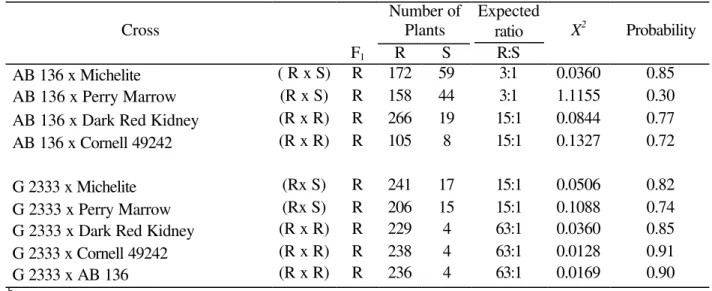
Table 2 - Cross, number of plants evaluated and expected phenotypic ratios in the F2 population for resistance to race 69 of Colletotrichum lindemuthianum (b) .
Number of Plants
Expected
ratio X2 Probability Cross
F1 R S R:S
AB 136 x Michelite ( R x S) R 172 59 3:1 0.0360 0.85 AB 136 x Perry Marrow (R x S) R 158 44 3:1 1.1155 0.30 AB 136 x Dark Red Kidney (R x R) R 266 19 15:1 0.0844 0.77 AB 136 x Cornell 49242 (R x R) R 105 8 15:1 0.1327 0.72
G 2333 x Michelite (Rx S) R 241 17 15:1 0.0506 0.82 G 2333 x Perry Marrow (Rx S) R 206 15 15:1 0.1088 0.74 G 2333 x Dark Red Kidney (R x R) R 229 4 63:1 0.0360 0.85 G 2333 x Cornell 49242 (R x R) R 238 4 63:1 0.0128 0.91
G 2333 x AB 136 (R x R) R 236 4 63:1 0.0169 0.90
b R = Resistance; S = Susceptibility
The data obtained in the G 2333 x Michelite and G 2333 x Perry Marrow crosses fitted the ratio of 15R:1S explained by the segregation of the two dominant and independent genes for resistance with equivalent effects, present in the G 2333 variety (Pastor-Corrales et al., 1994). One of these genes was denominated Co-5following latest gene nomenclature proposing symbols for anthracnose resistance genes (Kelly and Young, 1996), whereas the second gene was assigned the temporary name Co-7 until a complete characterization with other known resistance genes could be conducted (Young et al., 1998). The segregation data obtained from five different F2 populations indicated that G 2333 carried two dominant resistance genes for 69 and 453 races,
Co-5 gene and another one Co-7; Co for
Colletotrichum and 7 because it was the seventh greatest resistance gene to anthracnose characterized and reported in the literature
.
Within the crosses involving two resistant cultivars (R x R), two fitted the ratio 15R:1S and three fitted the ratio of 63R:1S.The ratio 15R:1S obtained in the F2 generation of the AB 136 x Dark Red Kidney cross indicated that the resistance in these crosses was explained by the segregation of the A (Co-1) in Dark Red Kidney, and Q (Co-6) in AB 136 genes. As previously stated, all these genes were independent amongst each other, and any one of them might give resistance in the dominant condition. The
15R:1S segregation, involving the crosses AB 136 x Cornell 49242 and AB 136 x Dark Red Kidney indicated that a single dominant gene gave resistance in AB 136 Q (Co-6),which segregated independently from the Are (Co-2) and A (Co-1) genes present in Cornell 49242 and in Dark Red Kidney, respectively.
When the G 2333 cultivar was crossed with the Dark Red Kidney, Cornell 49242, and AB 136, the data from the F2 generation fitted the 63R:1S ratio, indicating that resistance was controlled by the action of three dominant genes. In the first cross, the action of the A (Co-1) gene from Dark Red Kidney and of the Co-5 (Kelly and Young, 1996) and Co-7 genes from G 2333 became evident. In the cross G 2333 x Cornell 49242 the action of the
Co-5 and Co-7 genes from G 2333 and of Are ( Co-2) from Cornell 49242 was observed. Regarding the cross G 2333 x AB 136, where AB 136 cultivar carried the Q (Co-6) gene, it was observed that they gave resistance when placed together in a single genotype with the independent and dominant genes from G 2333.
the resistance reaction. The results from the AB 136 x Michelite and AB 136 x Perry Marrow crosses fitted the 3R:1S ratio, showing that the action of the Q (Co-6) gene present in the first cultivar was independent and dominant, as also shown by Gonçalves-Vidigal (1994). The gene from the AB 136 cultivar which provides dominant resistance to alpha, delta, and kappa (and other) races was named Co-6 by Young and Kelly (1996b).
When the susceptible varieties Michelite and Perry Marrow were crossed with the resistant line G 2333, all the three crosses fitted the 15R:1S ratio. This demonstrated that the resistant variety had two independent dominant genes with equivalent effects, as quoted by Pastor-Corrales et al. (1994). The first was named Co-5 according to the latest nomenclature suggested by Kelly and Young (1996) and the other one was named Co-7 in this study, following the same designation of Young et al. (1998).
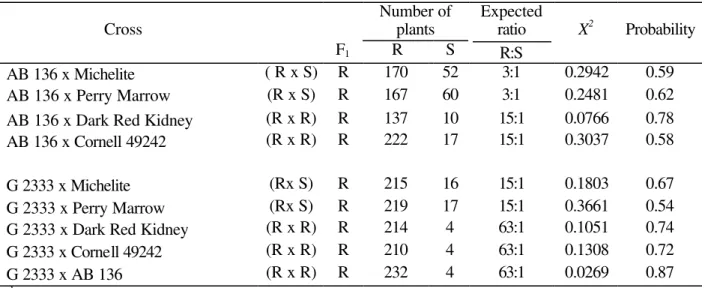
Table 3 - Cross, number of plants evaluated and expected phenotypic ratios in the F2 population for resistance to race 453 of Colletotrichum lindemuthianum (b).
Cross
Number of plants
Expected
ratio X2 Probability
F1 R S R:S
AB 136 x Michelite ( R x S) R 170 52 3:1 0.2942 0.59 AB 136 x Perry Marrow (R x S) R 167 60 3:1 0.2481 0.62
AB 136 x Dark Red Kidney (R x R) R 137 10 15:1 0.0766 0.78 AB 136 x Cornell 49242 (R x R) R 222 17 15:1 0.3037 0.58
G 2333 x Michelite (Rx S) R 215 16 15:1 0.1803 0.67 G 2333 x Perry Marrow (Rx S) R 219 17 15:1 0.3661 0.54 G 2333 x Dark Red Kidney (R x R) R 214 4 63:1 0.1051 0.74 G 2333 x Cornell 49242 (R x R) R 210 4 63:1 0.1308 0.72
G 2333 x AB 136 (R x R) R 232 4 63:1 0.0269 0.87
b R = Resistance; S = Susceptibility
The segregation in the crosses AB 136 x Dark Red Kidney and AB 136 x Cornell 49242 fitted the ratio 15R:1S. These could be explained by the action of the independent dominant A (Co-1) genes, from Dark Red Kidney, Are (Co-2) from Cornell 49242 and Q (Co-6) from AB 136.The data obtained in the F2 generation from crosses G 2333 x Dark Red Kidney, G 2333 x Cornell 49242 and G 2333 x AB 136 fitted the 63R:1S ratio, showing that there was joint segregation of the A
(Co-1), Are (Co-2) and Q (Co-6) genes. The resistance present in G 2333 was controlled by two independent and dominant genes, named Co-5 and
Co-7. In each one of these crosses, the resistance genes were located in independent loci and any one of them could give full resistance, even in the presence of the recessive allele of the other two, behaving, therefore, as triplicate dominance resistance factors.
The allele tests carried out for race 69 and for race
453 indicated that all the genes present in the resistant cultivars were independent from each other. The Co-5 and Co-7 genes, present in G 2333 behaved as dominant resistant genes with equivalent effects, independent from those present in the other cultivars. Dominant genes in G 2333 and its resistance to C. lindemuthianum races, could transferred anthracnose resistance with relative easy to susceptible cultivars.
ACKNOWLEDGMENTS
RESUMO
Os cultivares AB 136 e G 2333 ambos resistentes às raças 69 e 453 de Colletotrichum lindemuthianum foram cruzados com os cultivares Michelite e Perry Marrow (suscetíveis à ambas as raças) e com Dark Red Kidney e Cornell 49242 (resistentes à ambas as raças) e, obtidas as gerações F1 e F2. As plantas foram inoculadas com uma suspensão de esporos, utilizando-se uma concentração de 1,2 x 10⁶ esporos/ml de água. As reações das populações F1 e F2 evidenciaram que os cultivares Dark Red Kidney; Cornell 49242 e AB 136 possuem, respectivamente, os genes dominantes A (Co-1) Are (Co-2) e Co-6, os quais conferiram a resistência às raças 69 e 453. Os dados de segregação obtidos nas populações F2 indicaram que G 2333 carrega os genes dominantes de resistência Co-5 e Co-7. Os genes dominantes presentes em G 2333 e sua resistência às raças de C. lindemuthianum, poderão serem transferidos para cultivares suscetíveis com relativa facilidade.
REFERENCES
Balardin,- R. S.; Pastor-Corrales, M. A. (1990), Reação de germoplasma de Phaseolus vulgaris a nove raças de Colletotrichum lindemuthianum. Fitopatologia Brasileira, 15, 269-273.
Balardin, R. S.; Pastor-Corrales, M. A. & Otoya, M. M. (1990), Variabilidade patogênica de Colletotrichum lindemuthianum no Estado de Santa Catarina. Fitopatologia Brasileira, 15, 243-245.
Balardin, R. S.; Jarosz, A. M. & Kelly, J. D. (1997), Virulence and molecular diversity in Colletotrichum lindemuthianum from South, Central and North America. Phytopathology, 87, 1184-1191.
Cárdenas, F.; Adams, M. W. & Andersen, A. (1964), The genetic system for reaction of field beans (Phaseolus vulgaris L.) to infection by three physiologic races of Colletotrichum lindemuthianum. Euphytica, 13, 178-186.
Centro Internacional de Agricultura Tropical - CIAT (1990), Annual Report. Bean Program. CIAT: Cali, 70-125.
Cruz, C.D. (1997), Programa Genes: aplicativo computacional em genética e estatística. UFV, Viçosa. 442p.
Del Peloso, M. J.; Cardoso, A. A.; Vieira, C.; Saraiva, L. S & Zimmermann, M. J. de O. (1989), Genetic system for the reaction of Phaseolus vulgaris to the BA-2 (alpha) race of Colletotrichum lindemuthianum. Revista Brasileira de Genética, 12, 313-318.
Fouilloux, G. (1979), New races of bean anthracnose and consequences on our breding programs. Paper presented at International Symposium on Diseases o f Tropical Food Crops, 221-235, Universite Catholique de Louvain, Louvain la Neuve.
Fukuda, W. M. G. (1982), Herança da resistência a três raças fisiológicas de Colletotrichum lindemuthianum (Sacc. et Magn.) Scrib. em feijoeiro comum (Phaseolus vulgaris L.). Master’s thesis, Universidade Federal de Viçosa, Viçosa, MG.
Gonçalves-Vidigal, M. C.; Cardoso, A. A.; Vieira, C.; Zambolim, L.; Saraiva, L. S.; Cruz, C. D. & Vidigal-Filho, P. S. (1993), Resistance inheritance of beans to race kappa of C. lindemuthianum. Paper presented at 17th International Congress of Genetics, 119, School of Plant Sciences, Birmingham.
Gonçalves-Vidigal, M. C. (1994), Herança da resistência às raças alfa, delta e capa de Colletotrichum lindemuthianum (Sacc. et Magn.) Scrib. no feijoeiro (Phaseolus vulgaris L.). Doctor’s thesis, Universidade Federal de Viçosa, Viçosa, MG. Gonçalves-Vidigal, M. C.; Cardoso, A. A.; Vieira, C. &
Saraiva, L. S. (1997), Inheritance of anthracnose resistance in common bean genotypes P.I. 207262 and AB 136. Brazilian Journal of Genetics, 20, 59-62.
Habgood, H. (1970), Designation of physiological races of plant pathogens. Nature, 227, 1267-1269.
Kelly, J. D. & Young, R. A. (1996), Proposed symbols for anthracnose resistance genes. Annual Report of the Bean Improvement Cooperative, 39, 20-24. Mastenbroek, C. (1960), A breeding programme for
resistance to anthracnose in dry shell haricot beans, based on a new gene. Euphytica, 9, 177-184.
Mathur, R. S.; Barnett, H. L.; Lilly, V. G. (1950), Sporulation of Colletotrichum lindemuthianum in culture. Phytopathology, 40, 104-114.
McRostie, G. P. (1919), Inheritance of anthracnose resistance as indicated by a cross between a resistant and a susceptible bean. Phytopathology, 9, 141-148. Menezes, J. R. (1985), Variabilidade patogênica de
Colletotrichum lindemuthianum (Sacc. et Magn.) Scrib. em Phaseolus vulgaris L.. Master’s thesis, Universidade de Brasília, Brasília, DF.
Menezes, J. R. & Dianese, J. C. (1988), Race characterization of Brazilian isolates of Colletotrichum lindemuthianum and detection of resistance to anthracnose in Phaseolus vulgaris. Phytopathology, 78, 650-655.
Muhalet, C. S.; Adams, M. W.; Saettler, A. W. & Ghaderi, A. (1981), Genetic system for the reaction of field beans to beta, gamma, and delta races of Colletotrichum lindemuthianum. J. Amer. Soc. Hort. Sci., 106, 601-604.
Pastor-Corrales, M. A. (1988), Variación patogénica de Colletotrichum lindemuthianum, el agente causal de la antracnosis del frijol y una propuesta para su estandarización. In- La antracnosis del frijol común, Phaseolus vulgaris, en América Latina, ed. M. A. Pastor-Corrales. CIAT, Cali, pp. 212-239.
Pastor-Corrales, M. A. & TU, J. C. (1989), Anthracnose. In - Bean production problems in the tropics, ed. H. F. Schwartz & M. A. Pastor-Corrales. CIAT, Cali, pp. 77-104.
Pastor-Corrales, M. A.; Erazo, O. A.; Estreda, E. I. & Singh, S. P. (1994), Inheritance of anthracnose resistance in common bean accession G 2333. Plant Disease, 78, 959-962.
Schwartz, H. F.; Pastor-Corrales, M. A & Singh, S. P. (1982), New sources of resistance to anthracnose and angular leaf spot of beans (Phaseolus vulgaris L.). Euphytica, 31, 741-754.
Vieira, C. (1983), Doenças e pragas do feijoeiro. Imprensa Universitária, Viçosa. 231p.
Young, R. A. & Kelly, J. D. (1996a), RAPD markers flanking the Are gene for anthracnose resistance in common bean. J. Amer. Soc. Hort. Sci., 121, 37-41. Young, R. A. & Kelly, J. D. (1996b), Characterization
of the genetic resistance to Colletotrichum lindemuthianum in common bean differential cultivars. Plant Disease, 80, 650-654.
Young, R. A.; Melotto, M.; Nodari, R. O. & Kelly, J. D. (1998), Marker - assisted dissection of the oligogenic anthracnose resistance in the common bean cultivar, “G 2333”. Theor. Appl. Genet., 96, 87-94.