Determinants of the exclusive
breastfeeding abandonment:
psychosocial factors
Determinantes do abandono do
aleitamento materno exclusivo:
fatores psicossociais
I Programa de Pós-Graduação em Ciência
da Nutrição. Departamento de Nutrição e Saúde. Universidade Federal de Viçosa. Viçosa, MG, Brasil
II Departamento de Nutrição e Saúde.
Universidade Federal de Viçosa. Viçosa, MG, Brasil
III Hospital das Clínicas. Departamento
de Medicina Preventiva. Faculdade de Medicina. Universidade de São Paulo. São Paulo, SP, Brasil
Correspondence:
Mariana Campos Martins Machado Departamento de Nutrição e Saúde Campus Universitário
36570-000 Viçosa, MG, Brasil E-mail: [email protected] Received: 1/23/2014
Approved: 7/1/2014
Article available from: www.scielo.br/rsp
ABSTRACT
OBJECTIVE: To assess the determinants of exclusive breastfeeding abandonment. METHODS: Longitudinal study based on a birth cohort in Viçosa, MG, Southeastern Brazil. In 2011/2012, 168 new mothers accessing the public health network were followed. Three interviews, at 30, 60, and 120 days postpartum, with the new mothers were conducted. Exclusive breastfeeding abandonment was analyzed in the irst, second, and fourth months after childbirth. The Edinburgh Postnatal Depression Scale was applied to identify depressive symptoms in the irst and second meetings, with a score of ≥ 12 considered as the cutoff point. Socioeconomic, demographic, and obstetric variables were investigated, along with emotional conditions and the new mothers’ social network during pregnancy and the postpartum period.
RESULTS: The prevalence of exclusive breastfeeding abandonment at 30, 60, and 120 days postpartum was 53.6% (n = 90), 47.6% (n = 80), and 69.6% (n = 117), respectively, and its incidence in the fourth month compared with the irst was 48.7%. Depressive symptoms and traumatic delivery were associated with exclusive breastfeeding abandonment in the second month after childbirth. In the fourth month, the following variables were signiicant: lower maternal education levels, lack of homeownership, returning to work, not receiving guidance on breastfeeding in the postpartum period, mother’s negative reaction to the news of pregnancy, and not receiving assistance from their partners for infant care.
CONCLUSIONS: Psychosocial and sociodemographic factors were strong predictors of early exclusive breastfeeding abandonment. Therefore, it is necessary to identify and provide early treatment to nursing mothers with depressive symptoms, decreasing the associated morbidity and promoting greater duration of exclusive breastfeeding. Support from health professionals, as well as that received at home and at work, can assist in this process.
DESCRIPTORS: Breastfeeding. Weaning. Bottle Feeding. Depression, Postpartum. Risk Factors. Socioeconomic Factors. Cross-Sectional Studies.
Mariana Campos Martins MachadoI
Karine Franklin AssisI
Fabiana de Cássia Carvalho OliveiraI
Andréia Queiroz RibeiroII
Raquel Maria Amaral AraújoII
Alexandre Faisal CuryIII
Silvia Eloiza PrioreII
Breastfeeding offers beneits to infants’ health from a nutritional, gastrointestinal, immunological, psycholog-ical, and developmental perspective, and it also offers a platform for establishing mother-infant bonding.22 To combat early malnutrition and decrease infant morbidity and mortality, the World Health Organization (WHO) recommends exclusive breastfeeding (EBF) until the sixth month of life and complementary breast-feeding until age two years or beyond.23
However, at least 85.0% of mothers worldwide do not follow these recommendations, and only 35.0% of infants aged < 4 months are exclusively breastfed.22 In Brazil, this rate is only 23.3%.a
RESUMO
OBJETIVO: Avaliar os determinantes ao abandono do aleitamento materno exclusivo. MÉTODOS: Estudo longitudinal baseado em coorte de nascimentos realizado em Viçosa, Minas Gerais. Acompanharam-se 168 puérperas provenientes da rede pública de saúde em 2011/2012. Foram realizadas três entrevistas com as puérperas: aos 30, 60 e 120 dias após o parto. O abandono do aleitamento materno exclusivo foi analisado no segundo e quarto meses após o parto. Aplicou-se escala
Edinburgh Post-Natal Depression Escale para identiicar os sintomas depressivos
no primeiro e segundo encontros, adotando-se o ponto de corte ≥ 12. Foram investigadas variáveis socioeconômicas, demográicas, obstétricas, condições emocionais e rede social da puérpera durante a gestação e puerpério.
RESULTADOS: As prevalências de abandono do aleitamento materno exclusivo aos 30, 60 e 120 dias após o parto foram 53,6% (n = 90), 47,6% (n = 80) e 69,6% (n = 117), respectivamente, e sua incidência no quarto mês em relação ao primeiro foi 48,7%. Sintomas de depressão pós-parto e parto traumático associaram-se com abandono do aleitamento materno exclusivo no segundo mês após o parto. No quarto mês, mostraram signiicância as variáveis: menor escolaridade materna, não possuir imóvel próprio, ter voltado a trabalhar, não ter recebido orientações sobre amamentação no puerpério, reação negativa da mulher com a notícia da gestação e não receber ajuda do companheiro com a criança.
CONCLUSÕES: Fatores psicossociais e sociodemográicos se mostraram fortes preditores do abandono precoce do aleitamento materno exclusivo. Dessa forma, é necessário identiicar e tratar precocemente as nutrizes com sintomatologia depressiva, reduzindo a morbidade a ela associada e promovendo maior duração do aleitamento materno exclusivo. Os proissionais de saúde, bem como o apoio recebido no lar e no trabalho, podem beneiciar esse processo.
DESCRITORES: Aleitamento Materno. Desmame. Alimentação Artiicial.
Depressão Pós-Parto. Fatores de Risco. Fatores Socioeconômicos. Estudos Transversais.
INTRODUCTION
The principal factors that determine breastfeeding aban-donment are low income,17 low education level13 and maternal employment,20 as well as psychosocial factors, particularly lack of assistance from partners for infant care13 and symptoms of postpartum depression.8
The possible negative association between postpartum depression and breastfeeding has been widely discussed in the current literature regarding the determinants of feeding practices in the irst year postpartum (including breastfeeding and its duration). Studies show that the depressive symptoms negatively affect the EBF and duration of breastfeeding.6,8,10,11
a Ministério da Saúde, Secretaria de Atenção à Saúde, Departamento de Ações Programáticas e Estratégicas. II Pesquisa de Prevalência de
The factors hindering the maintenance of breastfeeding in mothers with depression and anxiety include anti-depressant use, sleep deprivation, apathy, and depres-sive mood.24 Some behaviors of depressed mothers, such as remoteness and disengagement from child care, negatively impact their infants. This less intense mother-infant interaction exposes infants to problems in emotional, behavioral, and cognitive development as well as malnutrition and physical health problems.8
Identifying the main factors that lead to early breast-feeding abandonment can guide interventions that aim to improve EBF rates at six months postpartum.
The aim of this study was to evaluate the factors deter-mining EBF abandonment.
METHODS
This was a longitudinal study based on data from the cohort “Condições de saúde e nutrição de crianças no primeiro ano de vida do município de Viçosa: um
estudo de coorte” (“Health and nutrition conditions in
infants in the irst year of life in the city of Viçosa: a cohort study”).b
All the mothers of infants born in the city of Viçosa, MG, Southeastern Brazil in the period October 2011 to April 2012 were included. Exclusion criteria were hospitalization of the infant in the neonatal inten-sive care unit (NICU), the presence of syndromes or malformations that could compromise breastfeeding, twin pregnancy, and refusal to participate in the study.
Participants were invited to join the study around the 30th day after delivery, when the infants received sched-uled vaccines. The other assessments were performed 60 and 120 days postpartum, also when the infants received scheduled vaccinations.
We followed 168 new mothers, which corresponds to 38.3% of the population of live births during the data collection period, and 19.1% of the live births in the city in the year of 2011 (n = 888).c
The outcome variable was early EBF abandonment, assessed at two and four months after giving birth. EBF was deined as infants receiving only breast milk from their mothers, no other liquids or solids, with the excep-tion of drops or syrups containing vitamins, mineral supplements or medications.23
Symptoms of postpartum depression, the main expo-sure variable, was evaluated at 30 and 60 days post-partum using the Edinburgh Postnatal Depression Scale
developed by Cox, Holden, and Sagovsky5 (1987) and validated for the Brazilian population.18
This scale is the methodology most commonly used to identify symptoms or risk of postpartum depression and has a high correlation with other well-established measures of depression.10 It consist of 10 questions with scores ranging from zero to three that correspond to the presence or intensity of depressive symptoms. The maximum total score is 30.18 The cutoff considered was ≥ 12,5,16 with 72.0% sensitivity, 88.0% speciicity, posi -tive-predictive value of 78.0%, and 83.0% accuracy.18
The scale was completed by almost all the participants, and was administered orally by the interviewer to new mothers with low educational levels5 or to those who requested it.
The socioeconomic and demographic variables inves-tigated were as follows: age and maternal education, number of people in the household, home ownership, income, mothers studying or work outside of the home at four months after delivery, smoking, and alcohol use. Income was considered to be the monthly income of everyone residing in the household, including beneits received and informal employment.
The following obstetric variables were analyzed: parity, presence of breastfeeding guidelines during pregnancy and the postpartum period, delivery type, traumatic delivery, and infant birth weight.
The emotional conditions and social network of the new mothers during pregnancy and after delivery were also veriied. The following issues were investigated: whether the pregnancy was planned, the reaction of the partner and the woman when they learned about the pregnancy, and emotional support from the partner during this period. The new mothers were asked if their partners helped in infant care in the irst month after delivery and if they received emotional support from relatives or friends in the irst two months after delivery.
Descriptive statistics were represented by means (stan-dard deviation), median (range), and rates of prevalence and incidence. Bivariate analyses were performed using the Pearson’s Chi-square test, the linear trend test or Fisher’s test, when necessary.
Multivariate analysis was performed using Poisson regression with robust variance adjustment, obtaining a prevalence ratio and its respective 95% confidence interval. This type of regression was chosen because the dependent variable had > 10.0% prevalence; in this case, the odds ratio
b Birth cohort conducted in Viçosa, Minas Gerais. The objective was to understand the health conditions of the children born in the city
between October 2011 and October 2012, evaluating their growth and development throughout the first year of life.
c Ministério da Saúde. DATASUS. Informações de Saúde – TABNET. Estatísticas Vitais. Nascidos vivos. Minas Gerais. Ano de 2011. Available
overestimates the rate of prevalence.2 The step-wise backward selection procedure was used, where all variables with p-values of < 0.20 in bivariate analysis were inserted into the multivariate model. The criteria for permanence in the model were a 5% significance level, importance to adjustment, or control variables. The heterogeneity or linear trend was evaluated by Wald test for each vari-able in the model. Survival analysis was applied to assess the time elapsed between birth and EBF abandonment. This method presents the accumu-lated odds of survival versus survival time,4 in other words, the proportion of mothers who prac-ticed EBF versus the time that they persisted with it. Thus, survival time in this study was the time in months until EBF abandonment.
The analysis was performed using the survival curve, a graphic representation of the survival function on the vertical axis versus the survival time on the hori-zontal axis. The Kaplan-Meier technique was used to construct the curve, using survival times grouped into intervals of months.4
The survival curve was built in bivariate analysis, according to the presence of depressive symptoms in the irst or second month after childbirth. The data were entered and analyzed in Stata 9.1 software.
Assessments were conducted on 168 new mothers at 30, 60, and 120 days postpartum. The median age was 25 years (range 13-44 years). Of the participants,d 20.2% (n = 34) were adolescents (age < 20 years), and 38.7% (n = 65) had < 8 years of education.
The average birth weight of the infants was 3,234.6 g (SD = 466.6 g) and approximately 29.0% had low birth weight (≤ 2,500 g).
The study was approved by the Human Research Ethics Committee of the Universidade Federal de Viçosa
(oficial register 011202-CEP/UFV, 12/16/2011). All patients participating in the study signed the free and informed consent form.
RESULTS
The incidence of EBF abandonment in the irst, second, and fourth month after birth was 53.6% (n = 90), 47.6% (n = 80), and 69.6% (n = 117), respectively. The inci-dence in the fourth month compared with the irst was 48.7%; among the 78 infants receiving EBF in the irst month after childbirth, 38 were given other foods in the fourth month.
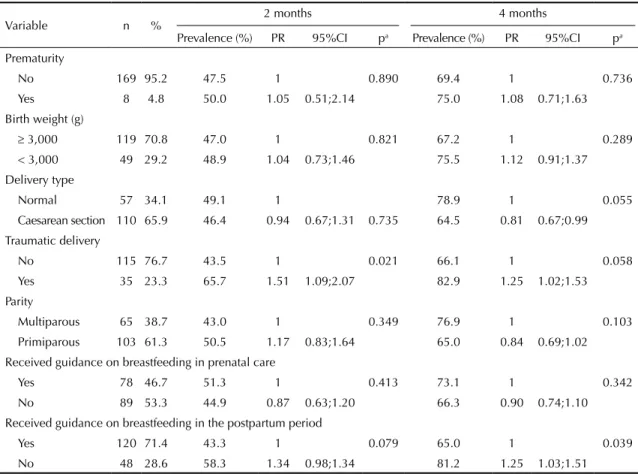
In the bivariate analysis, mothers who resided in house-holds with ive or more residents, had a traumatic
delivery, had an unplanned pregnancy, and showed symptoms of postpartum depression had a higher chance of EBF abandonment at two months. At four months, EBF abandonment was more common among mothers who had less education, had gone back to work, had not received breastfeeding guidance in the post-partum period, had an unplanned pregnancy, were not pleased with or were indifferent to the news of the preg-nancy, and those whose partners did not help in infant care in the irst month (Tables 1, 2, and 3).
Multiple regression analysis for the second month after childbirth showed that only the variables depres-sive symptoms and traumatic delivery maintained their signiicance in the model. In the fourth month after birth, early interruption of EBF was associated with lower maternal education levels, lack of homeown-ership, returning to work, not receiving guidance on breastfeeding in the postpartum period, mother’s nega-tive reaction to the news of pregnancy, and not receiving help in infant care child from her partner (Table 4).
The Figure presents the survival curve showing EBF abandonment throughout the monitoring period, according to the presence of depressive symptoms.
DISCUSSION
A high incidence of EBF abandonment was found, with only about 30.0% of new mothers exclusively breast-feeding four months after birth. Although low, this value was higher than that found in Brazil (23.3%).a
Despite the increase in breastfeeding rates and EBF in Brazil after the implementation of the National Program to Encourage Breastfeeding in the early 1980s,a there is still a strong tendency toward early EBF abandonment, and the proportion of exclusively breastfed infants falls short of the WHO recommendations, which is serious in terms of child health.
In the present study, the incidence of EBF abandon-ment in the second month (47.6%) was less than that in the irst month (53.6%). This is because, after the irst month, the assisted new mothers were encouraged and guided according to ethical principles so as to exclu-sively breastfeed their infants until the sixth month.
The only variables that maintained their signiicance in the multivariate model for EBF abandonment at two months postpartum were symptoms of post-partum depression and traumatic delivery, indicating that emotional vulnerability is an important risk factor in this period.
Furthermore, the incidence of EBF abandonment among mothers with depressive symptoms was
d World Health Organization. Los adolescentes. In: El estado físico: uso e interpretación de la antropometría. Geneva: WHO, 1995. p.
noticeably higher than in those without depressive symptoms, for all the months evaluated (Figure). In the second month after childbirth, 57.0% of the new mothers without depressive symptoms were exclusively breastfeeding their infants, compared with only 25.0% of those with depressive symptoms.
This result is explained by the fact that typical depres-sive symptoms may affect breastfeeding maintenance, such as anhedonia (decrease or loss of interest in previ-ously enjoyable activities), insomnia, fatigue, irrita-bility, agitation, psychomotor delay, feelings of unwor-thiness or guilt, and loss of concentration.6 The chances that mothers with depressive symptoms or stress will maintain breastfeeding or EBF are decreased between four and 16 weeks after childbirth.6,10,17
Depressive symptoms were associated with EBF aban-donment only in the second month after childbirth. In the fourth month, despite the higher rate of EBF aban-donment among the mothers with depressive symp-toms (33.0%, compared with 15.0% of those without
depressive symptoms) (Figure), this variable was not maintained in the multivariate model. This fact may result from the decreased prevalence of depres-sive symptoms between the irst to the second month (14.3% and 9.5%, respectively), and it is possible that the prevalence of depressive symptoms decreased even more in the fourth month, similar to the results of the study by Haga et al.10
Furthermore, according to ethical principles, the women diagnosed with depressive symptoms in this study were referred to appropriate treatment. Therefore, it is expected that four months after giving birth, they were already receiving treatment, and that the frequency of depressive symptoms was lower.
Traumatic delivery was also associated with EBF aban-donment two months after giving birth. Although no studies with similar results were found in the literature, this relationship can be explained by the fact that dissat-isfaction with childbirth is extremely signiicant for
Table 1. Prevalence and prevalence ratio for exclusive breastfeeding abandonment before two and four months after giving
birth, according to socioeconomic and demographic characteristics. Viçosa, MG, Southeastern Brazil, 2011-2012.
Variable n %
2 months 4 months
Prevalence (%) PR 95%CI pa Prevalence (%) PR 95%CI pa
Age (years)
≥ 20 34 79.8 47.3 1 0.478 67.16 1 0.165
13 |- 20 134 20.2 52.9 1.14 0.79;1.65 79.41 1.18 0.95;1.45
Income Continuous
variable
0.99 0.99;1 0.837 Continuous variable
0.99 0.99;1 0.146
Education (years)
≥ 12 28 16.7 32.1 1 0.199 39.3 1 0.000
9 to 11 75 44.6 50.7 1.57 0.87;2.82 72.0 1.83 1.13;2.97 0 to 8 52 31.0 50.8 1.57 0.87;2.85 80.0 2.03 1.26;3.28
Homeownership
Yes 100 59.5 47.0 1 0.846 65.0 1 0.112
No 68 40.5 48.5 1.03 0.74;1.42 76.5 1.17 0.96;1.43 Number of persons in household
2 to 4 116 69.1 42.2 1 0.037 65.52 1 0.082
≥ 5 52 30.9 59.6 1.41 1.03;1.92 78.85 1.20 0.99;1.46 Returned to study or work after 4 months
No – – – – – – 64.3 1 0.013
Yes – – – – – 85.5 1.32 1.09;1.59
Smoking
No 159 94.6 46.5 1 0.240 68.55 1 0.197
Yes 9 5.4 66.7 1.43 0.87;2.34 88.89 1.29 1;1.67
Alcoholic beverages
No 154 91.7 45.7 1 0.456 68.83 1 0.448
Yes 14 8.3 57.1 1.22 0.75;1.98 78.57 1.14 0.85;1.53
women and for increased psychological vulnerability to mood disorders in the postpartum period.4
Mothers with lower education level and who had not received guidance on breastfeeding in postpartum period were the ones that most frequently abandoned EBF four months after delivery. Indeed, greater access to information about the beneits of EBF is a decisive factor in the nursing mother’s decision to breastfeed exclusively.13
In Brazil, a major cause of early weaning is the lack of knowledge on the part of the mothers on breastfeeding practices, the quality of their milk, and its importance for the healthy development of the infant.1 Formal support provided by health professionals in the post-partum period can positively inluence the duration of breastfeeding16 and promote EBF.14,15
It is imperative that health professionals and services promote breastfeeding, highlighting the advantages of breastfeeding for the infant, mother, and family, and provide guidance on breastfeeding.22 A study
shows that mothers who were not well informed about breastfeeding planned to breastfeed for less time.12 In this context, the Family Health Strategy (FHS) in Brazil is seen to be in an advantageous position to adopt guidelines on breastfeeding among pregnant and lactating women.6
Lower income is associated with breastfeeding aban-donment.16 However, contrary to expectations, this relationship was not observed in the present study. The socioeconomic variables associated with the early EBF abandonment at four months postpartum were low maternal education levels, lack of homeownership, and returned to work before four months.
With regard to the association between greater aban-donment of breastfeeding at four months postpartum among mothers whose family did not own their resi-dence, it is possible that the form of occupation directly impacts the allocation of family income, especially in the population with lower purchasing power, which may direct a substantial portion of income towards paying rent.e Thus, home ownership seems to better represent
e Instituto Brasileiro de Geografia e Estatística. Censo Demográfico 2010: características da população e dos domicílios: resultados do
universo. Rio de Janeiro; 2011.
Table 2. Prevalence and prevalence ratio for exclusive breastfeeding abandonment before two and four months after giving
birth, according to obstetric conditions and infant health. Viçosa, MG, Southeastern Brazil, 2011-2012.
Variable n %
2 months 4 months
Prevalence (%) PR 95%CI pa Prevalence (%) PR 95%CI pa
Prematurity
No 169 95.2 47.5 1 0.890 69.4 1 0.736
Yes 8 4.8 50.0 1.05 0.51;2.14 75.0 1.08 0.71;1.63 Birth weight (g)
≥ 3,000 119 70.8 47.0 1 0.821 67.2 1 0.289
< 3,000 49 29.2 48.9 1.04 0.73;1.46 75.5 1.12 0.91;1.37 Delivery type
Normal 57 34.1 49.1 1 78.9 1 0.055
Caesarean section 110 65.9 46.4 0.94 0.67;1.31 0.735 64.5 0.81 0.67;0.99
Traumatic delivery
No 115 76.7 43.5 1 0.021 66.1 1 0.058
Yes 35 23.3 65.7 1.51 1.09;2.07 82.9 1.25 1.02;1.53 Parity
Multiparous 65 38.7 43.0 1 0.349 76.9 1 0.103
Primiparous 103 61.3 50.5 1.17 0.83;1.64 65.0 0.84 0.69;1.02 Received guidance on breastfeeding in prenatal care
Yes 78 46.7 51.3 1 0.413 73.1 1 0.342
No 89 53.3 44.9 0.87 0.63;1.20 66.3 0.90 0.74;1.10
Received guidance on breastfeeding in the postpartum period
Yes 120 71.4 43.3 1 0.079 65.0 1 0.039
No 48 28.6 58.3 1.34 0.98;1.34 81.2 1.25 1.03;1.51
the situation of socioeconomic vulnerability than actual income in this sample.
With regard to maternal employment, recent studies show that the rates of breastfeeding19 and EBF9 rapidly decline when women return to work. Consequently, maternity leave is an important protec -tive factor for breastfeeding. Viana et al21 found that mothers who worked outside the home and were given maternity leave had higher prevalence of EBF than those who worked outside their home but did not receive this beneit.
In Brazil, mothers are provided with 120 days of maternity leave without risk to employment or wages.f In 2010, the Congress approved, through the Citizen Company Program, extension of maternity
leave from 120 days to 180 days by granting tax incentives.g However, data from the Brazilian Revenue Service show that as of February 2012, the rate of participation among organizations eligible for the program was only 10.0%.h According to Viana et al21 many women who have paid employment do not receive maternity leave, either because employers are not in compliance with the law, or because they are in informal employment contracts.
Lack of information about pumping and storing breast milk to be offered to the child during the mother’s absence aggravates the situation related to the short period of maternity leave and informal work.21
The mother’s immediate reaction other than “pleased” to news of the pregnancy was also a predictor of
f Presidência da República, Casa Civil, Subchefia para Assuntos Jurídicos. Constituição da República Federativa do Brasil. Brasília (DF); 1988
[cited 2014 Ago 13]. Available from: http://www.planalto.gov.br/ccivil_03/constituicao/constituicaocompilado.htm
g Brasil. Decreto nº 7.052 de 23 de dezembro de 2009. Regulamenta a Lei nº 11.770, de 9 de setembro de 2008, que cria o Programa
Empresa Cidadã, destinado à prorrogação da licença-maternidade, no tocante a empregadas de pessoas jurídicas. Diario Oficial Uniao. 24 dez 2009; Seção 1, p. 15.
h Ministério da Fazenda, Secretaria da Receita Federal do Brasil [homepage]. Brasília (DF); s.d. [cited 2014 Ago 13]. Available from: http://
www.receita.fazenda.gov.br
Table 3. Prevalence and prevalence ratio for exclusive breastfeeding abandonment before two and four months after giving
birth, according to emotional conditions and social network. Viçosa, MG, Southeastern Brazil, 2011-2012.
Variable n %
2 months 4 months
Prevalence (%) PR 95%CI pa Prevalence (%) PR 95%CI pa
Planned Pregnancy
Yes 76 45.2 38.1 1 0.026 61.8 1 0.046
No 92 54.8 55.4 1.45 1.03;2.04 76.1 1.23 0.99;1.51
Partner’s reaction to the news of the pregnancy
Pleased 143 85.1 46.1 1 0.363 76.1 1 0.091
Others 25 14.9 50.0 1 0.82;1.22 84.0 1.25 1.01;1.53
Mother’s reaction to the news of the pregnancy
Pleased 135 80.4 45.1 1 0.201 65.9 1 0.034
Others 33 19.6 57.6 1.09 0.94;1.27 84.8 1.28 1.06;1.55
Partner’s support in pregnancy
Significant/± 157 93.5 43.5 1 0.271b 68.1 1 0.113b
Little/None 11 6.5 63.6 1.36 0.84;2.20 90.9 1.33 1.07;1.65
Partner’s help in infant care
Yes 48 28.6 45.7 1 0.800 58.3 1 0.044
No 120 71.4 48.1 1.05 0.70;1.57 74.2 1.27 0.97;1.65
Emotional support from relatives or friends
Yes 161 96.4 47.8 1 0.917 b 70.2 1 0.856b
No 6 3.6 50.0 1.04 0.46;2.37 66.7 0.94 0.53;1.69
PPD Symptoms
No 141 83.9 42.5 1 0.003 66.7 1 0.055
Yes 27 16.1 74.1 1.74 1.29;2.33 85.2 1.27 1.04;1.55 PPD: Postpartum depression
abandoning EBF by four months, which can be explained by the fact that women who want and plan a pregnancy are more dedicated to motherhood and the infant.
Nursing mothers who did not receive assistance from their partners for infant care also abandoned EBF. The association between partner support and the best indica-tors for breastfeeding was described in a study by Inoue et al13 wherein positive attitude and support from the father favored longer duration of breastfeeding. Another study showed that mothers who talk to their partner
about the infant’s health are more likely to continue EBF for six months.14
This indicates that early identiication and treatment of nursing mothers with depressive symptoms is necessary for decreasing associated morbidities, promoting better quality of life, and promoting longer duration of EBF. Health professionals are of great importance in this context because they can help women with depressive symptoms to receive the treatment needed to continue breastfeeding, as well as encourage and support EBF.
Moreover, there is a clear need for a support network that protects and promotes breastfeeding at home, especially involving the partners; in the workplace, by offering spaces suitable for breastfeeding, pumping and storing milk, as well as extending maternity leave to six months; and in health services, with health education activities focusing on breastfeeding and raising infants.
The main limitations of this study were losses in follow-up, typical of longitudinal studies, and possible selec-tion biases. Of all the infants born in the municipality in 2011, 18.9% were followed up (n = 888c). At 30 days postpartum, 259 new mothers agreed to participate in the study. Of these, 200 returned for the second meeting at 60 days postpartum, and 168 composed the inal sample, attending the third meeting at 120 days post-partum. Therefore, there was a loss of 91 women, 35.1% of the initial sample. However, there was no difference between the groups of loss and follow-up in terms of mean age (p = 0.4797), education (p = 0.47541), income (p = 0.9281; Student’s t test), and status of living with a partner (p = 0.222; Chi-square test).
PPD: Postpartum depression
Figure. Exclusively breastfed infants according to symptoms
of postpartum depression. Viçosa, MG, Southeastern Brazil, 2011-2012.
New mothers without PPD symptoms
Time after delivery (months) 0
0.00
0.25
0.50
0.75
1.00
1 2 3 4
Proportion of population
New mothers with PPD symptoms
Table 4. Results for multivariate analyses of the model for
exclusive breastfeeding abandonment at two and four months after giving birth. Viçosa, MG, Southeastern Brazil, 2011-2012.
Variable Time in months
after delivery PRadjusted 95%CI pa 2 months
PPD Symptoms
No 1 0.002
Yes 1.61 1.19;2.19
Traumatic delivery
No 1 0.035
Yes 1.40 1.02;2.91
4 months
Education (years)
≥ 12 1
9 to 11 2.01 1.28;3.17 0.002
0 to 8 2.15 1.36;3.38 0.001 Home ownership
Yes 1
No 1.23 1.02;1.48 0.025
Returned to work or study at four months
No 1
Yes 1.33 1.09;1.63 0.004
Received guidance on breastfeeding in the postpartum period
Yes 1
No 1.21 1.01;1.45 0.038
Mother’s reaction to the news of the pregnancy
Pleased 1
Others 1.29 1.09;1.52 0.002 Partner’s help with infant care
Yes 1
No 1.33 1.04;1.70 0.023
PPD: Postpartum depression
1. Azevedo DS, Reis ACS, Freitas LV, Costa PB, Pinheiro PNC, Damasceno AKC. Conhecimento de primíparas sobre os benefícios do aleitamento materno. Rev RENE. 2010;11(2):53-62.
2. Barros AJ, Hirakata VN. Alternatives for logistic regression in cross-sectional studies: an empirical comparison of models that directly estimate the prevalence ratio. BMC Med Res Methodol. 2003;3:21. DOI:10.1186/1471-2288-3-21
3. Barros FC, Victora CG. Epidemiologia da saúde infantil: um manual para diagnósticos comunitários. São Paulo: Hucitec/UNICEF; 1991.
4. Clement S. Psychological aspects of caesarean section. Best Pract Res Clin Obstet Gynaecol. 2001;15(1):109-26. DOI:10.1053/beog.2000.0152
5. Cox JL, Holden JM, Sagovsky R. Detection of postnatal depression. Development of the 10-item Edinburgh Postnatal Depression Scale. Br J Psychiatry. 1987;150(6):782-6. DOI:10.1192/bjp.150.6.782
6. Cruz EBS, Simões GL, Faisal-Cury A. Rastreamento da depressão pós-parto em mulheres atendidas pelo Programa de Saúde da Família. Rev Bras Ginecol Obstet. 2005;27(4):181-8. DOI:10.1590/S0100-72032005000400004
7. Cruz SH, Germano JA, Tomasi E, Facchini LA, Piccini RX, Thumé E. Orientações sobre amamentação: a vantagem do Programa de Saúde da Família em municípios gaúchos com mais de 100.000 habitantes no âmbito do PROESF. Rev Bras Epidemiol. 2010;13(2):259-67. DOI:10.1590/S1415-790X2010000200008
8. Dennis CL, McQueen K. The relationship between infant-feeding outcomes and postpartum depression: a qualitative systematic review. Pediatrics.
2009;123(4):e736-51. DOI:10.1542/peds.2008-1629
9. Franco SC, Nascimento MBR, Reis MAM, Issler H, Grisi SJFE. Aleitamento materno exclusivo em lactentes atendidos na rede pública do município de Joinville, Santa Catarina, Brasil. Rev Bras Saude Matern Infant. 2008;8(3):291-7. DOI:10.1590/S1519-38292008000300008
10. Haga SM, Ulleberg P, Slinning K, Kraft P, Steen TB, Staff A. A longitudinal study of postpartum depressive symptoms: multilevel growth curve analyses of emotion regulation strategies, breastfeeding self-efficacy, and social support. Arch Womens Ment Health. 2012;15(3):175-84. DOI:10.1007/s00737-012-0274-2
11. Hasselmann MH, Werneck GL, Silva CVC. Symptoms of postpartum depression and early interruption of exclusive breastfeeding in the first two months of life. Cad Saude Publica. 2008;24(Suppl 2):S341-52. DOI:10.1590/S0102-311X2008001400019
12. Idris NS, Sastroasmoro S, Hidayati F, Sapriani I, Suradi R, Grobbee DE, et al. Exclusive breastfeeding plan of pregnant Southeast Asian women: what encourages them? Breastfeed Med. 2012;8(3):317-20. DOI:10.1089/bfm.2012.0003
13. Inoue M, Binns CW, Otsuka K, Jimba M, Matsubara M. Infant feeding practices and breastfeeding duration in Japan: a review. Int Breastfeed J. 2012;7(1):15. DOI:10.1186/1746-4358-7-15
14. Kaneko A, Kaneita Y, Yokoyama E, Miyake T, Harano S, Suzuki K, et al. Factors associated with exclusive breast-feeding in Japan: for activities to support child-rearing with breast-feeding. J Epidemiol. 2006;16(2):57-63. DOI:10.2188/jea.16.57
15. Khresheh R, Suhaimat A, Jalamdeh F, Barclay L. The effect of a postnatal education and support program on breastfeeding among primiparous women: a randomized controlled trial. Int J Nurs Stud. 2011;48(9):1058-65. DOI:10.1016/j.ijnurstu.2011.02.001
16. Labarere J, Gelbert-Baudino N, Ayral AS, Duc C, Berchotteau M, Bouchon N, et al. Efficacy of breastfeeding support provided by trained clinicians during an early, routine, preventive visit: a prospective, randomized, open trial of 226 mother-infant pairs. Pediatrics. 2005;115(2):e139-46. DOI:10.1542/peds.2004-1362
17. Nishioka E, Haruna M, Ota E, Matsuzaki M, Murayama R, Yoshimura K, et al. A prospective study of the relationship between breastfeeding and postpartum depressive symptoms appearing at 1-5 months after delivery. JAffect Disord. 2011;133(3):553-9. DOI:10.1016/j.jad.2011.04.027
18. Santos MFS, Martins FC, Pasquali L. Escalas de auto- avaliação de depressão pós-parto: estudo no Brasil. Rev Psiquiatr Clin. 1999;26(2):90-5.
19. Skafida V. Juggling work and motherhood: the impact of employment and maternity leave on breastfeeding duration: a survival analysis on growing up in Scotland data. Matern Child Health J. 2012;16(2):519-27. DOI:10.1007/s10995-011-0743-7
20. Valdés V, Puggin E, Schooley J, Catalán S, Aravena R. Clinical support can make the difference in exclusive breastfeeding success among working women. J Trop Pediatr. 2000;46(3):149-54. DOI:10.1093/tropej/46.3.149
21. Vianna RPT, Rea MF, Venancio SI, Escuder MM. A prática de amamentar entre mulheres que exercem trabalho remunerado na Paraíba, Brasil: um estudo transversal. Cad Saude Publica. 2007;23(10):2403-9. DOI:10.1590/S0102-311X2007001000015
22. World Health Organization; UNICEF. Global strategy for infant and young child feeding. Geneva; 2003.
23. World Health Organization. Indicators for assessing infant and young child feeding practices: conclusions of a consensus meeting held 6-8 November 2007 in Washington, DC, USA. Part 1: Definitions. Geneva; 2008.
24. Zauderer C. Postpartum depression and breastfeeding: what should a new mother do? J Obstet Gynecol Neonatal Nurs. 2011;40(Suppl 1):S131. DOI:10.1111/j.1552-6909.2011.01244_15.x REFERENCES
Research supported by the Fundação de Amparo à Pesquisa do Estado de Minas Gerais (FAPEMIG – Protocol APQ 00846-11, de 2011 – Demanda Universal).
Master’s funding for Machado MCM and Assis KF and doctoral funding for Oliveira FCC granted by Coordenação de Aperfeiçoamento de Pessoal de Nível Superior (CAPES).
Based on the master’s dissertation of Machado MCM, titled: “Fatores associados ao estado emocional materno no período pós-parto e sua relação com a prática da amamentação”, presented to the Postgraduate Program in Nutritional Sciences in the Departamento de Nutrição e Saúde, Universidade Federal de Viçosa, in 2013.
HIGHLIGHTS
The present study investigated the determinants of discontinuation of exclusive breastfeeding (EBF) up to four months after delivery. The World Health Organization and the Ministry of Health recommend EBF until the age of six months, and a nutritional complementation with breast milk from 6 to 24 months because of the beneits of this practice for child development.
Discontinuation of EBF was correlated with symptoms of postpartum depression and the occurrence of traumatic childbirth in the second month after birth; in the fourth month, discontinuation was correlated with low education of the mother, lack of ownership of the property of residence, return to work, lack of guidance on breastfeeding at the postpartum, discontentment of the companion with the pregnancy, and lack of support of the companion for child rearing.
Health care professionals should be trained to identify early signs of postpartum depression and encourage and support the EBF, considering that mothers with less education and without guidance are likely to breastfeed their children for less time. The Humanization of Childbirth Program is a positive step towards providing greater support to women, considering that 23.3% of pregnant women reported traumatic delivery and that trauma was positively correlated with the early discontinuation of EBF.
Maternity leave is a protective factor against breastfeeding. In addition to the extension of the period of maternity leave to 180 days with federal incentives for female employers, the authors indicate the need for offering suitable spaces for breastfeeding during working hours and for conducting the withdrawal of milk for proper storage.
These measures may stimulate EBF until the age of six months and the nutritional complementation for up to 24 months.