Danielle Teles da Cruz
Luiz Cláudio Ribeiro
Marcel de Toledo Vieira
Maria Teresa Bustamante Teixeira
Ronaldo Rocha Bastos
Isabel Cristina Gonçalves Leite
Núcleo de Assessoria, Treinamentos e Estudos em Saúde. Universidade Federal de Juiz de Fora. Juiz de Fora, MG, Brasil
Correspondence:
Danielle Teles da Cruz
Núcleo de Assessoria, Treinamentos e Estudos em Saúde
Campus Universitário, s/nº – Martelos 36036-900 Juiz de Fora, MG, Brasil E-mail: [email protected] Received: 2/8/2011
Approved: 7/19/2011
Article available from: www.scielo.br/rsp
Prevalence of falls and
associated factors in elderly
individuals
ABSTRACT
OBJECTIVE: To estimate the prevalence of falls in elderly individuals and to analyze associated factors.
METHODS: Cross-sectional study with 420 elderly subjects (aged 60 years or older) living in the city of Juiz de Fora (Southeastern Brazil) in 2010. A household survey was conducted and the occurrence of falls in the 12 previous months was described. For the analysis of factors associated with the outcome, a theoretical determination model with three hierarchical blocks was built. The variables were adjusted among each other within each block; those with level of signifi cance ≤ 0.20 were included in the Poisson regression model and adjusted to the immediately higher level, with 5% signifi cance level. RESULTS: The prevalence of falls among the elderly was 32.1% (95%CI: 27.7; 36.9). Among those who experienced falls, 53% had a single fall and 19% had fractures as a consequence. Most of the falls (59%) occurred at the elderly person’s home. The occurrence of falls was associated with old age, female sex, need of help for locomotion and self-reported diagnosis of osteoporosis. CONCLUSIONS: Falls are frequent among the elderly. Knowledge of the factors associated with the occurrence of this event can aid the development of prevention strategies and adequate health services.
DESCRIPTORS: Aged. Accidental Falls. Risk Factors. Cross-Sectional Studies.
INTRODUCTION
Population aging is a worldwide phenomenon. The increase in the proportion of the elderly population occurs rapidly and abruptly mainly in developing countries, like Brazil. Simultaneously to these transformations, changes occur in the morbidity and mortality profi le of the population, which generates a concern about the quality of life and wellbeing of the elderly.19,21
In 1960, the number of elderly individuals was 3 million in Brazil. It rose to 7 million in 1975 and to 21 million in 2008. In this year there was 9.4 million people aged 70 years or older in the country (4.9% of the overall Brazilian population).21,a According to the synthesis of social indicators of 2009, presented
by Instituto Brasileiro de Geografi a e Estatística (IBGE – Brazilian Institute of Geography and Statistics), the proportion of elderly people increased from 8.8% to 11.1% between 1998 and 2008. The relative growth of this population
a Instituto Brasileiro de Geografi a e Estatística. Síntese de indicadores sociais – 2009. Rio
in age groups was also signifi cant. The age group of 80 years or older exceeded the others, reaching almost 70% or approximately 3 million people.a
Falls among the elderly are worthy of attention and have become a public health problem due to the high frequency with which they occur, the morbidity and mortality deriving from this event, to the high social and economic cost arising from the injuries caused and because they are events that can be prevented.3,4,15,19
They are responsible for a decline in the functional capacity and in the quality of life of the elderly and for an increase in the risk of institutionalization. These factors can affect the family caregivers, who assume a new routine and special care due to the rehabilitation or adaptation of the individual after the fall.4,12,14
Prevention and health promotion measures are impor-tant instruments to reduce the occurrence of these events and to minimize the secondary complications.15,17
Approximately 30% of the elderly fall once a year according to the Ministry of Health,b a result that is
similar to that of studies carried out in Brazil with elderly individuals living in the community.12,19
The aim of the present study was to estimate the prevalence of falls in elderly individuals and to analyze associated factors.
METHODS
Cross-sectional, observational and epidemiological study carried out with 420 elderly individuals aged 60 years or older from the north zone of the city of Juiz de Fora (Southeastern Brazil) in 2010. It is a representa-tive sample of the population of Juiz de Fora, as this is the region with the largest territorial availability in the urban area and the second most populous of the munici-pality. It concentrates the highest amount of neighbor-hoods, subnormal settlements and social programs. This study is part of the project Health Survey in the Municipality of Juiz de Fora/MG (in preparation).c
The participants were selected by stratifi ed random sampling and by multiple-stage cluster sampling. The primary sampling units were the census tracts. To the draw, the tracts were grouped into strata defi ned according to the different healthcare modalities in which the tract’s population was enrolled, subdivided into primary care (Family Health Strategy or traditional), secondary care, and uncovered area. The selection of the census tracts was performed with probabilities that were proportional to their size (dwelling population
according to data from the 2000 Demographic Census) in an independent way in each stratum.
To calculate the size of the sample, the national prevalence of elderly people who experienced falls, pointed by the literature (30%),12,d was considered.
We considered 5% of maximum desired error, 95% of level of confi dence, correction for fi nite populations, effect of the sampling plan equal to 1.5 (considering possible stratifi cation and clustering effects, depending on the adopted selection procedure) and possible losses due to refusal (approximately 30%). Initially, it was calculated that the size of the sample should be of 601 elderly individuals.
The population basis that was used was built by means of previous screening (quick count) in the urban census tracts of the region selected for the sample. The screening was performed by sampling: one out of every fi ve households was selected by systematic sampling to identify the existence of elderly people living there. Information referring to the neighboring households (two located on the left and two on the right) were surveyed in the selected households.
Based on the method of quick count per sampling, it was estimated that 602 individuals aged 60 years or older would be located in the households of the region to compose the study’s sample, a number close to the desired size of the sample. During the administration of the questionnaire, 559 people in this age group were identifi ed. Losses totaled 11, including death, change of address or impossibility to locate the elderly person after three attempts of contact in different days and times. Refusals totaled 86 individuals. Of the 462 interviewed elderly people, 42 were excluded because they met the exclusion criteria.
The questionnaire used for home survey was stan-dardized and pre-tested. The Mini-Mental State Examination (MMSE)2 was used as an instrument to
screen possible cognitive alterations, which determined the need or not of another respondent. In the case of another respondent, sociodemographic questions and the outcome of interest were approached. Elderly individuals whose behavior in the MMSE suggested cognitive impairment and who were not accompanied by relatives and/or caregivers were excluded.
The utilized question was: “Did you fall at least once last year?”. Those who answered yes were asked the number of falls, the place where it happened, the occur-rence of fracture resulting from the fall and the anatomic
b Ministério da Saúde, Secretaria de Atenção à Saúde, Departamento de Atenção Básica. Envelhecimento e saúde da pessoa idosa. Brasília
(DF): 2006
c Universidade Federal de Juiz de Fora, Núcleo de Assessoria Treinamento e Estudos em Saúde. Inquérito de saúde no Município de Juiz de
Fora-MG: relatório técnico.
d Ministério da Saúde, Secretaria de Atenção à Saúde, Departamento de Atenção Básica. Envelhecimento e saúde da pessoa idosa. Brasília:
place of the fracture. The adopted defi nition of fall was: “a non-intentional event whose result is the individual’s change of position to a lower level in relation to his/ her initial position”.11
Absolute and relative frequencies were described, as well as the prevalence of the outcome. The chi-square test (²) was used to analyze the association with the independent variables and with the dependent variable in the bivariate analysis. Poisson regression was used to analyze the independent variables associated with the outcome, controlled by possible confounding factors (adjusted PR) in the multiple analysis. The signifi cance level was tested using the Wald tests for heterogeneity and linear trend.
For the analysis of the factors associated with the occurrence of the fall (presence or not in the 12 previous months), a theoretical determination model was built with three hierarchized blocks of variables (Figure), adjusted among themselves within each block. Variables with level of signifi cance ≤ 0.20 were included in the Poisson regression model and adjusted to the immediately higher level.22
The independent variables were grouped into the three blocks: block 1 (demographic and socioeconomic char-acteristics: age, sex, marital status, home arrangement, level of schooling, socioeconomic level – Classifi cation of Associação Brasileira de Empresas de Pesquisa (Brazilian Association of Research Companies)); block 2 (elderly person’s health: self-rated health, vision and hearing; presence of reported morbidity; walking diffi culty; need of help for locomotion; use of device
to correct visual and hearing defi cit; number of drugs reported for continuous use; self-reported diagnosis of osteoporosis; history of fractures with no association with the fall; functional capacity for the performance of the basic activities of daily living by means of the Modifi ed Katz Scale, and functional capacity for the performance of instrumental activities through the Lawton and Brody Scale; block 3 (health services: type of Unidade Básica de Saúde (UBS – Primary Healthcare Unit) of the area in which the elderly person lives and orientation on fall prevention.
The software SPSS version 14.0, was used, in its module “complex samples”, which considers character-istics of the sampling plan and level of signifi cance of 5%, and also STATA 9.2, also considering the sampling plan (module survey data analysis).
The Ethics Committee of Universidade Federal de Juiz de Fora approved the study (Opinion no. 277/2009) and the participants signed a consent document.
RESULTS
In the study, 420 questionnaires were analyzed, 324 answered by elderly individuals and 96 by other respondents. The sample was composed of 65% of women, 47% of the interviewees were married or lived in a stable union, 88% lived with someone, 58% belonged to class C (lower middle-class). The mean age was 69.7 years (SD = 6.9) and the mean level of schooling was 3.9 years (SD = 3.4). Almost two thirds (65%) said they did not have walking diffi culties and 89% said they did not need help for locomotion. Poor
Figura. Modelo teórico de investigação dos efeitos das variáveis independentes sobre a queda em blocos hierarquizados. 1st Block:
demographic and socioeconomic variables Age, sex, marital status, household arrangement, level of schooling and socioeconomic level
Self-perceived
Health status, vision and hearing perception, and need of help to walk
Reported
Morbidity, use of glasses or contact lenses, use of hearing device, walking difficulty, continued use of medication, self-reported diagnosis of osteoporosis, history of fractures with no association with falls
Related to functional capacity
Functional capacity for BADLs and functional capacity for IADL
UBS: primary healthcare unit BADLs: basic activities of daily living; IADLs: instrumental activities of daily living 2nd Block:
variables referring to the elderly person’s health
3rd Block:
variables related to healthcare services Type of UBS and orientation on fall prevention
or regular self-rated health was reported by 54% of the individuals, 60% reported poor or regular vision and 31%, poor or regular hearing.
More than half (56%) lived in areas whose healthcare modality was UBS with implemented Estratégia Saúde da Família (ESF – Family Health Strategy). It was found that 82% of the sample mentioned the need to use at least one drug continually. The majority was independent, according to the functional capacity assessment for basic activities of daily living (Modifi ed Katz Scale, 98%) and instrumental activities of daily living (Lawton and Brody Scale, 93%) (Table 1). The prevalence of falls was 32.1% (95%CI = 27.7;36.9). Of those who experienced falls, 53% fell only once and 19% had fracture as a consequence (32% in the upper limbs, 47% in the lower limbs, 10% in the ribs and/ or vertebrae, 8% in the face and 3% in the hip). More than half of the falls (59%) occurred in their own home. Table 1. Characteristics of the sample according to
indepen-dent variables. Juiz de Fora, Southeastern Brazil, 2010.
Variable
Presence of fall
Absence of fall
n % n %
Age (years)
60 to 70 62 46 162 57
71 to 80 49 36 93 33
Above 80 24 18 30 10
Sex
Male 101 75 171 60
Female 34 25 114 40
Marital Status
Married or stable union 58 43 141 49
Widowed 61 45 96 34
Separated or divorced 12 9 27 10
Single 4 3 21 7
Household arrangement
Lives alone 13 10 36 13
Lives with someone 122 90 249 87
Level of schooling (years)
Illiterate 31 23 59 21
1 to 4 78 58 154 54
5 to 7 11 8 42 15
8 to 10 5 4 17 6
11 or more 10 7 13 4
Socioeconomic level
A or B 22 16 54 19
C 76 56 166 58
D or E 37 28 65 23
Self-rated healtha
Excellent/ Very good/ Good 38 39 111 49
Regular/ Poor 59 61 116 51
Self-rated visiona
Excellent/ Very good /Good 29 30 100 44
Regular/ Poor 68 70 127 56
Self-rated hearinga
Excellent/ Very good /Good 63 65 161 71
Regular/ Poor 34 35 66 29
Need of help to walka
No 97 81 227 93
Human help 6 6 11 5
Auxiliary device 13 13 6 2
Drugs reported for continuous usea
None 8 8 50 22
1 to 4 drugs 69 71 141 62
More than 4 drugs 20 21 36 16
To be continued
Table 1 continuation
Variable
Presence of fall
Absence of fall
n % n %
Self-reported diagnosis of osteoporosisa
No 28 29 102 45
Yes 38 39 48 21
I don’t know 31 32 77 34
History of fractures with no association with the falla
No 85 88 201 89
Yes 12 12 26 11
Functional capacity for the performance of BADLs (Modifi ed Katz Scale)a
Independent 96 99 220 97
Dependent 1 1 7 3
Functional capacity for the performance of IADLs (Lawton and Brody Scale)a
Independent 90 93 211 93
Dependent 7 7 16 7
Orientation on prevention of fallsa
Yes 22 23 81 36
No 75 77 146 64
Type of UBS
Uncovered area 13 10 32 11 UBS with ESF 76 56 159 56 Traditional UBS 23 17 36 13 Policlinic 23 17 58 20 BADLs: basic activities of daily living; IADLs: instrumental activities of daily living; UBS: Unidade Básica de Saúde (Primary Care Unit); ESF: Estratégia Saúde da Família (Family Health Strategy).
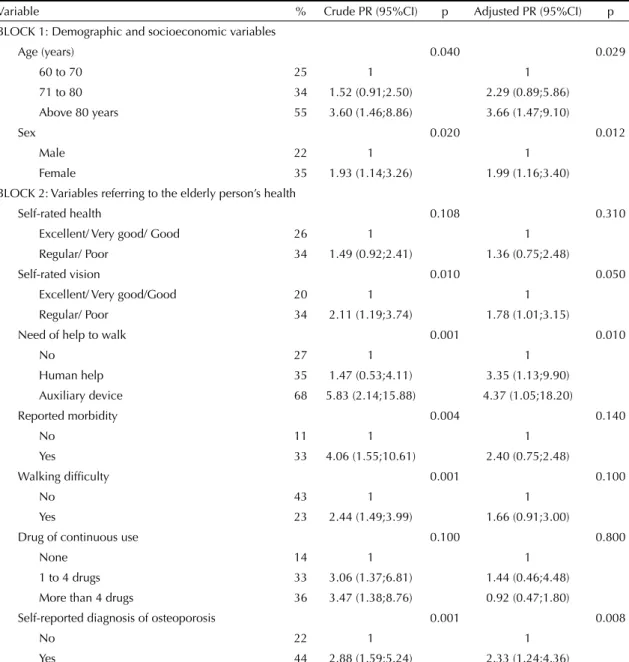
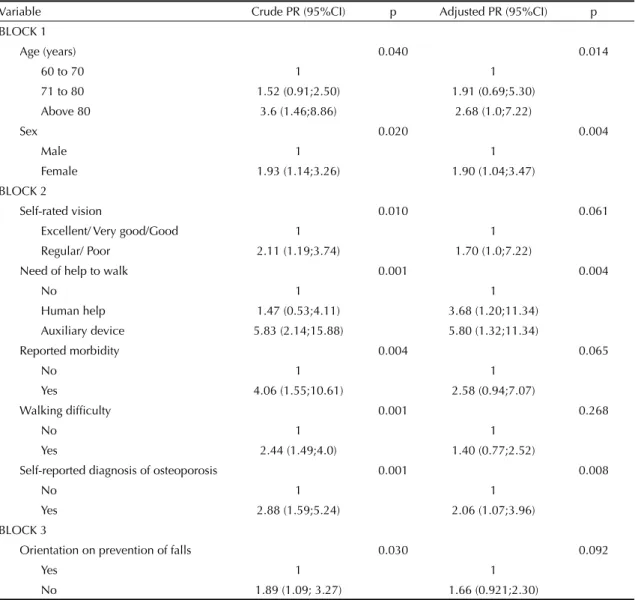
The falls were more frequent in women (p = 0.02), in individuals older than 80 years (p = 0.04), in those who needed help for locomotion (p = 0.001), in those who reported morbidity (p = 0.004), and in those with diag-nosis of osteoporosis (p = 0.001). The falls were associ-ated with poor or regular self-rassoci-ated health and vision, walking diffi culty, higher number of drugs and with not having received orientation to prevent falls (Table 2). Four variables remained associated with falls in the multiple regression model. Among the variables of the most distal level (block 1), the following variables constituted risk factors: age higher than 80 years (adjusted PR = 2.68; 95%CI 1.0;7.22) and female sex (adjusted PR = 1.89; 95%CI 1.04;3.47). In block 2,
the following constituted risk factors: need of help for locomotion through human aid (adjusted PR = 3.7; 95%CI 1.2; 11.34) or through an auxiliary device (adjusted PR = 5.8; 95%CI 1.32;11.34) and self-reported diagnosis of osteoporosis (adjusted PR = 2.1; 95%CI 1.07;3.96). Among the variables of the most proximal level (block 3), none presented statistical signifi cance after the adjusted analysis.
DISCUSSION
The prevalence of falls in the studied population was 32.1%, similar to what has been pointed by the Brazilian literature. In a cohort in São Paulo (Southeastern
Table 2. Occurrence of falls according to demographic, socioeconomic variables and variables referring to the elderly person’s health. Juiz de Fora, Southeastern Brazil, 2010.
Variable % Crude PR (95%CI) p Adjusted PR (95%CI) p BLOCK 1: Demographic and socioeconomic variables
Age (years) 0.040 0.029
60 to 70 25 1 1
71 to 80 34 1.52 (0.91;2.50) 2.29 (0.89;5.86) Above 80 years 55 3.60 (1.46;8.86) 3.66 (1.47;9.10)
Sex 0.020 0.012
Male 22 1 1
Female 35 1.93 (1.14;3.26) 1.99 (1.16;3.40) BLOCK 2: Variables referring to the elderly person’s health
Self-rated health 0.108 0.310
Excellent/ Very good/ Good 26 1 1
Regular/ Poor 34 1.49 (0.92;2.41) 1.36 (0.75;2.48)
Self-rated vision 0.010 0.050
Excellent/ Very good/Good 20 1 1
Regular/ Poor 34 2.11 (1.19;3.74) 1.78 (1.01;3.15)
Need of help to walk 0.001 0.010
No 27 1 1
Human help 35 1.47 (0.53;4.11) 3.35 (1.13;9.90) Auxiliary device 68 5.83 (2.14;15.88) 4.37 (1.05;18.20)
Reported morbidity 0.004 0.140
No 11 1 1
Yes 33 4.06 (1.55;10.61) 2.40 (0.75;2.48)
Walking diffi culty 0.001 0.100
No 43 1 1
Yes 23 2.44 (1.49;3.99) 1.66 (0.91;3.00)
Drug of continuous use 0.100 0.800
None 14 1 1
1 to 4 drugs 33 3.06 (1.37;6.81) 1.44 (0.46;4.48)
More than 4 drugs 36 3.47 (1.38;8.76) 0.92 (0.47;1.80)
Self-reported diagnosis of osteoporosis 0.001 0.008
No 22 1 1
Brazil), 31% of the elderly experienced a fall in the year before the interview.12 Siqueira et al19 calculated a
34.8% prevalence of falls in elderly individuals aged 65 years or older, belonging to seven Brazilian States in a cross-sectional research, differing from the present study regarding the participants’ minimum age. Higher preva-lences have been reported in the literature; 4,14 however,
the differences may be attributed to the studies’ design and to the adopted methodologies, or because they were point estimates that have margins of error.
More frequent occurrence of falls in women confi rmed other studies. 4,12,19,20 However, the mechanisms to
eluci-date this phenomenon are not clear and are controver-sial. Some factors are admitted as causes: lower amount of lean body mass and of muscular force compared to men of the same age; higher loss of bone mass due to the reduction in estrogen, increasing the probability of osteoporosis; higher prevalence of chronic diseases;
greater exposure to domestic activities and to riskier behavior.8,12,18
Advanced age was associated with higher number of falls and with increase in the risk of this event, as has been pointed by the literature.6,9,18,19 The process of
biological aging encompasses structural and functional alterations that are progressively accumulated with the increase in age. Such alterations may impair the performance of motor skills, hinder the individual’s adaptation to the environment and predispose him/ her to fall.1,20 As age advances, a decrease in muscular
force and elasticity is observed, as well as a decline in stability and in the dynamics of the joints, and altera-tions to the sensory, vestibular, somatosensory, and nervous systems. These changes imply an impairment in postural control mechanisms, changing the indi-vidual’s posture, gait and balance.1,7,20 Advanced age
is closely related to conditions that predispose to falls. Table 3. Multiple regression analysis in hierarchized blocks for the occurrence of the fall event among elderly individuals. Juiz de Fora, Southeastern Brazil, 2010.
Variable Crude PR (95%CI) p Adjusted PR (95%CI) p BLOCK 1
Age (years) 0.040 0.014
60 to 70 1 1
71 to 80 1.52 (0.91;2.50) 1.91 (0.69;5.30) Above 80 3.6 (1.46;8.86) 2.68 (1.0;7.22)
Sex 0.020 0.004
Male 1 1
Female 1.93 (1.14;3.26) 1.90 (1.04;3.47) BLOCK 2
Self-rated vision 0.010 0.061
Excellent/ Very good/Good 1 1
Regular/ Poor 2.11 (1.19;3.74) 1.70 (1.0;7.22)
Need of help to walk 0.001 0.004
No 1 1
Human help 1.47 (0.53;4.11) 3.68 (1.20;11.34) Auxiliary device 5.83 (2.14;15.88) 5.80 (1.32;11.34)
Reported morbidity 0.004 0.065
No 1 1
Yes 4.06 (1.55;10.61) 2.58 (0.94;7.07)
Walking diffi culty 0.001 0.268
No 1 1
Yes 2.44 (1.49;4.0) 1.40 (0.77;2.52)
Self-reported diagnosis of osteoporosis 0.001 0.008
No 1 1
Yes 2.88 (1.59;5.24) 2.06 (1.07;3.96)
BLOCK 3
Orientation on prevention of falls 0.030 0.092
Yes 1 1
Falls are more frequent among those with diagnosis of osteoporosis, as the presence of this pathology is associ-ated with female sex and advanced age.5,13 In addition,
there is the diffi culty in identifying if the fracture, in case it happens, was the cause or the consequence of the fall. According to Lebrão & Laurenti,8 the higher
occurrence of falls among women may be a factor indicating that fractures that precede the fall would be more frequent in this sex.
Osteoporosis has a strong relationship to falls, fractures and to decline in the individual’s functional capacity and quality of life.4,13,15 Individuals with osteoporosis
can present postural alteration, gait disturbance and body unbalance, which favors the occurrence of falls.15
The increase in the mortality and morbidity that derive from osteoporosis is related to the high economic costs that come from hospitalizations, outpatient care, insti-tutionalization and premature death.13,15
Among the studied elderly individuals, 11% needed human help or an auxiliary device for gait. Studies have shown that there is a relation between the utilization of a device to aid the gait and the presence of falls.10,16
The need of help for locomotion, either by another person or by an auxiliary device, may be associated with greater impairment of the gait pattern and of the postural control mechanisms, and it may be considered an indicator of the elderly person’s frailty.1,3,6
The aim of assistive technology is to enable the promo-tion of funcpromo-tional independence and facilitate the performance of the activities of daily living. However, in cases in which there is no indication, in which there is inadequate utilization and/or failures in the process of utilization and adaptation, it may have the opposite effect and contribute to unsafe locomotion and risk of falls.10 The use of the auxiliary device gives greater
freedom of locomotion and safety and might impel the
individual to risk him/herself more in relation to the environment’s barriers, making him/her become more exposed to risk factors for falls.18
In the present study, 19% of the falls resulted in some kind of fracture, a proportion that is higher than the one found by Siqueira et al.19 This difference may
be attributed to the high percentage of women with self-reported diagnosis of osteoporosis in our sample. Studies4,14 with different methodologies have found
frequency of fractures between 24% and 64%. The largest part of the falls (59%) occurred at home, like in other studies.3,4,14,19 This shows the importance of the
home environment and extrinsic factors for the occur-rence of falls and to the ways of preventing them, like adequate lighting, non slip fl oor, adequate disposition of the furniture and objects, absence of rugs, use of a support to seat while showering and some non-skid resource, grab bars to facilitate the access to stairs and steps, and others.4,6,9,14,19
The sampling process was carefully performed in the study and similar results have been pointed by the literature.12,19 In this sense, the present study has great
independence and, even if the sample were expanded, there would be little variation.
1. Abreu SSE, Caldas CP. Velocidade de marcha, equilíbrio e idade: um estudo correlacional entre idosas participantes e não participantes de um programa de exercícios terapêuticos. Rev Bras Fisioter. 2008;12(4):324-30. DOI:10.1590/S1413-35552008000400012
2. Bertolucci PHF, Brucki SMD, Campacci SR, Juliano Y. O Mini-Exame do Estado Mental em uma população geral: impacto da escolaridade. Arq Neuropsiquiatr. 1994;52(1):1-7. DOI:10.1590/S0004-282X1993000400026
3. Carvalho AM, Coutinho ESF. Demência como fator de risco para fraturas graves em idosos. Rev Saude Publica. 2002;36(4):448-54. DOI:10.1590/S0034-89102002000400010
4. Fabrício SCC, Rodrigues RAP, Costa Junior ML. Causas e conseqüências de quedas de idosos atendidos em hospital público. Rev Saude Publica. 2004;38(1):93-9. DOI:10.1590/S0034-89102004000100013
5. Frazão P, Naveira M. Prevalência de osteoporose: uma revisão crítica. Rev Bras Epidemiol. 2006;9(2):206-14. DOI:10.1590/S1415-790X2006000200007
6. Gama ZAS, Gómez-Conesa A. Factores de riesgo de caídas em ancianos: revisión sistemática. Rev Saude Publica. 2008;42(5):946-56. DOI:10.1590/S0034-89102008000500022
7. Horak FB. Postural orientation and equilibrium: what do we need to know about neural control of balance to prevent falls. Age Ageing. 2006;35 Suppl 2:ii7-ii11. DOI:10.1093/ageing/afl 077
8. Lebrão ML, Laurenti R. Saúde, bem-estar e envelhecimento: o estudo SABE no Município de São Paulo. Rev Bras Epidemiol. 2005;8(2):127-41. DOI:10.1590/S1415-790X2005000200005
9. Lord SR, Menz HB, Sherrington C. Home environment risk factors for falls in older people and the effi cacy of home modifi cations. Age Ageing. 2006;35 Suppl 2:ii55-ii59. DOI:10.1093/ageing/afl 088
10. Menezes RL, Bachion MM. Estudo da presença de fatores de riscos intrínsecos para quedas, em idosos institucionalizados. Cienc Saude Coletiva. 2008;13(4):1209-18. DOI:10.1590/S1413-81232008000400017
11. Moura RN, Santos FC, Driemeier M, Santos LM, Ramos LR. Quedas em idosos: fatores de risco associados. Gerontologia.1999;7(2):15-21.
12. Peracinni MR, Ramos LR. Fatores associados a quedas em uma coorte de idosos residentes na comunidade. Rev Saude Publica. 2002;36(6):709-16. DOI:10.1590/ S0034-89102002000700008
13. Pinheiro MM, Ciconelli RM, Jacques NO, Genaro PS, Martini LA, Ferraz MB. O impacto da osteoporose no Brasil: dados regionais das fraturas em homens e mulheres adultos – The Brazilian Osteoporosis Study (BRAZOS). Rev Bras Reumatol. 2010;50(2):113-27. DOI:10.1590/S0482-50042010000200002
14. Ribeiro AP, Souza ER, Atie S, Souza AC, Schilithz AO. A infl uência das quedas na qualidade de vida dos idosos. Cienc Saude Coletiva. 2008;13(4):1265-73. DOI:10.1590/S1413-81232008000400023
15. Riera R, Trevisani VFM, Ribeiro JPN. Osteoporose: a importância da prevenção de quedas. Rev Bras Reumatol. 2003;43(6):364-8.
16. Rubenstein LZ, Josephson KR. The epidemiology of falls and syncope. Clin Geriatr Med. 2002;18(2):141-58.
17. Rubestein LZ. Falls in older people: epidemiology, risk factors and strategies for prevention. Age Ageing. 2006;35 Suppl 2:ii37-41. DOI:10.1093/ageing/afl 084
18. Santos MLC, Andrade MC. Incidência de quedas relacionada aos fatores de riscos em idosos institucionalizados. Rev Baiana Saude Publica. 2005;29(1):57-68.
19. Siqueira FV, Facchini LA, Piccini RX, Tomasi E, Thumé E, Silveira DS, et al. Prevalência de quedas em idosos e fatores associados. Rev Saude Publica. 2007;41(5):749-56. DOI:10.1590/S0034-89102007000500009
20. Toledo DR, Barela JA. Diferenças sensoriais e motoras entre jovens e idosos: contribuição somatossensorial no controle postural. Rev Bras Fisioter. 2010;14(3):267-75. DOI:10.1590/S1413-35552010000300004
21. Veras R. Envelhecimento populacional
contemporâneo: demandas, desafi os e inovações. Rev Saude Publica. 2009;43(3):548-54. DOI:10.1590/ S0034-89102009005000024
22. Victora CG, Huttly SR, Fuchs SC, Olinto MTA. The role of conceptual frameworks in epidemiological analysis: a hierarchical approach. Int J Epidemiol. 1997;26(1):224-7. DOI:10.1093/ije/26.1.224 REFERENCES