Nursing Teaching Strategies by Encouraging
Students’ Questioning, Argumentation and
Explanation
O
r
i
g
i
n
a
l
a
r
ti
c
le
Dayse Neri de Souza1,Francislê Neri de Souza2
Estratégias dE Ensino dE EnfErmagEm, incEntivando os EstudantEs à QuEstão, argumEntação E Explicação
EstratEgias dE EnsEñanza dE EnfErmEría, fomEntando a los EstudiantEs a la cuEstión, la argumEntación y Explicación.
1,2 Education department, cidtff – research centre for didactics and technology in teacher Education, university of aveiro. aveiro, portugal.
doi: 10.1590/s0080-623420140000800023
reSumo
Os estudantes de enfermagem necessitam desenvolver as competências de
explica-ção, argumentação e quesionamento por -que estas são fundamentais também para que possam manter uma relação com seus
pacientes no senido de uma melhor hu
-manização dos cuidados. O presente arigo tem como objeivo analisar a perceção dos
alunos do 1º ano de enfermagem acerca da
humanização dos cuidados aos doentes, no contexto do incenivo à discussão de epi -sódios da vida real. O estudo foi de cariz
qualitaivo e a análise de conteúdo teve
como principais discursos as perguntas, a explicação e a argumentação dos estu-dantes. Os resultados apontam, entre ou-tras conclusões, para a importância de se
potencializar as aividades que esimulam os diferentes ipos de discursos dos estu -dantes de enfermagem e a capacidade de
perceberem os padrões de humanização e desumanização a parir de episódios da
vida real usados como caso de estudo.
DeScritoreS
Ensino de enfermagem
Quesionamento
Explicação Argumentação Discurso estratégias
Aprendizagem aiva
AbStrAct
Nursing students need to develop
com-petences in the ield of explanaion, ar
-gumentaion and quesioning as they are pivotal to foster a relaionship with their paients and achieve a greater humanisa
-ion of care. The objecive of this paper is to analyse the percepion of 1st-year nursing students with regard to the hu
-manisaion of care provided to paients by encouraging them to discuss real-life epi
-sodes. The study is qualitaive and content analysis used the students’ quesions, ex
-planaions and argumentaion as core dis
-courses. Among other conclusions, results point towards the importance of promot
-ing aciviies that encourage the diferent nursing students’ discourses and the ability to understand the humanisaion and dehu
-manisaion paterns arising from the real-life episodes used as case study
DeScriptorS
Nursing educaion Quesioning Explanaion Argumentaion
Discourse Strategies
Acive learning
reSumeN
Los estudiantes de enfermería ienen nece -sidad de desarrollar competencias de
expli-cación, argumentación y cuesionamiento
porque estas son fundamentales también para que puedan mantener una relación
con sus pacientes en el senido de una me
-jor humanización de los cuidados. El arícu
-lo presente iene como objeivo analizar la
percepción de los alumnos de 1er año de
enfermería respecto a la humanización de
los cuidados a los enfermos, en el contexto
del incenivo a la discusión de episodios de la vida real. El estudio ha sido de carácter cualitaivo y el análisis del contenido tuvo
como principales discursos las preguntas, la
explicación y la argumentación de los estu -diantes. Los resultados apuntan, entre otras conclusiones, a la importancia de la
poten-cialización de las acividades que esimulan los diferentes ipos de discursos de los es
-tudiantes de enfermería y la capacidad en entender los estándares de humanización y deshumanización a parir de episodios de la
vida real usados como caso de estudio
DeScriptoreS
educación en enfermería
cuesionamiento
explicación argumentación discurso estrategias
iNtroDuctioN
Nursing students are expected to develop criical thinking competences and make decisions regarding pa -ient care. In the words of Myrick and Yonge(1) “Clinical decision making and the ability to make a clinical judg -ment requires relevant knowledge for applicaion to the clinical situaion, skill in data collecion, and knowledge of appropriate strategies for efecive problem solving with paients. Clinical decision making requires the ability to think criically”.
These authors consider that the formulaion of simu -laing and challenging quesions is the most important skill that the clinical nurse instructor or preceptor can provide and add: “At best, efecive quesioning can trigger precep -tees to think criically and thus enhance their problem-solv-ing and clinical decision-makproblem-solv-ing abiliies by simulaproblem-solv-ing the highest level of thought processing”(1). It is believed that when faced with issues about paients’ real-life situaions, students can make efecive clinical decisions, remember relevant knowledge, interpret and adapt this knowledge in light of the speciic situaion that is quesioned.
While discussing the importance of the nurse precep -tor’s quesioning skills to help promote and develop the students’ criical thinking these authors state that the in -clusion of quesions “can challenge the way preceptees think, encourage them to jusify or clarify their asserions, promote the generaion of original ideas, explanaions, or soluions to paient problems, provide mental and emo -ional tools to help resolve dilemmas, promote discussion, and evaluate learning.”(1)
Despite this, researchers have realised that students do not formulate quesions and when they do they are scarce and of a low cogniive level. These few quesions are almost exclusively for the purpose of memorising in -formaion or lead to yes/no-type answers. Frambach et al.(2) atribute this quesioning patern to several factors: “Uncertainty and tradiion, group relaions and face, hier -archical relaions, and achievement and compeiion were generally found to inhibit students from speaking up, ask-ing quesions, and challengask-ing others in discussions.”
In their research the same authors(2) discuss four cul-tural factors and six contextual factors which inhibit and increase the eastern and western nursing students’ argu -mentaive behaviour. These four cultural factors are: (1) uncertainty and tradiion, (2) group relaions and face, (3) hierarchical relaions, and (4) achievement and compei -ion. By comparing results the authors realised that the factors inhibiing the discussion process were stronger in the students from non-western insituions. The six con -textual factors found in the discussion behaviour were: (1) the nature of students’ prior school educaion, (2) the scope of PBL implementaion, (3) students’ personal char -acterisics, (4) language of instrucion, (5) tutor behaviour and (6) the assessment system.
On the other hand Lim(3) believes that the strategy of
posing quesions to the students individually or in groups during class or throughout the clinical day may help in -crease interacion, improve clinical thinking and promote the implementaion of an evidence-based pracice. With this in mind, the same author suggests a set of quesions to be used periodically with students. For example: What’s the plan for this paient? What should you focus on when assessing this paient? iii) Did you wash your hands? Did you ask what your paient’s name and birth date were?
Addiionally, it is understood that the strategies im -proving the students’ quality of interacion through ques -ioning, argumentaion and explanaion should not be limited to the classroom. Nowadays, one must introduce informaion and communicaion technologies to pro -mote acive learning and consequently students’ criical thinking. However, Montello and Bonnel(4) believe that
“quesions posed in the online seing can be more eas -ily misunderstood than those posed in the classroom”, and that “Quesions can also help online students engage with others” as well as with the teacher, thus increasing the dynamics of online classes. These authors conclude their review aricle acknowledging that further research is needed on how to beter include quesioning techniques, emphasising the students’ role in the quesioning process. Taking into account the online interacion context, Be -audin’s(5) “survey of 135 online instructors suggested that
the best way to hold asynchronous discussions on topic is to design good quesions with pedagogical purpose, pro -vide guidance with the quesions, reword quesions when needed, and provide discussion summaries. For this au -thor designed quesions are clear, concise, and directly re -lated to the purpose of posing the quesion. A good ques -ion, based on Bloom’s taxonomy, can also promote acive learner engagement.”
One agrees with Tracey & Nichol when they state that in nursing educaion litle has been writen about the im -portance of efecive quesioning as a teaching technique to develop acive learning. Based on this research and ma -ny others, it is clear that efecive quesioning techniques improve students’ learning, their level of knowledge, trust and communicaion skills. However, one admits that only by raising issues in complex and real contexts is it possible to improve the students’ analysis, creaivity and argumen -taion skills. The efecive quesioning, argumen-taion and explanaion process is demanding. It involves planning and structuring the quesions or the argument in such a way that they are appropriate and it the educaional pur-poses one wishes to atain.
cogniive level and were used for the purpose of obtaining factual informaion and yes/no-type answers. One agrees with these authors when they acknowledge that in order to increase the complexity of educaion in nursing and its efecive pracice both teachers and students must have the ability to pose a greater variety of analysis, synthe -sis and assessment quesions to be used in diferent set-ings. Therefore, one expects an increase in the number of analysis, synthesis and assessment quesions as well as quesions that entail exploring and explaining to achieve an acive learning that eases the criical thinking process.
Sellappah, Hussey, Blackmore, McMurray(7) conirm the results arising from other researches, in this case clinical teachers of Australian Universiies who posed quesions of a low cogniive level (91.2%). They also rec -ommend that clinical teachers are taught how to pose quesions, especially quesions with a high cogniive level. Addiionally, this study revealed that high-level quesions posed by clinical teachers are posiively interrelated with high-cogniive-level answers given by the students (r=0.9, P=0.001).
In light of this, one understands that the act of ques-ioning and argumentaion can simulate reasoning as well as the skills needed to solve the problems underly -ing criical think-ing. Therefore, the incenive to quesion, argue and explain phenomena are eicient strategies to promote the nurses’ educaion and acive learning. Mak -ing relecive quesions and prepar-ing well-structured ar -guments are the most important aciviies in any science, so these skills are essenial for learning. Asking good ques -ions and arguing is a creaive act which becomes a tool for learning about nursing as well as learning how to do nursing. Asking quesions and arguing help us to make sense of the world and add meaning to informaion and the contexts in which we live, thus increasing our ability to explain.
As seen before, teachers’ quesions sill overpower the classroom and are of a low cogniive level in addi-ion to lacking the pedagogical intent to build knowledge. Bastable(8) shows that the proper use of quesions is one of the general principles to be used by all nursing faculty. This author presents three types of quesion: i) factual or descripive quesions, ii) clariicaion quesions and iii) high-level quesions.
For several decades, studies in this area have focused on teachers’ quesions. However, it is acknowledged that researchers have been increasingly encouraging student-based quesions as well as the study of students’ ques -ions. This new emphasis follows the general trend of student-centred educaion, focusing on the students’ au -tonomy and their being responsible for their own learning process - Acive learning.(9,10)
For example, Neri de Souza(9) conducted a research to
study the sort of diiculies arising from students’ ques
-ions and explana-ions. He concluded that the nature of the diiculies revealed by the quesions and explanaions is diferent. The quesions arose in more naturalisic con -texts, whereas the diiculies were complex and class -room-based. However, the explanaions show diiculies that do not relate to the teaching-learning process. These diiculies are more related to the concepts themselves, and in the students’ quesions these concepts are treated regarding other concepts and academic contexts. In this sense, these two aciviies complement each other, espe -cially when situaions-problems require an explanaion for diiculies raised by the quesions. Quesions can lead to a “return” to the strategies and tools used in the teach -ing and learn-ing process.
The present research analysed the percepions of 1st -year nursing students regarding Anthropology and Soci -ology of Health, by encouraging the quesioning, argu -mentaion and explanaion process following some acive teaching strategies. For this purpose, stories about the humanisaion of healthcare in real contexts were used.
Social sciences are included in the curriculum of nurs -ing courses in order to provide future nurses with the socio-cultural aspect of care. The socio-cultural factor in healthcare or disease has become paramount in under -graduate nursing degrees due to its acknowledgement by health professionals and social scienists, arising from the changes in socieies and increasing respect for the paients’ cultural diversity. Thus, nurses need to receive proper training in order to provide cross-cultural care.
The turning point for this new perspecive arose with Madeleine Leininger’s theory which fostered a new in -sight into nursing and the care process. According to Oriá, Ximenes and Alves(11), Leininger’s theory is pivotal in nurs -ing as it unveiled the mean-ing of cultural care, the prac -ice of care, which is speciic to each culture and such cul -tural factors as religion, poliics, economics, the way the world is perceived, the surrounding environment, gender among other factors which may inluence human care.
According to the same authors, Leininger acknowledg -es that in pracical terms there is a cultural and universal diversity of care which needs to be known and understood so that nurses are able to help their paients in a humane and saisfactory way.
-proving relaions between professionals, between users/ professionals (face-to-face interacions) and between the hospital and the community (socio-communitarian inter -acions), aimed at improving the quality and efeciveness of the services provided by these insituions”(12). Accord-ing to the same author, the programme enabled a more transversal perspecive of the welfare policy presently en -itled “Humaniza SUS”.
In his research done with families having newborns, Boehs(13) concluded that work performed from an anthro
-pological perspecive presents a huge challenge. It entails understanding the nurses’ culture, which entails moments which are protecive of the professional model whilst ob -serving the paients in their own world, in addiion to un -derstanding their acions and sill managing to be a nurse.
Naturally, students are not expected to have a precon -ceived broad sense of nursing. However, the intenion is to understand some of the diiculies, percepions and preconcepions pertaining to the role of nurses and of nursing itself, while raining awareness to the importance of humanising care.
Over the decades research has been done on the con -cept of humanising nursing. These studies have stressed the need for an understanding that goes beyond the tech-nical and instrumental elements of the services.
One of the aspects that were revealed regarding the humanisaion of care hint towards how the paient is perceived in anonymity, i.e. the depersonalisaion of the paient. This issue has been studied since the 1990s by Leclainche(14),who states that paients are not the focus of
atenion but rather a igure, a case, an object. This situ -aion leads to consider-aion on the role of nursing in care provision, quesioning the quality of care provided when tasks are fragmented, thus leading to a loss of the percep -ion of the paient in a holisic manner.
In 1968 Gelain(15) had already highlighted that the al
-ready poor provision of health care in nursing with regard to paient care had been deterioraing along with the tech -nological development that has hindered human relaions, leading to an individualisic, calculaive and, consequently, cold relaionship between the stakeholders. In the 21st cen-tury this perspecive remains unchanged. The authors of the present paper are not opposed to technology but con -sider that the provision of health care, as stressed by Fran -co e Florenim(16), must strive to atain paient saisfacion.
The perspecive of the professional in nursing is difer -ent from the pai-ents’ perspecive and might well be the factor that needs studying. Whereas the healthcare pro -fessional is concerned with decreasing the number of mis -takes and with the improvement of pracices, the paient wants to be assisted in comfortable and safe condiions.
One agrees with Oliveira, Collet and Viera(17) when they state that “humanisaion depends on the ability to
talk and listen, because worldly things only become hu -man when they are subject to dialogue with peers, i.e. enabling dialogue in human relaions and interacions not only as a verbal communicaion technique which has a pre-set goal but also as a means to get to know the other, understand him and set common goals that may lead to reciprocal well-being.”
In light of this complex and comprehensive reality, with the objecive of contribuing to a more humanising pracice, one believes that, like Casate e Corrêa(18), the training of nurs -ing professionals may contribute to a change in this situaion. The objecive is to rethink the training component which is sill focused on nursing technical factors and suggest the in -clusion of psychological, sociological and anthropological as -pects in the curriculum to enable the discussion of more hu -manisic subjects with the students and thus instruct them to the importance of humanising healthcare and consequently increasing the quality of care provided.
This proposal is emphasised by the Portuguese Nursing Council (2001), which addresses the humanisaion of care as an extension of nursing, via its ethical component, achieved through the relaion between the nurse and the paient as well as the respect for paients’ rights. Following this line of thought, Watson(19) stresses that “nursing is a profession that
has the social and ethical responsibility, both for the individ -ual and for society, to provide care and be at the forefront of the society’s present and future care needs”.(19)
method
In light of the fact that many students do not know the subject of Sociology and Anthropology in Health nor its contents, some quesions were raised by the teacher: What prior knowledge do students have about the con -tent of the subject?; ii) Do students understand the impor -tance of this subject in the context of an undergraduate degree in nursing?; iii) Can one understand the students’ problems and expectaions through their explanaions and quesions?; iv) Can students be encouraged to formu -late quesions, arguments and explanaions?; v) Can one understand how students feel about the humanisaion of care keeping in mind diferent discourses?
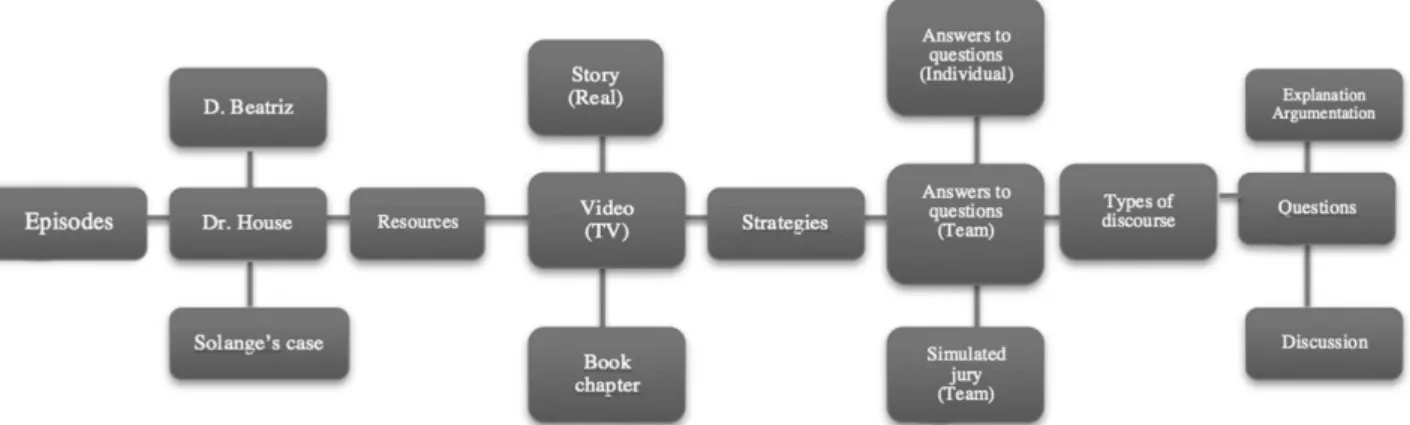
Based on these quesions one intends to analyse stu -dents’ percepions on the topic of humanisaion of care, an approach to be dealt with in the discipline of Anthropology and Sociology of health, by encouraging them to quesion and explain. The aciviies were based on situaions se -lected to promote relecion on the aitudes that health professionals should exercise when faced with similar cases with future paients. The aciviies consisted of the relec -ive discussion of three episodes. Two episodes occurred in real-life contexts and one was based on a television series.
Fig. 1 Sequence of activities used to encourage student interaction
The irst acivity was performed on the irst day prior to the teacher presening the programme for the disci -pline. The proposal was to get to know the real story of Ms. Beatriz, a 93-year-old woman, aided in the emergency room of a hospital in Lisbon. The objecive was to see if the students were able to guess what they were going to study in the subject based on the story presented. The ac -ivity consisted in reading the story and associaing it with the discipline. Two guiding quesions were presented to the students: Can you ind a connecion between the text and the importance of studying Anthropology and Sociol -ogy of Health? Reread Beatriz’s story and prepare one or more quesions about the episode.
For the second acivity an episode of the TV series Dr. House was used with the objecive of addressing the is -sue of the humanisaion and dehumanisaion of the care provided by healthcare professionals to paients going to the hospital. The students were teamed in pairs and asked to select scenes portraying the humanisaion and dehumanisaion of care. Following the selecion, the stu -dents had to prepare quesions on the scenes. The TV series Dr. House is well-known for the doctor’s behaviour with his paients.
In the third and last acivity the students were invit -ed to know the real story of Ms. Solange, a woman who got HIV from her husband, a case menioned in one of the chapters of Deslandes’s book(20). The students were
asked to simulate a jury in class. The group was divid -ed in three groups. One of them argu-ed the healthcare professionals’ point of view, whereas the other group argued Ms. Solange’s situaion. The third group of stu -dents was responsible for hearing and judging the argu -ments for and against.
The purpose of the aciviies was to promote students’ relecion on the issue of humanisaion of care and en -courage interacion as well as diferent discourses arising from the elaboraion of quesions, arguments and/or ex -planaions.
The sotware webQDA(21,22) was used to analyse the data content. The analysis included the validaion and in -crease of internal consistence using an iteraive process which is similar to that recommended by Frambach et al.(2), presented in igure 2.
Fig. 2 - Coding and analysis process
reSultS
The paricipants in the study were 1st year nursing stu -dents atending a school in the northern region of Por -tugal during the academic year 2007/2008. From the 50 students enrolled, 48 were present in the classroom and paricipated in the acivity voluntarily. With regards to gender, 14 were male and 36 female.
The two dimensions of data analysis that follow are based on i) evidence of the students’ cogniive level of learning as seen from their quesions, explanaions and arguments, and ii) the theme categories of dehumanisa -ion of care used in Howard’s model, daing from1975(20).
In order to analyse the irst dimension regarding the level of complexity and understanding in learning, one used an adaptaion of Biggs and Collis’s SOLO taxonomy(23)
performed by Neri de Souza(24).
i) Pre-structural - corresponds to a level in which stu -dents menion scatered pieces of informaion that are not organised and make no sense;
ii) Uni-structural - students make simple and obvious connecions with the content, but only one aspect of the task is menioned and there is no relaionship between facts and ideas;
iii) Muli-Structural - students establish some connec -ions, but they lack the meta-connecions between the content and the meaning of the whole;
iv) Relaional - students seek to assimilate knowledge in an atempt to appreciate the meaning of the part with regards to the whole.
v) Abstract Extensions - students make connections not only within a single area, but also beyond, seeking to generalise and transfer the principles to other spe -cific cases(24).
The other dimension of analysis used Howard’s model for the analysis of “Dehumanisaion”(20), with several cat
-egories: i) People in a sterile staic environment; ii) People as icebergs; iii) Isolated people; iv) People with no choice; v) Person receiving care; vi) Substandard; vii) Person as problem; viii) Person as object; ix) Person with less value; x) Technology; xi) Experimentaion.
In the scope of this analysis and to beter answer the research quesions one needed to develop a third analysis dimension called Humanisaion. Despite the fact that, to a certain extent, one may obtain this dimension from re -versing Howard’s model, the need to understand the most syntheic form of humanisaion expressed by the stu -dents, led to the development of the following categories: i) Psychology – Feelings; ii) Scieniic technique; iii) Social relaions and iv) Ethics.
For the purpose of this study one analysed the in -terconnecions of the SOLO Taxonomy, aspects of the humanisaion of care and Howard’s theory of dehu -manisaion with three types of discourse produced by the students which consitute the data to be analysed: i) Quesions, ii) Explanaion and iii)argumentaion. The discourses were done in writen based on three diferent episodes. As seen from Table 1, the students produced quesions (55.6%) and explanaions (44.3%) regarding Beatriz’ episode but they did not develop any argumen -taive discourse. On the other hand, for the acivity in -volving a simulated jury on Ms. Solange’s story no one asked explicitly for the posing of quesions as done with Beatriz’s story. The strategies used are jusiied because these episodes do not have this type of discourse. With regards to the acivity developed around an episode of Dr. House, one highlights the quesions (25.3%), explana -ions (37.3%) and argumenta-ions (37.3%) writen by the students on the (de)humanisaion of care.
Table 1 - Different types of discourse uttered by the students in
different strategies/episodes
Types of Discourse
Beatriz (PPT)
House (Video)
Solange
(Chapter) TOTAL
Questions 44 (55,6%) 19 (25,3%) 0 (0%) 63 Explanation 35 (44,3%) 28 (37,3%) 26 (55,3%) 89 Argument 0 (0%) 28 (37,3%) 21 (44,6%) 49
TOTAL 79 75 47 201
From table 1 it is clear that the emphasis or explicit request that leads students to ask quesions, develop ar -guments or uter explanaions is directly linked with the level of paricipaion and discussion in a classroom envi -ronment.
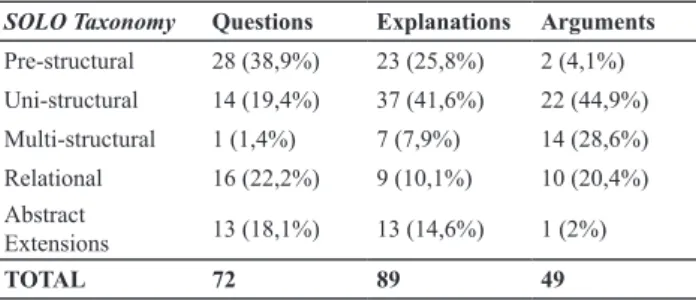
For a broader vision of the levels of these diferent dis-courses, in Table 2 one presents its ranking in relaion to the SOLO taxonomy. The analysis indicates that, in gener -al, students present a low level of complexity and under -standing as seen from the quesions (52.3%), explanaions (67.3%) and argumentaions (48.8%). The values were obtained from the sum of the values obtained in the pre-structural and uni-pre-structural categories. With regards to the sum of the percentages obtained in the highest levels (relaional and abstract extensions) the result was 45.9% for the quesions, 24.7% for the explanaions and 22.4% for the argumentaions. Based on these numbers one can conclude that students utered ideas of greater cogniive level through the posing of quesions. As seen further ahead, the quesions developed and coded as Abstract Ex -tensions arose from Dr. House’s episode (n=13). This fact may indicate that the content of videos, as long as they are purposely chosen and adequate, is an excellent means to encourage students to pose quesions.
Table 2 - Interconection between types of discourse and the
SOLO Taxonomy
SOLO Taxonomy Questions Explanations Arguments
Pre-structural 28 (38,9%) 23 (25,8%) 2 (4,1%) Uni-structural 14 (19,4%) 37 (41,6%) 22 (44,9%) Multi-structural 1 (1,4%) 7 (7,9%) 14 (28,6%) Relational 16 (22,2%) 9 (10,1%) 10 (20,4%) Abstract
Extensions 13 (18,1%) 13 (14,6%) 1 (2%)
TOTAL 72 89 49
Following there are some examples of the diferent discourses utered by the students:
i think anthropology and sociology of Health is a discipline in which we study the more human and psychological as-pects of the nursing profession, as in the story of former nurse Beatriz, nurse fatima becomes emotional and says that it is hard for her to see the elderly in these situations, as well as children and other people.
this episode of dr. House shows many examples of dehu-manisation, although there is an episode in which we can witness humanisation at the level of healthcare provision. To deepen the discussion on the students’ level of com -plexity and understanding perceived in their discourses, in Table 3 one shows the interrelaion between the SOLO Taxonomy and each one of the episodes corresponding to diferent aciviies. According to the developed aciviies, one can see, in general, that students utered quesions, explanaions and argumentaions of a low cogniive level. This fact is easily understood when the pre-structural and uni-structural levels are added up with regards to the aciv -ity on the episodes Beatriz (66.5%), Dr. House (51.1%) and Ms. Solange (55.2%), concerning the muli-structural level, considered as average (4.5%, 11.8%, 19.1%) and the sum of the levels Relaional and Abstract Extensions (28,6%,32.8%, 18.1%) considered to be of a high cogniive level.
Table 3 - Interrelation between the episodes and the SOLO Taxonomy
SOLO Beatriz (PPT) Dr. House (Video)
Ms. Solange (Chapter)
Pre-structural 36 (41,4%) 11(14,5%) 6 (12,8%) Uni-structural 22 (25,3%) 31 (40,8%) 20 (42,6%) Multi-structural 4 (4,6%) 9 (11,8%) 9 (19,1%) Relational 13 (14,9%) 13 (17,1%) 9 (19,1%) Abstract
Extensions 12 (13,8) 12 (15,8%) 3 (6,4%)
TOTAL 87 76 47
When one adds the three levels of the highest catego -ries (Muli-structural, Relaional and Abstract Extensions) one sees that 44.7% are associated with the Dr. House epi -sode, 33.1% with Beatriz and 44.6% with Solange. From this point of view, there are no diferences between the three aciviies; however, taking only into consideraion the values of the Abstract Extensions, the video-based ac -ivity is much above the chapter-based ac-ivity and slightly above the acivity using the PowerPoint presentaion. Fol-lowing there is an example of each one of the discourses.
in my opinion, anthropology and sociology in Heath stud-ies human behaviour. this subject is important for nurses as it will help them to better understand the patient and help them to psychologically cope with their disease. His work requires him to see every patient so he must not take too long in the consultations, thus restricting conver-sations to what is basic and concrete to be able to treat everyone.
perhaps the discipline that, i think, relates man and so-ciety in health is important for future nurses, in the sense that it helps to understand the different needs and feelings that involve the patient in different stages of life.
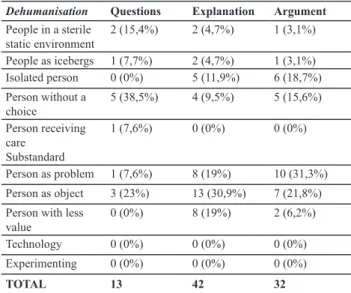
As menioned above, to study the dehumanisaion of care one used Howard’s model. One sought to check stu -dents’ understanding about the issue of dehumanisaion of healthcare through the aciviies used. From the total
quesions, explanaions and argumentaions presented in all aciviies only 13, 42 and 32 were classiied in one of the categories presented in Table 4. Students highlight the professionals’ dehumanisaion when they see paients as a problem in 31.3% of the ranked arguments, i.e. reduc -ing the paient to their pathology. For example, a student arguing on the (de)humanisaion seen in an episode of Dr. House:
i believe that the coldness and detachment are character-istics which allow him to see rationally, analysing the signs and symptoms without really seeing the patient. for him it
is important to ind the physical reason (pathology) for the patient’s condition and ind a cure.
However, in the explanaions, a percentage (30.9%) of the nursing students stress that many professionals do not see the paient as a person but rather as an object. This vision is clear when the student states:
in our opinion, there was humanisation seen in the healthcare team; however, dr. House did not have the same attitude, his interventions were devoid of humanisation and followed a as-sistance/technical component for the provision of care.
Concerning the drating ofquesions andsillbasedon Table4, students reportedthat professionals do notallow
patients to choose (38.5%). This ideaarises in themoiva -ions, for example, of thisquesion:Asa nurse, how would you actina situaionin which eventhe doctor himself al-most quitswhen there are noplausible soluions? When
it is understoodthat it isthe choice ofa doctor whichis crucialin a speciic situaion.
Table 4 - Interrelation between dehumanisation of care and types
of discourse
Dehumanisation Questions Explanation Argument
People in a sterile static environment
2 (15,4%) 2 (4,7%) 1 (3,1%) People as icebergs 1 (7,7%) 2 (4,7%) 1 (3,1%) Isolated person 0 (0%) 5 (11,9%) 6 (18,7%) Person without a
choice
5 (38,5%) 4 (9,5%) 5 (15,6%) Person receiving
care Substandard
1 (7,6%) 0 (0%) 0 (0%)
Person as problem 1 (7,6%) 8 (19%) 10 (31,3%) Person as object 3 (23%) 13 (30,9%) 7 (21,8%) Person with less
value
0 (0%) 8 (19%) 2 (6,2%) Technology 0 (0%) 0 (0%) 0 (0%) Experimenting 0 (0%) 0 (0%) 0 (0%)
TOTAL 13 42 32
Table 5 reveals that, regarding the dehumanisaion of care, the students have reached a level of elaboraion which is, in general, greater than the discourse on Dehumanisa -ion with regards to the sum of the ques-ions (N=57), expla -naions (N=56) and arguments (N=25). However, it is noted that concerning the students’ types of discourse and the categories of humanisaion there is relocaion with difer -ent emphases. Therefore, there were more quesions in the scope of the Psychological and Senimental category with 49,1%, whereas the explanaions (66%) and arguments (48%) focused on the Social and Relaional category.
Table 5 - Interrelation between the dimensions of humanisation
of care and the types of discourse
Humanisation Questions Explanation Argument
Psychological and Sentimental
28 (49,1%) 7 (12,5%) 6 (24%) Technical and
Scientiic 6 (10,5%) 2 (3,5%) 3 (12%)
Social Relations 7 (12,2%) 37 (66%) 12 (48%) Ethics 15 (26,3%) 8 (14,2%) 4 (16%) Other 1 (1,7%) 2 (3,5%) 0 (0%)
TOTAL 57 56 25
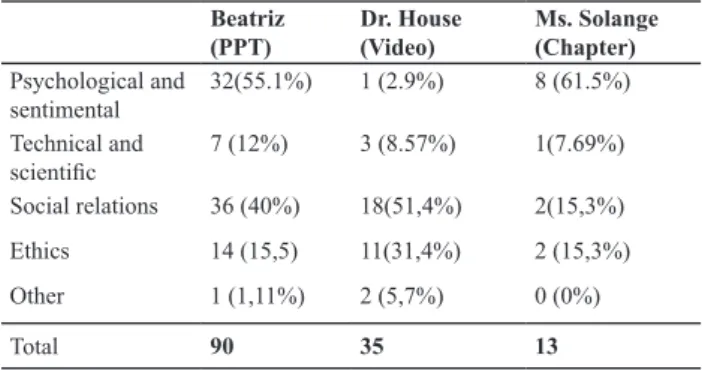
There does not seem to be a grounded reason to ex -plain the associaion of the type of discourse with the dif -ferent emphases found in the humanisaion category. One does also not believe that this fact is directly related to the type of acivity where these diferent discourses were encouraged (see Table 6), as in this event other categories are emphasised.
Table 6 - Interrelation between the dimensions of humanisation
of care and the different strategies used.
Beatriz (PPT)
Dr. House (Video)
Ms. Solange (Chapter)
Psychological and sentimental
32(55.1%) 1 (2.9%) 8 (61.5%) Technical and
scientiic 7 (12%) 3 (8.57%) 1(7.69%)
Social relations 36 (40%) 18(51,4%) 2(15,3%) Ethics 14 (15,5) 11(31,4%) 2 (15,3%) Other 1 (1,11%) 2 (5,7%) 0 (0%) Total 90 35 13
Although it is not possible to come up with reasons for these trends in this study, it is possible that in more controlled research one can study the existence of these associaions. In this study it is important to focus on the diferent aciviies and resources that can promote difer -ent emphases on the type and depth of the stud-ents’ dis -courses. Following are some examples of these discourses associated with diferent categories of humanisaion.
although the nurse knows that nurse Beatriz did not stand a chance to survive, he never gives up. Why doesn’t he
the doctor is afraid of feeling the patient’s pain and he is entitled to that because no one is forced to suffer along with other people who are suffering.
as he sees the patient suffering, the doctor is going to feel important, and he will feel bad for not being able to help and that can worsen the patient’s condition.
From these discourses one infers that 1st year nursing students have already developed humanisaion dimen -sions based on common sense and are focused on the as -pects of feelings and social relaions.
coNcluSioN
Ater this analysis, one can assert that it is possible, through aciviies such as reading, simulated jury and video presentaions, to use quesioning, explanaion and argumentaion to obtain students’ percepions and ex -pectaions as well as understand their diiculies. This method of acive learning can involve students enrolled in the course since the beginning of the academic year and lead them to think about some concepts of the subjects.
The study conducted by Neri de Souza and Neri de Souza(25) also found diferent direcions when quesions were compared with their explanaion. The analysis showed that the quesions are so important in diversity and quality as the hundreds of explanaions for the anal -ysed situaion-problem.
One reinforces that both quesions and explanaions are complementary and show diiculies of a diferent “nature”. However, quesions can be use in a breather sense with relates to the daily context within a class -room(10).
The results show that the incenive to the student’s quesioning, explanaion and argumentaion in several contexts and its subsequent analysis is essenial to pro -mote relecion on real life situaions that future profes-sionals will experience in addiion to acquiring the stu -dents’ preconceived percepions and encourage acive learning.
AckNowleDgemeNt
reFereNceS
1. Myrick F, Yonge O. Preceptor quesioning and student criical
thinking. J Prof Nurs. 2002 May;18(3):176–81.
2. Frambach JM, Driessen EW, Beh P, van der Vleuten CPM. Qui
-et or quesioning? Students’ discussion behaviors in
student-centered educaion across cultures. Stud High Educ [Inter
-net]. 2013 Jan 9 [cited 2014 Sep 24];39(6):1001–21. Available from: htp://www.tandfonline.com/doi/abs/10.1080/030750 79.2012.754865
3. Lim FA. Quesioning: a teaching strategy to foster clini
-cal thinking and reasoning. Nurse Educ [Internet]. 2011;36(2):52–3. Available from: htp://www.ncbi.nlm.nih. gov/pubmed/21330888
4. Montello L, Bonnel W. The versaile quesion: Diverse us
-es of qu-esioning in online and tradiional learning. Teach Learn Nurs [Internet]. Naional Organizaion for Associate Degree Nursing; 2009 Jul [cited 2014 Feb 27];4(3):71–5. Available from: htp://linkinghub.elsevier.com/retrieve/pii/ S1557308708001054
5. Beaudin BP. Keeping Online Asynchronous Discussions on Topic. J Asynchronous Learn Networks. 1999;3(2):41–53.
6. Profeto-McGrath J, Smith KB, Day RA, Yonge O. The quesion
-ing skills of tutors and students in a context based baccalaure
-ate nursing program. Nurse Educ Today. 2004;24:363–72.
7. Sellappah S, Hussey T, Blackmore AM, Mcmurray A. The use of
quesioning strategies by clinical teachers Conceptual frame
-work. 1998;28(1):142–8.
8. Bastable SB. Nurse as Educator: Principles of Teaching and
Learning for Nursing Pracice. 2nd ed. London: Jones and Bartlet Publishers; 2003.
9. Neri de Souza F. Quesions in Chemistry Learning in Higher Educaion. University of Aveiro; 2006.
10. Teixeira-Dias JJC, Pedrosa de Jesus H, Neri de Souza F, Wats DM. Teaching for Quality Learning in Chemistry. Int J Sci Educ. 2005;27(9):1123–37.
11. Oriá MOB, Ximenes LB, Alves MDS. Madeleine Leininger and
the Theory of the Cultural Care Diversity and Universality: an Historical Overview. Online Brazilian J Nurs. 2005;4(2).
12. Deslandes SF. Análise do discurso oicial sobre a humaniza
-ção da assistência hospitalar. Cien Saude Colet. 2004;9(1):7–
13. Boehs AE. Análise dos conceitos de negociação/acomo
-dação da teoria de M. Leininger. Rev Lat Am Enfermagem. 2002;10(1):90–6.
14. Leclainche X. É preciso humanizar o hospital. Rev Paul Hosp. 1962;10(5):7–10.
15. Gelain, I J. Humanização do hospital. RevPaul Hosp. 1968;16(1):3–7.
16. Franco, M, Florenim R. A saisfação dos utentes em serviços
de saúde: um estudo explicaivo sobre o Departamento de Pasiquiatria e Saúde Mental do Centro Hospitalar da Cova da Beira. A Saisf dos utentes. 2006;24(1).
17. Oliveira BRG, Collet N, Viera CS. A humanização na assitên
-cia à saúde. Rev Laino-am Enferm. 2006;14(2):277–84.
18. Casate JC, Corrêa AK. Humanização do atendimento em
saúde: conheciento veiculado na literatura brasileira de en
-fermagem. Rev Laino-am Enferm. 2005;13(1):105–11. 19. Watson J. Enfermagem: Ciência Humana e cuidar uma teoria
de enfermagem. 1a ed. Lisboa: Lusociência; 2002.
20. Deslandes SF. Humanização dos cuidados em saúde: concei
-tos, dilemas e práicas. Rio de Janeiro: Editora Fiocruz; 2006.
21. Neri de Souza F, Costa AP, Moreira A. Quesionamento
no Processo de Análise de Dados Qualitaivos com apoio do sotware WebQDA. EDUSER Rev Educ [Internet]. 2011;3(1):19–30. Available from: www.eduser.ipb
22. Neri de Souza D, Costa AP, Neri de Souza F. Avaliação da
Perceção dos Formandos sobre o Sotware WebQDA. II Con
-gresso Internacional TIC e Educação (icEDUCA2012). Lis
-boa: icEDUCA2012; 2012. p. 365–76.
23. Biggs JB, Collis KF. Evaluaing the Quality of Learning – the SOLO Taxonomy. New York: Academic Press; 1982.
24. Neri de Souza F, Moreira A. Peris de Quesionamento em
Contextos de Aprendizagem Online. Rev Iberoam Informái
-ca Educ. 2010;12:15–25.
25. Neri de Souza D, Neri de Souza F. Quesioning and Expla