RESUmo
Odolendipit landreet iriurem nisismolorer se consed dolut nibh exerosto cons adia-met pratum vel ipit, quis ad ea feugueros alit lut lamcomm odipit, velisis duis endig-na feugiamet el exero et, sendipis diametu msandio odo odiam verit inciliqui ing er am eum dolor acipisi. Uptat augue eugiam quat, volore vel iliquis nim ad exer susci incin euis num dolutpat, velenim irillam zzriure raesto etuer sed delit, commy nos-to dunt la aut wis er in eugiamcommy nim niscilit nim ipit alit il utet at. Duis aut lutpat eros nullaor ionulla feuis ex exerat. Ut acil doloris ad te consequat. Ut luptat. Equisit utaio odiam, consequis ea atueros inci -dunt ad tet nonsed magnibh essim dolobo-reet landignis nisisi tat velenisl ipisim inim vel doluptatum inibh exerit augiam, quipit illa commod modipsummy nonsenim aute magna consequat.
dEScRiToRES Religião
Espiritualidade Idoso
Envelhecimento
The religiosity in the process of
living getting old
*O
riginal
a
r
ticle
AbSTRAcT
This study aimed to idenify how religious and spiritual pracices are experienced at diferent ages during the aging process. The study was cross-secional and ob -servaional and conducted in the city of Chapecó, SC, from July 2008 to January 2009. The sample included 2,160 individu-als with 720 individuindividu-als interviewed in each age group. The analysis was univariate and obtained the absolute and relaive fre -quency of each variable. The inal data ob -tained were staisically analyzed with SPSS 13.0 sotware. It was observed that 77.6% of the respondents were Catholic and that the older individuals were more religious. A total of 50.6% of the respondents prayed once a day, 38.3% of them to ofer thanks and 30.4% in the supine posiion. We con -clude that religiosity is a valuable resource in coping with the crises of everyday life and posiively afects physical and mental health, paricularly in the elderly.
dEScRiPToRS Religion
Spirituality Aged Aging
RESUmEn
Se objeivó ideniicar cómo son experi -mentadas la religiosidad y las prácicas espirituales en las diferentes fajas etarias durante el proceso de envejecimiento. Es -tudio observacional, de ipo transversal, realizado en Chapecó-SC, de julio 2008 a enero 2009. Muestra de 2160 personas, con 720 individuos entrevistados en cada faja etaria. Se uilizó análisis descripivo univariado, con obtención de frecuencias simples y relaivas para cada variable. Los datos inales recibieron tratamiento esta -dísico por sotware SPSS 13.0. Se observó que: 77,6% de los entrevistados eran cató -licos, que a mayor edad correspondió ma-yor religiosidad, 50,6% de los entrevistados reza una vez al día, 38,3% de ellos reza para agradecer y 30,4% reza acostado. Se con -cluye en que la religiosidad es un recurso valioso para enfrentar las crisis coidianas y un factor que interiere posiivamente en la salud ísica y mental, principalmente en -tre las personas ancianas.
dEScRiPToRES Religión
Espiritualidad Anciano Envejecimiento
Leoni Zenevicz1, Yukio moriguchi2, Valéria S. Faganello madureira3
A religiosidAde no processo de viver envelhecendo
lA religiosidAd en el proceso de envejecimiento
*Extracted from the thesis “A dimensão espiritual no processo de viver envelhecendo”, Geriatrics and Gerontology Institute of the Pontiical Catholic University
of rio grande do sul, 2009. 1Nurse. PhD in Biomedical Gerontology at the Pontiical Catholic University of Rio Grande do Sul, 2009; Assistant Professor I of
Undergraduate Nursing, Federal University of Southern Frontier, Chapecó, SC, Brazil. [email protected] 2physician. phd in internal medicine, Keio
University School of Medicine, Professor of Geriatrics at the Pontiical Catholic University, Rio Grande do Sul; Researcher in Primary Prevention of the World Health Organization, Porto Alegre, RS, Brazil. [email protected] 3PhD in Nursing from the Federal University of Santa Catarina; Associate Professor I of
inTRodUcTion
Aging is a natural and universal process. As a result of
the decrease in death and ferility rates, the world popu
-laion is becoming older. In Brazil, forecasts indicate that
in 2025, the country will be sixth in the world in elderly
populaion, which relects scieniic and technological ad -vances in health care(¹).
The process of living and aging involves biological, psy-chological and social aspects common to all individuals.
However, these aspects difer from person to person as a result of variaion in the material condiions of each indi -vidual’s life. Factors related to the person and the spaces in which they live may meaningfully change this process.
In this view, aging is a coninuous process that promotes a progressive decline in the physiological funcions, which
decreases the organic capacity and can cause fatal diseas-es. Although these facts are true and common to all living beings, the way in which this stressful process occurs is not the same for all, and it is not equal in all contexts. This
pro-cess depends on the individual characterisics of how each
individual produces and reproduces his or her material and spiritual life while changing in accordance with the culture and values
of each society(²). Thus, aging successfully
is not a privilege or luck but an objecive to
be achieved in life with respect to the man-ner in which each individual copes with the changes that accompany the aging process.
Therefore, despite the aspects that are shared by all, aging is a unique experience of
individual construcion. To learn the mean -ing of the ag-ing process is to understand the life dance. Aging results in loss and sorrow.
However, religiosity represents a protecive
factor that makes individuals more resistant to experienc
-es such as loss and sorrow. The word religion derives from
Lain religio, which means rejoin. Religion is an important
part of the culture and history of the socieies that prac
-ice rites and celebraions(3). To rejoin may be understood
as to make a connecion between beings and with God or a similar source of strength compaible with each indi -vidual’s beliefs.
Religion is a common system of beliefs and pracices related to human beings and speciic cultures, and the va -riety of the phenomena categorized as religion should be
taken into consideraion(4). These belief systems may inlu
-ence directly or indirectly the process of making decisions. Similarly, they afect percepion and the understanding of situaions and aitudes toward them (5). Thus, religion is a
debated but relevant issue in human existence and in life
situaions that involve disease and death. To profess a reli -gion means more than to follow norms and rites. It means possessing faith, i.e., a strength that drives one to an
en-counter with God, or the sacred, in a personal relaionship
of reverence, respect and love(6).
The literature emphasizes that the experience and
pracice of a religion is essenial because religion strength -ens individuals when illness and loss occur while
main-taining or improving living and health condiions(7). Pray
-ing, singing and reading religious texts cause posiive emoions, such as love, self-esteem and forgiveness(8), and
as age advances, religiosity starts to represent an
impor-tant source of emoional support with meaningful reper -cussions for mental and physical health. Considering the
aspects described above, this paper aims to idenify how religiosity and spiritual pracices are experienced by dif -ferent age groups during the aging process.
mETHod
This paper is based on a transversal observaional
study conducted in 39 districts of Chapecó city (SC). The
invesigated sample consisted of 2160 individuals distrib
-uted in a proporional sampling. The sample was divided
into three age groups: 20 to 39 years, 40-59 years and over 60 years. In each group, 720 interviews were
con-ducted. The residences of the paricipants were mapped
and randomly numbered. The number of
residents in each house and their respecive ages were esimated. Three individuals from
each family were interviewed according to the established age groups.
To deine the sample dimension, the esi
-mate obtained based on a quesion concern -ing the presence of spiritual elements in an
individual’s life (67.0% (n = 1444)) was used as a basis for calculaion. Thus, assuming a signiicance level of 1% (n = 0,01) and a maxi
-mum relaive error of 3.7%. The mini-mum
sample size was set in 2160 individuals.
A quesionnaire with semi-structured quesions was
used. The interviews were conducted by the surveyor and ten trained nursing students between July 2008 and January 2009, Monday to Friday, in the morning and the evening.
For the staisical analysis, the program SPSS 13.0 was used. The analysis was developed using a descripive, mono-varied analysis in which simple frequencies relaive to each invesigated variable were obtained. For the com
-paraive analysis (bivariate), the chi-square of the Pearson test was performed, and the coningency coeicient was determined. When the age groups were compared using a dichotomous variable of answers to yes/no quesions,
in the inference, the proof of the linear tendency of the chi-square (linear by linear) was considered. Considering the ordinal categorical variables, when compared with
the age group, the coeicient of the Spearman correlaion
was implemented.
The enire survey process carefully followed the ethical precepts of Resoluion nº 196/6 of the Naional
...as age advances, religiosity starts
to represent an important source of
emotional support with meaningful repercussions for
Health Council, which regulates research on human beings.
The survey was started ater approval by the Ethics Com
-mitee for research of the Poniical Catholic University of Rio Grande do Sul under the protocol and record of CEP nº 08/04149. All of the paricipants signed the Consent Term Free and Clariied form and had their idenity preserved.
RESULTS
Of the 2160 surveyed individuals, 57.0% were female and 43% (n=937) were male. In the sample, females
were predominant (p<0,001). Regarding marital status,
the following breakdown was observed: married (52%) (n=1.137), single (18.3%) (n=394) and widows or widow
-ers (11.9%) (n=257).
Regarding marital status and age group, a staisically meaningful diference (p>0,001) was detected. That is,
the marital status single was meaningfully associated with
the 20-to-39-year group, separated individuals generally belonged to the 40-to-59-year group and widows or wid-owers belong to the 60 years or older group.
Regarding ethnic group, 48% (n=1.027) of the inter
-viewed individuals declared themselves to be of Brazilian ethnicity, 32.2% (n=689) Italian, 11.5% (n=2470) German, 2.0% (n=42) indigenous and 1.7% (n=36) African.
Regarding the socio-economic condiion, 84% (n=1.808) of the paricipants stated that they earned one to four imes the minimum wage. Those that earned more than ten imes de minimum wage represented 1.0% (n=22) of the interviewed.
Concerning religious belief, 77.6% (n=1.663) of those interviewed stated that they were Catholic, 9.9% (n=212) Protestant, 8.2% (n=175) Evangelical, 0.6% (n=13) Afro-Brazilian, 0.5% (n= 11) Kardec Spiriist and 1.95% (n=41) no religion. Of those interviewed, 82.3% (n=1.757) stated that they acively praciced their religion (Figure 1).
Figure 1 – Distribution of declared religion according to age group
In the comparison among age groups, the groups of those aged 60 years or more and 40 to 59 years exhibited
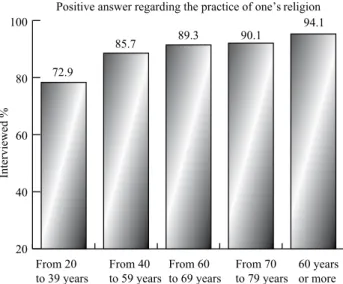
a meaningful associaion with religion pracice (p<0.001). The 20-to-39-year group was diferent. Here, those who do not pracice a religion predominated. Based on the linear-by-linear associaion result (p<=0.001), the data in -dicated that the older the age group is, the more frequent
is religious pracice (Figure 2). When asked why they prayed, 38% (N=823) of the sur
-veyed individuals replied that they pray to express thanks, 20.6% (n = 444) for personal strength and 20.7% (n= 445) to ask for blessing when problems occur (Figure 3). In the comparaive analysis of the age groups, a chi-square test indicated a staisically meaningful associaion with prayer
for the recovery of one’s health and for sins to be forgiven.
The 40-to-59-year group exhibited an associaion with ex
-pressing thanks, whereas the 20-to-39 year group exhibited an associaion with diferent reasons concerning personal strength, asking for blessing and in the case of problems.
Figure 2 – Relative distribution of those interviewed who
answe-red yes regarding their religion practice or doctrine obtained as a
0% 20% 40% 60% 80% 100%
60 years or more From 40 to 59 years
From 20 to 39 years Catholic
Protestant Evangelic Kardeck spirit Profess no religion Afro-Brazilian religions Other
% of the surveyed Individuals
27.6 38.5
70.7 54.5 37.7 31.6 32.1
58.6
23.1
4.9
27.3
33.1
33.5
33.6
13.8
38.5
24.4
18.2
29.1
34.9
34.3
20 40 60 80 100
Interviewed %
From 20 to 39 years
From 40 to 59 years
Positive answer regarding the practice of one’s religion
72.9
85.7 89.3 90.1
94.1
From 60 to 69 years
From 70 to 79 years
Figure 3 – Distribution of the reasons why one prays according to age group
Concerning prayer frequency, 50.6% (n= 1.073) of the
surveyed individuals stated that they pray once daily. A
to-tal of 23.5% (n=499) stated that they pray several imes daily. In the comparaive analysis of the age groups, a sta
-isically meaningful associaion was detected (p<0,001)
between the group aged 60 years and praying several
imes daily. In the 40-to-59-year group, an associaion was
observed with the frequency of the other locaion and
in several places, such as the car, while at one’s job, and
while walking. Based on the interviews, in the 20-to-39-year group, an associaion was observed with the prayer frequency of approximately once a month. Addiionally, an associaion with a once-daily prayer frequency was ob -served (Figure 4).
Figure 4 – Distribution of the frequency of prayer according to age group.
When asked about the way they pray, 30,4% (n=644) menioned the lying posiion (before or ater sleeping), 27.0% (n=571) reported praying in the siing posiion and 14.3% (n=304) informed the kneeling posiion. Con
-sidering the comparaive analysis, with the age group, the QUI-square test indicated staisically a meaningful asso
-ciaion (p<0.001), informing that people of 60 years or
more showed meaningfully associated to the prayer made
in the siing posiion with folded hands . In the age group of 40 to 59 years, the associaion occurred with the laying posture, as well as the tendency of associaion with the
no prayer category (Figure 5).
60 years or more Thanksgiving
Remission of sins
Asking for a bless in case of
Personal strengthening Ease pain or sorrow Get a job Improve health Other Asking for God too help in everything
Do not pray
% of Surveyed Individuals
02 04 06 08 0 100
53.8 7.7 38.5
37.5 28.8 33.8
30.8 38.5 30.8
11.9 35.6 52.5
42.9 42.9 14.3
38.1 23.8 38.1
30.4 36.8 32.8
26.7 28.6 44.7
38.4 28.8 32.8
38.3 34.2 27.5
From 20 to 39 years From 40 to 59 years
Several times a year
Every week
Several times a day
Once a day Several times per week Approximately once a month Less than once a year Other Don’t pray in any other place
60 years or more From 40 to 59 years
From 20 to 39 years
% of Surveyed Individuals
02 04 06 08 01 00
42.9 22.4 34.7
57.1 42.9
29.3 31.7 39.0
26.2 42.6 31.1
49.3 28.4 22.4
38.9 21.1 40.0
32.9 35.5 31.6
26.3 34.3 39.5
Figure 5 – Relative Distribution of the praying posture according the age group.
diScUSSion
Among the 2160 individuals surveyed, females
pre-dominated (57.0) and most female paricipants were mar
-ried (52.7%). Other studies(9-10) have indicated that in Brazil
as in other countries there are a larger number of women
among the elderly. In São Paulo, an epidemic transversal
study demonstrated that most of elderly were married or
maintained a consensual union (51.1%). These data agree with this study’s indings(¹¹).
The most frequently stated ethnicity was Brazilian (48.0%), followed by Italian (32.2%) and German (11,5%).
These data are in accordance with the ethnic origin of Santa Catarina, which is home to several groups that
origi-nated in several countries, paricularly Europeans. Ger
-man immigraion in Brazil centered on the setlement and development of southern Brazil. Similarly, Western Catari
-nense was setled by German immigrants and further de
-veloped by Italians, both considered the most signiicant
ethnic groups in the region(¹²).
Regarding the socio-economic condiion of the sur
-veyed individuals, 84.5% have an income between one and four imes the minimum wage. A study conducted on 6116 gaúchos elderly, found that 63.6% have an income of one to less than three imes the minimum wage. An important veriied result was that the income of elderly individuals that was between one and four imes the minimum wage presented a staisically signiicant asso
-ciaion with educaional level. This asso-ciaion suggested
that the elderly individuals had not had an opportunity to study and thus were employed at home, in agriculture or
in employment that did not require educaion. For these individuals, most of the current income comes from reire
-ment beneits(13). Thus, one can infer a relaion between
low educaion and the socio-economic condiion(14). In the
40-to-59 year group, the income was above 10 imes the
minimum wage, and in the 20-to-39-year group, the
as-sociaion was with ive to nine imes the minimum wage. It may be concluded that a higher educaion level opens
Em pé com as mãos postas Em pé Sentada e com as mãos postas Sentada Ajoelhada Ajoelhada com as mãos postas Deitado(a) antes ou após dormir Sentada, em pé ou ajoelhada Da forma como estiver no momento...
Não reza
60 anos ou mais De 40 a 59 anos
De 20 a 39 anos
% de pesquisados
02 04 06 08 0 100
47,6 19,0 33,3
33,6 36,8 29,6
20,5 34,1 45,5
45,3 24,7 30,0
28,2 32,4 39,4
28,6 38,5 32,9
18,1 38,9 43,1
30,0 41,8 28,2
25,6 30,6 43,8
27,9 41,4 30,7
an array of job opportuniies and the possibility of higher
income.
It was conirmed that 77.6% of the surveyed individu
-als were Catholic. Addiionally, several other religions were represented, such as: Guarani, Afro, Islamic, Bud
-dhism, Judaism, and Chrisianity. Brazil is 73.77% Roman Catholic. A total of 7.28% of Brazilians profess no religion, and 35% pracice other religions. In recent years, Catholi -cism has lost the most adherents among all of the states of
the Federal Union. However, Catholicism coninues to be the predominant religious group in Brazil(15). In the 2000
demographic census, 1.3% of the populaion claimed to be spiriist(15). Brazil is a country of faith. Over the last ive
decades, it has been increasingly possible to observe
dif-ferent religious denominaions in the society as a result of substanial changes associated with urbanizaion and social modernizaion(16). Currently, religion is a personal
choice, and an individual’s professed religion is not neces-sarily the religion in which the individual was raised but freely chosen(17).
Concerning why one prays, 38.3% of those surveyed pray to ofer thanks. During the aging process, the elder
-ly experience diferent types of stressful circumstances caused by disease, pain, sufering, loss or death, and pray for health or for the remission of sins. Prayer may be ben
-eicial in crises and when personal problems occur. Indi
-viduals pray for soluions to crises or personal problems, during inancial diiculies, to compensate for loss or for restored health. Elderly paricipants in another study(18)
indicated that prayer was the most important pracice of their daily life, paricularly with respect to promoing relecion and moivaing these individuals to coninue along their course in life. The objecives listed for prayer were asking for forgiveness (80.3%), help (63.6%), protec
stress for 91.3% of the paricipants, whereas 86.7% con -sidered prayer to be important for personal achievement.
Praying to God reduced loneliness for 87.3%, and 68.2% considered faith to have a beneicial inluence on their lives, whereas 95.3% prayed because they sought sup
-port from God during diicult circumstances. Those in the 40-to-59-year group prayed to ofer thanks, whereas
those aged 20-to-39 years prayed for personal strength and when problems occurred.
Prayer links humans with the highest spirituality, with God, and with the universe while contribuing to strengthening individuals and providing opportuniies for
improved health, increased business success and cures
for diseases(19). A study on the quality of life of women
living with HIV/AIDS performed in the São Paulo country
-side using the World Health Organizaion Quality of Life (WHOQOL)-HIV bref veriied that, among the six domains
assessed by the instrument, spirituality had been the best performance with respect to issues such as forgive-ness, guilt, and worries regarding the future and death. These results reinforced the belief that spirituality is a
useful strategy to cope HIV/AIDS and the biopsychic-social
changes that the disease causes in the lives of the indi-viduals who live with it(20).
It was veriied that the act of praying in other locaions once daily was praciced by 50% of the surveyed individu
-als. Daily prayer is praciced by a larger number of individ
-uals than weekly atendance at religious services. Prayer is the religious acivity most praciced by the elderly and
according to the authors was associated with anxiety and the fear of death(21).
Regarding the manner of prayer, the supine posiion (30.4%) was predominant, followed by seated posture (27.0%), and 14.3% stated that they prayed while kneel
-ing. The gospels of the sacred Bible provide indicaions regarding the importance of the prayer posture. Siing
provides comfort, facilitates listening to readings and
the sacraments and favors meditaion. It is the posiion of those who like what they are listening to. The posiion relects an individual’s aitude in face of the master and demonstrates atenion and welcome. The standing pos
-ture displays atenion and respect, whereas the bowed posture is a sign of respect. The kneeling posture was as
-sumed in ancient imes to pray at home or to pay pen
-ance and is currently used in the consecraion of wine and
bread in the Catholic rite. Religious individuals bow their
heads to receive solemn blessings. The genulecion is a
sign made when one enters or leaves a church or temple. Raised hands denote a request in the form of a
supplica-ion of those who pray and express a request for delivery from evil or distress. Folded hands indicate recollecion, i.e., a moment of search and encounter with God that involves faith, supplicaion, trust and life surrender. This
posture denotes deep piety and respect(22).
concLUSion
For the paricipants in this study, the act of prayer is a pracice present in life but which varies in its frequen -cy. The simple act of prayer relieves stress by providing
the mind with another focus and divering thoughts from problems and alicions.
During the process of living and aging, religion is a
powerful strategy with which to face existenial crises, paricularly for the elderly. Religious pracice provides hope for life ater death, and only religion can answer the quesion of life’s purpose. Addiionally, it was observed that young individuals paricipate in the same acts and re -ligious rites compared with adults and the elderly.
Religious pracice helps decrease anxiety, increase hope, and clarify the meaning of existence. Prayers may be ofered in thanks, supplicaion, silence (or not), and with a glad or a sorry heart. Prayer is an enhancing experi
-ence because there is a need to thank God for all, includ -ing the possibility of learn-ing from spiritual be-ings liv-ing on earth.
Regarding the manner and posture of prayer, it is
es-senial to understand that there is no mandatory posture when addressing thoughts and requests to God. Instead, it is important to know that the prayer is the primary source of salvaion, the means to achieve the immortality of the soul. Prayer is a special dialog between the human
being and the Creator, a moment of encounter with one’s
God, and a means to comprehend the soul’s immortality, life’s meaning, and the purpose of sufering or loneliness.
For the elderly, religious beliefs contribute decisively to well-being and have repercussions for physical and mental health.
In conclusion, religiosity is healthful primarily for adults and the elderly. It may be inferred that the act of
prayer provides a range of health beneits, regardless of age group and professed religion. Prayer is a personal way to talk to God and to believe in something that strength -ens and sustains.
It is recommended that spirituality be studied in difer
-ent ields of human knowledge and primarily the health
sciences because it represents an important factor in the disease process. This study will be an important means to increase the understanding of the phenomenon and
pres-ent the theme in naional scieniic journal because in this study the primarily limitaion was the topic’s scarce na
-ional publicity. Furthermore, spirituality should be stud
-ied with a focus on gender and from the perspecive of
REFEREncES
1. Almeida T, Lourenço ML. Envelhecimento, amor e sexu -alidade: utopia ou realidade. Rev Bras Geriatr Gerontol. 2007;10(1):101-13.
2. Penna FB, Santo FHE. O movimento das emoções na vida dos ido-sos: um estudo com um grupo da terceira idade. Rev Eletr Enferm [Internet]. 2006 [citado 2011 nov. 17];8(1):17-24. Disponível em: htp://www.fen.ufg.br/revista/revista8_1/original_02.htm
3. Pessini L, Bertachini L. Humanização dos cuidados em saúde: o desaio de cuidar do ser com competência humana e ciení-ica. In: Pessini L, Bertachini L, organizadores. Humanização e cuidados paliaivos. São Paulo: Loyola; 2004.p. 1-28.
4. Silva EM. Religião, diversidade e valores culturais: conceitos teóricos e a educação para a cidadania. REVER Rev Estudos Religião. 2004;4(2):1-14.
5. Salgueiro JB, Goldim JR. As múliplas interfaces da bioéica com a religião e a espiritualidade. In: Goldim JR, organizador. Bioé -ica e espiritualidade. Porto Alegre: EDIPUCRS; 2007. p. 11-27.
6. Angerami-Cameron VA. Espiritualidade e práica clínica. São Paulo: Thomson; 2004.
7. Moreira AA, Lotufo Neto F, Koening HG. Religiousness and mental health: a review. Rev Bras Psiquiatr. 2006;28(3):242-50.
8. Volcan SMA. Relaionship between spiritual well-being and minor psychiatric disorders: a cross-secional study. Rev Saúde Pública. 2003;37(4):440-5.
9. Silva MC. O processo de envelhecimento no Brasil: desaios e perspecivas. Textos Envelhecimento. 2005;8(1):43-60.
10. Garrido R, Menezes PR. O Brasil está envelhecendo: boas e más noícias por uma perspeciva epidemiológica. Rev Bras Psiquiatr. 2002;24 Supl. 1:3-6.
11. Alves JC. Determinantes da autopercepção dos idosos do município de São Paulo 1999/2000 [dissertação]. Belo Hori -zonte: Faculdade de Ciências Econômicas; Universidade Fed -eral de Minas Gerais; 2004.
12. Renk A. Sociodicéia às avessas. Chapecó: Grifos; 2000.
13. Bapista ASD. Estudo sobre as práicas religiosas e sua rela -ção com a saúde mental dos idosos: um estudo na comu -nidade [tese doutorado]. São Paulo: Escola Paulista de Me -dicina, Universidade Federal de São Paulo; 2004.
14. Berquó E. Algumas considerações sobre o envelhecimento populacional. In: Anais 1º Seminário Internacional sobre o Envelhecimento Populacional: Uma Agenda para o Final do Século; 1996; Brasília, DF, Brasil. Brasília: Ministério da Pre -vidência e Assistência Social; 1996. p. 16-34.
15. Insituto Brasileiro de Geograia e Estaísica (IBGE). Pesqui-sa Nacional por Amostra de Domicílios – PNAD 2001 [Inter-net]. Rio de Janeiro; 2001 [citado 2012 abr. 4]. Disponível em: htp://www.ibge.gov.br/home/estaisica/populacao/ trabalhoerendimento/pnad2001/notastecnicas.pdf
16. Jacob CR, Hees DR, Waniez P, Brustlein V. Atlas da iliação reli -giosa e indicadores sociais no Brasil. São Paulo: Loyola; 2003.
17. Pierrucci AF, Prandi R. Religiões e voto: a eleição presiden -cial de 1994. Opin Pública. 1995;3(1):20-44.
18. Goldstein LL, Neri AL. Tudo bem, graças a Deus: religiosidade e saisfação na maturidade e na velhice. In: Neri AL, Yassu -da MS, organizadoras. Quali-dade de vi-da e i-dade madura. Campinas: Papirus; 1999. p. 109-36.
19. Jotz JCP. Espírito saudável: mente sã, corpo são. Porto Alegre: Editora do Autor; 2008.
20. Gaspar J, Reis KR, Pereira FMV, Neves LAS, Castrighini CC, Gir E. Quality of life in women with HIV/aids in a municipality in the State of São Paulo. Rev Esc Enferm USP [Internet]. 2011 [cited 2012 Apr 4];45(1):230-6. Available from: htp://www. scielo.br/pdf/reeusp/v45n1/en_32.pdf
21. Lo B, Ruston D, Kates LW, Arnold RM, Cohen CB, Faber-Lan -gendoen K, et al. Discussing religious and spiritual issues at the end of life: a pracical guide for physicians. JAMA. 2002;287(6):749-54.
22. Sciadini P. Posições de oração. Rev Carmelitana Orar. 2008;(9):8.