RESUMo
Este estudo teve como objeivo esimar a prevalência de auto-relato de fatores de risco e eventos cardiovasculares na popu-lação lainoamericana imigrante adulta do Distrito 2 (Macarena) de Sevilla. Estudo piloto de invesigação descriiva de corte transversal, uilizou-se um quesionário anônimo com auto-relato de fatores de risco e eventos cardiovasculares. Paricipa-ram 34 pessoas, (18% do total da mostra), idade média: 31,8 anos, residência média: 6,5 anos, mulheres: 52.9%. Prevalências de fatores de risco: 8,8% diabetes, 26.5% co-lesterol elevado e 14,5% hipertensão arte-rial. Prevalência de eventos coronários é de 8,8%: angina de peito, infarto do miocárdio e acidente cerebrovascular, com 2,9% cada um. A conclusão é que a auto-relatada prevalência de eventos cardiovasculares é maior do que a literatura, esta questão merece a atenção de agências de saúde, este conhecimento deve ser considerada pelas enfermeiras para desenvolver planos de cuidados culturalmente apropriado do contexto dos imigrantes.
DEScRitoRES
Migração internacional América Laina
Doenças cardiovasculares Fatores de risco
Promoção da Saúde Cuidados de enfermagem
Risk factors and cardiovascular events in adult
latin american immigrants in the Macarena
District, Seville, Spain: a pilot study
*O
riginal
a
r
ticle
AbStRAct
In order to esimate the prevalence of self-reported risk factors and cardiovascular events in an adult immigrant Lain Ameri-can populaion of District 2 (Macarena) in Seville, we conducted a pilot study using cross-secional descripive research. We used an anonymous quesionnaire with self-reported risk factors and cardiovascu-lar events. 34 people paricipated (18% of the sample); mean age: 31.8 years, mean residence: 6.5 years, women: 52.9%. Prev-alence of risk factors: diabetes 8.8%, high cholesterol 14.7% and high blood pressure 23.5%. Prevalence of coronary events was 8.8%; angina pectoris, myocardial infarc-ion and stroke, 2.9% each. The conclusinfarc-ion is that self-reported prevalence of cardio-vascular events was higher than in the lit-erature, this issue deserving the atenion of health agencies. This knowledge should be considered by nurses to develop cultur-ally appropriate care plans of the context of immigrants.
DEScRiPtoRS
Emigraion and immigraion Lain America
Cardiovascular diseases Risk factors
Health Promoion Nursing care
RESUMEn
Con el objeivo de esimar la prevalencia por autorreporte de factores de riesgo y eventos cardiovasculares en población lai-noamericana inmigrante adulta del Distrito 2 (Macarena) de Sevilla, se realizó un es-tudio piloto de invesigación descripiva de corte transversal. Se uilizó un cuesionario anónimo con autorreporte de factores de riesgo y eventos cardiovasculares. Resulta-dos: pariciparon 34 personas, (18% de la muestra), edad media: 31,8 años, residen-cia media: 6,5 años, mujeres: 52,9%. Pre-valencias de factores de riesgo: 8,8% dia-betes, 14,7% colesterol elevado y 23,5% hi-pertensión arterial. Prevalencia de eventos coronarios es de 8,8%: angina de pecho, infarto de miocardio y accidente cerebro-vascular, con 2,9% cada uno. La conclusión es que la prevalencia de eventos cardio-vasculares autorreportados es superior a la literatura, mereciendo este asunto la atención de los organismos sanitarios, este conocimiento debe tenerse en cuenta por enfermería para elaborar planes de cuida-dos adaptacuida-dos culturalmente al contexto de este colecivo inmigrante.
DEScRiPtoRES
Migración internacional América Laina
Enfermedades cardiovasculares Factores de riesgo
Promoción de la Salud Atención de enfermería
José Rafael González-López1, María de las Mercedes Lomas-campos2, María de los Ángeles Rodríguez-Gázquez3
FATORES DE RISCO E EVENTOS CARDIOVASCULARES EM IMIGRANTES LATINO AMERICANOS ADULTOS NO DISTRITO MACARENA, SEVILLA, ESPANHA: ESTUDO PILOTO
FACTORES DE RIESGO y EVENTOS CARDIOVASCULARES EN INMIGRANTES LATINOAMERICANOS ADULTOS EN EL DISTRITO MACARENA, SEVILLA, ESPAñA: ESTUDIO PILOTO
* From Research Project “Análisis de las conductas de salud y prevalencia de enfermedades de la población inmigrante y autóctona de la ciudad de Sevilla”, University of Seville, 2009-2012. 1Ph.D. International in Health Sciences. Master in New Trends in Health Sciences. Nurse. Professor Faculty of Nursing,
Physiotherapy and Podiatry. Department of Nursing, University of Seville, Spain. [email protected] 2Ph.D. in Medicine. Full Professor, Faculty of Nursing,
Physiotherapy and Podiatry. Department of Nursing, University of Seville, Spain. [email protected] 3Ph.D. in Public Health, Epidemiologist, Nurse. Associate
intRoDUction
In a globalized world, it is indisputable that migraion is an increasingly important phenomena, both in its scope and complexity, afecing virtually every country in the world(1).
In Spain, during the irst decade of the 21st century, the immigrant populaion grew from 1.8% to 11.4% of all resi-dents; 40% of the foreigners came from Europe, followed by 31% from South America(2). The increase in immigraion has been a major challenge for social adaptaion, includ-ing the issues related to health and the organizaion of the health system(3). This phenomenon has required the per-formance of studies about the health of the immigrants, which ideniied this group as a healthy young popula-ion(4), with a good perceived health status and with mor-bidity similar to that of the local populaions(5).
Access to and use of health services on the part of the immigrants has been the focus of much of the
research interest; addiionally, since the early nineies, periodic populaion based surveys have been used to obtain an epidemiological proile, as well as to understand the accessi-bility and uilizaion of health services(6).
In Spain, although some work exists re-lated to immigrant health, the importance of socio-demographic, economic and life-style factors(7), quality of life(8), and the use of health services(9), there has been a scarci-ty of research into the prevalence of risk fac-tors and chronic diseases in this populaion. Despite the fact that they were conducted in the autochthonous populaion, exising lit-erature indicates that some health problems are similar in both populaions(6), predomi-nantly respiratory infecions, depressive syndromes and low back pain, in primary
care seings(10); whereas the prevalence of other prob-lems is lower in recent immigrants than what is esimated in the naive populaion(11). However, ater an extended stay, they may sufer diseases more related to the lifestyle of the host countries, such as hypertension, diabetes and various respiratory or cardiovascular diseases(10).
According to the Naional Immigrant Survey(12), 8% of the Lain American immigrants in Spain in 2009 were in Andalusia; this group represented almost half of the im-migrant populaion (46.3%) in Seville, of which one of ev-ery three could be found in the Macarena district.
Nursing as a profession provides care to sick and healthy people throughout their lifespan; it is required that professionals address the human responses of indi-viduals, families and communiies in a comprehensive manner(13). We believe, therefore, that one of the great challenges posed to this discipline is to promote health through the provision of quality care, avoiding risky
be-haviors and promoing healthy lifestyles, considering at-itudinal and behavioral aspects of the user. Hence, we proposed to measure the prevalence of risk factors and cardiovascular events, in the Lain American adult immi-grant populaion in the Macarena district of the city of Seville, in order to use this measurement as a factor in-dicaive of health problems and the need for care for this group, from the nursing discipline.
Taking into account that to provide nursing care to support people in maintaining or regaining their health must take into account the culture, health and illness be-liefs, values and pracices of the people(14), nurses must be prepared to face the challenge of caring for the im-migrant community(15). To accomplish this, it is of inter-est to know the health behaviors(15), many of which are culturally determined(16), so that they can intervene to maintain or restore health. In the past decade, how care should be tailored to the immigrant populaion has been an issue of concern in nursing(15), assering that the
nurs-ing care for this group is based on the appli-caion of integrated care based on cultural knowledge and of the iniial assessment, idenifying the main nursing diagnoses with those who will implement their intervenion in conjuncion with the immigrant person, resuling in a plan of care culturally tailored to their context(17). The objecive of our in-vesigaion was to esimate the prevalence of self-report of risk factors and cardiovas-cular events in the Lain American adult im-migrant populaion in District 2 (Macarena) of Seville, during the year 2010.
MEtHoD
A quanitaive, descripive study was de-veloped, using a transversal method with a straiied proporional sample of the vari-ables of gender, age and naionality, in which 34 adult Lain American immigrants paricipated, corresponding to 17.8% of the populaion, esimated to consitute a pilot study. The range of age in this study was between 25 to 44 years, which is the most frequent age group in this populaion(12).
We used some secions of the Behavioral Risk Factor Surveillance System quesionnaire associated with behav-ior (2009) from the Centers for Disease Control and Pre
-venion of the United States(18). In this aricle we present the results of: a) sociodemographic data of the respon-dent (gender, age, marital status, educaional level, place of birth, length of stay in Spain, and occupaion), b) knowl-edge of having sufered from hypertension, diabetes and / or high cholesterol; c) changes in dietary habits, pracice of physical exercise; d) correct knowledge of signs and symptoms of a heart atack or of a cerebral vascular ac-cident: recogniion of at least four of the six signs and / or symptoms listed of each pathology (opions for response:
Taking into account that to provide nursing care to support people
in maintaining or regaining their health must take into account the culture, health and illness beliefs, values and practices of the people, nurses must be prepared to face the challenge of caring
Yes/No)(18); and e) inferences about the variables men-ioned previously.
The prevalence of the risk factors and cardiovascular events were calculated by dividing the number of persons who airmed that a physician or a nurse had commented that they had a factor or that they were sufering / had sufered a cardiovascular event, by the total number of paricipants in the study.
For this invesigaion, we adopted the deiniion of im-migrant used by the Naional Insitute of Staisics (INE) in its Naional Immigrant Survey of 2007 (ENI 2007)(19):
any person who has as his/her country of origin one other than Spain, who at the moment of conducing the survey has established his/her habitual residence within the na
-ional territory.
The collecion of data occurred in the month of April of 2011, the recruitment of paricipants was made through diferent immigrant associaions. The selecion criteria were: resident of either gender in one of the oi-cial neighborhoods or census tracts of the second admin-istraive district (Macarena) of Seville; aged between 25 and 44 years; having been born in some of the countries considered by the United Naions(20) in its classiicaion of naionaliies, territories and regions as Lain American or South American countries (Argenina, Bolivia, Brazil, Chile, Colombia, Cuba, Ecuador, Paraguay, Peru, Uruguay, Venezuela) and having migrated to Spain; ability to com-municate and understand the requirements of the study and having signed the informed consent. To avoid biases in informaion we had a single interviewer, a healthcare provider, who asked the quesions and illed in the re-sponses. The interview lasted an average of 15 minutes and occurred in diferent associaions and groups of Lain American immigrants in the district to facilitate the collec-ion of the data.
The procedures used to conduct this study followed general ethical principles, and were approved by the Eth-ics Commitee of the University of Seville for studies with human subjects in Spain and the European Union. For this, we obtained informed writen consent and, in relaion to sociodemographic data, in order protect honor and per-sonal privacy, the quesionnaires were anonymous be-cause the respondents were not asked their names.
Data were analyzed using the staisical program,
Staisical Package for the Social Sciences (SPSS) version 17.0 for Windows. Descripive analyses were performed, using measures of central tendency and dispersion such as mean and standard deviaion. To check whether the quanitaive variables complied with the criteria of nor-mality, the Kolmogorov-Smirnov (KS) test for a sample was employed. In the case of qualitaive variables, proporions were calculated and the chi-square test was applied (X2). In all cases, we adopted the value of p < 0.05 for staisical signiicance.
RESULtS
Sociodemographic Characterisics
The age variable, which was normally distributed (probability in the z of the test K-S = 0.192), had a mean of 31.8 ± 5.8 years. In Table I the sociodemographic proile of the 34 people studied can be seen; women, less than 30 years, single and who had secondary educaion predomi-nated. For country of origin, the majority came from Bo-livia and Ecuador. In relaion to current and previous occu-paion, the majority of subjects were employed by others. When analyzing the ime of residence in Spain, it was found that the sample had a mean of 6.5 ± 3.5 years, slightly higher than the mean residence ime in the city of Seville (5.8 ± 3.6 years). Both variables also had a normal distribuion, which was veriied in the probabilites of the test of K-S of 0.480 and 0.914, respecively.
Table 1 – General characteristics of 34 Latin American adult
im-migrants of the Macarena District of Seville
Variable Value
Gender; n (%)
Female 18 (52.9)
Male 16 (47.1)
Age group; n (%)
25 to 29 years 17 (50.0)
30 to 34 years 7 (20.6)
35 to 39 years 6 (17.6)
40 years and older 4 (11.8)
Marital status; n (%)
Single 16 (47.1)
Married 15 (44.1)
Living together / unmarried partner 2 (5.9)
Separated 1 (2.9)
Level of education; n (%)
Primary education* 4 (11.7)
Secondary education† 19 (55.9)
Higher education‡ 6 (17.6)
University degree§ 5 (14.8)
Nationality; n (%)
Bolivia 13 (38.2)
Brazil 1 (2.9)
Colombia 3 (8.8)
Ecuador 9 (26.5)
Paraguay 2 (5.9)
Perú 4 (11.8)
Venezuela 2 (5.9)
Previous occupation; n (%)
Employee 28 (82.4)
Self-employed 2 (5.9)
Unemployed 1 (2.9)
Student 3 (8.8)
Current occupation; n (%)
Employee 26 (76.5)
Self-employed 2 (5.9)
Unemployed 4 (11.8)
Student 2 (5.9)
Prevalence and prevenive behaviors for three risk fac
-tors for cardiovascular disease
Diabetes. Of the total populaion surveyed, 41.2% (14
individuals) were measured frequently for blood glucose, including 13 persons (38.2%) who did so several imes a year, whereas one person (2.9%) did so several imes a month. The remaining populaion never did this.
It is important to note that 38.2% of the subjects in the study sample were overweight and 20.6% were obese, while the remaining (51.2%) were of normal weight. The probability of the z of the test of K-S for the IMC was 0.969, which signiied that this variable had a normal dis-tribuion.
The prevalence of self-reported diabetes was 8.8%, namely: three people claimed to have been diagnosed as diabeic (two with gestaional diabetes and a man with type I diabetes). Of the three people who reported having been diagnosed with diabetes: one was taking medicaion to control it; all had changed their eaing habits to con-trol their blood sugar; none examined their feet to detect possible wounds by irritaion; only one praciced physical exercise as a way to improve insulin sensiivity, and all said they had not atended any educaional acivity to learn how to control blood sugar.
Hypertension. Of the total populaion surveyed,
55.9% (19 people) said that their arterial blood pressure was measured several imes a year, with those never do-ing so accoundo-ing for 44.1% (15 people). When asked how long ago the blood pressure level was analyzed: 16 people (47.1%) stated that they measured it in the past year, nine people (26.5%) had never had it done, four people (11.8 %) had measured it in the past two years, two people (5.9%) in the past ive years, and for three people (8.8%) it was ive years or more. In 76.5% of the total sample (26 people), none had a medical or nursing professional indicate that they presented with high blood pressure or hypertension.
The self-reported prevalence of this disease was 23.5%, for the remaining eight people who claimed to have been diagnosed with the disease, one of which was during her pregnancy. In the analysis of the eight people who said they were diagnosed with hypertension, only one (12.5%) reported taking medicaion to control the high blood pres-sure; ive (62.5%) had changed their eaing habits ; all had reduced their consumpion of salt and alcohol and, inally only three people (37.5%) praciced physical exercise as a way to reduce blood pressure.
Cholesterol. There were 26.5% of the study
parici-pants (9 persons) who had their blood cholesterol level checked; ive of them (55.6%) had done so in the last year. The prevalence of self-reported hypercholesterolemia was 14.7% (ive people were informed by a medical praci-ioner or nurse). Of these, only two claimed to take
medi-caion for its control; four had modiied their eaing hab-its, reducing the consumpion of fats; ive had decreased the consumpion of cigaretes and alcohol; and, only two used physical exercise as a way to reduce blood high cholesterol. We did not ind staisically signiicant difer-ences between the variable cholesterol and alcohol intake (X2 = 3.214, p = 0.073).
Prevalence of cardiovascular events and recogniion of signs and symptoms associated with these complicaions
The prevalence of self-report for cardiovascular events was 8.8%: with one case each for acute myocardial infarc-ion, angina pectoris and cerebrovascular accident. In the case of cerebrovascular accident, the paient went to re-habilitaion and changed his lifestyle as a consequence of sufering cardiac pathology.
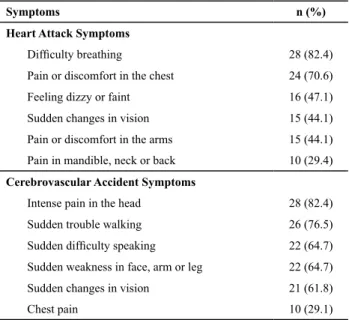
Regarding the recogniion of symptoms for the events of heart atack and cerebrovascular accident, the more recognized symptoms by this group were: diiculty breathing and pain or discomfort in the chest, for the for-mer, and severe headache and sudden trouble walking for the later (Table 2).
Table 2 – Recognition of symptoms associated with heart attack
and cerebrovascular accident.
Symptoms n (%)
Heart Attack Symptoms
Dificulty breathing 28 (82.4)
Pain or discomfort in the chest 24 (70.6)
Feeling dizzy or faint 16 (47.1)
Sudden changes in vision 15 (44.1)
Pain or discomfort in the arms 15 (44.1)
Pain in mandible, neck or back 10 (29.4)
Cerebrovascular Accident Symptoms
Intense pain in the head 28 (82.4)
Sudden trouble walking 26 (76.5)
Sudden dificulty speaking 22 (64.7)
Sudden weakness in face, arm or leg 22 (64.7)
Sudden changes in vision 21 (61.8)
Chest pain 10 (29.1)
The total proporion of correct answers to recogni-ion of the signs and symptoms of heart atack was 52.9% versus 63.2% for cerebrovascular accident; this diference was not staisically signiicant (X2 = 0.54, p = 0.46).
DiScUSSion
told by a medical professional or nurse that they were suf-fering from this disease, data signiicantly higher than the 2.7%(11)or 5%(22) in other studies. The bias could be due to the diferent sample size, since the smaller the sample, the more possibiliies exist that the results are not rep-resentaive of the study populaion, another atributable cause may be the range of ages studied. It is noteworthy that all people with diabetes in the sample had changed their dietary habits, but had not atended any formaive course on diabetes nor were feet examined for possible wounds from irritaions. Therefore, a priori, we observed deicient knowledge related to care in subjects with dia-betes in our sample.
Proceeding with other chronic disease such as arterial hypertension, its prevalence by self-report in our sample (23.5%) represented a much higher igure than the 4.1% recorded in one study(11)or the 10.8% another found(22), but we can establish a convincing explanaion for these diferences, which may be due to the reasons previously menioned of the sample size. It is necessary to comment that half of those diagnosed subjects performed health promoing behaviors when confroning their disease, such as decreasing the intake of alcohol and / or salt and / or increasing physical exercise.
The presence of blood cholesterol and diagnosis of hypercholesterolemia were indicated by 14.7% of the sample, a new igure signiicantly higher than the 5.4% analyzed by self-report(20). These diferences may be due to the measurement of the variable, or the ime of resi-dence in Spain was lower than in our sample and they had not abandoned the nutriional habits of the country of ori-gin; also all the sample in the latest study came from Lain America, as compared to only 75%. It should be noted that, of all subjects diagnosed with high cholesterol, the totality had stopped smoking, and the vast majority (80%) had changed their eaing habits; not found in the reviewed literature data that was collected, but also signiicant, was that half of those praciced exercise to improve their health. Research has found no staisically signiicant dif-ferences between this variable and the intake of alcohol.
We can say that self-perceived cardiovascular health by participants of our study was good, only 2.9% (1 per-son) was diagnosed with a heart attack, also only 2.9% was informed that he suffered angina, and one subject suffered a cerebrovascular accident, with this data be-ing similar to those described elsewhere(22), in which there existed a prevalence of other pathologies of the heart of 3.3% and 1.3% in one study(11), with data stem-ming from different autonomous communities, Cata-lonia and Madrid, respectively. No investigations were found about the knowledge of the immigrant popula-tion about the symptoms that appear both in heart at-tack and in cerebrovascular disease, although we be-lieve that, given the average number of correct answers (58.1%), measures can be established of an educational nature and oriented towards primary prevention of such problems of health.
Among the limitaions of this study, those that charac-terize a pilot study were found and dealt mainly with the number of subjects studied. This study will provide the basis of expanded research in the city of Seville, as well as to evaluate the suitability of the instrument used and the data collecion performed.
concLUSion
The results of this study have provided an expansion of knowledge about the health status of the collecive of immigrant people studied, which provide prevalences of self-reported risk factors and cardiovascular events in our pilot study higher than those found in the literature, mer-iing the atenion of the health agencies.
It is important to coninue this line of invesigaion, in order to guide the design and implementaion of dif-ferenial acions from the nursing perspecive, adequate to the needs of the immigrant collecive, such as forma-ive aciviies in the prevenion of diabetes or obesity to empower this populaion and thus improve their level of health.
REFEREncES
1. Naciones Unidas. Diálogo de alto nivel sobre la migración in-ternacional y el desarrollo. En: Asamblea General de las Na-ciones Unidas; 2006 sept.14-15; New York [Internet]. New York; 2006 [citado 2011 nov. 17]. Disponible en: htp://www. un.org/spanish/migraion/index.html
2. Cardim M, Luzón JL. Distribución por el territorio español de los inmigrantes procedentes de América Central y Caribe. En: Luzón JL, Cardim M, coordinadores. Problemas sociales y re-gionales en América Laina: estudio de casos. Barcelona: Uni-versidad Autónoma de Barcelona; 2009. p. 128-49.
3. Oliva J, Pérez G. Inmigración y salud. Gac Sanit. 2009;23 Supl 1:1-3.
4. Conceiro Rúa A, Pita-Vizoso R, Gómez-Besteiro I. Fulillment of basic needs of the moroccan female immigrant populaion in Arteixo. Rev Esc Enferm USP [Internet]. 2010 [cited 2011 Nov 17];44(2):249-56. Available from: htp://www.scielo.br/ pdf/reeusp/v44n2/en_02.pdf
330
Rev Esc Enferm USP 2013; 47(2):325-30Risk factors and cardiovascular events in adult latin american immigrants in the Macarena District, Seville, Spain: a pilot study
6. Haas JS, Phillips KA, Sonneborn D, McCulloch CE, Baker LC, Kaplan CP, et al. Variaion in access to health care for diferent racial/ ethnic groups by the racial/ethnic composiion of an individual’s country of residence. Med Care. 2004;42(7):707-14.
7. Agudelo-Suárez AE, Ronda-Pérez, Gil-González D, Vives-Cases C, García AM, García-Benavides F, et al. Proceso migratorio, condiciones laborales y salud en trabajadores inmigrantes en España (proyecto ITSAL). Gac Sanit. 2009;23 Supl 1:S115-21.
8. García Gómez P, Oliva J. Calidad de vida relacionada con la salud en población inmigrante en edad produciva. Gac Sa-nit.2009;23 Supl 1:S38-46.
9. Ángel N, Ramos JM. Uilización de servicios sanitarios por parte de las poblaciones inmigrante y naiva en la Comunidad Autónoma de la Región de Murcia. Gac Sanit. 2009;23 Supl 1:S12-8.
10. García Ballesteros A, Jiménez Basco B, Redondo González A. La inmigración lainoamericana en España en el siglo XXI. In-vesig Geogr. 2009;70(1):55-70.
11. Esteban-Vasallo MD, Domínguez-Berjón MF, Astray-Mochales J, Gènova-Maleras R, Pérez-Sania A, Sánchez-Perruca L, et al. Prevalencia de enfermedades crónicas diagnosicadas en po-blación inmigrante y autóctona. Gac Sanit. 2009;23(6):548-52.
12. España. Ministerio de Empleo y Seguridad Social; Secretaría de Estado de Inmigración y Emigración. Anuario Estadísico de Inmigración en 2008 [Internet]. Madrid; 2010 [citado 2010 nov. 4]. Disponible en: htp://extranjeros.empleo.gob. es/es/ObservatorioPermanenteInmigracion/Anuarios/Anu-ario2008.html
13. Holloway A, Watson H. Función de auto-eicacia y el cambio de comportamiento. Int J Nurs Pract. 2002;8(2):106-15
14. Leininger M. Transcultural nursing. New York: Mc Graw-Hill; 1995. Transcultural nursing: perspecives: basic concepts, principles and culture care incidents; p. 57-90.
15. Moreno-Preciado M, Marín Hernández T. Inmigración y necesidades formaivas de los cuidadores. Cult Cuidados. 2003;7(14):44-8.
16. Ruiz Salvador D, Torralbo Ojeda E, Oriz Morales MA, Pino Alcaraz MI, Artero López C. Sociedad actual e inmi-gración: el reto de la enfermería humanista. Cult Cuidados. 2006;10(20):76-82.
17. Grupo ASANEC de Inmigración. Atención de enfermería en población de origen extranjero. Biblioteca Lascasas [In-ternet]. 2006 [citado 2011 jun. 1];2. Disponible en: htp:// www.index-f.com/lascasas/documentos/lc0103.pdf
18. Centers for Disease Control and Prevenion (CDC). Behavioral risk factor surveillance system survey quesionnaire. Atlanta (GA): U.S. Department of Health and Human Services; 2009.
19. Insituto Nacional de Estadísica. Metodología de la Encues-ta Nacional de Inmigrantes 2007 [Internet]. Madrid; 2009 [citado 2010 nov. 12]. Disponible en: htp://www.ine.es/jaxi/ menu.do?type=pcaxis&path=%2Ft20%2Fp319&ile=inebase
20. Organización de las Naciones Unidas (ONU). World Popula-ion Prospects: the 2008 revisPopula-ion populaPopula-ion database [In-ternet]. New York; 2009 [cited 2010 Nov 30]. Available from: htp://www.un.org/esa/populaion/publicaions/wpp2008/ wpp2008_highlights.pdf
21. Llisterri JL, Alonso FJ, Marincano JL, López JM, Rodríguez GC, Banegas JR. Prevalencia de la hipertensión arterial en la población inmigrante asisida en atención primaria en Es-paña. Med Clin (Barc). 2007;129(6):209-12.
22. Vall-Llosera L, Saurina C, Sáez M. Inmigración y salud: nece-sidades y uilización de los servicios de atención primaria por parte de la población inmigrante en la región sanitaria Girona. Rev Esp Salud Pública. 2009;83(2):291-307.
(PI-0138), funded by the Ministry of Health of the Government of Andalusia (Government of Spain), in the noice of 2009, and implemented by the School of Nursing, Physiotherapy and Podiatry, University of Seville, Spain.