RESUmo
Estudo descriivo, transversal desenvolvi -do com objeivo de associar aspectos so -cio demográicos e clínicos aos domínios de qualidade de vida relacionada à saúde (QVRS), para avaliar pacientes onco-hema -tológicos submeidos à quimioterapia. Na coleta de dados uilizou-se um instrumen -to sociodemográico e clínico e o European Organizaion for Research and Treatment of Cancer Quality of Life Quesionnaire (EORTC) QLQ-C-30. A amostra foi consi -tuída de 32 pacientes, sendo oito (25%) com diagnósico de linfoma de Hodgkin, nove (28,12%) linfoma não Hodgkin e 15 (46,87%) leucemia. Os dados foram anali -sados pelo sotware Staisical Package for Social Science (SPSS). O QLQ-C-30 mostrou média das funções ísica, cogniiva, emo -cional, social e desempenho de papel de 54,81 a 41,18, demonstrando um nível pouco saisfatório. Nas escalas de sinto -mas, houve predomínio de fadiga média 64,57 seguida de insônia (56,90) e perda de apeite (50,71). Esses sintomas inter -feriram nas funções ísicas, emocionais e cogniivas demonstrando que efeitos cola -terais do tratamento inluenciam negaiva -mente na QVRS dos pacientes.
dEScRitoRES Enfermagem oncológica Neoplasias hematológicas Quimioterapia
Qualidade de vida
Quality of life in hematologic oncology patients
undergoing chemotherapy
O
r
i
g
i
n
a
l
a
r
ti
c
le
AbStRAct
This descripive and cross-secional study aimed to examine the socio-demographic/ clinical aspects of health-related quality of life (HRQoL) and assess the HRQoL of onco- hematological paients undergoing che -motherapy. The data collecion instrument was a socio-demographic/clinical quesion -naire, the European Organizaion for Re -search and Treatment of Cancer Quality of Life Quesionnaire (EORTC) QLQ-C-30. The sample consisted of 32 paients, eight of whom (25%) were diagnosed with Hodg -kin’s lymphoma; nine (28.12%), with non-Hodgkin’s lymphoma; and 15 (46.87%), with leukemia. The data were analyzed us -ing SPSS sotware. For the funcional scales of the QLQ-C-30 (physical, cogniive, emo -ional, social and role performance), the mean scores ranged from 54.81 to 41.18, demonstraing an unsaisfactory level of funcioning. In the symptom scales, there was a predominance of faigue (64.57), insomnia (56.90) and loss of appeite (50.71). These symptoms interfered with the paients’ physical funcioning, demon -straing that the emoional and cogniive side efects of the treatment negaively in -luenced the HRQoL of the paients
dEScRiPtoRS Oncologic nursing Hematologic neoplasms Drug therapy
Quality of life
RESUmEn
Estudio descripivo, transversal, objeivan -do asociar aspectos sociodemográicos y clínicos a dominios de calidad de vida re -lacionada a la salud (QVRS), para evaluar pacientes oncohematológicos someidos a quimioterapia. Datos recolectados me -diante instrumento sociodemográico-clí -nico y European Organizaion for Research and Treatment of Cancer Quality of Life Quesionnaire (EORTC) QLQ-C-30. Muestra de 32 pacientes, ocho de ellos (25%) con diagnósico de linfoma de Hodgkin, nue -ve (28,12%) con linfoma no Hodgkin y 15 (46,87%) con leucemia. Los datos se ana -lizaron con sotware Staisical Package for Social Science (SPSS). El QLQ-C-30 expresó promedio de funciones ísica, cogniiva, emocional, social y desempeño de papel de 54,81 a 41,18, mostrando nivel poco sa -isfactorio. En las escalas de síntomas hubo predominio de faiga promedio 64,57, se -guida de insomnio (56,90) y pérdida del apeito (50,71). Tales síntomas interirie -ron en las funciones ísicas, emocionales y cogniivas, demostrando que los efectos colaterales del tratamiento inluyen negai -vamente en la QVRS del paciente.
dEScRiPtoRES Enfermería oncológica Neoplasias hematológicas Quimioterapia
Calidad de vida
Viviane Andrade1, namie okino Sawada2, Elizabeth barichello3
Qualidade de vida de pacientes com câncer hematológico em tratamento Quimioterápico
calidad de vida de pacientes con cáncer hematológico en tratamiento Quimioterápico
1master’s student of the Fundamental nursing program of the school of nursing of ribeirão preto, university of são paulo. ribeirão preto, sp, Brazil.
[email protected] 2doctor. associated professor of the department of general and specialized nursing of the school of nursing of ribeirão preto,
intRodUction
Data from the Populaion Database of the Naional Cancer Insitute (INCA) indicate that cancer is a great public health problem in Brazil. In Brazil, for the year 2012/2013, there were an esimated 385 thousand new cases of can -cer, excluding cases of non-melanoma skin can-cer, rein -forcing the magnitude of this health problem(1).
In Brazil, there were a total of 257,870 cases of cancer in males and 260,640 cases of cancer in females in 2012. Of these, there were 5,190 are cases of non-Hodgkin’s lym -phoma in men and 4,450 in women, which corresponds to an esimated risk of ive new cases per 100 thousand men and four new cases per 100 thousand women. There have been an esimated 4,570 cases of leukemia in men and 3,940 in women, which corresponds to
an esimated risk of ive new cases per 100 thousand men and four new cases per 100 thousand women. Throughout the world, there are 257 thousand new cases of leuke -mia each year, with approximately 56% in -volving men. The highest incidence rates of leukemia are found in North America, Aus -tralia and New Zealand, whereas the lowest rates are found in sub-Saharan Africa(1).
The cumulaive average survival rate over ive years for cases of leukemia is ap -proximately 45% in developed countries. These rates are up to three imes higher than those observed in developing coun -tries. In cases of non-Hodgkin’s lymphoma, the average survival varies depending on the cell type and disease stage at the mo -ment of diagnosis. In developed regions, the cumulaive average survival rate over ive years is approximately 53%. In the less de -veloped regions, the survival rate is 50%(1).
From 2009 to 2013, the Naional Coali -ion for Cancer Survivorship (NCCS) pro -posed in the literature a new conceptual model for individuals diagnosed with cancer,
the cancer survivors, in which survival is the period from the diagnosis conirmaion through the treatment stages and coninues unil an equilibrium of life or death occurs(2).
Among the hematological cancers, leukemia is a malig -nant disease of the white blood cells with its main charac -terisic being the accumulaion of abnormal blast cells in the bone marrow, damaging the replacement of normal blood cells or hindering the producion of red blood cells (causing anemia), white blood cells (causing infecions) and platelets (causing bleeding)(3).
Hodgkin’s lymphoma is a form of cancer that originates in the nodes of the lymphaic system, which consists of organs and issues that produce the cells responsible for immunity and the vessels that carry these cells through
-out the body. There are more than 20 diferent types of non-Hodgkin’s lymphoma(3).
The therapeuic modaliies for cancer are locoregion -al therapy (surgery and radiotherapy), systemic therapy (chemotherapy, hormone therapy and immunotherapy) and/or rehabilitaion (physical and psychological). The purpose of therapy is to decrease the possibility of local and distant recurrence by acing on neoplasic circulat-ing cells as well as micro-metastases and metastases that have been detected in order to increase the cure and sur -vival rates and improve quality of life(4).
Chemotherapy, which entails the use of chemical sub -stances alone or in combinaion with the aim of treaing the malignant neoplasm, is one of the main therapies for hematologic cancers. Chemotherapy drugs act systemical
-ly at the cellular level, speciical-ly in cells un -dergoing cell division, interfering with their growth and division. Chemotherapy has been highly efecive in curing leukemia and for the early treatment of non-detectable metastases(4).
The adverse efects of chemotherapy involve non-hematological toxiciies, includ -ing gastrointesinal, pulmonary, cardiac, he -paic, neurological, renal, vesical and skin toxiciies; reproducive disorders; metabolic alteraion; allergic reacions; faigue; and hematological toxiciies, including leukope -nia, anemia, thrombocytopenia and febrile neutropenia(4). Thus, health professionals should be prepared to idenify the various disorders, such as the efects of chemother -apy, that individuals experience during can -cer survival and to ofer treatment opions to obtain an improved quality of life.
The evaluaion of the quality of life in oncology began in 1940, with a study that developed a scale to evaluate the physical funcioning of paients(5). Quality of life is a broad and controversial concept, for which, unil now, there has been no single deiniion that is uni -versally accepted. Health-related quality of life (HRQoL) has been used as a synonym for an individual’s perceived health status, with the main objecive of evaluaing when a disease or chronic condiion and its symptoms begin to interfere with the daily life of an individual(5). Measure -ment of HRQoL has been widely used to evaluate clinical trials with chemotherapy, with the purpose of measuring the side efects induced by chemotherapy. HRQoL has been one of the best ways to evaluate a paient’s toler -ance to the side efects of the toxicity on tumor cells and the posiive and negaive impacts on the quality of life of the paients undergoing chemotherapy(6).
Given the above, the present study aimed to char -acterize the subjects of the study regarding sociodemo
-measurement of health-related quality of life has been widely used to evaluate clinical trials
with chemotherapy, with the purpose of measuring the side effects induced by chemotherapy. hrQol
has been one of the best ways to evaluate a patient’s tolerance to
the side effects of the toxicity on tumor cells and the positive and negative impacts on the quality of life of the
graphic and clinical aspects to associate them with the do -mains of HRQoL and evaluate the HRQoL of paients with blood cancer undergoing chemotherapy.
mEtHodS
This exploratory study has an observaional-descrip -ive design and is cross-secional. It was performed at the Center for Chemotherapy (CC) of the Clinical Hospital of the Federal University of Triangulo Mineiro (HC/UFTM). The data collecion occurred ater the project was ap -proved by the Ethics Commitee on Human Research of UFTM (protocol nº 1357), and 32 oncologic paients of the specialized Hematology in chemotherapy treatment as -sisted by SUS signed the free and informed consent form from December 2009 to December 2010.
The data were collected by researchers on the return days of the onco-hematology paients in the referred unit to guarantee the uniformity and accuracy of the informa -ion. The inclusion criteria were being in chemotherapy treatment during the menioned period and being older than 18 years old. The exclusion criteria were refusal to paricipate in the study and non-atendance of the chemo -therapy center ater three atempts. During the study peri-od, there were 63 paients with blood cancer, and of these, according to the informaion collected in the chemothera -py center, 43 were undergoing chemothera-py treatment.
To obtain the data, two instruments were applied dur -ing the interview. A sociodemographic and clinical ques -ionnaire was used to obtain the social demographic and clinical characterisics of the subjects (age, gender, in -come, marital status, employment status, type of cancer, treatment adopted and symptomatology), which were submited to apparent and content validaion by an panel of experts consising of three specialists who evaluated the quesionnaire regarding the manner of presentaion, adequacy of the items and appropriateness for the pro -posed objecives. The European Organizaion for Research and Treatment of Cancer Quality of Life Quesionnaire Core 30 items (EORTC-QLQ-C30) was used to evaluate the aspects of HRQoL.
The EORTC-QLQ-C30 includes ive funcional scales: physical, cogniive, emoional, social and role perfor -mance. It also considers three symptom scales (faigue, pain, and nausea and vomiing), a range of quality of life and general health aspects and six other items that evalu -ate symptoms commonly reported by cancer paients (dyspnea, lack of appeite/anorexia, insomnia, consipa -ion, diarrhea, and inancial impact of the treatment and the disease). The responses are based on the week pre -ceding the interview(7). In the study(8), the QLQ-C30 was validated for Brazilian culture, and the internal consisten -cy in this study was 0.86, which is considered reliable.
For the QLQ-C30, scores closer to 100 on the general health status/QOL scale and funcional scales indicate
beter status and funcioning. For the symptom scales and inancial diiculies, values closer to 100 indicate a greater presence symptoms and diiculies(7).
SPSS 13.0 was used for the data analysis. A descrip -ive analysis of the data with absolute frequencies and percentages was conducted. To test the reliability of the instruments, internal consistency was tested using Cron -bach’s alpha (α). To verify the associaion the sociodemo -graphic and clinical data with the scores on the EORTC-QLQ-C30, an ANOVA was applied. A p value <0.05 was considered staisically signiicant.
RESULtS
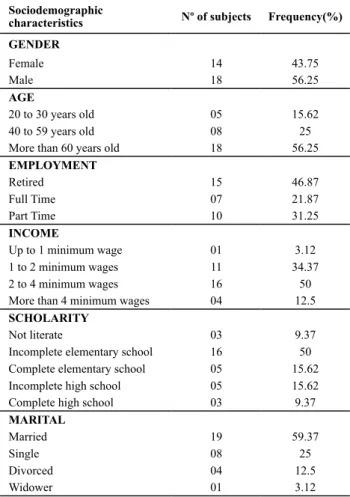
Of the 32 paients, 43.75% were female, and 56.25% were male. The following characterisics were predomi -nant: age older than 60 years, reired, married, income between one and two minimum wages and elementary school (Table 1).
Table 1 – Sociodemographic characteristics - Uberaba, MG, 2010
Sociodemographic
characteristics Nº of subjects Frequency(%)
GENDER
Female 14 43.75
Male 18 56.25
AGE
20 to 30 years old 05 15.62
40 to 59 years old 08 25
More than 60 years old 18 56.25
EMPLOYMENT
Retired 15 46.87
Full Time 07 21.87
Part Time 10 31.25
INCOME
Up to 1 minimum wage 01 3.12
1 to 2 minimum wages 11 34.37
2 to 4 minimum wages 16 50
More than 4 minimum wages 04 12.5
SCHOLARITY
Not literate 03 9.37
Incomplete elementary school 16 50
Complete elementary school 05 15.62
Incomplete high school 05 15.62
Complete high school 03 9.37
MARITAL
Married 19 59.37
Single 08 25
Divorced 04 12.5
Widower 01 3.12
Table 2 – Clinical characteristics - Uberaba, MG, 2010
Clinical characteristics Nº of subjects Frequency(%)
Blood cancer type
Hodgkin’s lymphomas 08 25
Non-Hodgkin’s lymphomas 09 28.12
Leukemia 15 46.87
Beginning of the treatment
1 month 04 12.5
2 to 3 months 06 18.75
4 to 5 months 01 3.12
More than 5 months 21 65.62
Symptoms
Fever and vomiting 07 21.87
Nausea 20 62.5
Diarrhea 12 37.5
Dry mouth 10 31.25
Low self-esteem 19 59.37
Physical effects of other diseases 14 43.75
Fatigue 12 37.5
Mouth ulcer 21 65.62
Pain or discomfort 19 59.37
Insomnia and weakness 24 75
Tiredness 23 71.87
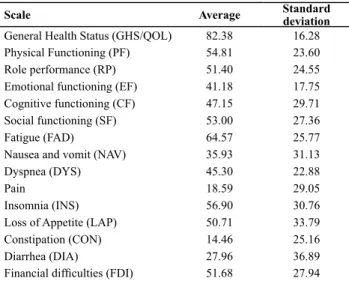
Table 3 shows the averages and standard deviaions of the scores on the QLQ-C30. The average score for general health status/QOL was 82.38, illustraing that these pa -ients consider their quality of life to be very good. With re -spect to physical, cogniive, and social funcioning and role performance, the averages ranged from 54.81 to 41.18, showing an unsaisfactory level. For emoional funcioning, the average was low (41.18%), indicaing that such paients are nervous, depressed, worried and angry: 25 (78.12%) re -ported worrying with their family and friends, 22 (68.75%) feared the side efects of the treatment and 21 (65.62%) reported worrying about their health status and decisions to be made regarding their treatment.
Table 3 – Averages and standard deviations of score for the scales
of the QLQ-C30 - Uberaba, MG, 2010
Scale Average Standard
deviation
General Health Status (GHS/QOL) 82.38 16.28
Physical Functioning (PF) 54.81 23.60
Role performance (RP) 51.40 24.55
Emotional functioning (EF) 41.18 17.75
Cognitive functioning (CF) 47.15 29.71
Social functioning (SF) 53.00 27.36
Fatigue (FAD) 64.57 25.77
Nausea and vomit (NAV) 35.93 31.13
Dyspnea (DYS) 45.30 22.88
Pain 18.59 29.05
Insomnia (INS) 56.90 30.76
Loss of Appetite (LAP) 50.71 33.79
Constipation (CON) 14.46 25.16
Diarrhea (DIA) 27.96 36.89
Financial dificulties (FDI) 51.68 27.94
With respect to the symptom scales, there was a pre -dominance of faigue with an average of 64.57, followed
by insomnia at 56.90, loss of appeite at 50.71, dyspnea at 45.30, nausea and vomiing at 35.93, diarrhea at 27.96, pain at 18.59, and consipaion at 14.46. These symptoms can be inferred to have interfered with the physical, emo -ional and cogniive funcioning of the paients.
Regarding inancial diiculies, the average score was 51.68, demonstraing that although the SUS service pro -vides full coverage, chemotherapy is a complex and costly treatment that oten results in the head of household hav -ing to stop work, thereby br-ing-ing some inancial concerns.
Table 4 – Pearson’s correlation between the scores for the func-tional and symptom scales of the EORTC-QLQ-C30, Uberaba, MG, 2010
Fatigue
(FAD) Pain
Dyspnea
(DIA)
Insomnia
(INS)
Loss of appetite
(LAP)
Global Health Scale
(GHS)
-0.138 -0.133 -0.029 -0.016 -0.400*
Physical functioning
(PF)
-0.606** -0.221 -0.415* -0.505** -0.190
Role performance
(RP)
-0.719** -0.469** -0.324 -0.128 -0.301
Emotional functioning (EF)
-0.026 -0.151 0.081 -0.375* -0.229
Cognitive functioning
(CF)
-0.494** -0.378* -0.464** -0.348 -0.283
Social functioning(SF)
-0.330 -0.351* -0.041 -0.226 0.071
*p < 0.05; ** p < 0.001
Table 4 shows the Pearson correlaion between the scores for the funcional and symptom scales. Faigue showed a highly signiicant correlaion with physical func -ioning, role performance and cogniive funcioning. The presence of pain was correlated with role performance and cogniive and social funcioning. The presence of dys -pnea was correlated with cogniive and physical funcion -ing. Insomnia was correlated with physical and emoional funcioning. Loss of appeite was the only symptom that showed a signiicant correlaion with general health status.
To verify whether the sociodemographic and clinical variables interacted with the domains of the EORTC-QLQ-C30, an ANOVA was applied, with p <0.05 as the level of signiicance. The results are shown in Table 5.
Table 5 – Averages, standard deviations and statistical signii -cance of the QLQ-C30 and sociodemographic and clinical data - Uberaba, MG, 2010
Scale Sociodemographic variable Average Standard deviation P value
(NAV) Nausea and Vomit
Beginning of the treatment 1-2 months 4-5 months
36,11 44,44
38,61 27,04
0,032*
(LAP) Loss of Appetite
Beginning of the treatment 1-2 months 4-5 months
49,83 59,90
40,90 27,14
0,039*
(FDI) Financial dificulties
Income
2-3 minimum wages 3-4 minimum wages
60,09 53,81
20,09 29,51
0,044*
(SF) Social Functioning
Educational Level Incomplete elementary school
Complete high school
23,80 67,00
15,20 33,00
Table 5 shows signiicant diferences, at p <0.05, in scores on the nausea and vomiing (NAV) and loss of ap -peite (LAP) scales between paients beginning of treat -ment early compared with paients beginning treat-ment later, namely, paients with more than ive months of treatment scored higher on the NAV and LAP scales. Re -garding the sociodemographic data related to educaional level, there was a highly signiicant diference, at p <0.001, in scores on the social funcioning scale (SF), with paients with an elementary school educaion scoring lower than paients with a high school educaion.
Regarding the sociodemographic data related to in -come, there were signiicant diferences, at p <0.05, in the scores on the inancial diiculty (FDI) scale, with higher scores for paients with lower income.
diScUSSion
With the increasing sophisicaion of chemotherapy regimens, chemotherapy has signiicantly improved sur-vival rates for cancer. However, because of the side efects of the treatments and the symptoms associated with can -cer, these paients may experience diminished HRQoL.
Few experiments have been published regarding HRQoL in paients with blood cancer. Highlighing the changes in the HRQoL domains for the scieniic com -munity, however, would facilitate the proper handling of these signs and symptoms to improve paient funcioning and thus increase the acceptance of chemotherapy.
A limitaion of this study is the small number of sub -jects, but the results are in agreement with the literature, demonstraing the importance of such studies that iden -ify the inluence of the efects of chemotherapy on the HRQoL of cancer paients. Understanding these implica -ions helps nurses plan the services aimed at reducing these symptoms and the strategies to improve the HRQoL of these paients. The selecion of the quality of life instru -ment is also important, which must be performed very carefully; these instruments have been demonstrated to be sensiive for the evaluaion of the HRQoL of onco-he -matological paients undergoing chemotherapy.
According to a study(9), Hodgkin’s lymphoma (HL) mainly afects young adults between 15 and 39 years old, with a male predominance (gender raio of men: women = 1.4:1.0). Our data corroborate the male pre -dominance in HL. However, regarding age, eight of the paients in this study (25%) with a diagnosis of Hodgkin’s lymphoma were 21 to 69 years old, with only two (8%) between 20 and 25 years old.
According to staisics of the INCA(1), cancer occurs pre -dominantly in the age group older than 40 years with low educaional levels and a low monthly income. Such epide -miological aspects were also found in this study, in which 26 of the paients (81.25%) were older than 40 years, 19
(59.37%) were from the surrounding regions of Uberaba and 24 (75%) had a low level of educaion and a monthly income of 1-2 minimum wages.
The results of a study(7) that evaluated the impact of nausea and vomiing on quality of life in paients under -going chemotherapy showed that the symptoms of fa -igue, nausea and vomiing had the greatest impact on the HRQoL of paients undergoing chemotherapy. In this study, there were eight of the paients in this study sig -niicant diferences in symptoms of nausea and vomiing between paients beginning of treatment early compared with paients beginning treatment later, i.e., such symp -toms were more frequently found in paients who had be -gun chemotherapy ater four months.
A study performed in the clinic of the Associaion Against Cancer of Central Brazil(10) highlighted that the fa -igue related to cancer is a clinical problem that requires a complex, mulifactorial and mulidimensional approach. Unil then, there was no standard method to measure faigue related to cancer, making it diicult to determine how to compare the results already found in studies. In this study, faigue had a relaively high average of 64.57.
Faigue is one of the most common symptoms men -ioned by survivors of Hodgkin’s lymphoma, in which 30% reported symptoms consistent with chronic faigue com -pared with 12% of the general populaion(11). In recent years, studies conducted in Norway(12) and at the Dana-Farber Cancer Insitute(13) used a variety of research instru -ments that have reairmed that quality of life, faigue, or both are worse in the survivors of Hodgkin’s lymphoma. In the Norwegian cohort study, approximately half of the sub -jects were evaluated eight years beforehand(12). Subjects who had chronic faigue at the beginning of treatment con -inued to experience faigue more frequently than those with other types of hematological cancer. The results of this study support the indings of previous studies, which have also reported that paients diagnosed with Hodgkin’s lym -phoma undergoing chemotherapy experienced faigue.
Faigue is a mulifactorial phenomenon that it com -mon in cancer paients, and it is diicult to treat(14). Fa -igue results from radiotherapy, chemotherapy and daily aciviies. The faigue associated with chemotherapy depends on neurotoxicity, encephalopathy, drug efects on hormones, low magnesium, and other factors. In our study, faigue showed a signiicant relaionship with the funcional scales of role performance and physical and cogniive funcioning.
A predominant complaint of the 32 subjects was relat -ed to sleep disorders, given that insomnia had a relaively high score with a mean of 56.7. Chemotherapeuic agents have previously been associate with sleep disorders, but the direct or indirect efects of these agents in causing sleep disorders are unknown(16-17).
The results of a pilot study(18) indicated that the quality of life of paients with acute leukemia and highly malig-nant lymphoma at the start of the treatment was severe -ly reduced, principal-ly by changes in role performance (44.7), social funcioning (51.0) and global quality of life (54.2) and by the presence of symptoms such as faigue (47.9), dyspnea (25.0) and sleep disturbance (25.0). In our study, the presence of pain (18.59) correlated with role performance (51.4), cogniive funcioning (47.15) and so -cial funcioning (53.0). Dyspnea (45.3) presented a corre-laion with physical and cogniive funcioning. Insomnia/ sleep disorders (56.9) correlated with physical and emo -ional funcioning.
In the literature, there are signiicant diferences be -tween groups of paients who underwent bone marrow transplants and those who did not in terms of emoional funcioning (P = 0.001) and experiencing sleep disorders, pain, and consipaion (P = 0.001)(19). Cogniive func -ioning was signiicantly beter in the non-transplanted individuals (P = 0.001). In our study, pain was correlated with role performance (P = -0.469), cogniive funcioning (P = -0.378) and social funcioning (P = -0.351), whereas insomnia was correlated with physical (P = -0.505) and emoional (P = -0.375) funcioning.
In this study, when asked about their concerns, 25 (78.12%) of the subjects reported worrying about their family and friends. Studies conducted in clinical hospitals specializing in the diagnosis and treatment of cancer in -dicate that cancer is the most feared by paients, family members and their closest friends. As a result, in most cases, paients experience negaive feelings such as fear of the diagnosis and the treatment side efects, uncer -tainty about the prognosis and fear of sufering pain and possibly dying(14).
With respect to the concerns raised by the studied sample, 22 (68.75%) of the respondents feared the side efects of the treatment, and 21 (65.62%) reported worry -ing about their health and the decisions to be made about their treatment. Such responses highlight the inluence of these concerns in the low averages shown in the domains of emoional funcioning (41.18) and role performance (51.40), corroboraing other research that emphasized the importance of considering the domains of physical and psychological well-being, general well-being, and so -cial and religious aspects when assessing the HRQoL of cancer paients(20).
A study conducted at the University of Oxford(16) found signiicant associaions among anxiety, stress, depression and low scores in the domains of cogniive funcioning
(CF) and emoional funcioning (EF). The results presented in our study support such a relaionship, as these domains also presented low scores.
A prospecive study on quality of life showed the pres -ence of impairments in funcional roles in the face of the ability and presence of anxiety, even with eight of the pa -ients in this study visible symptoms, and 80% of the re -spondents considered their quality of life to be good or excellent(21). The data presented in this study also showed that despite the low scores for physical, emoional and cogniive funcioning, the paients had high scores for gen -eral health status/quality of life, with an average of 82.38.
concLUSion
This study evaluated the HRQoL of paients with blood cancers undergoing chemotherapy. In recent years, nu -merous studies have addressed HRQoL in oncology, and such studies have actually become essenial, as one can -not think about prolonging a paient’s survival without preserving his or her quality of life.
Evaluaing the HRQoL of onco-hematology paients is diicult due to the characterisics of subjecivity and mul -idimensionality, and there is no criterion standard. There -fore, using valid and reliable instruments is necessary.
The obtained data showed that the symptoms that most afected HRQoL were nausea and vomiing, insom -nia, weakness, pain or discomfort and that the most af -fected domains were emoional and cogniive funcioning. By linking the sociodemographic and clinical data with the HRQoL domains, signiicant diferences in symptoms of nausea and vomiing and loss of appeite were found between paients beginning of treatment early compared with paients beginning treatment later; in social func -ioning between paients of diferent educaional levels; and in inancial diiculies between paients of diferent income levels.
In this context, the results of this study will contrib -ute to the nursing care of onco-hematology paients un -der chemotherapy once the key symptoms have been ideniied and related to the domains of HRQoL in these paients. Mulidisciplinary acion is important to allevi -ate these symptoms and plan the process to rehabilit-ate these paients.
REFEREncES
1. Brasil. Ministério da Saúde; Insituto Nacional de Câncer. Es
-imaivas 2012: incidência de câncer no Brasil [Internet]. Rio de Janeiro; 2010 [citado 2011 dez. 14]. Disponível em: htp:// www.inca.gov.br/esimaiva/2012/esimaiva20122111.pdf 2. Fisher PT. Survivorship. Clin J Oncol Nurs. 2006;10(1):93-8.
3. Brasil. Ministério da Saúde; Insituto Nacional do Câncer. Ti
-pos de câncer [Internet]. Rio de Janeiro; 2010 [citado 2009 out. 10]. Disponível em: htp://www2.inca.gov.br/wps/wcm/ connect/iposdecancer/site/home/leucemia
4. Bonassa EMA. Enfermagem em terapêuica oncológica. 3ª ed. São Paulo: Atheneu; 2005. p. 538-40.
5. Karnofsky DA, Abelmann WH, Craver LF, Burchenall JF. The use of nitrogen mustard in the palliaive treatment of cancer with paricular reference to bronchogenic carcinoma. Cancer. 1948;1(4):634-56.
6. Sawada NO, Nicolussi AC, Okino L, Cardoszo FMC, Zago MMF. Quality of life evaluaion in cancer paients to submited to chemotherapy. Rev Esc Enferm USP [Internet]. 2009 [cited 2011 Dec 14];43(3)581-87. Available from: htp://www.scielo. br/pdf/reeusp/v43n3/en_a12v43n3.pdf
7. Polit DF, Beck CT, Hungler BP. Fundamentos de pesquisa em enfermagem: métodos, avaliação e uilização. 5ª ed. Porto Alegre: Artes Médicas; 2004.
8. Brabo EP, Paschoal MEM, Biasoli I, Nogueira FE, Gomes MCB, Gomes IP, et al. Brazilian version of the QLQ-LC13 lung cancer
module of the European Organizaion for Research and Treat
-ment of Cancer: preliminary reliability and validity report. Qual Life Res. 2006;15(9):1519-24.
9. Ballatori E, Roila F. Impact of nausea and vomiing on quality of life in cancer paients during chemotherapy. Health Qual Life Outcomes; 2003;1:46.
10. Vena C, Parker K, Cunningham M, Clarck J, McMillan S.
Sleep-wake disturbances in people with cancer part II: eval
-uaing the evidence for clinical decision making. Oncol Nurs Forum. 2004;31(4):747-67.
11. Loge JH, Abrahamsen AF, Ekeberg O, Kaasa S. Hodgkin’s dis
-ease survivors more faigued than the general populaion. J Clin Oncol. 1999;17(1):253-61.
12. Hjermstad MJ, Fossa SD, Oldervoll L, Holte H, Jacobsen AB, Loge JH. Faigue in long-term Hodgkin’s disease survivors: a follow-up study. J Clin Oncol 2005;23(27):6587-95.
13. Ng AK, Li S, Reckliis C, Neuberg D, Chakrabari S, Silver B, et al. A comparison between long-term survivors of Hodgkin’s
disease and their siblings on faigue level and factors predict
-ing for increased faigue. Ann Oncol. 2005;16(12):1949-55.
14. Understanding and treaing cancer-related faigue. J Sup
-port Oncol. 2006;4(2):72.
15. Mota DDCF, Cruz DALM, Pimenta CAM. Fadiga: uma análise do conceito. Acta Paul Enferm. 2005;18(3):285-93.
16. Lezak MD, Howieson DB, Loring DW. Neuropsychological as
-sessment. New York: Oxford University Press; 2004. 17. Barichello E, Sawada NO, Sonobe HM, Zago MMF. Quality
of sleep in postoperaive surgical oncologic paients. Rev La
-ino Am Enferm. 2009;17(4):481-8.
18. Persson L, Larsson G, Ohlsson O, Hallberg IR. Acute leukaemia or highly malignant lymphoma paient’s quality of life over two years: a pilot study. Eur J Cancer Care (Engl). 2001;10(1):36-47. 19. Hjermstad MJ, Evensen SA, Kvaløy SO, Fayers PM, Kaasa S.
Health-related quality of life 1 year ater allogeneic or autol
-ogous stem-cell transplantaion: a prospecive study. J Clin Oncol. 1999;17(2):706-18.
20. Monga U, Kerrigan AJ, Thornby J, Monga TN, Zimmermann
KP. Longitudinal study of quality of life in paients with local
-ized prostate cancer undergoing radiotherapy. J Rehabil Res Dev. 2005;42(3):391-9.
21. Hjermstad MJ, Knobel H, Brinch L, Fayers PM, Loge JH, Holte H, et al. A prospecive study of health-related quality of life,
faigue, anxiety and depression 3-5 years ater stem cell trans