RESUmo
O objeivo deste estudo é avaliar a carga de trabalho na admissão e alta dos pacientes em três grupos (síndrome coronária aguda, insuiciência respiratória aguda e sepsis) em cuidados intensivos. Trata-se de um es-tudo prospecivo, descriivo, que decorreu durante 27 meses, incluindo 563 pacien-tes. Para a avaliação da carga de trabalho uilizou-se a escala Nursing Aciviies Score. A parir dos resultados do estudo parecem exisir diferenças signiicaivas na carga de trabalho no dia da admissão e alta entre os grupos de pacientes, sendo a carga maior em ambos os tempos a dos pacientes com insuiciência respiratória aguda e sepsis. Durante os primeiros sete dias de interna-mento esta diferença manteve-se, desa-parecendo ao oitavo dia, equilibrando-se a carga de trabalho para os três grupos. Conclui-se que para se conseguir os re-cursos adequados é essencial se dispor de instrumentos para medir as necessidades de cuidados e conhecer a carga de traba-lho dos diferentes grupos de pacientes que com mais frequência passam pelas unida-des de cuidados intensivos.
dESCRItoRES Carga de trabalho Terapia intensiva
Recursos humanos de enfermagem no hospital
Assessment of nursing workload in three
groups of patients in a spanish ICU using
the Nursing Activities Score scale
O
riginal
a
r
ticle
AbStRACt
The purpose of this study was to assess the nursing workload at admission to and dis-charge from intensive care of three groups of paients (i.e., acute coronary syndrome, acute respiratory failure, and sepsis). A pro-specive, descripive study was performed over a 27-month period and included 563 paients. The workload was assessed us-ing the Nursus-ing Aciviies Score scale. Sig-niicant diferences in the workload were determined on the days of admission and discharge: the workload was higher in both cases for paients with acute respiratory failure and sepsis compared with paients diagnosed with acute coronary syndrome. This diference was maintained over the irst seven days of their hospital stay. From day 8 on, the diference disappeared, and a workload balance was achieved in the three groups. Good staing requires ad-equate tools for measuring care needs and understanding the workload required in the groups of paients who are most fre-quently admited to intensive care.
dESCRIPtoRS Workload Intensive care Nursing staf, hospital
RESUmEn
Se objeivó valorizar la carga de trabajo al ingreso y al alta en tres grupos de pacien-tes (síndrome coronario agudo, insuicien-cia respiratoria aguda y sepsis) en terapia intensiva. Estudio descripivo, prospecivo, de 27 meses, incluyéndose 563 pacientes, valorando carga de trabajo según Nursing Aciviies Score. Exisieron diferencias sig-niicaivas en la carga de trabajo al ingreso y en el alta entre los grupos de pacientes, siendo superior en ambos momentos la de pacientes con insuiciencia respirato-ria aguda y sepsis frente a pacientes co-ronarios. Durante los siete primeros días de estancia se mantuvo esta diferencia, desapareciendo a parir del octavo día, equilibrándose la carga de trabajo para los tres grupos. Para conseguir una adecuada dotación de personal es fundamental con-tar con instrumentos para medir las nece-sidades de cuidados y conocer la carga de trabajo de los disintos grupos de enfermos que ingresan con mayor frecuencia en las unidades de terapia intensiva.
dESCRIPtoRES Carga de trabajo Cuidados intensivos
Personal de enfermería en hospital
Francisco Javier Carmona-monge1, Ana Jara-Pérez2, Cristina Quirós-Herranz3, Gloria Rollán-Rodríguez4, Isabel Cerrillo-González5, Sonia García-Gómez6, montserrat martínez-Lareo7, dolores marín-morales8 Carga de trabalho em três grupos de paCientes em uma uti espanhola
segundo NursiNg Activites score
Carga de trabajo en tres grupos de paCientes de uti española según
NursiNg Activities score
IntRodUCtIon
Advances in the treatment of criical diseases in recent years have changed the types of paients admited in crii-cal care units. There are more therapeuic opions for re-placing the vital funcions of various organs and systems in the human body and for maintaining these funcions unil the cause of the disorder disappears. Treatment and care create high hospitalizaion expenses, parially be-cause of the treatments per se but also because of the large number of employees required for these services. Furthermore, because of the complexity of these treat-ments, paients admited to Intensive Care Units (ICUs) require increased care. Determining the precise needs of the nursing staf for these highly specialized services is es-senial to ensure quality nursing care and thus avoid the occurrence of adverse events associated with health care.
Diferent internaional organizaions note the rel-evance of having the appropriate nursing staf when at-temping to increase paient safety and
consequently reduce the potenial compli-caions associated with health care(1).
Vari-ous studies have shown that an adequate number of nurses for the types of paients admited to the ICU has a posiive efect and results in a reducion of hospital-acquired infecions, number of skin lesions, ime on mechanical venilaion, and stay in the in-tensive care unit(2-6).
Nursing workload is a fundamental ele-ment of establishing the needs of the staf in a speciic unit. Over the past 30 years, there have been atempts to measure the real needs of nurses in ICUs. Iniially, indi-rect measuring instruments derived from medical scales were developed. These irst tools assessed nursing workload as a result of implemening a series of therapeuic in
-tervenions on the paient. However, these scales have
many limitaions because they do not assess the amount of nursing care administered during rouine paient aten-ion that does not originate directly from the therapeuic intervenions/treatments(7). The Nursing Aciviies Score
(NAS) scale was developed to try to resolve this(8). This
scale consists of 23 items that assess the aciviies and care that nurses provide to criical paients. Each item has an assigned value, and the total score is the sum of all of the values. The total score represents the percentage of ime a nurse spends in direct care of the paient over a 24-hour period of ICU stay. Thus, a total score of 100% in-dicates the amount of work a nurse can do over a 24-hour period. The sum of the values from the 23 items on the scale can range from 0% to 177%(9).
Several studies using the NAS scale have been con-ducted, most of them to determine the diference be-tween actual nurse staing and that esimated by the
scale(10-13). Similarly, other studies have compared the
val-ues obtained using this scale and the valval-ues obtained us-ing other assessment scales regardus-ing the workload in the ICU, such as the Nine Equivalents of Nursing Manpower Use Score (NEMS) or the Therapeuic Intervenion Scoring System-28 (TISS-28). The NAS scale provided greater ac-curacy in assessing the workload(14).
No studies have been found in the literature assessing the workload of nurses while taking care of diferent sub-groups of paients (diferent diagnoses at admission to the unit) or assessing the evoluion of the workload from the admission day of these paients to the unit. The purpose of this study is to idenify diferences in the workload at admission and discharge in three groups of paients with the highest percentage of admissions to our unit: acute coronary syndrome (ACS), acute respiratory failure (ARF), and sepsis. The workload in each of these groups for a period of 30 days is also assessed to determine whether there are diferences between groups.
mEtHodS
Design and Seing
A prospecive, descripive study was performed over a 27-month period (October 2007 – December 2009). The study was con-ducted in a university hospital of the Com-munity of Madrid with 450 beds (Spain). Data collecion was conducted in the 12-bed adult medical ICU. Most admissions to this unit were because of a medical pathology, and a small percentage of paients were postoperaive. The nurse-to-paient-raio on all shits was 1:2 or 1:3. The nursing staf worked 12-hour shits.
Paricipants
Included in the study were paients admited to the ICU who were at least 18 years of age, had a minimum hospital stay of 24 hours, and were diagnosed at admis-sion with acute coronary syndrome (ACS), acute respira-tory failure (ARF), or sepsis. Of the 913 paients admited to the unit over the study period, 563 made up the study sample.
Data Collecion
Demographic and clinical data of the paients were obtained during the study period. Furthermore, work-load informaion was collected on a daily basis for each of the paients admited to the unit using the Nursing Ac-iviies Score (NAS) scale. Data collecion was performed every day at seven o´clock in the morning; all informa-ion from the 24 hours prior to the paient´s admissinforma-ion to the unit was also gathered. The NAS scale consists of 23 items that assess the rouine aciviies performed by
no studies have been found in the literature assessing
the workload of nurses while taking care of different sub-groups of patients (different diagnoses
at admission to the unit) or assessing the evolution of the
workload from the admission day of these
the nurses while caring for criical paients. Each item has an assigned weight that assesses the amount of ime re-quired to perform certain aciviies during paient care. The scores represent a percentage of the ime the nurs-ing staf employ in performnurs-ing the aciviies included in the tool over a 24-hour period. Summing the values of the items provides the total ime that nurses spend in the ICU performing these tasks on a speciic day. The results indi-cate that the NAS can specify what is being done for 81% of the ime that nurses spend in the ICU.
Follow-up of the paients was performed throughout their stay in the unit. However, to analyze the workload diferences among the three groups of paients, only the data from the irst 30 days of their stays in the unit were used. To analyze the workload diferences between pa-ient admission and papa-ient discharge, all papa-ients were included, even if their stay in the unit were longer than 30 days.
The Ethics and Research Commitee of the center ap-proved the project (09/68).
Data analysis
Data were analyzed using the Staisical Package for the Social Sciences (SPSS) version 16.0 for Windows (SPSS Inc., Chicago, IL) and are presented as the means (standard deviaion) or median (25th percenile - 75th percenile), depending on variable characterisics. One-factor ANOVA
was used to analyze the correlaion between admission diagnosis and nursing workload as well as the diferences between workload at admission and at discharge, using Schefé’s method for post hoc comparisons. Eta-squared was used to measure the efect size. All p values < 0.05 were considered signiicant (bilateral).
RESULtS.
During the study period, 563 admissions met the in-clusion criteria; 5704 measurements were obtained using the NAS scale. The mean daily number of paients in the unit was 10.4 (SD = 2.2); bed occupancy during the study period was 91.2%.
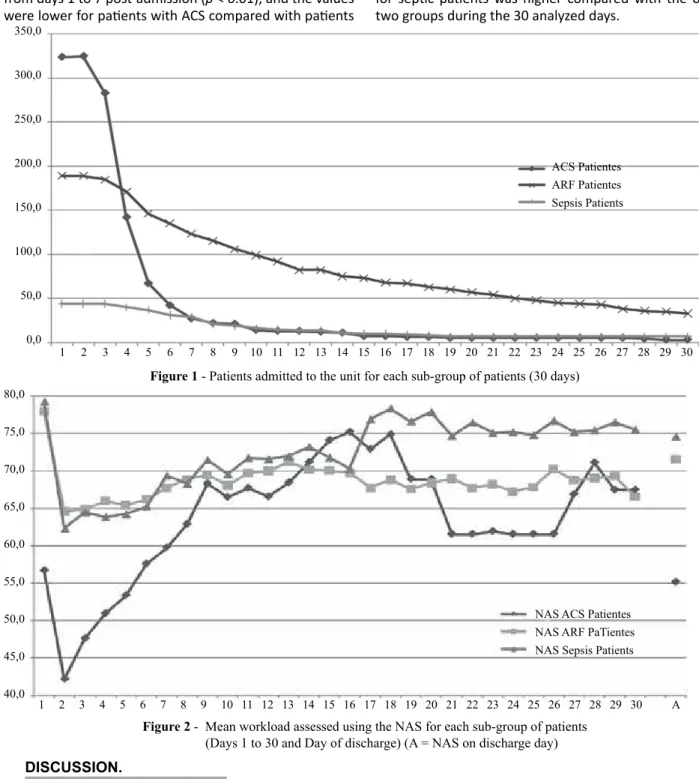
Regarding the study sample, most paients were male (72.5%; n = 408), with a mean age of 62.5 years (SD = 14.0). The main cause for admission was coronary disease (58.1%; n = 327), followed by ARF (34.1%; n = 192) and sepsis (7.8%; n = 44). The median stay in the ICU was 3.6 days (2.2 – 8.2) and ranged between 1 and 139 days. The number of paients in each group admited to the unit for a period of 30 days is shown in Figure 1. From the 503 studied paients, most were discharged to a convenional ward in the hospital (88.8%; n = 500), 52 paients died during their stay in the ICU (9.2%), and 11 paients were transferred to another center to receive the appropriate treatment for their disease (2.0%). The remaining charac-terisics of the study sample are shown in Table 1. Table 1 - Clinical and demographic characteristic of the sample
Total ACS ARF Sepsis
n = 563 n = 327 n = 192 n = 44
Gender
Male 72.5 (408) 76.1 (249) 68.2 (131) 63.6 (28)
Female 27.5 (155) 23.9 (78) 31.8 (61) 36.4 (16)
Age 64.0 (52.0-74.0) 64.0 (52.3-73.8) 65.0 (52.0-75.0) 59.5 (51.5-69)
Median stay 3.33 (2.19-8.02) 2.42 (1.96-3.38) 9.10 (4.27-22.69) 6.77 (4.34-14.95)
Mean workload 65.9 (6.6) 61.6 (8.1) 66.3 (2.4) 69.9 (4.8)
Fate at discharge
Died 9.2 (52) 1.8 (6) 18.8 (36) 22.7 (10)
Ward 88.8 (500) 95.4 (312) 80.2 (154) 77.3 (34)
Transfer 2.0 (11) 2.8 (9) 1.0 (2) 0 (0)
Mechanical ventilation 32.0 (179) 6.4 (21) 70.2 (134) 54.4 (24)
Central line 44.9 (253) 11.9 (39) 88.5 (170) 100 (44)
Arterial line 18.8 (106) 4.3 (14) 38.0 (73) 43.2 (19)
Urinary catheter 46.4 (261) 15.3 (50) 88.5 (170) 93.2 (41)
data are presented as % (n) or median (interquartile range) as appropriate.
Mean daily workloads on admission and discharge days were analyzed, as was the mean workload during the admission of paients with ACS, paients with ARF, and paients with sepsis. A one-factor ANOVA was used for these analyses. Signiicant diferences were deter-mined for the three assessed variables (Figure 2). On the admission day, the workload for paients with ACS was 56.7 (DT = 9.9); for paients with ARF, the workload was 77.6 (DT = 16.1); and for paients diagnosed with sepsis, the result was 79.2 (SD = 17.9) (F(2, 554) = 179.7; p <
Next, the workload over a 30-day follow-up period for each of the indicated diagnosic categories was analyzed (Figures 1 and 2). Another one-factor ANOVA was con-ducted to compare the mean daily workload for each sub-group of paients. Signiicant diferences were determined from days 1 to 7 post-admission (p < 0.01), and the values were lower for paients with ACS compared with paients
with ARF or sepsis; no diferences were determined be-tween these two last sub-groups in the post-hoc analysis. From day 8 post-admission and unil day 30, no signiicant diferences were observed between the workload and the diferent types of paients, although the nursing workload for sepic paients was higher compared with the other two groups during the 30 analyzed days.
Figure 1 - Patients admitted to the unit for each sub-group of patients (30 days)
Figure 2 - Mean workload assessed using the NAS for each sub-group of patients (Days 1 to 30 and Day of discharge) (A = NAS on discharge day)
dISCUSSIon.
The scores from the NAS scale in the three sub-groups of paients with diferent diagnosed diseases provide in-formaion regarding the nursing staing needs of the groups. This informaion should be helpful in planning the workforce required in criical care units that admit pa-ients with characterisics similar to the studied sample(15).
First, the workload with ACS paients is lower than that for paients diagnosed with ARF or sepsis. This lower workload is usually relected during workforce planning; nurse-to-paient raios are higher in coronary care units than in medical ICU units. A relevant observaion in this study is that these diferences in workload disappear ater
350,0
300,0
250,0
200,0
150,0
100,0
50,0
0,0
1 2 3 4 5 6 7 8 9 10 11 12 13 14 15 16
ACS Patientes ARF Patientes Sepsis Patients
17 18 19 20 21 22 23 24 25 26 27 28 29 30
80,0
75,0
70,0
65,0
60,0
55,0
50,0
45,0
40,0
1 2 3 4 5 6 7 8 9 10 11 12 13 14 15 16 17 18 19 20 21 22 23 24 25 26 27 28 29 30 A
day 7 post-admission to the unit. This situaion is expect-ed because the care neexpect-eds of a paient with ACS with a certain degree of complicaion (i.e., those who will stay in the ICU for longer periods) are similar to those of a paient with ARF or sepsis. These requirements should be consid-ered when calculaing staing for shits in medical ICUs; both the number of coronary paients who are being ad-mited to the unit and the number of paients with some type of complicaion (staying more than 7 days in the unit) are required. A more realisic assessment of the required nursing staf will be possible with this informaion.
Conversely, the workload at discharge was medium-high for paients with ARF and sepsis. These paients are sent to a convenional care unit and have high care needs. Although their stay in the ICU may not be jusiied, their needs can be excessive for the staf in a convenional ward because of higher nurse-to-paient raios on convenional wards. Other studies have previously shown the need for intermediate care units for paients who sufer from a criical disease as an addiional step before sending such paients to a convenional ward. The workload results at discharge in this group of paients again reveal the useful-ness of units for paients requiring high-intensity care but low-intensity medical treatment(16-17).
The score for the global workload in our sample was 65.9 points, which is quite similar to the score obtained for ICU paients in Brazil (mean NAS of 63.7).(13) This result indicates that for each of the 12-hour shits in the unit, each of the paients requires a total of 7.91 hours
of direct nursing care, which is in line with the results in other studies. Adjustments in the nursing staf have not been evaluated here. However, in other studies in which the NAS scale was applied, overstaing was determined.
There are some limitaions to this study, such as the fact that the data were collected only in one unit. Because of the characterisics of the unit, the workload for post-surgical paients was not assessed. In other studies, the NAS scores for these paients are quite high during the irst days of an ICU stay.
ConCLUSIonS
Appropriate staing in ICUs is essenial to ensure qual-ity care for criical paients. Such staing will increase the paients’ safety and reduce the risk of adverse events that may occur while staying in the unit. To achieve adequate staing, tools to measure the care needs of the paients are necessary, as is knowledge of the workload required for the diferent groups of paients who are most fre-quently admited to these units.
This irst analysis of the workload in diferent sub--groups of paients has provided NAS scores for paients with ACS, ARF, and sepsis. A priori, the workload for coro-nary paients is lower compared with the other two stu-died groups. However, when the stay of coronary paients is extended, the workload is comparable to that of any other criical paient, which should be considered during workforce planning in a unit.
6. Blot SI, Serra ML, Kouleni D, Lisboa T, Deja M, Myrianthefs P, et al. Paient to nurse raio and risk of venilator-asso-ciated pneumonia in criically ill paients. Am J Crit Care. 2011;20(1):e1-9.
7. Subirana Casacuberta M, Sola AI. Instrumentos basados en medidas indirectas para UCI: TISS y NEMS. Metas Enferm. 2007;10(1):15-20.
8. Miranda DR, Nap R, de Rijk A, Schaufeli W, Iapichino G; TISS Working Group. Therapeuic Intervenion Scoring System. Nursing aciviies score. Crit Care Med. 2003;31(2):374-382.
9. Subirana Casacuberta M, Sola AI. Instrumentos basados en medidas directas para UCI: NAS (Nursing Aciviies Score). Metas Enferm. 2006;9(10):67-71.
10. Bernat Adell A, Abizanda Campos R, Cubedo Rey M, Quin-tana Bellmunt J, Sanahuja Rochera E, Sanchis Munoz J, et al. Nursing Aciviies Score (NAS). Our experience with a nurs-ing load calculaion system based on imes. Enferm Inten-siva. 2005;16(4):164-73.
REFEREnCES
1. Bray K, Wren I, Baldwin A, St Ledger U, Gibson V, Goodman S, et al. Standards for nurse staing in criical care units deter-mined by: the Briish Associaion of Criical Care Nurses, The Criical Care Networks Naional Nurse Leads, Royal College of Nursing Criical Care and In-light Forum. Nurs Crit Care. 2010;15(3):109-11.
2. Aiken LH, Clarke SP, Sloane DM, Sochalski J, Silber JH. Hospital nurse staing and paient mortality, nurse burnout, and job dissaisfacion. JAMA. 2002;288(16):1987-93.
3. Cho SH, Keteian S, Barkauskas VH, Smith DG. The efects of nurse staing on adverse events, morbidity, mortality, and medical costs. Nurs Res. 2003;52(2):71-9.
4. Lang TA, Hodge M, Olson V, Romano PS, Kravitz RL. Nurse-paient raios: a systemaic review on the efects of nurse staing on paient, nurse employee, and hospital outcomes. J Nurs Adm. 2004;34(7-8):326-37.
11. Goncalves LA, Padilha KG, Cardoso Sousa RM. Nursing Acivi-ies Score (NAS): a proposal for pracical applicaion in Inten-sive Care Units. IntenInten-sive Crit Care Nurs. 2007;23(6):355-61.
12. Padilha KG, de Sousa RM, Queijo AF, Mendes AM, Reis Mi-randa D. Nursing Aciviies Score in the intensive care unit: analysis of the related factors. Intensive Crit Care Nurs. 2008;24(3):197-204.
13. Padilha KG, Sousa RM, Garcia PC, Bento ST, Finardi EM, Hata-rashi RH. Nursing workload and staf allocaion in an inten-sive care unit: a pilot study according to Nursing Aciviies Score (NAS). Intensive Crit Care Nurs. 2010;26(2):108-13.
14. Padilha KG, Sousa RM, Kimura M, Miyadahira AM, Cruz DALM, Vaimo MF, et al. Nursing workload in Inten-sive Care Units: a study using the Therapeuic Interven-ion Scoring System-28 (TISS-28). Intensive Crit Care Nurs. 2007;23(3):162-69.
15. Hickey PA. Increasing nurse staing levels in cardiac surgery centres appears to be a cost efecive paient safety inter-venion. Evid Based Nurs. 2010;13(4):102.
16. Silva MC, Sousa RM, Padilha KG. Paient desinaion ater discharge from intensive care units: wards or intermediate care units? Rev Laino Am Enferm. 2010;18(2):224-32.
17. Goncalves LA, Padilha KG. Factors associated with nursing workload in adult intensive care units. Rev Esc Enferm USP. 2007;41(4):645-52.
Acknowledgements
The Carlos III Health Insitute has parially inanced this study as part of the support of the Spanish Health Research Funds (project PI10/02198). The authors wish to thank Dr. Kaia Grillo Padilha for reading and reviewing the irst