A comparison between two catheters
for clean intermittent catheterization
in continent children with a urostomy
ESTUDO COMPARATIVO SOBRE DOIS TIPOS DE CATETERES PARA CATETERISMO INTERMITENTE LIMPO EM CRIANÇAS ESTOMIZADAS
ESTUDIO COMPARATIVO SOBRE DOS TIPOS DE CATÉTERES PARA CATETERISMO INTERMITENTE LIMPIO EN NIÑOS ENTOMIZADOS
1 Nurse. Graduate degree in Stomal Therapy and Master's Degree in Nursing from School of Nursing, University of São Paulo. São Paulo, SP, Brazil. [email protected] 2 Stomal Therapy Nurse (TiSOBEST). Associate Professor in Medical-Surgical Nursing at School of Nursing, University of São Paulo. São Paulo, SP, Brazil. [email protected] 3 Nurse. Ph.D. Professor at Surgical-Nursing Department, School of Nursing, University of São Paulo. São Paulo, SP, Brazil. [email protected] 4 Nurse. Graduate degree in Stomal Therapy. Nurse at Hospital Israelita Albert Einstein. São Paulo, SP, Brazil. [email protected] 5 Nurse. Graduate degree in Stomal Therapy. Nurse at São Mateus General Hospital. São Paulo, SP, Brazil. [email protected] 6 Nurse. Graduate degree in Stomal Therapy. Nurse at Darcy Vargas Children
O
RIGINAL
A
R
TICLE
RESUMO
O estudo, do tipo crossover, objetivou com-parar o uso de dois cateteres para catete-rismo intermitente limpo em crianças com urostomias continentes, no que se refere ao manejo, complicações e custos diretos. Cumpridas as exigências éticas, foi desen-volvido em um Hospital Infantil, em São Paulo. As crianças que, juntamente com seus responsáveis, consentiram em parti-cipar da investigação, foram submetidas à utilização consecutiva de cateter tradicio-nal e do cateter pré-lubrificado, durante um mês cada um. Nesse período, as crianças preencheram os instrumentos de coleta de dados e foram acompanhadas pelas pesqui-sadoras semanalmente, por meio de visi-tas domiciliares e consulvisi-tas hospitalares, que incluíram a coleta quinzenal de cultu-ras qualitativas e quantitativas de urina. Os dados foram analisados utilizando-se os testes de Wilcoxon e Kaplan Meyer. Onze crianças completaram o estudo. Os resul-tados mostraram diferenças estatistica-mente significativas apenas quanto aos cus-tos direcus-tos (p=0,003), superiores para o ca-teter pré-lubrificado.
DESCRITORES Estomas cirúrgicos. Derivação urinária. Cateterismo urinário. Custos de cuidados de saúde.
Maristela Santini Martins1, Vera Lúcia Conceição de Gouveia Santos2, Silvia Regina Secoli3, Sandra Midori Mata4, Divonélia Santos Nogueira5, Donata Maria de Souza6
ABSTRACT
The objective of this crossover study was to compare the use of two catheters for clean intermittent catheterization in conti-nent children with a urostomy, in terms of their handling, complications and direct costs. This study complied with all ethical requirements and was developed at a Children's Hospital in the city of São Paulo. The children who, together with their guardians, agreed to participate in the study were submitted to the consecutive use of both the traditional and the pre-lubricated catheter, for one month each. During that period, the children completed the data collection instruments and were followed by the researchers once a week through home visits and hospital consultations, in-cluding quantitative and qualitative urine cultures that were performed every other week. Data analysis was performed using Wilcoxon and Kaplan-Meier tests. Eleven children completed the study. Statistical significant differences were found only for costs (p=0.003), which were higher for pre-lubricated catheters.
KEY WORDS Surgical stomas. Urinary diversion. Urinary catheterization. Health care costs.
RESUMEN
El estudio, del tipo crosover, objetivó com-parar el uso de dos catéteres para catete-rismo intermitente limpio en niños con urostomías continentes, en lo que se refie-re al manejo, complicaciones y costos di-rectos. Cumplidas las exigencias éticas, fue desarrollado en un Hospital Infantil, en São Paulo. Los niños que, juntamente con sus responsables, consintieron en participar de la investigación, fueron sometidos a la uti-lización consecutiva de catéter tradicional y de catéter lubrificado, durante un mes cada uno. En ese período, las niños llena-ron los instrumentos de recolección de da-tos y fueron acompañados por las investi-gadoras semanalmente, por medio de visi-tas domiciliares y consulvisi-tas hospitalarias, que incluyeron a recolección quincenal de culturas cualitativas y cuantitativas de ori-na. Los datos fueron analizados utilizando las pruebas de Wilcoxon y Kaplan Meyer. Once niños completaron el estudio. Los re-sultados mostraron diferencias estadística-mente significativas apenas en lo que se refiere a costos directos (p=0,003), supe-riores para el catéter lubrificado.
INTRODUCTION
The improvement of technological resources in health has allowed children, who are born or struck by chronic disorders, to reach adult life. These include stomas for con-genital malformations or severe urinary tract traumas.
When dealing with these conditions, health profession-als should consider that, even though the treatment and consequences of the chronic disease can influence the tasks of each age group, a sick child has the same development needs as others.
The possibility of controlling the own body can be com-plicated by the presence of a chronic condition – such as the ostomy – compromising the establishment of body image, self-esteem and, consequently, self-concept. These consequences can also happen whenever ostomized chil-dren are submitted to stress factors (exams, treatments, hospitalization and even handling of the stoma) and to in-complete comprehension of physical limitations, common to the chronic disease(1). In this context, encouraging and
providing conditions for the maximum devel-opment of a sense of normalization are very important contributions health professionals and particularly nurses can provide. Conti-nent stomas and the use of the clean inter-mittent catheterization technique (CIC) exem-plify some of these interventions aimed at a greater level of normality.
In children, urinary tract malformations can be detected as early as during intrauterine life. Bladder or cloacal exstrophies, lumbosacral spine dysraphism, posterior urethral valve, anorectal malformations, neoplasms, Prune Belly syndrome and other chronic problems
can require a urinary diversion, which is often definitive(2).
The search for continence of the urinary stoma became possible due to the technical concepts established by Kock. The great functional, aesthetic and clinical results obtained by the heterotopic continent diversions made several au-thors develop continent valves associated to detubulization, which allows for increased capacity and, consequently, de-creased pressure of the urinary reservoir. In Pediatrics, the most used techniques include the continent reservoirs of Mitrofanoff(3).
Catheterization is a mandatory technique for the con-trol of the continent stoma. Sterile intermittent catheter-ization was introduced by Guttmann, in 1947, for the treat-ment of people with traumatic spinal cord injury. In 1972, Comarr trained patients for the application of self-catheter-ization, still with the sterile technique, as the Rancho Hos-pital had an insufficient number of nursing professionals. In the same year, Lapides and his team used the clean tech-nique for the training of 14 patients with neuro-vesical dys-function, who presented high residual urine volumes,
be-sides repetitive urinary infection(4). From that moment on,
several studies emphasized the favorable results of CIC, provided that it was properly indicated. There were reports of better control of the renal function, reduction of the hy-dronephrosis and vesicoureteral reflux, lower rates of bac-teriuria and urinary infections and, mainly, the possibility to obtain autonomy and urinary continence and, therefore, to improve quality of life and social reinsertion(4-6).
Minor complications were also found and they were mainly related to the period of use of the CIC, as well as to the type of catheter employed. Persistent bleeding, discom-fort, lithiasis and epididymitis; urethral inflammations; ure-thral strictureand false passages constitute some of the complications mentioned(5-8).
A prospective randomized study, developed with children who have neuropathic bladder due to meningomyelocele, evidenced that only 10% of those who used the CIC prophy-lactically presented deterioration of the superior urinary tract, comparatively to 50% of the control group(9).
At its last consensus, the International Continence So-cietykept the concept that intermittent cath-eterization is bladder suction and drainage or urinary reservoir with the subsequent re-moval of the catheter(10). Clean Intermittent
Catheterization (CIC), on the other hand, con-sists in the use of the clean technique, that is, the use of common washing and the use of a clean reusable or disposable catheter.
Some authors discuss advances related to the reduction of CIC complications, which is already established as an important tech-nique in the handling of countless urinary dys-functions. Among these complications, there are those resulting from the type of catheter employed, mainly the bleedings, and chronic inflammatory processes that may lead to strictures(7).
There are few studies about the use of the CIC in chil-dren and, in cases in which they relate to continent sto-mas, it is not possible to identify the reason that motivated the development of the research.
PURPOSES
This study aimed to evaluate and compare the use of two catheters for CIC, in children with continent stomas, regarding handling (introduction, removal and period of procedure), complications (bleeding, perforation, discom-fort and infection) and direct cost.
METHOD
This is a prospective study with a crossover and quanti-tative approach. It was developed at the Outpatient Clinic Bladder or cloacal
exstrophies, lumbosacral spine dysraphism, posterior urethral valve, anorectal
malformations, neoplasms can require
of the Children’s Hospital Darcy Vargas, which is public and a referral for specialized services to children with stomas, with the support of a multi-professional team, including a nurse who is an expert in esterostomal therapy.
Before data collection, the project was approved by the Ethics Committee of the Nursing School of USP (process 459/05) and by the Clinical Administration and the Center of Studies of the Hospital Darcy Vargas.
In January 2005, 141 children and adolescents with con-tinent stomas were registered at the service. Among these, 46 complied with the inclusion criteria: being between 11 and 18 years old; using self-CIC for at least three months; being competent for CIC; not showing current clinical signs of urinary infection and not having shown them in the last month; having intellectual and mental conditions to answer the interview and fill out the data collection forms; having the authorization of the caregiver and individually consent-ing to participate in the study.
From these 46 children, only 19 started the study, since 11 were not found, nine refused to participate, two stated they had reconstructed the urinary tract and five lived out of the study coverage area. After the start of data collection, eight children did not complete their participation due to the fol-lowing reasons: one of them presented a psychiatric crisis; one used the two employed catheters during the second stage of the study, two used the traditional catheter inappropriately (permanently fixed) and did not adapt to the established pro-tocols, two presented strictures not related to the use of the catheters and two gave up without explanations.
The Post-Informed Consent Term was signed by the child’s caregiver in all situations.
Data collection was carried out by the researchers, dur-ing the period from September 2005 to December 2006.
The selected children were monitored for two months, using two types of catheters, both made from polyvinyl chloride (PVC), which were only different regarding the pres-ence of pre-lubrication. In the first month, the children used the traditional catheter, according to the procedures adopted at the service (indication and training performed by the esterostomal therapy service) and, in the second month, the pre-lubricated catheter(a). This is a single use
catheter, whose technical specification relates to the need to fill the individual packing with water, for its lubrication – as the water reaches the urea and polyvinylpyrrolidone (PVP), a flexible and sliding film is produced, which reduces friction during the procedure. In order to use it, the chil-dren were previously submitted to specific training, given by the esterostomal therapist nurse of the hospital.
During the use of the catheters, every child was sub-mitted to five quantitative and qualitative urine
evalua-tions, previous to the study and at the end of the 2nd, 4th,
6th and 8th weeks. The sample was collected and analyzed
at the laboratory of the institution, through the use of a sterile collector container and catheter. In 4 cases, the col-lection took place at the children’s home, due to their dif-ficulties to go to the laboratory, as they depended on a wheel chair or did not have an escort. In those cases, the researchers themselves collected the material, following the same procedures adopted at the laboratory of the in-stitution, being conditioned in a refrigerated space and sent to the service within a maximum of two hours after the collection.
In cases in which urinary infection was identified, the children interrupted their participation, were submitted to the treatment prescribed by the urologist of the institu-tion, and returned to the study right after clinical discharge. According to the hospital protocol, the authors did not con-sider only positive culture as urinary infection, but also the presence of the following symptoms: hyperthermia, odor, decrease of urine volume and lethargy.
Five instruments were employed for data collection, based on the proposal of the International Protocol for Evaluative Study of EasiCath. The first instrument aimed to obtain sociodemographic (gender, age) and clinical (di-agnosis, postoperative period and CIC period) data of the children; the second managed the registration of results of the urine cultures; the third referred to the micturition diary, in which the child registered the frequency and time spent for each CIC, besides the occurrence of problems (bleeding, discomfort and others) and the total of cath-eters used during the 24 hours; the fourth, for the evalu-ation of catheters by the children, regarding their han-dling before, during and after the CIC, filled out at the end of each stage; and the fifth instrument was used by the children to state their opinion about their preferences regarding the two catheters, which was only filled out at the end of the study. The two last forms were obtained through an interview.
The researchers visited the children at home twice a week, according to the availability of the children and the people who looked after them. The visits aimed to evalu-ate the continuation of the study, at the conference of the notes taken by the children in their micturition diary and the occurrence of eventual complications such as in-fection, bleeding, discomfort (irritation, colic pain) and others.
The calculation of the direct cost included the monetary values of the catheter, treatment of the urinary infection, if present, and respective diagnostic urocultures. The cost of the products was provided by the departments of purchase (traditional catheter), and pharmacy (ciprofloxacin and sulfamethoxazole/trimetropin) and the laboratory of the institution (urocultures). The cost of the pre-lubricated cath-eter, which was not available on the national market yet, was provided by the manufacturer.
The average monthly cost(b) per child, according to the type
of catheter, was calculated through the following formula:
Average monthly cost = NC × CC + CD + CT
number of children
In which:
Nc = number of catheters used in the period of a month by the total number of children;
CC = cost of the catheter;
CD = cost of the diagnostic culture, in the presence of infection; CT = cost of the treatment for urinary infection.
The results of the study were submitted to descriptive and inferential statistical analysis, using SPSS version 13.0.
The comparison of the culture results was carried out through the Friedman test for repeated measures. The com-parisons between the catheters regarding complications, handling and costs were analyzed through Wilcoxon’s test of signs. The significance level adopted was 5%.
RESULTS
The results were presented according to the character-ization of the clients, the micturition diary, the evaluation of catheter use and the cost.
Characterization of the client
(b) The company Coloplast do Brasil provided the necessary number of pre-lubricated catheters for use in the study; financed the transportation of the children and one caregiver, from their home to the hospital and vice-versa, as well as the transportation of the researchers during the home visits; besides
Table 1 Demographic and clinical characteristics of the sample -São Paulo - 2006
Characteristics Patients (N=11) Gender
Male 6
Female 5
Age(complete years)
11 |– 14 4
14 |– 16 3
16 |– 18 4
Average+SD 14+2
Diagnosis
Bladder exstrophy 5
Posterior urethral valve 2
Trauma 2
Meningomyelocele 1
Anorectal malformation 1
Average time of CIC (months) 53.45+ 30,52
Table 1 shows that the children present continent sto-mas, which mainly result from bladder exstrophy, poste-rior urethral valve and traumas, performing the CIC for about 4.5 years.
When they were questioned about the occurrence of problems related to the stoma previous to the study, 10 children positively indicated urinary infections and stric-tures as the most frequent problem. Clinically, the authors highlight that no previous urine culture was positive.
Micturition diary
Table 2 - Characterization of the use of CIC, according to the catheter - São Paulo - 2006
Traditional Pre-lubricated
CATHETER
CIC
No. catheters/ month
No. procedures/
day
Duration of procedure (minutes)
Average
7.7
SD
0.4
Average
139.4
SD
1.1
4.7 1.3 4.8 1.1
3.2 1.2 3.2 1.2
Despite the high number of pre-lubricated catheters that were used by the ostomized children – over 18 times higher than the average of traditional catheters – the average time for the execution of the CIC was the same.
Evaluation of the catheter
Table 3 - Complications presented by the children, according to the catheter - São Paulo - 2006
CATHETERS COMPLICATIONS
p
(Wilcoxon Test)
Bleeding 0.564
Pain 0.347
1 Uroculturest
2 Uroculturend
3 Uroculturerd
Infection*
4 Urocultureth
Traditional
1
7
-1
- Pre-lubricated
1
3
-2
-0.999
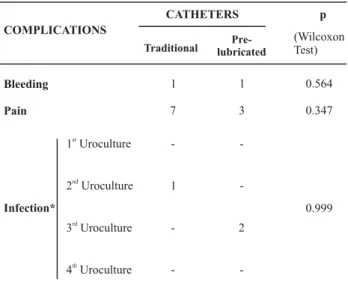
Table 3 shows that there were no statistically significant differences found between the catheters regarding the oc-currences of bleeding, pain and infection. Twenty-three samples of urine were found colonized and three were
in-fected, one in the second urine culture, using the traditional catheter, and two in the third culture, during the use of the pre-lubricated catheter. The most frequent microorganisms were Proteussp, E coli, Edwardsiella sp and Enterobacter sp.
Table 4 - Evaluation of the handling of catheters, according to the children’s opinion - São Paulo - 2006
Opinion Handling
Previous handling
Upon introduction
Traditional
Upon removal
Previous handling
Upon introduction
Upon removal
Very easy
4
5
6
2
4
6
Easy
5
4
3
7
6
5
Neutral
1
1
1
1
0
0
Difficult
1
1
1
0
1
0
Very difficult
0
0
0
1
0
0
Pre-lubricated
Even though nine children considered the handling of the traditional catheter easy and very easy in all stages of the procedure, 10 and 11 children mentioned the same opinions regarding the pre-lubricated catheter, respectively, for its introduction and removal. It was observed that the only child who indicated a very difficult evaluation, referred to the handling of the pre-lubricated catheter before its insertion into the stoma. There was also one answer that considered all handling stages of the traditional catheter as difficult. However, Wilcoxon’s test did not show statisti-cally significant differences between the groups with p = 0.527; p = 0.334 and p = 0.999, respectively, for previous handling, introduction and removal of the catheters.
The children preferred the pre-lubricated catheter, mainly during introduction and removal, justifying that it is more hygienic, presents a lower risk of infection, is dis-posable and more comfortable. The type of lubrication, which is already present in the pre-lubricated catheter, was also preferred by eight out of 11 children.
Cost
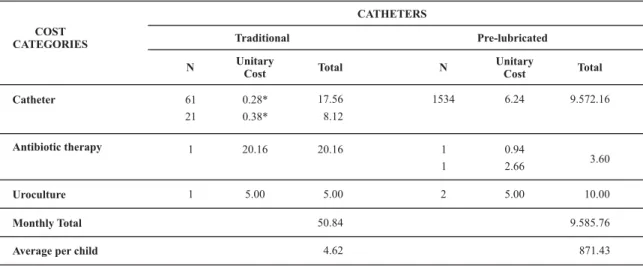
During the use of the traditional catheter, the average monthly cost was R$ 4.62 per child; whereas for the use of the pre-lubricated catheter, the cost was R$ 871.43 per child. The application of the Wilcoxon test indicated a statistically significant difference between the catheters (p=0.003).
Table 5 - Direct costs of the catheters used, according to the considered categories - São Paulo - 2006
CATHETERS
COST
CATEGORIES Traditional Pre-lubricated
N Unitary
Cost Total N
Unitary
Cost Total
61 0.28* 17.56
Catheter
21 0.38* 8.12
1534 6.24 9.572.16
1 0.94
Antibiotic therapy 1 20.16 20.16
1 2.66 3.60
Uroculture 1 5.00 5.00 2 5.00 10.00
Monthly Total 50.84 9.585.76
Average per child 4.62 871.43
* There was a variation in the specification of the catheter used: 10FR and 12FR, with different costs.
DISCUSSION
There are few studies with children that perform uri-nary CIC, and the authors could not find studies with
The study about the two types of catheters for CIC, in children with continent stomas – who already used the tra-ditional catheter for over three years, on average – did not show statistically significant differences (p>0.05) regarding the performance of both in terms of the presence of compli-cations such as pain, bleeding and urinary infection. How-ever, the authors highlight that 10 children mentioned pain, mainly when using the traditional catheter (seven), in spite of the insertion through the stoma, which presents different pain characteristics, that is, the visceral type. Qualitative and quantitative characteristics of the pain experience were not investigated since they were not the object of this study.
Regarding the urinary infection, it is also necessary to consider the particularities of the urinary continent stoma also need to be taken into account. Asymptomatic bacteri-uria is rather frequent in patients with neurogenic bladder treated with CIC, which does not justify antibiotic therapy in these cases(11). In the situations in which the treatment is
indicated, the seriousness of the symptoms needs to be taken into account(12). Some patients, however, complain
about the sensation of fullness of the reservoir, pyuria and fever, and treatment is only indicated in the presence of urine thickness, fetid odor and fever, which characterizes infection(13), similarly to the criterion adopted in our
inves-tigation, based on the current institutional protocol.
Some studies developed with CIC, through the urethral route, found a lower incidence of inflammatory processes and hematuria with the use of the pre-lubricated catheter, comparatively to the traditional, due to the minor urethral trauma(14-15). However, there is no definitive study proving
that the incidence of infection is associated to the type of catheter used, being it a single use catheter or not. Based on the current data, it is not possible to indicate that one type, technique or strategy for using a catheter is better than others(16-17).
The qualitative results of the urinary culture in the present study are similar to those of other studies, which identify Escherichia. Coli, Proteus sp, Edwardisiella sp and
Enterobacter sp as the most frequent uropathogenic spe-cies found in urinary tract infections in children, higher among those who use vesical catheterization(18).
Besides the presence of complications, the catheters were evaluated regarding their handling during the entire procedure. Once again, statistically significant differences were not found among the opinions of the children in this evaluation, whenever it was possible to apply a statistical test, due to the sample size. In this context, despite consid-ering the handling of both catheters easy and very easy, including preparation, insertion and removal from the stoma, the children preferred the pre-lubricated catheter, mainly during its stages of insertion and removal, justify-ing it is more hygienic, presents a lower risk of infection, it is disposable, more comfortable and already lubricated. It is worth highlighting that most of the children did not use any type of lubrication for the traditional catheter in their daily use, which was kept during the study in order to
fa-cilitate the evaluation without influencing its results. Dif-ferently from this study, in terms of statistical significance, but similarly to our findings, some studies observed higher levels of convenience and comfort attributed to the pre-lubricated catheter, exactly because this device does not require lubrication, which facilitated the procedure(15).
Regarding the direct monthly cost, as expected, the cost related to the use of the pre-lubricated catheter was signifi-cantly higher, about 190 times when compared to the tradi-tional one (p= 0.003). Certainly, all factors included in the av-erage monthly cost per child need to be considered, for in-stance the cost of each catheter, of the diagnostic urocultures (before starting the treatment) and the antibiotic treatment prescribed by the doctor, according to the antibiogram. Be-sides, in our area, traditional catheters are reused, at least during the same day, regardless of the number of times the CIC is executed (four to six times), as well as in the protocol established by the hospital Darcy Vargas. Since there is no stan-dardization in this practice, there are services that recommend the hygienization of the traditional catheter, reusing it for sev-eral days, since they are washed right after use.
In the literature review, only one study(15) evaluated the
cost of the catheters and also observed a significant differ-ence between the values - US$ 576.00 and US$ 30.60, respec-tively, for the pre-lubricated and traditional catheters, rather higher than those observed in our study (US$ 464.32 and US$ 2.46, respectively(c)). Despite this fact, and since the
pre-lubri-cated catheter is not distributed by the Unique Health System in the country, by evaluating the Brazilian reality, and espe-cially the reality of the children assisted by the Hospital Darcy Vargas, it would not be possible for families in general to keep up the use of the pre-lubricated catheter at their own expense, as the monthly cost would correspond to 2.3 minimum sala-ries. The authors highlight that the monthly cost of the use of the traditional catheter, in the same conditions, would corre-spond to 1.22% of the minimum salary, much more compat-ible with the income of these families.
Anyway, the study(15) considered that it is difficult to
determine the financial value of patient satisfaction, as well as the risk of urethral trauma in the long term when using catheters without lubrication, which should always be con-sidered when proposing protocols or public policies for care delivery to ostomized children who use CIC.
Although unprecedented, the most important limitation of this study was the sample size, which resulted not only from its strict composition, since the beginning, due to the already mentioned reasons, but also from the high rates of
abandonment (42.1% of the children who started to par-ticipate in the study). This factor certainly compromised the possibility of applying more refined statistical tests, as they depended on a greater casuistic. Besides, the data collection instruments were based on the international pro-tocol – which would facilitate the comparison of the
sults – requiring validation as well as the establishment of scores for the analysis of the indicators easiness of han-dling and comfort, related to the opinions of the involved children.
CONCLUSION
This study did not find statistically significant differences in the execution of the CIC, with the different catheters – traditional and pre-lubricated – regarding the presence of pain, bleeding and infection, besides the opinions and
Acknowledgement
The authors thank Coloplast do Brasil for their support in the development of the study, as previously described. preferences of the children with continent stomas, going against the previously established hypothesis. Only the di-rect costs of the use of the pre-lubricated catheter con-firmed to be significantly higher when compared to those found for the traditional catheter.
Clearly, the limitations mentioned indicate the need to develop other studies, also prospective, to better evaluate the benefits of pre-lubricated catheters in terms of reduc-ing complications and cost-effectiveness, permittreduc-ing its definitive insertion in our area, and contributing to a bet-ter care quality for children who execute the CIC.
REFERENCES
1. Carvalho WAF, Yamamoto MS, Del Cistia MEGF. A criança ostomizada. In: Santos VLCG, Cesaretti IUR, editores. Assistên-cia em estomaterapia: cuidando do ostomizado. São Paulo: Atheneu; 2000. p. 133-54.
2. Rocha RFC. Estomas na criança. In: Santos VLCG, Cesaretti IUR, editores. Assistência em estomaterapia: cuidando do ostomiza-do. São Paulo: Atheneu; 2000. p. 69-81.
3. Rodrigues P. Estomas urinários: aspectos conceituais e técnicos. In: Santos VLCG, Cesaretti IUR, editores. Assistência em estomaterapia: cuidando do ostomizado. São Paulo: Atheneu; 2000. p. 55-68. 4. Webb RJ, Auriol LL, Neal DE. Clean intermittent
self-catheteri-sation in 172 adults. Br J Urol. 1990;65(1):20-3.
5. Bakke A, Digranes AA. Bacteriuria in patients treated with clean in-termittent catheterization. Scand J Infect Dis. 1991;23(5):577-82. 6. Bakke A, Vollset SE, Hoisater PA, Irgens LM. Physical
complica-tions in patients treated with clean intermittent catheteriza-tion. Scand J Urol Nephrol. 1993;27(1):55-61.
7. Lundgren J, Bengtsson O, Israelsson AS, Jonsson AC, Lindh AS, Utas J, et al. The importance of osmolality for intermittent catheterization of the urethra. Spinal Cord. 2000;38(1):45-50. 8. Waller L, Jonsson O, Norlen L, Sullivan L. Clean intermittent catheterization in spinal cord injury patients: long term follow up of a hydrophilic low friction technique. J Urol. 1995;153 (2):345-8. 9. Gerianotis E, Koff AS, Enrile B. The prophylactic use of clean intermittent catheterization in the treatment of infants and young children with myelomeningocele and neurogenic bladder dysfunction. J Urol. 1988;139(1):85-6.
10. Sand PK, Dmochowski R. Analysis of the standardisation of termi-nology of lower urinary tract function: report from the standard-isation sub committee of the International Continence Society [text on the Internet]. Bristol; 2002 [cited 2008 Jul. 25]. Available from: http://www.icsoffice.org/ASPNET_Membership/Membership/ Documents/DocumentsDownload.aspx?DocumentID=43
11. Salomon J, Gory A, Bernard L, Ruffion A, Denys P, Chartier-Kastler E. Urinary tract infection and neurogenic bladder. Prog Urol. 2007;17(3):448-53.
12. Shortliffe LM, McCue JD. Urinary tract infection at the age extremes: pediatrics and geriatrics. Am J Med. 2002;113 Suppl 1A:55S-66S.
13. Borrelli M, Borrelli Jr. M. Complicações precoces e tardias dos estomas intestinais e urinários: aspectos preventivos e terapêuticos. Estomas urinários. In: Santos VLCG. Cesaretti IUR. Assistência em estomaterapia: cuidando do ostomizado. São Paulo: Atheneu; 2000. p. 215-22.
14. Wyndaele JJ, Ridder D, Everaert K, Heilporn A, Congard-Chassol B. Evaluation of the use of Urocath-Gel catheters for intermit-tent self-catheterization by male patients using conventional catheters for a long time. Spinal Cord. 2000 Feb;38(2):97-9. 15. Sutherland RS, Kogan BA, Baskin LS, Mevorach RA. Clean
intermittent catetherization in boys using the LoFric catheter. J Urol. 1996;156(6):2041-3.
16. Getliffe K, Fader M, Allen C, Pinar K, Moore KN. Current evi-dence on intermittent catheterization: sterile single-use cath-eters or clean reused cathcath-eters and the incidence of UTI. J Wound Ostomy Continence Nurs. 2007;34(3):289-96. 17. Moore KN, Fader M, Getliffe K. Long-term bladder
manage-ment by intermittent catheterisation in adults and children. Cochrane Database Syst Rev. 2007;(4):CD006008.