Students' physical activity: an analysis
according to Pender's health
promotion model
ATIVIDADE FÍSICA DE ESCOLARES: ANÁLISE SEGUNDO O MODELO TEÓRICO DE PROMOÇÃO DA SAÚDE DE PENDER
LA ACTIVIDAD FÍSICA DE ESCOLARES: ANÁLISIS SEGÚN EL MODELO TEÓRICO DE PROMOCIÓN DE LA SALUD DE PENDER
1 Nurse. Master's Student in Nursing Graduate Program at Federal University of Ceará, Fortaleza, CE, Brazil. [email protected] 2 Nurse. Master's Student in Nursing Graduate Program at Federal University of Ceará, Fortaleza, CE, Brazil. [email protected] 3 Nurse. Master's Student in Nursing Graduate Program, Federal University of Ceará, Fortaleza, CE, Brazil. [email protected] 4 Ph.D. in Nursing. Associate Professor at Federal University of Ceará, Fortaleza,
O
RIGINAL
A
R
TICLE
RESUMO
Estudo com objetivo de descrever hábitos de atividade física presentes no cotidiano de escolares e analisar a prática de atividade fí-sica e seus determinantes, a partir do pri-meiro componente do modelo teórico de promoção da saúde de Pender. Estudo trans-versal, realizado em 2004 e 2005, com 79 escolares de escola pública de Fortaleza. Coleta de dados em entrevista e exame físi-co. Os dados foram analisados com base no modelo teórico citado. A maioria dos esco-lares tinha prática ativa de atividades físicas (60). Os adolescentes, proporcionalmente, foram mais ativos (80,4%). Os sedentários tiveram prevalência maior de sobrepeso e obesidade (21,1%). Grande parte dos esco-lares desenvolvia atividades físicas ao ar li-vre, que não requeriam estrutura física e boas condições econômicas. Os resultados mostraram ser possível trabalhar a relação entre o primeiro componente do modelo teórico de promoção da saúde de Pender e o cotidiano dos escolares referentes às prá-ticas de atividades físicas.
DESCRITORES Promoção da saúde. Atividade motora. Criança.
Adolescente.
Nirla Gomes Guedes1, Rafaella Pessoa Moreira2, Tahissa Frota Cavalcante3, Thelma Leite de Araujo4,
Lorena Barbosa Ximenes5
ABSTRACT
The objective of this study was to describe the everyday physical activity habits of stu-dents and analyze the practice of physical activity and its determinants, based on the first component of Pender's health promo-tion model. This cross-secpromo-tional study was performed from 2004 to 2005 with 79 stu-dents in a public school in Fortaleza, Ceará, Brazil. Data collection was performed by interviews and physical examinations. The data were analyzed according to the re-ferred theoretical model. Most students (n=60) were physically active. Proportion-ally, adolescents were the most active (80.4%). Those with a sedentary lifestyle had higher rates for overweight and obe-sity (21.1%). Many students practiced out-door physical activities, which did not re-quire any physical structure and good finan-cial conditions. The results show that it is possible to associate the first component of Pender's health promotion model with the everyday lives of students in terms of the physical activity practice.
KEY WORDS Health promotion. Motor activity. Child. Adolescent.
RESUMEN
Estudio con los objetivos de describir hábitos de actividad física presentes en lo cotidiano de escolares y de analizar la práctica de la ac-tividad física y sus determinantes, a partir del primer componente del modelo teórico de promoción de la salud de Pender. Estudio transversal, realizado en 2004 y 2005, con 79 escolares de una escuela pública de Fortale-za. Recolección de datos en entrevista y exa-men físico. Los datos fueron analizados con base en el modelo teórico citado. La mayoría de los escolares tenía práctica activa de acti-vidades físicas (60). Los adolescentes, propor-cionalmente, fueron más activos (80,4%). Los sedentarios tuvieron prevalencia mayor de sobrepeso y obesidad (21,1%). Gran parte de los escolares desarrollaba actividades físicas al aire libre, que no requerían estructura físi-ca o buenas condiciones económifísi-cas. Los sultados mostraron ser posible trabajar la re-lación entre el primer componente del mo-delo teórico de promoción de la salud de Pen-der y lo cotidiano de los escolares referente a las prácticas de actividades físicas.
DESCRIPTORES Promoción de la salud. Actividad motora. Niño.
INTRODUCTION
In the healthcare area, the biomedical model, based on biological knowledge, risk and individual care, is increas-ingly unable to explain and respond to a given population’s health and disease processes. Evidence shows that health is more related to people’s lifestyle than the prevalent idea about their genetic-biological determination(1).
This situation shows the need to outline strategies and actions that will contemplate the positive aspects of the emerging healthcare approach, replacing the notion of health as absence of disease by another that increases the autonomy of the subjects to attain health with quality of life. Therefore, health promotion arises as a conceptual, methodological and instrumental field, seeking to overcome the idea of the natural history of diseases, demanding a broadened perspective of the health-disease process(1-2).
With the publication of the Ottawa Charter for Health Promotion (1986), several conferences and international meetings were held regarding the relevance and meaning of health promotion, including healthy public policies (Adelaide, 1988), favorable environment (Sundsvall, 1991), strengthening of community actions (Jakarta, 1997) and the consolidation of health promotion as a
fun-damental component of public policies and programs (Mexico City, 2000)(3). It is worth
noting that all charters address lifestyle as one of the central components of health promo-tion strategies.
Lifestyle is defined as a set of individual decisions that affect health, over which a cer-tain level of control can be exerted. Personal
decisions and habits that are detrimental for health create risks originated by the individual himself. When these risks result in disease or death, it can be said that the lifestyle contributed to or caused the disease or disorder(4).
After the Industrial Revolution, socioeconomic and cul-tural changes and the many technological advances yielded a new lifestyle for the world population. Even considering the benefits from an economic perspective, the lifestyle changes brought by modernization can be translated in a general, imminent risk for health(5).
Among lifestyle changes, one of the main characteris-tics was that it became more sedentary. A sedentary lifestyle is responsible for approximately two million deaths world-wide. Yearly, it is estimated to be responsible for 10% to 16% of colon and breast cancers and diabetes, and 22% of ischemic heart diseases.
Promoting health, therefore, depends on giving atten-tion to integral development, contemplating the following aspects: attention to the quality of interpersonal relation-ships, a balanced dietary supply, good living conditions and access to healthcare services, access to information and for-mal or professional education and doing sports or other
types of leisure in order to have good physical, emotional, intellectual and social development(7).
School is one of the spaces acknowledged for the promo-tion of a healthy lifestyle. The health promoting school is de-fined as a place with an integral view of being human, which considers people – especially children and adolescents – within their family, community and social environments. Therefore, the school is seen as one of the most important spaces in the promotion of a healthy lifestyle, with the practice of physical activities, since children and adolescents, as well as teachers and auxiliaries, spend a great deal of time there(8).
However, sedentary habits like playing videogames and watching television are increasingly more common in the daily routine of children and adolescents(9). Besides, physical
activity actions acquired in childhood seem to persist during adult life. They can even be vital in the prevention of several diseases, and especially in attaining a healthier life(10).
As such, healthcare professionals need to become aware of the habits of children and adolescents in school, espe-cially regarding the practice of physical activity, so that they can implement strategies to promote health and wellbeing for schoolchildren, as well as the prevention of diseases. In an effort to meet this need, Pender developed a theoretical nursing model of health promotion that may be used to know, execute and assess health promotion actions, including the practice of physical activities(11).
GOALS
The purpose of this study was to describe physical activity habits in the daily routine of a specific group of schoolchildren and ana-lyze the practice of physical activity and its determiners, according to the first theoretical component of health promotion proposed by Pender(11).
METHOD
The Health Promotion Model (HPM) was developed by Nola J. Pender, professor emeritus of the Nursing School at University of Michigan in the United States, and is supported on the concept of health promotion, defined as those fo-cused on the development of resources that can maintain or improve wellbeing(11-12).
American, Asian and European researchers have often used this health promotion model to study behaviors that lead to health promotion. Its theoretical basis is focused on the multidimensional nature of individuals, in which there are interpersonal and environmental interactions. Both contribute substantially to achieve health(11-12). Its
structure is simple and clear, enabling nurses to provide care either individually or as a group, allowing for plan-ning, intervention and assessment of their actions(12).
In addition, this science model attempts to evaluate the behavior of individuals that leads to health promotion,
A sedentary lifestyle is responsible for approximately two
according to three basic components: 1) individual charac-teristics and experiences (previous behaviors and personal factors); 2) feelings and knowledge about the desired be-havior (perception of benefits, barriers, self-efficacy,
inter-Perceives self-efficacy
Interpersonal influences (family, spouse, rules, providers,
models)
Situations that influence (opinions,
demands, aesthetics) Previous behavior
Perceives benefits for the
action
Perceives barriers for
the action
Personal factors: physical, sociocultural
and psychological
Feelings regarding the
behavior
Commitment to a plan of action
Health promotion behavior 1. Individual experiences
and characteristics
2. Specific behavior 3. Results of that behavior
Immediate demands (low control) Preferences (self-control)
personal influences); and 3) desirable health promotion behavior (commitment to the plan of action, demands and preferences), as seen in figure 1(11-12).
As nurses have experience with biopsychosocial factors and ongoing contact with the patients, they have the chance to improve the health of the community. It is important for primary care to be organized in order to reduce or elimi-nate barriers that make it difficult for patients to seek a healthy behavior, which includes doing physical activities(11).
In the present study, we chose to address the lifestyle of a group of schoolchildren with children and adolescents, according to the first component of the illustrated diagram (figure 1). Previous behavior is defined in the adopted theo-retical model as the individual’s previous habits related to the search for health, and is linked to the idea that people have personal factors/characteristics and experiences that subsequently affect their actions(11).
As such, previous behavior is the standard condition for the elaboration of nursing interventions, and personal factors interfere directly in individual behavior in order to promote
Figure 1 – Diagram of the health promotion model – Fortaleza - 2002.
This is a cross-sectional study. It was carried out at a public elementary and high school, located in the city of Fortaleza/Ceará/Brazil. Data collection occurred from Oc-tober, 2004 to March, 2005, during weekly visits to the school in the morning and afternoon periods, according to the researchers’ availability.
The study population contained children and adoles-cents aged 6 to 18 years. The studied group consisted of 79 children and adolescents who agreed to participate in the study, with the consent of their parents.
guard-The form also included space for observations about what occurred when the students arrived or left school, the spaces available for physical activities in the school and how physical education classes were organized in the school.
After the interview, children and adolescents were sub-mitted to an anthropometric evaluation (weight and height measurements) to calculate the BMI. The BMI values were classified in percentages, according to the American method(13), such as low weight (below the 5% percentile);
normal weight (between percentiles 5% and 85%); over-weight (between percentiles 85% and 95%) and obesity (above the 95% percentile).
As for the practice of physical activities, children and ado-lescents who did physical activities less than three times a week for less than 30 minutes were considered sedentary.
The results were analyzed by reading and interpreting the data, according to Pender’s theoretical model of health promotion(11), in an attempt to comprehend these data in
relation to the first component of the theory.
Considering the administrative and ethical aspects of scientific research, school management received the appropriate documents, requesting authorization to perform the study, which was granted. In addition, the study proposal was sent to and approved by the Review Board of Universidade Federal do Ceará - COMEPE, (Protocol No 95/ 04), in accordance with recommendations for research involving human beings.
RESULTS AND DISCUSSION
All 79 children and adolescents study in a public school in the outskirts of Fortaleza, being enrolled for either morn-ing or afternoon classes. Most students walked to school by themselves or with friends. The students’ parents or le-gal guardians often did not accompany them.
Once per week, the teachers and coordinators welcomed the children and adolescents in the main schoolyard to in-form them about the general activities planned for the week.
In addition, the school offered cultural activities and permitted the development of research and extension ac-tivities in several areas, especially healthcare. Among these, projects on cardiovascular disease, healthcare education and eye care of the Nursing Department of Universidade Federal do Ceará, as well as the Schoolchildren’s health program, are worth noting.
The physical activities promoted by the school were available only for the 5th grade and upwards, guided by a
physical educator. Each class had a 50-minute physical edu-cation class once a week. It is worth noting that the place where the physical education classes were held was also used for other activities, which made it difficult to have physical activities more often.
This situation contradicts the recommendations of the National Policy of Physical Activity Promotion (14), which
em-phasizes the incorporation of at least 30 minutes of physical activity, most days of the week – daily, if at all possible – of moderate intensity, as a strategy to reduce the risk of non-transmissible chronic diseases and to improve quality of life.
Researchers note the importance of the school to promote the daily involvement of children and adolescents in basic physical activities(11). The same authors address the need for
families, communities and primary healthcare to complement the role of the school in physical activity(11). At the school where
the study was developed, the idea of a health-promoting school focused on physical activity had not been incorporated.
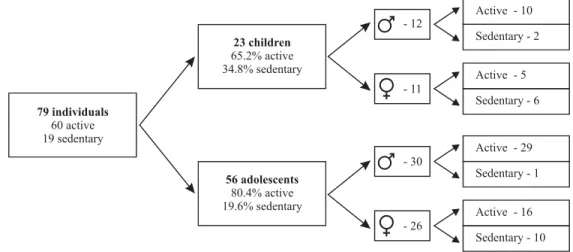
With the purpose of analyzing the first component of Pender’s Theory, we chose to focus on gender, age range and Body Mass Index (BMI) among physical factors. The figure below shows the profile of physical activity practice in children and adolescents.
79 individuals
60 active 19 sedentary
23 children
65.2% active 34.8% sedentary
56 adolescents
80.4% active 19.6% sedentary
Active - 10
Sedentary - 2
Active - 5
Sedentary - 6
Active - 29
Sedentary - 1
Active - 16
Sedentary - 10 - 12
- 11
- 30
- 26
In order to analyze issues regarding the practice of physi-cal activity, it should be noted that physiphysi-cal activity is defined as any body movement produced by the muscle-skeletal sys-tem that consumes energy beyond baseline consumption(15).
Although the school did not develop physical activity practice according to health policy recommendations, most children and adolescents practiced physical activities for over thirty minutes more than three times a week.
As for gender, girls were more sedentary when com-pared to boys. Regarding the age range, adolescents (12 to 18 years old) were proportionally more active.
In contrast with our findings, authors of the theory(11)
state that physical activity declines by about 50% during adolescence. Regarding gender, the authors state that physical activity is higher among boys than girls, in ac-cordance with our study. Such behavior is justified be-cause girls mention more setbacks to start physical ac-tivities and not enjoying physical education classes in school(11).
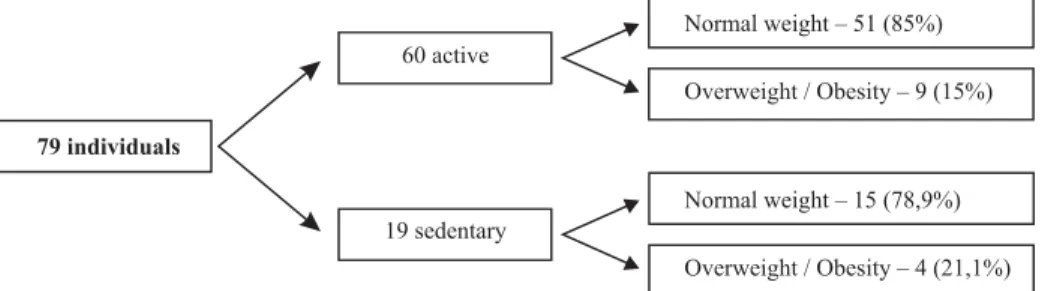
Regarding the Body Mass Index, higher prevalence of overweight and obesity was observed among sedentary children and adolescents (Figure 3).
79 individuals
60 active
19 sedentary
Normal weight – 51 (85%)
Overweight / Obesity – 9 (15%)
Normal weight – 15 (78,9%)
Overweight / Obesity – 4 (21,1%)
Figure 3 – Description of physical activity according to Body Mass Index - Fortaleza - 2005
It is known that the practice of physical activities in over-weight individuals is usually lower than that of non-obese. However, the tendency to a sedentary life is still a matter of discussion as to whether it is a cause or consequence of obesity. Children and adolescents tend to become obese when they are sedentary, and obesity itself can make them even more sedentary(9).
Changes in the physical activity profile of the popula-tion, more time spent on sedentary activities (television, videogames, computers) and the change of sociocultural factors, such as considering excess weight as a synonym of health and prosperity, has a negative impact on health(11).
As such, the school, as a health-promoting place, has a fundamental role in changing sedentary habits, since it can encourage and strengthen the capacity of children and adolescents, as well as their families, to deal with the mul-tiplicities of conditioners for physical activity practice. This concept refers to strengthening the promotion of a healthy lifestyle by building on the capacity of choice(16).
In addition to the school, families and informal com-munity networks should not only be considered receivers of healthcare, but also active subjects who can contribute with their own resources for the process of health produc-tion, especially the practice of physical activity(16).
Socioeconomic status is one of the sociocultural factors addressed in the theory. Particularly socioeconomic level directly influences participation in sports organized outside the school, since there are financial expenses involved with the sport and transportation. Another obstacle is that family members need to find time to take their children to the places where these activities are held. It is known that the
influence of the family during childhood has a positive ef-fect on the development of an active lifestyle(11).
Among active schoolchildren, a large share developed unsupervised outdoor physical activities, which did not re-quire special facilities or good financial conditions, such as: walking, playing soccer and riding bicycles. Other activities needing professional supervision and with financial expenses, such as gymnastics, dancing, bodybuilding, swimming and water gymnastics were not common among these students.
Health behaviors may be related to family support, so-cioeconomic variables and socialization by means of the family, the school and the media. Socioeconomic status plays a significant role in these behaviors, as families with better financial conditions can provide better resources and access to multiple sports activities(11).
The authors of the theoretical model of health promo-tion(11), by addressing the psychological factor, described
that it includes variables like self-esteem, self-motivation and perception of their health status.
The practice of physical activities offers opportunities for leisure, social integration and development of skills that result in higher self-esteem and confidence for the child. In the present study, although the school does not assume the role of promoting physical activities, as explained be-fore, it was observed that the students were active and motivated to do physical activities during periods like class intervals and before or after school.
the benefits that derive from a healthy lifestyle in order to attain quality of life. The empowered individual is capable of behaving in a certain way, influencing his own environment and acting according to the goals of health promotion(17).
It should be noted that, the higher the social, environmen-tal and family supports are, the higher are the chances of com-plying with and keeping up physical activities in children and adolescents. Initiatives that use education with environmen-tal support have the highest chances of success(12).
The previous behavior of individuals is another element in the first component of Pender’s theory(11). The
theoreti-cal model highlights, in its first precept, that genetic and acquired features influence the search and involvement in activities directed at health promotion. The analysis of pre-vious behaviors in relation to sedentary activities in chil-dren and adolescents is presented in Figure 4.
Sitting
Sleeping
Using the computer
Watching television
Attending lessons
9.05 hours
8.88 hours
0.10 hours
2.63 hours
3.50 hours
Figure 4 Average hours spent on sedentary activities per day -Fortaleza - 2005
In the studied group, although most subjects practiced some type of physical activity, they spent many hours a day on sedentary activities. Some studies evidenced concerns with the time spent on electronic activities like computers and television(9).
In this study, the average daily hours spent using the com-puter and watching television amounted to 2.73 hours. There is a study showing that the obesity rate for children who watch television for more than one hour a day is 10%, whereas hab-its of watching television for three, four, five or more hours per day are associated to a prevalence of nearly 25%, 27% and 35%, respectively, and that television takes up the free hours in which a child could be doing other activities. The child of-ten eats in front of the television, and a large share of the commercials offer calorie-rich, non-nutritious foodstuffs.
The media plays an important role in broadcasting and building opinions. Therefore, it should disseminate infor-mation related to health and wellbeing, emphasizing the
importance of a healthy lifestyle and encouraging such hab-its since childhood, which would promote the health of individuals, families and communities(11).
In addition to the media, the school has an important role in health promotion, as it should encourage children and adolescents to perform leisure and socialization activi-ties in association with the educational process, so that they have fewer moments of idleness, which would favor the development of sedentary habits.
Physical, sociocultural and psychological factors, as well as previous behaviors proposed in the first component of the theory under study are considered to influence physi-cal activity practice of children and adolescents.
CONCLUSIONS
The use of theoretical nursing models could help health-care professionals to understand the health-disease com-plex, and also support nursing practice.
The present study showed that the first component of Pender’s theoretical model of health promotion can be re-lated with the daily routine of children and adolescents, focusing on physical activities, supporting nursing interven-tions in order to promote the health of schoolchildren.
The main results show that most schoolchildren were active. Sedentary ones had a higher prevalence of over-weight and obesity. A large share of the schoolchildren did outdoor physical activities, which did not require special facilities or good financial conditions. In spite of these find-ings, the school where the study was held did not promote the health of its students.
Healthcare institutions, family and the school environ-ment are important resources that can influence the com-mitment and involvement of people with behaviors that lead to health promotion either positively or negatively. As such, they can be seen as either benefits or barriers for the acquisition of healthy habits.
The importance of physical activity is well-known as a component that promotes the health of the population, and, if encouraged since childhood, it will contribute to reduce health risks throughout life.
It is worth noting that the notion of schools as health-promoting institutions is an eminent idea, which still needs to be consolidated in Brazilian public policies, so that it can benefit the health of children and adolescents.
REFERENCES
1. Brasil. Ministério da Saúde. Programa Nacional de Promoção da Atividade Física “Agita Brasil”. Atividade física e sua contri-buição para a qualidade de vida. Rev Saúde Pública. 2002; 36(2):254-6.
3. Brasil. Ministério da Saúde. Secretaria de Políticas de Saúde. Pro-jeto Promoção da Saúde. Declaração de Alma-Ata, Carta de Ot-tawa, Declaração de Adelaide, Declaração de Sunsvall, Declara-ção de Santafé de Bogotá, DeclaraDeclara-ção de Jacarta. Brasília; 2001. 4. Colombo RCR, Aguillar OM. Estilo de vida e fatores de risco de pacientes com o primeiro episódio de infarto agudo do miocárdio. Rev Lat Am Enferm. 1997;5(2):69-82.
5. Gomes MJF, Rico SR. La actividad física hacia la salud em la enseñanza técnica de Brasil. Rev Digital (Buenos Aires) [perió-dico na Internet]. 2003 [citado 2007 nov. 13];9(63). Disponível em: http://www.efdeportes.com/efd63/salud.htm
6. Brasil. Ministério da Saúde. Secretaria de Atenção à Saúde. In-quérito domiciliar sobre comportamentos de risco e morbi-dades referidas de doenças e agravos não transmissíveis [texto na Internet]. Brasília; 2003. [citado 2007 out. 13]. Disponível em: http://www.inca.gov.br/inquerito
7. Muza GM, Costa MP. Elementos para a elaboração de um proje-to de promoção à saúde e desenvolvimenproje-to dos adolescentes: o olhar dos adolescentes. Cad Saúde Pública. 2002;18(1):321-8. 8. Tavares MFL. Da saúde escolar à escola saudável: construindo
espaços de promoção da saúde. In: Zancan L, Bodstein R, Marcondes WB. Promoção da saúde como caminho para o desenvolvimento local: a experiência de Manguinhos, RJ. Rio de Janeiro: ABRASCO; 2002. p. 159-73.
9. Mello ED, Luft VC, Meyer F. Obesidade infantil: como
pode-mos ser eficazes? J Pediatr. 2004;80(3):173-82.
10. Pellanda LC, Echenique L, Barcellos LMA, Maccari J, Borges FK, Zen BL. Doença cardíaca isquêmica: a prevenção inicia durante a infância. J Pediatr. 2002;8(2):91-6.
11. Pender NJ, Murdaugh CL, Parsons MA. Health promotion in nursing practice. Upper Saddle River: Prentice Hall; 2002. 12. Victor JF. Tradução e validação da exercise Benefits/Barriers
scale [tese]. Fortaleza: Programa de Pós-Graduação em En-fermagem, Universidade Federal do Ceará; 2007.
13. National Center for Health Statistics (NCHS). CDC Growth Charts: United States. Hyattsville; 2000.
14. Brasil. Ministério da Saúde. Portaria GM n.1893, de 15 de outubro de 2001. Divulga a criação do programa de promo-ção da atividade física. Diário Oficial da União, Brasília, 16 out. 2001. Seção 1, p. 55-60.
15. Thompson PD, Buchner D, Piña IL. Exercise and physical activity in the prevention and treatment of atherosclerotic cardiovascular disease. Statement reviewed and endorsed by American College of Sports Medicine. Circulation. 2003; 107(24):3109-16.
16. Czeresnia D, Freitas CN. Promoção da Saúde: conceitos, reflexões, tendências. Rio de Janeiro: FIOCRUZ; 2003. 17. Carvalho SR. Os múltiplos sentidos da categoria