Nurses' time distribution: dentification
and analysis in a medical-surgical unit
*DISTRIBUIÇÃO DO TEMPO DAS ENFERMEIRAS: IDENTIFICAÇÃO E ANÁLISE EM UNIDADE MÉDICO-CIRÚRGICA
DISTRIBUCIÓN DEL TIEMPO DE LAS ENFERMERAS: IDENTIFICACIÓN Y ANÁLISIS EN UNA UNIDAD MÉDICO QUIRÚRGICA
* Extracted from the thesis "Distribuição do tempo das enfermeiras: identificação e análise em unidade médico-cirúrgica", School of Nursing, University of São
O
RIGINAL
A
R
TICLE
RESUMO
Diante do impacto da distribuição do tem-po de trabalho da profissional enfermeira na determinação de parâmetros para a ope-racionalização do processo de dimensionar pessoal de enfermagem, este estudo teve por objetivo identificar e analisar a distri-buição do tempo de trabalho das enfermei-ras em uma unidade de internação médi-co-cirúrgica. Para a consecução dos objeti-vos da pesquisa considerou-se, como po-pulação estatística, as atividades de enfer-magem realizadas pelas enfermeiras duran-te os turnos de trabalho. Verificou-se que 50% do tempo destas profissionais foram dedicados às intervenções de cuidado indi-reto, 22% às intervenções de cuidado dire-to, 18% às atividades de tempo pessoal e 10% às atividades associadas. Estes dados corroboram a indicação de pesquisadores que apontam a necessidade de serem con-siderados o tempo pessoal dos trabalhado-res de enfermagem e a realização das ativi-dades associadas nos métodos de dimensi-onamento de pessoal preconizados pelos órgãos oficiais.
DESCRITORES
Recursos humanos de enfermagem no hospital.
Gerenciamento do tempo. Carga de trabalho. Classificação.
Luiz Carlos Bordin1, Fernanda Maria Togeiro Fugulin2
ABSTRACT
This study was performed to identify and analyze the distribution of nurses' work hours at a medical-surgical hospitalization unit, in view of the impact on making the nursing personnel dimensioning process effective during their work hours. Of the activities that nurses performed, 50% of the nurses' time was invested on indirect care interventions, 22% on direct care interven-tions, 18% on personal time activities, and 10% on associated activities. These data confirm previous reports that show a need to consider nursing personnel's personal time and associated activities in the official rightsizing methods.
KEY WORDS Nursing staff, hospital. Time management. Workload. Classification.
RESUMEN
Delante del impacto de la distribución del tiempo de trabajo de la profesional enfer-mera en la determinación de parámetros para la operacionalización del proceso de dimensionar el personal de enfermería, este estudio tuvo por objetivo identificar y anali-zar la distribución del tiempo de trabajo de las enfermeras en una unidad de internación médico quirúrgica. Para la consecución de los objetivos de la investigación se conside-ró, como población estadística, las activida-des de enfermería realizadas por las enfer-meras durante los turnos de trabajo. Se ve-rificó que 50% del tiempo de estas profesio-nales fue dedicado a las intervenciones de cuidado indirecto, 22% a las intervenciones de cuidado directo, 18% a las actividades de tiempo personal y 10% a las actividades aso-ciadas. Estos datos corroboran la indicación de investigadores que apuntan la necesidad de considerar el tiempo personal de los tra-bajadores de enfermería y la realización de las actividades asociadas en los métodos de dimensionamiento de personal preconiza-dos por los órganos oficiales.
DESCRIPTORES
Personal de enfermería em hospital. Administración del tiempo. Carga de trabajo.
INTRODUCTION
Health organizations, including hospitals, are constantly influenced by political and economic activities, technologi-cal progress and globalization that compel them to reach efficient results.
Within this context, health institution administrators have been investing in the search for new management strategies that facilitates costs reduction, improves the quality for the services offered and increases customers’ satisfaction(1).
However, adopting measures that result from a diver-sity of political priorities, usually from establishing guide-lines that contain and reduce expenses, can be noticed immediately in health institutions’ human resources poli-cies(2). Therefore, despite the fundamental role nursing ser-vices play in care practice within these organizations, the need for decreasing costs and increasing the service of-fered immediately places health institution’s nursing per-sonnel in a difficult situation. As a result,
personnel costs are the largest portion of overall costs(3-4).
For this reason, nurses who are respon-sible for personnel and for the coordination of nursing care are constantly involved resolv-ing problems regardresolv-ing the lack of personnel. Consequently, they must identify methods, criteria and parameters that will help them estimate and evaluate the personnel staff under their responsibility.
In Brazil, the Gaidzinsk nursing personnel measurement method has been used for per-forming these activities as well as helping nurses to predict, evaluate and adjust the quantity and quality of nursing personnel in health organizations(3). In order to use this
method, the identification of the following variables is nec-essary: the unit’s load of work, technical safety rate (TSR) and effective working time(4).
According to the nursing team’s degree of dependency, work load in the nursing care unit is defined by result of the average quantity of patients, and by the average nurs-ing care time used per client. The daily patient average, according to the nursing team’s degree of dependency, is obtained by a daily classification of patients. In order to perform this task, a patient classification instrument is elected among those available in literature(4).
Identification of the time used for patient care is con-sidered to be the most complex process of the nursing per-sonnel measurement methods due to the fact that it inter-feres in its definition. Because of the instrumental and operational difficulties for performing this procedure, the nursing care time referred to in the literature can be tested and validated within the reality of each service(4).
By professional category, TSR refers to the increase in nursing personnel quantity, in order to cover for the pre-dicted and non-prepre-dicted absences on care service, and it must be identified according to the reality of each service, with a view to the availability of methods that will enable the identification of such values(4).
The effective working time variable considers the daily working time of the nursing team and the need to reduce working hours in order to perform activities not related to professional activities (exchange information not connected to work, celebrations)(4). Some variables are part of the Con-solidated Labor Laws (CLL)(5) (physiologic needs calls, meals, periods of rest), which happen throughout the working shift. Therefore, the effective working time is determined accord-ing to the reduction of work hours by the professional based on the available productivity rates in literature(4).
In addition to a method that allows for systematizing the inter-relationship of variables that will interfere in its effectiveness, this framework demonstrates that the pro-cess of putting the nursing personnel mea-surement technique into practice requires the adoption of parameters that will enable the planning and the evaluation (quantitatively and qualitatively) of nursing personnel ac-cording to patients’ care needs.
The measurement method proposed by the author(3) is consolidated in the Brazilian scenario. However, once the TSR can be iden-tified according to each institution’s situation, the election of related parameters, mainly to nursing care hours and effective working hours, still demonstrates as a critical aspect for putting of this technique into practice(6).
Because of the existing official regulation for the nursing personnel measurement pro-cess, the Federal Nursing Service Council (FNSC)(7) estab-lished parameters for measurement professionals in health institutions. Based on PCS(8), the FNSC Resolution # 293/ 04(7) indicates the minimum care hours for each type of care and recommends that working hours must be observed based on the contract established by health institutions.
For each care category, the average hours for care pre-determined by the FNSC(7) were established by nurses and care unit managers from many regions of the country con-sultations. They suggest that the ideal scenario for nursing professionals is to care for a specific number of minimum, intermediate, semi-intensive and intensive care patients. Hence, we can observe that this proposition was performed based on patients’ care needs evaluation and although not explained in the Resolution(7), we can infer that they refer to the direct and indirect care for patients(2,6).
Literature shows various studies (9-15) that analyze the activities developed by the nursing team and mainly those undertaken by nurses to evaluate the professionals’ work-despite the fundamental
role nursing services play in care practice
within these organizations, the need
for decreasing costs and increasing the
service offered immediately places
health institution’s nursing personnel in a
ing time distribution. Although these studies are not di-rectly comparable due to differences in definitions and the adopted methodologies, they do demonstrate that in ad-dition to direct and indirect care activities, nursing profes-sionals undertake other activities, many of which are not specifically related to nursing services. Therefore, in addi-tion to considering the total working time of a nursing pro-fessional in the quantity of anticipated hours, ignoring rest periods provided for in Brazilian legislation, the FNSC(7) also failed to consider the fact that these professionals under-take a series of activities, not related to those direct and indirect care for patients, while their time is being consid-ered for these actions(6).
OBJECTIVE
Considering the impact of the nursing team’s working time distribution has on determining the appropriate pa-rameters for measurement nursing personnel, the study aims at identifying and analyzing nurses’ working time dis-tribution in a surgical-medical unit.
METHOD
Type of research
To analyze a field descriptive-exploratory prospective research under a quantitative approach.
Study location
The research was carried out in the Surgical-Medical Clinic Unit of São Camilo Pompéia Maternity Hospital. The unit has 37 active beds for adult patients carrying acute or chronic surgical clinical pathologies. All beds were distrib-uted on the same floor (3rd Floor), in Blocks I (25 beds) and II (12 beds).
Working in the Unit was a head nurse, ten registered nurses and 35 enrolled nurses, distributed into four peri-ods: morning, afternoon, odd nights and even nights.
In other Units, nurses from the Surgical-medical Clinic developed four phases in the nursing process: history, di-agnosis, evolution and nursing prescription.
Ethic aspects
The research was approved by the Research Ethics Com-mittee (REC) of the São Camilo University Center (protocol # 055/07). The free and informed consent form was signed by the nurses participating in the research.
Population/sample
In order to meet the objectives, the activities under-taken by nurses during their working shifts were consid-ered as the statistics population. Therefore, the population
comprises the total of activities undertaken by nurses dur-ing the continuous functiondur-ing of the unit.
This compound of activities A1, A2, A3, ..., Ai, present dis-tinct time periods, considered as random variables d1, d2,
d3, ... , di.
Since the population size N (activities) is unlimited due to the continuity of services (there are always new activi-ties) and activity Ai has a variable execution time for each
new service i, the exact value of each one of these popula-tion parameters cannot be determined. Only converging values can be obtained as new population samples are con-tinuously taken.
Considering that the quantity of activities performed by nurses is unpredictable and that some activities occur more frequently than others, theoretically all activities can occur as long as a sample of activities, undertaken by nurses, occur for a sufficient period so that those that occur less frequently can occur.
Therefore, as a criterion to establish the sample size, we chose to discard activities that held occurrence prob-ability p lower than 0.1%. In other words, p=1/1000 (or less than one occurrence in 1000 samples), where at least 1000 samples of the activities undertaken by nurses must be collected.
In order to determine the sample’s period T that was enough for composing the activities compound that held a previously established occurrence probability p, the follow-ing equation was elaborated:
T =
enf
p. . 1440
t
(1)
Where:
T =sample period;
τ= interlude between activities observations, expressed in minutes;
p= minimum probability of occurrence for an activity
(0.001);
andnf= number of nurses per shift (02);
1440 = 24h X 60 minutes.
In order to determine the interlude between observa-tions (τττττ), an interlude of 15 minutes between an observa-tion and other activities performed by nurses was established. Therefore, the sample period corresponded to 5.2 days.
Methodological procedures - identification and classification of nursing activities
Nurses were required to list in writing the daily activi-ties undertaken by them at work in the Hospital Unit.
include or exclude any nursing activity and also eliminate possible doubts regarding the name of the activity and its real meaning.
Then, the activities were set into categories based on a standard language system that aimed at setting a common meaning for terms used in professional practice, resulting in reducing imprecision from semantics ambiguity. Also, it aimed at comparing the activities undertaken by nurses into different scenarios. In order to perform these procedures, the Nursing Interventions Classification (NIC)(16) was chosen. It denominates and describes interventions nursing profes-sionals undertake in clinical practice as a response to an established nursing diagnosis(17).
Each nursing activity in the single list were compared with these definitions and with the activities described in each NIC intervention(16). Those that corresponded to a cer-tain nursing intervention were grouped under a standard intervention. After this procedure, interventions were clas-sified as direct and indirect care interventions according to the definitions in NIC(16):
•
Direct care interventions: treatment carried out through patients’ interaction, including nursing actions in the physi-ologic and psychosocial scope, and also, practice actions and those for support and life counseling.•
Indirect care interventions: patient treatment performed from a distance; however, benefiting patients or group of pa-tients, comprehending actions guided to care environment management and interdisciplinary collaboration. These actions support the efficiency of direct care interventions.Activities that showed no accordance to any interven-tions in NIC(16) were grouped into two categories: Associ-ated Activities - relAssoci-ated to work, although not specific to the nurse and nursing, but that can be undertaken by any other professional in the Unit(13) and Personal Time - activi-ties regarding the workers’ personal necessiactivi-ties(13,18), that have no connection to the work to professional tasks.
Construction of the instrument for data collection
Interventions and nursing activities classification en-abled the elaboration of the data collection instrument, for the observation of one nurse per instrument, according to shifts and working wards. The first field in the instrument indicated the data collection location (ward I or II) and was used for registering information related to the date and the nurses’ identification (name initials). The second field had the nursing interventions list (with the respective codes and related activities), the associated activities and personal time. Also, it presented a specific checklist system for each ward and working shift in the Unit.
Data collection procedure.
In order to perform observation and register the activi-ties undertaken by nurses, four clerks who worked in the
institution were hired. They were chosen because they knew the work being developed by the nursing team, pro-vided that they signed a service provider contract. These clerks, called field observers, were oriented on procedures related to research data registration and collection. They were specifically trained to develop the activity.
While collecting data, the field observers were distrib-uted into the four working shifts (6a.m. to 12p.m.; 12p.m. to 6p.m.; 6p.m. to 12 a.m.; 12a.m. to 6a.m.). They started their activity as the shift started. In order to regulate the time between one observation and another, they used a watch as measuring instrument.
Identifying Nurses’ time distribution used in undertaking nursing activities.
The proportion of nurses’ time in undertaking the main nursing interventions was obtained through the following equation:
I i
P%] =
[ i
.( t)
100 ∑
T
t
∑
(2)
I
[Pi%I = Activity Percentage i in the period T of the sample; i
t
∑ = sum of all interludes between samples where the activity occurred i;
T
t
∑ = sum of all interludes between samples that oc-curred during the sample T.
Identifying the time proportion that nurses used in each nursing activity was made by summing up possible activity percentages categorized under the same intervention. As a result, the corresponding percentage for each one of the selected interventions was obtained. Afterwards, the value of all classified interventions as direct care, indirect care and activities classified as Associated or Personal Time were summed. A working time distribution for nurses was es-tablished according to the classification adopted in this present study.
RESULTS AND DISCUSSION
Population/sample
October, 2007. Therefore, 1032 samples of activities under-taken by nurses in the Unit were obtained.
Nurses’ profile participating in the study
Twelve nurses working in the Unit during data collection took part in this research. Most (66.7%) were females, aged between 40 and 49 years (50%). Regarding professional edu-cation graduation time, five nurses (41.7%) graduated more than ten years ago, four nurses (33.3%) graduated between five and nine years ago and three nurses (25%) had gradu-ated less than five years ago. Four nurses (33.3%) had been employed for more than ten years, one nurse (8.3%) worked in the institution for five years and seven nurses (58.4%) worked in the institution for less than 5 years.
Identification and classification of nursing activities
The activities lists comprised 150 nursing activities. From the 150 listed nursing activities, 138 (92%) corresponded to the definitions and activities described in 45 NIC inter-ventions(16). Hence, they were categorized according to the equivalent intervention.
The 45 selected nursing interventions were classified into 31 direct care interventions and 14 indirect care inter-ventions, according to NIC definitions(16). Twelve (8%) of the 150 activities in the Surgical-medical Clinic Unit did not cor-respond to any NIC nursing interventions(16). Thus, these activities were classified as Personal Time and Associated Activities.
IdentifyingNurses’ time distribution used in undertaking nursing activities.
From the 45 selected nursing interventions, only 32 (71%) were observed during the data collection period. The 13 (29%) nursing interventions that remained unregistered and the nursing activities that were attributed to these in-terventions were excluded from the sample.
The records obtained were transferred to electronic spreadsheets, which allowed for the identification and ad-dition of all interludes between samples that each activity occurred, in addition to all interludes between samples that were verified during the sample period T. Thus, it was pos-sible to make calculations that enabled determining the nurse time proportion caring for each observed interven-tion and activity (Associated and Personal Time) in each block and in the Unit as a whole.
The nursing interventions related to work activity showed that more nurses’ spent their time in Documenta-tion (18.4%), Supervision (11.4%), Associated Activities (9.7%) and Delegation (9.3%) respectively.
The activities related to Documentation, which used the most time (18.4%), comprised the following actions: per-form daily nursing evolution (7.5%), perper-form daily nursing
prescription (5.1%), write the shift summary in the shift change log book (elaborating the shift report) (3.8%) and taking notes (2.0%).
By analyzing these results, only two studies stood out(9-10) pointing to the time taken by nurses for documentation (9% and 23%, respectively), however, not clarifying the type of documentation. One of these studies(9) also presented data related to the elaboration of reports (8%). Therefore, the percentage found in this present study is similar only to the percentage found in one of the listed studies(9), if percentages regarding documentation and elaboration of reports are added (17%).
The study Unit has a computerized system that allows for carrying out the nursing evolution and prescription in an electronic environment. It aims at also enabling higher agility in registering this information. However, results found in the present research suggest the need for performing new investigations or validations of intervening factors in undertaking these interventions in a way to reduce nurses’ working time dedicated for Documentation.
The activities related to supervision, which took 11.4% of the nurses’ working time refer to undertaking actions related to acquiring and continuous interpreting patients’ data. They hold a view to clinical decision making and were not solely analyzed by researchers that developed studies on this theme. However, they constitute an important ac-tivity undertaken by nurses, guided to planning and imple-menting nursing care for patients.
The percentage of time dedicated by nurses in associ-ated activities, not specific to nurses, was considered only in two studies(11,13). They identified respectively the follow-ing percentages 7% and 21%. In the present research, nurses demonstrated that they used 9.7% of their time in this kind of activity.
Once a certain type of task emphasis is determined by the characteristics of each institution, each service and also by nursing professionals’ beliefs and values, these results demonstrate the need for nurses and health institutions to review their working processes, searching concentrated ef-forts to make more time available for undertaking specific professional activities, increasing, consequently, workers motivation, care quality and nursing team productivity(6).
Regarding intervention Delegation, nurses for the Surgi-cal-medical Clinic Unit from São Camilo Maternity Hospital demonstrated that they used 9.3% of their time in activities related to guiding other professionals in the nursing team.
50%
18% 10%
22%
Indirect care interventions
Direct care interventions
Personal time
Associated activities
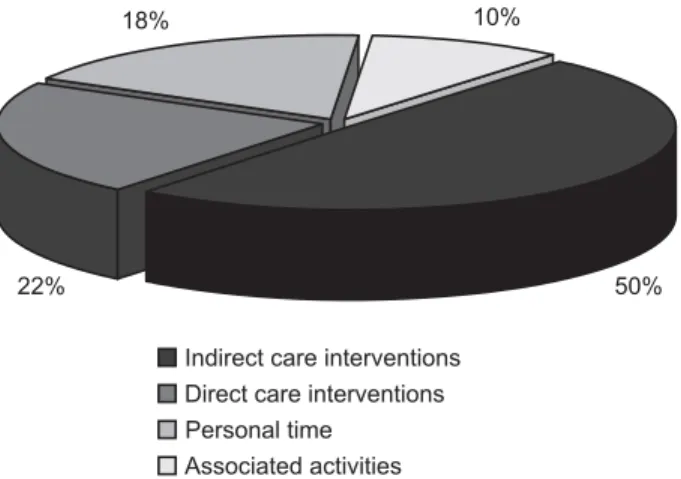
Figure 1 - Percentage distribution of nurses’ working time in the Surgical-medical Clinic Unit according to the adopted classification - São Paulo - 2008
Nurses from the Surgical-medical Clinic Unit from São Camilo Pompéia Hospital spent 50% of their working time in indirect care activities, 22% in direct care activities, 18% in personal time activities, and 10% in associated activities or in activities not specific to nurses (Figure 1). These data corroborate with a few studies that, although they cannot be directly compared due to differences in definitions and adopted methodologies, demonstrate nurses dedicate most part of their working time to non-related to direct patient care activities.
However, results from other studies(10-15) demonstrated that nurses spent more working time in direct patient care activities (36%, 30%, 39%, 40%, 49.9% and 32%) than the s present study (22%).
Regarding indirect care activities, the percentages found other studies are inferior to the percentages observed in the present study. However, for those activities related to general maintenance and documentation, most developed studies have classified the listed activities independently from indirect care activities. On the contrary, the present study, classified some of these activities as indirect care in-terventions (documentation, supply control, checking of the emergency cart). Therefore, we can verify that if these ac-tivities are considered to be indirect care acac-tivities, the time spent by nurses in these activities become compatible with the results observed in the studied Unit.
The percentage of time dedicated by nurses of the Sur-gical-medical Clinic Unit of São Camilo Pompéia Maternity Hospital in associated activities corresponded to 10% of the
nurses’ working time in the Unit. They also present higher conformity with the 7% percentage observed in one of the studies available in literature(11).
Personal time activities in this study were greater at 18% than the personal time activities in other studies 4%, 14%, 13% and 13%(9-10,12,15). However, the personal time activity in the study corresponds with studies developed in the United Kingdom(13) where the average was 17%.
When analyzing the data found in the studied Unit, 18% of the working hours in the ward was not dedicated to activi-ties related to work; therefore, professional efficiency was 82%. This value was within the range considered to be nor-mal for work and, according to productivity evaluation cri-teria proposed by literature(19); is regarded as an excellent productivity index.
Results found in the study agrees with other studies(3-4,6) who state the need for considering the nurse’s personal time as well as associated activities in the personnel mea-surement methods anticipated by officials organizations.
FINAL CONSIDERATIONS
Data analysis shows that the objectives were achieved within conditions and criteria established for the develop-ment of the study.
Nurses in the Surgical-medical Clinic Unit of São Camilo Pompéia Maternity Hospital demonstrated that they spent 50% of their working time in indirect care interventions, 22% in direct care interventions, 18% in personal time, and 10% in associated activities not specific to nurses. These data agrees with other studies that note that nurses use most of their working time in activities not related to pa-tients’ direct care.
Identifying the percentage of time nurses’ dedicate to activities classified as personal time verifies that their effi-ciency corresponds to 82%. According to evaluation crite-ria available in literature, this index is considered to be an excellent productivity index.
Results found in the present study reaffirm the need to consider personal time as well as associated activities in personnel measurement methods anticipated by official organizations.
The study demonstrates perspectives for carrying out new investigations that improve parameters related to nurs-ing personnel measurement in hospital institutions.
REFERÊNCIAS
1. Rogenski KE, Fugulin FMT. Índice de segurança técnica da equi-pe de enfermagem da equi-pediatria de um hospital de ensino. Rev Esc Enferm USP. 2007;41(4):683-89.
3. Gaidzinski RR. Dimensionamento de pessoal de enfermagem em instituições hospitalares [tese livre-docência]. São Paulo: Escola de Enfermagem, Universidade de São Paulo; 1998.
4. Gaidzinski RR, Fugulin FMT, Castilho V. Dimensionamento de pessoal de enfermagem em instituições de saúde. In: Kurcgant P, coordenadora. Gerenciamento em enfermagem. Rio de Ja-neiro: Guanabara Koogan; 2005. p. 125-37.
5. Nelson M, organizador. Consolidação das leis do trabalho, le-gislação previdenciária. São Paulo: Revista dos Tribunais; 2001.
6. Fugulin FMT. Avaliação da aplicabilidade da resolução COFEN n. 293/04 enquanto referência oficial para o dimensionamento de pessoal de enfermagem em instituições hospitalares [texto na Internet]. São Paulo: EEUSP; 2007. [citado 2008 abr. 6]. Dis-ponível em: http://www.ee.usp.br/observatorio/observatorio/ relatorios/rel021.pdf
7. Conselho Federal de Enfermagem (COFEN). Resolução n. 293/ 04. Fixa e estabelece parâmetros para dimensionamento do quadro de profissionais de enfermagem nas instituições de saú-de [legislação na Internet]. São Paulo: Conselho Regional saú-de Enfermagem de São Paulo (COREn-SP); 2004. [citado 2008 abr. 6]. Disponível em: http://corensp.org.br/072005
8. Fugulin FMT, Silva SHS, Shimizu HE, Campos FPF. Implanta-ção do sistema de classificaImplanta-ção de pacientes na unidade de clínica médica do hospital universitário da USP. Rev Med HU-USP. 1994;4(1/2):63-8.
9. Cardona P, Tappen RM, Terril M, Acosta M, Eusebe MI. Nursing sataff time allocation in long-term care: a work sampling study. J Nurs Adm. 1997;27(2):28-36.
10. Urden LD, Roode JL. Work sampling: a decision-making tool for determining resources and work redesign. J Nurs Adm. 1997;27(9):34-41.
11. Upenieks VV. Work sampling: assessing nursing efficiency. Nurs Manage. 1998;29(4):27-9.
12. Lundgren S, Segesten K. Nurses’ use of time in a medical-surgical ward with all-RN staffing. J Nurs Manag. 2001;9(1):13-20.
13. Hurst K. Selecting and applying methods for estimating the size and mix of nursing teams: a systematic review of literature commissioned by the Department of Health [text on the Internet] Leeds, UK; 2002. [cited 2008 Apr. 6]. Available from: http://www.who.int/hrh/documents/hurst_mainreport.pdf
14. Ricardo CM, Fugulin FMT, Souza TM. Dimensionamento de pessoal de enfermagem: análise do tempo efetivo de traba-lho das enfermeiras da UTI pediátrica do HU-USP. Rev Gaú-cha Enferm. 2004;25(3):357-66.
15. Chaboyer W, Wallis M, Duffield C, Courtney M, Seaton P, Holzhauser K, et al. A comparison of activities undertaken by enrolled and registered nurses on medical wards in Australia: an observational study. Int J Nurs Stud. 2008;45(9):1274-84.
16. Dochterman JM, Bulechek GM. Classificação das Intervenções de Enfermagem (NIC). Trad. de Regina Machado Garcez. 4ª ed. Porto Alegre: Artmed; 2008.
17. Santos NC. Construção de instrumento para identificação da carga de trabalho da equipe de enfermagem em unidades pediátricas [dissertação]. São Paulo: Escola de Enfermagem, Universidade de São Paulo; 2006.
18. Mello MC. Estudo do tempo no trabalho de enfermagem: construção de instrumento de classificação de atividades para implantação do método amostragem do trabalho. [disserta-ção]. São Paulo: Escola de Enfermagem, Universidade de São Paulo; 2002.