Contexto Internacional vol. 39(1) Jan/Apr 2017 http://dx.doi.org/10.1590/S0102-8529.2017390100004
Narratives of Change and
Theorisations on Continuity:
the Duality of the Concept of
Emerging Power
in International
Relations
Lucas de Oliveira Paes*
André Moreira Cunha**
Pedro Cezar Dutra Fonseca***
Abstract: his essay aims to discuss the appropriation of the concept of emerging power to the ield of international relations, the theoretical impact it inlicts on the discipline, and the duality of its for-mation as a theoretical category. he adjective emerging has been appropriated into the vocabulary of international relations, but such lexical novelty comprises a debate with earlier theorisations on
intermediate states. It is argued that this dialogue between the transience in the narratives of change, brought up by the qualiier emerging powers, and the stasis from the theoretical accumulation on the condition from which it breaks through is a constitutive foundation for the concept as an analytical device for international relations.
Keywords:Emerging Powers; Emerging Markets; Intermediate States; Middle Powers; Regional Powers; Semi-Periphery.
Introduction
his essay aims to discuss the appropriation of the concept of emerging power by the ield of international relations and the duality between change and continuity in its formation as a theoretical category within the discipline. he term emerging or rising power has been used to describe countries whose inluence in international relations is expected to be currently expanding. he term is not new in the ield, but has gained special attention recently as a particular subject of study, even receiving speciic institutional initiatives
* University of Denver, Denver–CO, United States; [email protected].
** Federal University of Rio Grande do Sul, Porto Alegre–RS, Brazil; [email protected].
in relevant universities.1 Despite manifold robust appreciations of its theoretical
delimi-tation, the concept still has to deal with a lack of consensus concerning its connotative and denotative spectrum (Hurrell 2006, 2013; Narlikar 2010; Schwengel 2008). his work intends to contribute to this debate by analysing the meanings underlying the narratives that brought the term to international relations literature and the theoretical challenge the concept inlicts upon theory in such appropriation. By tracing this constitutive formation, we expect to shed light on the analytical possibilities the term emerging power has as a device of international relations theory.
he current meaning of the term emerging power derives from the ‘stretching’ of the adjective emerging, beyond the connotative range of the terminology of emerging market, which has ‘travelled’ to denote those rising players in the international order.2 his
catego-ry regards transformations of world economy and politics in the course of the twenty-irst century by semantically framing its historical particularity. he concept, then, has been widely spread in both academic literature and political practice to refer to international relations phenomena of a particular kind: the empowerment of states that generally sym-bolise rupture with the status quo. However, at the same time, by being incorporated into the international relations’ vocabulary, such lexical and historical novelty comprises an established debate within the ield: theoretical appraisals on intermediate states, how stable this condition is, and how to rise from it.
In the terms of Koselleck (2004), the concept of emerging power frames a histori-cal process in its own time and engenders a diachronic contention with the accumulated interpretations of a longer past established within international relations theory through other concepts. he concepts of semi-periphery, middle powers, and regional powers were formulated in the discipline to denote the political consequences of the intermediate po-sition of certain states in the international system, those which are ‘too big to play no role in the balance of forces, but too small to keep the forces in balance by themselves’.3
However, in order to make sense of the intermediate states of international relations, these categories theorised on positions, their determinants, and their consequences, relecting a static account of the international system. Opposing continuity and stasis, the narratives about emerging powers posit themselves as portraying a rupture from the intermediate state’s position, as its asymmetrical counter-concept (Kosselleck 2004: 155–91). As such, this content manifested by the irst cannot be detached from the latter, which it intends to negate. Hence, their dialogue reveals its constitutive duality.
he theoretical accumulation on intermediate states stands out as the rules of usage
within the ield by which the category is appropriated. In this sense, the consolidated un-derstanding on intermediate states in international relations theory,carried out by the concepts of semi-periphery, middle powers, and regional powers, is part of properly un-derstanding the theoretical role of the term emerging power. hese contrasting categories allow one to reason about the concept beyond a theory of its own historical momentum, a narrative of an epochal change, by facing the theoretical determination that its pragmatics challenges in order to constitute itself as a concept within the discipline.
inher-ent duality between disruption and stasis. Firstly, it describes the appropriation of the lexicon for emerging – from the adjective emerging markets inthe inancial literature until its fusion with the category of rising/emerging power – as a manifestation of the historical transformation that comprises the increase in its use in the academic vocabulary of inter-national relations. he work proceeds, then, to analyse the duality in the semantic patterns brought by the concept emergingpower. In this sense, the second section discusses the very depiction of transience in the term as opening a dialogue with conceptions of conti-nuity.he third section contrasts the latter with established categories of international re-lations theory regarding phenomena that are the opposite face of its same kind as a means to complete its constitutive dialogue with endowed knowledge in the discipline. For in-stance, this section appraises how the theorisations of the concepts of semi-periphery, middle powers, and regional powers outline the determination of the position from which the emerging powers ultimately break through. Finally, the concluding remarks engage in a comprehensive synthesis of this process, stating the duality comprising the concept and how it better allocates its theoretical place in the discipline.
The appropriation of the lexicon for
emerging
by the field of international
relations
he post-Cold War world has raised an ongoing discussion on the distribution of power in the international system. Much of the contemporary literature of international relations has focused on understanding the challenges to the preponderance of the United States, hegemony, or unipolarity (Khanna 2008; Layne 2009, 2012; Ilkenberry et al2011; Buzan 2011). Even though there is a high level of power concentration in restricted poles, the redesign of economic relations has particularly raised the discussion of the increased par-ticipation of peripheral spaces in world production and economic lows during this new phase. his shit has given relevance to interpretive eforts on the theoretical characterisa-tion of those states that have been playing a greater role in the internacharacterisa-tional system, even of those most distant to the reality of a hegemonic transition. Unlike as theories of war and change predict, the focus is now on the enhanced inluence of mid-level actors instead of the great powers’ politics of systemic change.
Within this context, the debate on conceptual alternatives for the denotation of these new actors arises (Hurrell et al 2000; Jordaan 2003; Cooper, Antikiewicz and Shaw 2007; Schwengel 2008; Nolte 2010; Schenoni 2012; Hurrell 2013; Cooper and Flemes 2013; Brüt-sch and Papa 2013). Underlying the dispute among established categories of international relations theory – i.e. middle powers, regional powers, semi-periphery – an expansion of the lexicon for emerging has been observed, (in expressions such as emerging
coun-tries, emerging powers, emerging markets, and a profusion of combinations of ‘emerging’
international relations and outlines the historical process in world economy and interna-tional politics that it is narrating.
Genealogically, the predicate emerging, although already present in the vocabulary of international relations, has been taken in its contemporary mood from a diferent ield, that of the literature on inancial markets, providing an equally diferent semantic context to the term. he connotative changes undergone by the meaning of the term emerging as a reference to international relations phenomena describe a process of ‘conceptual travel-ling’ and ‘conceptual stretching’ in the sense originally proposed by Sartori (1970). he notion of ‘conceptual stretching’ is used by the author to indicate the distortion a concept undergoes in its over-extension,4 namely its reference to cases that put their constitutive
attributes in check. he denotation of cases confronting the term’s original connotative borders is what Sartori calls ‘conceptual travelling’. he present work observes that the ‘travelling’ and ‘stretching’ of the lexical ield emerging, from the term of emerging market
to the new meanings attached to the term emerging power, are constitutive elements of its appropriation by the study of international relations. It is argued that the appropriated cat-egory does not sufer from an over-extension, but requires additional efort to understand its place in the new theoretical context in which it is operating. hus, this study is built upon the narratives that conducted this semantic transformation and, consequentially, promoted its dissemination as a qualiier of international relations phenomena.
his movement of the lexicon for emerging was initiated as a description of the subject
of emerging markets in inancial literature, referring to countries then newly integrated to
the conditions of inancial globalisation in the late twentieth century. Its initial environ-ment was the scheme of the reinancing of developing countries’ elevated debt stocks since the mid-1980s. he creation of the term emerging markets is attributed to Antoine Van Agtamael, former president of IFC (International Finance Corporation), the inancial arm of the World Bank. He coined the term in order to reframe those countries in the inancial markets risk classiications and to resume the low of private capital to recycle their debt stocks. his classiication replaced the former hird World funds in order to give greater credibility to these borrowers once they adopted the adjustment policies set by interna-tional inancial institutions. In efect, what was being developed was a new category of inancial assets that would gain prominence since the release of Brady Bonds (Levi 2009; Pilbeam 2013). However, this distinctive qualiication of some hird World countries as emerging markets would later reveal a new semantic opposition that constituted the emerging powers. In the 1990s, the emerging market bonds became important ixed in-come components of various assets (Levi 2009; Pilbeam 2013).
interchangeable with developing countries. his merger, however, has not received a de-limiting systematisation; it has only been the identiication of these geographic areas with new expanding economic opportunities. Emerging markets and developing countries are all those economies that are not the advanced ones, measured by the level of per capita in-come (World Bank 2013; International Monetary Fund 2015). he originally distinctive term of emerging markets turns itself into an operational term for the identiication of a universal rest.
However, these new emerging markets found a new role in the international economy in the beginning of this century (Kose 2008). On the inancial side, the diference in inter-est rates ofered by some of these markets’ currencies in relation to the dollar and other convertible currencies directed a large inlow of capital to them, mostly related to carry
trade operations5 (Levi 2009; Pilbeam 2013). At the same time, there was a reorganisation
of trade and production chains on the real side of the international economy. Since then,
emerging markets have registered continued surpluses in their current accounts, driven by
the performance of another ‘emergent’ factor, the rising industrial production of East Asia. his briely summarised process was already underway when Goldman Sachs irst highlighted, among the many emerging economies, those that would play a central role in the future of the world economy: Brazil, Russia, India, and China (O’Neill 2001; 2003; 2005; 2007). Whereas the works of Goldman Sachs compose an empirical and operational literature, intended to help inancial market agents, they reveal two important aspects of the content carried in the appropriation of this new meaning of the predicate emerg-ing by the international relations literature. First, these works specify among the ‘emerging world’ a group of countries whose growth path could constitute a long-term movement towards the centre of the international economy. Second, the work argues that such a promise should allow their proper inclusion in international inancial governance spheres, in particular through the G-7 expansion. Hence, this body of work casts a diferent view, within the inancial literature, on these actors whose prominence was conirmed over the irst decade of this century, and has outranged the scope of the inancial market in the same way that the the meanings carried through the adjective emerging have overlowed that literature.
The duality in the narratives of change comprising the concept of
emerging power
he twenty-irst century has witnessed the spread of the qualiier emerging or rising em-ployedwith political referents, either by scholars or by diplomats, which carried these historical transformations into a vernacular legacy to be explored in the discipline of in-ternational relations. In this discipline, the term emerging power conlates past and pres-ent, becoming interchangeable with rising powers, both covalent to describing a renewed feature of the ield, the novel role of the former emerging markets in the world economy and politics. he term that once described power transition among great powers6 now
World or the Global South. herefore, the concept comprises wider dimensions of change that have to be commensurate.
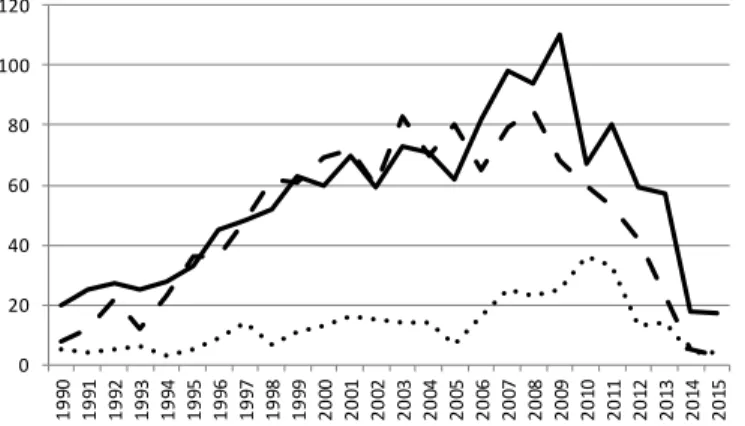
In order to quantitatively gauge the bulk of the term’s dissemination, the frequency of reference to the term in recent years was appraised, irstly in several academic databases7
and, then, narrowing the search for journals in JSTOR’s sector of international relations and area studies. Figure 1 shows the growth rate average of references to this term dur-ing the process described earlier. It illustrates the expansion of the term emerging/rising
power in academic production during this century, despite a smaller absolute relevance in
comparison with the category of emerging markets. Furthermore, by narrowing the results only to journals in the section international relations and area studies at JSTOR, Figure 2 shows that the terms emerging/rising power gain absolute relevance, besides an increased trend of expansion until soon ater the 2008’s economic crisis. Alone, these igures support the perception that the nominalisations emerging/rising power have been the ones particu-larly appropriated by international relations vernacular.
Figure 1: Growth rate average of references in academic journals.
0% 5% 10% 15% 20% 25% 30% 35% 40% 45% 50%
1990–2002 2003–2008 2009–2014
emerging markets emerging countries emerging/rising powers
Source: Authors’ elaboration from academic databases.
Figure 2: Frequency of references in JSTOR international relations and area studies – full text.
0 20 40 60 80 100 120 1 9 9 0 1 9 9 1 1 9 9 2 1 9 9 3 1 9 9 4 1 9 9 5 1 9 9 6 1 9 9 7 1 9 9 8 1 9 9 9 2 0 0 0 2 0 0 1 2 0 0 2 2 0 0 3 2 0 0 4 2 0 0 5 2 0 0 6 2 0 0 7 2 0 0 8 2 0 0 9 2 0 1 0 2 0 1 1 2 0 1 2 2 0 1 3 2 0 1 4 2 0 1 5 emerging markets emerging countries emerging/rising powers
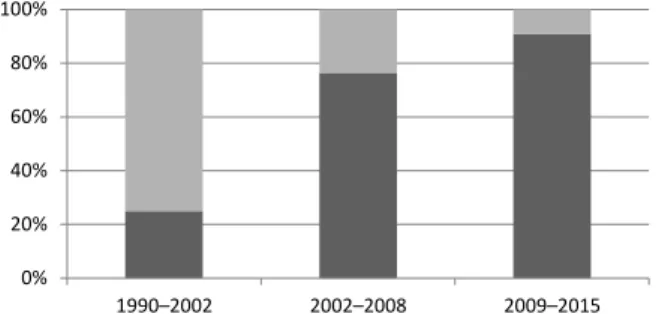
Moreover, if contrasted with some simple igures from the world economy, this move-ment reveals an interesting correlation. Figures 3 and 4 display, respectively, the emerging markets’ share of the world’s income and their GDP annual growth. he expansion in the use of the overall adjectives seems to follow an expansion of emerging markets’ economic performance and relevance, ater a short interpretational lag. From that, it is reasonable to suggest that the appropriation of the term by the discipline and the expansion in its use may relect a necessity to make sense of material and distributive transformations hap-pening in international afairs. If we pay attention to the referents associated specially with the term emerging/rising powers, as shown in Figure 5, this perception can be reinforced.
As emerging markets gain real space in the world economy, their empirical referents also
become predominantly those of the qualiiers emerging/rising powers. he novel role of what were previously called emerging markets is told as a story of emerging powers and, thus, the very difusion of the latter seems to be related to a transformation in the analyti-cal perception of the irst.
Figure 3: Emerging markets’ and developing economies’ share of world income, PPP (%).
0% 10% 20% 30% 40% 50% 60% 70% 1 9 9 1 1 9 9 2 1 9 9 3 1 9 9 4 1 9 9 5 1 9 9 6 1 9 9 7 1 9 9 8 1 9 9 9 2 0 0 0 2 0 0 1 2 0 0 2 2 0 0 3 2 0 0 4 2 0 0 5 2 0 0 6 2 0 0 7 2 0 0 8 2 0 0 9 2 0 1 0 2 0 1 1 2 0 1 2 2 0 1 3 2 0 1 4 2 0 1 5
Source: Authors’ elaboration from IMF World Economy Outlook Database
Figure 4: Emerging markets’ and developing economies’ gross domestic product growth, constant prices (%). 0 1 2 3 4 5 6 7 8 9 1 9 9 1 1 9 9 2 1 9 9 3 1 9 9 4 1 9 9 5 1 9 9 6 1 9 9 7 1 9 9 8 1 9 9 9 2 0 0 0 2 0 0 1 2 0 0 2 2 0 0 3 2 0 0 4 2 0 0 5 2 0 0 6 2 0 0 7 2 0 0 8 2 0 0 9 2 0 1 0 2 0 1 1 2 0 1 2 2 0 1 3 2 0 1 4 2 0 1 5 A n n u a l G ro w th ( % )
Figure 5: Compositions of empirical referents to the qualifier emerging power in JSTOR internatio-nal relations and area studies.
0% 20% 40% 60% 80% 100%
1990–2002 2002–2008 2009–2015
Other referents
China, India, Brazil and South Africa
Source: Authors’ elaboration from academic database.
In order to address the qualitative transformations in the term emerging within the discipline, the guiding narratives in the use of the terms emerging market, emerging
countries, emerging power, and rising power have been studied. he semantic patterns
in works that referentially used that term in relevant journals of the studied databases8
have been analysed. Both quantitative and qualitative analyses suggest the existence of a clear segmentation in the employment of the adjective emerging. he narratives attributed
to emerging markets maintain their original dialogue with the operational classiication
of inancial literature. he nominalisations emerging country, emerging power,and rising
power, in turn, seem to depict the structural changes perceived in international relations
in the course of recent decades. In general, the authors associate emerging with the phe-nomena of inluence, material capacities, political activism, hegemony, and dominance, all of which relate to manifold dimensions of might. hus, power is the quality that emerg-es from this literature, conveying the terms rising or emerging power to qualify it within this lexical range appropriated by international relations. herefore, the adjective emerging
seman-tic momentum: as these narratives gave sense to the rising power of some actors, they delineated a set of connotative dimensions that built themselves in the identity of this phenomenon.
he analysed narratives of emergence consider the main attributes associated with the historical process of the emerging powers. In the literature studied,9 the most ubiquitous
aspect identiied in such a dynamic is the forecast or assumption that emerging powers will sustain a continuous economic growth and have long-term greater economic rele-vance, which would reinforce a greater inluence in the international order (Andreasson 2001; Cooper, Antikiewicz and Shaw 2007; Macfarlane 2006; Claudín 2011; Sharma 2012; Stephen 2014; Chin 2014). In addition, the literature primarily qualiies the behaviour of the emerging powers through their claim for space in global governance, discussing whether their strategies have a reformist or revisionist character (Hurrell 2006; Tammem 2006; Cooper Antikiewicz and Shaw 2007; Ikenberry 2008; 2011; Beeson and Bell 2009; Mattoo and Subramanian 2009; Casteñeda 2010; Patrick 2010; Barros-Platiau 2010; Chin 2010; Schirm 2010; Desai and Vreeland 2011; Gray and Murphy 2013; Niu 2013; Golub 2013; Vanaik 2013; Weinlich 2013; Flemes 2013; Stephen 2014; Cooper and Farooq 2015). his quest for recognition has oten been associated with the historical identity of not belonging to the status quo order regarding the ties of these countries to the hird World movement and to the idea of Global South (Burirty 2008; Palat 2008; Callahan 2008; Kang 2007; Stuenkel 2010; Nel 2010; Santos 2011; Hurrel and Segupta 2012; Narlikar 2013; Hur-rell 2013). he ideological foundation or identity underpinning this behaviour is regarded
in the literature as their trajectory of not belonging to the hegemonic order. At the same time, a regional scope is oten attributed to these players, and regional dynamics are seen as the Gordian knot of their rise, either enhancing or undermining it (Waltz 1993; Hurrell 2006; Whitaker 2010; Flemes 2010; Buzan 2011; Burges 2013; Schenoni 2012).
hus, the observation of gains in the redistribution of world economic lows in recent years seems to be the material base of this shit in the institutional and regional activism of the so-called emerging powers in the international order. Even ater the more recently contracted expectation on further economic expansion of these countries, the relation between political behaviour and material redistribution of power to the Global South still governs the agenda in the literature (Sharma 2012; Brütsch and Papa 2013; Stephen 2014). For instance, Chin (2014) advocates the New Development Bank initiative of BRICS as the utmost symbol of this enterprise on reviewing international order to facilitate their devel-opment. herefore, the literature outlines these four dimensions of the narratives driving the lexicon for emerging to international relations:
■ perspective of relevant economic growth in the near future and a greater share of world economic lows;
■ claim for greater recognition in global governance, whether through reformist or re-visionist strategies;
In this sense, the emerging power semantic momentum comprises narratives describ-ing change set through the ambition of reform or revision of the international order, as-sociated with an identity of non-belonging to the status quo of that order. At same time, the transience in these narratives is perceived in the relevance attributed to the perspective of the progressive acquisition of material conditions to support this empowerment. How-ever, the persistence of the conundrum encompassing the redistributive politics in inter-national arenas, the ideational dispute underlying that, and the material substrate of this process are here conceived as the semantic content conveyed to the discipline through the pragmatics of the concept.
he analyses of the semantic transformations within the term emerging in its appro-priation by international relations sought to contribute to its analytical framing, systema-tising general aspects of the momentum that gave rise to its current meanings. However, as Gerring (2001: 53–4) ponders, the pragmatics in general language, per se, do not provide the conceptual validity, but a terminological spectrum that can be embedded in a spe-ciic technical language. Incorporation of the concept to international relations demands expanding the ‘state of the art’ expressed in its use and specifying the rules of usage gov-erning it within the discipline. In other words, recognising Wittgenstein’s allegory (2009: 38), once the ‘nodes of the network of similarities’ in the concept’s use are concatenated, the task of deining its theoretical terms arises. he very sense that the term conveys a transient depiction of recent history into a semantic conception of change in interna-tional relations contends a veiled debate with the established understanding of how this phenomenon has not happened before. hus, it is argued that each exposed dimension deserves its own study, incorporating a literature review and an intellectual relection on its role in this new theoretical context.
Conceptions of rising from the
stasis
of the approaches to the
intermediate states in international relations theory
he ield of international relations was envisaged to comprehend interactions among sys-tem-determining states, the centre, or the great powers (Keohane 1969). Nevertheless, the globalisation of industrial and inancial capitalism since the late twentieth century has given room to other players who do not determine systemic order, but whose integration in world dynamics would not allow this taxonomical gap anymore (Lima 1990: 7). A spe-ciic object of study has been recognised: a group of countries which ‘are diferent from Great World Powers, but could not be confused with the mass of small countries’10 (Sennes
2003: 17). his theoretical approach to intermediate states has been developed into three categories: semi-periphery, middle powers, and regional power. All these three attribute distinct substances to this position. To address these categories as the pragmatics underly-ing the theory on the rise of intermediate states, this essay investigates how each position is conceived and how the rupture with this is perceived in the literature.
Firstly, the concept of semi-periphery has its inception in the reinterpretation of the dualistic stratiication ‘centre and periphery’, from ECLAC,11 by Braudel (1985) and
capi-talism has a ‘texture’ of the same kind in the microcosm of social domination and in the macrocosm of relations among states, areas, and populations (Braudel 1985: 67–9). he international system is perceived as a World-System,12 functionally and geographically
stratiied by the concentration of capital. Beyond this conception, it was Arrighi (1998: 137–253) who ascertained the theoretical determinants of the semi-periphery. For him, this group of states is stuck to its development illusion to the extent that their provision of revenue advantages to capital ultimately reduces their cost advantages. In other words, it is possible to understand the semi-periphery as a class of highly integrated players in the system, but whose interactions are subject to a structural constraint of resources.
he semi-periphery is, therefore, a rigid position understood as part of the process of systemic reproduction instead of its transformation. Still, Arrighi (1994; 1998) and Wallerstein (1976) discuss an exceptionally disruptive condition that allows a state to rise from within this position. his situation is the building up of sustained surpluses with the whole system. So, by maintaining advantages of cost to capital in relation to the centre and of revenue in relation to the periphery and semi-periphery, a state encloses a virtuous combination that, maintained in the long run, would symptomatically perform a trajec-tory towards the centre. However, the sustainability of such a path is dependent upon its ability to retain capital and, therefore, retain the innovation within its jurisdiction. hus, the cases of emergency presented by Arrighi13 have their determinants mostly deriving
from a change in the economic activities within the country, and consequently, in its in-sertion in the systemic accumulation process.
he literature on middle powers extracts the substance of this category from the behavioural rationale of the intermediate position. Keohane (1969) has been one of the subject’s pioneer analysers, organising states according to the degree of inluence they play in the international system. Middle powers are those states which have inluence in international afairs through alliances and multilateral coalitions: the system-afecting
states (Keohane 1969: 295). Lima (1990: 10-1) dilutes this segmentation in a continuum
between autonomy and vulnerability, where middle powers are players that present the two similar doses, depending on the context of interaction. In this sense, given its posi-tional limitations, the authors associate rise with strategies seeking greater inluence in the international order. Coalition building and leadership strategies in international regimes are seen as the prime way to efectively impact international order and the constitutive attitudes of middlepowermanship (Holmes 1965; Cox 1989). Hurrell and Fawcett (2009) emphasise multilateral organisations as an arena that catalyses the power of intermediate States, being loci for cooperation among players with similar interests and for bargaining with Great Powers.
and Waever (2003: 50-6) consider that the end of bipolarity removed the overlay of sys-temic securitisation, and that it has been increasingly diicult to project the use of force worldwide, making regional spaces the environment where the security dilemma is most pungently manifested to the majority of states. Mearsheimer (2001: 234-8) generalises this restriction as a consequence of the ‘stopping power of water’ (2001: 114-28), which makes the dispute for regional hegemony determine the polarity and polarisation of the system. Whereas rise in this literature, mainly connected with security studies, is related to amplifying the scope of force projection or the conditions to determine systemic polarity, part of the literature stresses the relevance of more plural regional dynamics on this path.
Buzan and Waever (2003) conceive regional polarisation, its patterns of amity and enmity, as a complex societal phenomenon. Leadership and authority are perceived as central components in this sense (Flemes 2007; 2010; Nolte 2010; Destradi 2010; Frazier and Stewart-Ingersoll 2013). Hence, a diplomatic claim for regional leadership must be grounded in the possession of will and resources to provide public goods and act as the stabiliser of the subsystem, but also in being recognised for this role (Mattli 1999; Flemes 2007; 2010; Schirm 2010; Wehner 2014). Pedersen (2002) conceives this social element of the path to leadership as a cooperative hegemony, in which the beneits from coopera-tion – i.e. material gains and stability – exceed the costs related to the acceptance of the authority. Nolte (2010: 895) stresses the asymmetry of such cooperation once the magni-tude of the gains made by the cooperative leader is greater than those obtained by other members. Gilpin (2000; 2001: 361) highlights the relevance of economic regionalisation as a necessary strategy for states and economic groups within it to be able to thrive globally in the oligopoly environment of globalisation.
Altogether this literature provides three conceptions of the intermediate position, of the content that characterises it, and provides its internal logics. In distinctive ways, by ob-serving what gives sense to the particularity of intermediate states, these categories reveal the limits of their own existence within its own logics. In this sense, the convention on the rupture with stasis of the intermediate position is manifested in three dimensions. he semi-periphery discusses it as an organic feature of world capitalism, possessing longue
dureé determinants and from which the rise of a particular state is due to a very particular
situation. he other two categories discuss the positional consequences of that as a struc-tural constraint, but also as its behavioural consequences. Middle power literature focuses on how their limits of hard power make it reasonable to search for greater inluence in the system by engaging in international institutions through coalition building. Recent work on regional powers stresses that intermediate states have a geographical range in their inluence, in which threats, leadership, historical identities, interstate cooperation, and economic integration have augmented relevance and particularly afect the role those countries can play in world afairs.
continuity and those narratives of change from the intermediate position in international politics is seen as one that constitutes the substantive content of the concept of an emerg-ing power in international relations.
Final remarks:
transience
and
stasis
in the duality concept of an
emerging power
in international relations
As stated before, the concept of emerging power arises as a semantic manifestation of the historical process of economic and political transformations in international relations ob-served in this century, highlighting the empowerment of former emerging markets. he gain of space these players have observed in the world economy opened a conceptual blank in the discipline’s theoretical framework to comprehend such a phenomenon. he adjective emerging transformed its meaning derived from the inancial literature, in which the change of its referents has been narrated through the label emerging power, conducting it to a renewed place in international relations vocabulary.
In this narrative of change, such a greater economic growth in the developing world has empowered its major players to make a claim for space in global governance, by either reforming or revising status quo order (Hurrell 2006; Tammem 2006; Cooper, Antikiewicz and Shaw 2007; Ikenberry 2008; 2011; Chin 2010; Schirm 2010; Narlikar 2013; Kahler 2013; Gray and Murphy 2013; Stephen 2014; Chin 2014; Cooper and Farooq 2015). heir ambitions are conceived as being related to their particular trajectory of exclusion, attach-ing their behaviour to an ideological foundation or identity connected with their common historical origin in the Global South or the hird World (Palat 2008; Callahan 2008; Nel 2010; Santos 2011; Hurrell and Segupta 2012; Hurrell 2013). hese attributes defy the theoretically stagnant conception of intermediate states, shedding light onto narratives of change.
about the object it connotes – stratiication of the international system – which reveals its disruptive dynamic through its opposite – the conceptions of rise of intermediate states.
he confrontation of conceptions of rise associated with the experience of emerging
powers nowadays and those established in the theory of international relations aims to
outline a route to understanding the transformation the rising powers inlict on interna-tional afairs by contextualising its episodic manifestation with the endowed conceptions on the regularity of the phenomena that history is now describing. he opposition within the concept of emerging power allows for outlining at three synthetic dimensions that are presented here to guide this dialogue between change and continuity. Firstly, the rise of intermediate states has to address its materialistic foundation, the disruptive change in the conjunction of transactions that make up a country’s position in the world economy and enables its political inluence. his aspect raises the question of the efective struc-tural character of the empowerment acquired by some states denoted as emerging powers. Secondly, these countries’ management of those inequalities in the international order makes it relevant to understanding their strategy of leadership in international institutions regarding how they afect normative structures and whether they achieve a rule-making role in diferent international regimes. In this sense, this dimension permits theory to face the contingency of praxis, addressing the real potentialities of a ‘meta-power’14 from
mul-tilateral activism as an efective strategy for non-establishment and historically excluded actors. hirdly, the connections between regional and global dynamics seems inherent to the comprehension of the conditions of rising for emerging powers. hus, the search for global inluence has to deal with a greater concentration both of potential sources of threats and of stronger cooperation within the regional realm.
In conclusion, this duality between particularity and regularity, transience and stasis, change and continuity comprising the concept’s formation reveals three aspects that seem to deserve further debate regarding the constitutive analytical character of the phenom-enon of emerging power in international relations. he concept, in this sense, portrays a reality that instigates theorisation on the intermediate position to face the efective de-terminants of its change and, at same time, it states the limits of such possible change. herefore, this work is intended to present this constitutive analysis of the concept of an
emerging power as a necessary route to properly understanding its role as an analytical tool
within the discipline.
Notes
1 Examples of such initiatives are: the Centre for Rising Powers at the University of Cambridge; the Rising
Powers Initiative at George Washington University, the BRICLab at Columbia University, and the BRICS Center at the University of Toronto.
2 Refering to the terms of Sartori (1970: 38). ‘Conceptual travelling’ is the qualiication of new referents
throughout space and time, the ampliication of the concept´s extension. ‘Conceptual stretching’ is the connototive distortion that derives from the attempt to it these new cases by widening its intension.
3 his illustrative reprentation is atributed by Hurrell (2000: 3) to a German diplomat in the post-war period.
4 Sartori (1970: 1041) identiies extension as the number of referents in a given category and intension as
the ‘ladder of generality’ of a concept. An over-extension occurs when a concept is deformed to embrace new cases. To better understand the evolution of this discussion, see Sartori (1970; 1984: 52–3), Collier and Mahon (1993), and Goertz (cited in Collier and Gerring 2009).
5 Resources taken in the short term, in low interest rate markets, to be invested in higher risk and return
operations, in this case, securities denominated in non-convertible currencies of emerging countries (Cintra 2005; Levi 2009; Pilbeam 2013).
6 Visentini (2013) traces the term emerging power back to debate on the rise of contenders to British
hegemony in the late nineteenth centurey. Paul Kennedy’s (1989) comprehensive research sought to understand the overall paterns guiding the rise of new great powers. Waltz (1993) revives the term emerging power to identify Japan and Germany as the potential rivals of American leeting unipolarity. he idea of a rising power is also familiar in literature on power transition and on war and change in international relations. However, those concepts usually refer to dispute of power among irst-tiers of internation politics, in contrast with the current meaning attributed to contemporary emerging powers.
7 he reference to these terms has been searched in fulltexts with boolean search throughout iteen academic
databases: 1) Academic Search Premier – EBSCO; 2) Gale – Academic One File; 3) Cambridge Journals Online; 4) Duke University; 5) JSTOR; 6) Project Muse; 7) political science area of Qualis CAPES/Brasil; 8) CAPES/Brasil database for doctoral dissertations; 9) Sage; 10) Oxford University Press for Social Sciences; 11) Google Academic; 12) SCOPUS for Social Sciences; 13) Scielo Brasil; 14) Web of Science; and 15) Wiley and Sons Online.
8 hose previously stated in the footnote 6.
9 he analysed texts were all those that employed the terms emerging market, emerging country, emerging
power or rising power in their title or abstract in the area of international relations of JSTOR reviews or in A1 or A2 reviews in the Qualis-CAPES system, plus additional referential corpus. he semantical study consisted of family resemblance analysis, which means the search of common qualifations or deintions attributed to the adjectives analysed. he semantic patterns that derive this network of analogous meanings were translated into the text that comprises this section.
10 Translated from Portuguese.
11 Economic Commission of Latin America and the Caribbean of United Nations, created in 1948.
12 Here the concept of World-System in terms of Wallerstein (1974) is adopted, in lieu of Braudel´s (1985) concept of World-Economy. he option relies on the reasoning exposed by Braudel himself (1985), about the necessarily universal character of the irst and spatially delimited of the second.
13 Nominally, the case of Japan and China (Arrighi 1994; 2007).
14 In reference to Krasner´s (1985: 13–5) conception of ‘meta-power’ as the inluence a country acquires by changing the rules of the game according to its preferences. It is worth mentioning that it would also mean for the country to be closer to having what Suzan Strange (1989) has called structural power, as capacity to inluence the environment in which others’ interactions occur, in contrast with relational power, which emerges directly from a speciic interaction in a Dahlnian sense.
References
Andreasson, Stefan. 2001. ‘Africa’s prospects and South Africa’s leadership potential in the emerging markets century’. hird World Quarterly, 32 (6): 1165–81.
Arrighi, Giovanni. 1990. ‘he Developmentalist Illusion: A Reconceptualization of the Semiperiph-ery.’ In William G. Martin (eds). Semiperipheral States in the World-Economy, pp. 11–41. New York: Greenwood.
________. 1994. he Long Twentieth Century: Money, Power and the Origins of Our Times. London: Verso.
Barros-Platiau, Ana Flávia. 2010. ‘When emerging countries reform global governance of climate change’. Revista Brasileira de Política Internacional, 53: 73–90.
Beeson, Mark and Stephen Bell. 2009. ‘he G-20 and International Economic Governance: He-gemony, Collectivism, or Both’. Global Governance: A Review of Multilateralism and International Organizations, 15 (1): 67–86.
Braudel, Fernand. 1985. A Dinâmica do Capitalismo. Rio de Janeiro: Rocco.
Bruetsch, Christian and Mihaela Papa. 2013. ‘Deconstructing the BRICS: Bargaining Coalition, Imagined Community, or Geopolitical Fad?’ Chinese Journal of International Politics, 6: 299 – 327. Burges, Sean. 2013 ‘Brazil as a bridge between old and new powers?’ International Afairs, 89 (3): 577–94.
Buzan, Barry. 2011. ‘A World Without Superpowers: Decentered Globalism’. International Relations, 25(1): 1–23.
Buzan, Barry and Ole Waever. 2003. Regions and Powers: he Structure of International Security.
Cambridge, Cambridge University Press.
Callahan, William. 2008. ‘Chinese Visions of World Order: Post-hegemonic or a New Hegemony?’
International Studies Review, 10: 749-61.
Castañeda, Jorge. 2010. ‘Not Ready for Prime Time: Why Including Emerging Powers at the Helm Would Hurt Global Governance’. Foreign Afairs, 89 (5): 109–22.
Chin, Gregory. 2010. ‘Remaking the architecture: the emerging powers, self-insuring and regional insulation’. International Afairs, 86(3): 693–715.
________. 2014. ‘he BRICS-led Development Bank: Purpose and Politics beyond the G20.’ Global Policy, 5(3): 363–76.
Cooper, Andrew and Asif Farooq. 2015. ‘Testing the club culture of the BRICS: the evolution of a New Development Bank.’ Contexto Internacional, 37(1): 13–56.
Cintra, Marco Antônio. 2006 ‘A Exuberante Liquidez Global’. Economia Política Internacional: Aná-lise Estratégica, 5: 17–26.
Cooper, Andrew, Agata Antikiewicz and Timothy Shaw. 2007. ‘Economic Size Trumps All Else? Les-sons from BRICSAM’. International Studies Review, 9: 673–89.
Cooper, Andrew and Daniel Flemes. 2013. ‘Foreign Policy Strategies of Emerging Powers in a Multipolar World: an introductory review’. hird World Quarterly, 34 (6): 943–62.
Claudín, Carmen. 2011. ‘¿Qué Rusia veinte años después?’ Revista CIDOB d’afers internacionals, 96: 11–23.
Collier, David and James Mahon. 1993. ‘Conceptual “Stretching” Revisited: Adapting Categories in Comparative Studies.’ American Political Science Review, 87(4): 845–55.
Collier, David and Stephen Levitsky. 1997. ‘Democracy with Adjectives: Conceptual Innovation in Comparative Research’. World Politics, 49(3): 430–51.
Cox, Robert. 1989. ‘Middlepowermanship, Japan, and Future World Order.’ International Journal, 44: 823–62.
Destradi, Sandra. 2010 ‘Regional powers and their strategies: empire, hegemony and leadership’.
Desai, Raj and James Vreeland. 2011. ‘Global Governance in a Multipolar World: he Case for Re-gional Monetary Funds’. International Studies Review, 13: 109–21.
Fernandes, Luis, Ana Garcia and Paula Cruz. 2015. ‘Desenvolvimento desigual na era do conheci-mento: a participação dos BRICS na produção cientíica e tecnológica mundial.’ Contexto Internac-ional, 37(1): 215–53.
Flemes, Daniel. 2007. ‘Conceptualising Regional power in International Relations: Lessons from the South African Case’. GIGA Working Papers, 53.
Flemes, Daniel (ed). 2010. Regional Leadership in the Global System: Ideas, Interests and Strategies of Regional powers. London: Ashgate.
________. 2013. ‘Network Powers: strategies of change in the multipolar system’. hird World Quar-terly, 34 (6): 1016–36.
Frazier, Derrick and Robert Stewart-Ingersoll. 2013 Regional powers and Security Orders: a theoreti-cal framework. New York: Routledge.
Gerring, John. 2001. Social Science Methodology: a criteria framework. Cambridge: Cambridge Uni-versity Press.
Gilpin, Robert. 2000. he Challenge of Global Capitalism: he World Economy in the 21st Century. New Jersey: Princeton Paperbacks.
________. 2001. Global International Political Economy: understanding the International Economic Order. New Jersey: Princeton Paperbacks.
Goertz, Garry. 2006. Social Science Concepts: a user’s guide. Princeton: Princeton University Press. ________. 2009. ‘Point of Departure: intension and extension.’ In David Collier and John Gerring (eds). Concepts and Method in Social Science: he Tradition of Giovanni Sartori, pp. 181–203. Lon-don: Routledge.
Golub, Philip. 2013. ‘From the New International Economic Order to the G20: how the ‘global South’ is restructuring world capitalism from within’. hird World Quarterly, 34 (6): 1000–15.
Gray, Kevin and Craig Murphy. 2013. ‘Introduction: rising powers and the future of global gover-nance.’ hird World Quarterly, 34(2): 183–93.
Harvey, Campbell. 1995a. ‘Predictable Risk and Returns in Emerging Markets.’ Review of Financial Studies, 8: 773–816.
________. 1995b. ‘he Risk Exposure of Emerging Equity Markets.’ World Bank Economic Review, 9(1): 19–50.
Holmes, John. 1984. ‘Most Safe in the Middle’, International Journal, 39(2): 367–88.
Hurrell, Andrew. 2006. ‘Hegemony, liberalism and global order: what space for would-be great pow-ers?’ International Afairs, 82(1): 1–19.
_______. 2013. ‘Narratives of emergence: Rising powers and the end of the hird World?’ Brazilian Journal of Political Economy, 33(2): 203-21.
_______. 2000. ‘Some Relections on the Role of Intermediate Powers in International Institutions’. In Andrew Hurrell et al. (eds.) Paths to Power: Foreign Policy Strategies of Intermediate States, pp. 1–11. Washington: Woodrow Wilson Centre for Scholars.
International Monetary Fund. 2015. World Economic Outlook, April. Washington, DC.
Ikenberry, Gilford John. 2008. ‘he Rise of China and Future of the West.’ Foreign Afairs, 87(1): 23–37.
________. 2011. ‘he Future of Liberal World Order.’ Foreign Afairs, 90(3): 56–62.
Ikenberry, Gilford John, Michael Mastanduno and William C Wohlforth (eds). 2011. International Relations heory and the Consequences of Unipolarity. Cambridge: Cambridge University Press. Jordaan, Eduard. 2003. ‘he Concept of a Middle power in International Relations: Distinguishing between Emerging and Traditional Middle powers’. Politikon: South African Journal of Political Stud-ies, 30(2): 165–81.
Kahler, Miles. 2013. ‘Rising powers and global governance: negotiating change in a resilient status quo.’ International Afairs, 89(3): 711–29.
Kang, David C. 2007. China Rising: peace, power and order in East Asia. New York: Columbia Uni-versity Press.
Keohane, Robert. 1969. ‘Lilliputian’s Dilemmas: Small States in International Politics’, International Organization, 23(2): 291–310.
Khanna, Parag. 2008. O Segundo Mundo. Rio de Janeiro: Intrínseca.
Kose, M Ayhan. 2008. ‘Seven Questions About Decoupling’. IMF Research Bulletin, 9(3).
Krasner, Stephen. 1985. Structural Conlict: he hird World against Global Liberalism. Berkeley: University of California Press.
Koselleck, Reinhart. 2004. Future Past: On Semantics of Historical Time. New York: Columbia Uni-versity Press.
Lakof, George. 1990. Women, ire and dangerous things: what categories reveals about the mind.
Chicago: University of Chicago Press.
Layne, Christopher. 2009. ‘he Waning of U.S. Hegemony: Myth or Reality’. International Security, 34(1): 147–72.
________. 2012. ‘his Time it’s Real: the end of unipolarity and the pax Americana.’ International Studies Quarterly, 6: 203–13.
Lees, Nicholas. 2012. ‘he dimensions of the divide: vertical diferentiation, international inequality and North–South stratiication in international relations theory.’ Cambridge Journal of International Afairs 25 (2): 209–30.
Levi, Maurice D. 2009. International Finance. London: Routledge.
Lima, Maria Regina Soares de. 1990 ‘A Economia Política da Política Externa Brasileira: Uma Pro-posta de Análise’. Contexto Internacional, 12: 7–28.
MacFarlane, Neil. 2006. ‘he “R” in BRICs: is Russia an emerging power?’ International Afairs, 82 (1): 41–57.
Mattli, Walter. 1999. he Logic of Regional Integration: Europe and Beyond. Cambridge: Cambridge University Press.
Mattoo, Aaditya and Arvinda Subramanian. 2009. ‘From Doha to the Next Bretton Woods: A New Multilateral Trade Agenda’. Foreign Afairs, 88(1): 15–26.
Narlikar, Amrita. 2010. New Powers: How to become one and how to manage them. London/New York: Hurst Publications/Oxford University Press.
________. 2013. ‘Negotiating the rise of new powers’. International Afairs, 89 (3): 561–76.
Nel, Philip. 2010. ‘Redistribution and recognition: what emerging regional powers want’. Review of International Studies, 36: 951–74.
Nolte, Detlef. 2010. ‘How to compare regional powers: analytical concepts and research topics.’ Re-view of International Studies, 36 (4): 881–901.
O’Neill, Jim. 2001. ‘Building Better Global Economic BRICs.’ Goldman Sachs Global Economics Pa-per, 66.
________. 2003. ‘Dreaming With BRICs: Path to 2050’. Goldman Sachs Global Economics Paper, 99. ________. 2007. BRICs and Beyond. New York: Goldman Sachs.
O’Neill, Jim, Dominic Wilson, Roopa Purushothaman and Anna Stupnytska. 2005. ‘How Solid are the BRICs?’ Goldman Sachs Global Economics Paper, 134.
Palat, Ravi. 2008. ‘A new Bandung? Economic growth vs. distributive justice among emerging pow-ers’. Futures, 40(8): 721–34.
Patrick, Stewart. 2010. ‘Irresponsible Stakeholders? he Diiculty of Integrating Rising Powers’. For-eign Afairs, 89 (6): 44–53.
Pedersen, homas. 2002. ‘Cooperative hegemony: power, ideas and institutions in regional integra-tion’. Review of International Studies, 28 (4): 677–96.
Pereiro, Luis. 2002. Valuation of companies in emerging markets – a practical approach. New York: Wiley.
Pilbeam, Keith. 2013. International Finance. London: Palgrave Macmillan.
Rosch, Eleanor and Carolyn Mervis. 1975 ‘Family Resemblance: Studies in the Internal Structure of Categories’. Cognitive Psychology, 7: 579–605.
Santos, heotonio. 2011. ‘Globalization, Emerging Powers, and the Future of Capitalism’. Latin American Perspectives, 38: 45–57.
Sartori, Giovanni. 1970. ‘Concept Misformation in Comparative Politics’. American Political Science Review, 64: 1033–53.
Sennes, Ricardo. 2003. As mudanças da política externa brasileira nos anos 80: uma Potência Média recém industrializada. Porto Alegre: UFRGS.
Sharma, Ruchir. 2012. ‘Broken BRICs: Why the Rest Stopped Rising.’ Foreign Afairs, 91 (6). Avail-able in: https://www.foreignafairs.com/articles/brazil/2012-10-22/broken-brics.
Schenoni, Luis Leandro. 2012. ‘Ascenso y hegemonía: pensando a las potências emerginges desde América del Sur’. Revista Brasileira de Política Internacional, 55(1): 31–48.
Schirm, Stefan. 2010. ‘Leaders in need of followers: emerging powers in global governance.’ Euro-pean Journal of International Relations, 16: 197–221.
Schweller, Randall. 2011. ‘Emerging Powers in an Age of Disorder’. Global Governance, 17: 285–97. _________. 2014. ‘he Age of Entropy.’ Foreign Afairs, 92 (3). Available in: https://www.foreignaf-fairs.com/articles/united-states/2014-06-16/age-entropy.
Solnik, Bruno. 1991. International Investments
.
New York: Addison Wesley.Stuenkel, Oliver. ‘Identidade, status e instituições internacionais: o caso do Brasil, da Índia e do tratado de não proliferação.’ Contexto Internacional, 32 (2): 519–61.
Stephen, Matthew. 2014. ‘Rising powers, global capitalism and liberal global governance: A histori-cal materialist account of the BRICs challenge.’ European Journal of International Relations, 21: 1–27. Strange, Susan. 1989. States and Markets. New York: Continuum.
Tammen, Ronald. 2006. ‘he Impact of Asia on World Politics: China and India Options for the United States’. International Studies Review, 8(1): 563–80.
hakur, Ramesh. 2014. ‘How Representative are the BRICS?’ hird World Quarterly, 35(1); 1791–808. Vanaik, Achin. 2014. ‘Capitalist Globalisation and the Problem of Stability: enter the new quintet and other emerging powers.’ hird World Quarterly, 34(2): 194–213.
Visentini, Paulo. 2013. BRICS: As potências emergentes. São Paulo: Vozes.
Wallerstein, Immanuel. 1974. heModern World-System: Capitalist Agriculture and the Origins of the European World-Economy in the Sixteenth Century. New York: Academic Press.
_________. 1976. Semi-Peripheral Countries and the Contemporary World Crisis. New York: Aca-demic Press.
Wehner, Leslie. 2014. ‘Role expectation as foreign policy: South American secondary powers’ expec-tation of Brazil as a regional power’. Foreign Policy Analysis, 0: 1–21.
Weinlich, Silke. 2014. ‘Emerging powers at the UN: ducking for cover?’ hird World Quarterly, 35(1), 1829–44.
Wittgenstein, Ludwig. 2009. Philosophical Investigations. Oxford: Backwell. World Bank. 2013. World Development Report2013. Washington, DC.
Acknowledgements
he authors would like to thank the Editors of Contexto Internacional and the anonymous reviewers for their insightful comments and sugestions, and for the thorough revision.
About the authors
Lucas de Oliveira Paes is a PhD candidate at the Josef Korbel School of International
André Moreira Cunha is Associate Professor of Economics and International Relations
at the Federal University of Rio Grande do Sul (UFRGS). He holds both a Masters’s and a Doctoral degree in Economics from the University of Campinas (UNICAMP), Brazil. He is Research Fellow in Economics at CNPq, Brazil, and former Visiting Scholar at Cam-bridge University, United Kingdom (2011/2012), and at Leiden University, Netherlands (2006). His research interests include the macroeconomic aspects of international trade and inance, globalisation, economic integration, and their efects on policy options in the periphery of the world economy. His work has been published in the Brazilian Journal of
Political Economy, Cepal Review, Latin America Research Review, Journal of Post Keynesian
Economics, America Latina Hoy, among others.
Pedro Cezar Dutra Fonseca is Professor of Economics and International Relations at the
Federal University of Rio Grande do Sul (UFRGS), Brazil. He holds both a Bachelor’s and a Master’s degree in Economics from the same institution, and a PhD in Economics from the University of São Paulo (USP), Brazil. He is Senior Research Fellow in Economics at CNPq, and a full member of its Economics Committee. His research interests are on nomic development, Brazilian economic history in the 20th century, and history of eco-nomic thought. He is currently a member of the board of directors at the Celso Furtado International Center, and Director of the Center for International Studies on Government at the UFRGS, Brazil.
Received on 20 May 2016, and approved for publication on 11 October 2016.