Artigo Original
Karla Paoliello1 Gisele Oliveira1 Mara Behlau1
Keywords
Voice Quality of life Self-assessment Evaluation studies Voice quality Music
Descritores
Voz Qualidade de vida Autoavaliação Estudos de avaliação Qualidade da voz Música
Correspondence address: Karla Paoliello
R. Marques do Herval, 682/03, Centro, Taubaté (SP), Brasil, CEP: 12080-250. E-mail: [email protected] Received: 10/26/2011
Accepted: 10/18/2012
Study carried out at the Centro de Estudos da Voz – CEV – São Paulo (SP), Brazil. (1) Centro de Estudos da Voz – CEV – São Paulo (SP), Brazil.
Conlict of interests: nothing to declare.
self-assessment instruments
Desvantagem vocal no canto mapeado por diferentes
protocolos de autoavaliação
ABSTRACT
Purpose: To map voice handicap of popular singers with a general voice and two singing voice self-assessment questionnaires. Methods: Fifty singers, 25 male and 25 female, 23 with vocal complaint and 27 without vocal complaint answered randomly the questionnaires. For the comparison of data, the following statistical tests were performed: Mann-Whitney, Friedman, Wilcoxon, Spearman and Correlation. Results: Data showed that the VHI yielded a smaller handicap when compared to the other two questionnaires (VHI x S-VHI – p=0.001; VHI x MSVH – p=0.004). The S-VHI and MSVH produced similar results (p=0.723). Singers with vocal complaint had a VHI total score of 17.5. The other two instruments showed more deviated scores (S-VHI – 24.9; MSVH – 25.2). There was no relationship between gender and singing style with the handicap perceived. A weak negative correlation between the perceived handicap and the time of singing experience was found (-37.7 to -13.10%), that is, the smaller the time of singing experience, the greater the handicap is. Conclusion: The questionnaires developed for the assessment of singing voice, S-VHI and MSVH, showed to be more speciic and correspondent to each other for the evaluation of vocal handicap in singers. Findings showed that the more the time of singer’s singing experience, the smaller the handicap is. Gender and singing styles did not inluence the perception of the handicap.
RESUMO
INTRODUCTION
According to the World Health Organization (WHO), health is the state of complete physical, mental, and social well-being. This deinition has been constantly extended, including important considerations about quality of life. Quality of life is the perception a person has of his/her position in life, based on socioeconomic and cultural contexts; the value system in which he/she lives; and the objectives, expectations, standards, and interests in his/her life(1).
Several studies in the past have attempted to measure the quality of life of their subjects who had disorders and/or dis-eases. As a separate discipline, speech therapy has also focused on quality of life because objective evaluation, which provides important data about the pathological process, does not report patient’s point of view about his/her problem and his/her pro-fessional and social perspectives(2,3).
As would happen with research pursuits that attempt to evaluate a person’s general health status, the voice health as-sessment, too, must analyze the perspective that a patient has concerning his/her quality of life, by measuring the extent of changes that have taken place in his/her quality of life on account of problems related to impairment in voice health(4,5).
Thus, it is possible to learn the functional, social, and emo-tional consequences for a person’s professional and inancial performances in light of his/her voice alteration(4).
Since the 1990s(6), several instruments that were used to
evaluate a person’s voice perception became more reined and carefully developed to include advanced test processes and validation methods, including tools such as self-assessment psychometric measures.
Following these, to better understand the perception that a patient has of his/her voice, general protocols were developed, such as the Voice Handicap Index (VHI)(7), an instrument that
assesses the handicap caused by problems in spoken voice(7-11);
the Voice-Related Quality of Life (V-RQOL) questionnaire(4), a
tool that measures the impact of a voice issue on the quality of life; and the Voice Activity and Participation Proile (VAPP)(12),
a type of dysphonia perception assessment that focuses on the limitation of activities and restriction of participation. These three protocols have already been validated for use in Brazilian Portuguese language(13).
In order for self-assessment protocols to be regarded as more eficient instruments, they must be designed for assess-ing speciic diseases, populations, occupations, and so on. Therefore, in the voice area, after the VHI protocol implemen-tation, which is current the most internationally diffused self-assessment instrument(7,8), investigators are concerned about
developing protocols speciic to certain groups of people, for example, singers. Singers seem to be more susceptible to factors that adversely affect their voice, like, for example, gastroesophageal relux and allergies. Such disorders, coupled with higher voice demand and/or use of inappropriate singing techniques, result in voice fatigue causing dysphonia; even though this order hardly poses any risk to life, it can still compromise his/her singing performance(14). Hence speciic
protocols were developed to assess singers’ quality of life,
such as the Singing Voice Handicap Index (S-VHI)(14), the
S-VHI 10(15), Adaptation of the S-VHI(16), Modern Singing
Handicap Index (MSHI), and Classical Singing Handicap Index (CSHI)(17). The MSHI and CSHI are two versions of
the same instrument that focus on speciic aspects of modern and classical singing in Brazilian Portuguese language(18,19).
It is not known whether these protocols are interchangeable, complementary, or relect several perspectives of the same problem. Therefore, the present study aimed to carry out a comparative analysis between VHI-30, which assesses the general impact of a dysphonia, and two speciic protocols for singing (S-VHI and MSHI), by identifying the similarities and differences in a group of popular singers with and with-out vocal complaint. It had also investigated the inluence of gender on patient’s perception about the voice handicap and whether singing style inluenced an individual’s perception on his/her voice handicap and the length of time the patient had experienced the handicap.
METHODS
The study was approved by the Research Ethics Committee of the Institution (REC 1316/08), and all the participants signed the Informed Consent granting their permission to participating and disclosure of this research and its results.
Fifty professional and nonprofessional singers took part in this work, which included 25 male and 25 female; out of these, 23 were with vocal complaints and 27 were without it; study volunteers included professional and nonprofessional singers, students, and teachers. Subjects were assigned to these two groups on the basis of the number of symptoms reported in the questionnaire of signs and symptoms developed by Roy et al.(20). People with three or more voice symptoms were
considered as having vocal complaints(21). They were aged
between 16 and 74 years and were on average 34.8 years old; the sample included 27 singing students, 12 nonprofessional singers, 11 professional singers, and 7 were singing teachers as well. The mean singing period of the sample subjects was 13 years, ranging from a period as short as 1 year to a maxi-mum 55 of years. Concerning types of singing, it was found a variety of styles were used by the study subjects (some of them had experience singing in up to 5 different styles); 27 of them sang in chorus, 26 were classical singers, 18 were popular singers, 13 were gospel singers, 6 were rock singers, 5 followed other styles, 4 were country singers, and 3 were
samba/pagode singers. Another inding concerning source of
Singers answered questions posed to them from three protocols (VHI-30, S-VHI, and MSHI); the protocols were administered without the investigator’s support, with questions posed in a random order and without consulting previously answered questionnaires.
VHI-30 is a protocol directed to assess voice handicap in a dysphonic patient and included 30 items and 3 domains: emotional, functional, and organic. Each item is answered using a 5-point Likert-type scale: 0=never, 1=hardly ever, 2=sometimes, 3=almost always, and 4=always. The total score varied from 0 to 120 points, with 0 indicating no handicap and 120 indicating maximum handicap due to a voice problem. The domain scores varied from 0 to 40.
S-VHI includes 36 items developed to measure handicap caused by damage to singing voice; the question were an-swered using ive-point Likert-type scale: 0=never, 1=hardly ever, 2=sometimes, 3=almost always, and 4=always. The total score varied from 0 to 144 points, and the higher the value, the higher the voice handicap. This protocol does not present domains or subscales.
MSHI is also a protocol developed to measure singing-voice handicap and includes 30 items, which were divided into 3 subscales: inability, handicap, and law, which correspond to functional, emotional, and organic domains, respectively(18).
Each subscale is composed of 10 items and were answered similar to that demonstrated in the other protocols. Items in this instrument were also answered in a 5-point Likert-type scale: 0=never, 1=hardly ever, 2=sometimes, 3=almost always, and 4=always. The MSHI score calculation is carried out similar to that of VHI-30 and S-VHI, and the total score varied from 0 to 120 points, and the subscales from 0 to 40 points.
Scores from the three protocols were changed to percentage values in order to facilitate a comparison between different inal results; thus, the values presented correspond to the handicap percentage but not to the gross values obtained.
Results were submitted to statistical treatment with a 0.05 signiicance level (5%), and the conidence intervals were developed with 95% statistical conidence. For the analysis of nonparametric variables, Mann-Whitney’s U test was used
to compare the results between genders in all domains and the results of all protocols between the complaint group and the control group. Friedman’s test was used to compare between the total scores of the three protocols. Wilcoxon’s test was used to carrying out paired comparisons between the total scores. Spearman’s test was used to measure the degree of relation-ship between musical styles and results of protocols, and the correlation test was used to conirm the values of correlations obtained by Spearman’s test. Spearman’s correlation was used to the study the correlation between the scores measured by using VHI-30, MSHI, and S-VHI protocols that assessed mu-sical style and perceived handicap. A correlation matrix was developed and used for identifying correlation signals (positive or negative), that is, voice handicap determination and quality, in addition to the Kappa concordance index, which measures the degree of concordance between two qualitative variables (quality <20%=unimportant, 21% to 40%=minimum; 41% to 60%=regular, 61% to 80% = good, and above 81% = great)(22).
Table 2 presents a comparison of total and partial scores of the three protocols between groups with and without voice complaint. All scores from the three protocols were different when both groups were compared, with the exception of VHI functional score (p=0.054). Furthermore, the vocal complaint group scored higher than the control group.
Table 3 shows means and standard deviations found in partial and total scores of protocols in relation to gender.
Table 4 presents correlations between scores of protocols and singing experience time. It was veriied that correlation of singing experience time was negative in all scores of across the protocols (varying from -37.70 to -13.10%). In other domains, correlations were positive. Correlation was high between VHI-30 total score and VHI-30 (emotional, physical, and organic scores), between total MSHI and MSHI (inability, handicap, and law), and between S-VHI and MSHI (law and total). Correlation was good between VHI-30 total score and MSHI (inability, handicap, law, and total) and S-VHI and between VHI-30 emotional score and VHI-30 (physical and organic scores) and total MSHI. Correlation was regular between VHI-30 emotional score and MSHI (inability, handicap, and law) and S-VHI and be-tween VHI-30 functional score and MSHI (inability and handicap) and S-VHI. The analysis was done based on Kappa’s concordance index(22).
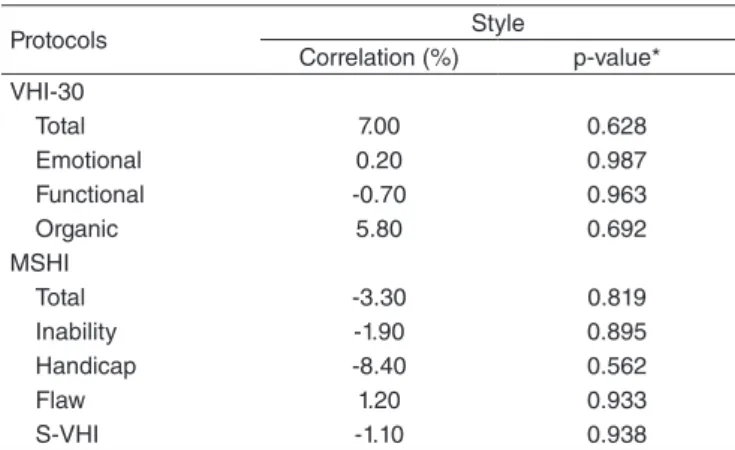
Table 5 presents values of associations between scores and quantity of styles experienced. Correlations found in this analysis were classified as unimportant because all values were lower than 20%, according to Kappa’s con-cordance index(22).
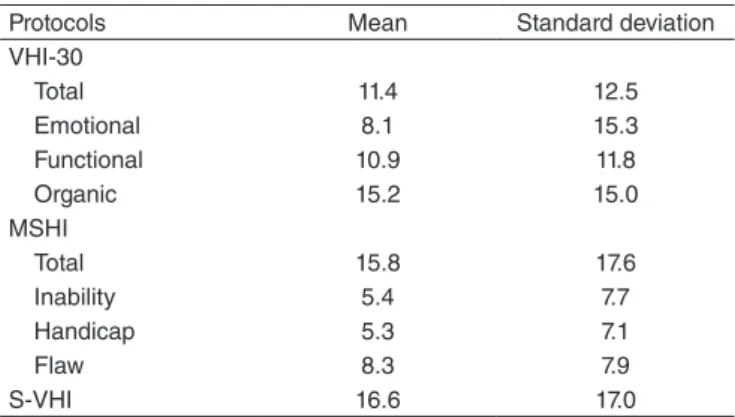
Protocols Mean Standard deviation
VHI-30
Total 11.4 12.5
Emotional 8.1 15.3
Functional 10.9 11.8
Organic 15.2 15.0
MSHI
Total 15.8 17.6
Inability 5.4 7.7
Handicap 5.3 7.1
Flaw 8.3 7.9
S-VHI 16.6 17.0
Table 1. Mean scores of the domains from the Handicap Voice Index,
Modern Singing Handicap Index, and Singing Voice Handicap Index protocols of the whole sample
Friedman’s test: VHI-30xMSHIxS-VHI – p-value of the total score = 0.001; Wilcox-on’s test: VHI-30xMSHI – p=0.004; VHI-30xS-VHI – p=0.001; S-VHIxMSHI=0.723
Caption: VHI-30 = Handicap Voice Index; MSHI = Modern Singing Handicap Index; S-VHI = Singing Voice
RESULTS
Table 3. Mean scores of the Voice Handicap Index, Modern Singing Handicap Index, and Singing Voice Handicap Index protocols according to gender
Protocols Female Male p-value*
Mean Standard deviation Mean Standard deviation
VHI-30
Total 12.8 15.7 10.0 8.2 0.823
Emotional 11.6 20.3 4.6 6.3 0.401
Functional 11.5 14.2 10.2 9.0 0.769
Organic 15.2 16.7 15.2 13.4 0.689
MSHI
Total 16.9 21.2 14.6 13.5 0.801
Inability 5.5 9.1 5.3 6.1 0.319
Handicap 6.3 9.1 4.2 4.2 0.791
Flaw 8.5 8.6 8.1 7.2 0.953
S-VHI 18.3 20.1 14.9 13.4 0.915
Mann-Whitney’s Test
Caption: VHI-30 = Handicap Voice Index; MSHI = Modern Singing Handicap Index; S-VHI = Singing Voice
Table 2. Mean scores of the domains of the Handicap Voice Index, Modern Singing Voice Handicap Index, and Singing Voice Handicap Index for the groups with and without vocal complaint
Protocols With complaint Without complaint p-value*
Mean Standard deviation Mean Standard deviation
VHI-30
Total 17.5 15.0 6.2 6.4 0.001
Emotional 15.0 20.1 2.2 4.6 <0.001
Functional 14.1 13.1 8.1 10.0 0.054
Organic 23.4 17.3 8.2 7.7 <0.001
MSHI
Total 25.2 21.3 7.7 7.6 0.001
Inability 9.5 9.6 1.9 2.2 0.004
Handicap 8.5 8.8 2.5 3.5 0.004
Flaw 12.2 9.0 5.0 4.8 0.004
S-VHI 24.9 21.2 9.5 7.3 0.012
Mann-Whitney’s Test
Caption: VHI-30 = Handicap Voice Index; MSHI = Modern Singing Handicap Index; S-VHI = Singing Voice
Table 4. Valores da correlação entre escores dos protocolos Índice de Desvantagem Vocal, Índice de Desvantagem Canto Moderno e Índice de Desvantagem Vocal para o Canto e Tempo de canto
Protocols Singing
experience time
VHI-30 (total score)
VHI-30 (emotional
score)
VHI-30 (functional
score)
VHI-30 (organic score)
MSHI (inability)
MSHI (handicap)
MSHI (flaw)
MSHI (Total)
VHI-30 Corr -25.90%
Total p-value 0.069#
Emotional Corrp-value -13.10%0.363 85.40%<0.001*
Physical Corr -37.10% 83.80% 64.20%
p-value 0.008* <0.001* <0.001*
Organic Corr -30.00% 92.50% 73.10% 68.20%
0.034* <0.001* <0.001* <0.001*
MSHI Corr -20.50% 73.60% 59.50% 58.80% 74.70%
Inability p-value 0.153 <0.001* <0.001* <0.001* <0.001*
Handicap Corr -37.60% 64.50% 57.90% 48.70% 63.50% 65.80%
p-value 0.007* <0.001* <0.001* <0.001* <0.001* <0.001*
Flaw Corr -26.40%0.064# <0.001*74.90% <0.001*57.90% <0.001*61.00% 78.40%<0.001* 79.30%<0.001* <0.001*71.90%
Total Corrp-value -33.40%0.018* 78.10%<0.001* 64.80%<0.001* <0.001*63.10% 79.60%<0.001* 86.00%<0.001* <0.001*85.80% <0.001*94.50%
S-VHI Corr -37.70% 69.50% 53.70% 51.10% 78.00% 71.20% 70.50% 80.10% 81.10%
p-value 0.007* <0.001* <0.001* <0.001* <0.001* <0.001* <0.001* <0.001* <0.001*
*p-values considered statistically significant for the adopted significance level; #p-values that tend to be significant because they are close to the acceptance limit
DISCUSSION
A singer is a voice professional who belongs to a group exposed to the risk of developing voice problems; therefore, his/her voice health requires more care(14,15).
Recently, it has come to light that voice disorders in this population result in changes, adaptations, and/or interruptions in their daily as well as professional life. In addition, lifestyle, social environment, and the place where voice is professionally used can contribute to the emergence or persistence of vocal disorders(23,24).
Measuring how such changes and adaptations affect a pa-tient’s life facilitates the evaluation and management of these professional singers(14) because the degree of limitation in a
subject’s quality of life does not necessarily point to degree of severity of dysphonia(25). Hence, use of quality-of-life protocols
in dysphonic patients is important(26), specially in singers,
be-cause it could provide an appropriate orientation in therapeutic management and voice use during treatment.
Thus, in order to optimize singers’ evaluation process, we comparatively analyzed the VHI-30 protocol, which is the most widely used questionnaire in the world, and two speciic proposals for singing, the S-VHI and MSHI, for identifying similarities and differences.
It was seen that VHI-30 under-evaluated the sample, which is expected since it is a generic protocol. As for MSHI, in comparing the three subscales, the law subscale, which is the organic domain, presented the highest scores, followed by inability and handicap subscales that represent the functional and emotional domains, respectively. Since the majority in the study group were nonprofessional singing students, for whom singing is not the primary source of income, their per-ception on restriction or a decrease in their ability to sing did not point to a severe handicap vis-à-vis the scores obtained through this protocol. In S-VHI, however, the average score of the assessed group of singers indicated a discrete, perceived
handicap. Since there were no studies speciic to the Brazilian context that managed these protocols, we do not have values for comparison (Table 1).
It is seen that the highest scores of VHI-30 happened in the organic and emotional domains (p<0.001), a inding similar to the those reported in other literature studies(8,13), which were
carried out for dysphonic individuals who were not singers. Singers with complaint had higher scores than dysphonic people, probably because of the attention given to the vocal in-strument, with more demands placed on their quality. In MSHI, the group of singers with complaint scored higher in the law subscale, followed by inability. A study with nonprofessional singers(18) also found similar results. The word law is deined
as any psychological, physiological, anatomic, structural, tem-porary, or permanent loss or abnormality. Inability means any restriction or decrease in the ability to perform an activity that is usually expected of a subject. Otherwise, handicap is a result of a law or inability, characterized by limitations or restraints in accomplishing a role expected of a person, which in turn has social, cultural, development, and economic consequences(27,28).
Thus, singers notice there is something wrong with their voice production and perceive this to be a limitation or disadvantage. As previously mentioned, majority of the study sample included both singing students and nonprofessional singers; therefore, the perception of a voice handicap in their lives can have a lower value than would be the case with the population of professional singers. Although S-VHI results were statistically different from groups with and without vocal complaint, as shown in literature indings(14,28), scores were lower than those observed
by Cohen et al.(14). Furthermore, all mean scores of the group
without complaint were lower than the other group (Table 2). As for gender, it was observed that even though women in the speech therapy clinic asked for help due to dysphonia(29), in
the present study it was found that the impact of a possible voice problem was perceived by both genders on a similar level. This was reported in other studies as well(18,30), which noticed the
self-reported impact of voice alteration on the quality of life varied according to gender, age, and professional singing (Table 3).
It has been noticed that correlations between voice handicap and singing experience time indicated a negative association in all protocols, evidencing that there is higher disadvantage if the singing voice was developed within a shorter period. This is understandable, since singing classes provide training for muscle adjustments that differ substantially with spoken voice, leading to discomfort and voice problems in the early learning stages(22). Although the said inding relates to a negative
correla-tion, its strength is low, and therefore, deviations in the protocol of singers who are at an early stage of practice must be carefully assessed. Other correlations between protocols were all posi-tive and statistically signiicant, indicating association between the various scores of protocols, although at different levels of strength. For example, correlation between S-VHI and VHI-30 and MSHI total score is strong and higher than that observed between S-VHI and VHI-30, which is only moderate. Thus, both speciic singing protocols have higher correspondence between
Table 5. Correlation values between scores of the protocols Voice Handicap Index, Modern Singing Handicap Index, and Singing Voice Handicap Index and quantity of styles practiced
Protocols Style
Correlation (%) p-value* VHI-30
Total 7.00 0.628
Emotional 0.20 0.987
Functional -0.70 0.963
Organic 5.80 0.692
MSHI
Total -3.30 0.819
Inability -1.90 0.895
Handicap -8.40 0.562
Flaw 1.20 0.933
S-VHI -1.10 0.938
Spearman’sTest
them than with the generic protocol used for assessing dysphonia since subjects demonstrated lower sensibility in identifying the speciic questions to singing voice when subjected to questions posed through this protocol(15,18,19) (Table 4).
There is a correlation between music style and VHI-30, MSHI, and S-VHI protocols. Results show correlations with val-ues lower than 9%, and the speciic singing protocols presented a negative association. Thus, there was no signiicant relationship between the variables; therefore, singing more than one musical style does not increase voice handicap perception (Table 5).
This study was carried out with popular professional and nonprofessional singers and corroborates the fact that in voice evaluation one should take into the consideration patients’ self-assessment. However, in order to optimize the process, it is necessary to use a speciic protocol for this group, and the evaluator must choose between S-VHI and MSHI because both are interchangeable.
CONCLUSION
Based on a comparative analysis between different self-assessment protocols used for assessing the impact of an alteration in singing voice in both singers with and without vocal complaint, it was concluded that VHI-30 is a generic instrument and cannot fully assess the impact of a voice prob-lem. The MSHI and S-VHI better explore this dificulty and are interchangeable. Furthermore, gender and singing in more number of styles did not inluence the voice-handicap percep-tion, indicating that the longer a singer’s experience time, the lower is his/her voice handicap.
*KP was in charge of data collection, tabulation and analysis, and writing of the manuscript; GO and MB were in charge of the study outlining, general guidance about the phases of manuscript development and elaboration.
REFERENCES
1. World Health Organization. Measuring Quality of Life – The World Health Organization quality of life instruments. Geneva, Switzerland: WHO/MSA/MNH/PSF; 1997.
2. Berlim MT, Fleck MPA. Quality of life: a brand new concept for research and practice in psychiatry. Rev Bras Psiquiatr. 2003; 25(4):249-52. 3. Higginson IJ, Carr AJ. Measuring quality of life: using quality of life
measures in the clinical setting. BMJ. 2001;322(7297):1297-300. 4. Gasparini G, Behlau M. Quality of Life: Validation of the Brazilian
Version of the Voice-Related Quality-of-Life (V-RQOL) Measure. J Voice. 2009; 23(1):76-81.
5. Gonzáles BS, Batalla FN, Santos PC, Nieto CS. Indice de Incapacidad Vocal: factores preditivos. Acta Otorrinolaringol Esp. 2006; 57:101-8. 6. Colton RH, Casper JK, Leonard R. Anamnese, Exames e Avaliações.
In: Colton RH, Casper JK, Leonard R. Compreendendo os problemas da voz – Uma perspectiva Fisiológica no Diagnóstico e Tratamento das Disfonias. Revisão Técnica: Behlau M. 3ª ed. Rio de Janeiro: Revinter; 2010. p. 195-251.
7. Jacobson BH, Johnson A, Grywalski C, Silbergleit A, Jacobson G, Benninger MS, et al. The Voice Handicap Index (VHI): Development and Validation. Am J of Speech-Lang Pathol. 1997;6:66-70.
8. Gräbel E, Hoppe U, Rosanowski F. Grading of the Voice Handicap Index. HNO. 2008;56(12):1221-8.
9. Behlau M, Alves Dos Santos L de M, Oliveira G. Cross-cultural adaptation and validation of the Voice Handicap Index into Brazilian Portuguese. J Voice. 2011;25(3):354-9.
10. Verdonck-de Leeuw IM, Kuik DJ, De Bodt M, Guimaraes I, Holmberg EB, Nawka T, et al. Validation of the Voice Handicap Index by assessing equivalence of European translations. Folia Phoniatr Logop. 2008;60(4):173-8.
11. Kasama ST, Brasolotto AG. Percepção Vocal e Qualidade de Vida. Pró-Fono Revista de Atualização Cientíica. 2007;19(1):19-28.
12. Ricarte A, Oliveira G, Behlau M. Validação do protocolo Peril de Participação e Atividades Vocais no Brasil. CoDAS. 2013;25(3):242-9. 13. Behlau M, Oliveira G, Ricarte A, Santos LAS. Validação no Brasil de
protocolos de autoavaliação do impacto de uma disfonia. Pró-Fono R Atual Cient. 2009;21(4):326-32.
14. Cohen SM, Jacobson BH, Garrett CG, Noordzij JP, Stewart MG, Attia A, et al. Creation and Validation of the Singing Voice Handicap Index. Ann Otol Rhinol Laryngol. 2007;116(6):402-6.
15. Murry T, Zschommler A, Prokop J. Voice Handicap in Singers. J Voice. 2009;23(3):376-9.
16. Morsomme D, Gaspar M, Jamart J, Remacle M, Verduyckt I. Adaptation du Voice Handicap Index à la voix chantée. Rev Laryngol Otol Rhinol. 2007;128(5):305-14.
17. Fussi F, Fuschini T. Foniatria artistica: la presa in carico foniatrico-logopedica del cantante classico e moderno. Audiol Foniatr. 2008;13(1-2):4-28.
18. Moreti F, Rocha C, Borrego MCM, Behlau M. Desvantagem vocal no canto: análise do protocolo Índice de Desvantagem para o Canto Moderno – IDCM. Rev Soc Bras Fonoaudiol. 2011;16(2):146-51. 19. Ávila MEB, Oliveira G, Behlau M. Índice de desvantagem vocal no
canto clássico (IDCC) em cantores eruditos. Pró-Fono R Atual Cient. 2010;22(3):221-6.
20. Roy N, Merrill RM, Thibeault S, Parsa RA, Gray SD, Smith EM. Prevalence of voice disorders in teachers and the general population. J Speech Lang Hear Res. 2004;47(2):281-93.
21. Behlau M, Zambon F, Guerrieri AC, Roy N. Epidemiology of Voice Disorders in Teachers and Nonteachers in Brazil: Prevalence and Adverse Effects. J Voice. 2012 (no prelo).
22. Madazio G, Leão S, Behalu M. The phonatory deviation diagram: a novel objective measurement of vocal function. Folia Phoniatr Logop. 2011;63(6):305-11.
23. Sataloff RT. Voice Impairment, Disability, Handicap, and Medical-Legal Evaluation. In: Sataloff RT, editor. Professional Voice: The Science and the Art of Clinical Care. 2ª ed. San Diego: Singular; 2005. p.1433-41. 24. Wingate JM, Brown WS, Shrivastav R, Davenport P, Sapienza
CM. Treatment outcomes for professional voice users. J Voice. 2007;21(4):433-49.
25. Ugulino AC, Oliveira G, Behlau M. Perceived dysphonia by the clinician’s and patient’s viewpoint. J Soc Bras Fonoaudiol. 2012;24(2):113-8.
26. Hogykyan ND, Wodchis WP, Spak C, Kileny RK. Longitudinal effects of Botulinum Toxin injections on Voice-related quality of life (V-RQOL) for patients with adductory spasmodic dysphonia. J Voice. 2001;15(4):576-86.
27. WHO: World Health Organization. International Classification of Functioning, Disability and Health. Geneva, Switzerland: WHO; 2001. 28. American Medical Association. Guides to the Evaluation of Permanent
Impairment. 5th ed. Chicago: American Medical Association; 2001.
29. Putnoki DM, Hara F, Oliveira G, Behlau M. Qualidade de vida em voz: o impacto de uma disfonia de acordo com sexo, idade e uso vocal proissional. Rev Soc Bras Fonoaudiol. 2010;15(4):485-90.