AR
TICLE
1 Instituto de Medicina Social, Universidade do Estado do Rio de Janeiro. R. São Francisco Xavier 524/1006 A, Maracanã. 20550-900 Rio de Janeiro RJ Brasil.
Policy of Labor Management and Health Education:
a ProgeSUS experience
Abstract Aim: To evaluate the stage of labor man-agement and education policies in municipal and state health secretariats (SMS and SES, respective-ly), having as reference the adherence to a qualifi-cation and structuring program of work manage-ment and education in the Unified Health System. Method: A descriptive and quantitative study, de-veloped with 519 representatives from the Human Resources (HR) area of SMS and SES, through a survey composed of 56 questions, via a comput-er-assisted telephone interview in 2012. Responses were processed in a computerized database and the data treated by descriptive statistics. Results: Changes in professional qualification, the estab-lishment of job and salary plans and negotiation processes were identified; on the other hand, there was no progress related to the financial and bud-getary autonomy of the area of work management and health education. Conclusion: It is observed progress in the incorporation of innovations in the management in SES and SMS from the process of training of managers and financial induction. It is necessary to monitor and periodically evaluate the operationalization of labor and education policies aimed at strengthening them, correcting directions and implementing innovative actions.
Key words Human resources in health, People
management, Decentralization, Public health pol-icies
Carinne Magnago 1
Celia Regina Pierantoni 1
Tania França 1
Swheelen de Paula Vieira 1
Rômulo Gonçalves de Miranda 1
M
ag
nag
Introduction
In Brazil, over the last decades, the area of hu-man resources in health (HRH) stands out as a field for coping with system problems. Despite the progress made by the Unified Health System (SUS), particularly regarding the decentraliza-tion guideline and the expansion of coverage of health actions and services, some challenges re-main. In 2003, in the restructuring of the Min-istry of Health (MS), the Secretariat of Labor Management and Health Education (SGTES) was created as the main federal instrument to mobilize management actions in the field of work and training, aiming to valorize and qualify the workers of the area1.
Its main purpose is to equalize the existing problems in the area and define policies, artic-ulating, on the one hand, actions linked to the Ministry of Education and Labor, the Legisla-tive and Civil Society and, on the other, the de-mands of the federative management bodies of the system. Moreover, to assume, among others, a strategic role in the intersectoral guidelines that involve the development of a National Human Resources Health Policy (PNRHS) for the effec-tive performance of SUS.
The construction of the SGTES2 positive
agenda is an important milestone for the HRH area, insofar as it incorporates themes accu-mulated and discussed in previous decades in health conferences and related in the Principles and Guidelines for Basic Operational Norms of Human Resources for SUS (NOB-HR), name-ly: guidelines for the elaboration of health care positions, careers and wages (PCCS); National Program for the Desprecarization of Labor in the SUS; Permanent Negotiation Tables of SUS (MNP-SUS); Qualification of labor and educa-tion management in SUS, among others.
Based on evidence collected in research car-ried out by the National Council of Health Sec-retaries3 and by the Observatory Network of
Human Resources in Health (IMS/UERJ)4,5 the
Program for Qualification and Structuring of Labor and Education Management in SUS (Pro-geSUS)6 was conceived in 2006. It was born with
the objective of structuring, qualifying and sup-plying health secretariats with management tools for the organization and professionalization of work management in SUS. It is a program of technical and financial cooperation with states and municipalities, aiming at the qualification and strengthening of state (SES) and municipal (SMS) HR structures of SUS.
The program combines four components: I) financing for structuring the area of work and education management in the SES and SMS, through the acquisition of furniture and com-puter equipment; II) provision by the MS of a management information system for the work and education management in health; III) train-ing of staff worktrain-ing in that sector of the SES and SMS; IV) participation, by the secretariats that join ProgeSUS, in the National System of Infor-mation in Labor Management of SUS.
This study aimed to evaluate the stage of policies of work and education management in health implemented in the SES and SMS that adhered to the restructuring project, consider-ing the need to present subsidies that collaborate with the redirection and advancement of these policies.
Method
This is a descriptive, quantitative, national-level research aimed at the SES and SMS that joined ProgeSUS until October 2011, totaling 644 struc-tures. The subjects of the study were the manag-ers responsible for the area of HR in the health secretariats.
The data collection was done through a sur-vey composed of 56 questions, whose observed variables are related to the identification of the institution and the person responsible for the HR department; adherence to ProgeSUS; job, careers and salary plan; performance evaluation (AD – from the Portuguese Avaliação de Desempenho); Permanent Trading Desk; deprecarization of work; budget and funding; health education; and opinions that included topics such as autonomy and management tools, evaluation of policies implemented by SGTES among others.
The collection instrument was prepared and structured in electronic form and applied through computer-assisted telephone interviews (ETAC), between July and September 2012. 519 (81% of the universe) interviews were complet-ed, including all SES (n = 27) and the SMS of the capitals (n = 26), and 466 SMS.
differ-aúd
e C
ole
tiv
a,
22(5):1521-1530,
2017
entiated readings that can be performed safely. The stratification by region (North, Northeast, South, Southeast and Midwest) and by popula-tion size (up to 50 thousand, 50,001 to 100,000, 100,001 to 500,000, over 500 thousand) indicated coverage of respondents higher than 70% in all strata where the secretaries are located.
The answers were processed in computerized database in Microsoft Office Excel® spreadsheets
and Statistical Package for the Social Sciences (SPSS)®, and data treated by descriptive
statis-tics. All the results were discussed and validated in periodic meetings with the set of actors of the National Permanent Negotiating Desk of SUS.
In agreement with the ethical norms destined to the research involving human beings, the study was submitted to the Committee of Ethics in Re-search of the Institute of Social Medicine of the State University of Rio de Janeiro and approved. The Informed Consent Form was sent to all the respondents by electronic mail, and read before the telephone interview began. At the end of the reading, the respondent was asked to confirm, under recording, the understanding of the term and his desire to participate freely in the research.
Results
Profile of the respondents
Those responsible for the area of HR in SES and SMS are mostly women (61%), aged between 30 and 49 years (31%), and higher education in non-health related areas (33%), especially law And administration. Regarding the denomina-tion of the head of the HR department, the de-nominations set “manager”, “director” and “co-ordinator” represented the highest percentage (29%), followed by “secretaries of health” (17%). The highest proportion of respondents held the position up to three years (30%).
Profile of the investigated health secretariats
The characterization due to the subordination of the area of work and health education manage-ment indicated that most of the organs are sub-ordinate to the health department (65.9%). 27% of the organs of the SMS and 23% of the capitals SMS are subordinated to the central of HR of the city hall. In smaller municipalities (up to 100,000 inhabitants), the degree of decentralization is still small, given that just over 33% of HR organs are
directly subordinated to the city hall. Regarding the hierarchical level of the area in the organiza-tion chart of the health department, the results indicate a predominance related to the second (26.4%) and third (20.2%) levels.
The main activities developed in the area of work and health education management, accord-ing to the respondents were: “personnel admin-istration” and “performance evaluation”. In the capital SMS, the “professional training and de-velopment for the health area” and “regulation” and “labor negotiation” stood out. The lowest percentages for SES and capital SMS were found, respectively, in the activities of “planning and budget” and “information systems”. In munici-palities above 500,000, in turn, the “integration between the education and health sectors” and “promote the articulation with the educational organs, trade union and supervision of profes-sional practice and social movements “were the main activities cited.
Adherence to ProgeSUS
For 50.7% of the respondents to the adhesion to ProgeSUS, it made possible changes in the structuring of the management area, especially in the context of SES and capital SMS. When ques-tioned about the degree of importance attributed to the components of ProgeSUS, it was observed a greater valuation for the financing for the ac-quisition of computer and furniture equipment, regardless of the type of secretariat, region or size of the municipality of location.
The most important aspects for the qualifica-tion and structuring of health work and educa-tion, based on ProgeSUS, were: the Specialization course in Work Management and Health Educa-tion that contributed to the qualificaEduca-tion of the management processes and; the development and supply of information tools.
The restructuring of the team and the cre-ation of the work and educcre-ation management area, after participating in the specialization course, were the main changes most indicated.
Position, Career and Salary Plan (PCCS – from the Portuguese Plano de Cargos, Carreira e Salário)
M
ag
nag
The lack of plans in 29% of the secretariats (especially those located in small municipalities) was justified by the inexistence of a management policy that contemplates the implementation of PCCS and the lack of autonomy of the secretariat to elaborate the plan.
Regarding the specific plans for SUS workers (n = 137), 44% incorporated the National Guide-lines for the establishment of PCCS under the SUS, approved by the National Permanent Nego-tiation Table of the SUS (MNNP-SUS)7,
accord-ing to the Respondents; 39% did not know how to report. Among those who answered that there was no influence of the guidelines in the prepa-ration of the plans, the most mentioned reasons were the lack of knowledge of the existence of the guidelines, the lack of understanding of them, and the lack of interest by them.
Regarding the aspects covered in the specif-ic PCCS for health, the most cited as criteria for career progression were: development opportu-nities associated with continuing education and length of service (79.9% and 73.5%, respective-ly).
The discussion of PCCS models to the health differentiated by professional category and level of education was reported by 31.6% and 18.3% of managers, respectively. Among these secretar-iats, 50.6% treat this discussion within a specific
commission for this purpose, 8.1% discuss at the negotiation tables and another 16% at other ne-gotiation venues.
Performance evaluation (AD – from the Portuguese Avaliação de Desempenho)
In 47% of the secretariats (n = 242) there are AD processes for all public workers; In 24% there are specific processes for the health sector, among which 67% are fruits of negotiation be-tween workers and managers.
The main aspects of health-specific AD are “career development opportunities” and “career advancement” (70.7% and 61.8%, respectively). Specifically between SES and SMS capital, the most cited was “the payment of gratuities”.
Permanent negotiation table of work
The labor negotiation tables are not imple-mented in 44% of the secretariats (n = 226). The main reasons for non-implantation are shown in Graph 1.
It was identified the existence of 137 tables (26%) implemented, among which only 53 are in operation, and 76 have approved internal reg-ulations. The largest number of SES and capital SMS tables was implemented between 2003 and
Graph 1. Reasons for not installing the Permanent Negotiating Table of the Unified Health System in the states and municipalities, according to respondents. Brazil, 2012 (n = 226).
Source:: ObservaRH/IMS-UERJ. Evaluation of National Policies and Programs of Labor Management and Health Education in SUS. Brazil, 2014.
DK/DR: Does not know/Does not respond; SMS: municipal health secretariats; SES: state health secretariats. Did not have technical advice for implementation
SMS/SES already uses tool for work negotiation in SUS
Other
There was no interest of the managers
There was no interest of the workers
DK/DR
Does not consider relevant to have negotiation table
31% 21%
14%
13%
8% 8%
aúd
e C
ole
tiv
a,
22(5):1521-1530,
2017
2008, and between SMS, as of 2009. Regarding the scope, 45% of the tables are specific to the health sector.
After the tables implantation, 46.7% of the respondents stated that there had been changes in work relationships, especially in relation to public tenders and selection processes, working conditions, PCCS and salary.
The study investigated the existence of other spaces of labor negotiation, and the places most mentioned by the respondents were: meetings of health councils and assemblies with workers. For 19.5% of the secretariats, conflicts are not re-solved in any instance.
Improvement of work
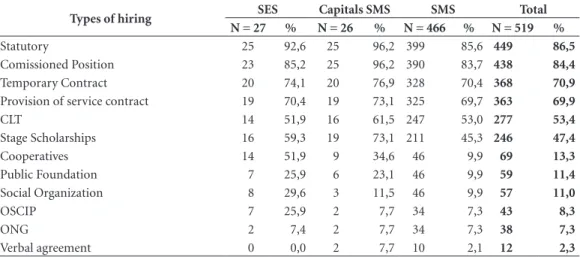
There are numerous contracting methods used by the secretariats. The most mentioned types were: statutory (86.5%) and commissioned position (84.4%), as shown in Table 1.
Among the managers of the researched secre-tariats, 72.3% were not aware of the Protocol on the Improvement of Work of MNNP-SUS. Of the secretariats that indicated knowing the protocol (n = 144), 72% reported having used it to guide relative policies; 20% said they had no interest in using it and another 20% said they did not un-derstand the concept of precarious work.
Budget and financing
Regarding the budget and funding, 78% (n = 21) of the SES managers, 80.8% (n = 21) of the capitals SMS and 65.7% (n = 306) of the SMS reported the existence of a budget for the work management and health education area. The in-corporation of payroll in this budget occurs in 66% of the secretariats.
The lack of financial and budgetary autono-my of the managers was reported by 63% of the managers of the SES, 84.6% of the capitals SMS and 62.2% of the SMS. Most respondents (62%, n = 321) were not able to report the percentage of funding allocated to the area. Among those who knew (38%, n = 198), 12% indicated that the per-centage of resources is less than 5%.
The study, when investigating the opinion of the manager regarding the sources of financing of the area, obtained a majority (71.5%) indica-tion for the responsibility of the three govern-mental spheres (federal, state and municipal).
Health education
According to the results of this study, 209 (41%) health secretariats are referenced to some Permanent Education Pole (PEPS), of which 14 are SES and six SMS.
Table 1. Modalities of hiring of human resources practiced by health secretariats according to type of secretary. Brazil, 2012.
Types of hiring SES Capitals SMS SMS Total
N = 27 % N = 26 % N = 466 % N = 519 %
Statutory 25 92,6 25 96,2 399 85,6 449 86,5
Comissioned Position 23 85,2 25 96,2 390 83,7 438 84,4
Temporary Contract 20 74,1 20 76,9 328 70,4 368 70,9
Provision of service contract 19 70,4 19 73,1 325 69,7 363 69,9
CLT 14 51,9 16 61,5 247 53,0 277 53,4
Stage Scholarships 16 59,3 19 73,1 211 45,3 246 47,4
Cooperatives 14 51,9 9 34,6 46 9,9 69 13,3
Public Foundation 7 25,9 6 23,1 46 9,9 59 11,4
Social Organization 8 29,6 3 11,5 46 9,9 57 11,0
OSCIP 7 25,9 2 7,7 34 7,3 43 8,3
ONG 2 7,4 2 7,7 34 7,3 38 7,3
Verbal agreement 0 0,0 2 7,7 10 2,1 12 2,3
Source: ObservaRH/IMS-UERJ. Evaluation of National Policies and Programs of Labor Management and Health Education in SUS. Brazil, 2014.
M
ag
nag
As the main difficulties faced by PEPS, there are: few budgetary and financial resources for many projects; release of financial resources be-yond needs, and financial implementation by PEPS. This scenario does not change when strat-ification by type of secretary.
Among the positive aspects of PEPS, the most mentioned were the existence of Administrative Rule no. 198/GM/MS of 2004, which instituted
the National Policy of Permanent Education in Health (PNEPS)8; the articulation of a local team;
and dialogue with educational institutions. Re-garding the main positive aspects of the MS sup-port ways to states and municipalities, the main indications were for the transfer of financial re-sources.
Evaluation of policies implemented by SGTES
Managers were asked to evaluate the policies implemented by SGTES. The results are shown in Table 2.
ProgeSUS, followed by training / specializa-tion programs and PCCS were the ones that ob-tained the highest approval percentages. It em-phasizes the high percentage of ignorance of the other initiatives and programs of the SGTES.
Autonomy
Regarding the degree of the leader autonomy of the work management area to perform differ-ent activities in the area, 77% and 72% of respon-dents said they had little or no autonomy over hiring personnel and optimizing financial re-sources, respectively. The greater autonomy was credited to the training of personnel (35.6%).
Management tools
The management tools PCCS, AD and nego-tiation table were considered as facilitators of the management processes by 57%, 70% and 47%, respectively. The non-use of these tools was re-ported by 25%, 17% and 37%, respectively.
Discussion
With the expansion of the SUS, and especially after the 1996 NOB, decentralization to munic-ipalities became official and priority, giving them responsibility for the organization, coordination and execution of local health systems (municipal
SUS). The municipalization took place primarily at the primary level of care, while when it comes to third-level, specialized and hospital care, there is a greater division of responsibility between government spheres.
However, it is still argued about the mana-gerial capacity of the municipality, even because the regulation of the decentralization process remains incomplete, generating ambiguity and indefiniteness regarding the responsibilities of the federated entities. And because the munic-ipalization itself does not require extrapolation of organizational difficulties and management at the local level9.
Moreover, the expansion and increasing mu-nicipal responsibility, especially in this decade, regarding primary health care, demands the in-corporation of innovations not always able to overcome old existing problems10. Thus, it is
con-sensual that the municipalization of SUS must be linked to a cooperative relationship between the spheres, in order not to allow a fragmentation of the health system.
Previous and parallel to this process of de-centralization, we find the social and economic transformations, especially in the field of work. These become more evident from the process of productive restructuring, characterized mainly by the incorporation of technologies and other innovations, aiming at a more flexible organiza-tion and work management11,12.
Within SUS, SGTES, besides reconfiguring this area in national politics, brings with it an accumulation of power for this field of action. In this sense, among other initiatives, ProgeSUS emerges, whose proposal is intrinsically articulat-ed with the objectives that guidarticulat-ed the creation of the SGTES, among them, to plan and formulate policies for management and regulation of work and health education, aiming at the best quality of health services and actions13.
This study identified that the induction pro-voked by the project in the health secretariats favored the creation of RHS (Human Resourc-es in Health, in PortuguResourc-ese known as Recursos Humanos em Saúde), structured physical areas and qualified management teams of the SES and SMS, as part of the first and third components of the proposal. All states and capitals adhered to the program, even though the financial resourc-es offered to each management structure were scarce.
aúd e C ole tiv a, 22(5):1521-1530, 2017
the effort made by the MS in the development and provision of information tools to support management, this did not Managed to be incor-porated in the processes of management of the
health secretariats, still remaining a great chal-lenge for the area.
The comparison of these results with find-ings from a previous study14, published later15-17,
Table 2. Opinion of the human resources managers on the actions of the Secretariat of Labor Management and Health Education according to type of secretariat. Brazil, 2012.
Actions Evaluation SES Capitals SMS SMS Total
N = 27 % N = 26 % N = 466 % N = 519 %
Reorientation National Program for Professional Training in Health (Pro-health) Good Regular Insufficient Doesn’t know DK/DR 16 0 1 7 3 59,3 0,0 3,7 25,9 11,1 18 3 1 2 2 69,2 11,5 3,8 7,7 7,7 163 64 18 201 20 35,0 13,7 3,9 43,1 4,3 197 67 20 210 25 38,0 12,9 3,9 40,5 4,8 Education Program
for Working for Health (PET-Health) Good Regular Insufficient Doesn’t know DK/DR 19 1 0 7 0 70,4 3,7 0,0 25,9 0,0 19 3 0 2 2 73,1 11,5 0,0 7,7 7,7 149 48 15 234 20 32,0 10,3 3,2 50,2 4,3 187 52 15 243 22 36,0 10,0 2,9 46,8 4,2 National Program of
Support to the Training of Physicians Specialists in Strategic Areas (Pro-residencies) Good Regular Insufficient Doesn’t know DK/DR 18 0 1 8 0 66,7 0,0 3,7 29,6 0,0 11 4 1 6 4 42,3 15,4 3,8 23,1 15,4 93 32 18 303 20 20,0 6,9 3,9 65,0 4,3 122 36 20 317 24 23,5 6,9 3,9 61,1 4,6 Middle Level Professional Training Program for Health (PROFAPS) Good Regular Insufficient Doesn’t know DK/DR 20 0 1 6 0 74,1 0,0 3,7 22,2 0,0 6 3 3 10 4 23,1 11,5 11,5 38,5 15,4 70 37 14 325 20 15,0 7,9 3,0 69,7 4,3 96 40 18 341 24 18,5 7,7 3,5 65,7 4,6 Training/ Specialization Programs Good Regular Insufficient Doesn’t know DK/DR 14 6 1 6 0 51,9 22,2 3,7 22,2 0,0 9 6 2 4 5 34,6 23,1 7,7 15,4 19,2 203 69 30 144 20 43,6 14,8 6,4 30,9 4,3 226 81 33 154 25 43,5 15,6 6,4 29,7 4,8 Position, Career and
Salary Plan Good Regular Insufficient Doesn’t know DK/DR 16 7 2 2 0 59,3 25,9 7,4 7,4 0,0 13 4 2 3 4 50,0 15,4 7,7 11,5 15,4 182 72 50 144 18 39,1 15,5 10,7 30,9 3,9 211 83 54 149 22 40,7 16,0 10,4 28,7 4,2 Negatiation Table of SUS Good
Regular Insufficient Doesn’t know DK/DR 15 4 3 4 1 55,6 14,8 11,1 14,8 3,7 19 0 2 1 4 73,1 0,0 7,7 3,8 15,4 160 61 49 173 23 34,3 13,1 10,5 37,1 4,9 194 65 54 178 28 37,4 12,5 10,4 34,3 5,4 Reward InovaSUS Good
Regular Insufficient Doesn’t know DK/DR 20 1 1 5 0 74,1 3,7 3,7 18,5 0,0 18 1 1 2 4 69,2 3,8 3,8 7,7 15,4 154 47 17 226 22 33,0 10,1 3,6 48,5 4,7 192 49 19 233 26 37,0 9,4 3,7 44,9 5,0 Program for the
qualification and structuring of labor and education management in SUS (ProgeSUS)
Good Regular Insufficient Doesn’t know DK/DR 21 1 3 2 0 77,8 3,7 11,1 7,4 0,0 17 5 0 1 3 65,4 19,2 0,0 3,8 11,5 240 72 23 111 20 51,5 15,5 4,9 23,8 4,3 278 78 26 114 23 53,6 15,0 5,0 22,0 4,4
M
ag
nag
suggests a greater decentralization of the RHS, which, for the most part, is directly linked to the respective health secretariats. This finding is also corroborated by the hierarchical position of these organs in the organizational chart: sec-ond and third levels, mostly. It also points to the expansion of the labor negotiation policy, due to the considerable increase of secretariats with specific PCCS for health and an increase in the number of negotiating tables installed.
This movement can be explained, at least in part, by the reinstallation of MNNP-SUS in 2003, which since then has been operating uninter-ruptedly and by the valorisation of this manage-ment tool by the MS18 Labor Management Policy.
Nevertheless, maintaining the effective function-ing of the tables already installed is one of the great challenges posed for the maintenance of the negotiation process. And in this context, the lack of mobilization and ignorance of the actors in-volved in negotiation processes and management tools, under-financing of the sector, the lack of technical support by the SES and the “lack of po-litical will” is taken as hindrances.
The change of government and health man-agers is seen as an obstacle to the negotiation and implementation of PCCS, since, generally, the processes initiated in previous management are not followed up. The low institutionality of ac-tions in the field of work and education in health facilitates discontinuities and changes experi-enced with alternation of managers, although the field of HR presents a rotation that can overcome an elective mandate, in some cases19.
The pairing of the findings between the two surveys is also not favorable to this when it comes to knowledge of the MNNP-SUS Policy and Pro-tocol of Work Improvement20. In 2008, the
per-centage of those who reported not knowing such protocol was 42.3% (n = 107). In this study, the lack of knowledge was slightly more than 72% (n = 373). Likewise, there was a lower number of health secretariats referenced to PEPS; as there was no significant progress in relation to the fi-nancial and budgetary autonomy of the work management area and health education, when compared to previous studies4,5,14-17.
In general, the HR organs of the SES and SMS, especially those of the capitals, have been putting into practice instruments of the SGTES ‘positive agenda, although there are significant variations in the breadth and extention of this implementa-tion. Confirming that this is a universe composed of disparate units, characterized by deep regional inequalities and a large number of fiscally and
administratively fragile municipalities, the re-search showed that the HR organs of the SES and, in particular, the capitals SMS, showed a greater dynamics and have more resources to program the management and development of the work according to the policies defined by the MS.
In this context, it is clear the cooperation of the SES in fulfilling its role as articulator and technical supporter of the municipalities in the process of structuring and developing labor and education management policies, thus promoting the regulatory and planning capacity of the func-tion HR by the municipal SUS16.
Despite the advances, there is no doubt about the interference of the variable “autonomy” of the respective HR body in the institutionalization of its technical - financial, administrative and orga-nizational capacity - to ensure that the manage-ment functions are being performed by the unit of government. It is assumed that the delegation of the allocative function of budgetary and finan-cial resources and organizational autonomy to its management structure has a positive impact on the scope of the exercise of the functions of coor-dination of working conditions and permanent education strategies.
In view of the above, it is noted that the fed-eral commitment to implement policies that promote changes in work management, such as ProgeSUS, is remarkable. Such policies have proven to be very relevant and fundamental for the strengthening of the HR area. However, there is still a lot to be done in order for municipalities and states to incorporate the guidelines estab-lished in the negotiation processes and to acquire the desired managerial capacity.
Conclusion
The purpose of this study was to identify if the managerial processes and organizational struc-ture recommended by MS for the area of HR have been incorporated by the SES and SMS that joined a program to strengthen work manage-ment and education. The results point to changes that have contributed especially to professional qualification, implementation of PCCS and ne-gotiation processes.
aúd
e C
ole
tiv
a,
22(5):1521-1530,
2017
addition, the common trait observed in the ana-lyzed groups goes back to the fragility of broader issues such as the autonomy of financial manage-ment and processes that involve work (planning, hiring, career, etc.).
This study does not exhaust all the possi-bilities, even more, the analyzes presented here should be discussed and disseminated to the var-ious actors involved in the process of assessment,
validation and construction of alternatives to the area, aimed at strengthening the SUS.
There is a need for constant monitoring and evaluation of the operationalization by federal agencies of labor management and health educa-tion policies, to account for the specificities of the area and the trends of changes in these adminis-trative realities, contributing to the strengthening of national conduction strategies of MS/SGTES policies.
Collaborations
M
ag
nag
References
1. Brasil. Decreto nº 4.726, de 9 de junho de 2003. Apro-va a Estrutura Regimental e o Quadro Demonstrativo dos Cargos em Comissão e das Funções Gratificadas do Ministério da Saúde, e dá outras providências. Diário Oficial da União 2003; 10 jun.
2. Brasil. Ministério da Saúde. Secretaria de Gestão do Trabalho e da Educação na Saúde. Departamento de Gestão e Regulação do Trabalho em Saúde. Gestão do trabalho e da regulação profissional em saúde: agenda positiva. Brasília: MS; 2004.
3. Conselho Nacional dos Secretários de Saúde (CO-NASS). Estruturação da Área de Recursos Humanos nas
Secretarias de Saúde dos Estados e do Distrito Federal.
Brasília: CONASS; 2004.
4. Observatório de Recursos Humanos em Saúde. Uni-versidade do Estado do Rio de Janeiro. Instituto de Me-dicina Social. Capacidade gestora de recursos humanos em instâncias locais de saúde em municípios com
popu-lação superior a 100 mil habitantes. Relatório Técnico.
Rio de Janeiro: ObservaRH-IMS/UERJ; 2004. 5. Observatório de Recursos Humanos em Saúde.
Uni-versidade do Estado do Rio de Janeiro. Instituto de Me-dicina Social. Capacidade gestora de recursos humanos em instâncias locais de saúde em municípios com popula-ção inferior a 100 mil habitantes. Relatório Técnico. Rio de Janeiro: ObservaRH-IMS/UERJ; 2006
6. Brasil. Ministério da Saúde (MS). Portaria nº 2.261, de 22 de setembro de 2006. Institui o Programa de Qua-lificação e Estruturação da Gestão do Trabalho e da Educação no SUS (ProgeSUS). Diário Oficial da União
2006; 26 set.
7. Brasil. Ministério da Saúde (MS). Secretaria de Gestão do Trabalho e da Educação na Saúde. Mesa Nacional de Negociação Permanente do SUS. Protocolo nº 006/2006.
Aprova as Diretrizes Nacionais para a instituição de Pla-nos de Carreira, Cargos e Salários no âmbito do Sistema
Único de Saúde - PCCS – SUS. Brasília: MS; 2006.
8. Brasil. Ministério da Saúde. Portaria nº 198/GM/MS, de 13 de fevereiro de 2004. Institui a Política Nacional de Educação Permanente em Saúde (PNEPS). Diário Oficial da União 2004; 14 fev.
9. Costa V. Relações Intergovernamentais no Brasil: de-senvolvimento recente e perspectivas. In: Meekison JP, organizador. Relações intergovernamentais em países fe-derais: uma série de ensaios sobre a prática de governança
federal. Ottawa: Fórum de Federações; 2003. p. 77-89.
10. Dedecca CS, Trovão CJBM. A força de trabalho no complexo da saúde: vantagens e desafios. Cien Saude
Colet 2013; 18(6):1555-1567.
11. Santana MA, Ramalho JR. Sociologia do trabalho no
mundo contemporâneo. Rio de Janeiro: Jorge Zahar;
2004.
12. Martins MIC, Molinaro A. Reestruturação produ-tiva e seu impacto nas relações de trabalho nos ser-viços públicos de saúde no Brasil. Cien Saude Colet
2013;18(6):1667-1676.
13. Dau DM, Cerca AP. A negociação coletiva como meto-dologia de gestão do trabalho em saúde. Divulg saúde debate. 2012; (47):29-30.
14. Observatório de Recursos Humanos em Saúde. Uni-versidade do Estado do Rio de Janeiro. Instituto de Medicina Social. Gestão do trabalho e da educação em
saúde:análise da década atual. Rio de Janeiro:
Obser-vaRH-IMS/UERJ; 2008.
15. Pierantoni CR, Garcia AC. Human resources for health and decentralization policy in the Brazilian health sys-tem. Hum resour health [serial on the Internet]. 2011. [cited 2013 jun 12];9(12). Available from: http://www. human-resources-health.com/content/9/1/12. 16. Pierantoni CR, Garcia AC. A Gestão do Trabalho e da
Educação na Saúde em secretarias estaduais e muni-cipais de Saúde. Divulg saúde debate 2012; (47):45-55. 17. Pierantoni CR, França T, Garcia AC, Varella TC,
Mat-sumoto KS. Gestão do trabalho e educação na saúde. Rio de Janeiro: CEPESC-IMS/UERJ-ObservaRH; 2012. 18. Brasil. Ministério da Saúde (MS). Secretaria de Gestão
do Trabalho e da Educação na Saúde. Conselho Nacio-nal de Saúde. Mesa Nacional de Negociação Permanente do SUS: democratização nas relações de trabalho no
Sis-tema Único de Saúde. Brasília: MS; 2003.
19. Silva ND. Sistema Nacional de Negociação Permanente do SUS: um instrumento de gestão do trabalho na saúde
[dissertação]. Rio de Janeiro: Fundação Oswaldo Cruz; 2012.
20. Brasil. Ministério da Saúde (MS). Secretaria de Gestão do Trabalho e da Educação na Saúde. Mesa Nacional de Negociação Permanente do SUS. Protocolo nº 007/2007. Dispõe sobre a implementação da Política de Desprecari-zação do Trabalho no SUS junto às Mesas e Mecanismos
de Negociação no SUS. Brasília: MS; 2007.
Article submitted 10/07/2016 Approved 12/09/2016