Autor Responsável: André Garay
10.1590/S1517-707620150001.0009
Data de envio: 08/01/2013 Data de aceite: 04/11/2014
Studies on thermal and viscoelastic
properties of vinyl ester resin and its
composites with glass fiber
André C. Garay1, Lucas T. Paese1, Jeferson A. Souza2, Sandro C. Amico1
1
GCOMP/LAPOL/PPGEM - UFRGS C.P. 91501-970, Porto Alegre/RS. e-mail: [email protected]; [email protected]; [email protected] 2
School of Engineering – FURG C.P. 96203-900, Rio Grande/RS. e-mail: [email protected]
ABSTRACT
Vinyl ester resins are widely used in sandwich composite structures. Because of their good resistance to chemicals, flexibility and easy processing, these sandwich are extensively applied in the marine sector. These composites are typically manufactured by liquid molding processes, especially infusion. In this study, RTM light was used to inject the polymeric resin into the mold cavity, flowing in the space between the impermea-ble core and the mold walls, where the fibrous medium was. In this process, viscosity, gel time and curing time of the resin are very important parameters. This work addressed the curing and post-curing characteris-tics of a vinyl ester resin, and also the characterischaracteris-tics of neat and reinforced vinyl ester using dynamic me-chanical analysis (DMA). The increase in shear rate did not significantly influence resin viscosity within the studied range. Differential scanning calorimetry showed the efficiency of the post-curing stage, with the de-crease in residual enthalpy. With DMA, it was possible to determine gel time and gel temperature, which yielded similar values to those found by the SPI (Society of the Plastics Industry) method, indicating that the simpler SPI method can be reliably used for that.
Keywords: Vinyl ester, DMA, RTM light, sandwich composites.
1. INTRODUÇÃO
Vinyl ester resins (VER) result from the reaction between bisphenol-A based epoxy oligomers and unsaturat-ed carboxylic acids, such as acrylic or methacrylic acid which provides unsaturatunsaturat-ed terminal sites [1]. This resin is one of the most important thermoset polymers that combine the chemical, mechanical and thermal properties of epoxy resins with the fast cure of unsaturated polyester resins (UPRs) [2-3].
Composite materials produced with vinyl ester resins and glass fibers are widely used in marine appli-cation, such as fishing trawlers, canoes, patrol boats, mine hunters and submarine domes [4]. In many cases, sandwich composite structures are chosen and the easy processing of VER allows the use of liquid molding techniques, such as infusion and RTM light. In these processes, resin is injected into the mold cavity, flowing in the space between the impermeable core of the sandwich and the mold walls, where the fibrous medium is. Since resin flow occurs through long distances, viscosity and gel time of the resin become critical parameters. The cure of VER plays a vital role in their processing and cure kinetics studies have received much attention. Calorimetry has been used to determine the effect of the initiator concentration and oxygen on the rate of cure [5]. These resins generally contains 30-60% styrene by weight, which serves as diluents to en-hance linear chain extension and to reduce viscosity of the resin, allowing for easy processing and room tem-perature curing [6]. Styrene also acts as a “bridge’’ between chains during the cross-link process, that occurs when an initiator opens up double-carbon bonds between vinyl ester and styrene molecules, allowing these free radicals to link and crosslink, resulting in a cured material with high strength and resistance to degrada-tion.
65 RTM light (L-RTM) [7] and vacuum assisted resin infusion (VARI). These processes are rapidly becoming very popular because they are ecofriendly, being carried out in closed molds [8].
Dynamic mechanical analysis (DMA) has proven a valuable tool for studying the structure of poly-mers and composites [8, 9]. Study of the glass transition by DMA involves measuring loss and storage modu-lus of the material in a given oscillation frequency from room temperature to above the glass transition tem-perature (Tg). During curing of a thermoset polymer, the number of crosslinks increases, consequently, re-ducing mobility of the molecular segments and increasing Tg of the material [5]. Once the temperature of the material exceeds the curing temperature, freezing of the reactive groups occurs, preventing further reactions [10]. Post-curing of the polymer also modifies loss and storage modulus, and its Tg, that can be used to verify completeness of the curing reaction.
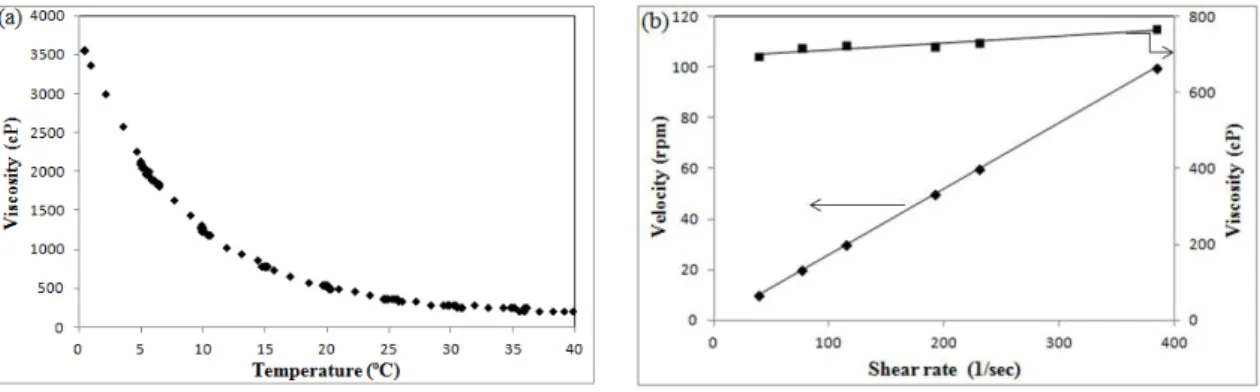
This work aims to study characteristics of interest of a vinyl ester resin for liquid molding processing, including viscosity variation with shear rate and temperature, gel time and maximum curing temperature. The influence of post-curing on the viscoelastic properties (storage modulus, loss modulus and tan δ) of neat and glass-fiber reinforced resin was also investigated.
2. EXPERIMENTAL
2.1 Materials
Commercial vinyl ester resin (Derakane momentum 470-300) was used. Commercial grade initiator Butanox M-50 (methyl-ethyl-ketone peroxide, P-MEK), at 1.0-2.0%, catalyzed with 0.6% of cobalt naphthenate (NafCO), both in relation to the resin volume. E-glass fiber mats (350 g/m2) manufactured by Owens Corn-ing were used as reinforcement.
2.2 Methods
Viscosity measurements were performed with neat resin (without initiator), from 0 to 40 °C. A Brookfield HBDV-II+C/P viscometer was used with the S51 spindle and at different speeds (20, 30, 50, 60 e 100 rpm). Gel time and maximum temperature of cure were determined according to the SPI method together with ASTM D2471. Differential scanning calorimetry (DSC) was carried out in a DSC equipment (model Q20V24.2 Build107), within 20-250 °C temperature range, under nitrogen atmosphere with a heating rate of 10 °C/min.
Six types of rigid samples were studied: cured and post-cured neat resin, 4-layers cured/post-cured composite (C4 andC4,pc, respectively), 6-layers cured/post-cured composite (C6 and C6,pc, respectively). The neat resin samples were cast into silicone molds with rectangular geometry (length × width × thickness: 35 × 12 × 4 mm). The monolithic composites C4 and C6 were produced by RTM, that comprises the injection of the liquid resin into a closed mold cavity (320 × 150 × 3.6 mm) containing the fiber reinforcement and the subsequent resin cure at room temperature for 24 h, producing a rigid composite. Post-curing at 90 °C for 6 h was done in an air-circulation oven (DLAF02-2).
Fiber volume fraction of the composites was determined using the rule of mixtures and also following burning in a muffle furnace (at 560 ± 25 °C for 6 h) and weighing of the residue. Resin and composite densi-ty were calculated using the Archimedes method. Shore D hardness was performed according to ASTM D2240-05 in DWOLTEST durometer, model SD300, with 10 measurements in each sample. Dynamic me-chanical analysis (DMA) was performed in a TA Instruments Model 2980 (up to 600 ºC), at various frequen-cies (0.1, 1.0, 3.0, 10, 30 and 100 Hz).
3. RESULTS AND DISCUSSION
66
Figure 1: Variation of resin viscosity with temperature (a) and shear rate with velocity and viscosity in 25 °C (b).
The DSC heat flow curves of the cured and post-cured neat resin are shown in Figure 2a. The cured resin sample shows a large peak (within ~50-160 °C), with an associated enthalpy of reaction of 327.3 J/g and a Tg value of ~110 ºC. As for the post-cured resin sample, the measured residual enthalpy (6.9 J/g) was comparatively negligible, and Tg shifted to ~115 ºC. This decrease in the value of enthalpy due to elimination of residual reactions, which leaves almost complete reaction.
The tan δ curves obtained with DMA for the cured and post-cured samples are shown in Figure 2b. The cured sample shows two peaks, at ~65 °C and ~120 °C, similar values to those found in the literature that were ~68 °C and ~127 °C [4]. The former nearly disappears and the latter narrows and shifts to ~115 °C after post-curing. The presence of two tan δ peaks can be attributed to the partial cure of the resin, whereas a sin-gle peak, i.e. only one glass transition temperature (Tg) [11], suggests the complete cure of the resin, high-lighting the need for post-curing. It is therefore interesting to notice that the cured resin shows a shoulder at around 60-70 oC in both DSC and DMA curves.
With post-curing, residual reactions are almost completely eliminated, avoiding adverse effects on the mechanical properties. This is ratified by the Shore D hardness values, which increased from 1.55 (± 0.13) to 1.62 (± 0.11) after post-curing of the Resin-1.0% initiator sample due to increased crosslinking, i.e. the mate-rial becomes more rigid.
Figure 2: Characteristics of the cured and post-cured (1.0% initiator) samples by: a) DSC and b) DMA (at 3 Hz).
67
Table 1: Gel time, gel temperature and maximum curing temperature of studied systems.
System Gel time (min) Tgel (ºC) Tmax (ºC)
Resin-1.0% initiator 36.9 93.8 138.4
Resin-1.5% initiator 24.0 106.7 154.8
Resin-2.0% initiator 19.7 104.9 156.5
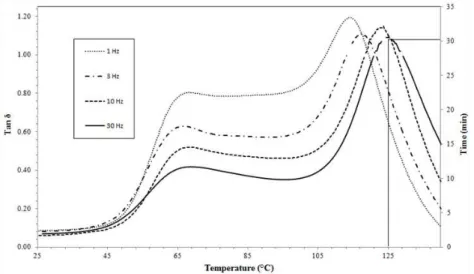
The tan δ curves obtained by DMA at distinct frequencies for the cured Resin-1% sample are seen in Figure 3. The E’ (storage modulus) values are smaller than E’’ (loss modulus), knowing that tan δ = E’’/ E’, confirming that the characteristics of an elastic solid are not reached before the gel region. Increasing the frequency leads to the increase in storage modulus (i.e. rigidity) and the shift in tan δ to lower temperatures. It is also seen that there is a shift of Tg to higher temperatures with the increase in frequency. This occurs because the greater the frequency, the more lagged response of the material when subjected to tension, be-cause the relaxation time is longer. The other samples showed similar behavior.
The gel time of the resin can be determined by the tan δ peak maximum criterion [12]. The gel time values were within the 32 to 35 min range and the gel temperature within 115-125 °C. These values are close to those found with the SPI method (Table 1), and the difference may be due to excessive heat loss in the technique.
Figure 3: Tan δ curve obtained at distinct frequencies for the cured resin-1% sample.
Density and fiber volume fraction of the composites are shown in Table 2. Density increased with fi-ber content due to the higher density of E-glass in comparison with the VER (2.54 and 1.18 g/cm3, respec-tively). The C4 sample, with four layers (%Vf = 16.3-17.0%), is almost at the limit of the so-called structural composites [13], whereas C6 sample has %Vf = 21.6-23.0%. Fiber content directly influences the thermo-mechanical properties of the composite.
Table 2: Density and fiber volume fraction of composites C4 and C6.
Composites ρ
(g/cm3)
Vf (Archimedes) (%)
Vf (Burned) (%)
C4 1.448 17.0 16.3
C6 1.537 23.0 21.6
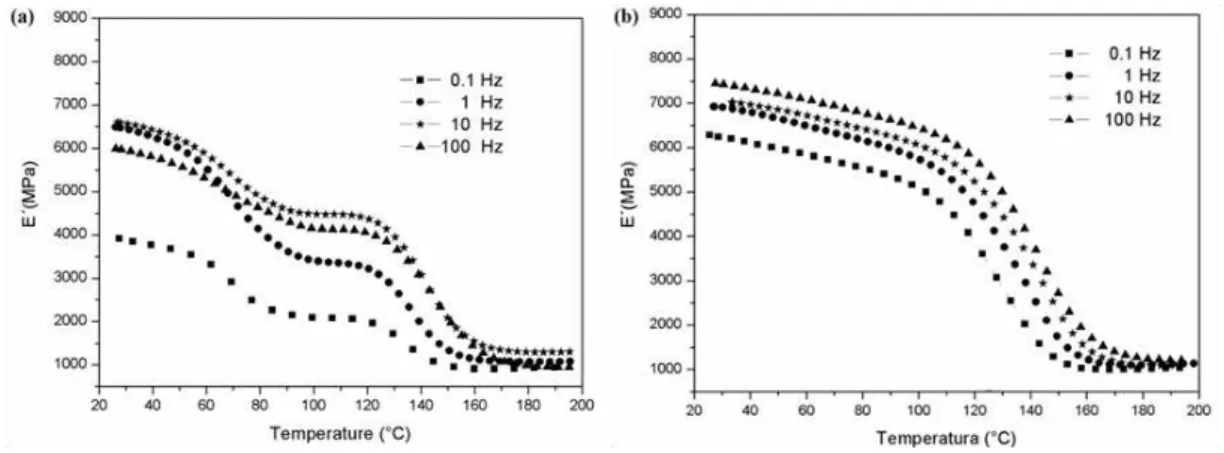
68 restrictions imposed by the glass fiber to the matrix movement [14]. As the temperature increases, E' decreas-es, with a sharp decline in the glassy region. This can be attributed to the increased molecular mobility of the polymer chains above Tg.
In both samples, post-curing increased storage modulus in around 40%, again due to the increase in the degree of crosslinking which yields a more rigid composite. In addition, the shoulders in the DMA spec-tra in the viscous region (before Tg) disappeared with the post-curing (e.g. compare Figures 4a-b). The same was noted in both C4 and C6 composites. The change in DMA spectra endorsed the complete cure of the composite and the need for post-curing. The effect of frequency variation can be summarized as, at higher frequencies, the E' values are higher and the composite behaves more like a glassy material (i.e. more rigid) due to the longer relaxation times in comparison with the timescale of the experiment.
Figure 4: Storage modulus curves of the cured C4 (a) and post-cured C4 (b) composites for different frequencies.
Figure 5: Storage modulus curves of the cured C6 (a) and post-cured C6 (b) composites for different frequencies.
69
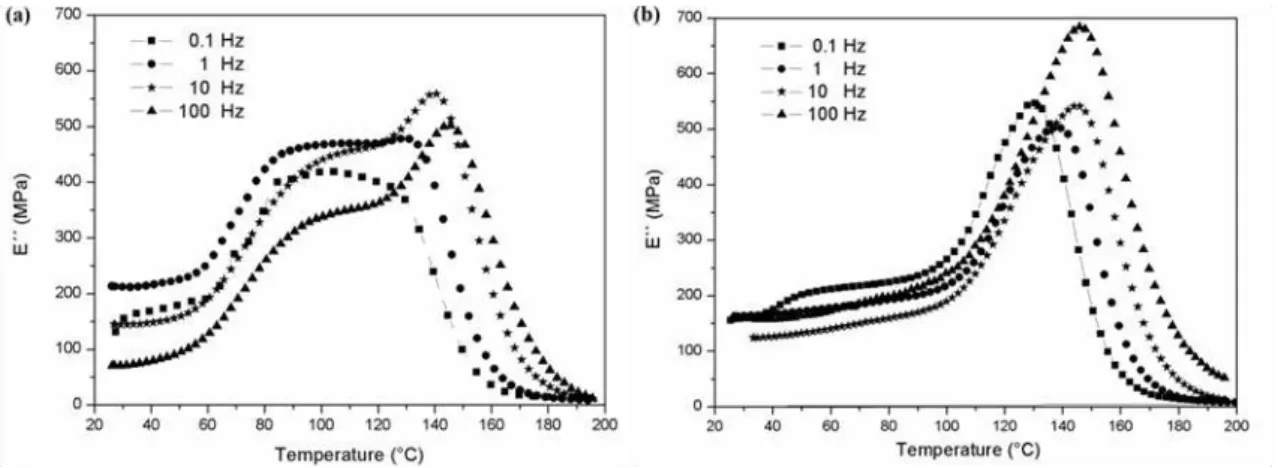
Figure 6: Loss modulus curves of the C4 (a) and post-cured C4 (b) composites for different frequencies.
Figure 7: Loss modulus curves of the C6 (a) and post-cured C6 (b) composites for different frequencies.
70
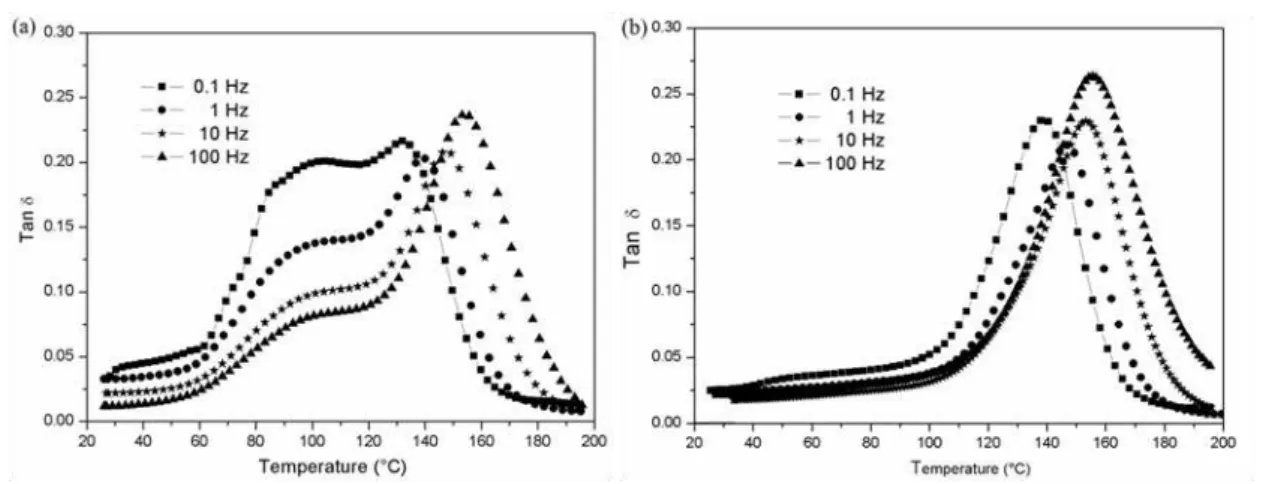
Figure 8:Tan δ curves of the C4 (a) and post-cured C4 (b) composites for different frequencies.
Figure 9: Tan δ curves of the C6 (a) and post-cured C6 (b) composites for different frequencies.
4. CONCLUSIONS
This paper focused on the thermal-mechanical characteristics of a vinyl ester resin and composites reinforced with glass fiber using mainly DSC and DMA analyses, which were used to verify the effect of the post-curing on composite characteristics. The need for post-post-curing was justified, for instance, by the purge of re-sidual enthalpy of the curing reaction and a significant increase in storage modulus (around 39%). Post-curing increased crosslinking degree, yielding a more rigid material less susceptible to premature failure. The gel time and gel temperature of the uncured resin were determined by the Society of the Plastics Industry (SPI) method, which is a more readily available technique than DMA, even though usually regarded as non-reliable. Nevertheless, comparison between these two methods revealed very similar results, indicat-ing suitability of the simpler and cheaper SPI method to evaluate gel time.
5. ACKNOWLEDGMENTS
The authors would like to thank CNPq, CAPES and FAPERGS for the financial support.
6. BIBLIOGRAPHY
71 [2] SULTANIA, M., RAI, J.S.P., SRIVASTAVA, D., “Studies on the synthesis and curing of epoxidized novolac vinyl ester resin from renewable resource material”, European Polymer Journal, v. 46, n. 10, pp. 2019-2032, Oct. 2010.
[3] BOYARD, N., MILLISCHER, A., SOBOTKA, V., et al., “Behaviour of a moulded composite part: Mo d-elling of dilatometric curve (constant pressure) or pressure (constant volume) with temperature and conver-sion degree gradients”, Composites Science and Technology, v. 67, n. 6, pp. 943-954, May 2007.
[4] VISCO, A.M., CAMPO, N., CIANCIAFARA, P., “Comparison of seawater absorption properties of thermoset resins based composites”, Composites Part A-Applied Science and Manufacturing, v. 42, n. 2, pp. 123-130, Feb. 2011.
[5] SCOTT, T.F., COOK, W.D., FORSYTHE, J.S., “Kinetics and network structure of thermally cured vinyl ester resins”, European Polymer Journal, v. 38, n. 4, pp. 705-716, Apr. 2002.
[6] CRAWFORD, S., LUNGU, C.T., “Influence of temperature on styrene emission from a vinyl ester resin thermoset composite material”, Science of the Total Environment, v. 409, n. 18, pp. 3403-3408, Aug. 2011. [7] GARAY, A.C., HECK, V., ZATTERA, A.J., SOUZA, J.A., AMICO, S.C., “Influence of calcium ca r-bonate on RTM and RTM light processing and properties of molded composites”, Journal of Reinforced Plastics and Composites, v. 30, n. 14, pp. 1213-1221, Jul. 2011.
[8] NAFFAKH, N., DUMON, M., GÉRARD J., “Study of a reactive epoxy-amine resin enabling in situ dis-solution of thermoplastic films during resin transfer moulding for toughening composites”, Composites Sci-ence and Technology, v. 66, n. 10, pp. 1376-1384, Aug. 2006.
[9] ORNAGHI, H.L., SILVA, H.S.P.da., ZATTERA, A.J., et al., “Dynamic mechanical properties of curaua composites”, Journal of Applied Polymer Science, v. 125, n. 2, pp. E110-E116, Sep. 2012.
[10] COOK, W.D., SCOTT, T.F., QUAY-THEVENON, S., et al., “Dynamic mechanical thermal analysis of thermally stable and thermally reactive network polymers”, Journal of Applied Polymer Science, v. 93, n. 3, pp. 1348-1359, Aug. 2004.
[11] SCOTT, T.F., COOK, W.D., FORSYTHE J.S., “Effect of the degree of cure on the viscoelastic proper-ties of vinyl ester resins”, European Polymer Journal, v. 44, n. 10, pp. 3200-3212, Oct. 2008.
[12] LAZA, J.M., JULIAN, C.A., LARRAURI, E., et al., “Thermal scanning rheometer analysis of curing kinetic of an epoxy resin: 2. An amine as curing agent”, Polymer, v. 40, n. 1, pp. 35-45, Jan. 1999.
[13] GU, H., “Dynamic mechanical analysis of the seawater treated glass/polyester composites”, Materials & Design, v. 30, n. 7, pp. 2774-2777, Aug. 2009.