*Correspondence: V. A. Menezes. Faculdade de Odontologia, Universidade de Pernambuco. Av. Gal Newton Cavalcanti, n.1650 - 54753-020 - Camaragibe – PE, Brasil. E-mail: [email protected]
A
rti
Pharmaceutical Sciences vol. 46, n. 1, jan./mar., 2010
Pediatric medicines and their relationship to dental caries
Valdenice Aparecida de Menezes
1,*, Gabriela Cavalcanti
2, Cristiana Mora
2, Ana Flávia Granville
Garcia
3, Rossana Barbosa Leal
41Dentistry College, University of Pernambuco, 2Dentistry College of the Caruaruense Higher Education Association, 3Department of Dentistry, State University of Paraíba, 4Dentistry College of the Caruaruense Higher Education Association
The aim of this study was to evaluate mothers’ knowledge about the cariogenic potential of pediatric medicines. A total of 111 mothers were interviewed using a standardized form containing 15 questions relating to the association of pediatric drug use with dental caries and oral hygiene care. Descriptive and inferential statistics (Chi-square test and Fisher’s exact) were used at a signiicance of 5%. Most of the mothers were aged 40 years or under (77.4%), high school educated (30.6%) and not working (50.5%). The association between medication use and dental caries or defects in teeth structure was mentioned by 35 (43.2%) mothers, 33 of whom (40.7%) cited this was due to the presence of sugar in the formulations. Only 32 mothers (28.8%) performed oral hygiene for the child after drugs ingestion, although 81.1% (n = 90) had never received guidance on the importance of this practice. The type of occupation and maternal education level were not signiicant in these issues (p> 0.05). Pediatric medicines can create problems for the teeth and a high percentage of mothers are unable to establish a clear cause and effect relationship with this association. Therefore, the pharmaceutical industry needs to be more aware of this and should prepare pediatric medicines without the presence of sucrose.
Uniterms: Pediatric medicine/cariogenic potential. Dental caries/prevention.
O objetivo do estudo foi veriicar o conhecimento materno sobre o potencial cariogênico de medicamentos infantis. Foram entrevistadas 111 mães por meio de formulário padronizado contendo 15 perguntas relativas à associação do uso de fármacos pediátricos com a cárie dentária e aos cuidados com a higiene bucal. Foi usada a estatística descritiva e inferencial (Qui-quadrado de Pearson e exato de Fischer), com signiicância de 5%. A maioria das mães tinha até 40 anos (77,4%), ensino médio (30,6%) e não trabalhava (50,5%). A associação entre uso de medicamentos e cárie dental ou defeitos na estrutura dos dentes foi apontada por 35 (43,2%) mães, das quais 33 (40,7%) devido à presença de açúcar nas formulações. Apenas 32 (28,8%) realizavam a higienização bucal da criança após a ingestão de medicamentos; 81,1% (n=90) nunca receberam orientações quanto à importância desta prática. O tipo de ocupação e o grau de escolaridade materno não foram signiicativos nestas questões (p>0,05). Os medicamentos pediátricos podem trazer problemas para os dentes e alto percentual de mães não consegue estabelecer claramente a relação de causa e efeito existente em tal associação, portanto, é necessária maior conscientização das indústrias farmacêuticas para elaboração de medicamentos pediátricos sem a presença de sacarose.
Unitermos Medicamento infantil/potencial cariogênico. Cárie dental/prevenção.
INTRODUCTION
Dental caries is one of the most common oral dis-eases in childhood (Brazil, 2004). Its etiology is multi-factorial and related to an imbalance between the tooth
structure and oral environment, of which microbiota, diet and host are responsible for the disease initiation and pro-gression (Shaw, Glenwright, 1989). Updated concepts also consider social and behavioral factors of the individual (Gill, 2003).
Therefore, sugar addition to various medications for children is a supplementary source of carbohydrates for pediatric patients. Its purpose is to mask the unpleasant taste of some active constituents, allowing for better accep-tance by patients (Shaw, Glenwright, 1989; Hebling, 2002; Neves, 2006). Studies have emphasized that a signiicant portion of the population ignores the type and concentra-tion of sugars added to foods and/or beverages, including pediatric formulations (Mentes, 2001; Pierro, et al., 2005). Studies show a positive association between intake of these drugs and dental caries. This represents a cause for concern for children’s oral health, since many studies have shown increased prevalence of the disease and its relationship with the habitual intake of these liquid for-mulations (Shaw, Glenwright, 1989; Mackie et al., 1993; Bigeard, 2000; Neves 2006; Neves, Pierro, Maia, 2007). However, there are studies in which the true relationship between drug intake and caries rates in the population assessed was not proven. (Campos et al., 2006).
Thus, children with chronic or recurrent health pro-blems who make frequent use of medicines are particularly at risk (Souza, et al., 2002, Peres et al, 2005), whereas caries is a sucrose-dependent disease. Moreover, as many liquid medicines for children have low endogenous pH, they can also promote dental erosion, particularly if they stay for prolonged periods in contact with the tooth surface (Neiva, 2001; Pierro, et al. 2005; Neves, Pierro, Maia, 2007).
The use of sugar products (syrups, expectorants, an-tibiotics in solution, tonic and homoeopathic products) and those that cause reduced salivary low (benzodiazepines, antihistamines, appetite suppressants, antiparkinsonian, hypotension, muscle relaxants, diuretics, etc.) become potentially cariogenic with regular use as does any other product containing sugar, especially when used during the night (Silva, Guimarães, 2001; Neves, Pierro, Maia, 2007). Against this background, this study aimed to eva-luate the mothers’ knowledge about the use of pediatric medicines and their cariogenic potential.
METHODS
This was a cross-sectional study, with exploratory clinical-epidemiological characteristics. The project was approved by the Committee of Ethics in Research of the Caruaruense Higher Education Association under the No. 071/07. The study was conducted at the Center for Dental Specialties (CEO) of the Early Childhood Care and Clinical Dentistry, Faculty of Dentistry, Caruaru (FOC), located in Caruaruense Association of Higher Education (ASCES). The study involved interviewing 111 mothers of children aged between 0 and 12 years of age whose
children were screened or receiving dental care from Fe-bruary to July 2008. The interviews were conducted by two researchers in a private room, at the facilities of the institution using a questionnaire containing 15 questions, consisting of two parts: the irst recorded mothers’ identii-cation and demographic data and the second part evaluated data relevant to the proposed objectives.
First, the purpose of the research and the participa-tion that would be expected of the mothers was explained to them, after which they signed a consent form.
The responses were noted during the interview, allowing for greater idelity and accuracy of the informa-tion, and avoiding inaccuracies due to memory failure. The reliability of responses was tested by the method of validation of “face” in 10% of the respondents (Frankfort-Nachimir, (Frankfort-Nachimir, 1992). In this method, the researcher asks decision makers to make clear in their own words, what they understood by each question.
The data obtained was calculated using descriptive statistics by means of absolute distribution, percentage of measures and techniques of inferential statistics. The software used was EPI-INFO version 3.3 and Microsoft® Ofice Excel 2003.
RESULTS
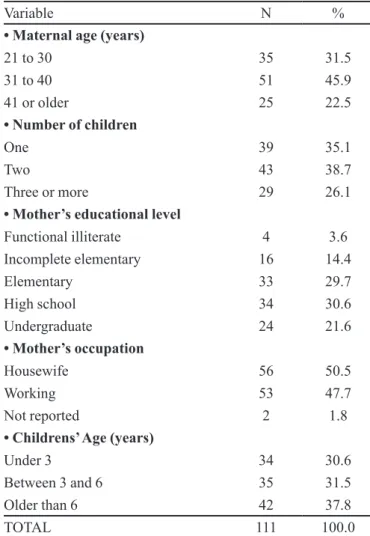
Table I highlights that the majority of mothers were aged younger than 40 years (77.4%), high school educated (30.6%) and had children under the age of 6 years (62.1%). Of the diseases that required the use of medicine, the most cited were “Asthma/ bronchitis” (33.1%), “Al-lergy”(23.8%) and infection (21%), for which antibio-tics (45.6%) and antihistamines (33.3%) were the most used. The presentation of medicines in “suspension” and “syrup” corresponded to (52.6%), as shown by results presented in Table II.
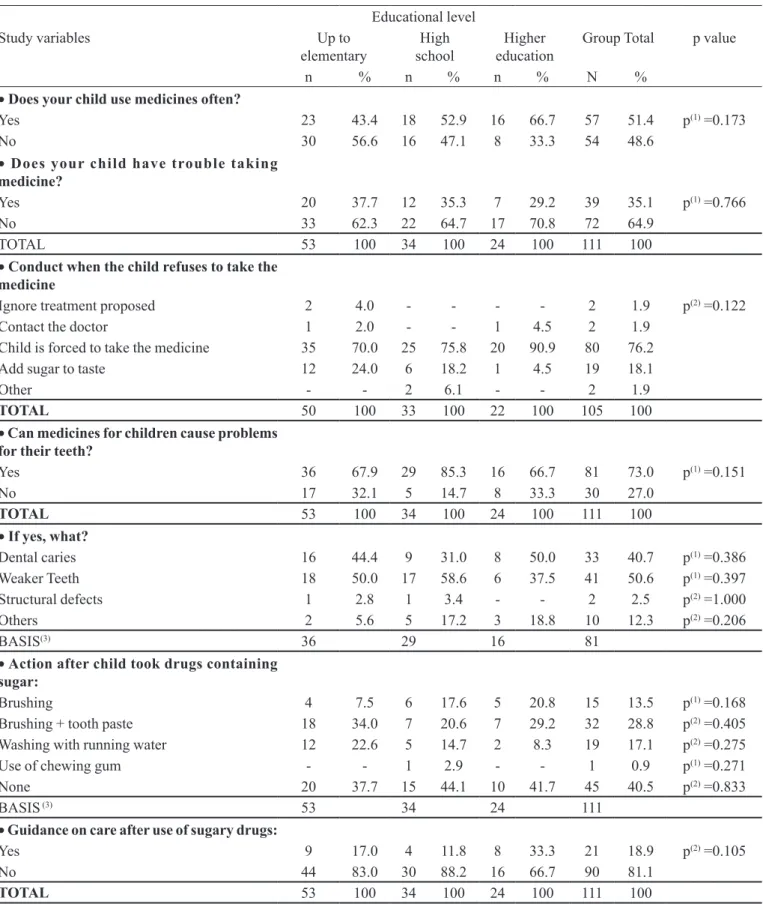
In Table III, no significant association is evident between issues relating to the mothers’ knowledge about the use of pediatric medicines and educational level of mothers surveyed.
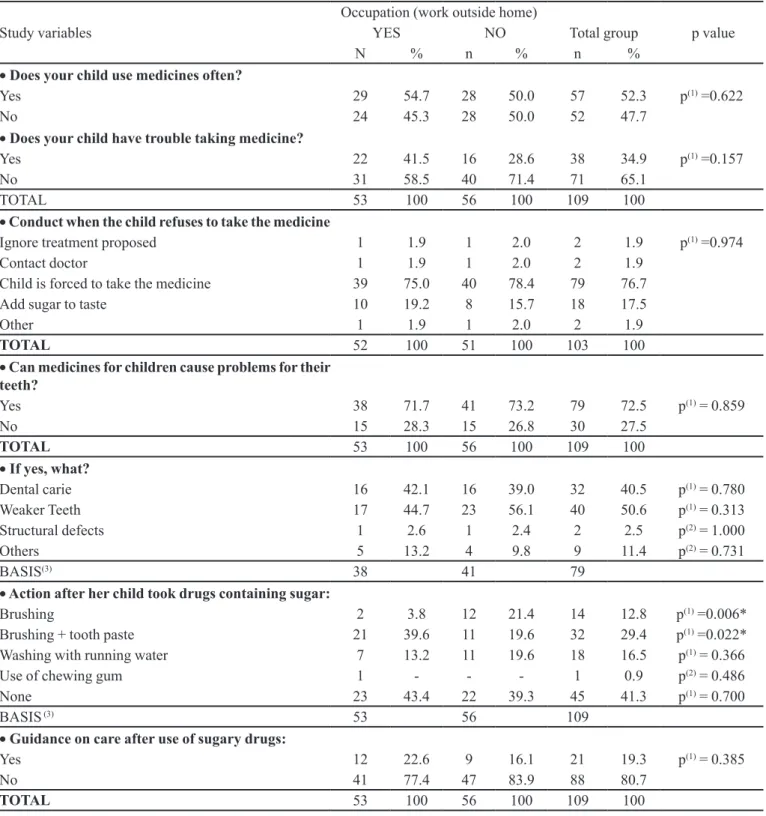
Table IV shows that the percentage of mothers who reported problems when the child took medicine and those who brush with toothpaste was higher in the group of mothers who worked outside the home, at 41.5% and 39.6%, respectively. A signiicant association of the cited items with occupation was identiied (p <0.05).
DISCUSSION
TABLE I - Sample Distribution by sociodemographic variables
Variable N %
• Maternal age (years)
21 to 30 35 31.5
31 to 40 51 45.9
41 or older 25 22.5
• Number of children
One 39 35.1
Two 43 38.7
Three or more 29 26.1
• Mother’s educational level
Functional illiterate 4 3.6
Incomplete elementary 16 14.4
Elementary 33 29.7
High school 34 30.6
Undergraduate 24 21.6
• Mother’s occupation
Housewife 56 50.5
Working 53 47.7
Not reported 2 1.8
• Childrens’ Age (years)
Under 3 34 30.6
Between 3 and 6 35 31.5
Older than 6 42 37.8
TOTAL 111 100.0
TABLE II - Sample distribution by variables related to “Maternal Knowledge on Use of Pediatric Medicines”
Variable N %
• Does your child use medicines
often?
Yes 57 51.4
No 54 48.6
TOTAL 111 100.0
• Type of Disease
Allergy 14 23.8
Asthma/ bronchitis 18 33.1
Cancer 1 1.7
Epilepsy 3 5.1
Inlammation 6 10.2
Infection 12 21.0
Others 3 5.1
TOTAL 57 100.0
• What was the drug used?
Analgesic 3 5.3
Antifreeze -
-Antibiotic 26 45.6
Antitussive 2 3.5
Anticonvulsant 3 5.3
Antihistamine 19 33.3
Anti-inlammatory 1 1.8
Not reported 2 3.5
Others 3 5.3
BASE (1) 57
• What form of presentation of these
medicines have you used?
Drops -
-Suspension 19 33.3
Syrup 11 19.3
Tablets 27 47.4
Capsules -
-Other -
-TOTAL 57 100.0
(1): Whereas a single patient could have taken more than one product, only the basis is registered for the calculation of percentages and not the total.
the overall goal of this education. As mothers are often responsible for the administration and care related to the use of pediatric medicines, they should be counseled about the risk factors associated with caries, conirming the important role mothers play in establishing the oral health of their children.
In Brazil, parents frequently report the poor state of the oral health of their children as the main issue related to the use of antibiotics during childhood (Smith, Silva, Maia, 2002). In this study, it was found that the need to use drugs regularly for children was high (51.4%). Among the-se, antibiotics (45.6%) and antihistamines (33.3%), used to treat respiratory problems (33.1%), allergies (23.8%) and infections (21%), showed a higher percentage. In a recent study (Neves, Pierro, Maia, 2007), antibiotics were used with high frequency in children (88.4%), although at a lower percentage in relation to antipyretics (98.8%). These were not mentioned by the mothers, probably be-cause of the drugs common use, this however makes their cariogenic role no less important.
in-TABLE III - Evaluation of issues on “Maternal Knowledge about Use of Pediatric Medicines” by educational level of mothers interviewed
Educational level
Study variables Up to
elementary schoolHigh educationHigher Group Total p value
n % n % n % N %
• Does your child use medicines often?
Yes 23 43.4 18 52.9 16 66.7 57 51.4 p(1) =0.173
No 30 56.6 16 47.1 8 33.3 54 48.6
• Does your child have trouble taking
medicine?
Yes 20 37.7 12 35.3 7 29.2 39 35.1 p(1) =0.766
No 33 62.3 22 64.7 17 70.8 72 64.9
TOTAL 53 100 34 100 24 100 111 100
• Conduct when the child refuses to take the
medicine
Ignore treatment proposed 2 4.0 - - - - 2 1.9 p(2) =0.122
Contact the doctor 1 2.0 - - 1 4.5 2 1.9
Child is forced to take the medicine 35 70.0 25 75.8 20 90.9 80 76.2
Add sugar to taste 12 24.0 6 18.2 1 4.5 19 18.1
Other - - 2 6.1 - - 2 1.9
TOTAL 50 100 33 100 22 100 105 100
• Can medicines for children cause problems
for their teeth?
Yes 36 67.9 29 85.3 16 66.7 81 73.0 p(1) =0.151
No 17 32.1 5 14.7 8 33.3 30 27.0
TOTAL 53 100 34 100 24 100 111 100
• If yes, what?
Dental caries 16 44.4 9 31.0 8 50.0 33 40.7 p(1) =0.386
Weaker Teeth 18 50.0 17 58.6 6 37.5 41 50.6 p(1) =0.397
Structural defects 1 2.8 1 3.4 - - 2 2.5 p(2) =1.000
Others 2 5.6 5 17.2 3 18.8 10 12.3 p(2) =0.206
BASIS(3) 36 29 16 81
• Action after child took drugs containing
sugar:
Brushing 4 7.5 6 17.6 5 20.8 15 13.5 p(1) =0.168
Brushing + tooth paste 18 34.0 7 20.6 7 29.2 32 28.8 p(2) =0.405
Washing with running water 12 22.6 5 14.7 2 8.3 19 17.1 p(2) =0.275
Use of chewing gum - - 1 2.9 - - 1 0.9 p(1) =0.271
None 20 37.7 15 44.1 10 41.7 45 40.5 p(2) =0.833
BASIS (3) 53 34 24 111
• Guidance on care after use of sugary drugs:
Yes 9 17.0 4 11.8 8 33.3 21 18.9 p(2) =0.105
No 44 83.0 30 88.2 16 66.7 90 81.1
TOTAL 53 100 34 100 24 100 111 100
TABLE IV – Evaluation of issues on “Maternal Knowledge about Use of Pediatric Medicines”, by occupation of mothers interviewed
Occupation (work outside home)
Study variables YES NO Total group p value
N % n % n %
• Does your child use medicines often?
Yes 29 54.7 28 50.0 57 52.3 p(1) =0.622
No 24 45.3 28 50.0 52 47.7
• Does your child have trouble taking medicine?
Yes 22 41.5 16 28.6 38 34.9 p(1) =0.157
No 31 58.5 40 71.4 71 65.1
TOTAL 53 100 56 100 109 100
• Conduct when the child refuses to take the medicine
Ignore treatment proposed 1 1.9 1 2.0 2 1.9 p(1) =0.974
Contact doctor 1 1.9 1 2.0 2 1.9
Child is forced to take the medicine 39 75.0 40 78.4 79 76.7
Add sugar to taste 10 19.2 8 15.7 18 17.5
Other 1 1.9 1 2.0 2 1.9
TOTAL 52 100 51 100 103 100
• Can medicines for children cause problems for their
teeth?
Yes 38 71.7 41 73.2 79 72.5 p(1) = 0.859
No 15 28.3 15 26.8 30 27.5
TOTAL 53 100 56 100 109 100
• If yes, what?
Dental carie 16 42.1 16 39.0 32 40.5 p(1) = 0.780
Weaker Teeth 17 44.7 23 56.1 40 50.6 p(1) = 0.313
Structural defects 1 2.6 1 2.4 2 2.5 p(2) = 1.000
Others 5 13.2 4 9.8 9 11.4 p(2) = 0.731
BASIS(3) 38 41 79
• Action after her child took drugs containing sugar:
Brushing 2 3.8 12 21.4 14 12.8 p(1) =0.006*
Brushing + tooth paste 21 39.6 11 19.6 32 29.4 p(1) =0.022*
Washing with running water 7 13.2 11 19.6 18 16.5 p(1) = 0.366
Use of chewing gum 1 - - - 1 0.9 p(2) = 0.486
None 23 43.4 22 39.3 45 41.3 p(1) = 0.700
BASIS (3) 53 56 109
• Guidance on care after use of sugary drugs:
Yes 12 22.6 9 16.1 21 19.3 p(1) = 0.385
No 41 77.4 47 83.9 88 80.7
TOTAL 53 100 56 100 109 100
(*): Signiicant association at the level of 5.0%. (1): Using the Chi-square test. (2): Using Fisher’s Exact test. (3): Whereas a single survey could cite more than one alternative, it is only registered in the basis for the percentages calculation and not the total.
lammation or upper respiratory tract infection (Durward, Thou, 1997), heart, respiratory or renal (Silva Santos, 1994) disease who make frequent use of these drugs (Smi-th, Silva, Maia, 2002).
also cited such as: acidity, frequency of administration and formulation (Costa et al., 2004; Marquezan et al., 2007).
While many parents recognize that sugar causes tooth decay, they do not normally associate this chan-ge with the sugar added to pediatric liquid medicines (Mentes, 2001). This fact was clearly seen in the present study: of 81 mothers (73%) who reported that pediatric medicines can cause problems for their child’s teeth, only 33 (40.7%) associated them with the occurrence of dental caries, correctly linking them with the presence of sugars in the formulations. Note that 50.6% of mothers believed medicines can make teeth weaker, with no necessary con-nection with the sugar addition (Table III). The reported association with defects in teeth structure was low (2.5%) in contrast to another study (Neves, Pierro, Maia, 2007) which detected a percentage of 70.9%. The type of occu-pation and level of maternal education did not differ on these issues (p> 0.05).
Regarding the medicine intake, it was found that the percentage of mothers who reported problems was higher in the group who worked outside the home (41.5%). Moreover, the practice of forcing children to swallow the medicine when they refused was higher among mothers with a higher education (90.9%). The percentage of mo-thers who add sugar to improve the taste of the medicine was lower among those with a higher education (4.5%) but very similar between groups of mothers with up to elemen-tary school and high school education (70.0% and 75.8%, respectively) (p> 0.05). This data clearly demonstrates the importance of education in maternal behavior.
The risk of developing caries associated with the use of sugar products becomes aggravated when no measure of oral hygiene is performed (Bigeard, 2000). However, despite all the risk involved, 40.5% of mothers did not adopt any action after the administration of the dose pres-cribed, a higher rate compared to the indings of another study (28.6%) (Neves, Pierro, Maia, 2007). In addition, only 28.8% of mothers had an adequate oral hygiene routine for their children, using a brush and toothpaste. The percentage of those who performed oral hygiene was lower among those who had elementary education (7.5%). It is noteworthy that 81.1% (90) of mothers had ne-ver received guidance on the importance of oral cleaning after intake of medicines. Other authors found similar results (Paiva, 1991;, Souza, et al., 2002; Neves, Pierro, Maia, 2007). The type of occupation and level of maternal education were not signiicant factors inluencing these issues (p> 0.05).
Further, drugs administered in the evening or at bedtime, the period when there is a decrease in salivary low as well as reduced relexes of swallowing and muscle
movement, remain longer in the oral cavity (Durward, Thou, 1997; Bigeard, 2000; Costa et al., 2004).
It is noteworthy that data showed that most (52.6%) drugs had been prescribed in liquid form (syrup or suspen-sion) for which elimination occurs more slowly. However, most mothers had children under the age of six years (62.1%), a phase in which the indication of use of tablets is not common, and therefore the adoption of proper practice of oral hygiene after ingesting certain drugs by children is essential. Another aspect to consider is the use of a variety of sugar products without prescription such as throat lo-zenges, cough syrup, lickers, chewable vitamins and liquid tonics, which require dietary advice, and intensiication of preventive methods against caries (Paiva, 1991).
Reducing the cariogenic potential of pediatric medi-cines should be a concern among all health professionals. Although the market has already made available sugar-free drugs or sweetened with other substances, medicinal products containing sucrose are still among the most prescribed and do not warn about the risk of developing carious lesions (Durward, Thou, 1997). Moreover, the manufacture of pediatric medicines not containing fer-mentable carbohydrates, could be the best health policy. In addition, research should be conducted to ind acceptable levels of fermentable carbohydrates to preserve the taste of medicines (Peres et al., 2005).
Therefore, it is essential that clear instructions re-garding oral hygiene be provided for each prescription of medicines containing sugar, in order to avoid the develo-pment of caries in many children, particularly those who consume medicines on a routine basis and especially those who have chronic diseases.
Although the relationship between the continued use of sugar products and the development of dental ca-ries is not clearly established, the administration of these drugs should be done preferably during meals and before sleeping (Bigeard,2000) and should be followed by ins-tructions for cleaning the oral cavity.
CONCLUSIONS
REFERENCES
BIGEARD, L. The role of medication and sugars in pediatric dental patients. Dent. Clin. North Am., v.44, n.3, p.443- 456, 2000.
BRASIL. Ministério da Saúde. Secretaria de Atenção a Saúde. Departamento de Atenção Básica. Projeto SB Brasil 2003: condições de saúde bucal da população brasileira 2002-2003: resultados principais. Brasília: Ministério da Saúde, 2004. Available at: <http://bvsms.saude.gov.br/ bvs/publicacoes/projeto_sb2004.pdf>. Accessed on: 06 out. 2008.
CAMPOS, J. A. D. B.; GIRO, E. M. A.; ORRICO, S. R. P.; OLIVEIRA, A. P. C.; LORENA, S. M. Correlação entre a prevalência de cárie e a utilização de medicamentos em pacientes com necessidades especiais institucionalizados e não institucionalizados. Salusvita, v.25, n.1, p.35-42, 2006.
COSTA, C. C.; ALMEIDA, I. C.; RAYMUNDO M. S.; FETT, R. Análise do pH endógeno, da acidez e da concentração de sacarose de medicamentos pediátricos. Rev. Odonto Ciênc., v.19, n.44, p.164-169, 2004.
DURWARD, C.; THOU, T. Dental caries and sugar containing liquid medicines for children in New Zealand. N. Z. Dent. J., v.93, n.414, p.124-129, 1997.
FRANKFORT-NACHIMIAS, C.; NACHIMIAS, D. Research methods in the social. 4.ed. London: Edward Arnold, 1992. 144 p.
GONÇALVES, M. R. Cárie dental: uma doença psicossomático-ambiental. J. Bras. Clin. Odontol. Integr., v.7, n.39, p.251-255, 2003.
HEBLING, J. ;TEIXEIRA, H. M.;PIZZOLITTO, A. C. Potencial cariogênico de medicamentos infantis. Robrac, v.11, n.31, p.35-39, 2002.
MACKIE, I. C.; WORTHINGTON, H. V.; HOBSON, P. An investigation into sugar containing and sugar-free over-the counter medicines stocked and recommended by pharmacists in the north western region of England. Br. Dent. J., v.175, n.3, p.93-98, 1993.
MARQUEZAN, M.; MARQUEZAN, M., POZZOBON, R. T., OLIVEIRA, M. D. M. Medicamentos utilizados por pacientes odontopediátricos e seu potencial cariogênico. RPG Rev. Pós Grad., Santa Maria, v.13, n.4, p.334-339, 2007.
MENTES, A. pH changes in dental plaque after using sugar- free pediatric medicine. J. Clin. Pediatr. Dent., v.25, n.4, p.307-312, 2001.
NEIVA, A.; SILVA, V. S.; MAIA, L. C.; SOARES, E. L.; TRUGO, L. C. Análise in vitro da concentração de sacarose e pH de antibacterianos de uso pediátrico. Pesqui. Bras. Odontopediatria Clín. Integr., v.1, n.1, p.9-16, 2001.
NEVES, B. G. Avaliação dos fatores relacionados ao potencial cariogênico e erosivo de medicamentos líquidos infantis. Rio de Janeiro, 2006. 99 p. [Dissertação de Mestrado. Faculdade de Odontologia. Universidade Federal do Rio de Janeiro].
NEVES, B. G.; PIERRO, V. S.; SILVA, M. L. C. Perceptions and attitudes among parents and guardians on the use of pediatric medicines and their cariogenic and erosive potential. Ciênc. Saúde Coletiva, v.12, n.5, p.1295-1300, 2007.
PAIVA, M. S. Cariogênicidade dos medicamentos: um risco a saúde bucal. Rev. Gaúcha Odontol., v.39, n.5, p.336-338, 1991.
PERES, K. G.; OLIVEIRA, C. T.; PERES, M. A.; RAYMUNDO, M. S.; FETT, R. Sugar content in liquid oral medicines for children. Rev. Saúde Pública, v.39, n.3, p.486-489, 2005.
PIERRO, V. S. S.; ABDELNUR, J. P.; MAIA, L. C.; TRUGO, L. C. Free sugar concentration and pH of pediatric medicines in Brazil. Community Dent. Health, v.22, n.3, p.180-183, 2005.
PINTO, V. G. Saúde bucal coletiva. 4.ed. São Paulo: Editora Santos, 2000. 541 p.
SHAW, L.; GLENWRIGHT, H. D. The role of medications in dental caries formation: need for sugar-free medication for children. Pediatrician, v.16, n.3-4, p.153-155, 1989.
SILVA, M. F. A.; GUIMARÃES, J. A. T. L. Potencial cariogênico de medicamentos utilizados no tratamento de doenças do trato respiratório e alergia. JBP, J. Bras. Odontopediatr. Odontol. Bebê, v.4, n.21, p.383-386, 2001.
SILVA, V. S.; SILVA, A. N.; MAIA, L. C. Antibacterianos pediátricos e cárie dental em crianças: mitos e realidades. Rev. Paul. Pediatr., v.20, n.4, p.191-195, 2002.
SOUZA, M. I. C.; SEGAL, M. T.; MEDEIROS, U. V.; BARBOSA, A. R. S. Potencial cariogênico dos xaropes infantis para doenças respiratórias prolongadas. JBP, J. Bras. Odontopediatr. Odontol. Bebê, v.5, n.25, p.209-214, 2002.
Received for publication on 18th December 2008