GLIOBLASTOMA MULTIFORME OF THE PINEAL REGION
Case report
Emerson Leandro Gasparetto
1, Danny Warszawiak
2, Guilherme Pradi Adam
1,
Luiz Fernando Bleggi-Torres
3, Arnolfo de Carvalho Neto
4ABSTRACT - Purpose: pineal region tumors are uncommon, and comprise more frequently three categories: germ cell, parenchymal cell and glial tumors. Most pineal gliomas are low-grade astrocytomas. Glioblastoma multiforme, the most aggressive and common brain tumor, is extremely rare at this location with only few cases reported. Case description: a 29-year-old woman with a two month history of headache, nuchal pain, fever, nausea and seizures and physical examination showing nuchal rigidity, generalized hypotony, hypotrophy and hyper-reflexia, Babinski sign and left VI cranial par palsy. CT scan examination revealed a ill-defined hypodense lesion at the pineal region with heterogeneous contrast enhancement. MRI showed a lesion at the pineal region infiltrating the right thalamic region. The patient underwent a right craniotomy with partial resection of the mass. The histological examination of paraffin-embedded material defined the diagnosis of glioblastoma multiforme. Post-operative radiotherapy was indicated but the patient refused the treatment and died two months afterwards. Conclusion: in spite of its rarity at this location, glioblastoma multiforme should be considered in the differential diagnosis of aggressive lesions at the pineal region.
KEY WORDS: brain tumor, pineal gland, glioblastoma multiforme.
Glioblastoma multiforme de região pineal: relato de caso Glioblastoma multiforme de região pineal: relato de casoGlioblastoma multiforme de região pineal: relato de caso Glioblastoma multiforme de região pineal: relato de casoGlioblastoma multiforme de região pineal: relato de caso
RESUMO - Objetivo: Os tumores da região pineal são incomuns e podem ser divididos em três categorias de acordo com a sua origem: células germinativas, células do parênquima e células gliais. Em sua maioria, os gliomas de pineal são astrocitomas de baixo grau, sendo que o seu correspondente maligno, glioblastoma multiforme, é o mais comum e agressivo tumor encefálico e é extremamente raro nesta localização, com apenas alguns casos relatados na literatura. Caso: Mulher com 29 anos apresentando há 2 meses cefaléia, nucalgia, febre, náuseas e crises convulsivas. O exame físico mostrou rigidez de nuca, hipotonia, hipotrofia e hiperreflexia generalizadas, sinal de Babinski e paralisia do VI nervo craniano. A tomografia computadorizada revelou lesão hipodensa mal delimitada na topografia de pineal, com captação heterogênea de contraste. A ressonância magnética demonstrou lesão na região pineal com infiltração de tálamo à direita. A paciente foi submetida a craniotomia direita com ressecção parcial do tumor. O exame histológico definiu o diagnóstico de glioblastoma multiforme. No pós-operatório foi indicada radioterapia, mas a paciente recusou o tratamento e morreu dois meses depois. Conclusão: Apesar de raro nesta topografia, os glioblastomas multiformes devem ser considerados no diagnóstico diferencial de lesões agressivas localizadas na glândula pineal.
PALAVRAS-CHAVE: tumor encefálico, glândula pineal, glioblastoma multiforme.
Discipline of Diagnostic Radiology (ELG, DW, GPA, CAN) and Department of Pathology (LFBT), University of Parana School of Medicine, Curitiba PR, Brazil. (UFPR): 1Resident of Diagnostic Radiology, Hospital de Clinicas, UFPR; 2Medical Student, UFPR; 3Professor of the
Department of Pathology, UFPR; 4Professor of the Discipline of Diagnostic Radiology, UFPR.
Received 9 August 2002, received in final form 26 November 2002. Accepted 7 December 2002.
Dr. Emerson Leandro Gasparetto - Avenida Silva Jardim 296/502 - 80230-000 Curitiba PR - Brasil. FAX: 41 360 1800. E-mail: [email protected]
Pineal region tumors are rare, comprising 0.4% to 1% of adult brain tumors1,2. Despite its small size,
the pineal gland is the origin of a surprisingly diverse array of tumor types. The three major categories are germ cell tumors, parenchymal cell tumors, and the supporting tissues neoplams (glial tumors). Germinomas are the most common histological type,
comprising 50-60% of all pineal tumors3,4.Gliomas
account for 33% of pineal neoplams, but are mainly
low grade astrocytomas1,4. Pineocytomas and
We present a patient with GBM of the pineal gion emphasizing the imaging findings and the re-view of the literature reported cases.
CASE
A 29-year-old woman presented with a two-month his-tory of headache, nuchal pain, drowsiness, fever, nausea, dizziness and seizures. Physical examination revealed nu-chal rigidity, horizontal nistagmus, generalized hypotony, hypotrophy and hyper-reflexia, decrease in muscle strength in all four limbs, Babinski’s sign and left VI cranial nerve palsy. At this time, a hydrocephalus was diagnosed and the patient underwent a ventricle-peritoneal shunt. The CT-scan examination showed a rounded hypodense ill-de-fined lesion at the pineal region with extension to the right thalamus. After contrast administration the mass showed heterogeneous enhancement (Fig 1 and 2). The MRI re-vealed a lesion at the pineal region with malignant cha-racteristics infiltrating discretely the right thalamic region. On account of the size of the mass and its extension to thalamus, the patient underwent a right parieto-occi-pital craniotomy with a transtentorial approach (Ausman technique) in order to exsiccate the lesion. The surgery revealed a yellow swelling and bleeding mass, which was partially (60%) exsiccated.
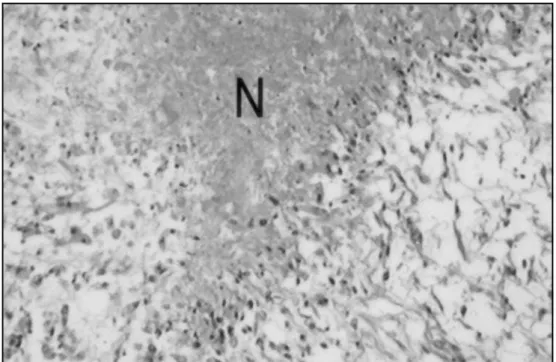
Histopathological study of the resected tissue revealed a lesion composed of highly anaplastic glial cells, with mi-totic activity, microvascular proliferation and areas of ne-crosis, defining the diagnosis of GBM (Fig 3 and 4).
The after surgery period elapsed normally in spite of a right hemiparesis, which was not present when the patient went home. At this time radiotherapy was recommended but the patient refused the treatment and died two months afterwards.
Fig 1 (A) and (B). Axial CT scan showing a hypodense ill-defined mass at the pineal region.
DISCUSSION
The pineal region is defined as the space delimi-tated superiorly by the splenium of the corpus callo-sum and choroid plexus of the third ventricle, ante-riorly by the third ventricle, antero-infeante-riorly by the lamina quadrigemina, inferiorly by the anterior face of the cerebellum culmen and laterally by the thalami
and medial faces of the cerebral hemispheres13. The
tumors of the pineal region are uncommon, ranging from 0.5 to 2% of all intracranial neoplasms in several review papers 3,5,6,14. The origin of the tumors of this
region can be the pineal gland itself, the posterior portion of the third ventricle and the quadrigemina cistern. The symptoms are generally related to the compression of the adjacent structures and not related to the histopathology of the tumor. The most frequent symptoms are hydrocephalus (compression of the Sylvius aqueduct) and dysfunctions of the eyes movement. CT-scan and MRI make the diagnosis of the presence of the pineal region tumor. These tu-mors are usually variable in shape, often irregular, with thick walls (more than 2 mm), larger than 20 mm, frequently compressing neighbor structures and infiltrative13. The MRI is essential to analyze the
Fig 2 (A) and (B). Axial CT scan after contrast injection revealing heterogeneous enhancement of the mass and demonstrating the invasion of the right thalamus (arrow).
Fig 3. Histological section showing a tumor composed of anaplastic glial cells with mitosis and extensive area of necrosis (N) (HEx40).
thalamus presented in our case denotes a malignant lesion and has to be differentiated from any other malignant lesion of the pineal region. The main as-pects for this differentiation are discussed below. Ho-wever, the final diagnosis should only be given with the histopathologic examination. The majority of the pineal region tumors appears to be of germ cell origin and include germinomas, teratomas, and less
commonly, embryonal carcinoma and choriocarci-noma. In fact, the pineal region is the most common site of intracranial germinomas and teratomas. These tumors usually develop in the first two decades of
life and predominate in males1,4,11. The germinomas
Fig 4. Histological section showing in detail a vessel with proliferation, common in glioblastoma multiforme (HEx100).
Table 1. Clinical and imaging findings of 10 cases diagnosed as glioblastoma multiforme of the pineal region.
Case Sex Age Clinical presentation CT scan findings Treatment Survival
(years) (months)
Cho et al.5 male 63 ↑I CP and changing Hyperdense pineal mass with Surgery and 6
behavior ring contrast enhancemente RTX and hydrocephalus
de Girolami et al.6 female 12 - - RTX and CTX 18
Frank et al.7 male 36 ↑ICP, Parinaud’s Third ventricle mass and RTX 4
syndrome, hearing hydrocephalus loss and tremors
Kalynaraman 8 female 52 ↑ICP and oculomotor - RTX 4
nerve disturbance
Norbut et al.9 female 68 Ataxic gait, dementia, Calcified midline mass and Surgery 4
blurred vision and hydrocephalus and RTX upward gaze palsy
Pople et al.10 male 50 - Hydrocephalus - 6
Vaquero et al.11 female 6 - - -
-Bradfield et al.14 - - ↑ICP and vertical - Surgery
-gaze palsy and RTX
Bradfield et al.14 - - ↑ICP - RTX
-Bradfield et al.14 - - ↑ICP - RTX
-Gasparetto et al. female 29 ↑ICP, fever, seizures Hypodense pineal mass with Surgery 2 heterogeneous contrast
enhancement
a specific image characteristic usually appearing as mixed density/intensity lesions.
The neoplasms originating from the pineal paren-chymal cells occur with considerably less frequency. This tumors include pineocytoma, which is composed of relatively mature pineal cells, and the pineoblas-toma, a more immature, poorly differentiated neo-plasm. These tumors tend to occur in a slightly older age group and occur evenly in males and females6,7,11.
The pineocytomas are radiologically indistinguishable from the benign pineal cysts. The pineoblastomas appear as big non-encapsulated masses with a strong or heterogeneous contrast enhancement and frequen-tly invade the adjacent parenchyma.
Additional tumors arising from the glial compo-nents of the pineal gland include ganglioneuroma, ganglioglioma, chemodectoma, meningeoma, and gliomas, more frequently low-grade astrocytomas. The gliomas origin either from the glial tissue of the pineal gland (astrocytes are a normal component of the pineal gland) or from the glial cells of the vicinity of this gland, such as the posterior portion of the third ventricle or the lamina quadrigemina. The low-grade astrocitomas would appear on CT-scan as iso or hypodense lesions with heterogeneous moderate contrast enhancement. MRI would show an iso or hypointense lesion on T1-wheighted image and hy-perintese on T2-wheigthed images. Edema, hemorr-hage and contrast enhancement are common fea-tures. Nonneoplastic processes that may also simu-late a pineal tumor at this location include epider-moid, dermoid and glial cysts3,4,7,14.
Although GBM (WHO’s astrocytoma grade IV) is the most frequent brain tumor, it is exceedingly rare at the pineal region with only few-reported cases1, 5-12.
Because these tumors are usually included within series of pineal region tumors it is difficult to study the clinical and imaging features of these cases (Table 1). However, in 7 cases the age and sex of the patients
were recorded1, 7-12. The age ranged between 6 and
68 years (mean age: 50 years). The predominant symptoms were related to hydrocephalus and
oph-thalmologic symptoms (specially Parinaud’s syn-drome)2,6,8,9,15. The CT scan examination often showed
hydrocephalus8, 9,11,12. The lesion on CT has different
patterns such as a calcified mass in the midline8, a
mass lesion in the posterior third ventricle9, or a
rounded hyperdense mass at the pineal region with
ring enhancement after contrast administration12.
One of the reported cases had a diffuse leptome-ningeal involvement, with spinal subarachnoid metastases9. In all cases which survival time has been
reported the prognosis had been poor.
The presented case, along with the others previously reported, suggest that the GBM, in spite of its rarity at this location, should be considered in the differential diagnosis of aggressive lesions at the pineal region.
REFERENCES
1. Edwards MSB, Hudgins RJ, Wilson CB, Levin VA, Wara WM. Pineal region tumors in children. J Neurosurg 1988; 68:689-697.
2. Tenuto R, Canelas HM, Zaclis J, Aisen J, Tognola WA. Tumores da região pineal: considerações sobre 12 casos. Arq Neuropsiquiatr 1969; 27:97-102.
3. Bailey S, Skinner R, Lucraft HH, Perry RH, Todd N, Pearson ADJ. Pineal tumours in the north of England 1968-93. Arch Dis Child 1996;75:181-185. 4. Prahlow JA, Challa VR. Neoplasms of the pineal region. South Med J
1996;89:1081-1087.
5. Cho BK, Wang KC, Nam DH, et al. Pineal tumors: experience with 48 cases over 10 years. Child Nerv Syst 1998;14:53-58.
6. De Girolami U, Schmidek H Clinicopathological study of 53 tumors of the pineal region. J Neurosurg 1973;39:455-462.
7. Frank F, Gaist G, Piazza G, Ricci RF, Sturiale C, Galassi E. Stereotaxic biopsy and radioactive implantation for interstitial therapy of tumors of the pineal region. Surg Neurol 1985;23:275-280.
8. Kalyanaraman UP. Primary glioblastoma of the pineal gland. Arch Neurol 1979;36:717-718.
9. Norbut AM, Mendelow H. Primary glioblastoma multiforme of the pineal region with leptomeningeal metastases: a case report. Cancer 1981;47:592-596.
10. Pople IK, Arango JC, Scaravilli F. Intrinsic malignant glioma of the pineal gland. Child Nerv Syst 1993;9:422-424.
11. Vaquero J, Ramiro J, Martinez R, Bravo G. Neurosurgical experience with tumours of the pineal region at Clinica Puerta de Hierro. Acta Neurochir (Wien) 1992;116:23-32.
12. Vaquero J, Ramiro J, Martinez R. Glioblastoma multiforme of the pineal region. J Neurosurg Sci 1990;34:149-150.
13. Caldas, JG, Doyon D, Lederman H, Carlier R. Estudo por ressonância magnética da região pineal: pineal normal e cistos simples. Arq Neuropsiquiatr 1998;56:237-244.
14. Bradfield JS, Perez CA. Pineal tumors and ectopic pinealomas. Analysis of treatment and failures. Radiology 1972;103:399-406.