Faculdade de Medicina de Lisboa, Lisbon, Portugal (FML); Universidade de São Paulo, São Paulo SP, Brazil (USP); Universidade Católica Dom Bosco, Campo Grande MS, Brazil (UCDB): 1Psychiatrist, Post-doctorate, Instituto de Medicina Molecular (IMM), FML,
P ro f e s s o r, UCDB; 2Head of the Neurology Service and of the EEG and Sleep Laboratory, Pro f e s s o r, FML, Head Researc h e r, Neuro s c i e n c e s
and Pathophysiology Unit, IMM, FML; 3N e u rologist, Pro f e s s o r, USP. This study presents partial results of post-doctorate thesis
defend-ed in the Molecular Mdefend-edicine Institute, Faculdade de Mdefend-edicina de Lisboa, Lisbon, Portugal. Received 28 February 2005, received in final form 16 June 2005. Accepted 10 August 2005.
Dr. José Carlos Souza - Rua Theotônio Rosa Pires 88 - 79004-340 Campo Grande MS - Brasil. E-mail: [email protected]
SLEEP HABITS, SLEEPINESS AND ACCIDENTS
AMONG TRUCK DRIVERS
José Carlos Souza
1, Teresa Paiva
2, Rubens Reimão
3ABSTRACT - Objective: To evaluate the quality of sleep, shift work, alcohol and psychostimulant drug use, and the prevalence of accidents among truck drivers. Method: Data were collected using a demograph-ic questionnaire, the Epworth Sleepiness Scale (ESS) and the Pittsburgh sleep quality index (PSQI). Statistdemograph-ical analysis was conducted using the Student t, chi-square, Pearson and Fisher tests. Results: 43.2% of the drivers drove over 16 h a day, and 2.9% worked shifts. Mean number of sleep hours/day was 5.97±1.47; 23.8% slept <5 hours; 50.9% made use of alcohol, 95.6% of caffeine, and 11.1% of amphetamines. Mean PSQI was 4.95±2.56; 35.4% had a PSQI >5; 23 subjects snored more than three times a week (11.1%). Mean ESS was 6.56±4.2; 21.7% had a score >10. In the preceding five years, 27 drivers (13.1%) were involved in accidents, 5 of which resulted in injuries and 3 in deaths. Conclusion: Results showed a high prevalence of sleep disorders, use of alcohol and psychostimulant drugs, and accidents.
KEY WORDS: sleep, sleep habits, sleepiness, transit accidents, truck drivers.
Hábitos de sono, sonolência e acidentes em caminhoneiros
RESUMO - Objetivo: Avaliar a qualidade do sono, trabalho em turnos, consumo de álcool e psicoestimulan-tes, e a prevalência de acidenpsicoestimulan-tes, entre caminhoneiro s . Método: Foram aplicados questionários demográfi-cos, a Escala de Epworth e o Índice de Pittsburgh. A análise estatística foi feita com os testes t de Student, qui-quadrado, Pearson e Fisher. Resultados: 43,2% dirigiam mais que 16 h/dia; 2,9% faziam trabalho por t u rnos. A média de horas de sono foi 5,97 +/- 1,47. 23,8% dormiam menos de 5 horas. 50,9% faziam uso de bebida alcoólica; usavam cafeína 95,6% e anfetaminas 11,1%. A média do PSQI foi 4,95 +/- 2,56; 35,4% tinham o PSQI maior que 5; 23 sujeitos ressonavam mais que 3 vezes por semana (11,1%). A ESE teve uma média de 6,56 +/- 4,2; 21.7% um escore superior a 10. Nos últimos cinco anos 27 motoristas (13,1%) estive-ram envolvidos em acidentes, 5 com feridos e 3 com mort o s . Conclusão: Foi alta a prevalência de distúr-bios do sono, uso de álcool e estimulantes, e de acidentes.
PALAVRAS-CHAVE: sono, hábitos de sono, sonolência, acidentes de trânsito, caminhoneiros.
Sleep is an active, cyclic biological phenomenon n e c e s s a ry for surv i v a l1 - 3. One of the most fre q u e n t
sleep disorders is excessive daytime sleepiness (EDS), which affects 4 to 12% of the general population. People with EDS may be affected by psychological s t ress, decreased productivity at work or school, and i n c reased risk of accidents4 , 5. Excessive daytime
sle-epiness, reduced number of sleep hours, shift work, excessive driving time, use of alcohol and other dru g s a re predictive factors of automotive accidents6 - 1 5.
Stoohs et al.1 6evaluated 90 commercial
long-haul truck drivers 20 to 64 years of age, and found that EDS was one of the factors of greatest risk for road accidents. In the United States, McCartt et a l .1 7studied long-distance truck drivers and found
that 47.1% had already fallen asleep at the wheel while driving. Multivariate logistic re g ression re-vealed that a reduced number of sleep hours was one of the 6 predictive factors of falling asleep at the wheel, together with EDS, arduous schedules with more hours of work and fewer hours off - d u t y, older age and more experience as a driver, and dri-ving at night. In Finland, Häkkänen and Summala1 8
10 hours. In New Zealand, Connor et al1 9. eval u a
t-ed 588 car drivers traveling on roads using the Ep-w o rth Sleepiness Scale (ESS). They found that 3.1% of the drivers had 5 or fewer hours of sleep in the p receding 24 hours, 7.9% had ESS scores b e t w e e n 10 and 15, and 1.3% had high scores (16 to 24), a sign of severe EDS.
Sleep assessment can be conducted with the u s e of questionnaires, such as the Pittsburgh sleep qua-lity index (PSQI), validated by Byusse et al. in 1989 and whose purpose is to assess the subjective quali-ty of sleep and identify sleep disorders in the pre-ceding 30 days. A PSQI total score greater than 5 is diagnostic of sleep disorders, and diff e re n t i a t e s between people that have sleep of good quality f rom those with a poor quality sleep, with a sensi-tivity of 89.6% and specificity of 86.5%2 0. Excessive
daytime sleepiness can be measured with the ESS, a scale with a high degree of internal consistency (Cronbach α= 0.88)21.
The statistics of the Brazilian Tr a n s p o rt a t i o n M i n i s t ry show that, of a total of 104 862 accidents in 2003, the probable cause of 2372 fatal accidents with a total of 7100 deaths was “lack of attent i o n ” , w h e reas the probable cause of other 80 fatal acci-dents was sleepiness.22
T h e re f o re, the purpose of this study was to eva-luate the effect of EDS, reduced number of sleep hours, shift work, driving time, and use of alcohol and other drugs among truck drivers in Brazil, and to investigate their association with accidents inv o l-ving professional and private drivers. This study is p a rt of a larger epidemiological study comparing truck drivers in Brazil and Portugal.
METHOD
The data for this cross-sectional, comparative explo-r a t o explo-ry descexplo-riptive study weexplo-re collected by means of a
q u e s t i o n n a i re about demographic data and habits, the ESS and the PSQI. A pilot study was conducted with 20 t ruck drivers. The sample was composed of 260 truck d r i v-ers working on federal roads in the State of Mato Gro s s o do Sul, Brazil, during 15 days. Each consecutive interv i-ew lasted 20 to 30 minutes; trained assistants individual-ly interviewed the drivers at four gas stations, after in-formed consent.
The following factors were analyzed: subjective qual-ity of sleep, sleep hours and sleep habits on working and off-duty days, shift work, sleep disorders, use of al-cohol or psychostimulant drugs, prevalence of accidents in the last five years. Statistical analysis of data was con-ducted with the Student t test, the chi-square test for contingency analysis, the Pearson correlation test, and the Fisher exact test. The level of significance was estab-lished at 5%.
The study was approved by the Research Ethics Com-mittee of Universidade Católica Dom Bosco, Campo Grande, Brazil. All subjects included in the study signed an informed consent form.
RESULTS
The drivers were all men, and their mean age was 38.2±10.6 (21 to 79 years). Most drivers were m a rried (76.6%) and had a primary school educa-tion (71.3%). Only 4.8% had another occupaeduca-tion, such as construction worker (0.9%), and a few wor-ked shifts (2.9%) or had a fixed morning and after-noon schedule (2.4%). Mean body mass index (BMI; w e i g h t / s q u a re height) was 27.64±4.34 (19 to 43.9 k g / m2); 14.6% had a BMI between 30 and 33 kg/m2;
12.1% had a BMI equal to or greater than 33 kg/m2.
The data on the number of driving hours re-vealed that 42.2% drove 11 to 15 hours a day, and 43.2% drove more than 16 hours a day (Fig 1). Considering these results for number of driving hours, only 2.9% worked shifts. Mean number of sleep hours on working days was 5.97±1.47 (2 to
10 h); 23.8% slept less than 5 hours, and about half (50.4%) slept 5 to 6 hours. Only 23.3% slept 7 to 8 hours on working days, and only 5 drivers (2.4%) slept more than 9 hours. On off-duty days, 47.5% slept 9 or more hours, 38.3%, 7 to 8 h, 11.6%, 5 to 6 h, and 2.4%, less than 5 h. On work-ing days, 2.0% woke up between 0 and 3 a.m., 65% between 4 and 5 a.m., and 33% between 6 and 7 a.m. On off-duty days, 0.5% woke up bet-ween 0 and 3 a.m., 9.2% betbet-ween 4 and 5 a.m., 39.3% between 6 and 7 a.m., 40.3% between 8 and 9 a.m., and 10.7% after 10 a.m.
Alcohol use was re p o rted by 50.9% of the driv-ers; 8.7% drank more than six times a week, and 21.8%, only once a week (p<0.0001). The most common beverages were beer (49.0%) and dis-tilled liquor (48.0%) (p<0.0001), Stimulant substan-ces such as caffeine were used by 95.6% of the dri-vers, and cola drinks were the most frequent (p<0. 0001). Other stimulant substances, such as amphet-amines (fenpro p o rex and diethylpropion) were
used by 11.1% (p<0.0001), 77.1% of which took it six or more times a week (p<0.0001).
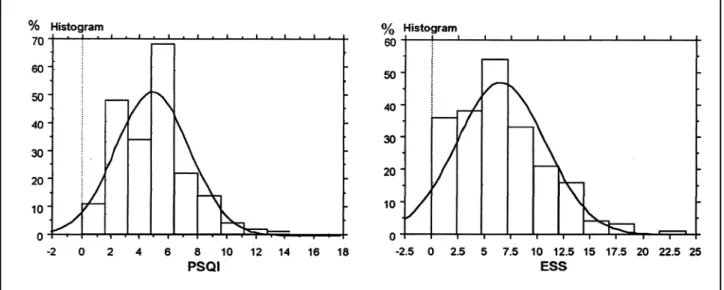
Mean PSQI was 4.95±2.56 (0 to 16); 35.4% had a PSQI greater than 5. In addition, 23 subjects sno-red more than three times a week (11.1%). The PSQI score was higher among those who slept few-er hours (<5 h or 5 to 6 h) than in the group of dri-vers who slept 7 to 8 hours. It was also significant-ly higher in the group that woke up earlier, before 5 a.m. (Table 1).
Mean ESS was 6.56±4.2 (0 to 24); 51.5% had s c o res below 6, 16.5%, between 7 and 8, and 2 1 . 7 % , g reater than 10; 2.9% had scores greater than 16 (Fig 2). The ESS results were significantly diff e re n t for drivers with a primary education and those w i t h a secondary education, and were greater for those with less education. It was also greater for those who slept less than 5 h or between 5 to 6 h on w o r k-ing days than for those who slept 7 to 8 h. Com-parisons with drivers that slept more than 9 hours w e re not possible because of the small number of
Table 2. Significant associations with the ESS variable.
Categories Brazil Subcategory df T P
Dependent variable - ESS Education
Primary 6.99 +/- 4.33 Prim / Prof 146 – –
Secondary 5.345 +/- 3.507 Prim / Sec 203 2.582 0.0105 Sleep hours on working days
<5 7.347 +/- 4.196 <5 / 5-6 151 +1.341 0.1821 5 to 6 6.423 +/- 3.781 <5 / 7-8 95 +2.288 0.0244 7 to 8 5.479 +/- 3.832 5-6 / 7-8 150 +1.402 0.1630 PSQI
<5 6.068 +/- 3.928
<5 / >5 204 -2.311 0.0218
>5 7.466 +/- 4.537
Table 1. Significant associations with the PSQI variable.
Categories Brazil Subcategory df T P
Independent variable - PSQI Sleep hours on working days
<5 5.796 +/- 2.318 <5 / 5-6 151 +1.738 0.0842
5-6 4.981 +/- 2.869 <5 / 7-8 95 +3.940 0.0002
7-8 4.146 +/- 1.762 5-6 / 7-8 150 +1.859 0.0650
Wake-up time on working days
0-3 6.000 +/- 2.582 0-3 / 6-7 70 2.39 0.0222
4-5 5.567 +/- 2.626 4-5 / 6-7 200 5.278 <0.0001
drivers in this group. The ESE was also greater for drivers with a PSQI greater than 5. No significant d i ff e rence was found for number of driving hours per day (Table 2).
In the preceding five years 27 drivers (13.1%) had been involved in accidents with their tru c k s , 5 of which resulted in injuries and 3 in deaths. Tw o drivers were involved in accidents with private cars; one resulted in injuries, and one in death.
The occurrence of accidents was significantly as-sociated with age (p=0.0311): the group of drivers who had accidents had a lower mean age (34.1± 8.98) than those who had not been involved in ac-cidents (mean age = 38.8±10.7). It was also signifi-cantly associated with EDS (p=0.0239): mean EDS was 8.2±4.2 in the group of drivers that had had ac-cidents, and 6.3±4.1 for those that had not (Fig 3). No significant diff e rences in BMI, driving hours, sle-ep hours, waking-up time, or use of alcohol and
psy-chostimulant drugs were found between these 2 g roups. No significant diff e rence in PSQI was found between these groups, but all drivers that had been involved in accidents had a PSQI greater than 5.
DISCUSSION
All drivers studied had life and work habits that negatively affected their daytime wakefulness, m e a s u red by the ESS, and the quality of their sleep, measured by the PSQI.
In our study, age and EDS were associated with accidents. Other studies have also shown that younger drivers (age below 25 years) are more fre-quently involved in accidents and have more fatal accidents23.
B e n b a d i s2 4points out that EDS is a symptom that
leads to serious consequences, such as higher risks of automotive accidents. There f o re, it is import a n t to initially diff e rentiate between a normal sensa-tion of fatigue or sleepiness and actual EDS. Canani et al.1 3found growing evidence that sleepiness might
decisively contribute to the occurrence of accidents.
T h e re are variations in the prevalence of EDS not only in the general population, but also among dri-vers, because of the diff e rent methodologies and evaluation instruments used in diff e rent studies1 9 , 2 5.
Among drivers of urban buses, EDS prevalence ran-ges from 12.5% to 16.0%2 6 , 2 7. Johns and Hocking2 8
conducted a study with 507 Australian workers using the ESS, and found an EDS prevalence of 10.9%, which was not significantly associated with age (22 to 59 years), sex, obesity, or use of dru g s , but was significantly associated with a reduced
numFig 3. Box plot distribution of number of professional acci -dents and ESS.
ber of sleep hours and insomnia. In Los Angeles, Bixler et al.2 9found an EDS prevalence of 7.1%. In
Brazil, Souza et al.3 0found a 14.0% prevalence in
the general population of Campo Grande3 0. In New
Zealand, Connor et al.1 9evaluated 588 car drivers
traveling on roads using the ESS, and found that 3.1% of them had had 5 or fewer hours of sleep in the preceding 24 hours; 7.9% had ESS scores bet-ween 10 and 15, and 1.3% had high scores (16 to 24), which are knowingly associated with severe EDS. Häkkänen et al.2 6and Souza et al.2 7found an
EDS prevalence that ranged from 12.5 to 16.0% among urban bus drivers2 6 , 3 0. In this study, we found
a prevalence of 21.7% for an ESS >10, and, as men-tioned above, significantly greater values in the g roup of drivers that had had accidents.
The statistics of the Brazilian Tr a n s p o rt a t i o n M i n i s t ry suggest that the probable cause of 2372 accidents that resulted in 7100 deaths was lack of attention, and of 80 other accidents was sleepiness. H o w e v e r, in many of those cases there might have been a cause and effect relationship between the two probable causes. Stoohs et al.1 6evaluated 90
c o m m e rcial long-haul truck drivers 20 to 64 years of age, and found that EDS was one of the factors of greatest risk for road accidents. Their truck driv-ers re p o rted 42 accidents. Their study used the same definition criteria adopted in our study - vehicle col-lided with any moving or static object, or ran off the road in the absence of any obstacles. Four driv-ers re p o rted two accidents and two drivdriv-ers re p o rt-ed 3 accidents in the precrt-eding five years.
Another worrisome cause of accidents is the reduction in the number of sleep hours. In Austra-lia, Arnold et al.9found that about 38.0% of the
truck drivers drove for more than 14 hours a day, and 51.0% also had another job; 12.0% of the tru-ck drivers had slept fewer than 4 hours in one or m o re working days in the preceding week. In the United States, McCartt et al.1 7studied
long-distan-ce truck drivers and found that a redulong-distan-ced number of sleep hours was a predictive factor of falling asleep at the wheel, together with EDS, ard u o u s schedules with more hours of work and fewer hours off - d u t y, older age and more experience as driver, and driving at night. In their study, 47.1% of the drivers re p o rted having already fallen asleep at the wheel. In Finland, Häkkänen and Summala1 8
found that 21.0% of the short-haul truck drivers studied had problems staying alert in 20% of their drives; reduced number of sleep hours was also a p redictive factor. In our study, the reduction in
sle-ep time was significantly associated with an in-crease in daytime sleepiness, but was not greater in the group of drivers that had had accidents. Moreover, 85.4% of the truck drivers drove more than 11 hours a day, which made it difficult to eval-uate the association of this factor with accidents.
The work in shifts, associated with the re d u c-tion in sleep hours, is also a very frequent compli-cating factor among truck drivers. In Finland, Häk-känen and Summala1 8found that 13.0% of the
long-haul truck drivers were shift workers, and 40.0% of them had problems keeping alert. Tru c k drivers were responsible for 16.0% of all accidents. In our study with Brazilian truck drivers, only 2.9% were shift workers.
The use of alcohol and other drugs stands out in some studies as a predictive factor of EDS and road accidents. Crouch et al.8evaluated 168
Ame-rican truck drivers and found that 67% used one or more drugs. The most prevalent drugs in their study were cannabinoids and ethanol, each found in 13% of the drivers, followed by cocaine (8.0%) and amphetamines (7.0%). In Australia, Arnold et a l .9found that 8.6% of the truck drivers used
alco-hol, 25.7% used other drugs, and 23.5% used psy-c h o t ropipsy-c drugs. The most frequently used dru g s w e re cannabinoids (13.5%), opioids, morphine, co-deine and methadone (4.9%), stimulant drugs (in-cluding caffeine) (4.1%), benzodiazepine dru g s (4.1%), and other psychotropic drugs (2.7%). In Brazil, Muller1 1studied 48 professional drivers, and
REFERENCES
1. Kryger MH, Roth T, Dement WC. Principles and practice of sleep medi-cine, 2nd ed. Philadelphia: WB Saunders, 2000.
2. C h o k roverty S. Sleep disorders medicine: basic science considerations and clinical aspects. Washington: Butterworth-Heinmann, 1999. 3. Culebras A. Clinical handbook of sleep disorders. Boston:
Butterworth-Heinemann, 1996.
4. Roth T, Roehrs TA. Etiologies and sequelae of excessive daytime sleepi-ness. Clin Ther 1996;18:562-576.
5. Weber SAT, Montovani JC. Doenças do sono associadas a acidentes com veículos automotores. Rev Bras Otorrinolaringol 2002;68:412-415. 6 . Akerstedt T. Sleepiness as a consequence of shift work. Sleep 1988;11 : 1 7 - 3 4 . 7. Aldrich MS. Automobile accidents in patients with sleep disord e r s .
Sleep 1989;12:487-494.
8. C rouch DJ, Birky MM, Gust SW, et al. The prevalence of drugs and alcohol in fatally injured truck drivers. J Forensic Sci 1993;38:1342-1353. 9. Arnold PK, Hartley LR, Corry A, Hochstadt D, Penna F, Feyer A M . Hours of work and perceptions of fatigue among truck drivers. A c c i d Anal Prev 1997;29:471-477.
10. Maycock G. Sleepiness and driving: the experience of UK car drivers. Accid Anal Prev 1997;29:453-462.
11. Muller CN. The use of alcohol by professional drivers of motor vehi-cles. Tese Curitiba, 2000.
12. Akerstedt T, Fredlund P, Gillberg M, Jansson B. A p rospective study of fatal occupational accidents - relationship to sleeping difficulties and occupational factors. J Sleep Res 2002;11:69-71.
13. Canani SF, Barreto SSM. Sonolência e acidentes automobilísticos. J Pneumol 2001;27:94-96.
14. Philip P, Vervialle F, Le Breton P, Ta i l l a rd J, Horne JA. Fatigue, alcohol, and serious road crashes in France: factorial study of national data. Br Med J 2001;322:829-830.
15. D rummer OH, Gerostamoulos J, Batziris H, et al. The incidence of dru g s in drivers killed in Australian road traffic crashes. Forensic Sci Int 2003; 134:154-162.
16. Stoohs RA, Itoi A, Guilleminault C, Dement WC. Tr a ffic accidents in c o m m e rcial long-haul truck drivers: the influence of sleep-disord e re d breathing and obesity. Sleep 1994;17:619-623.
17. McCartt AT, Rohrbaugh JW, Hammer MC, Fuller SZ. Factors associat-ed with falling asleep at the wheel among long-distance truck drivers. Accid Anal Prev 2000;32:493-504.
18. Häkkänen J, Summala H. Fatal traffic accidents among trailer tru c k drivers and accident causes as viewed by other truck drivers. A c c i d Anal Prev 2001;33:187-196.
19. Connor J, Norton R, Ameratunga S, Robinson E, Wi g m o re B, Jackson R. Prevalence of driver sleepiness in a random population-based sam-ple of car driving. Sleep 2001;24:688-698.
20. Buysse DJ, Reynolds CF 3rd, Monk TH, Berman SR, Kupfer DJ. The P i t t s b u rgh Sleep Quality Index: a new instrument for psychiatric practi-ce and research. Psychiatry Res 1989;28:193-213.
21. Johns MW. A new method for measuring daytime sleepiness: the Ep-worth sleepiness scale. Sleep 1991;14:540-545.
22. Brasil, Ministério dos Transportes. Programa de Redução de A c i d e n t e s no Trânsito - PARE. Estatística de acidentes de trânsito nas ro d o v i a s federais do Brasil. Brasília: Ministério dos Transportes, 2003. 23. Souza JC. Sono, hábitos, qualidade de vida e acidentes em camionistas
do Brasil e de Portugal. Tese. Lisboa: 2004.
24. Benbadis SR. Daytime sleepiness: when is it normal? When to re f e r ? Cleve Clin J Med 1998;65:543-549.
25. Philip P, Ta i l l a rd J, Guilleminault C, Quera-Salva MA, Bioulac B, Oha-yon M. Long distance driving and self-induced sleep deprivation among automobile drivers. Sleep 1999;22:475-480.
26. Häkkänen H, Summala H, Partinen M, Tiihonen M, Silvo J. Blink dura-tion as an indicator of driver sleepiness in professional bus drivers. Sleep 1999;22:798-802.
27. Souza JC, Magna LA, Reimão R. Sonolência diurna excessiva em mo-toristas de ônibus urbanos de Campo Grande, MS. Rev Bras Neuro l Psiq 2002;3:85-89.
28. Johns M, Hocking B. Excessive daytime sleepiness: daytime sleepiness and sleep habits of Australian workers. Sleep 1997;20:844-849. 29. Bixler EO, Kales A, Soldatos CR, Kales JD, Healey S. Prevalence of sleep
d i s o rders in the Los Angeles metropolitan area. Am J Psychiatry 1979;136:1257-1262.