SEASONAL FLUCTUATIONS OF BACTERIAL POPULATION
AND MICROBIAL ACTIVITY IN SOILS CULTIVATED
WITH EUCALYPTUS AND
PINUS
Everlon Cid Rigobelo1; Ely Nahas2*
1
UNESP/FCAV - Programa de Pós-Graduação em Microbiologia. 2
UNESP/FCAV - Depto. de Produção Vegetal, Rod. Prof. Paulo Donato Castellane, s.n. - 14884-900 - Jaboticabal, SP - Brasil.
*Corresponding author <[email protected]>
ABSTRACT: The accumulation and decomposition of litter in soils under forests depend on climatic and biotic conditions. This work evaluated the effect of monthly rainfall and temperature on total bacteria, and on the dehydrogenase and respiration microbial activities. The effects of organic matter, total organic C and soil
moisture were also evaluated. Performed from April, 1999 to March, 2000 in an Eucalyptus-cultivated and
Pinus-cultivated Oxisol (Typic Haplustox), the study showed that climate and the soil variables affect the
total number of bacteria and the microbial activities. The highest air temperatures and rainfall intensities were found during the Summer and, consequently, all the studied variables were maximal during this period. Minimal values varied from Autumn to Winter or, for some parameters, up to Spring. A positive correlation proved the influence of the organic matter, organic C and soil moisture on the total bacteria and on the respiratory and dehydrogenase activities. Litter content was also higher in the Summer as compared to the
Winter, but it correlated only with the total bacteria (r = 0.52***). However, the correlation between the litter
content and organic matter (r = 0.64***) and soil moisture (r = 0.49**) suggest that the soil organic matter may
have influenced microbial activity. All variables found in the Eucalyptus soil were higher than that of Pinus
soil, probably favored by the best soil fertility and higher pH value. Key words: MPN, dehydrogenase, microbial respiration, litter, temperature
FLUTUAÇÃO SAZONAL DA COMUNIDADE BACTERIANA E DA
ATIVIDADE MICROBIANA EM SOLOS SOB EUCALIPTO E
PINUS
RESUMO: O acúmulo e decomposição da serapilheira em solos de florestas dependem das condições climáticas e bióticas. Este trabalho avaliou as variações mensais no número de bactérias totais e nas atividades da desidrogenase e da respiração microbiana, relacionando-as à quantidade de serapilheira depositada e aos teores de matéria orgânica e de água do solo. O estudo foi realizado de abril de 1999 a março de 2000 em um
Latossolo Vermelho-Escuro plantado com eucalipto e com Pinus. Houve influência do clima e das variáveis
do solo nas bactérias totais e a atividade microbiana. Todas as variáveis ajustaram-se a equações de 3o
grau. Durante o verão, foram obtidos os maiores valores de temperatura e de chuvas e, consequentemente, todas as variáveis estudadas apresentaram seus valores máximos neste período, e os valores mínimos no outono-inverno ou, para alguns parâmetros, até mesmo na primavera. A correlação positiva comprovou a influência da matéria orgânica e da água do solo no número de bactérias e nas atividades respiratórias e da desidrogenase. O teor de serapilheira sobre o solo também foi maior no verão do que no inverno, mas só apresentou correlação
com as contagens de bactérias (r = 0,52***). Contudo, a correlação entre os teores de serapilheira e os de
matéria orgânica (r = 0,64***) e de água do solo (r = 0,49**) demonstra que a matéria orgânica pode ter
influenciado a atividade microbiana. Todas as variáveis analisadas no solo de eucalipto foram maiores do que
no de Pinus, provavelmente favorecidas pela melhor fertilidade e maior valor do pH.
Palavras-chave: NMP, desidrogenase, respiração microbiana, serapilheira, temperatura
INTRODUCTION
Major amount of forest soil organic matter is de-rived from the vegetation that is partly disposed on the soil surface as an organic layer (litter) and partly distrib-uted into the soil (Klein, 2000; Santa Regina & Tarazona, 2001). Dames et al. (1998) reported annual litter
produc-tion of 3.64 to 5.89 t ha-1 in a
Pinus patula forest in South
The main factors that control the organic matter transformation process are: the quantity and quality of lit-ter malit-terial components, the physical and chemical en-vironment, and the decomposition organisms (Swift et al., 1979). Laboratory experiments have evidenced that some environment factors, like soil water content and air tem-perature, affect the organic matter decomposition rate, which is usually higher in tropical than in temperate re-gions (Taylor & Parkinson, 1988). In Europe, the litter
decomposition rate of Pinus was positively related to the
average annual temperature and pluviosity (Pausas, 1997). In the subtropical Australia, reduction below 80% on eu-calyptus forest litter humidity, caused a decrease in mi-crobial respiratory activity (O’Connell, 1990).
Among the soil organisms, the bacteria and fungi present the highest values of biomass and respiratory me-tabolism, and have greater participation in the organic matter decomposition process (Persson et al., 1980). The bacteria represent the major group, responsible for 25 to 30% of the total soil microbial biomass. Increases in the bacterial community during the summer have been attrib-uted to increases in air temperature (Chhonkar & Tarafdar, 1984); however, decreases on fungi and increases on bac-teria relative quantities, respectively, were observed with increasing soil fertility (Pennanen et al., 1999). In India, records on the number of soil bacteria from several for-ests were higher in September and lower in July, prob-ably because of the rain and temperature regimes (Jha et al., 1992).
The bacterial community, the microbial respira-tory activity, and specific soil chemical compounds may, together, indicate the transformation evolution occurring in soils under specific forest litters (Luizão et al., 1992). The soil microbial enzyme activity is affected by edaphic and climatic factors (Jha et al., 1992). For example, in Indonesia, a study demonstrated that the dehydrogenase activity was positively correlated with soil moisture and N concentrations (Gunadi et al., 1998). However, contrar-ily to this result, no variation was observed in the
dehy-drogenase and cellulase activities for Pinus litter (Faber
et al., 1992). Other factors have been related to the litter decomposition process: Schneider et al. (2000) showed that the acid phosphatase activity was dependent on the total organic C, N and the amount of soil litter found in
Quercus pyrenaica and Pinus pinaster soils from Spain.
Neverthless, there is little information on the fluc-tuations of bacterial community and soil microbial activ-ity in response to the climatic variations in eucalyptus and
Pinus forests. The objective of this research was to
evalu-ate the effects of seasonal climevalu-ate and litter variations on the soil bacterial community and soil microbial activity, the main agents for the soil organic matter mineralization
under eucalyptus and Pinus forests established on
Oxisols.
MATERIAL AND METHODS
The experiment was carried out in Jaboticabal,
SP, Brazil (21o17’05’’S; 48o17’09’’W; altitude 590 m);
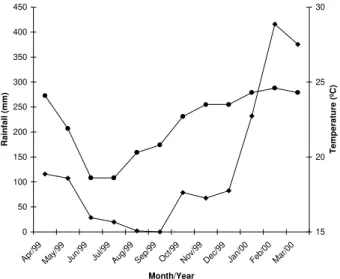
monthly air temperature and rainfall distribution are pre-sented in Figure 1. The woodland areas are established on a Typic Haplustox, medium texture, an acid and low
fertility soil (Table 1). The Eucalyptus spp. woodland
is part of a reforested area, planted during February 1969, in a 3 x 2 m spacing, with several native and ex-otic species, each species grouped in seven row plots
with nine plants in each plot. The Pinus spp. woodland
was planted in March 1975, in a 3 x 2 m spacing, being part of an experiment related to species and variety com-petition.
The areas under eucalyptus and Pinus (2 ha each)
were split in six subareas of similar size (around 3,000 m2).
From each subarea, sixteen randomized, simple soil subsamples were collected, grouped and homogenized, resulting in one composite sample. Six composite samples were obtained from each area. The soil samples collected from the 0-20 cm soil layer, after litter removal, were
s u t p y l a c u
E Pinus
H
p 5.3 4.6
m d g ( r e t t a m c i n a g r
O -3) 38 27
m d g m ( n i s e r
P -3) 21 12
K+(mmol cdm
3
-) 1.8 1.1
a
C 2+(mmol cdm
3
-) 45 20
g M 2+ (mmol
c dm 3
-) 13 7
H++Al3+ (mmol c dm
3
-) 34 47
l o m m ( s e s a b f o m u
S c dm-3) 59.8 28.1
l o m m ( y t i c a p a c e g n a h c x e n o i t a
C cdm-3) 93.8 75.1
) % ( n o i t a r u t a s e s a b l i o
S 64 37
Table 1 - Chemical properties of the soils grown with
Eucalyptus and Pinus.
Figure 1 - Monthly variation in rainfall (♦) and air temperature (•) monitored at Jaboticabal, SP, Brazil.
0 50 100 150 200 250 300 350 400 450
Apr/99 May/99 Jun/99 Jul/99 Aug/99 Sep/99 Oct/99 Nov/99 Dec/99 Jan/00 Feb/00 Mar/00
cleaned from pieces of leaves, stalks and roots, split in two subsamples, one of which was stored in a refrigera-tor for microbiological analysis and the other, oven dried
at 50o C for chemical analysis.
For the determination of the most probable num-ber (MPN) of total soil bacteria (Alexander, 1982), 2.7 mL of the Bunt & Rovira (1955) culture medium were transferred to each well of a 24-well plate. A soil sus-pension was prepared by shaking 10 g of moist soil into 95 mL of a 0.1% pyrophosphate solution (m/v) during 30
minutes; a 10-3 serial dilution of the soil suspension was
made in test tubes. Thereafter a 0.3 mL aliquot sample was transferred to each of the four wells of the first plate row. After homogenization, a 0.3 mL aliquot sample was taken from each well of the first row and transferred to the following one in the second row, and so successively,
until a 10-9 suspension dilution. The plates were incubated
at 30oC for 24 hours. The wells presenting bacterial
growth presented turbidity, and the minimal turbidity was considered a positive result. The positive results of the last three series of wells were considered for bacterial counting.
The respiratory activity was determined accord-ing to Jenkinson & Powlson (1976), by transferraccord-ing 100 g-fresh-collected soil sample into 2,500 mL recipients,
which were incubated at 30oC for one week. The
dehy-drogenase activity was determined according to Casida Jr. (1977) in soil extracts obtained after incubation of 3
g of dried soil at 37oC for 24 hours, and then addition of
30 mL methanol. After filtration, the absorbances were read in spectrophotometer at the 485 nm wavelength. One unit of enzyme activity corresponded to the quantity of
enzyme producing 1.0 µg triphenylformazan from 1.0 g
dry soil per three hours.
Total organic carbon was determined according to Sims & Haby (1971), using 1.0 g, dried soil sample.
The soil pH was determined in 0.01 mol L-1 CaCl
2
solu-tion (1:2.5). Soil moisture was determined by oven
dry-ing the soil samples at 105oC for 24 hours. Organic
mat-ter was demat-termined afmat-ter soil sample furnace incineration
at 550oC for 24 hours.
Monthly, litterfall samples were collected from
inside a 0.25 m2 gauge and the fresh and dry weights were
determined. The litterfall samples were dried in a forced
air oven at 105oC for three days before dry matter
deter-minations.
A split-plot experimental design was used with main plots being the two types of litter and the sub-plots, the monthly collected litterfall samples. The most probable number of total bacteria (MPN) was evaluated by a com-puter program (Hurley & Roscoe, 1983). For the analysis of variance, MPN values were transformed into log (X +
1), where X = NMP g-1 dried soil. Mean comparisons were
made according to the Tukey test (P = 0.05). Correlation
between variables and regression analysis of the time de-pendent variables were also calculated. All the statistical analysis were performed using SAS (1990).
RESULTS AND DISCUSSION
All variables showed fluctuations over time, sta-tistically adjusted to third degree equations, possibly due to variations in the climatic variables. Monthly variation
of the soil bacterial number under eucalyptus and Pinus
followed the variation trend observed in the respiratory and dehydrogenase activities (Figure 2). From June to Septem-ber, months with lower rainfall and air temperature ure 1), the bacterial community numbers decreased ure 2A), also followed by a decrease in the respiratory (Fig-ure 2B) and dehydrogenase activities (Fig(Fig-ure 2C). During the warmer and moister months, December to March, the bacterial number decreased followed by an increase in the microbial activities (Figure 2 B,C). Consequently,
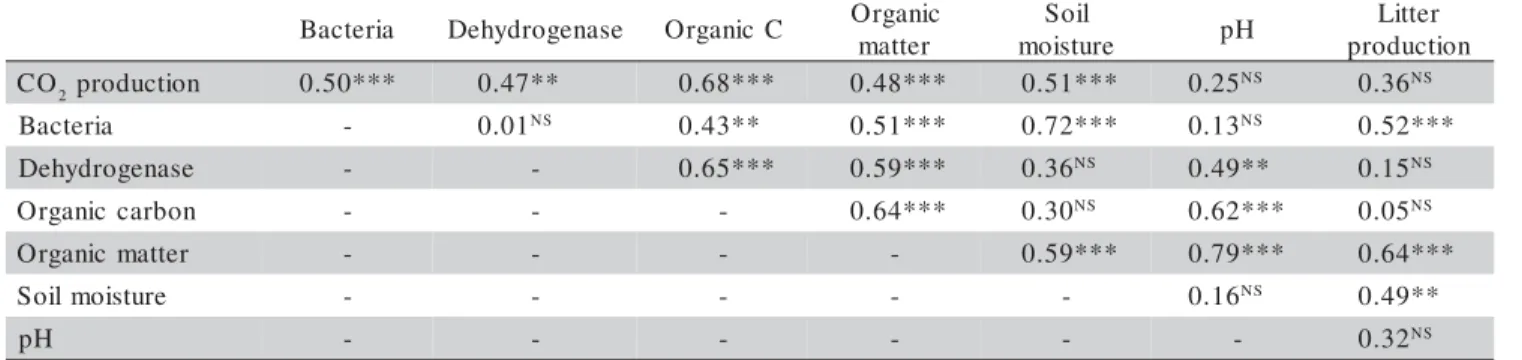
corre-lations between the bacterial counting and CO2 evolution
(r = 0.50***), and between this latter variable and
dehydro-genase activity (r = 0.47**) were found. No correlation was
observed between the number of bacteria and dehydroge-nase activity, possibly because of the low microbial
activ-ity in the Pinus soil. In the eucalyptus soil, the
dehydro-genase activity increased seven fold from the minimal (Oc-tober) to the maximal (December) activity, which coin-cided with the higher bacteria numbers.
a i r e t c a
B Dehydrogenase OrganicC Organic r e t t a m
l i o S
e r u t s i o
m pH
r e t t i L
n o i t c u d o r p O
C 2production 0.50*** 0.47** 0.68*** 0.48*** 0.51*** 0.25NS 0.36NS
a i r e t c a
B - 0.01NS 0.43** 0.51*** 0.72*** 0.13NS 0.52***
e s a n e g o r d y h e
D - - 0.65*** 0.59*** 0.36NS 0.49** 0.15NS
n o b r a c c i n a g r
O - - - 0.64*** 0.30NS 0.62*** 0.05NS
r e t t a m c i n a g r
O - - - - 0.59*** 0.79*** 0.64***
e r u t s i o m l i o
S - - - 0.16NS 0.49**
H
p - - - 0.32NS
Table 2 - Correlation coefficients (r) between selected variables including data of the Eucalyptus and Pinus soils.
The bacterial community numbers increased 54
and 65 times for the eucalyptus and Pinus soils,
respec-tively (Figure 2A) from the dry and chilly period to the warmer and rainy period, that is from September to Janu-ary. The fluctuations in the number of bacteria agree with the results obtained by Clarholm & Rosswall (1980) in a
Pinus forest, although there was only a 10-fold increase
in the bacteria numbers, possibly because of the lower air temperatures.
Maximal microbial respiratory activity was ob-served from December/1999 to January-February/2000,
as compared to other months (Figure 2B). CO2 evolution
increased three to four fold from the driest to the most humid month, and was correlated with the soil moisture
content (r = 0.51***). In an eucalyptus soil from
Austra-lia, there was a 2-fold increase in CO2 evolution,
corre-lated with soil temperature and moisture during the moist
season (Chen et al., 2002). In a Pinus soil, Fang et al.
(1998) attributed the increase in CO2 evolution to the
in-crease in root biomass, soil litter and humus contents.
However, CO2 evolution was inversely correlated to the
soil organic matter content. Although no correlation was observed between the respiratory activity and the litter quantity accumulated in the soil (Table 2), positive cor-relations between soil organic matter content and
respi-ratory activity (r = 0.48***) and litter content (r = 0.64***)
were observed.
The greater litter accumulation observed during the moisty season (Figure 3) can be attributed to the greater rainfall and consequently to the increase in the vegetal biomass. The influence of the soil moisture on the litter production was evidenced by the correlation
found between these two variables (r = 0.49**). In
Aus-tralia, Grigg & Mulligan (1999) observed that the de-crease in the litter production in two eucalyptus forests occurred when the rainfall amount also decreased. Mean-while, in New Zealand, Guo & Sims (1999a) found out that 70 to 80% of the total annual litter production was formed during the summer, what was also observed in an
Eucalyptus tereticornis forest in India (Bahar et al., 2001).
Seasonally-variable environmental factors, like air temperature and soil moisture, may influence the soil microbial community and activity and control the organic matter decomposition process (Maire et al., 1999). Higher decomposition rates in eucalyptus tropical forests were related to rainfall, soil moisture and temperature (Virzo de Santo et al., 1993; Pande, 1999). The higher litterfall
during the rainy season, for both Pinus and eucalyptus,
associated to the increase in the soil moisture content
Figure 2 - Monthly variation in bacterial population (A), CO2 production (B) and dehydrogenase activity (C) in Eucalyptus (♦) and Pinus (•) soils. (TPF, triphenylformazan; MPN, most probable number). F-test, Bacteria: Species (S) = 0.8NS, Time (T) = 4.2**, S
x T = 0.6NS; CO
2 production: S = 73.9**, T = 93.5**, S
x T = 4.1*; Dehydrogenase: S = 118.3*, T = 21.0*, S x T = 14.2*. NS, not significant; *, **, significant at P < 0.05 and P < 0.01, respectively.
(A)
-10 0 10 20 30 40 50
Bacteria
(MPN g
-1 dry soil x 10 6)
(B)
0 10 20 30 40 50 60 70 80 90 100
CO
2
production
(mg CO
2
100 g
-1 dry soil)
(C)
0 20 40 60 80 100 120 140 160
Apr/99 May/99 Jun/99 Jul/99 Aug/99 Sep/99 Oct/99 Nov/99 Dec/99 Jan/00 Feb/00 Mar/00 Month/Year
Dehydrogenase
(
µ
g TPF g
-1 dry soil)
Figure 3 - Monthly variation in litterfall in Eucalyptus (♦) and Pinus (•) soils. F-test, Species (S) = 16.7**, Time (T) = 20.6**, S x T = 1.0NS. NS, not significant; **, significant
(Figure 4A) and to the air temperature (Figure 1), might have contributed to the increase in the soil organic mat-ter (Figure 4B) and organic carbon contents (Figure 4C), as consequence of the increase in the litter decomposi-tion.
Dilly & Munch (1996) reported a lower
decom-position rate in Alnus glutinosa, during the summer, when
the litter moisture content was lower, contrarily to the re-sults obtained in this research. However, rere-sults herein
found for Pinus and eucalyptus soils, may be corroborated
by the correlation found between the bacterial number and
the litterfall (r = 0.52***), and bacterial number and the
increase in the organic carbon content (r = 0.43**) derived
from the organic matter mineralization. The increase in the bacterial number and in the microorganism activity resulted, probably, from the organic matter accumulation (Figure 4B), which was positively correlated to the
bac-teria number (r = 0.51***), to the respiratory activity (r =
0.48***) and to the dehydrogenase activity (r = 0.59***)
(Table 2). The increase in the microbial biomass C might
have resulted from the increase in the soil organic C (McGill et al., 1986; Anderson & Domsch, 1989). Nohrstedt (1985) have also concluded that the soil organic C from several forests was the factor influencing micro-bial activity.
Except for the bacterial numbers, similar in both
eucalyptus and Pinus soils, data obtained for the other
variables were higher for the eucalyptus soil than for the
Pinus soil (Figures 2, 3 and 4). The quantity and
mois-ture of litterfall might have affected the results, because litter accumulation was significantly higher for
eucalyp-tus (1.69 kg m-2) than for
Pinus (1.50 kg m-2)(Figure 3),
and with moisture contents of 18% and 17% (data not shown), respectively. On the other hand, the eucalyptus
soil had higher fertility and pH than the Pinus soil (Table
1), which might have caused an increase in the micro-bial activity and in the litter decomposition processes in the first one.
ACKNOWLEDGMENTS
To FAPESP and CNPq for fellowships.
REFERENCES
ALEXANDER, M. Most probable number method for microbial populations. In: PAGE, A. L; MILLER, R.H.; KEENEY, D.R. (Ed.)
Methods of soil analysis: Part 2. Chemical and microbiological properties. 2.ed. Madison: ASA, 1982. p.815-820.
ANDERSON, T.H.; DOMSCH, K.H. Ratios of microbial biomass to total organic carbon in arable soils. Soil Biology andBiochemistry, v.21, p.471-479, 1989.
BAHAR, N.; KAPOOR, K.S.; JAIN, A.K. Litter production pattern of
Eucalyptus tereticornis plantation in protected and unprotected areas of upper Gangetic plain. IndianForester, v.127, p.814-820, 2001. BUNT, J.S.; ROVIRA, A.D. Microbiological studies of some subantartic
soils. Journal of Soil Science, v.6, p.119-128, 1955.
CASIDA JR., L.E. Microbial metabolic activity in soil as measured by dehydrogenase determinations. Applied and Environmental Microbiology, v.34, p.630-636, 1977.
CHEN, X.; EAMUS, D.; HUTLEY, L.B. Seasonal patterns of soil carbon dioxide efflux from a wet-dry tropical savanna of northern Australia.
Australian Journal of Botany, v.50, p.43-51, 2002.
CHHONKAR, P.K.; TARAFDAR, J.C. Accumulation of phosphatases in soil. Journal of IndianSociety of Soil Science, v.132, p.266-272, 1984. CLARHOLM, M.; ROSSWALL, T. Biomass and turnover of bacteria in a forest soil and a peat. Soil Biology and Biochemistry, v.12, p.49-57, 1980.
DAMES, J.F.; SCHOLES, M.C.; STRAKER, C.J. Litter production and accumulation in Pinuspatula plantations of the Mpumalanga Province, South Africa. Plant and Soil, v.2, p.183-190, 1998.
DILLY, O.; MUNCH, J.C. Microbial biomass content, basal respiration and enzyme activities during the course of decomposition of leaf litter in a black alder (Alnus glutinosa (L.) Gaertn.) forest. Soil Biology and Biochemistry, v.28, p.1073-1081, 1996.
FABER, J.H.; TEUBEN, A.; BERG, M.P.; DOELMAN, P. Microbial biomass and activity in pine litter in the presence of Tomocerus minor (Insecta
Collembola). Biology and Fertility of Soils, v.12, p.233-240, 1992. FANG. C.; MONCRIEFF, J.B.; GHOLZ, H.L.; CLARK, K.L. Soil CO2
efflux and its spatial variation in a Florida slash pine plantation. Plant and Soil, v.205, p.135-146, 1998.
GRIGG, A.H.; MULLIGAN, D.R. Litterfall from two eucalypt woodlands in central Queensland. Australian Journal of Ecology, v.24, p.662-664, 1999.
Figure 4 - Monthly variation in soil moisture (A), organic matter (B) and organic carbon (C) in Eucalyptus (♦) and Pinus (•) soils. F-test, Organic matter: Species (S) = 89.3**, Time (T) = 3.9**, S x T = 0.5NS; Organic carbon: S =
33.1**, T = 4.2**, S x T = 1.0NS; Soil moisture: S =
9.1**, T = 10.0**, S x T = 4.1**. NS, not significant; ** significant at P < 0.01.
(A)
8 12 16 20 24
Soil moisture
(%, w/w)
(C)
12 14 16 18 20 22 24
Apr/99 May/99 Jun/99 Jul/99 Aug/99 Sep/99 Oct/99 Nov/99 Dec/99 Jan/00 Feb/00 Mar/00 Month/Year
Organic carbon
(mg 100 g
-1 dry soil)
(B)
7 8 9 10 11 12 13 14 15
Organic matter
(g 100 g
-1
GUNADI, B.; VERHOEF, H.A.; BEDAUX, J.J.M. Seasonal dynamics of decomposition of coniferous leaf litter in a forest plantation (Pinus merkusii) in Central Java, Indonesia. Soil Biology and Biochemistry,
v.30, p.845-852, 1998.
GUO, L.B.; SIMS, R.E.H. Litter decomposition and nutrient release via litter decomposition in New Zealand eucalypt short rotation forests.
Agriculture, Ecosystems and Environment, v.75, p.133-140, 1999a. GUO, L.B.; SIMS, R.E.H. Litter production and nutrient return in New
Zealand eucalypt short-rotation forests: implications for land management. Agriculture, Ecosystems and Environment, v.73, p.93-100, 1999b.
HURLEY, M.A.; ROSCOE, M.E. Automated statistical analysis of microbial enumeration by dilutions series. Journal of Applied Bacteriology, v.55,
p.159-164, 1983.
JENKINSON, D.S.; POWLSON, D.S. The effects of biocidal treatments on metabolism in soil-V. A method for measuring soil biomass. Soil Biology and Biochemistry, v.8, p.209-213, 1976.
JHA, D.K.; SHARMA, G.D.; MISHRA, R.R. Soil microbial population numbers and enzyme activities in relation to altitude and forest degradation. Soil Biology and Biochemistry, v.24, p.761-767, 1992. KLEIN D.A. The rhizosphere. In: LEDERBERG, J. (Ed.) Encyclopedia of microbiology. 2.ed. San Diego: Academic Press, 2000. v.4, p.117-126.
LUIZÃO, R.C.; BONDE, T.A.; ROSSWALL, T. Seasonal variation of soil microbial biomass - the effects of clearfelling a tropical rainforest and establishment of pasture in the Central Amazon. Soil Biology and Biochemistry, v.24, p.805-813, 1992.
MAIRE, N.; BORCARD, D.; LACZKÓ, E.; MATTHEY, W. Organic matter cycling in grassland soils of the Swiss Jura mountains: biodiversity and strategies of the living communities. Soil Biology and Biochemistry, v.31, p.1281-1293,1999.
McGILL, W.B.; CANNON, K.R.; ROBERTSON, J.A.; COOK, F.D. Dynamics of soil microbial biomass and water-soluble organic C in Breton L after 50 years of cropping to two rotations. Canadian Journal of Soil Science, v.66, p.1-19, 1986.
NOHRSTEDT, H-Ö. Biological activity in soil from forest stands in Central Sweden, as related to site properties. Microbial Ecology, v.11, p.259-266, 1985.
O’CONNELL, A.M. Microbial decomposition (respiration) of litter in eucalypt forest of south-western Australia: an empirical model based on laboratory incubations. Soil Biology and Biochemistry, v.22, p.153-160, 1990.
PANDE, P.K. Litter decomposition in tropical plantations: impact of climate and substrate quality. Indian Forester, v.125, p.599-608, 1999. PAUSAS, J.G. Litter fall and litter decomposition in Pinus sylvestris forests
of the eastern Pyrenees. Journal of Vegetation Science, v.8, p.643-650, 1997.
PENNANEN, T.; LISKI, J.; BÁÁTH, E.; KITUNEN, V.; UOTILA, J.; WESTMAN, C. J.; FRITZE, H. Structure of the microbial communities in coniferous forest soils in relation to site fertility and stand development stage. MicrobialEcology, v.38, p.168-179, 1999.
PERSSON, T.; BAATH, E.; CLARHOLM, M.; LUNDKVIST, H.; SÖDERSTRÖM, B.; SOHLENIUS, B. Trophic structure, biomass dynamics and carbon metabolism of soil organisms in a Scots pine forest.
EcologicalBulletins, v.32, p.419-459, 1980.
SANTA REGINA, I.; TARAZONA, T. Nutrient pools to the soil through organic matter and throughfall under a Scots pine plantation in the Sierra de la Demanda, Spain. European Journal of Soil Biology, v.37, p.125-133, 2001.
SAS INSTITUTE. SAS/STAT use’s guide (Version 6). 3.ed. Cary: SAS Institute, 1990. 705p.
SCHNEIDER, K.; TURRION, M.B.; GALLARDO, J.F. Modified method for measuring acid phosphatase activities in forest soils with high organic matter content. Communications inSoil Science and Plant Analysis, v.31, p.3077-3088, 2000.
SIMS, J.R.; HABY, V.A. Simplified colorimetric determination of soil organic matter. Soil Science, v.112, p.137-141,1971.
SWIFT, M.J.; HEAL, O.W.; ANDERSON, J.M. Decomposition in terrestrial ecosystems. Oxford: Blackwell Scientific Publications, 1979. 372p.
TAYLOR, B.R.; PARKINSON, D. Aspen and pine leaf litter decomposition in laboratory microcosms. II. Interactions of temperature and moisture level. Canadian Journal of Botany, v.66, p.1966-1973, 1988. VIRZO de SANTO, A.; BERG, B.; RUTIGLIANO, F.A.; ALFANI, A.;
FIORETTO, A. Factors regulating early-stage decomposition of needle litters in five different coniferous forests. SoilBiology and Biochemistry, v.25, p.1423-1433, 1993.