Tomato and garlic by gavage modulate
7,12-dimethylbenz[a]anthracene-induced genotoxicity and oxidative
stress in mice
1Department of Biochemistry, Faculty of Science, Annamalai University,
Tamil Nadu, India
2School of Life Sciences, Jawaharlal Nehru University, New Delhi, India
V. Bhuvaneswari1,
B. Velmurugan1,
S.K. Abraham2
and S. Nagini1
Abstract
Chemoprotection by dietary agents is a promising strategy for cancer prevention. The aim of the present study was to evaluate the combined effect of tomato and garlic against 7,12-dimethylbenz-[a]anthracene (DMBA)-induced genetic damage and oxidative stress in 12-14-week-old male Swiss albino mice. The animals were randomized into experimental and control groups and divided into eight groups of five animals each. Group 1 animals were injected intraperitoneally with 35 mg/kg body weight DMBA suspended in peanut oil as a single dose. Groups 2-4 animals received tomato (500 mg/kg body weight), garlic (125 mg/kg body weight) and a combination of tomato and garlic for 5 days by gavage, respec-tively, followed by DMBA 1.5 h after the final feeding. The doses of tomato and garlic correspond to the average human daily con-sumption. Animals in groups 5, 6 and 7 received tomato alone, garlic alone and tomato + garlic combination, respectively, for 5 days. Group 8 animals received the same volume of water and served as control. The incidence of bone marrow micronuclei and the extent of lipid peroxidation and the concentrations of antioxi-dants glutathione, glutathione peroxidase and glutathione-S-trans-ferase were measured in the liver, 48 h after DMBA exposure. Increased frequency of micronuclei and enhanced lipid peroxida-tion accompanied by compromised antioxidant defenses were ob-served in DMBA-treated animals. Although pretreatment with to-mato or garlic significantly reduced the frequency of DMBA-induced bone marrow micronuclei, the combination of tomato and garlic exhibited more profound effect in inhibiting DMBA-induced genotoxicity and oxidative stress. We suggest that a broad spec-trum of antimutagenic and anticlastogenic effects can be achieved through an effective combination of functional foods such as tomato and garlic.
Correspondence
S. Nagini
Department of Biochemistry Faculty of Science Annamalai University Annamalainagar-608 002 Tamil Nadu
India
Fax: +91-4144-23-8145/23-8080 E-mail: [email protected] or [email protected]
Research supported by the Department of Science and Technology, New Delhi, India.
Received September 12, 2003 Accepted April 8, 2004
Key words
•Antioxidants
•DMBA
•Garlic
•Lipid peroxidation
•Micronuclei
•Tomato
Environmental factors are recognized to play a major role in the etiology of various cancers that account for over 80% of human malignancies. When cells are exposed to a carcinogenic agent, the carcinogen interacts with DNA directly, or via the formation of reactive oxygen species (ROS), resulting in chromosomal abnormalities and compro-mised host antioxidant defense mechanisms that eventually culminate in neoplastic trans-formation (1). It follows that cancer control can be achieved by decreasing the rate of DNA damage and enhancing antioxidant de-fenses. ROS scavengers have therefore evolved as effective cancer chemopreven-tive agents. Recently, a great deal of attention has been focused on fruits and vegetables with potent antioxidant properties. In par-ticular, tomato and garlic are recognized to possess a wide range of beneficial effects.
Tomatoes and tomato-based products are rich sources of lycopene, an antioxidant carotenoid reported to be a more stable and potent singlet oxygen quenching agent com-pared to other carotenoids. Garlic (Allium sativum Linn.) used for flavoring and as a medicinal herb for centuries, is known to exhibit antioxidant, antimutagenic and anti-carcinogenic effects. Epidemiological stud-ies have provided evidence that an increased intake of tomato and garlic is associated with a decreased cancer risk (2,3). In previous studies from this laboratory, we demon-strated the modulatory effects of tomato and garlic on lipid peroxidation, antioxidant and detoxification systems during chemopreven-tion of 7,12-dimethylbenz[a]anthracene (DMBA)-induced oral carcinogenesis (4,5). The current focus of chemopreventive research is on intermediate biomarkers ca-pable of detecting early changes that can be correlated with inhibition of carcinogenic progression. Short-term tests such as the mouse bone marrow micronucleus assay as well as assessment of ROS-induced lipid peroxidation and the status of antioxidants are widely used in the detection and
evalua-tion not only of environmental carcinogens, but also of presumptive antimutagens and anticarcinogens (6,7). The present study was designed to evaluate the effect of oral pretreatment with tomato and garlic alone and in combination on DMBA-induced geno-toxicity and oxidative stress. The incidence of bone marrow micronuclei as well as the changes in lipid peroxidation and the status of the antioxidants, reduced glutathione (GSH), glutathione peroxidase (GPx), and glutathi-one-S-transferase (GST) in the liver were used as intermediate biomarkers of chemo-prevention.
corre-spond to the average daily dietary intake by a person weighing 65-70 kg (2,8).
The animals were randomized into exper-imental and control groups and divided into eight groups of five animals each. The smaller number of animals used per group is in keeping with the regulations of the Ethics Committee to minimize the number of ani-mals. Animals in group 1 were given DMBA (35 mg/kg body weight) intraperitoneally (9). Animals in groups 2, 3 and 4 received an intragastric administration of tomato (500 mg/kg body weight), garlic (125 mg/kg body weight) and a combination of tomato and garlic (500 + 125 mg/kg body weight), respectively, for 5 days followed by DMBA 1.5 h after the final feeding (8,10). Animals in groups 5, 6 and 7 were given tomato alone, garlic alone and the tomato + garlic combina-tion, respectively, for 5 days. Group 8 ani-mals received the same volume of water and served as control. The animals were sacri-ficed by cervical dislocation 48 h after DMBA exposure. Both femurs were removed imme-diately and used for the analysis of micro-nucleated polychromatic erythrocytes (MnPCEs). The liver tissues were immedi-ately removed and placed in cold 0.9% NaCl solution.
The mouse bone marrow micronucleus test was carried out by the method of Schmid (11) for the evaluation of chromosomal dam-age in experimental animals.Bone marrow from the femur was flushed in the form of a fine cell suspension into a centrifuge tube containing fetal calf serum. The cell suspen-sion was centrifuged at 500 g for 10 min and the supernatant was discarded. The pellet was resuspended in a drop of serum and used for preparing slides. The air-dried slides were stained with May-Grünwald and Gi-emsa. A total of 2,500 polychromatic eryth-rocytes were scored per animal from a single slide to determine the frequency of MnPCEs. All slides were scored by the same observer. Lipid peroxidation as evidenced by the formation of thiobarbituric acid reactive
sub-stances (TBARS) was assayed in the liver tissues by the method of Ohkawa et al.(12). The reaction mixture corresponding to a total volume of 10 ml containing 0.2 ml tissue homogenate, 0.2 ml 8.1% sodium dodecyl-sulfate, 1.5 ml 20% acetic acid, 1.5 ml distilled water, and a 5-ml n-butanol and pyridine mixture, was heated at 95ºC for 60 min. The pink-colored chromogen formed by the reaction of 2-thiobarbituric acid with the breakdown products of lipid peroxidation was read at 535 nm.
The concentration of GSH was deter-mined by the method of Anderson(13) based on the development of a yellow color when 5,5'-dithiobis(2-nitrobenzoic acid) is added to compounds containing sulfhydryl groups. The reaction mixture contained equal vol-umes of 4% sulfosalicylic acid and tissue samples homogenized in 4 volumes of ice-cold 0.1 M sodium phosphate buffer, pH 7.4. GPx activity was assayed by the method of Rotruck et al. (14) with modifications. The reaction mixture corresponding to a total volume of 1.0 ml containing 0.2 ml of 0.4 mM sodium phosphate buffer, pH 7.0, 0.2 ml of 0.4 mM EDTA, 0.1 ml of 10 mM sodium azide, and 0.2 ml tissue homogenate was incubated with 0.1 ml H2O2 and 0.2 ml GSH
for 10 min. The amount of H2O2 utilized was
determined by estimating GSH content by the method of Anderson (13). GST activity was determined as described by Habig et al. (15). The reaction was started by the addi-tion of 0.1 ml of 30 mM GSH to the reacaddi-tion mixture containing 2.0 ml of sodium phos-phate buffer, 0.1 ml of 30 mM 1-chloro-2,4-dinitrobenzene (CDNB), 0.1 ml tissue ho-mogenate, and 1.7 ml distilled water. The reaction mixture was preincubated at 37ºC for 5 min. The increase in absorbance at 340 nm was read using CDNB as substrate. The protein content was estimated by the method of Lowry et al. (16) using bovine serum albumin as standard.
ana-lyzed by the Student t-test. The data for lipid peroxides and antioxidants were analyzed by analysis of variance (ANOVA) and the group means were compared by the least signifi-cant difference (LSD) test. The results were considered statistically significant when P < 0.001.
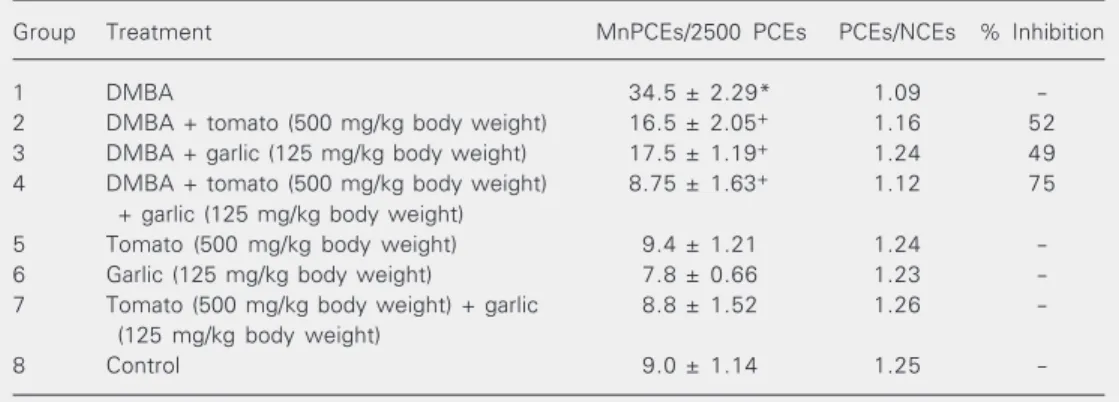
Table 1 summarizes the effect of pre-treatment with tomato and garlic alone and in combination on the frequencies of DMBA-induced MnPCEs. A significant increase (P < 0.001) in the frequency of MnPCEs was found in DMBA-treated animals (group 1) compared to the untreated control (group 8). Pretreatment with tomato and garlic alone and in combination significantly reduced (P < 0.001) the incidence of MnPCEs com-pared to group 1. However, the combination of tomato and garlic exhibited greater protec-tion (75%) against DMBA-induced bone marrow micronuclei than either agent used alone. The frequency of MnPCEs in animals of groups 5-7 was not significantly different from that observed in group 8.
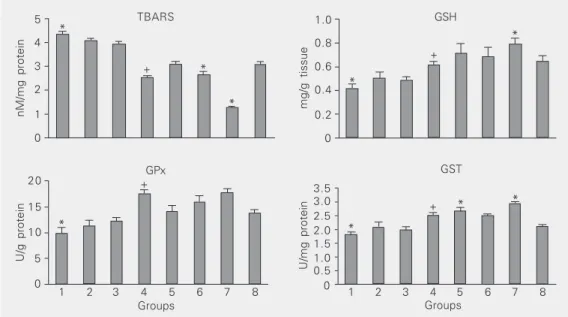
Figure 1 shows the effect of pretreatment with tomato and garlic alone and in combina-tion on the levels of TBARS, GSH and the activities of GPx and GST in the liver of control and experimental animals.
Adminis-tration of DMBA (group 1) significantly increased (P < 0.001) the extent of hepatic lipid peroxidation and decreased GSH and GSH-dependent enzymes compared to con-trol. Pretreatment with combined dose of tomato and garlic significantly decreased (P < 0.001) hepatic lipid peroxidation and en-hanced the antioxidant levels compared to group 1. Among groups 5-7, the combina-tion of tomato and garlic significantly de-creased lipid peroxidation and inde-creased GSH and GSH-dependent enzymes compared to either agent alone.
DMBA, a member of the polycyclic aro-matic hydrocarbons, is present in the envi-ronment as a product of incomplete combus-tion of complex hydrocarbons. Being an indirect carcinogen, DMBA requires meta-bolic activation to become a carcinogen. DMBA is metabolized by cytochrome P4501A1 in liver microsomes and by cyto-chrome P4501B1 in primary bone marrow stromal cells to form diol epoxides and other toxic ROS. The toxic metabolites of DMBA, including diol epoxides, are capable of bind-ing to adenine residues of DNA causbind-ing chromosomal damage (17).
ROS formed during DMBA metabolism can diffuse from the site of generation to
Table 1. Inhibitory effects of pretreatment with tomato and garlic alone and in combination on DMBA-induced bone marrow micronucleated polychromatic erythrocytes.
Group Treatment MnPCEs/2500 PCEs PCEs/NCEs % Inhibition
1 DMBA 34.5 ± 2.29* 1.09
-2 DMBA + tomato (500 mg/kg body weight) 16.5 ± 2.05+ 1.16 52
3 DMBA + garlic (125 mg/kg body weight) 17.5 ± 1.19+ 1.24 49
4 DMBA + tomato (500 mg/kg body weight) 8.75 ± 1.63+ 1.12 75
+ garlic (125 mg/kg body weight)
5 Tomato (500 mg/kg body weight) 9.4 ± 1.21 1.24
-6 Garlic (125 mg/kg body weight) 7.8 ± 0.66 1.23
-7 Tomato (500 mg/kg body weight) + garlic 8.8 ± 1.52 1.26
-(125 mg/kg body weight)
8 Control 9.0 ± 1.14 1.25
other targets within the cells or even propa-gate the injury outside to intact cells. These ROS produce deleterious effects by initiating lipid peroxidation directly or by acting as second messengers for the primary free radicals that initiate lipid peroxidation (1). Thus, enhanced hepatic lipid peroxidation in DMBA-treated animals may be attributed to excessive generation of ROS exacerbated by decreased efficiency of host antioxidant de-fense mechanisms.
The liver, which is rich in GSH, supplies it to various extrahepatic tissues via a distinct GSH transport system. GSH maintains the integrity of the liver when the organ is chal-lenged by a wide variety of xenobiotics, ROS and toxic compounds. GSH, in conjunction with GPx and GST, detoxifies reactive inter-mediate species generated during DMBA metabolism, thereby enhancing resistance against oxidative stress (7). The depletion of GSH and GSH-dependent enzymes in the liver resulting from increased utilization to scavenge lipid peroxides may shift the redox status of the liver towards oxidative stress. Oxidative stress arising due to ROS overpro-duction coupled with deficiency of host antioxidant defense mechanisms observed in the present study may be an important factor
contributing to the increase in bone marrow micronuclei. Mayer et al. (18) have also demonstrated a positive correlation between lipid peroxidation status and genotoxicity as reflected by increased micronucleus forma-tion in lymphocytes. These findings confirm reports by other workers on the clastogenic effects of DMBA (17).
Pretreatment with tomato and garlic ef-fectively reduced the frequency of occur-rence of DMBA-induced bone marrow mi-cronuclei as well as the extent of hepatic lipid peroxidation and enhanced the antioxidant status. Moreover, our data demonstrate that the administration of tomato plus garlic ex-hibited a stronger effect in reducing DMBA-induced genotoxicity and oxidative stress than either agent used alone. This synergistic interaction between tomato and garlic in inhibiting the clastogenic effects of DMBA has been reported recently by Sengupta et al. (19). In this study, concomitant administra-tion of a combined dose of tomato and garlic by gavage was found to attenuate bone marrow chromosomal aberrations induced in Swiss mice by topical application of DMBA. In the present study, pretreatment with to-mato and garlic combination exerted signifi-cant protective effects against increased
fre-nM/mg protein
5
20
15
10
5
0 4
3
2
1
0
U/g protein
mg/g tissue
1.0
0.8
0.6
0.4
0.2
0
3.5 3.0 2.5 2.0 1.5 1.0 0.5 0
U/mg protein
TBARS GSH
1 2 3 4 5 6 7 8
Groups
1 2 3 4 5 6 7 8
Groups
GPx GST
*
* *
+
+
+ +
* *
* *
*
*
quency of bone marrow micronuclei and oxidative stress induced by intraperitoneal injection of DMBA, potentiating the anti-genotoxic and antioxidant properties of these agents.
The protective effects of tomato and garlic observed in the present study may be related to the antioxidant and antimutagenic properties of their constituents such as lyco-pene and organosulfur compounds, respec-tively. Being lipophilic, lycopene is absorbed in the intestine, taken up by the liver and from there transported to various tissues (2). Ly-copene has been reported to protect the liver against T2 toxin by reducing lipid peroxida-tion and modulating GSH metabolism in vivo (20). Recently, we have reported
dose-de-pendent protection of tomato paste against DMBA-induced genotoxicity and oxidative stress in mice as well as the incidence of hamster buccal pouch tumors (4,9). The antigenotoxic and anticarcinogenic effects of garlic and its organosulfur constituent SAC have also been reported by us as well as by others (3,5,9).
The results of the present study clearly indicate that a broad spectrum of antimu-tagenic and anticlastogenic effects can be achieved through an effective combination of functional foods such as tomato and garlic which would be more cost effective than supplementation of individual antioxidants for protection against oxidative stress.
References
1. Das UN (2002). A radical approach to cancer. Medical Science Monitor,8: 79-92.
2. Giovannucci E (1999). Tomatoes, tomato-based products, lyco-pene, and cancer: Review of the epidemiologic literature. Journal of the National Cancer Institute, 91: 317-331.
3. Thomson M & Ali M (2003). Garlic (Allium sativum): A review of its potential use as an anti-cancer agent. Current Cancer Drug Targets, 3: 67-81.
4. Bhuvaneswari V, Velmurugan B & Nagini S (2004). Dose-response effect of tomato paste on 7,12-dimethylbenz[a]anthracene-induced hamster buccal pouch carcinogenesis. Journal of Experimental and Clinical Cancer Research (in press).
5. Balasenthil S, Arivazhagan S, Ramachandran CR & Nagini S (1999). Effects of garlic on 7,12-dimethylbenz[a]anthracene induced ham-ster buccal pouch carcinogenesis. Cancer Detection and Preven-tion, 23: 524-538.
6. Ohyama W, Gonda M, Miyajima H et al. (2002). Collaborative validation study of the in vivo micronucleus test using mouse colonic epithelial cells. Mutation Research, 518: 39-45.
7. Locigno R & Castronovo V (2001). Reduced glutathione system: Role in cancer development, prevention and treatment (Review). International Journal of Oncology, 19: 221-236.
8. Singh SP, Abraham SK & Kesavan PC (1996). Radioprotection of mice following garlic pretreatment. British Journal of Cancer, 74: S102-S104.
9. Abraham SK (1991). Inhibitory effects of coffee on the genotoxicity of carcinogens in mice. Mutation Research, 262: 109-114. 10. Chandra Mohan KVP, Bhuvaneswari V, Abraham SK & Nagini S
(2003). Dose-dependent protection by tomato against 7,12-dimethylbenz[a]anthracene-induced genotoxicity and oxidative stress in mice. Journal of Medicinal Food, 6: 169-173.
11. Schmid W (1975). The micronucleus test. Mutation Research,31:
9-15.
12. Ohkawa H, Ohishi N & Yagi K (1979). Assay for lipid peroxides in animal tissues by thiobarbituric acid reaction. Analytical Biochemis-try,95: 351-358.
13. Anderson ME (1985). Determination of glutathione. In: Meister A (Editor), Methods in Enzymology. Academic Press, New York, 548-551.
14. Rotruck JT, Pope AL, Ganther HE, Swanson AB, Hafeman DG & Hoekstra WG (1973). Selenium: Biochemical roles as a component of glutathione peroxidase. Science, 179: 588-590.
15. Habig WH, Pabst MJ & Jakoby WB (1974). Glutathione-S-trans-ferases, the first enzymatic step in mercapturic acid formation. Journal of Biological Chemistry, 249: 7130-7139.
16. Lowry OH, Rosebrough NJ, Farr AL & Randall RJ (1951). Protein measurement with the Folin phenol reagent. Journal of Biological Chemistry, 193: 265-275.
17. Guerin MR (1978). Energy sources of polycyclic aromatic hydrocar-bons. In: Gelboin HV & Ts’o POP (Editors), Polycyclic Hydrocarbons and Cancer: Chemistry, Molecular Biology and Environment. Aca-demic Press, New York, 1-42.
18. Mayer C, Schmezer P, Freese R, Mutanen M, Hietanen E, Obe G, Basu S & Bartsch H (2000). Lipid peroxidation status, somatic mutations and micronuclei in peripheral lymphocytes: a case ob-servation on a possible interrelationship. Cancer Letters,152: 169-173.
19. Sengupta A, Ghosh S & Das S (2002). Administration of garlic and tomato can protect from carcinogen induced clastogenicity. Nutri-tion Research,22: 859-866.