ISSN 0102-695X
DOI: 10.1590/S0102-695X2013005000038 Received 13 Dec 2012
Accepted 3 Apr 2013 Available online 14 May 2013
resin, and its derivatives display larvicidal
activity against
Anopheles darlingi
and
Aedes
aegypti
(Diptera: Culicidae)
Frances Tatiane Tavares Trindade,
1,4Rodrigo Guerino Stabeli,
2,4Antônio Almeida Pereira,
3Valdir Alves Facundo,
3Alexandre de
Almeida e Silva
*,1,41Laboratório de Bioecologia de Insetos, Departamento de Biologia, Universidade Federal de Rondônia, Brazil,
2Centro de Estudos de Biomoléculas Aplicadas a Medicina, Departamento de Medicina, Universidade Federal de Rondônia, Brazil,
3Laboratório de Pesquisas Químicas em Produtos Naturais, Departamento de Química, Universidade Federal de Rondônia, Brazil,
4Fiocruz-Rondonia, Brazil.
Abstract: Copaifera spp. is a common tree species found in the tropical region of Latin America, popularly known as copaiba or pau-d’alho. Oil-resin from different
Copaifera species and its components present several biological activities such as
antimicrobial, anti-inl ammatory, antioxidant and insecticidal, including larvicidal activity against mosquitoes. Thus, bark and leaf ethanolic extracts, oil-resin, essential
oil and alepterolic acid from Copaifera multijuga Hayne, Fabaceae, were tested as larvicides against the main malaria vector in the north of Brazil, Anopheles darlingi and also Aedes aegypti, the dengue vector. A. darlingi larval mortality was signii cantly
higher than A. aegypti for most tested compounds. Bark and leaf extracts resulted in
lower Lethal Concentrations (LC50) values for A. darlingi, 3 and 13 ppm, respectively, while the essential oil provided the lowest LC50 value for A. aegypti, 18 ppm. Despite of that, the lowest LC values were from the alepterolic acid for both species, i.e. 0.9 and 0.7 ppm for A. darlingi and A. aegypti, respectively.
Keywords:
Copaifera multijuga Anopheles darlingi Aedes aegypti
vector control
Introduction
Mosquitoes (Diptera: Culicidae) are important vectors of several human diseases including malaria and dengue. Anopheles darlingi is the principal vector of malaria in Rondonia and other Amazonian states; it is captured in high densities and frequency in anthropized environments (Gil et al., 2003). The dengue vector, Aedes aegypti, is a domestic and highly endophilous mosquito species (Consoli & Lorenço-de-Oliveira, 1994). Among many variables, the use of insecticides in vector control plays an important role in preventing transmission of these diseases. However, since chemical control often results in insect resistance to synthetic insecticides (Hemingway & Ranson, 2000), identifying new molecules with insecticidal
properties remains a priority in the biotechnology i eld.
Copaifera spp. (commonly know as copaiba or pau-d’alho) is a tree species found throughout the
tropics of Latin America that exudes oil-resin from the
trunks (Leandro et al., 2012). Although many Copaifera
species exists in the Amazon region, Copaifera multijuga Hayne, Fabaceae, provides a considerable amount of
oil-resin commercialized (≈5%) (Lawrence, 1980), that
peaks during the rainy season, especially ones growing
in clay soils (Alencar, 1982). Up to 60% of the oil-resin
composition comprises diterpene acids and volatile substances, such as sesquiterpene hydrocarbons. Plant nutrition, insect herbivory and light conditions greatly
inl uences the concentration and composition of copaiba’s
oil-resin (Veiga Jr. et al., 2005; Langenheim, 1990). The medicinal properties of Copaifera oil-resin
have been described since the sixteenth century (see
Veiga Jr et al., 2005 for a review). Oil-resin and other substances derived from different Copaifera species
displayed antimicrobial, anti-inl ammatory, antioxidant,
and insecticidal activities (Leandro et al., 2012). Regarding insecticides, previous studies reported that oil-resin effectively killed mosquito larvae (Prophiro et al., 2012; Silva et al., 2003). Therefore, we evaluated the larvicidal
activity of copaiba extracts, oil-resin, essential oil and
alepterolic acid from C. multijuga against the malaria and dengue vectors, A. darlingi and A. aegypti.
Material and Methods
Processing the plant material
Oil-resin, bark, and leaves from Copaifera multijuga Hayne, Fabaceae, were collected in March 2008 from a tree located in Candeias do Jamari, Rondonia
State, Brazil. Taxonomists from the Instituto Nacional de Pesquisas da Amazônia performed plant identiication and
the voucher specimen was deposited in the herbarium with
identiication number 223.353.
Dried and grounded C. multijuga trunk bark (1.6
kg) and leaves (1.9 kg) were extracted with 99% ethanol
(2.0 L and 2.5 L, respectively) at room temperature over
the course of ive days. The solvent was evaporated under reduced pressure, leaving 36.0 g of bark ethanolic extract and 29.6 g of leaves ethanolic extract.
Extracting and analyzing the essential oil
Ten milliliters of oil-resin was distillated in a
500 mL round-bottom lask itted with a 40 cm distillation
column and a serpentine condenser coupled with an oil separator. The distillation process took 4 h and yielded 4 mL of essential oil.
The essential oil was analyzed by GC/MS (determination of Kovats Indices) with a HP-5971
apparatus, using a 25 m x 0.25 mm fused silica capillary SP-2100 column, helium as carrier gas 1 mL/min low
rate, and temperature programmed from 50-250 ºC at 4
°C/min. Compound identiication was initially done using
a MS library search with Kovats indices as a pre-selection routine (Alencar et al. 1984; 1990) followed by visual
conirmation to the standard MS obtained from literature
(Adams, 2007).
Isolating and characterizing the components from the remaining oil-resin
After extracting the volatile compounds from
the oil-resin, the remaining oil was separated from the aqueous phase using a separation funnel. This fraction was dried using anhydrous sodium sulphate and submitted to silica gel column chromatography eluted with n-hexane and chloroform in increasing polarity. The resulting white amorphous solid was subjected to IR, RMN 1H and 13C
spectroscopic analysis.
Collecting mosquitoes and breeding larvae
Adult A. darlingi mosquitoes were captured using
a modiied BG sentinel trap in peri-urban regions of Porto
Velho, Rondonia. A. aegypti eggs were obtained from the Laboratório de Ecologia Química de Insetos Vetores, UFMG, Brazil and colonized under laboratory conditions
(25-28 °C, 12 h photoperiod and 80% humidity). Adult
mosquitoes fed on blood from rabbits for 15 min to stimulate egg production and then were transferred to
plastic cups covered with ine netting, where they fed on 20% sucrose. Three days after a meal, oviposition was
induced in female mosquitoes by removing one wing from A. darlingi or introducing beakers containing distilled water to A. aegypti. The resulting larvae were fed with
TetraMin Tropical Flakes ish food ad libitum until the 3rd
or 4th instar stage.
Larvicidal bioassays
Larvicidal tests were performed in two sets. Set 1 was a dose response test with nine concentrations for
extracts and oils (ppm: 5, 10, 25, 50, 125, 250, 500, 750,
1000) in order to determine the concentrations for the lethal
concentration (LC50 and LC90) assay (Set 2) using ive
different concentrations and four replicates (WHO, 2005). Set 2 tests were repeated three times. Larval mortality was recorded from 24 to 48 h for LC calculation and interrupted
after 96 h. Plant extracts or oils were diluted in DMSO and
pipetted under the water surface of plastic cups (150 mL) containing 100 mL of distillated water and larvae (10 for Set 1 or 25 for Set 2) were introduced in the cups 30 min after pipetting. Lethal concentrations (LC) were calculated using Probit analysis and Weibull distribution (Minitab, Minitab Inc).
Statistical analysis
The effects of extract oils and isolated substance
concentration on larval mortality were analyzed by TwoWay Anova or by non-parametric analysis, i.e., Kruskal-Wallis or Rank sum test (SigmaStat 2.0, 1992-1997) when data transformation for normalization failed.
Results
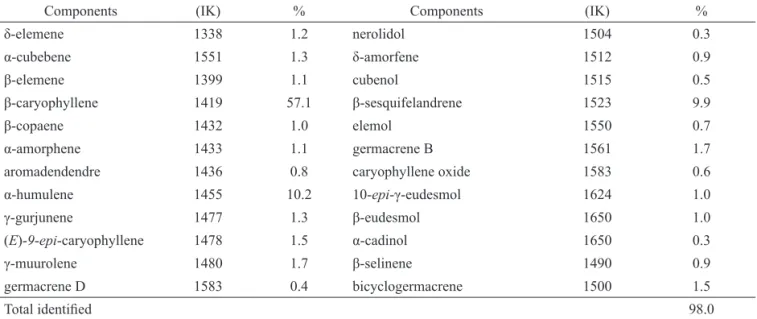
The essential oil extracted from the oil-resin
was comprised of sequiterpene hydrocarbons with
β-caryophyllene (57.1%) and α-humulene (10.2%) making
up the principal compounds (Table 1).
The IR, RMN 1H and 13C spectroscopic analysis
of the white amorphous solid isolated from the remaining
oil-resin (after essential oil extraction) was identiied as alepterolic acid or 3-hydroxy-copalic acid. Comparison of
the RMN 1H e 13C data with published data (Geris et al.,
2008) conirmed the proposed structure.
The mortality rate of A. darlingi and A. aegypti larvae was significantly affected by different
often showing, an increasing number of deaths from 24 to 96 h. The larval mortality of A. aegypti and A. darlingi in most assays increased up to 48 and 72 h, accordingly (Figure 2 and 3). However, A. aegypti larval mortality was
signii cantly lower than A. darlingi’s when fed with bark (T=5.68; p<0.001) or leaf extract (T=8700.0; p<0.001), or oil-resin (T=7323.5; p=0.003), but not for essential oil (T=6593.0; p=0.603) even at high concentrations (Figure 1 and 2, respectively).
The C. multijuga bark extract affected of A. aegypti and A. darlingi larval mortality signii cantly in
most of the extract concentrations tested (F=294,81;
p<0,001 and F=29.36; p<0.001, respectively). At 200
ppm, bark extracts killed 86% of A. aegypti larvae after
48 h, while 83% of the A. darlingi larvae were dead within the same period at 125 ppm. A. darlingi larvae mortality
reached 93% after 96 h (Figure 1A and 2A).
Table 1. Chemical composition of the essential oil extracted from the Copaifera multijuga oil-resin.
Components (IK) % Components (IK) %
δ-elemene 1338 1.2 nerolidol 1504 0.3
α-cubebene 1551 1.3 δ-amorfene 1512 0.9
β-elemene 1399 1.1 cubenol 1515 0.5
β-caryophyllene 1419 57.1 β-sesquifelandrene 1523 9.9
β-copaene 1432 1.0 elemol 1550 0.7
α-amorphene 1433 1.1 germacrene B 1561 1.7
aromadendendre 1436 0.8 caryophyllene oxide 1583 0.6
α-humulene 1455 10.2 10-epi-γ-eudesmol 1624 1.0
γ-gurjunene 1477 1.3 β-eudesmol 1650 1.0
(E)-9-epi-caryophyllene 1478 1.5 α-cadinol 1650 0.3
γ-muurolene 1480 1.7 β-selinene 1490 0.9
germacrene D 1583 0.4 bicyclogermacrene 1500 1.5
Total identii ed 98.0
Figure 1. Larvicidal activity of Copaifera multijuga: ethanolic extract of bark (A), leaf (B), essential oil (C), oil-resin (D) against
Larvicidal leaf extract caused larval mortality of
both species in a similar temporal pattern described above,
but with weaker effects compared to bark extract. For example, larval mortality at 200 ppm after 48 h reached 57% for A. aegypti (F=102.2; p<0.001) and 72% for A. darlingi (F=13.17; p<0.001) (Figure 1B and 2B).
Oil-resin from C. multijuga was tested at different concentrations for A. aegypti and A. darlingi. Oil-resin caused A. darlingi larval mortality only at higher concentrations (100-75 ppm) (F=30,1; p<0,001). For all other concentrations tested, A. aegypti larval mortality
differed signii cantly (F=282.2; p<0.001). Although the larval mortality caused by the oil-resin was generally
signii cantly higher for A. darlingi than A. aegypti (T=7325.5; p=0.003), the larval mortality of A. aegypti
reached 90% after 96 h at 200 ppm, while for A. darlingi,
90% larval mortality was reached with 100 ppm (Figure
1D).
When mosquito larvae were exposed to the
C. multijuga essential oil, the mortality rate did not differ between mosquito species. The number of deaths
increased signii cantly after 24 h (F=6.84; p<0.001 - A. aegypti and F=5.52; p=0.002 - A. darlingi) and with increasing concentrations (F=175.34; p<0.001- A. aegypti and F=22.26; p<0.001 - A. darlingi) (Figure 1C and 2C).
The larvicidal activity of alepterolic acid did not
differ signii cantly between species (T=6113.5; p=0.26) or change over the course of time (H=0.67; p=0.87 - A. aegypti and H=0.12; p=0.98 - A. darlingi) (i.e., highest mortality was reached after 24 h and did not increase
afterwards) (Figure 3). However, larvae mortality increased
signii cantly (H=77.3; p<0.001 - A. aegypti and H=77.5; p<0.001 - A. darlingi) with the concentration range tested,
surpassing 50% for the lowest concentration evaluated at
1 ppm (Figure 3).
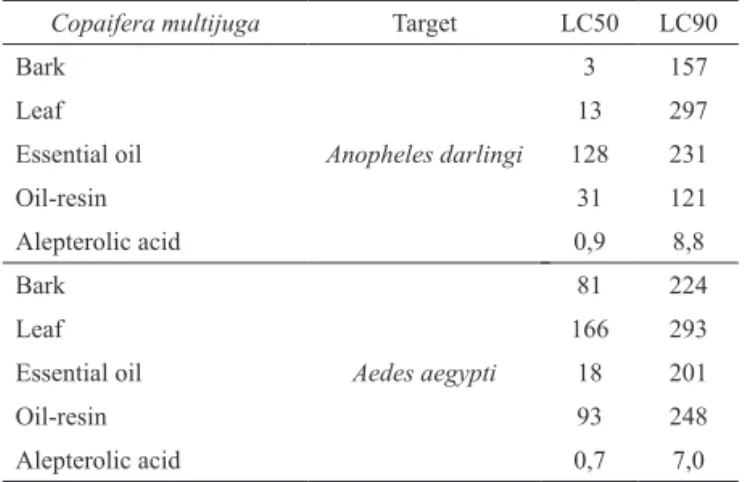
Bark and leaf extracts resulted in lower LC50
values for A. darlingi while the essential oil provided the lowest LC50 value for A. aegypti. Despite of that, the lowest LC values were from the alepterolic acid for both species (Table 2).
Table 2. Lethal Concentrations in part per million of bark, leaf
extract, oil-resin, essential oil and alepterolic acid from Copaifera multijuga for Anopheles darlingi and Aedes aegypti (Diptera: Culicidae) larvae.
Copaifera multijuga Target LC50 LC90 Bark
Anopheles darlingi
3 157
Leaf 13 297
Essential oil 128 231
Oil-resin 31 121
Alepterolic acid 0,9 8,8
Bark
Aedes aegypti
81 224
Leaf 166 293
Essential oil 18 201
Oil-resin 93 248
Alepterolic acid 0,7 7,0
LC50 and LC90: Concentrations needed to kill 50% and 90%,
respectively, of the larvae in the bioassays
Figure 2. Larvicidal activity of Copaifera multijuga: ethanolic extract of bark (A), leaf (B), essential oil (C), oil-resin (D) against
Discussion
All the C. multijuga extracts tested affected larval mortality of the malaria vector A. darlingi and the dengue vector A. aegypti. However, the degree of larvicidal activity depended on concentration and duration of the assays.
The present data indicate that Copaifera ethanolic
extracts from different organs have signii cant larvicidal
activity against the mosquito species tested. Ribeiro et
al. (2009) reported that fruit peel and leaf extracts of C.
langsdorfi i lead to greater reduction in food consumption and larvae weight of Spodoptera frugiperda compared
to fruit pulp and seed extracts. The fungitoxicity of C. multijuga essential oil was higher than the oil-resin. Furthermore, the response of different fungus species to this species was variable (Deus et al., 2011). Such variation in biological activity probably arises from differences in qualitative and quantitative active chemical compounds from Copaifera. For example, Chen et al. (2009) showed that the concentration of individual sesquiterpenes of C.
ofi cinalis isolated from various plant organs (leaves, stems and roots) were different.
Thus, comparing biological activity using Copaifera extracts or mixtures was not a straightforward process even when using the same species due to different biological aspects, such as the chemical composition of
extracts and compound mixtures and species variation. For example, Silva et al. (2007) and Kanis et al. (2011)
evaluated the larvicidal activity of the oil-resin of C. reticulata on A. aegypti and acquired very different lethal concentration (LC) values.
Oliveira et al. (2006) studied the oil-resin production and composition of C. duckei, C. marttii, and C. reticulata in Moju, Para, Brazil for several months in 2003 and 2004 and related differences in oil-resin production and composition, even between individuals of the same species.
A. darlingi larvae were more susceptible to
C. multijuga extracts compared to A. aegypti larvae. However, susceptibility to larvicides in Anophelinae and Culicinae species did not follow a pattern. Joseph et al. (2004) demonstrated that Culex quinquefasciatus larvae acquired a higher LC50 than A. gambiae when exposed
to petroleum extracts of Neotatenia mitus. Other studies showed that A. stephensis larval mortality to pure oil of Dalbergia sissoo was much lower than A. aegypti and C. quinquefasciatus (Ansari et al., 2000). Bond et al. (2004) related a similar larvicidal activity of spinosad, a
neurotoxin mixture produced by an actinomycete, against
A. aegypti and A. albimanus.
The calculated LC for A. aegypti was generally greater than A. darlingi, except for when essential oil and
isolated substance was applied. Bark extract had a LC50
ten times lower than oil-resin for A. darlingi, but most biological assays and chemical characterization comprise Copaifera oil-resin only. Silva et al. (2001; 2003) tested the susceptibility of A. aegypti and C. quinquefasciatus
larvae to the oil-resin extracted from C. langsdorfi i and C. reticulata, respectively, and observed a gradual decrease in susceptibility as the larvae progressed from 1st to 4th instar. The estimated LC50 ranged from 0.4 (1st instar) to 80 ppm (4th instar); Prophiro et al. (2012) related a LC50 of 47 and LC90 of 91 ppm for wild A. aegypti using Copaifera spp. oil.
Larvicidal activity of isolated substances or subfractions of Copaifera spp oil-resin components resulted in a much lower LC for A. aegypti. For example, the LC50 of methanolic subfractions of C. reticulata for mono, sesquiterpenes, and labdane diterpenes were 3.9, 7.5 and 0.8 ppm, respectively (Silva et al., 2007).
The labdane diterpene 3-β-acetoxylabdan-8
(17)-13-dien-15-oic acid isolated from C. reticulata with LC50 0.8 ppm (Geris et al., 2008) caused several ultra-structural alterations in the A. aegypti midgut and killed
the larvae after 22 h of exposure (Valotto et al., 2011).
Geris et al. (2008) also evaluated the larvicidal effect of the alepterolic acid against A. aegypti but received LC Figure 3. Larvicidal activity of alepterolic acid isolated from Copaifera multijuga against 3rd-4th instar larvae of Anopheles darlingi
values 100 times higher compared to the present work. This was not surprising since resistance to insectides (e.g.,
temephos) and detoxifying enzymes, such as GST and
alfa esterases activity, may vary greatly within A. aegypti populations that are 10 km apart (Lima et al., 2011).
Finally, C. multijuga larvicidal activity against A. darlingi, the main malaria vector in Northern Brazil, is
presented here for the irst time. Chemical characterization of bark and leaf extract derived from C. multijuga and larvicidal evaluation of the isolated compounds against A. darlingi or the principal essential oil compounds against A. aegypti may provide insight into potential larvicidal compounds with a lower lethal concentration as demonstrated with alepterolic acid. The present data also show that A. darlingi are more susceptibility to Copaifera
extracts compared to the dengue vector A. aegypti.
Acknowledgements
The authors thank Nanobiotec-CAPES 10; CNPq grants 575563/2008-7, 550854/2010-0 and 550934/2010-3
for inancial support of this project; Mei Tong, UMass
Medical School for the English revision of the manuscript, and Elizângela Melo, Isabel Lucena and Hilamani Torres for their assistance during the insect collection and
experiment set up.
Authors’ contributions
FTTT contributed in the larvicidal experiments,
analysis of the data and drafted the paper. AAP contributed in the phytochemical analysis. VAF supervised the phytochemical analysis and critical reading of the manuscript. RGS contributed to critical reading of the manuscript. AAS designed the study, supervised the laboratory work, drafted the paper and contributed with
data analysis. All the authors have read the inal manuscript
and approved the submission.
References
Adams RP 2007. Identiication of Essential Oil Components
by Gas Chromatography/Mass Spectroscopy. Allured Publishing Corporation: New York, NY, USA.
Alencar JC 1982. Estudos silviculturais de uma população natural de Copaifera multijuga Hayne-Leguminosae, na Amazonia Central. Acta Amazonica 12: 75-89.
Alencar JW, Craveiro AA, Matos FJA, Machado MLL 1990. Kovats indices simulation in essential oil analysis. Quim Nova 13: 282-284.
Alencar JW, Craveiroand AA, Matos EJA 1984. Kovats indices preselection routine in mass spectra library searches of volatiles. J Nat Prod 47: 890-892.
Ansari MA, Razdan RK, Tandon M, Vasudevan P 2000. Larvicidal and repellent actions of Dalbergia sissoo
Roxb. (F. Leguminosae) oil against mosquitoes. Bior Tech 73: 207-211.
Bond JG, Marina C F, Williams T 2004. The naturally derived
insecticide spinosad is highly toxic to Aedes and
Anopheles mosquito larvae. Med Vet Entomol 18: 50-56. Chen F, Al-Ahmad H, Joyce B, Zhao N, Kollner TG, Degenhardt
J, Stewart Jr. CN 2009 Within-plant distribution and emission of sesquiterpenes from Copaifera oficinalis.
Plant Physiol and Biochem 47: 1017-1023.
Consoli RAGB, Oliveira RL 1994. Principais mosquitos de importância sanitária no Brasil. Rio de Janeiro, RJ, Brasil.
Deus RJA, Alves CN, Arruda MSP 2011. Avaliação do efeito antifúngico do óleo resina e do óleo essencial de copaíba (Copaifera multijuga Hayne). Rev Bras Pl Med 13: 1-7. Geris R, Silva IG, Silva HHG, Barison A, Rodrigues-Filho
E, Ferreira AG 2008. Diterpenoids from Copaifera reticulata Ducke with larvicidal activity against Aedes aegypti (L.) (Diptera, Culicidae). Rev Inst Med Trop S Paulo 50: 25-28.
Gil LHS, Alves FP, Zieler H, Salcedo JMV, Durlacher RR, Cunha RPA, Tada MS, Camargo LMA, Camargo EP, Pereira-Da-Silva LH 2003. Seasonal malaria transmission and variation of anopheline density in two distinct endemic areas in Brazilian Amazônia. J Med Entomol 40: 636-641.
Hemingway J, Ranson H 2000. Insecticide resistance in insect vectors of human disease. Annu Rev Entomol 45: 371-391.
Josepha CC, Ndoilea MM, Malimab RC, Nkunyaa MHH 2004.
Larvicidal and mosquitocidal extracts, a coumarin, isolavonoids and pterocarpans from Neorautanenia mitis. Trans of the Roy Soc Trop Med Hyg 98: 451-455. Kanis LA, Prophiro JS, Vieira ES, Nascimento MP, Zepon
KM, Kulkamp-Guerreiro IC, Silva OS 2011. Larvicidal activity of Copaifera sp. (Leguminosae) oleoresin microcapsules against Aedes aegypti (Diptera: Culicidae) larvae. Parasitol Res 110: 1173-117.
Langenheim JH 1990. Plant resins. Americ Scient 78: 16-24. Lawrence BM 1980. Progress in essential oil: Natural Flavor and
Fragance. Materials 5: 32.
Leandro LM, Vargas FS, Barbosa PCS, Neves JKO, Silva JA, Veiga-Junior VF 2012. Chemistry and biological activities of terpenoids from Copaiba (Copaifera spp.) oleoresins. Molecules 17: 3866-3889.
Lima EP, Paiva MHS, Araújo AP, Silva EVG, Silva UM, Oliveira LN, Santana AEG, Barbosa CN, Neto CCP, Goulart MOF, Wilding CS, Ayres CFJ, Santos MAVM 2011. Insecticide resistance in Aedes aegypti populations from Ceará, Brazil. Paras & Vectors 4: 1-12.
Oliveira ECP, Lameira AO, Zoghbi MGB 2006. Identiicação
da época de coleta do óleo-resina de copaíba (Copaifera
spp.) no município de Moju, PA. Rev Bras Pl Med 8: 14-23.
JE, Silva OS 2012. First report on susceptibility of wild Aedes aegypti (Diptera: Culicidae) using Carapa guianensis (Meliaceae) and Copaifera sp. (Leguminosae).
Parasitol Res 110: 699-705.
Ribeiro RR, Alves DS, Vilas Boas MA, Carvalho GA, Oliveira
DF 2009. Efeito de extratos de Copaifera langsdorfii Desf. (Fabaceae: Caesalpinoideae) sobre diferentes características biológicas de Spodoptera frugiperda
(J. E. Smith) (Lepidoptera: Noctuidae). Rev Bras de Agroecologia 4: 3423-3426.
Silva HHG, Geris R, Filho ER, Rocha C, Silva IG 2007. Atividade larvicida das frações do óleo-resina da planta medicinal brasileira Copaifera reticulata Ducke (Leguminosae-Caesalpinoideae) sobre o Aedes aegypti (Diptera, Culicidae). Rev da Soc Bras de Med Trop 40: 264-267. Silva IG, Silva HHG, Guimarães VP, Lima CG, Pereira AL,
Filho ER, Rocha C 2001. Prospecção da atividade inseticida de plantas do cerrado, visando ao combate do Aedes aegypti. Informe Epidemiológico do SUS 10: 51-52.
Silva IG, Zanon VOM, Silva HHG 2003. Larvicidal activity of Copaifera reticulata Ducke oil-resin against Culex quinquefasciatus Say (Diptera: Culicidae). Neotr Entom 32: 729-732.
Valotto CFB, Silva HHG, Cavasin G, Geris R, Filho ER, Silva IG 2011. Alterações ultraestruturais em larvas de Aedes aegypti submetidas ao diterpeno labdano, isolado de
Copaifera reticulata (Leguminosae), e a uma fração rica em taninos de Magonia pubescens (Sapindaceae). Rev Soc Bras de Med Trop 44: 194-200.
Veiga Jr VF, Maciel MAM, Pinto AC 2005. Plantas medicinais: cura segura? Quim Nova 28: 519-528.
WHO 2005. Guidelines for laboratory and ield testing of mosquito
larvicidas. World Health Organization Technical Report Series. Geneva.
*Correspondence
Alexandre de Almeida e Silva
Laboratório de Bioecologia de Insetos, Departamento de Biologia, Universidade Federal de Rondônia
BR 364, km 9,5 (sentido Acre), 78900-000 Porto Velho-RO, Brazil
Fiocruz-Rondonia, Rua da Beira, 7671, 76812-245 Lagoa, Porto Velho-RO, Brazil
[email protected] Tel.: +55 69 3219-6010