112
INDIVIDUAL ANALYSIS OF CREATINE KINASE CONCENTRATION
IN BRAZILIAN ELITE SOCCER PLAYERS
ANÁLISE INDIVIDUAL DAS CONCENTRAÇÕES DA CREATINA QUINASE EM JOGADORES
DE ELITE DO FUTEBOL BRASILEIRO
ANÁLISIS INDIVIDUAL DE CONCENTRACIONES DE LA CREATINA QUINASA EN FUTBOLISTAS
BRASILEÑOS DE ELITE
Adriano Lima Alves1
(Profissional de Educação Física) Emerson Silami Garcia2
(Profissional de Educação Física) Rodrigo Figueiredo Morandi1
(Profissional de Educação Física) João Gustavo Claudino3
(Profissional de Educação Física) Eduardo Mendonça Pimenta4
(Profissional de Educação Física) Danusa Dias Soares1
(Profissional de Educação Física) 1.Universidade Federal de Minas Gerais, Belo Horizonte, MG, Brasil. 2. Universidade Federal do Maranhão (UFMA), Departamento de Educação Física São Luís, Maranhão, Brasil.
3. Universidade de São Paulo, São Paulo, SP, Brasil.
4. Universidade de Leon, Spain.
Correspondencia:
Rua: Colomita, 120. Bairro Santa Teresinha, Belo Horizonte, MG, Brasil. [email protected]
ABSTRACT
Objective: to determine the individual profile of blood concentration of creatine kinase (CK) in elite soccer players as well as to analyze the CK concentrations in different periods during the Professional Brazilian Championship. Methods: resting CK of 17 soccer players was evaluated before the competition (pre-season) and after the matches (36 and 46 hours after the games) (CKGame) for the individual blood CK. The Chi-square test was used to analyze the individual CK during the season. The competitive season was divided into three periods: initial, intermediate and final. The one-way ANOVA with repeated measurements followed by post hoc Student-Newman-Keuls test was used to compare the individual CK of each soccer player in each competitive period. The significance level was set at p<0.05. Results: the highest frequency of individual CK was found in the second quartile (71 observations) and the lowest frequency in the first (26 observations) and the fourth quartile (40 observations) compared to the expected number of 45.8 (x2=22.21). CK concentrations were lower in the intermediate (mean=66.99%) and final (mean=60.21%) periods than in the initial period (mean=89.33%). Conclusion: soccer players did not show elevated mus-cle damage and probably a musmus-cle adaptation occurred in the competition, due to the reduction of CK concentrations observed.
Keywords: soccer,muscle strength, creatine/blood.
RESUMO
Objetivo: determinar o perfil individual das concentrações sanguíneas de creatina quinase em jogadores de futebol de elite, bem como, analisar as concentrações de CK em diferentes períodos durante o campeonato brasileiro. Métodos: a CK de repouso de 17 jogadores de futebol foi avaliada antes da competição (pré-temporada) e após as partidas (36 e 46 horas após os jogos) (CKGame) para obter a CK sanguínea individual. O teste de
Chi-quadrado foi utilizado para analisar a CK individual durante a temporada. A temporada competitiva foi dividida em três períodos: inicial, intermediário e final. A ANOVA one-way com medidas repetidas seguida pelo teste post hoc Student-Newman-Keuls foi utilizada para comparar a CK individual de cada jogador de futebol em cada período competitivo. O nível de significância adotado foi de p < 0,05. Resultados: a maior frequên-cia da CK individual foi encontrada no segundo quartil (71 observações) e a menor frequênfrequên-cia no primeiro (26 observações) e no quarto quartil (40 observações) em comparação com o número esperado de 45,8 (x2 = 22,21). As concentrações de CK foram menores nos períodos intermediário (média = 66,99%) e final
(média = 60,21%) do que no período inicial (média = 89,33%). Conclusão: os jogadores de futebol não apresenta-ram dano muscular elevado e provavelmente uma adaptação muscular ocorreu na competição, devido à redução observada das concentrações de CK.
Palavras-chave: futebol, força muscular, creatina/sangue.
RESUMEN
Objetivo: determinar el perfil individual de las concentraciones sanguíneas de creatina quinasa en futbo-listas de elite, y evaluar las concentraciones de CK en diferentes períodos durante el campeonato brasileño. Métodos: la CK de reposo de 17 futbolistas se evaluó antes de la competición (pretemporada) y después de los partidos (36 y 46 horas después de los juegos) (CKGame) para obtener la CK sanguínea individual. La prueba de Chi-cuadrado se utilizó para analizar la CK individual durante la temporada. La temporada competitiva se dividió en tres periodos: inicial, intermedio y final. El ANOVA one-way con medidas repetidas seguido por el test post hoc Student-Newman-Keuls se utilizó para comparar la CK individual de cada futbolista en cada período competitivo. El nivel de significación se fijó en p < 0,05. Resultados: la mayor frecuencia de la CK individual fue encontrada en el segundo cuartil (71 observaciones) y la frecuencia más baja en el primero (26 observaciones) y el cuarto cuartil (40 observaciones) en comparación con el número esperado de 45,8 (x2 = 22,21). Las
con-centraciones de CK fueron menores en los períodos intermedio (media = 66,99%) y final (media = 60,21%) que ARTIGO ORIGINAL
ORIGINAL ARTICLE
113
INTRODUCTION
The main Brazilian Soccer Championship has been played with a variation of one game or two per week for seven months. The interval between games may not be enough for an adequate recovery and that can expose the soccer players to an elevated muscle damage1-3. Moreover, soccer is an intermittent and high intensity sport4 presen-ting many eccentric muscle actions as jumps and direction changes during a match5. Thus, muscle actions are the main causes of skeletal muscle damage6 which increase the permeability of the plasmatic membrane and the release of cytoplasmatic enzymes into the blood stream7. Among these enymes, creatine kinase (CK) has been described as a good marker of muscle damage and the peak CK concentration has been associated with changes in the peak of maximal isometric strength as well as the changes in the knee-joint range of motion8.
Although CK concentration during a soccer competition has been in-vestigated9,10 and the results have contributed to enabling the adjustment of the training load, it lowered the unbalance between stress and muscle recovery and the injury risk11. These studies are contradictory. While some studies reported no changes in CK concentration9,12 others showed CK concentration decreases during a competition10. In addition, the absolute values of CK concentration have been used in some of the previous stud-ies which evaluated CK concentration of soccer players1,9,10,13,14.
In sports, the use of fixed reference values for CK concentration has been proposed for monitoring training load, these fixed reference values indicate a threefold for injury risk augmented13,15. The reference value of physiological parameters are important for interpretation of data16. How-ever, the use of fixed reference values for CK concentration as indicators of severe muscle damage is made difficult due to rather high inter and intra individual variability6,7,15. Another concurring factor might be the training status of the athletes17. Therefore, the use of a fixed reference value may underestimate or overestimate the presence of muscle damage. More-over, recently, a joint consensus statement about monitoring training status of athletes suggested the definition of a range of meaningful dif-ferences by determination of individual ranges to the markers utilized18. We have not found studies describing the CK concentration profile of elite soccer players during a competitive season based on individual values. Therefore, the main purposes of the present investigation were a) to determine the individual´s profile of blood CK concentration of elite soccer players and b) to analyze the CK concentration in differ-ent periods during a Professional Brazilian First Division Championship.
METHODS
seventeen players from a first-division Brazilian soccer team volun-teered for the study. At the beginning of the season, the age and body mass of the soccer players were registered, 26.6 ± 3.7 years and 77.8 ± 5.6 kg, respectively. At baseline, body mass was measured using standardized procedures, with a calibrated scale (Filizola, Brazil), their percent of body fat was estimated by using the Jackson and Pollock19 equation (i.e. sum of chest, axilla, triceps, subscapular, abdomen, suprailium, and thigh skin folds). The VO2max was estimate by specific soccer test, Yoyo Endurance Test level 24, with the players using their soccer shoes in the field4. This test was performed at the beginning of the season.
This study had the approval of the Ethics Committee of the Minas Gerais Federal University, Brazil (Protocol 485/10) and all volunteers signed an informed consent form prior to participation in the study.
Procedures
Blood CK concentration was assessed by reflectance photometry at 37°C(Reflotron Plus; Roche, Germany), previously calibrated. After the finger asepsis by using alcohol, a 30-μl blood sample was drawn out into a heparinized capillary tube and it was later put on specific reagent strips which were inserted into the instrument. The CK con-centration baseline values (CKBas) and the maximal concentration of CK were employed to determine the individual´s profile of blood CK con-centration of elite soccer players. The CKBas were obtained during the soccer players’ presentation after a 30-day rest from any physical activity. During the competitive season, CK concentration was evaluated between 36 and 46 hours post games (CKGame), a period in which the peak of CK concentration is most likely reached1,20.The maximal con-centration of CKGame found throughout the season, was denominated as CKMax. In the period encompassing the end of the game and the evaluation of CKGame, the soccer players simply rested or performed activities considered to be light.
The maximal difference of blood concentration of CK (ΔCKMax) was calculated by using the following equation 1:
ΔCKMax = CKMax – CKBas
Therefore, the ΔCKMax was considered to be 100% and this value was employed to relativize the difference between the CKGame and CKBas. The percentage relation between ΔCKGame and ΔCKMax wasdenominated as %ΔCKGame (Equation 2):
%ΔCKGame = ΔCKGame/ΔCKMaxx100
The %ΔCKGame was thus grouped into quartiles (i.e., 1st, 2nd, 3rd, 4th): ≤25%, >25 and ≤50%, >50 and ≤75%, more than >75%, respectively. This recording procedure of CK was similar to that of Yamin et al.21. The CKGame measurements were included only if the soccer players played more than 75 minutes per game2,didnot sustain any muscle strain injury and had not taken any kind of medicine. The occurrence of muscle injury was confirmed by the magnetic resonance imaging (MRI) (Magnetom Vision Plus 1.5 Tesla., Siemens, Germany). Moreover, to be included in the study, the soccer players should have had at least four CK concentration evaluations throughout the season.
The blood CK concentrations of the players were evaluated after each of the 25 official games of the 2010 Brazilian championship from July to December. The CK concentration response during the compe-tition was shown in accordance with the division of the competitive calendar in three periods (i.e., initial, intermediate and final). That divi-sion was done in accordance with the number of evaluated games, thus each period would have a similar number of evaluations. The initial period was arranged by grouping the first nine analyses of the games which took place between July and August. The intermediate period corresponded to the month of September when the 10th to the
en el período inicial (media = 89,33%). Conclusión: las futbolistas no presentaron un daño muscular alto y probablemente una adaptación muscular ocurrió en la competición, debido a la reducción observada de las concentraciones de CK.
Palabras clave: fútbol, fuerza muscular, creatina/sangre.
114
17th games were evaluated. At the final period, eight games that took place between October and November were analyzed. For this analysis, a higher CK concentration was used for each soccer player from each period. Beyond the inclusion criterion above, for this analysis, there was an inclusion criterion that the soccer players should have at least one CK concentration evaluation in each period and not have remained more than 20 consecutive days without any training at all, which is considered to cause detraining in soccer players22.
Monitoring training load
In the training sessions, the workload was recorded by counting the minutes of effective training for each soccer player, to determine the training volume (i.e. minutes trained in each period) and by the training intensity defined as the heart-rate percentage (i.e. %HRMax) (Polar Team System
; Polar, Finland). The highest heart-rate value reached by the soccer players during training sessions or friendly games was used as their maximal heart rate (HRMax)23. The training volume was recorded during games and training sessions. However, the intensity training was recorded only in the training sessions, since according to soccer rules, it is not allowed to use the heart rate monitors in official games. The environmental conditions during the season was recorded according to data supplied by the National Institute of Metereology.
Statistical analysis
The normality of data was analyzed using the Kolmogorov-Smirnov test. The data that have not shown normality were presented as median and amplitude between the minimal and maximal values and the ones that presented normality were expressed as mean and standard devia-tion. For the analysis of the individual´s profile of blood CK concentration of the %ΔCKGame frequency in each quartile during the competition, the chi-square (X2) was employed, the chi-square test had as a null hypothesis that every quartile was equal. The comparison among the three periods of the competitive calendar was used through ANOVA one way with repeated measurements followed by the Student Newman Keuls test, in which the highest measurement of %ΔCKGame for each soccer player in each period was used. To verify whether CKGame was different from CKBas, the paired t-test was used, in which the lowest value of CK
Game of the season was considered. The Sperman correlation coefficient was performed to verify the relationship between changes in training volume, training intensity and CK during the season. The adopted significance level was p<0.05. The data were analyzed using the sigma Stat 3.5 pack. The descriptive analysis of data was expressed in terms of mean, standard deviation, median and frequency distribution.
RESULTS
The percent of body fat (%fat) and VO2max of the soccer players were 9.5 ± 1.4 % and 55.5 ± 3.6 mL.kg-1.min-1, respectively.
For the individual´s profile of CK concentration of elite soccer players, the frequency higher than the expected of %ΔCKGame was observed in the 2nd quartile while the frequency in the 1st and 4th was lower than the expected one. However, no difference was found between the observed frequency and the expected one in the 3rd quartile (table 1).
The comparison of CK concentration between the periods was performed, made with the data of 12 soccer players. Two soccer players were excluded because of injury and for having remained inactive for more than 20 consecutive days. In addition, three others were excluded for not having at least one CK concentration analysis in each period. In the three analyzed periods during the competition, it was observed that the highest %ΔCKGame of the intermediate and final periods was lower than the highest %ΔCKGame of the initial period (figure 1). Moreover, it was observed that all soccer players reached the CKMax between the 1st – 13th games (value of median in the 5th game). During the com-petition, there were four soccer players who sustained muscle injury. Among them, two soccer players had the post-injury CKGame measured as 577 and above 2000 U/L (value above the detectable by the instru-ment), well above their respective CKMax of 558 e 573 U/L. Using these measures between periods CK concentration, the standard error of measurement according to Weir24 was 31.1%.
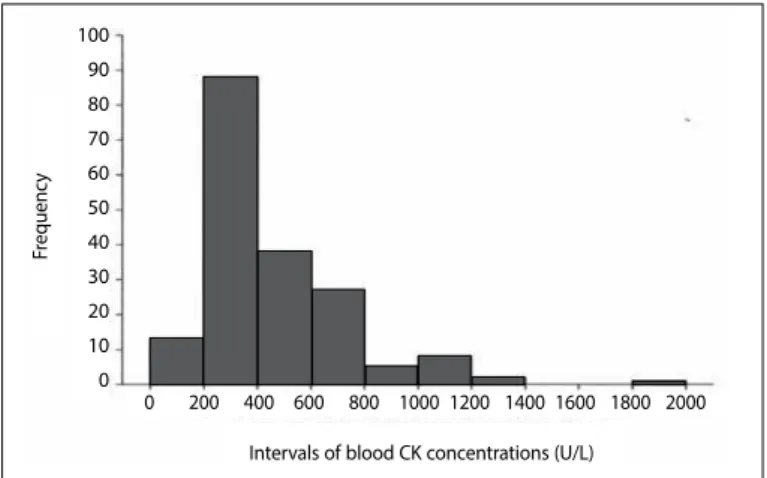
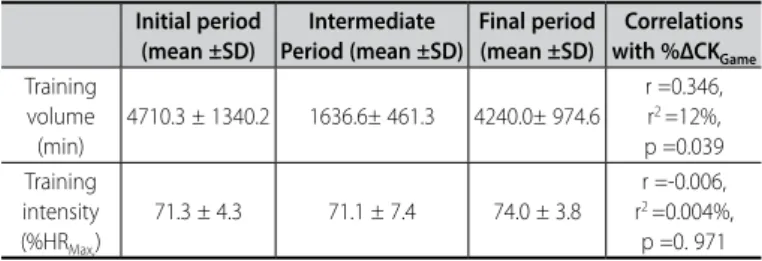
CKGame was higher than CKBas (p<0.001) and the CKGame showed a non-normal distribution, with values ranging from 141 to 1830 U/L (figure 2). The median of CKBas, CKMax, ΔCKMax CKGame, andΔ%CKGame was 120 U/L (range 26.3-475 U/L), 626 U/L (range 350-1830 U/L), 478 U/L (range 251.8-1355 U/L), 376.5 U/L (range 141-1830 U/L) and 47.30% (range 6.6-100.0%) respectively. During the competition, the soccer players had their CK concentration measured 10.8 times on the average. Moreover, the monitoring of training volume, training intensity and their correlations with %ΔCKGame are in the table 2. During the all season, their mean playing official soccer match was 1505.9 ± 571.4 min. The mean values for temperature and air relative humidity during the study were 20.9 ± 4.6ºC e 69.0 ± 0.2%, respectively.
Table 1.Observed and expected frequencies in each quartile of %ΔCKGame from
17 soccer player.
Quartile N Observed N Expected
1° Quartile 26 (14.2%) * 45.8 2° Quartile 71 (38.8%) * 45.8 3° Quartile 46 (25.1%) 45.8 4° Quartile 40 (21.9%) * 45.8
Total analyses 183 183
Value of chi-square 22.21. * Observed frequency different to the expected (p< 0.01).
Figure 1. Highest %ΔCKGame in each period. N = 12. Significative difference in comparison to Initial Period. (p<0.05).
Figure 2. Frequencies of observations of CKGame of 17 soccer players during a Brazilian championship.
Initial period Intermediate period Final period
%
ΔC
KGame
120
100
80
60
40
20
0
100 90 80 70 60 50 40 30 20 10 0
Intervals of blood CK concentrations (U/L)
Fr
equenc
y
115
DISCUSSION
To the best of our knowledge, this is the first report to determine the individual´s profile of blood CK concentration of elite soccer players therewith, the main finding of this study was the identifica-tion of the individual’s profile during competiidentifica-tion in the 2nd quartile. Thus, the frequency of %ΔCKGame at the 2nd quartile was higher than expected. On the other hand, the observed frequency at the 1st and 4th quartiles was lower than expected. Thus, based on the CK con-centration response, the soccer players presented muscle damage between 25 and 50 % of the percentage relation between ΔCKGame and ΔCKMax along the competition, suggesting that it did not represent an elevated magnitude of muscle damage. However, they did not have a low magnitude of muscle damage and according to the frequen-cies during the 1st quartile, were lower than expected. Moreover, there was a decrease of the highest frequency of %ΔCKGame of each soccer player, in the intermediate and final periods in comparison with the initial period. Considering that in the present study, there was not a monitoring only of intensity of games, the chronic effect of training and games in CK concentration response was also observed, and thus the CK concentration observed decrease suggests that the soccer players had muscle adaptations owing to the stimuli inflicted during the season25. Such a fact contributed to the higher observed frequency of %ΔCKGame at the 2nd quartile and lower at the 4th quar-tile. The profile of the observed %ΔCKGame corresponded to that of a sample of soccer players of a team that ranked among the top four teams in the championship.
The reduction of CK concentration observed over time in this study may be ascribed to muscle adaptation26,which has been observed in protocols of eccentric exercise27 and in soccer players during a Brazil-ian first-division championship10.One of the mechanisms responsible for muscle adaptation can be derived from the activation of myo-genic satellite cells that act in the repair of damaged muscle fibers28. According to CKMax observed in the initial period, the first games of each soccer player may represent more muscle damage than the other games. Therefore, it may contribute for the CKmax that was found in the soccer players in the first games.
Different results were reported by Zoppi et al.9 who did not see any decreases of CK concentration for five months of the soccer championship, but they performed their study during a regional competition with a different competitive calendar and the players belonged to a different competitive level than in the present study. Silva et al.12, who evaluated the CK concentration response during a three-month training period, did not report any differences during that period. However, they performed only three evaluations, one being at the beginning, another 6 weeks later and the last on the 12th week, each evaluation being performed 12 hours after the last activity. The studies that analyzed the CK concentration during a soccer season evaluated it once a month9,10 or once every six weeks12 and they did not take into consideration whether the last physical activity before each evaluation had been a game or a training session9,10,12.
Therefore, the present study was the first, to our knowledge, that evaluated the CK concentration after official games and which had an elevated number of measurements on the same individual. The protocol we used, measuring CK concentration after every game appears to be more adequate to detect alterations in that marker than the protocol used in previous studies.
Throughout the competition the CK concentration of the soc-cer players remained above the resting and reference values accept for the sedentary population. This corroborates the results of other studies with soccer players during a competition9,10 and studies that analyzed the increase of CK concentration 48h after a single game1,20,29. Moreover, the median blood CK
Game concentrations (i.e., 376.5 U/L which corresponded to a %ΔCKGame 47.30%) of the present study were similar to the mean values of plasmatic concentrations of studies with soccer players in competitions9,10 and slightly lower than studies that evaluated the players after a single soccer match1,20,30. One limitation of the present study was the one assessment of CKBas, however, the CKBas about the values of sedentary adult men21 and soccer players in rest remained1.
At the end of the competition, the soccer players in the present study showed a CKMax of 626 U/L. The CK concentration of 14 soc-cer players remained below the threshold value for the increased risk of injury suggested by Mougios13 (1492 U/L) and Lazarim et al.10 (975 U/L). It should be noted that the CK concentration of three soc-cer players was above 975 U/L and the highest being above 1492 U/L, but no clinical problems were reported. Lazarim et al.10, reported that in his study, one soccer player whose CK concentration exceeded the proposed reference value was injured. During the present study, four soccer players underwent muscle injury, with two of them presenting CKGame above their CKMax, This may suggest the occurrence of a higher rupture of the muscle tissues, resulting in a larger extravasation of CK into the blood stream31.
The observed positive correlation between training volume and %ΔCKGame as well as the absence of correlation with training in-tensities indicates that training volume, likewise type of exercise21 might be, among others, one factor that influences the CK concentra-tion7. However, only 12% of common variance exists between train-ing volume and CK concentration. The remaintrain-ing 88% is originated from others variables. Thus, CK concentration should be interpreted along with other variables such as training status and the individual response to %ΔCKGame.
Due to the high variability found in CK concentration response to exercise in this as well as in other studies15,21, the CK
Max of soccer players during a competition may not reach the proposed reference values, even knowing that the soccer players are being subjected to elevated muscle damage. Therefore, the use of a fixed CK threshold value may not be warranted. It is likely that different soccer play-ers have different thresholds and the individualized CK concentra-tion profile should be used to monitor each soccer player during a championship.
CONCLUSIONS
The individualized CK concentration responses of the elite soc-cer players during a Brazilian championship in the present study indicate that they did not remain at elevated muscle damage. One probable muscle adaptation may occur based on reduced CK concentration.
All authors have declared there is not any potential conflict of interests concerning this article.
Table 2. Description of training volume and training intensity and their correlations with %ΔCKGame.
Initial period (mean ±SD)
Intermediate Period (mean ±SD)
Final period (mean ±SD)
Correlations with %ΔCKGame
Training volume (min)
4710.3 ± 1340.2 1636.6± 461.3 4240.0± 974.6
r =0.346, r2 =12%,
p =0.039 Training
intensity (%HRMax,)
71.3 ± 4.3 71.1 ± 7.4 74.0 ± 3.8
r =-0.006, r2 =0.004%,
116
REFERENCES
1. Ispirlidis I, Fatouros IG, Jamurtas AZ, Nikolaidis MG, Michailidis I, Douroudos I, et al. Time-course of changes in inflammatory and performance responses following a soccer game. Clin J Sport Med. 2008;18(5):423-31.
2. Dupont G, Nedelec M, McCall A, McCormack D, Berthoin S, Wisløff U. Effect of 2 soccer matches in a week on physical performance and injury rate. Am J Sports Med. 2010;38(9):1752-8.
3. Nedelec M, McCall A, Carling C, Legall F, Berthoin S, Dupont G. The influence of soccer playing actions on the recovery kinetics after a soccer match. J Strength Cond Res. 2014;28(6):1517-23. 4. Bangsbo J. The physiology of soccer--with special reference to intense intermittent exercise. Acta
Physiol Scand Suppl. 1994;619:1-155.
5. Stølen T, Chamari K, Castagna C, Wisløff U. Physiology of soccer: an update. Sports Med. 2005;35(6):501-36.
6. Clarkson PM, Hubal MJ. Exercise-induced muscle damage in humans. Am J Phys Med Rehabil. 2002;81(Suppl 11):S52-69.
7. Brancaccio P, Maffulli N, Buonauro R, Limongelli FM. Serum enzyme monitoring in sports medicine. Clin Sports Med. 2008;27(1):1-18.
8. Nosaka K, Clarkson PM. Variability in serum creatine kinase response after eccentric exercise of the elbow flexors. Int J Sports Med. 1996;17(2):120-7.
9. Zoppi CC, Antunes-Neto J, Catanho FO, Goulart LF, Motta e Moura N, Macedo DV. Alterações em biomarcadores de estresse oxidativo, defesa antioxidante e lesão muscular em jogadores de futebol durante uma temporada competitiva. Rev Paul Educ Fis. 2003;17:119-30.
10. Lazarim FL, Antunes-Neto JM, da Silva FO, Nunes LA, Bassini-Cameron A, Cameron LC, et al. The upper values of plasma creatine kinase of professional soccer players during the Brazilian National Championship. J Sci Med Sport. 2009;12(1):85-90.
11. Smith LL. Cytokine hypothesis of overtraining: a physiological adaptation to excessive stress? Med Sci Sports Exerc. 2000;32(2):317-31.
12. Silva ASR, Santhiago V, Papoti M, Gobatto CA. Psychological, biochemical and physiological responses of brazilian soccer players during a training program.Sci Sports. 2008;23:66-72.
13. Mougios V. Reference intervals for serum creatine kinase in athletes. Br J Sports Med. 2007;41(10):674-8. 14. Hammouda O, Chtourou H, Chaouachi A, Chahed H, Bellimem H, Chamari K, et al. Time-of-day effects on biochemical responses to soccer-specific endurance in elite Tunisian football players. J Sports Sci. 2013;31(9):963-71.
15. Totsuka M, Nakaji S, Suzuki K, Sugawara K, Sato K. Break point of serum creatine kinase release after endurance exercise. J Appl Physiol (1985). 2002;93(4):1280-6.
16. Silva ASR, Papoti M, Pauli JR, Gobatto CA. Elaboração de tabelas de percentis através de parâmentros antropométricos, de desempenho, bioquímicos, hematológicos, hormonais e psicológicos em fute-bolistas profissionais. Rev Bras Med Esporte. 2012;18(3):148-152.
17. Brink MS, Nederhof E, Visscher C, Schmikli SL, Lemmink KA. Monitoring load, recovery, and performance in young elite soccer players. J Strength Cond Res. 2010;24(3):597-603.
18. Meeusen R, Duclos M, Foster C, Fry A, Gleeson M, Nieman D, et al. Prevention, diagnosis, and treatment of the overtraining syndrome: joint consensus statement of the European College of Sport Science and the American College of Sports Medicine. Med Sci Sports Exerc. 2013;45(1):186-205. 19. Jackson AS, Pollock ML. Generalized equations for predicting body density of men. Br J Nutr.
1978;40(3):497-504.
20. Fatouros IG, Chatzinikolaou A, Douroudos II, Nikolaidis MG, Kyparos A, Margonis K, et al. Time-course of changes in oxidative stress and antioxidant status responses following a soccer game. J Strength Cond Res. 2010;24(12):3278-86.
21. Yamin C, Oliveira J, Meckel Y, Eynon N, Sagiv M, Ayalon M, et al. CK-MM gene polymorphism does not influence the blood CK activity levels after exhaustive eccentric exercise. Int J Sports Med. 2010;31(3):213-7.
22. Bangsbo J. Mizuno M. Morphological and metabolic alterations in soccer players with detraining and retraining and their relation to performance. In: Reilly T, Lees A, Davids K, Murphy WJ, editors. Science and Football. Proceeding of the first world congress. Liverpool, England; 1987. p. 11-24.
23. Antonacci L, Mortimer LF, Rodrigues VM, Coelho DB, Soares DD, Silami-Garcia E. Competition, estimated, and test maximum heart rate. J Sports Med Phys Fitness. 2007;47(4):418-21.
24. Weir JP. Quantifying test-retest reliability using the intraclass correlation coefficient and the SEM. J Strength Cond Res. 2005;19(1):231-40.
25. Maio Alves JM, Rebelo AN, Abrantes C, Sampaio J. Short-term effects of complex and con-trast training in soccer players’ vertical jump, sprint, and agility abilities. J Strength Cond Res. 2010;24(4):936-41
26. McHugh MP. Recent advances in the understanding of the repeated bout effect: the protective effect against muscle damage from a single bout of eccentric exercise. Scand J Med Sci Sports. 2003;13(2):88-97.
27. Chen TC, Nosaka K. Effects of number of eccentric muscle actions on first and second bouts of ec-centric exercise of the elbow flexors. J Sci Med Sport. 2006;9(1-2):57-66.
28. Tidus PM. Skeletal muscle damage and repair. United Kingdom: Human Kinetics; 2008.
29. Ascensão A, Rebelo A, Oliveira E, Marques F, Pereira L, Magalhães J. Biochemical impact of a soccer match - analysis of oxidative stress and muscle damage markers throughout recovery. Clin Biochem. 2008;41(10-11):841-51.
30. Ascensão A, Leite M, Rebelo AN, Magalhäes S, Magalhäes J. Effects of cold water immersion on the recovery of physical performance and muscle damage following a one-off soccer match. J Sports Sci. 2011;29(3):217-25.