Juliana Nunes Ferreira
I, Lury Renata Barbosa Ribeiro Correia
I, Renata Moreira de Oliveira
I,
Silvia Naomi Watanabe
I, João Francisco Possari
I, Antônio Fernandes Costa Lima
III Instituto do Câncer do Estado de São Paulo, General Direction of Assistance. São Paulo, Brazil.
II Universidade de São Paulo, Nursing School, Department of Professional Guidance. São Paulo, Brazil.
How to cite this article:
Ferreira JN, Correia LRBR, Oliveira RM, Watanabe SN, Possari JF, Lima AFC. Managing febrile neutropenia in adult cancer patients: an integrative review of the literature. Rev Bras Enferm [Internet]. 2017;70(6):1301-8.
DOI: http://dx.doi.org/10.1590/0034-7167-2016-0247
Submission: 06-24-2016 Approval: 10-02-2016
ABSTRACT
Objective: To analyze the interventions performed by health professionals with a view to managing chemotherapy-induced febrile neutropenia. Method: Integrative literature review, the sample of 12 primary articles was selected from the following databases: LILACS, SciELO, BVS, PubMed, CINAHL and Web of Science. Results: There was a prevalence of studies, realized by doctors, focused on pharmacological treatment and on the association of methods for greater diagnostic accuracy of febrile neutropenia. A study was found on pharmaceutical management regarding antibiotic dosing efficacy and a study indicating that nurses could contribute to the identification of elderly patients who would benefit from prophylactic use of growth factor. Conclusion: There was a shortage of studies involving the participation of other health professionals, besides the doctors, and a knowledge gap regarding interprofessional practice in the management of interventions specific to their area of specialism, joint interventions and non-pharmacological interventions.
Descriptors: Oncology; Hospital Oncology Service; Chemotherapy-Induced Febrile Neutropenia; Management; Patient Care Team.
RESUMO
Objetivo: Analisar as intervenções realizadas por profissionais de saúde visando ao manejo da neutropenia febril induzida por Quimioterapia. Método: Revisão integrativa da literatura cuja amostra de 12 artigos primários foi selecionada nas bases LILACS, SciELO, BVS, PubMed, CINAHL e Web of Science. Resultados: Constatou-se a prevalência de estudos, desenvolvidos por
médicos, centrados no tratamento farmacológico e na associação de métodos para maior precisão diagnóstica da neutropenia febril. Encontrou-se um estudo sobre manejo farmacêutico relativo à eficácia de dosagem de antibióticos e um estudo indicando que os enfermeiros poderiam contribuir para a identificação de pacientes idosos que se beneficiariam com uso profilático de fator de crescimento. Conclusão: Evidenciou-se a escassez de estudos com a participação de outros profissionais de saúde, além dos médicos, e a lacuna de conhecimento quanto à prática interprofissional na condução de intervenções específicas a sua área de competência, intervenções conjuntas e intervenções não farmacológicas.
Descritores: Oncologia; Serviço Hospitalar de Oncologia; Neutropenia Febril Induzida por Quimioterapia; Manejo; Equipe de Assistência ao Paciente.
RESUMEN
Objetivo: Analizar las intervenciones realizadas por profesionales de salud visando el manejo de la neutropenia febril inducida por Quimioterapia. Método: Revisión integradora de la literatura cuya muestra de 12 artículos primarios fue seleccionada en las bases LILACS, SciELO, BVS, PubMed, CINAHL y Web of Science. Resultados: Se constató la prevalencia de estudios, desarrollados por médicos, centrados en el tratamiento farmacológico y en la asociación de métodos para mayor precisión diagnóstica de la neutropenia febril. Se encontró un estudio sobre manejo farmacéutico relativo a la eficacia del dosificación de antibióticos y un estudio indicando que los enfermeros podrían contribuir para la identificación de pacientes de edad avanzada que se beneficiarían
Managing febrile neutropenia in adult cancer patients:
an integrative review of the literature
INTRODUCTION
The treatment of cancer patients is subject to factors which range from diagnostic confirmation of the disease to staging and to individual and psychological characteristics of the patient. There are various therapeutic approaches: hormone therapy, surgical procedures, radiotherapy and chemotherapy (CT)(1).
Despite the technological advances, antineoplastic CT con-tinues to be an indispensable therapeutic option. This constitutes a method which uses one or more drugs in order to reach the different cellular populations and in the various phases of the cellular cycle, thereby weakening the development of those cells with disordered growth. The chemotherapies act on tumor cells and also in distinct cells of the body, such as the bone marrow, hair and mucosa of the digestive tract. CT is applied in repetitive cycles, since the normal cell presents a recovery period(2).
The duration of toxic exposure to the drugs depends on the quantity used, the plasma concentration and individual char-acteristics of each patient. The drugs can lead to toxicities and undesirable effects, such as alopecia, gastrointestinal altera-tions, myelodepression, fever, and also infectious signs and symptoms. The occurrence of fever in patients undergoing chemotherapeutic treatment represents an oncological emer-gency, since it is indicative of febrile neutropenia (FN)(2-3),
rep-resenting a severe complication with mortality levels that can reach over 50%(4). Axillary temperature measurements greater
than 37.8°C, whether single or multiple episodes, already constitutes a warning sign for a picture of FN. Laboratory ex-ams are performed in the presence of fever and diagnosis of FN is confirmed whenever there is a neutrophil count less than 500/mm³, or a reduction to less than 500 neutrophils/ mm³ within the following 48 hours(5).
Individuals with FN can be classified as low-risk, interme-diate-risk and high-risk neutropenic patients. The risk score is determined using the MASCC (Multinational Association for Supportive Care of Cancer) risk index, which allocates points according to the importance of each variable: asymptomatic patient; patient presenting mild, moderate or severe symptoms; no hypotension; no chronic obstructive pulmonary disease; solid tumor with no previous fungal infection; no dehydration; outpatient status at onset of fever; and age under 60 years. The MASCC risk index has a maximum score of 26 points and clas-sifies the patients into low-risk (≥ 21 points) or high-risk (< 21 points)(6). It is widely used and considered to be simple, while
presenting good sensitivity and a high positive value.
It should be noted that patients with hematologic neoplasia reach an initial score, regardless of any other conditions, up to a maximum of 22 points; implying a high rate of hospitalization
that is not always necessary and incurs high costs to the health system(7). Patients considered to be high-risk should receive
broad-spectrum intravenous antibiotic therapy (ABT) and indi-cated for hospitalization; Patients with low-risk and intermedi-ate-risk of complications may be considered candidates for ABT orally or intravenously and without hospitalization(5).
The focus of infection is not always clearly defined in neu-tropenic patients admitted to the health services, even with clinical anamnesis, since fever may be the only sign of infec-tion. Thus, empiric treatment with broad-spectrum antibiotics is initiated early so that future complications are avoided(8).
Management of FN varies according to each health institu-tion, such that establishing care guidelines based on the MAS-CC risk index would allow patients to benefit from complete treatment, reduce the variation of conduct in care provided, optimize decision making and thereby, improve care quality and treatment results(5).
Considering that FN is a complication induced by che-motherapy treatment, which can incur high mortality rates and faced with increasing hospital costs, it requires proper management to ensure the best results for both patients and the health institution. Consequently the present study was conducted with the objective of analyzing the interventions performed by health professionals for management of CT in-duced FN in adult patients.
METHOD
An integrative review of the literature was performed since this is considered a unique tool in the field of health, by en-abling the synthesis of available evidence on a given theme and directs clinical practice based on scientific knowledge(9). The
guiding research question was: “What are the interventions de-veloped by health professionals, as reported in the literature, for the management of CT induced FN in adult oncology patients?”
The integrative review was organized with the PICO search strategy, which is an acronym for Patient or problem, Inter-vention, Control or comparison and Outcome(10); the
abbre-viations in this study were defined as: “P” - adult oncology patients submitted to CT; “I” - interventions performed by health professionals; “C” – not applicable as no intervention was established for comparison; and “O” - FN management.
The research was undertaken in the following steps: estab-lishment of the hypothesis and objective; estabestab-lishment of in-clusion and exin-clusion criteria for articles (sample selection); definition of the information to be extracted from selected articles; analysis of results; presentation and discussion of re-sults; and finally, presentation of the review(11).
Antônio Fernandes Costa Lima E-mail: [email protected]
CORRESPONDING AUTHOR
con uso profiláctico de factor de crecimiento. Conclusión: Se evidenció la escasez de estudios con la participación de otros profesionales de salud, además de los médicos, y la laguna de conocimiento cuanto a la práctica interprofesional en la conducción de intervenciones específicas a su área de competencia, intervenciones conjuntas e intervenciones no farmacológicas.
In order to select the articles, databases were used to broad-en the scope of the search(11): LILACS (Latin American and
Caribbean Literature in Health Sciences), SciELO (Scientific Electronic Library Online), BVS (Virtual Library of Health), PubMed, CINAHL (The Cumulative Index to Nursing and Al-lied Health Literature) and Web of Science.
The inclusion criteria were: primary articles published in Portuguese, English or Spanish, with their entire texts avail-able in the selected databases, published between 2010 and 2015; articles whose methodology demonstrated interven-tions related to the practices of health team professionals (ei-ther in conjunction or individually) for the management of CT-induced FN in adult patients.
As recommended by Lopes, Galvão(11), due to the specific
characteristics of accessing each of the selected databases, the strategies used to locate the articles were adapted according to the research questions and the inclusion criteria to main-tain consistency in the search for articles and avoid possible biases. From this perspective, the keywords used were: fe-brile neutropenia/oncology, fefe-brile neutropenia/cancer, fever/ chemotherapy neutropenia, febrile neutropenia/chemother-apy-induced, febrile/classification neutropenia, febrile neu-tropenia/complications, febrile/therapy neutropenia, febrile neutropenia/treatment, febrile neutropenia/management, fe-brile neutropenia/mucositis, fefe-brile neutropenia/hematology, fever/nursing neutropenia, febrile/dental neutropenia, febrile/ pharmacy neutropenia, febrile neutropenia/social service, fe-brile neutropenia/nutrition, fefe-brile neutropenia/fefe-brile neutro-penia and medicine/medical.
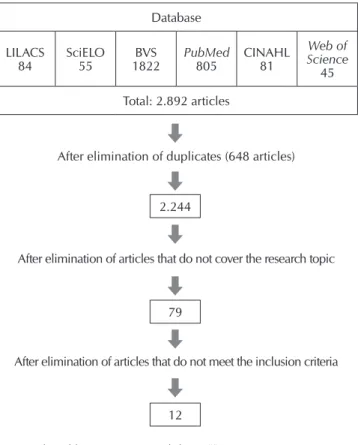
The online search found 2,892 articles; after applying the inclusion criteria, the final sample for this integrative review comprised 12 articles, as shown in Figure 1.
Data collection of primary articles(13-24) included in the
inte-grative review was made possible through an instrument detail-ing: identification of the original article (title, periodical, authors, specialism of authors, year of publication); objective(s); method-ological characteristics of the study (type, sample, specialism of the professionals involved in FN management); intervention for FN management; and main findings, conclusions and identifica-tion of limitaidentifica-tions and/or biases. For the analysis and synthesis of these articles, we used synoptic tables(11) containing: title,
author/year and professional category; interventions realized; results; and recommendations/conclusions.
RESULTS
This integrative review located a sample of 12 articles(13-24)
which met the inclusion criteria and are presented in Chart 1. All of the studies analyzed were performed in hospital in-stitutions, of which 10 by doctors, one by a pharmacist and one by nurses. They were published in the following journals:
Support Care Cancer (3), Clinical Journal of Oncology Nurs-ing (1), Journal of Clinical Oncology (1), BMCPharmacology and Toxicology (1), Farmacia Hospitalaria (1), European Jour-nal of Cancer Care (1), Supportive Care in Cancer (1), BMC Infectious Diseases (1), Journal of Oncology Pharmacy Prac-tice (1) and International Journal of Infectious Diseases (1).
Source: adapted from Mistiaen, Franckel, Poot(12)
Figure 1 – Flow diagram of the article inclusion process, São Paulo, Brazil, 2016
Database
LILACS
84 SciELO55 1822BVS PubMed805 CINAHL81
Web of Science
45
Total: 2.892 articles
After elimination of duplicates (648 articles)
After elimination of articles that do not cover the research topic
After elimination of articles that do not meet the inclusion criteria 2.244
79
12
Chart 1 – Characterization of the 12 primary articles included in the integrative review, according to title, author, year and professional category, São Paulo, Brazil, 2016
Title Author/year Professional category
Managing neutropenia in older patients with cancer receiving chemotherapy
in a community setting(13) Flores QI, Ershler W; 2010 Nurse
Safety of Early Discharge for Low-Risk Patients With Febrile Neutropenia: A
Multicenter Randomized Controlled Trial(14) Talcott JA, et al.; 2010 Doctor
Pharmacokinetics of piperacillin/tazobactam in cancer patients with
In relation to the type of study, three were “retrospective cohort”; two “randomized controlled”; two “multicenter randomized pro-spective”; two “prospective observational”; one “prospective de-scriptive”; one “retrospective observational”; and one “prospective cohort”. A summary of the contents (Intervention, Results and Rec-ommendations/Conclusion) of each article is presented in Chart 2. Regarding the interventions for management of CT-induced FN, there was a prevalence of studies focused on pharmaco-logical treatment (use of empiric ABT in hospital and outpatient
settings, adherence to an antimicrobial management protocol and use of prophylactic or non-prophylactic growth factor) (14-15,18-24) and improvement in the diagnostics (association of
biomark-ers with the MASCC risk index)(17). Only one study(16)
investi-gated pharmaceutical management in relation to the efficacy of antibiotic dosage and a study which implied that nurses could contribute to the identification of elderly patients who would benefit from prophylactic use of growth factor in order to reduce the occurrence of FN(13).
Title Author/year Professional category
Análisis descriptivo de los motivos que originan visitas a urgencias en
pacientes oncológicos: toxicidad postquimioterapia(16) Bravo SB, et al.; 2013 Pharmacist
C-reactive protein and the MASCC risk index identify high-risk patients with
febrile neutropenia and hematologic neoplasms(17) Juan F, Lombana M, Pino LE, Arango M; 2013 Doctor
Incidence of chemotherapy-induced neutropenia and current practice of prophylaxis with granulocyte colony-stimulating factors in cancer patients in
Spain: a prospective, observational study(18) Jolis L, et al.; 2013 Doctor
Adding procalcitonin to the MASCC risk-index score could improve risk
stratification of patients with febrile neutropenia(19) Ahn S, Lee YS, Lim KS, Lee JL; 2013 Doctor
Feasibility and safety of a reduced duration of therapy of colony-stimulating
factor in a dose-dense regimen(20) Puccini LRB, et al.; 2014 Doctor
Association between adherence to an antimicrobial stewardship program and mortality among hospitalised cancer patients with febrile
neutropaenia: a prospective cohort study(21)
Rosa RG, Goldani LZ, Santos
RP; 2014 Doctor
Incidence, treatment, and consequences of chemotherapy-induced febrile
neutropenia in the inpatient and outpatient settings(22)
Weycker D, Barron R, Kartashov A, Adicionar J,
Lyman GH; 2014 Doctor
Randomized controlled trial comparing ciprofloxacin and cefepime in febrile
neutropenic patients with hematological malignancies(23) Yasuda T, et al.; 2014 Doctor
Value of lipopolysaccharide binding protein as diagnostic marker of infection
in adultcancer patients with febrile neutropenia: comparison with C-reactive
protein, procalcitonin, and interleukin(24) Garcia GRL, et al.; 2015 Doctor
Note: MASCC - Multinational Association for Supportive Care of Cancer.
Chart 2– Presentation of the synthesis of interventions, results and recommendations/conclusions for each of the 12 primary
articles included in the integrative review, São Paulo, Brazil, 2016
Intervention Results Recommendations/Conclusions
Compare the prophylactic use of Pegfilgrastim, as of the first CT cycle, against the use of medical criteria to manage the occurrence of FN(13)
A reduction was observed in the occurrence of NF amounting to
approximately 60% with the prophylactic use of Pegfilgrastim since the beginning of the CT cycle in elderly patients and a reduction by approximately 50% when used according to medical criterion
Prophylactic use of Pegfilgrastim in elderly patients was shown to be efficient in avoiding the reduction of CT doses and CT cycle delays. It favors the reduction of complications due to NF, reducing the number of prolonged hospitalizations and use of ABT. Nurses can contribute to the identification of elderly patients who would benefit from the proposed intervention.
To recommend home treatment for low-risk NF patients in order to reduce hospital costs(14).
Early hospital discharge for low-risk FN patients, with ambulatory follow-up and/ or supervision contributes to a reduction in hospital costs and improves the quality of life for patients.
Promoting early hospital discharge of low-risk FN patients, with appropriate ABT and ambulatory follow-up and/or supervision, attenuates the occurrence of complications and reduces hospital costs.
Intervention Results Recommendations/Conclusions
Evaluate the pharmacokinetics of administering piperacillin/tazobactam in patients with hematologic neoplasms and FN after CT(15).
Demonstrated improved efficacy of piperacillin/tazobactam, for the treatment of FN, when initiated after CT.
FN patients medicated with piperacillin/ tazobactam, after realizing CT, present more favorable pharmacokinetic variations for the prevention of FN complications.
Analyze administration of growth factor
as a prophylaxis against FN(16). The use of growth factor reduced the occurrence of CT-induced FN. It was concluded that use of growth factor in patients submitted to CT prevents the occurrence of FN.
Evaluate the association of the C-reactive protein value with the MASCC risk index for the identification of high-risk FN patients(17).
The combination of results from the MASCC risk index and C-reactive protein value during the first five days of an FN episode allows the high-risk patient group to be identified.
Association of the C-reactive protein analysis and MASCC risk index score favors greater accuracy in the diagnosis of high-risk NF patients.
To analyze the effects of prophylactic administration of growth factor, from the first cycle of CT, in patients with breast cancer and lymphomas(18).
Patients with breast cancer and lymphomas who received prophylactic growth factor presented a reduction in the interruption of chemotherapy treatment due to FN.
Findings showed the majority of high-risk or moderate-risk NF patients who received growth factor in the 1st cycle of CT presented less treatment delay.
Realize the collection of procalcitonin (PCT) associated with application of the MASCC risk index in patients with a score ≥ 21 in order to prevent the occurrence of bacteremia and septic shock(19).
The use of PCT as an adjunct biomarker together with the MASCC risk index score could improve the risk stratification of patients with CT-induced NF.
The association of PCT and results of the MASC risk index favors an improved risk stratification for NF patients.
Prophylactic use of granulocyte colony-stimulating factor (G-CSF) for CT patients in order to prevent the occurrence of FN(20).
Prophylactic G-CSF could help reduce
alterations in the neutrophil count after CT. Use of G-CSF appears to be safe and effective, while contributing to cost reduction, however further randomized studies are necessary to define the correct dosage to avoid NF.
To evaluate the association between adherence to an antimicrobial
management protocol and the mortality of hospitalized NF patients(21).
Mortality rates of patients treated according to the antimicrobial management protocol were lower when compared to mortality rates of patients treated with other ABT regimens.
Adherence to an antimicrobial management protocol has a favorable repercussion on NF management, since it supports the rational use of antibiotics and contributes to the reduction of mortality rates.
To compare the prophylactic use of G-CSF and/or ABT for the treatment of low-risk neutropenic patients in hospital and outpatient settings(22).
Outpatient prophylactic treatment reduces the mortality rate and need for long-term hospitalizations, while also reducing hospital costs.
Despite the benefits of outpatient prophylaxis, it has been proven over the last three years that most patients with low-risk NF were initially treated in the hospital setting.
To compare the efficacy of cefepime versus ciprofloxacin in the treatment of FN patients(23).
Although the overall clinical response was similar between both groups, the efficacy of cefepime treatment on day 7 of CT was proven to provide a better response in the neutrophil count in high-risk NF patients.
The efficacy of cefepime in relation to the use of ciprofloxacin on day 7 of CT was identified. Thus, the authors recommend that cefepime be used as the initial standard treatment of choice for NF and ciprofloxacin as empiric prophylactic treatment.
To determine the value of
lipopolysaccharide binding protein as a predictor of infection in patients with FN compared to other biomarkers: C-reactive protein, PCT and interleukin (24).
At admission of FN patients, the biomarkers of lipopolysaccharide, C-reactive, PCT and interleukin binding proteins were increased, with no significant differences between them for early detection of septic shock and bacteremia.
At admission of neutropenic patients, the lipopolysaccharide binding protein confers early diagnostic accuracy of infection similar to that of other biomarkers studied.
Note: FN: Febrile Neutropenia; CT: Chemotherapy; ABT: Antibiotic therapy; MASCC: Multinational Association for Supportive Care of Cancer; PCT: Procalcitonin; (G-CSF) Granulocyte colony-stimulating factor.
Chart 2 (concluded)
DISCUSSION
The proven relevance of the use of growth factor as a pro-phylaxis in elderly patients with breast cancer and lymphoma is well-known since they are more likely to develop FN(13,16,18).
This prophylactic intervention, performed after CT, decreas-es the occurrence of FN episoddecreas-es (neutrophils > 1000)(20).
According to the clinical practice of the authors, the use of
growth factors as drug intervention is essential to avoid the oc-currence of FN, associated with performing a complete blood count and the monitoring the results.
Regarding the efficacy of antimicrobial use, a study demon-strated the benefits of using piperacillin/tazobactam in the treat-ment of FN and prevention of complications(15). In another study,
between cefepime and ciprofloxacin, a study recommended that cefepime be used as the initial standard treatment of choice for FN and ciprofloxacin as an empiric and prophylactic treatment. Thus, the significant efficacy of cefepime treatment on day 7 of CT has been demonstrated, resulting in a better response in neu-trophil counts of high-risk FN patients(23). It should be emphasized
that the rational use of antimicrobial therapy has a favorable effect on FN management, while reducing hospital costs and lowering mortality rates. In the hospital context in which the investigators of the present research work, there are protocols established for each degree of FN, and empirical ABT is administered until confirma-tion of culture results and, subsequently, ABT according to the sensitivity of the bacterium.
Pharmacological prophylactic treatment in an outpatient set-ting reduces the mortality rate and prolonged hospitalization, thereby reducing hospital costs(22). Early hospital discharge for
patients classified as low risk, combined with adequate ABT and ambulatory follow-up and/or supervision, attenuates the occur-rence of complications and reduces both hospital costs and also outpatient treatment costs, while improving the patient’s quality of life(14). In the clinical practice of the authors, those classified
as low-risk neutropenic patients are usually treated with ambula-tory ABT and a weekly follow-up.
Studies that associated the identification of biomarkers (C-reactive, PCT, interleukin)(17,19,24) with the results of the
MASCC risk index obtained higher accuracy in the score and in identification of the severity of FN and its complications (bacteremia and septic shock). Based on their clinical practice the authors have noted that even though identification of CT-induced FN using the MASCC risk index is recommended by the institution’s current guidelines, it is still not fully applied--which constitutes a challenge to be faced.
Despite the methodological option to expand the keywords, the present integrative review has demonstrated a lack of studies addressing non-pharmacological interventions for the manage-ment of CT-induced FN and also a lack of studies related to the practice of some health professionals and the team.
These results have drawn the authors’ attention, since in the hospital in which they are employed, they observe the daily work of other professionals in the health team (such as nutritionists, social workers, psychologists and nurses) devel-oping non-pharmacological interventions that are integrated with their Interprofessional Practice (IPP).
The nutritionist proposing a specific diet for neutropenic patients, in order not to expose them to foods that could lead to infection due to their immunodepression.
The social worker analyzing the conditions that prevent patients from going to the hospital to receive treatment and/ or prophylaxis with growth factor (Filgrastim); indicating that the patient should use the medication at home, in situations such as bedridden, impaired mobility, residing in another mu-nicipality or state and vulnerability; including making health facilities available at the place of residence of these patients in cases where transport is not available for them to receive the prescribed antimicrobial and G-CSF on a daily basis.
The nurse responsible for the guidelines and care intended to prevent the occurrence of infection, as well as supervising
and monitoring the patient’s myelodepression in the NADIR period, time elapsed between the application of the drug and the occurrence of the lowest hematological count(25), and
when there could be a drop in the neutrophils, checking the laboratory tests and administering the prescribed treatment.
The psychologist participating in providing emotional as-sistance to help patients face the disease, as well as to encour-age adherence to the proposed treatment and avoiding inter-ruptions due to absenteeism.
The dentist contributes both to the prevention and treat-ment of mucositis, using laser therapy, since an open lesion in the buccal region leads to the appearance of infection in patients submitted to CT.
Therefore, in view of the present results and reality of the disease, it is reiterated that the occurrence of FN, since it con-stitutes an important risk for the well-being and survival of patients under chemotherapy treatment, requires the presence of highly qualified health professionals and knowledge based on scientific evidence. From this perspective, it is necessary to develop studies that give visibility to the IPP to ensure success-ful management of CT-induced FN.
It is imperative to emphasize IPP in different contexts of health services, since it allows problematization and, conse-quently, a possible displacement of the acknowledged frag-mentation to the articulation and integration of health actions; it also tends to increase the resolutivity of services and the quality of health care, to increase and improve communica-tion between professionals and to give recognicommunica-tion to the spe-cific contributions of each area and its overlapping borders(26).
Study limitations
The low number of studies found in the literature is consid-ered to be a limitation; it is recommended that future studies use a broader database.
Contribution to the area of nursing health or public policy
The present study synthesized the main results and rec-ommendations of research on the interventions performed by health professionals for management of CT-induced FN in adult patients. By sharing the experience of a public hospital institution, specialized in teaching, research and humanized treatment of cancer patients, especially in the conduct of non-pharmacological interventions, it constitutes an advance in the verticalization of knowledge on the subject.
CONCLUSION
In this integrative review, 12 primary studies were selected and analyzed the objectives of which were to investigate in-terventions for the management of CT-induced FN. Most were performed by doctors with an emphasis on pharmacological treatment with antimicrobials and/or growth factors and as-sociations of methods for greater diagnostic accuracy of FN.
REFERENCES
1. Nogueira EA, Bergmann A, Paixao DE, Thuler LCS . Alterações sensitivas, tratamento cirúrgico do câncer de mama e nervo intercostobraquial: revisão da literatura. Rev Bras Cancer[Internet]. 2010 [cited 2015 Oct 21];85-91. Available from: http://www. inca.gov.br/rbc/n_56/v01/pdf/12_revisao_de_literatura_alteracoes_sensitiv as_apos_cancer_mama.pdf
2. Instituto Nacional de Câncer Jose Alencar Gomes da Silva (INCA). Tratamento do câncer no SUS[Internet]. Rio de Janeiro; 2015[cited 2015 Oct 21];94-8. Available from: http://www.inca.gov.br/situacao/arquivos/acoes_tratamento_cancer_sus.pdf 3. Bellesso M, Costa SF, Chamone DAF, Llacer PED. Screening for the outpatient treatment of febrile neutropenia. Rev Bras Hematol
Hemoter[Internet]. 2010 [cited 2015 Oct 21];32(5):402-08. Available from: http://www.scielo.br/pdf/rbhh/v32n5/en_aop97010.pdf 4. Borges G, Petrarca CR, Azambuja AA, Hasse J, Zimath T, Barbosa TBR. Febrile neutropenia in patients with cancer and low risk of
complications: outpatient treatment versus hospital treatment. Rev Bras Oncol Clin[Internet]. 2013[cited 2015 Oct 21];9(33):93-5. Available from: http://sboc.org.br/revista-sboc/pdfs/33/artigo2.pdf
5. Hoff PM, Diz EPDM, Pereira J, Testa L, Mak PM. Manual de Condutas em Oncologia 2 ed. São Paulo, 2013. p. 335-45.
6. Klastersky J, Paesmans M, Rubenstein EB, Boyer M, Elting L, Feld R, et al. The Multinational Association for Supportive Care in Cancer risk index: a multinational scoring system for identifying low-risk febrile neutropenic cancer patients. J Clin Oncol 2000; 18:3038-51.
7. Sanz MA. Testes clínicos no paciente neutropênico. In: Critical Practice in Infection Diseases. Recomendações para o tratamento da neutropenia febril baseadas em evidências. Baltimore (MD): Williams and Wilkins; 2005. p.17-22.
8. Venâncio IMS. Neutropenia Febril em doentes Oncológicos. [Dissertação] [Internet]. Universidade do Porto. 2013[cited 2015 Oct 21]. Available from: http://hdl.handle.net/10216/72391
9. Souza MT, Silva MD, Carvalho R. Revisão integrativa: o que é e como fazer. Einstein[Internet]. 2010[cited 2015 Oct 21];8(1Pt1):102-6. Available from: http://www.scielo.br/pdf/eins/v8n1/pt_1679-4508-eins-8-1-0102.pdf
10. The Joanna Briggs Institute. Reviewers’ Manual: 2014 edition[Internet]. Adelaide: JBI; 2014[cited 2015 Oct 21]. Available from: http://joannabriggs.org/assets/docs/sumari/reviewersmanual-2014.pdf
11. Lopes CMM, Galvão CM. Surgical Positioning: evidence for nursing care. Rev Latino-Am Enferm [Internet]. 2010 [cited 2016 Mar 03];18(2):287-94. Available from: http://dx.doi.org/10.1590/S0104-11692010000200021
12. Mistiaen P, Francke AL, Poot E. Interventions aimed at reducing problems in adult patients discharged from hospital to home: a systematic meta-review. BMC Health Serv Res[Internet]. 2007[cited 2015 Oct 21];7:47. Available from: http://www.ncbi.nlm.nih. gov/pmc/articles/PMC1853085/
13. Flores QI, Ershler W. Managing Neutropenia in Older Patients With Cancer Receiving Chemotherapy in a Community Setting. Clin J Oncol Nurs[Internet]. 2010[cited 2015 Oct 21];14(1)81-6. Available from: http://www.ncbi.nlm.nih.gov/pubmed/20118030 14. Talcott JA, Yeap BY, Clark JA, Siegel RD, Madeireiros ET, Lu C, et al. Safety of early discharge for low-risk patients with febrile neutropenia: a multicenter randomized controlled trial. J Clin Oncol[Internet]. 2011 [cited 2015 Oct 21];20;29(30):3977-83. Available from: http://www.ncbi.nlm.nih.gov/pubmed/21931024
15. Álvarez JC,Cuervo SI , Garzón JR , Gómez JC , Díaz JA , Silva E , et al. Pharmacokinetics of piperacillin/tazobactam in cancer patients with hematological malignancies and febrile neutropenia after chemotherapy. BMC Pharmacol Toxicol[Internet]. 2013[cited 2015 Oct 21];14:59. Available from: http://www.ncbi.nlm.nih.gov/pubmed/24286231
16. Bravo SB, Peña EGH, Sánchez RG, Durán PA, Sánchez Fresneda MNS, Sáez MS. Análisis descriptivo de los motivos que originan visitas a urgencias en pacientes oncológicos: toxicidad postquimioterapia. Farm Hosp[Internet]. 2015[cited 2016 Apr 02];39(6):333-7. Available from: http://dx.doi.org/10.7399/fh.2015.39.6.8728
17. Juan F, Lombana M, Pino LE, Arango M. C-reactive protein and the MASCC risk index identify high-risk patients with febrile neutropenia and hematologic neoplasms. Support Care Cancer[Internet]. 2015[cited 2015 Oct 21];23(4):1009-13. Available from: http://www.ncbi.nlm.nih.gov/pubmed/25270848
18. Jolis L, Carabantes F, Pernas S, Cantos B, López A, Torres P, et al. Incidence of chemotherapy-induced neutropenia and current practice of prophylaxis with granulocyte colony-stimulating factors in cancer patients in Spain: a prospective, observational study. Eur J Cancer Care [Internet]. 2013 [cited 2015 Oct 21];22(4):513-21. Available from: http://www.ncbi.nlm.nih.gov/pubmed/23730920
19. Ahn S, Lee YS, Lim KS,Lee JL. Adding procalcitonin to the MASCC risk-index score could improve risk stratification of patients The IPP, aiming at FN management, with the use of
prophylac-tic drugs, accurate diagnosis, monitoring and treatment (pharma-cological and non-pharma(pharma-cological), contributes to the achieve-ment of effective results, such as improveachieve-ment in quality of life and adherence of patients to the treatment regimen, reduction
with febrile neutropenia. Support Care Cancer[Internet]. 2013[cited 2015 Oct 21];21(8):2303-08. Available from: http://www. ncbi.nlm.nih.gov/pubmed/23519568
20. Puccini LRB, Koyalchujk S, Fabbri E, Bonizzoni E, Perrone T, Bosi A. Feasibility and safety of a reduced duration of therapy of colony-stimulating factor in a dose-dense regimen. Support Care Cancer[Internet]. 2014[cited 2015 Oct 21];22(9):2557-61. Available from: http://www.ncbi.nlm.nih.gov/pmc/articles/PMC4118033/
21. Rosa RG, Goldani LZ, Santos RP. Association between adherence to an antimicrobial stewardship program and mortality among hospitalised cancer patients with febrile neutropaenia: a prospective cohort study. BMC Infect Dis[Internet]. 2014[cited 2015 Oct 21];14(1):1-18. Available from: http://bmcinfectdis.biomedcentral.com/articles/10.1186/1471-2334-14-286
22. Weycker D, Barron R, Kartashov A, Legg J, Lyman GH. Incidence, treatment, and consequences of chemotherapy-induced febrile neutropenia in the inpatient and outpatient settings. J Oncol Pharm Pract[Internet]. 2014 [cited 2015 Oct 21];20(3):190-8. Available from: http://www.ncbi.nlm.nih.gov/pubmed/23824496
23. Yasuda T, Suzuki R, Ishikawa Y, Terakura S, Inamoto Y, Yanada M, et al. Randomized controlled trial comparing ciprofloxacin and cefepime in febrile neutropenic patients with hematological malignancies. Int J Infect Dis[Internet]. 2013 [cited 2015 Oct 21];17(6):385-90. Available from: http://www.ncbi.nlm.nih.gov/pubmed/23317527
24. Garcia GRL, Español MI, Cerezuea FP, Consuega SL, Hernando HA, Esteban TP , et al. Value of lipopolysaccharide binding protein as diagnostic marker of infection in adult cancer patients with febrile neutropenia: comparison with C-reactive protein, procalcitonin, and interleukin 6. Support Care Cancer[Internet]. 2015 [cited 2015 Oct 21];23(7):2175-82. Available from: http:// www.ncbi.nlm.nih.gov/pubmed/25564222
25. Bonassa EMA, Gato MIR. Esquemas antineoplásicos. In: Bonassa EMA, Gato MIR. Terapêutica oncológica para enfermeiros e farmacêuticos. 4ª ed. São Paulo: Atheneu; 2012. p. 531-624.