Original article (short paper)
An After-School, high-intensity, interval physical
activity programme improves health-related
itness in children
Sergio Reloba Martínez Luis Javier Chirosa Ríos
Ignacio Martín Tamayo
Universidad de Granada, Granada, España
Laura Guerrero Almeida
Universidad de Sevilla, Sevilla, España
Miguel Angel López-Gomez
Universidad de Granada, Granada, España
Christian Campos Jara
Universidad Andrés Bello, Santiago, Chile
Abstract–– Health problems related to a low level of physical activity (PA) in children and adolescents have prompted research into extracurricular PA programs. This study was designed to determine the effects of two different levels of PA on the health-related itness of school children. Ninety-four girls and boys (7–9 years) were randomly assigned to a control group (CG) or intervention group (IG). Over a 12 week study period, children in the CG participated in a similar PA program to that of a standard school physical education program while those in the IG completed a high intensity interval training (HIIT) program. Both programs involved two 40 minute extracurricular sessions per week. Our indings indicate that the HIIT intervention improved motor capacity (speed/agility), Vpeak, VO2 max and excess
post-exercise oxygen consumption (EPOC) (p< 0.05) along with the musculoskeletal capacity of the lower trunk (mean propulsive velocity and standing long jump, p < 0.05). The PA program had no effect on anthropometric variables or hand-grip strength. The data indicate that a 12 week strength training program using workloads adapted to children may signiicantly improve several markers of health and physical itness compared to a standard school PA program.
Keywords: children, physical condition, aerobic training, high intensity, health, Alpha-itness
Introduction
Concern about growing sedentary behaviour, overweight and obesity1, 2 along with reduced physical activity (PA) among
chil-dren3, 4 has recently prompted a series of investigations designed
to assess the beneits of extracurricular PA programs5-7. Such
studies have indicated beneicial effects of PA interventions on various health and itness markers8-12 as well as diminishing
sedentary habits13, 14.
However, authors such as Leek15 and Myer and Faigenbaum16
have argued that these PA interventions currently do not guar-antee that young people attain the levels of health and PA recommended by the different organizations and authors. This has sparked an exponential increase in research on the impact of extracurricular PA9, 16, 17-26.
As may be inferred from the vast amount of literature available on the topic, most PA interventions involve moderate-intensity aerobic PA, or so-called moderate-moderate-intensity training (MIT), and are based on working techniques similar to those of a traditional school physical education (PE) program9, 17-20. However, over the past 10 years, several complementary studies
have started to emerge that suggest that high-intensity intermit-tent aerobic exercise, otherwise known as high-intensity interval training (HIIT), adapted for children and preadolescents21-25
shows a beneicial effect on cardiovascular health and itness16, 26.
This type of PA program has been proposed as an alternative to the conventional school PE syllabus.
For HIIT, Baquet, Van Praagh and Berthoin27 suggested a
relative exercise intensity of ≥80% of the maximum heart rate to produce signiicant changes in the maximal oxygen consumption (VO2 max) of prepubertal children. Myer and Faigenbaum
16
tar-geted neuromuscular development and motor skills to improve the health of young children while Naclerio and Faigembaum28
highlighted the eficacy of high-intensity exercise in improving the health and itness of school children. Other authors have also described positive effects of HIIT programs on growth and development29-31, along with improved postural control and
stability32, a spontaneous increase in PA during the day33, and a
reduced risk of injury while playing sport16.
the health-related itness of children. In addition, the different variables and training protocols such as duration, frequency, volume and intensity assessed along with intervening factors such as nutrition education17, 34, 35 and healthy habits13, 36 hinder
indirect comparisons between the two PA intervention strategies. This study was designed to determine the effects of a moderate-intensity PA and a high-intensity interval PA program on the health-related itness of school children. As markers of health and itness, we used the Alpha-itness battery of tests designed for children and adolescents37-39 along with several other frequently used markers. A further objective of this study was to assess the use of the Alpha-itness test battery and of the indicators, VO2 max, excess post-exercise oxygen consump-tion (EPOC) and mean propulsive velocity of the lower trunk (MVprop) in school children.
Methods
Subjects
The study participants were 52 boys and 42 girls, aged 7–9 years (mean 8.2 ± 0.7 years) randomly assigned to a control group (CG, n = 56; 34 boys) that took part in an extracurricular moderate-intensity aerobic PA program or an intervention group (IG, n = 38; 18 boys) that participated in a similar duration high-intensity interval training (HIIT) PA program The age range selected was based on criteria that identify the onset of neuromuscular coordination in children28. The sample selection
criteria were: 1) belonging to the second cycle of primary school education (ages from 7 to 9); and 2) Having a higher attendance than 90% in the programs over 90% of program assistance The exclusion criteria were: 1) any illness suggesting possible dif-iculty in completing the study in the 3 months prior to its onset; and/or 2) any medical or orthopaedic problem that could impair completion of the exercise program. All the participants (and their parents or legal guardians) were informed of the procedures involved and possible risks and/or beneits. The study protocol was approved by the Bioethics Committee of the Universidad de Granada (Granada, Spain) and adhered to the tenets of the Declaration of Helsinki. All parents/legal guardians signed a written consent form.
Experimental design
The study consisted of a pre-posttest with natural groups that had similar characteristics. The extracurricular intervention was performed during the two hours per week of physical education (PE) on the primary school timetable. The groups did not engage in regular PE classes. Instead, they followed the two programs offered. Five groups were randomly assigned to either program.
The following indicators of itness and health were used as dependent variables: maximum oxygen consumption (VO2 max); peak velocity (Vpeak); hand-grip; – grip; jumping
abil-ity; lower trunk mean propulsive velocity (MVprop); excess post-exercise oxygen consumption (EPOC); percentage of fat
mass (% body fat); body mass index (BMI); and waist circum-ference. PA practised by the participants was employed as an independent variable.
Data acquisition and measurements
To compare the two interventions, the following tests were performed before and after each program. All the participants took part in several practice sessions before each set of tests.
Alpha-itness. An explanation of the tests that were per-formed follows. a) Maximum oxygen consumption (VO2 max).
As a measure of aerobic capacity,VO2 max was determined in the 20 m shuttle run test. For the test, subjects ran 20 m (there and back) in time with an acoustic signal. The signal sets a starting velocity of 8 km/h, which thereafter increases by 1 km·h−1 each minute. The test ends when the subject cannot keep up with the rhythm set. The authors of the Alpha-itness test battery express the test results as the “stage’ completed by the subject. However, we indirectly calculated VO2 max by
entering the maximum velocity recorded for each subject in the equation described by Leger, Mercier, Gadoury and Lambert40
for children under 18 years of age. b) Peak velocity (Vpeak). As a further measure of aerobic capacity, we determined Vpeak as the maximum velocity recorded before the child abandoned the 20 m shuttle run test. c) Speed/agility. As a measure of motor capacity, speed/agility was determined in the 4x10 m shuttle run test. In this test, the subject runs 10 m, picks up a cone, returns to the starting line, switches the cone for another cone and continues the process until he/she covers 4 x 10 m. The result is expressed in seconds. d) Hand-grip. Hand strength (right and left) was measured by dynamometry in kilograms. e) Jumping ability. The distance jumped in a standing long jump was recorded in centimetres. Starting with the legs at shoulders’ width, the subjects were instructed to jump as far as possible, landing with their feet together. f) Waist circumference. As a measure of central body fat, waist circumference was measured in centimetres.
Body composition analyser. Body composition was as-sessed through bioimpedance and measured using Tanita® Body
Composition Monitor model BF-350. This instrument provides
body fat and body mass index (BMI) when height is introduced. T-force System platform. Lower trunk mean propulsive velocity (MVprop) was measured using this force platform (T-Force System, Ergotech, Murcia, Spain) when subjects per-formed 5 half-squat repetitions using a lightweight wooden bar-bel with no added weights. The children were given instructions carefully and encouraged verbally to undertake the concentric phase of the athletic movement as quickly as possible. Feedback was provided by an observer, who informed the subject of the velocity reached in each repetition. Six practice sessions were performed before the test.
HR monitor equipped with the corresponding software
All participants were assigned to stage I of Tanner’s devel-opment stage41, 42
Training interventions
Intervention group (IG)
Subjects in the IG participated in an interval training program for 12 weeks, which consisted of 2 sessions of 40 minute duration per week. Each session involved 20 minutes of high-intensity intermittent exercises (around 10–20 s) and 20 minutes of sports activities as described in prior studies by Faigenbaum and Myer33, Behringer, Vom Heede, Yue, Mester29,
Baquet, Van Praagh, Berthoin27 and Baquet, Guinhouya,
Dupont, Nourry, Berthoin26. Following a standard warm-up,
sessions commenced with several sets of half-squats followed
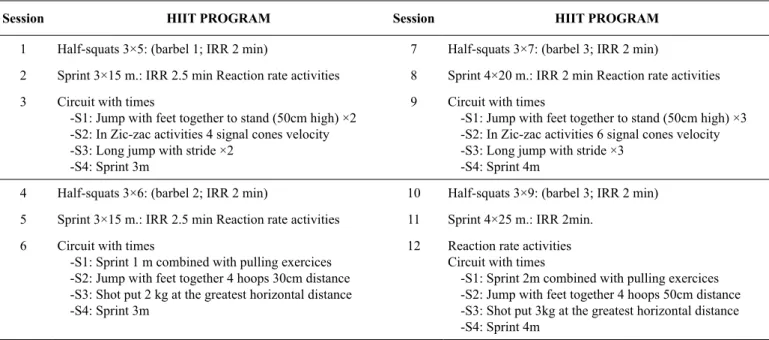
by sprints and a training circuit consisting of jumps, speed/ agility tasks, carrying weights, pulling exercises, etc. Activities were performed as games or in a competitive manner and par-ticipants were constantly encouraged verbally to perform the high-intensity exercises with maximum effort. The details of the HIIT performed in each session are provided in Table 1. Workloads and stimuli in each session were carefully designed for maximum eficiency16.
Control group (CG)
The CG subjects underwent the same 12 week extracurricular training program, but instead of completing 20 minutes of interval exercises they took part in 20 minutes of moderate-intensity aerobic exercises and games; this was also followed by 20 minutes of sport.
Table 1. Details of the irst 20 minutes of each high-intensity interval training (HIIT) session carrying weights, pulling exercises
Session HIIT PROGRAM Session HIIT PROGRAM
1 Half-squats 3×5: (barbel 1; IRR 2 min) 7 Half-squats 3×7: (barbel 3; IRR 2 min)
2 Sprint 3×15 m.: IRR 2.5 min Reaction rate activities 8 Sprint 4×20 m.: IRR 2 min Reaction rate activities
3 Circuit with times
-S1: Jump with feet together to stand (50cm high) ×2 -S2: In Zic-zac activities 4 signal cones velocity -S3: Long jump with stride ×2
-S4: Sprint 3m
9 Circuit with times
-S1: Jump with feet together to stand (50cm high) ×3 -S2: In Zic-zac activities 6 signal cones velocity -S3: Long jump with stride ×3
-S4: Sprint 4m
4 Half-squats 3×6: (barbel 2; IRR 2 min) 10 Half-squats 3×9: (barbel 3; IRR 2 min)
5 Sprint 3×15 m.: IRR 2.5 min Reaction rate activities 11 Sprint 4×25 m.: IRR 2min.
6 Circuit with times
-S1: Sprint 1 m combined with pulling exercices -S2: Jump with feet together 4 hoops 30cm distance -S3: Shot put 2 kg at the greatest horizontal distance -S4: Sprint 3m
12 Reaction rate activities Circuit with times
-S1: Sprint 2m combined with pulling exercices -S2: Jump with feet together 4 hoops 50cm distance -S3: Shot put 3kg at the greatest horizontal distance -S4: Sprint 4m
IRR: inter-repetition rest period; m: metres; barbel 1: cushioned 2 kg bar; barbel 2: cushioned 2.5 kg bar; barbel 3: cushioned 3 kg bar.; S: Station; All sessions include a formal initial meeting, which included familiarization with the exercises provided in the session.
Statistical Analysis
Data are provided as means and their corresponding stan-dard deviations (M ± SD). The homogeneity of the two study groups in terms of the anthropometric and health-related fitness variables recorded at baseline was confirmed by one-way ANOVA. Intervention effects were assessed through ANOVA of pre/post intervention data by examining PA intervention and measurement time point as the inde-pendent variables along with their interactions. Significant interactions were subjected to Bonferroni correction. All statistical tests were performed using the software pack-age SPSS version 20.0 for Windows (Chicago, IL, USA). Significance was set at p<0.05.
Results
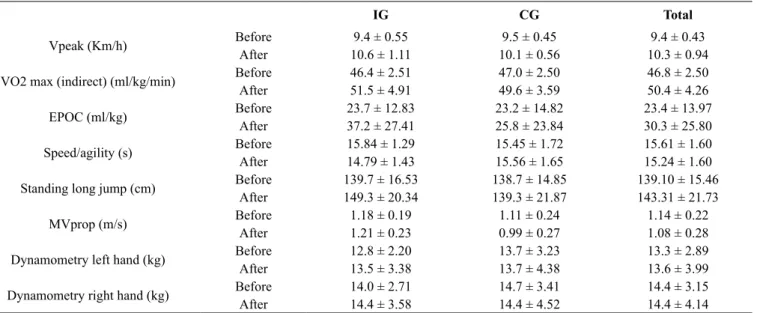
The means and standard deviations of the health-related itness and anthropometric variables recorded before and after the in-tervention are provided in Tables 2 and 3. The effects of each intervention on the health-related itness variables are illustrated in Figures 1 and 2, and Tables 4 and 5.
The HIIT intervention led to improved motor capacity (speed/agility), Vpeak, VO2 max and EPOC, along with
No signiicant differences were detected when Vpeak val-ues between the two interventions were compared (F1,79=1.927; η2=0.024;1-β=0.279; p=0.169) though differences were observed
between pre – and post-intervention values (F1,79=155.88; η2=0.664;
1-β=1.000; p=0.001) and for the interaction between time point and intervention (F1,79 =12.306; η2=0.135; 1-β=0.934; p=0.001). When
Vpeak values between the CG and IG were compared, no signiicant differences were recorded before the intervention (p=0.627), but
dif-ferences did emerge after the intervention (p=0.002). In addition, both groups showed signiicant effects of the intervention when pre – and post-intervention data were compared (IG p=0.001; CG p=0.001).
VO2 max values differed significantly, both
accord-ing to the measurement time point (F1,79 =129.697; η2=0.621;1-β =0.9999; p=0.001) and its interaction with the
intervention (F1,79 =15.370; η2=0.163; 1-β=0.972; p=0.001).
No differences in VO2 max were recorded according to the
type of intervention (F1,79 =0.757; η2=0.009; 1-β=0.138;
p=0.387). Paired comparisons revealed an effect of the
time point (pre – vs post-intervention) in both groups (IG
p=0.001; CG p=0.001) along with differences between groups in post-intervention VO2 max values (p=0.044), but not
pre-intervention values (p=0.207).
Table 2. Health-related itness variables (M ± SD) recorded before and after a 12 week extracurricular, moderate-intensity training (MIT) or
high-intensity interval training (HIIT) program.
IG CG Total
Vpeak (Km/h) Before 9.4 ± 0.55 9.5 ± 0.45 9.4 ± 0.43
After 10.6 ± 1.11 10.1 ± 0.56 10.3 ± 0.94
VO2 max (indirect) (ml/kg/min) Before 46.4 ± 2.51 47.0 ± 2.50 46.8 ± 2.50
After 51.5 ± 4.91 49.6 ± 3.59 50.4 ± 4.26
EPOC (ml/kg) Before 23.7 ± 12.83 23.2 ± 14.82 23.4 ± 13.97
After 37.2 ± 27.41 25.8 ± 23.84 30.3 ± 25.80
Speed/agility (s) Before 15.84 ± 1.29 15.45 ± 1.72 15.61 ± 1.60
After 14.79 ± 1.43 15.56 ± 1.65 15.24 ± 1.60
Standing long jump (cm) Before 139.7 ± 16.53 138.7 ± 14.85 139.10 ± 15.46
After 149.3 ± 20.34 139.3 ± 21.87 143.31 ± 21.73
MVprop (m/s) Before 1.18 ± 0.19 1.11 ± 0.24 1.14 ± 0.22
After 1.21 ± 0.23 0.99 ± 0.27 1.08 ± 0.28
Dynamometry left hand (kg) Before 12.8 ± 2.20 13.7 ± 3.23 13.3 ± 2.89
After 13.5 ± 3.38 13.7 ± 4.38 13.6 ± 3.99
Dynamometry right hand (kg) Before 14.0 ± 2.71 14.7 ± 3.41 14.4 ± 3.15
After 14.4 ± 3.58 14.4 ± 4.52 14.4 ± 4.14
Vpeak: peak velocity; VO2 max: maximum oxygen consumption; EPOC: excess post-exercise peak oxygen consumption; MVprop: mean propulsive velocity
Table 3. Anthropometric variables (M ± SD) recorded before and after a 12-week, extracurricular, moderate-intensity training (MIT) or high-intensity interval training (HIIT) program.
IG CG Total
Body mass index (kg/m2) Before 17.8 ± 3.4 18.1 ± 3.7 18.0 ± 3.6
After 18.8 ± 3.6 18.8 ± 3.6 18.8 ± 3.6
Body fat (%) Before 18.7 ± 7.9 19.8 ± 8.9 19.3 ± 8.5
After 22.5 ± 8 22.5 ± 9.1 22.5 ± 8.6
Waist circumference (cm) Before 61.2 ± 8.7 62.9 ± 7.9 62.2 ± 8.2
After 62.9 ± 8.5 62.4 ± 6.7 62.6 ± 7.5
8,5 9 9,5 10 10,5 11
G.I G.C
**
**
** Vpeak
42 44 46 48 50 52
G.I G.C
PRETEST
POSTEST **
**
** VO2max
Figure 1. Vpeak and VO2 max values recorded in the 20 m shuttle sprint test before and after the control and high-intensity interval training
EPOC values varied according to the measurement time point and the interaction time point x intervention. No effects were observed of the intervention type (see Table 4). Pre-intervention EPOCvalues failed to vary between the groups
(p=0.560), but post-intervention values varied (p=0.050). No
differences in pre – and post-intervention EPOCvalues were recorded in the CG (p=0.534), but differences were detected in the IG (p=0.001).
Table 4. Statistics obtained for excess post-exercise oxygen consumption
F1,79 η2 1-β p Pairwise comparisons
EPOC CG/IG CG IG
Before/After 16.254 0.171 0.978 0.001** Before 0.560
PA intervention 1.323 0.016 0.206 0.254 After 0.050*
Interaction 10.534 0.118 0.894 0.002 Before/ After 0.534 0.001**
(** p<.01; *p<.05)
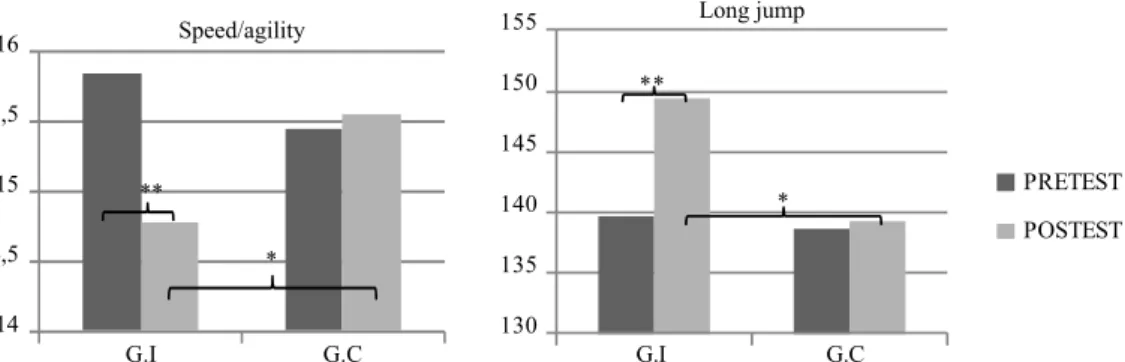
Similarly, when we compared the results of the 4x10 m speed/agility test, signiicant effects were observed of the measurement time point (F1,85 =11.398; η2=0.018;1-β
=0.916; p=0.001) and of the interaction time point x in-tervention (F1,85 =17.483; η2=0.171; 1-β=0.985; p=0.001).
No effects of the intervention were noted (F1,85=0.291;
η2=0,003;1-β =0.083; p=0.591). In the Bonferroni test
com-parisons, speed/agility showed no inter-group differences before the intervention (p=0.219), but did differ after the intervention (p=0.027). Differences between the two time
points were not observed in the CG (p=0.533), yet were detected in the IG (p=0.001).
14 14,5 15 15,5 16
G.I G.C
Speed/agility
* **
130 135 140 145 150 155
G.I G.C
PRETEST
POSTEST Long jump
**
*
Figure 2. Speed/agility and standing long jump values recorded in the Alpha itness test battery before and after the control and high-intensity
interval training programs (** p<.01; *p<.05)
Standing long jump results differed signiicantly ac-cording to both the measurement time point (F1,90 =8.019; η2=0.082; 1-β =0.800; p=0.006) and the interaction time
point x intervention (F1,90 =6.095; η2=0.063; 1-β =0.685;
p=0.015). No effects of the intervention were detected (F1,90
=2.237; η2=0.024;1-β =0.316; p=0.138). Bonferroni test
com-parisons revealed no differences between the CG and IG in pre-intervention long jump results (p=0.768), yet differences
in post-intervention results were observed (p=0.036). No
dif-ferences in before/after long jump distances were detected in the CG (p=0.772), but these emerged in the IG (p=0.001) (see Figure 2). MVprop varied according to the intervention and the interaction time point x intervention. After the inter-vention, this variable decreased in the CG to provide before/ after differences (p=0.001) whereas MVprop showed a slight
increase in the IG (see Tables 2 and 5).
Table 5. Statistics obtained for lower trunk musculoskeletal capacity
F1,81 η2 1-β P Pairwise comparisons
MVprop CG/IG CG IG
Before/After 3.763 0.044 0.483 0.056 Before 0.227
PA intervention 8.658 0.097 0.828 0.004** After 0.001**
Interaction 8.390 0.094 0.816 0.005** Before/ after 0.001** 0.531
** p<.01; *p<.05
No signiicant effects were produced on the dynamometer results of the measurement time point (left hand F1,90=0.927, η2=0.010;1-β =0.159, p=0.338; right hand F
1,89=0.012, η
2=0.0001,
1-β=0.051, p=0.912), intervention (left hand F1,90=0.728,
η2=0.008;1-β=0.135, p=0.396; right hand F
1,89=0.257, η
2=0.003,
1-β=0.079, p=0.613) or interaction time point x intervention (left hand F1,90=0.953, η2=0.010, 1-β=0.162, p=0.332; right hand
The anthropometric variables examined increased both in the IG and CG (see Table 3). Signiicant differences in BMI values were observed for the different measurement time points (F1,83=22.550; η2=0.214; 1-β=0.997; p=0.001), yet no changes
were observed according to intervention type (F1,83=0.021; η2=0.0001;1-β=0.052; p=0.885) or the interaction between
time point and intervention (F1,83=0.101; η2=0.001;1-β=0.061;
p=0.752). The percentage of body fat varied similarly
accord-ing to the time point (F1,83=55.488; η2=0.401;1-β=0.9999;
p=0.001), but not according to the intervention (F1,83=0.002; η2=0.0001;1-β=0.050; p=0.965) or the interaction time
point x intervention (F1,83=0.060; η2=0.001;1-β=0.057;
p=0.807). Waist circumference failed to vary signiicantly
according to the time point (F1,83=3.720; η2=0.043;1-β=0.479;
p=0.057), intervention (F1,83=0.001; η2=0.0001;1-β=0.050;
p=0.970), or interaction time point x interaction (F1,83=2.447;
η2=0.029;1-β=0.340; p=0.122).
Discussion
The main indings of this study were that a 12 week extra-curricular strength training program consisting of controlled workloads adapted for children was more able to improve sev-eral health-related itness variables than the effects of a more conventional lower intensity PA program. The high-intensity interval activities undertaken in the training intervention led to signiicant improvements in Vpeak, VO2 max, EPOCand lower
trunk MVprop as well as in the performance of speed/agility tests and long jump.
All the variables recorded after a 20 m shuttle run test was signiicantly improved in the intervention group. The effects pro-duced on both Vpeak and VO2 maxresemble those described in a
large number of studies22, 26, 43, 44. Despite improvements in
post-intervention VO2 max values recorded in both our intervention
and control groups, the greatest effects were produced in the IG to the extent that signiicant post-intervention differences were observed with respect to the CG despite even lower pre-interven-tion values (see Figure 1). These indings are consistent with the conclusions arrived at by Baquet, Van Praagh, Berthoin27, who
reported that the VO2 maximprovement produced in response
to the aerobic PA generally undertaken by children in this age group is reduced in comparison to the effects of high-intensity short-duration activities on the cardiovascular health of chil-dren. In effect, intermittent exercises performed at maximum intensity may be observed in a child’s spontaneous activity45. In
a study by Bailey, Olson, Pepper, Porszasz, Barstow, Cooper46,
it was found that the mean duration of the physical activities of children between the ages of 6 and 10 years was no more than 3 seconds (under 15 seconds in 95% of cases) and that intensities were high. Many authors have attributed the lower anaerobic performance of children to a non fully-developed glucose metabolism pathway47,48, thus, contraindicating high-intensity PA. However, the results of several studies seem to challenge this idea49-51. Accordingly, Van Praagh and Doré51 argued that
lower blood and muscle lactate concentrations in children may be explained by the lower muscle mass involved in physical
exercise. According to Ratel et al.45, there is no sound
physi-ological evidence to indicate that high-intensity exercise could be harmful for children and these authors endorsed this type of program based on their observation of appreciable effects on both the aerobic and anaerobic capacity of prepubertal children. These indings are in line with the present results. The Vpeak and VO2 max improvements observed are related to the EPOC
values attained by our subjects. During the stage of recovery following exercise, calorie intake increases and this increase is maintained until all metabolic processes return to their baseline state. In our study, EPOC were recorded during the rapid stage of oxygen consumption within the initial hour of recovery52, 53. The
highest post-intervention EPOC levels recorded in the IG may be related to a greater metabolic disruption54 as a consequence
of the increased oxygen consumption or VO2 max, during the
20m sprint. Descriptive studies in adults such as those of Bahr, Grønnerød, Sejersted55 and Laforgia, Withers, Shipp, Gore56
have shown that the intensity at which an exercise is executed (3 x 2 min on a cycle ergometer at 108% VO2max; 20 x 1 minute
sprints at 105% VO2 max, respectively) will affect excess
post-exercise oxygen consumption signiicantly. In a review of the effects of the exercise intensity, duration and modality on excess post-exercise oxygen consumption, Borsheim and Bahr52
re-ported that high-intensity activities signiicantly increase EPOC values, thus, supporting the results of our intervention. Despite the frequent use of this variable in adults, as far as we know no such data are available for children precluding any comparisons.
Besides the beneicial cardiovascular effects observed, our HIIT program also led to better agility/velocity levels (see Figure 2). Other authors have also described a link between cardiovascular status and other itness-related factors including agility/velocity26, 57-59. In contrast, Ardoy et al.60 observed no
such improvement in pairwise comparisons in two experimen-tal groups despite high-intensity exercise in one of the groups relected by a high mean heart rate.
Among the factors related to muscular-skeletal capacity, we detected signiicant improvements in the explosive force generated in the legs, both in the standing long jump test and in the variable MVprop. Thus, following the intervention, subjects in the IG covered a signiicantly longer distance in the long jump compared to those in the CG (see Figure 2). These data are consistent with those reported by Baquet, Guinhouya, Dupont, Nourry, Berthoin26, Secchi, García, España-Romero,
Castro-Piñero59 and Cuenca-García et al.37, which the beneicial
effects of a HIIT program on lower trunk strength. The mean propulsive velocity, MVprop, was unaffected by the interven-tion, most likely because of the instability experienced doing squat exercises at this age.
In conclusion, the indings of our study indicate that short-duration high-intensity neuromuscular exercises are an effective option to improve the health-related physical itness of school children. To date, this kind of program has only been implemented in sports’ clubs and teams in which population bias exists due to the level of motor competence. Hence, this type of training program in an education setting, whether curricular or extracurricular, would be a powerful tool to improve the physical itness of children, regardless of their unwillingness to participate in sport. More work in the ield is needed with special emphasis on aspects such as motivation levels during longer-duration programs and levels of adherence to such programs.
References
1. Janssen I. Physical activity guidelines for children and youth.
APNM. 2007; 32: 109–121.
2. Ortega F, Ruiz J, Castillo M, Moreno L, Gonzalez-Gross M, Wärnberg J. et al. Bajo nivel de forma física en los adolescentes españoles. Importancia para la salud cardiovascular futura (Estudio
AVENA). Rev Esp Cardiol. 2005; 58(8): 898-909.
3. Reverter J, Plaza D, Jové C, Hernández V. Actividad físico-de -portiva extraescolar en alumnos de primaria: el caso de Torrevieja (Alicante). Retos. 2014; 25: 48-52.
4. Troiano RP, Berrigan D, Dodd KW, Masse LC, Tilert T, McDowell M. Physical activity in the United States measured by accelerometer. Med Sci Sports Exerc. 2008; 40(1): 181-188.
5. Escalante Y, Saavedra J, García-Hermoso A, Domínguez A.
Improvement of the lipid proile with exercise in obese children:
A systematic review. PrevMed. 2012; 54: 293-301.
6. García-Cantó E, Pérez JJ. Programa para la promoción de actividad física saludable en escolares murcianos. Retos. 2014; 25: 131-135
7. González J, Portolés A. Actividad física extraescolar: relaciones con la motivación educativa, rendimiento académico y conductas
asociadas a la salud. RIPED. 2014; 1 (9): 51-65.
8. Annesi J, Faigenbaum A, Westcott W, Smith A, Unruh J, Hamilton
F. Effects of the Youth Fit For Life protocol on physiological,
mood, self-appraisal, and voluntary physical activity changes in African American preadolescents: Contrasting after-school care and
physical education formats. Int J Clin Hlth Psyc. 2007; 3: 641-659.
9. Cordova A, Villa G, Sureda A, Rodriguez-Marroyo JA, Sanchez-Collado P. Actividad física y factores de riesgo cardiovascular de
niños españoles de 11-13 años. Rev Esp Cardiol. 2012; 65 (7):
620-626.
10. Hasselstrøm H, Karlsson M, Hansen S, Grønfeldt V, Froberg K,
Andersen L. A 3-Year Physical Activity Intervention Program
Increases the Gain in Bone Mineral and Bone Width in Prepubertal Girls but not Boys: The Prospective Copenhagen School Child Interventions Study (CoSCIS). Calc Tiss Res. 2008; 83: 243-250. 11. Hogg J, Diaz A, Cid M, Mueller C, Grace E, Cheruvu S. et al. An
after-school dance and lifestyle education program reduces risk factors for heart disease and diabetes in elementary school children.
J Pediatr Endocr Met. 2012; 25(5-6): 509–516.
12. Resaland GK, Anderssen LB, Mamen A, Anderssen SA. Effects of a 2-year school-based daily physical activity intervention on
cardiorespiratory itness. The Sogndal school-intervention study.
Scand J Med Sci Spor. 2011; 21: 302-309.
13. Colín-Ramírez E, Castillo-Martínez L, Orea-Tejeda A,
Vergara-Castañeda A, Keirns-Davis C, Villa-Romero A. Outcomes of a
school-based intervention (RESCATE) to improve physical activity patterns in Mexican children aged 8-10 years. Health Educ Res. 2010; 25 (6): 1042-1049.
14. Wright K, Giger JN, Norris K, Suro Z. Impact of a nurse-directed, coordinated school health program to enhance physical activity behaviours and reduce body mass index among minority children:
A parallel-group, randomized control trial. Int J Nurs Stud. 2012; 50 (6): 727–737
15. Leek D, Carlson J, Cain K, Henrichon S, Rosenberg D, Patrick K.
et al. Physical Activity During Youth Sports Practices. Arch Pediatr
Adolesc Med. 2010; 4 (165): 294-299.
16. Myer GD, Faigenbaum AD. Exercise is sports medicine in youth: Integrative neuromuscular training to optimize motor development and reduce risk of sports related injury. Kronos. 2010; 10 (1): 39-48.
17. Ben Ounis O, Elloumi M, Zouhal H, Makni E, Denguezli M, Amri M, Lac G, Tabka Z. Effect of individualized exercise training
combined with diet restriction on inlammatory and igf-1/igfbp-3 in obese children. Ann Nutr Metab. 2010; 56: 260-266.
18. Kriemler S, Zahner L, Schindler C, Meyer U, Hartmann T,
Hebestreit H, Brunner-La Rocca H, Van Mechelen W, Puder J. Effect of school based physical activity programme (KISS) on it -ness and adiposity in primary schoolchildren: cluster randomised controlled trial. BMJ. 2010; 340: 1-8.
19. Sandercock G, Cohen D, Grifin M. Evaluation of a multicompo
-nent intervention to improve weight status and itness in children: Upstarts. Pediatr Int. 2012; 6 (54): 911-917.
20. Sigmund E, El Ansari W, Sigmundová D. Does school-based physi -cal activity decrease overweight and obesity in children aged 6¿ 9 years? A two-year non-randomized longitudinal intervention study
in the Czech Republic. BMC Public Health. 2012; 1 (12): 570-583.
21. Faigenbaum A, Westcott W, LaRosa R, Long C. The Effects of Different Resistance Training Protocols on Muscular Strength and
endurance development in children. Pediatrics. 2005; 1 (104): 1-7.
22. Gamelin FX, Baquet G, Berthoin S, Thevenet D, Nourry C, Nottin S, Bosquet L. Effect of high intensity intermittent training on heart rate variability in prepubescent children. Eur J Appl Physiol. 2009;
105: 731-738.
23. Nourry C, Deruelle F, Guinhouya C, Baquet G, Fabre C, Bart F, Berthoin S, Mucci P. High-intensity intermittent running training improves pulmonary function and alters exercise breathing pattern in children. Eur J Appl Physiol. 2005; 94(4): 415-23.
24. Rosenkranz R, Welk G, Dzewaltowski D. Environmental correlates of objectively measured physical activity and sedentary behaviour in after-school recreation sessions. JPAH. 2011; 8: 214-221. 25. Yu C, Sung YT, So R, Lui KC, Lau W, Lam P, Lau E. Effects
of Strength Training on Body Composition and Bone Mineral Content in Children Who Are Obese. J Strength Cond Res. 2005;
19(3): 667-672
26. Baquet G, Guinhouya C, Dupont G, Nourry C, Berthoin S. Effects
27. Baquet G, Van Praagh E, Berthoin S. Endurance Training and Aerobic Fitness in Young People. Sports Med. 2003; 33(15): 1127-1143.
28. Naclerio F, Faigenbaum A. Integrative neuromuscular training for youth. Kronos. 2011; 10 (1): 49-56.
29. Behringer M, Vom Heede A, Yue Z, Mester J. Effects of resistence
training in children an adolescents: a metaanálisis. Pediatrics.
2010; 126 (5): 199-210.
30. Faigenbaum A, Myer GD. Resistence training among young
athletes: safety, eficacy an injury prevention effects. Br J Sports
Med. 2009; 44: 56-63
31. Slining M, Adair LS, Goldman BD, Borja JB, Bentley M. Infant overweight is associated with delayed motor development. J
Pediatric. 2010; 157: 20-25.
32. Mickle KJ, Munro BJ, Steele JR. Gender and age affect balance performance in primary school-aged children. J Sci Med Sport. 2011; 14: 243-248.
33. Faigenbaum A, Myer GD. Resistance training and paediatric health. Kronos. 2011; 10 (1): 31-38.
34. Donnelly J, Jacobsen D, Whatley J, Hill J, Swift L, Cherrington
A, Polk B, Tran Z, Reed G. Nutrition and physical activity pro -gram to attenuate obesity and promote physical and metabolic
itness in elementary school children. Obes Res. 2012; 3 (4):
229-243.
35. Gortmaker S, Lee R, Mozaffarian R, Sobol A, Nelson T, Roth B, Wiecha J. Effect of an After-School Intervention on Increases in Children’s Physical Activity. Med Sci Sport Exer. 2012; 44(3):
450-457.
36. McMinn D, Rowe DA, Murtagh S, Nelson NM. The effect of a school-based active commuting intervention on children’s com-muting physical activity and daily physical activity. Prev Med. 2012; 15 (54): 316-318.
37. Cuenca-García M, Jiménez-Pavón D, España-Romero V, Artero
E, Castro-Peñero JC, Ortega F, Ruiz JR, Castillo M. Condición
física relacionada con la salud y hábitos de alimentación en ni -ños y adolescentes: propuesta de addendum al informe de salud escolar. Rev Invest Ed. 2011; 9 (2): 35-50.
38. Serra-Paya N, Ensenyat A, Real J, Castro-Viñuales I, Zapata
A, Galindo G, Solé-Mir E, Bosch-Muñoz J, Mur JM, Teixido
C. Evaluation of a family intervention programme for the
treat-ment of overweight and obese children (Nereu Programme): a
randomized clinical trial study protocol. BMC Public Health. 2013; 13: 1-14.
39. Torrijos-niño C, Martínez-Vizcaino V, Pardo-Guijarro MJ,
García-Prieto JC, Arias-Palencia NM, Sánchez-López M.
Physical Fitness, Obesity, and Academic Achievement in Schoolchildren. J Pediatr. 2014; 1 (165): 104-109.
40. Leger LA, Mercier D, Gadoury C, Lambert J. The multistage
20 metres shuttle run test for aerobic itness. J Sport Sci. 1988;
6: 93-101.
41. Muñoz MT, Pozo J. Pubertad normal y sus variantes. Pediatr
Integral. 2011; 15 (6): 507-518.
42. Tanner JM. The measurement of maturity. Trans Eur Orthod
Soc. 1975; 45-60.
43. Baquet G, Berthoin S, Dupont G, Blondel N, Fabre C, Van Praagh
E. Effects of high intensity intermittent training on peak VO (2)
in prepubertal children. Int J Sports Med. 2012; 23(6): 439-44
44. Berthoin S, Baquet G, Dupont G, Van Praagh E. Critical velocity during continuous and intermittent exercises in children. Eur J Appl Physiol. 2006; 98: 132-138.
45. Ratel S, Lazaar N, Dore E, Baquet G, Williams C, Berthoin S. et al. High-intensity intermittent activities at school: controversies
and facts. J Sport Med Phys Fit. 2004; 44: 272-280.
46. Bailey R, Olson J, Pepper S, Porszasz J, Barstow T, Cooper D. The level and tempo of children´s physical activities: an
obser-vational study. Med Sci Sport Exer. 1995; 7 (27):1033-1041. 47. Falgairette G, Bedu M, Fellman N, Van Praagh E, Coudert J.
Bioenergetic proile in 144 boys aged from 6 to 15 years with
special reference to sexual maturation. Eur J Appl Physiol. 1991; 62: 151-156.
48. Van Praag E, Doré E. Short-term muscle power during growth
and maturation. Sports Med. 2002; 32: 701-708.
49. Armstrong N, Welsman JR, Kirby BJ. Performance on the
Wingate anaerobic test and maturation. Pediatr Exerc Sci. 1997;
9: 253-261.
50. Petersen SR, Gaul CA, Stanton MM., Hanstock CC. Skeletal muscle metabolism during short-term, high-intensity exercise
in prepuberal and pubertal girls. J Appl Physiol. 1999; 21 (87):
51-56.
51. Van Praagh E, Bedu M, Falgairette G, Fellmann N, Coudert
J. Oxygen uptake during a 30-s supramaximal exercise in 7 to
15-year-old boys. In: R Frenkl, 1 editor. Children and exercise
XV. Budapest: Natl Inst for health promotion. 1991; 281-287.
52. Børsheim E, Bahr R. Effect of Exercise Intensity, Duration and Mode on Post-Exercise Oxygen Consumption. Sports. 2003; 14
(33): 1037-1060.
53. Lamont LS, Romito R, Rossi K. Fat-free mass and gender inlu -ences the rapid-phase excess postexercise oxygen consumption.
Appl Physiol Nutr Me. 2010; 35 (1): 23-26.
54. Earnest CP, Scott CB. Resistance Exercise Energy Expenditure
is Greater with Fatigue as Compared to Non-Fatigue. JEPonline.
2011; 14 (1): 1-10.
55. Bahr R, Grønnerød O, Sejersted OM. Effect of supramaximal exercise on excess postexercise O2 consumption. Med Sci Sport
Exercise. 1992; 1 (24): 66-71.
56. Laforgia J, Withers T, Shipp J, Gore J. Comparison of energy expenditure elevations after submaximal and supramaximal
run-ning. J. Appl. Physiol. 1997; 2 (82): 661–666.
57. Ara I, Rodriguez V, Perez-Gomez J, Jimenez-Ramirez J, Serrano-Sanchez JA, Dorado C, Calbet J. Inluence of extracurricular sport activities on body composition and physical itness in boys: a 3-year longitudinal study. Int J Obesity. 2006; 30: 1062-1071.
58. Ortega F, Ruiz JR, Castillo MJ, Moreno LA, González-Gross
M, Wärnberg J, Gutiérrez À. Bajo nivel de forma física en los
adolescentes españoles.Importancia para la salud cardiovascular
futura (Estudio AVENA). Rev Esp Cardiol. 2005; 58(8): 898-909.
59. Secchi JD, García C, España-Romero V, Castro-Piñero J. Condición física y riesgo cardiovascular futuro en niños y ado-lescentes argentinos: una introducción de la batería ALPHA. Arch Argent Pediatr. 2014; 112 (2): 132-140
60. Ardoy D, Fernández-Rodríguez JM, Ruiz JR, Chillón P,
España-Romero V, Castillo M, Ortega F. Mejora de la condición física en adolescentes a través de un programa de intervención educativa:
Corresponding author
Sergio Reloba Martínez
Doctor en Educación física Departamento Educación Física y deportiva, Facultad de Ciencias de la Actividad física y la Salud. Universidad de Granada (España). Email: [email protected]
Manuscript received on October 12, 2014 Manuscript accepted on June 20, 2016