Sustainability and Consumer
Responses: The Effect of Bad
Industry Reputation and Fit
Sandra Oexle, No. 1375
A Project carried out on the area of Corporate Social Responsibility, under
the supervision of Professor Joana Story
Title
Sustainability and Consumer Responses: The Effect of Bad Industry Reputation and Fit
Abstract
This work project investigates how consumers’ responses to sustainability activities of organisations are influenced by the bad reputation of the industry they are operating in. Specifically, it tested how consumers’ attributions about the motives behind companies’ engagement are affected and whether the fit of the cause with companies’ core business influences this attributional processing. Surveying 299 participants, the study provides support that a high fit program provokes values-driven attributions, which likewise im-prove consumers’ trust, corporate reputation and image, rendering companies’ sustain a-bility investments effective, even in bad reputation industries. Furthermore, theoretical and practical implications together with future research suggestions are provided.
1.
Introduction
Sustainability practices are gaining importance within companies’ efforts to address societal expectations and hereby creating a favorable corporate image and developing a positive relationship with consumers and other stakeholders (Blackburn, 2007). In par-ticular, companies operating in industries which are known for their negative impact on the environment, unethical business practices and breaches of labor and safety stand-ards, such as the chemical or the oil and gas industry (oekom research, 2012a), seem to be interested in changing their negative perception through sustainability initiatives (Du & Vieira, 2012). However, while some companies (e.g. Henkel and Sony) successfully improved their image (Laszlo, 2008; oekom research, 2012a), especially those compa-nies operating in industries with a bad reputation regarding sustainability are still nega-tively perceived by consumers despite their efforts (e.g. OMV). This raises the question why those companies are not benefitting to the extent of their investments.
The abundance of theoretical work in sustainability literature suggesting how to de-sign an effective sustainability strategy confuses rather than helps managers (Laszlo, 2008). Furthermore, to date, there is little empirical research providing an understanding of how sustainability activities (including economic, social and environmental initia-tives) influence consumer responses (Choi & Ng, 2011). In order to investigate how companies operating in bad reputation industries can design an effective sustainability program, the Corporate Social Responsibility (CSR) literature can be used as a concep-tual underpinning. Scholars indicate that the effectiveness of CSR initiatives is influ-enced by the motives consumers attribute to a company’s engagement in CSR. Hereby,
con-sumers share a general tendency of suspicion toward businesses, especially toward those with a bad reputation that are now trying to change their perception through CSR (Yoon et al., 2006). Yet, researchers provide support that a high fit of the CSR activity with the company’s core business reduces suspicion and likewise provokes favorable consumers’ attributions leading to positive consumer responses (Ellen et al., 2006; Fein,
1996). However, the validity of these results has not been tested for companies operat-ing in bad reputation industries. Thus, this work project aims at answeroperat-ing the followoperat-ing research questions: (a) Why are companies operating in industries with a bad reputation regarding sustainability not benefitting from the advantages sustainability initiatives should yield? (b) Do consumers’ attributions about the motives behind sustainability activities influence the effectiveness of these? (c) Does a high fit sustainability program change consumers’ negative perceptions of the organization (i.e. consumer trust, corpo-rate reputation and image)?
Hence, this work project contributes to the understanding of how sustainability prac-tices (covering economic, social and environmental initiatives) influence consumers’ responses. This understanding indicates managers how to design effective sustainability programs, especially in bad reputation industries. Moreover, it extends the CSR litera-ture in important ways, as it is the first research about how consumers’ perceptions of companies’ CSR activities are affected by the reputation of the industry.
2.
Literature Review
2.1 Corporate Social Responsibility and Sustainability
A growing number of global industry leaders, such as DuPont, General Electric and Unilever, are adopting sustainability strategies in their core business and are hereby acknowledging businesses’ broader responsibilities toward the society and the enviro n-ment (Laszlo, 2008). Yet, the debate about companies’ societal obligations is not new
and can be traced back for centuries (Carroll, 1999; Smith, 2003). In this discussion, the two concepts of Corporate Social Responsibility (CSR) and sustainability are used in-terchangeably, leading to confusion about what exactly is meant by each term.
Despite numerous approaches to define CSR, there is no agreement on a single defi-nition (Jha, 2009; O’Riordan & Fairbrass, 2008). Nevertheless, most definitions share three ideas: First, companies have societal responsibilities (social and environmental) that go well beyond maximizing their profit (economic responsibility). Second, by ac-knowledging this broader set of responsibilities, companies’ engagement goes beyond
the mere fulfillment of legal obligations, and third, these responsibilities do not only derive from companies’ shareholders but also from their stakeholders (Freeman, 1984; Swaen & Chumpitaz, 2008). All three principles are highlighted in the definition devel-oped by the Commission of the European Communities (2001): CSR is “a concept whereby companies integrate social and environmental concerns in their business opera-tions and in their interacopera-tions with their stakeholders on a voluntary basis”.
Similar to the concept of CSR, authors do not agree on a single definition for sus-tainability (Blackburn, 2007). Yet, probably the most widely used is related to the con-cept of Sustainable Development, which the United Nations’ World Commission on
that which meets the needs of the present without compromising the ability of future generations to meet their own needs.”Based on three pillars, the “Triple Bottom Line” (Elkington, 1998), companies have to simultaneously integrate economic, social and environmental goals into their business strategy. Hereby, companies should not only minimize their business activities’ negative impacts on the environment and society, but also contribute actively to the sustainable development of the whole society. This ena-bles future generations to fulfill their own needs (Blackburn, 2007; DesJardins, 2009).
In an attempt to differentiate both concepts from each other, various scholars argue that CSR can be seen as an intermediate stage, where companies try to balance econom-ic, social and environmental issues of the current society, toward the ultimate goal of achieving this balance also for future generations, which reflects the concept of sustain-ability (Blackburn, 2007; Kaptein & Wempe, 2002). Due to this relationship, the CSR literature can be used as a conceptual underpinning for the sustainability literature.
However, there is also dispute in academia and practice about businesses’ role in s o-ciety, with Friedman (1970) stating that businesses’ only social responsibility is to ma
but also for their business, creating a win-win situation (Laszlo, 2008; Porter & Kramer, 2006). Hartman and DesJardin (2007) declare that sustainable businesses will be the winners of the 21st century, gaining competitive advantage through improved corporate reputation, cost savings, innovations, access to new markets, strengthened risk-management and the attraction and retention of consumers and qualified employees. However, few firms benefit from sustainability initiatives to the extent of their invest-ments. Most managers do not know how to successfully invest in sustainability pro-grams as there is an abundance of theoretical work about how to effectively design sus-tainable strategies confusing managers what the best strategy is (Laszlo, 2008). Fur-thermore, to date, there is little empirical research investigating how specific sustaina-bility practices (covering economic, social and environmental initiatives simultaneous-ly) influence consumers’ responses, and in turn desirable firm outcomes (Choi & Ng, 2011). Thus, addressing this gap in the sustainability literature is key for the understand-ing of how sustainability initiatives can lead to favorable consumer responses (i.e. con-sumer trust, corporate reputation and image), even in industries with a bad reputation.
2.2 Consumers’ Attributions and Influencing Factors
CSR has been the center of many studies demonstrating that CSR activities may not always achieve their desired effects, such as its positive influence on consumer respons-es: consumers’ attitude toward the company and its products (Brown & Dacin, 1997;
Fombrun & Shanley, 1990), customer satisfaction (Lev et al., 2010), consumer trust (Vlachos et al., 2009) and consumers’ purchase intention (Creyer & Ross, 1997; Sen &
1997). Traditionally, researchers viewed corporate efforts along a self-centered (egois-tic) or other-centered (altruis(egois-tic) continuum, where only altruistic motives lead to posi-tive consumer evaluations of the firm and its actions rendering CSR activities effecposi-tive (Handelman & Arnold, 1999; Webb & Mohr, 1998). Yet, Ellen et al. (2006) demon-strate that consumers’ attributions about the motives underlying companies’ engage-ment in CSR are more complex. Consumers differentiate self- and other-centered mo-tives further: Within self-centered momo-tives consumers distinguish strategic (where the company wants to achieve strategic business goals such as increasing sales) and egoistic
motives (where the company is more interested in exploiting a cause than helping it). Likewise, other-centered motives are differentiated in values-driven (where the compa-ny engages in CSR because they believe it is the right thing to do) and stakeholder-driven motives (where the company engages in CSR due to stakeholders’ pressure). Consumers’ responses to companies’ CSR activities are most positive (i.e. purchase
prompt consumers to attribute values-driven and strategic motives leading to positive consumers’ responses and making companies’ efforts worthwhile.
However, the question arises under which conditions consumers are making those favorable attributions allowing companies to achieve the before mentioned advantages. From attribution theory perspective, which demonstrates a pervasive correspondence bias, it is known that people usually take the behavior of a person about whom they have little prior information at face value and attribute it dispositionally (Gilbert & Jones, 1986; Jones, 1979; Trope, 2000): “those who do good (bad) things do so because
they are good (bad) people” (Yoon et al., 2006). This fundamental attribution error is
more prominent for negative than for positive behavior, since negative behavior breaks through social demands and expectations (Ross, 1977). Positive behavior, however, tends to arise from social norms making it less diagnostic for the person’s underlying dispositions (Lingle & Ostrom, 1979; Pratto & John, 1991; Skowronski & Carlston, 1989). Adopting this psychological research to consumer behavior and CSR, it appears that companies are engaging in CSR in the hope that consumers will attribute positive motives to the company, thus achieving favorable consumer responses (Yoon et al., 2006). However, people are not making these correspondent trait attributions whenever they have reason to suspect that an actor’s good behavior rests on ulterior motives (Fein
et al., 1990; Fein, 1996; Hilton et al., 1993). When people become suspicious, they en-gage in more complex attributional processing, including “the generation of multiple,
attributing positive motives (like values-driven and strategic motives) that would result in positive consumer responses (Ellen et al., 2006; Yoon et al., 2006). Thus, CSR activi-ties and, respectively, sustainability initiatives are most successful whenever consum-ers’ suspicion is low.
In the age of companies being permanently in the news with ethical scandals and in-consistent practices, consumers’ confidence and trust in businesses diminish, resulting
in a general tendency toward suspicion (Ellen et al., 2006). Furthermore, when compa-nies, especially the ones with prior bad reputation, engage in CSR activities to appear as a “good citizen”, consumers are particularly reluctant to draw the desired positive
infer-ences as this action breaks with their expectations (Ellen et al., 2006; Yoon et al., 2006). However, Yoon et al. (2006) show that CSR activities can still be successful, even for companies with prior bad reputation, when they show a sincere interest in the cause they are supporting, thereby reducing suspicion. How sincere companies are about their chosen cause depends majorly on the nature and, more precisely, on the fit of the cause with the company’s core business1
(Yoon et al., 2006). Within the CSR literature there is disagreement whether a high or a low fit between the cause and the company’s core
business best reduces suspicion. According to Smith (1994), early corporate donators chose the causes “least associated with their lines of business” in the fear that
consum-ers would attribute opportunistic motives and thus evaluate the company negatively. Furthermore, Drumwright (1996) supports these results stating that a high fit CSR activ-ity causes managers to be afraid of cynical consumers’ reactions judging companies as
exploiting the cause. Moreover, Forehand and Grier (2003) show that a high congruence between the cause and the company reveals company-serving benefits, which lead to a
1 Other influencing factors include the source of CSR information and the ratio of CSR contributions as well as
negative company evaluation when companies claim public-serving benefits through their CSR initiatives. In line with this reasoning is Yoon et al.’s research (2006),
indi-cating that a high benefit salience of the cause for the company influences consumers’ perceived sincerity of a company’s motives. Hereby, consumers become most
suspi-cious when CSR activities reflect a high benefit salience cause.
Yet, there are also various studies supporting the opposite: Researchers and practi-tioners constantly suggest companies to choose a cause that logically fits with their product lines, brand image, positioning or target market (Cone et al., 2003; Varadarajan & Menon, 1988). Sen and Bhattacharya (2001) also demonstrate that consumers’ eval u-ation of a company improves when the company’s CSR initiatives are relevant to their
products. According to Hoeffler and Keller (2002), consumers perceive a company as being more expert when choosing a high fit CSR initiative. This increases the likelihood that consumers prompt positive feelings to the company. Furthermore, Becker-Olsen et al. (2006) confirm that a low fit CSR activity negatively influences consumers’ beliefs, attitudes and purchase intent. Moreover, Fein (1996) indicates that a high fit is less like-ly to raise suspicion due to the fact that the company is following its prime directive.
Although Yoon et al.’s research (2006) is particularly relevant to this work project, it
has to be noted that the authors used a controversial fit for their study. Even though a cancer prevention association represents a higher fit for a tobacco company than the chosen low fit (an environmental association), this cause rather emphasizes the negative consequences of smoking cigarettes than showing a sincere interest in changing the business practice (Elving, 2013). Hence, it appears that this high fit CSR activity rather increases than reduces consumers’ suspicion supportingYoon et al.’s (2006) argument.
reduces suspicion becomes inconclusive. This leads to the assumption that, in the case of companies operating in bad reputation industries, a high fit CSR and, respectively, a high fit sustainability initiative reduces consumers’ suspicion, which in turn prompts
consumers to attribute positive motives behind companies’ engagement. According to Ellen et. al (2006), it is these values-driven and strategic motives which lead to favora-ble consumer responses making companies’ efforts worthwhile. Following the same
argument, a low fit CSR and, respectively, a low fit sustainability program does not reduce suspicion, which leads consumers to engage in a more complex attributional processing preventing them from attributing positive motives. Thus, consumers appear to attribute egoistic and stakeholder-driven motives to companies’ engagement leading to unfavorable consumer responses. This reasoning results in the following hypotheses:
Hypothesis 1: In the case of companies operating in industries with a bad reputation regarding sustainability, (a) values-driven and (b) strategic attributions will be signifi-cantly higher for a high fit than a low fit between a company’s sustainability initiatives
and a company’s core business.
Hypothesis 2: In the case of companies operating in industries with a bad reputation regarding sustainability, (a) egoistic and (b) stakeholder-driven attributions will be sig-nificantly lower for a high fit than a low fit between a company’s sustainability initi a-tives and a company’s core business.
2.3 Consumer Responses
Consumer Trust
According to Pivato et al. (2008), trust can be generally defined as “an expectation that the trustee is willing to keep promise and to fulfill obligations.” Consumers’ trust in a company and its products is a key variable for creating and preserving long-term rela-tionships between companies and customers, as consumer trust positively influences consumer loyalty leading to positive consumer responses (i.e. purchase intentions) and finally to corporate success (Bibb & Kourdi, 2004; Morgan & Hunt 1994; Vlachos et al., 2009). Despite this central role, few studies have examined the effect of CSR activi-ties on consumer trust. Kennedy et al.’s study (2001) was one of the first investigating
the relationship between a company’s perceived level of ethics and consumer trust. Their results indicate that consumers’ perception of a company being ethical creates a trust-based relationship based on the belief that the company’s discourse and actions are honest and credible. Swaen and Chumpitaz (2008) build on this argument and provide support that consumers’ perceptions of a company’s CSR activities positively influence consumers’ trust in this company. According to Pivato et al. (2008), this trust then in turn influences consumers’ subsequent actions, showing that trust serves as a link b
e-tween CSR perceptions and purchasing intentions. Furthermore, Vlachos et al. (2009) confirm that consumer trust mediates the effect of consumers’ attributions of comp a-nies’ motives for engaging in CSR on consumers’ behavioral responses (i.e. patronage and recommendation intentions). Hereby, only companies’ CSR activities perceived as
Corporate Reputation and Corporate Image
While academics and practitioners confirm a company’s strong reputation and image as an important success factor, there is no agreement on whether those two concepts are synonymous or different from each other. However, Gotsi and Wilson (2001) argue that the majority of researchers suggest that “corporate reputations are largely dependent on the everyday images that people form of an organization”, and hence regard corporate reputation as the sum of all stakeholders’ established corporate images. Hereby,
corpo-rate image can be defined as a person’s “perception” (Carlson, 1963), mental “picture” of a company (Bristol, 1960) or further as “evaluations, feelings and attitudes toward a company” (Barich & Kotler, 1991).
Since stakeholders routinely rely on companies’ reputations for making investment decisions, career decisions and product choices, favorable reputations can provide a competitive advantage (Balmer, 2009; Dowling, 1986). However, these positive reputa-tions are hard to build and easy to lose (Gotsi & Wilson, 2001). Although Fombrun and Shanley (1990) as well as Turban and Greening (1997) early demonstrated that a com-pany’s contributions to social welfare positively influences its reputation, CSR has only
recently been acknowledged as one of the key factors determining corporate reputation (Worcester, 2009). Stanaland et al. (2011) support this positively correlated relationship between consumers’ evaluation of a company’s CSR activities and perceived corporate reputation. Hereby, they further identify that corporate reputation mitigates the per-ceived risk that a customer may experience in buying and using a firm’s products and
thus influences consumers’ purchase decisions.
envi-ronmental activities generate a positive image, as consumers would reward companies for trying to reduce their environmental footprint. Brown and Dacin (1997) go further and demonstrate that a company’s CSR efforts have a positive influence on its corporate image (i.e. corporate evaluation), which in turn influences consumers’ evaluation of the
company’s new product offerings. Hereby, CSR information is seen as being critical to a company’s image, as it provides consumers with insights into the company’s value
system (Turban & Greening, 1997), “soul” (Chappell, 1993) or “character” (Brown & Dacin, 1997). Sen and Bhattacharya (2001) confirm this positively correlated relation-ship between CSR initiatives and a company’s image (i.e. company evaluation) and state even further that this relationship is mediated by consumers’ perception of self
-company congruence and moderated by their support for the CSR domain.
Yoon et al. (2006) show the positive relationship between sincere motives and corpo-rate image (i.e. company evaluation), which suggests that companies’ CSR activities and, respectively, sustainability initiatives will only improve companies’ image when being associated with values-driven and strategic motives. Since corporate image can be regarded as being part of corporate reputation, the same assumptions apply to corporate reputation. Based on these main arguments the following hypotheses can be formulated:
Hypothesis 3: When consumers perceive sustainability practices as (a) values-driven
and (b) strategic, consumer trust, corporate reputation and corporate image will in-crease, while they will decrease for (c) egoistic and (d) stakeholder-driven attributions.
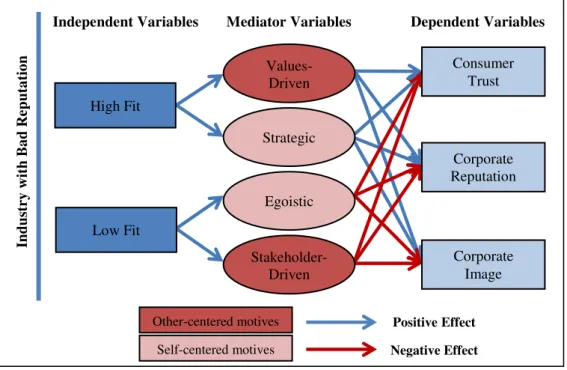
These four developed hypotheses result in the following research model (see. Figure 1), whose aim is to investigate this work project’s research questions.
Figure 1: Research model of the work project
3.
Methodology
3.1 Pre-Survey
To identify the industry with the worst reputation regarding sustainability, an online pre-survey was sent out to 120 participants. Thereof, 51 valid answers (42.5% response rate) were collected constituting the final sample. Hereby, respondents were asked to rate 15 different industries2 according to their perception of their engagement toward sustainability on a 7-point Likert-type scale ranging from 1=Extremely unsustainable to 7=Extremely sustainable. The results show that consumers perceive all industries as being rather unsustainable with a total mean of all industries of 3.68. Having tested the statistical significance of the lowest mean value of 2.14 (p<.01; see appendix 1), the oil and gas industry has been identified as the industry with the worst reputation.
2
Industries were chosen from oekom research’s (2012a) sustainability industry ranking: Automobile, Chemicals,
Construction, Consumer Electronics, Financials & Commercial Banks, Food & Beverages, Household Products, Insurance, IT & Computer, Machinery, Oil & Gas, Pharmaceuticals, Real Estate, Telecommunication and Utilities.
Other-centered motives Self-centered motives High Fit Low Fit Values-Driven Strategic Egoistic Stakeholder-Driven Corporate Reputation Corporate Image Consumer Trust PositiveEffect Negative Effect
Independent Variables Mediator Variables Dependent Variables
3.2 Expert Interview
Four face-to-face interviews with CSR and sustainability experts were conducted in order to define appropriate high and low fit sustainability programs (including econom-ic, social and environmental initiatives). Hereby, the experts verified two created news-paper articles with a brief description of a fictitious oil and gas company (Bisgol) fol-lowed by a high and respectively low fit sustainability program (see appendices 2 and 3), which were designed according to the industry’s main sustainability challenges (IPIECA, 2010; oekom research, 2012b).
3.3 Main Survey
To determine whether the fit of the sustainability initiatives with the company’s core business differentially affects consumers’ attributions and, likewise, consumers’ re-sponses, two online surveys, one with the high and one with the low fit sustainability program, were sent out to 723 (364, high fit; 359, low fit) participants. Thereof, 299 valid responses (148, 40.66% response rate, high fit; 151, 42.06% response rate, low fit) were collected constituting the final sample. The majority of the participants were 26 to 34 years old (49.3%, high fit; 47.7%, low fit) and most of them had a Master’s degree (53.4%, high fit; 47.0%, low fit). The sample was almost gender balanced (59.5% male, high fit; 57.0% male, low fit) and internationally composed with the majority being German (68.9%, high fit; 64.9%, low fit).
each sub-scale was measured by five (values-driven), four (egoistic and stakeholder-driven) or three (strategic) items. Sample questions include “Bisgol is making these initiatives because they feel morally obligated to help” (values-driven), “they hope to increase profits by making this offer” (strategic), “they want it as a tax write-off” ( ego-istic) and “they feel their customers expect it” (stakeholder-driven). Scale reliability for
values-driven attributions is α=.71 for the high fit initiatives (α=.76, low fit), for strate-gic it is α=.71 (α=.70, low fit), for egoistic it is α=.56 (α=.67, low fit) and for stakehold-er-driven it is α=.55 (α=.66, low fit).3Consumer Trust was rated in a six questions scale designed by Swaen and Chumpitaz (2008). A sample item contains “Bisgol is honest with its customers” and reliability is α=.72 for the high fit program (α=.78, low fit).
Corporate Reputation was rated in a 15 questions scale developed by Walsh et al. (2009). A sample question includes “Bisgol is concerned about its customers” and relia-bility is α=.79 for the high fit survey (α=.90, low fit). Corporate Image was rated using a three questions scale adapted from Andreassen and Lindestad (1998). A sample item contains “I perceive Bisgol as customer oriented” and reliability is α=.48 for the high fit
initiatives (α=.67, low fit). All questions can be seen in appendices 2 and 3 and the composition of each variable is shown in appendix 4.
4.
Results
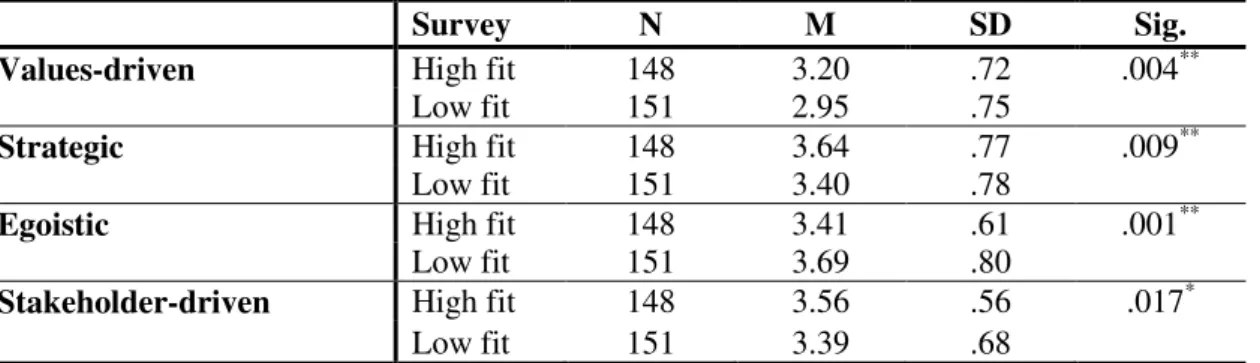
To test hypotheses 1 and 2, if the fit of the sustainability initiatives with a company’s core business differentially affects consumers’ attributions, an analysis of variance (ANOVA) was run on the two groups (high vs. low fit; see table 1). As predicted, the means of values-driven and strategic attributions are significantly higher for the high than the low fit program, confirming hypothesis 1 a) and b). While the mean of egoistic
3 In order to improve reliability of the scales, the items V4 and ST3 were deleted for the high fit and the question E2
attributions is significantly lower for the high than the low fit initiatives, which supports hypothesis 2 a), the mean of stakeholder-driven attributions is significantly higher for the high than the low fit program. Thus, hypothesis 2 b) cannot be confirmed.
Survey N M SD Sig.
Values-driven High fit 148 3.20 .72 .004**
Low fit 151 2.95 .75
Strategic High fit 148 3.64 .77 .009**
Low fit 151 3.40 .78
Egoistic High fit 148 3.41 .61 .001**
Low fit 151 3.69 .80
Stakeholder-driven High fit 148 3.56 .56 .017*
Low fit 151 3.39 .68
Table 1: Results of the ANOVA for Consumers’ Attributions; with Sample Sizes, Means, Standard Devia-tions and Statistical Significance. Note: p<.05*, p<.01**
Next, a bivariate correlation was used to assess the relationship between consumers’ attributions and consumers’ responses (hypothesis 3). For better measuring the direct effects for the high and low fit group, the analysis was conducted separately (see appen-dices 5 and 6). As expected, values-driven attributions have a significant positive rela-tionship with consumer trust (R=.49, high fit; R=.54, low fit), corporate reputation (R=.63, high fit; R=.65, low fit) and corporate image (R=.42, high fit; R=.59, low fit) for both the high and low fit survey, supporting hypothesis 3 a). In contrast to the estab-lished assumption, strategic attributions do not show a significant positive relationship with consumer responses, besides some positive effect on corporate reputation in the low fit group (R=.17). Thus, hypothesis 3 b) cannot be confirmed. As predicted, egoistic
responses, but some positive influence on corporate reputation in the high fit group (R=.22). Hence, hypothesis 3 d) cannot be confirmed. The linear regression analysis supports these findings, as values-driven and egoistic attributions show the only signifi-cant results for both the high and low fit survey. Hereby, values-driven attributions have the strongest influence on consumer responses, explaining 24% of the variance in con-sumer trust in the high fit group (29%, low fit), 40% of the variance in corporate reputa-tion (42%, low fit) and 18% of the variance in corporate image (35%, low fit).
To test hypothesis 4, whether consumers’ attributions mediate the relationship be-tween the fit of the sustainability program with consumer responses, a Sobel-Test fol-lowing Preacher and Leonardelli’s procedure (2013) was conducted. Hereby, all
varia-bles (independent (IV), mediator (MV) and dependent (DV)) need to be significantly correlated as a prerequisite. Since only values-driven and egoistic attributions are signif-icantly correlated with all three consumer responses for both the high and low fit sur-vey, regressions for just those two variables were run to enter the relevant data into the Sobel-Test equation (see tables 2 and 3). Results show that both values-driven and ego-istic attributions significantly mediate the effect of the fit of the initiatives on consumer trust, corporate reputation and corporate image in the high and low fit group (p<.01; see appendix 7), providing partial support for hypothesis 4.
Predictors / Outcomes Values-driven Egoistic
B SE Sig. B SE Sig.
High fit 0.25 0.09 0.004** -0.28 0.08 0.001**
Low fit -0.25 0.09 0.004** 0.28 0.08 0.001**
Predictors / Outcomes Consumer Trust Corp. Reputation Corporate Image
B SE Sig. B SE Sig. B SE Sig.
Values-driven & High fit 0.33 0.03 0.000** 0.41 0.03 0.000** 0.43 0.04 0.000** Values-driven & Low fit 0.33 0.03 0.000** 0.41 0.03 0.000** 0.43 0.04 0.000** Egoistic & High fit -0.22 0.04 0.000** -0.26 0.04 0.000** -0.26 0.05 0.000** Egoistic & Low fit -0.22 0.04 0.000** -0.26 0.04 0.000** -0.26 0.05 0.000**
Table 3: Results of the Regression Analysis for the Sobel-Test: IV and MV on DV; with Unstandardized Coefficient B, Standard Error and Statistical Significance. p<.05*, p<.01**
5.
Discussion
The results of this work project suggest that companies operating in industries with a bad reputation regarding sustainability can change consumers’ negative perceptions and responses (i.e. consumer trust, corporate reputation and image) through pursuing sus-tainability initiatives which have a high fit with their core business. Apparently, high fit bprograms lead consumers to believe that the company is motivated by values-driven,
strategic and, contrary to previous established assumptions, stakeholder-driven attribu-tions, whereas low fit initiatives are associated with egoistic attributions. It is these pro-voked values-driven attributions, which show a positive and, likewise, the strongest effect on consumers’ responses. Yet, egoistic attributions negatively influence consumer trust, corporate reputation and image. As opposed to the previous drawn assumptions, consumers’ responses are not significantly affected by strategic and stakeholder-driven
attributions. Moreover, the results indicate that the effect of the fit of the cause with companies’ core business on consumer responses is mediated by values-driven and
ego-istic attributions, highlighting their key role in consumers’ responses to sustainability initiatives. These results lead to important theoretical and practical implications.
5.1Theoretical Implications
particular companies operating in bad reputation industries and thus its validity for businesses in industries with good or neutral reputation has to be tested. Nevertheless, it provides support for Ellen et al.’s research (2006) that the effectiveness of a
sustainabil-ity program is influenced by the motives consumers attribute to companies’ efforts. Fur-ther, in line with Fein’s work (1996), this research confirms that this attributional pro-cess can be manipulated through the fit of the cause with the company’s core business.
Moreover, this work project extends the CSR literature by investigating how con-sumers’ responses to companies’ sustainability activities are affected by industry
repu-tation. In case of companies operating in industries with a bad reputation, consumers are particularly suspicious when businesses engage in sustainability issues (Du & Vieira, 2012; Yoon et al., 2006). Yet, this study provides support that a high fit sustainability program reduces suspicion, allowing consumers to attribute values-driven, strategic and
stakeholder-driven motives. In contrast to previous studies (Ellen et al., 2006; Vlachos et al., 2009), consumers view strategic and stakeholder-driven attributions neither nega-tively nor posinega-tively. This might arise from the fact that these companies are constantly under pressure from stakeholders and that only through meeting their expectations com-panies can gain legitimacy (Du & Vieira, 2012). However, values-driven attributions are identified as having a positive and the strongest effect on consumers’ responses render-ing sustainability investments effective, even in bad reputation industries.
5.2Practical Implications
r-porate strategy (cf. Laszlo, 2008). Only through this strategic approach, consumers are likely to attribute values-driven motives, whereas egoistic attributions can be prevented, which both mediate the effect of sustainability initiatives on consumer responses. Fur-ther research has to be done about how companies can best communicate their sincere and benevolent intention provoking additional values-driven attributions without caus-ing credibility doubts.
5.3Limitations and Future Research Suggestions
Beyond these limitations future research should identify other factors influencing consumers’ attributions about the motives of companies’ engagement toward
sustaina-bility, such as the effect of the information source or advertising, and their relative im-portance. Moreover, as this work project only investigated internal consumer responses (i.e. consumer trust, corporate reputation and image), future research should also exam-ine how consumers’ attributions influence behavioral consumer responses. Examining in-role and extra-roles behavior might support the impact of sustainability programs on the bottom-line. Hereby, studies should also investigate whether this effect on behavior-al responses might even be mediated or moderated by internbehavior-al responses, gaining a more explicit insight into consumers’ responses toward sustainability. Further, the effect of consumers’ personal support for sustainability should be included in this research.
6.
Conclusion
This work project investigates how specific sustainability practices (including eco-nomic, social and environmental initiatives) influence consumers’ responses. Based on attribution theory, the study reveals consumers’ attributions about the motives underly-ing companies’ participation in sustainability efforts as a key driver of the effectiveness
of sustainability initiatives. Moreover, this research confirms that this attributional pro-cess can be manipulated through the fit of the cause with companies’ core business. Furthermore, this study investigates how these consumers’ attributions and, likewise consumers’ responses are influenced by the bad reputation of an industry in which com-panies are operating. The results suggest that comcom-panies operating in bad reputation industries should design high fit sustainability initiatives, which provoke values-driven
7.
References
Andreassen, T. W.; Lindestad, B. 1998. Customer loyalty and complex services. The impact of corpo-rate image on quality, customer satisfaction and loyalty for customers with varying degrees of service expertise. International Journal of Service Industry Management, 9(1): 7–23.
Balmer, J. M. 2009. Corporate marketing: apocalypse, advent and epiphany. Management Decision, 47(4): 544–572.
Barich, H.; Kotler, P. 1991. A framework for marketing image management. Sloan Management Re-view, 32: 94–104.
Becker-Olsen, K. L.; Cudmore, A. B.; Hill, R. P. 2006. The Impact of Perceived Corporate Social Re-sponsibility on Consumer Behavior. Journal of Business Research, 59(1): 46–53.
Bibb, S.; Kourdi, J. 2004. Trust matters for organisational and personal success. New York: Palgrave Macmillan.
Blackburn, W. R. 2007. The sustainability handbook. The complete management guide to achieving social, economic and environmental responsibility. London: Earthscan.
Bristol, L. H. Jr. 1960. WhyDevelop Your Corporate Image? New York: Charles Scribner's Sons.
Brown, T. J.; Dacin, P. A. 1997. The Company and the Product: Corporate Associations and Consumer Product Responses. Journal of Marketing, 61: 68–84.
Carlson, R. O.1963. “The Nature of Corporate Images.” In The Corporation and Its Publics, ed. Riley, J. W. Jr., 24-47. New York: John Wiley & Sons.
Carroll, A. B. 1999. Corporate Social Responsibility. Evolution of a Definitional Construct. Business & Society, 38(3): 268–295.
Chappell, T. 1993. The Soul of a Business: Managing for Profit and the Common Good. New York: Bantam Books.
Choi, S.; Ng, A. 2011. Environmental and Economic Dimensions of Sustainability and Price Effects on Consumer Responses. Journal of Business Ethics, 104: 269–282.
Commission of the European Communities. 2001. Promoting a European Framework for Corporate Social Responsibility. Brussels. Available online at:
http://eur-lex.europa.eu/LexUriServ/site/en/com/2001/com2001_0366en01.pdf, checked on: 29/11/2013.
Cone, C. L.; Feldman, M. A.; DaSilva A. T. 2003. Causes and Effects. Harvard Business Review, 81: 95–101.
Creyer, E. H.; Ross, W. T. 1997. The influence of firm behavior of purchase motive: Do consumers really care about business ethics? Journal of Consumer Marketing, 14: 421-432.
DesJardins, J. R.2009. “Sustainable Business: Environmental Responsibilities and Business Opportuni-ties.” In Ethical theory and business, ed. Beauchamp, T. L.; Bowie, N. L.; Arnold, D. G., 409-115. Boston: Pearson Education.
Dowling, G. R. 1986. Managing your corporate images. Industrial Marketing Management, 15: 109–115.
Drumwright, M. E. 1996. Company Advertising With a Social Dimension: The Role of Noneconomic Criteria. Journal of Marketing, 60:71–87.
Du, S.; Vieira, E. T. 2012. Striving for Legitimacy Through Corporate Social Responsibility: Insights from Oil Companies. Journal of Business Ethics, 110(4): 413–427.
Elkington, J. 1998. Cannibals with forks. The triple bottom line of 21st century business. Oxford: Cap-stone.
Ellen, P. S.; Webb, D. J.; Mohr, L. A. 2006. Building Corporate Associations: Consumer Attributions for Corporate Socially Responsible Programs. Journal of the Academy of Marketing Science, 34: 147– 157.
Fein, S. 1996. Effects of Suspicion on Attributional Thinking and the Correspondence Bias. Journal of Personality and Social Psychology, 70(6): 1164–1184.
Fein, S.; Hilton, J. L.; Miller, D. T. 1990. Suspicion of ulterior motivation and the correspondence bias. Journal of Personality and Social Psychology, 58: 753–764.
Fombrun, C.; Shanley, M. 1990. What's in a name? Reputation building and corporate strategy. Acade-my of Management Journal, 33(2): 233–258.
Forehand, M. R.; Grier, S. 2003. When is Honesty the Best Policy? The Effect of Stated Company Intent on Consumer Skepticism. Journal of Consumer Psychology, 13(3): 349–356.
Freeman, R. E. 1984. Strategic management. A stakeholder approach. Boston: Pitman.
Friedman, M. 1970. The Social Responsibility of Business is to Increase its Profits. The New York Times Magazine, 13/09/1970.
Gilbert, D. T.; Jones, E. E. 1986. Perceiver-induced constraint: Interpretations of self-generated reality. Journal of Personality and Social Psychology, 50(2): 269–280.
Gotsi, M.; Wilson, A. M. 2001. Corporate reputation: seeking a definition. Corporate Communications: An International Journal, 6(1): 24–30.
Handelman, J. M.; Arnold, S. J. 1999. The Role of Marketing Actions With a Social Dimension: Ap-peals to the Institutional Environment. Journal of Marketing, 63: 33–48.
Hartman, L.; DesJardins, J. R. 2007. Business ethics. Decision-making for personal integrity and so-cial responsibility. New York: McGraw-Hill/Irwin.
Hilton, J. L.; Fein, S.; Miller, D. T. 1993. Suspicion and dispositional inference. Personality and Social Psychology Bulletin, 19: 501–512.
Hoeffler, S.; Keller, K. L. 2002. Building Brand Equity Through Corporate Societal Marketing. Journal of Public Policy and Marketing, 21(1): 78–89.
IPIECA. 2010. Oil and gas industry guidance on voluntary sustainability reporting. Available online at: http://www.ipieca.org/publication/oil-and-gas-industry-guidance-voluntary-sustainability-reporting-2010-update, checked on: 01/12/2013.
Jha, A. K. 2009. The growing importance of CSR. Available online at: http://ezinearticles.com/?The-Growing-Importance-of-CSR&id=4787936, checked on: 29/11/2013.
Jones, E. E. 1979. The rocky road from acts to dispositions. American Psychologist, 34: 107–117.
Kaptein, M.; Wempe, J. 2002. The balanced company. A theory of corporate integrity. Oxford, New York: Oxford University Press.
Kennedy, M. S.; Ferrell, L. K.; LeClair, D. T. 2001. Consumers' trust of salesperson and manufacturer: an empirical study. Journal of Business Research, 51(1): 73–86.
Lafferty, B. A.; Goldsmith, R. E. 1999. Corporate Credibility's Role in Consumers' Attitudes and Pur-chase Intentions When a High Versus Low Credibility Endorser is Used in The Ad. Journal of Busi-ness Research, 44: 109–116.
Laszlo, C. 2008. Sustainable value. How the world's leading companies are doing well by doing good. Sheffield, UK, Stanford, Calif: Greenleaf; Stanford University Press.
Lev, B.; Petrovits, C.; Radhakrishnan, S. 2010. Is doing good good for you? How corporate charitable contributions enhance revenue growth. Strategic Management Journal, 31(2): 182–200.
Lingle, J. H.; Ostrom, T. M. 1979. Retrieval selectivity in memory-based impression judgments. Jour-nal of PersoJour-nality and Social Psychology, 37: 180–194.
Menon, A.; Menon, A. 1997. Enviropreneurial Marketing Strategy: the emergence of corporate envi-ronmentalism as marketing strategy. Journal of Marketing, 61(1): 51–67.
Morgan, R. M.; Hunt, S. D. 1994. The Commitment-Trust Theory of Relationship Marketing. Journal of Marketing, 58(3): 20–38.
Morrison, J. 2009. International business. Challenges in a changing world. New York: Palgrave Mac-millan.
O’Riordan, L.; Fairbrass, J. 2008. Corporate Social Responsibility CSR. Models and Theories in Stakeholder Dialogue. Journal of Business Ethics, 83: 745–758.
oekom research. 2012a. oekom Corporate Responsibility Review. Taking stock of sustainability perfor-mance in corporate management and capital investment. Available online at: http://www.oekom-research.com/homepage/english/oekom_CR_Review_2012_en.pdf, checked on: 29/11/2013.
oekom research. 2012b. oekom Industry Focus: Oil & Gas. Available online at: http://www.oekom-research.com/homepage/english/oekom_Industry_Focus_O&G_2012_en.pdf, checked on: 01/12/2013.
Osterhus, T. L. 1997. Pro-social consumer influence strategies: When and how do they work? Journal of Marketing, 61: 16–29.
Pivato, S.; Misani, N.; Tencati, A. 2008. The impact of corporate social responsibility on consumer trust: the case of organic food. Business Ethics: A European Review, 17(1): 3–12.
Porter, M. E.; Kramer, M. R. 2006. Strategy and Society: The Link Between Competitive Advantage and Corporate Social Responsibility. Harvard Business Review, December: 78-92.
Pratto, F.; John, O. P. 1991. Automatic vigilance: The attention-grabbing power of negative social in-formation. Journal of Personality and Social Psychology, 61: 380–391.
Preacher, K. J.; Leonardelli, G. J. 2013. Calculation for the Sobel test: An interactive calculation tool for mediation tests. Available online at: http://quantpsy.org/sobel/sobel.htm, checked on: 05/12/2013.
Ross, L. 1977. The intuitive psychologist and his shortcomings: Distortions in the attribution process. Advances in experimental social psychology, 10: 173-220.
Sen, S.; Bhattacharya, B. B. 2001. Does doing good always lead to doing better? Consumer reactions to corporate social responsibility. Journal of Marketing Research, 38: 225–243.
Skowronski, J. J.; Carlston, D. E. 1989. Negativity and extremity biases in impression formation: A review of explanation. Psychological Bulletin, 105: 131–142.
Smith, C. 1994. The New Corporate Philanthropy. Harvard Business Review, 72: 105–116.
Smith, C. 2003. Corporate Social Responsibility: Whether or How? California Management Review, 45(4): 52–76.
Stanaland, A. J.; Lwin, M. O.; Murphy, P. E. 2011. Consumer Perceptions of the Antecedents and Consequences of Corporate Social Responsibility. Journal of Business Ethics, 102(1): 47–55.
Swaen, V.; Chumpitaz, R. C. 2008. Impact of Corporate Social Responsibility on consumer trust. Re-cherche et Applications en Marketing, 23(4): 7–31.
Trope, Y. 2000. Processing alternative explanations of behavior correction or integration. Journal of Personality and Social Psychology, 79: 344–354.
Turban, D. B.; Greening, D. W. 1997. Corporate social performance and organizational attractiveness to prospective employees. Academy of Management Journal, 40: 658–672.
United Nations. 1987. World Commission on Environment and Development: Our Common Future. Oxford: Oxford University Press.
Varadarajan, P. R.; Menon, A. 1988. Cause-Related Marketing: A Coalignment of Marketing Strategy and Corporate Philanthropy. Journal of Marketing, 52(3): 58–74.
Vlachos, P. A.; Tsamakos, A.; Vrechopoulos, A. P.; Avramidis, P. K. 2009. Corporate social respon-sibility: attributions, loyalty, and the mediating role of trust. Journal of the Academic Marketing Sci-ence, 37(2): 170–180.
Walsh, G.; Beatty, S. E.; Shiu, E. M. 2009. The customer-based corporate reputation scale: Replication and short form. Journal of Business Research, 62: 924–930.
Webb, D. J.; Mohr, L. A. 1998. A Typology of Consumer Responses to Cause-Related Marketing: From Skeptics to Socially Concerned. Journal of Public Policy and Marketing, 17: 226–238.
Worcester, Sir R. 2009. Reflections on corporate reputations. Management Decision, 47(4): 557–589.
8.
Appendix
Appendix 1: Statistical Results of the Pre-Survey
Industry Freq. M SD Sig.
1 2 3 4 5 6 7
Automobile 1 10 13 2 16 9 0 3.96 1.51 .000** Chemicals 5 24 10 5 3 3 1 2.80 1.43 .002** Construction 0 8 18 8 12 5 0 3.76 1.26 .000** Consumer Electronics 0 19 9 5 14 4 0 3.51 1.43 .000** Financials &
Commer-cial Banks 7 10 6 19 5 4 0 3.33 1.47 .000
**
Food & Beverages 1 9 10 6 14 10 1 4.12 1.53 .000** Household Products 1 7 13 12 9 9 0 3.94 1.38 .000** Insurance 2 2 11 22 9 5 0 3.96 1.15 .000** IT & Computer 0 6 19 8 12 5 1 3.88 1.29 .000** Machinery 1 11 17 9 8 4 1 3.55 1.36 .000**
Oil & Gas 20 18 6 4 0 2 1 2.14 1.40
-Pharmaceuticals 5 8 13 7 9 8 1 3.69 1.64 .000** Real Estate 1 9 8 17 10 5 1 3.88 1.35 .000** Telecommunications 0 5 9 11 14 9 3 4.43 1.39 .000** Utilities 0 3 9 21 12 5 1 4.20 1.10 .000**
Appendix 2: Main Survey 1 – High Fit
Corporate Strategies and Consumer Responses
Introduction
Dear participant,
my name is Sandra Oexle and I am a current Master's student in Management with a major in Marketing and Strategy at NOVA School of Business and Economics.
Under the supervision of Professor Joana Story, I am writing my Master's Thesis investigating consumers' perception of organizations' initiatives.
I would really appreciate your participation by filling out this survey. If you like to participate, please read the following instructions carefully.
Thank you very much for your support!
Best regards, Sandra Oexle
Procedure
At first, you will be given a brief description of the fictitious company Bisgol and their initiatives. Afterwards, you will be asked to answer various questions regarding your perception of this organiza-tion's initiatives.
The questionnaire consists of 7 questions and will take approximately 10 minutes or less.
Please try to answer all questions and if possible without any interruption in order to make an evaluation possible.
It is important that you read the initial company profile and their initiatives carefully and that you answer the following questions based on the information you read.
Confidentiality
All data obtained from participants will be kept confidential and will only be reported in an aggregate format (by reporting only combined results and never reporting individual ones). All questionnaires will be concealed, and no one other than the primary investigator and assistant researcher listed below will have access to them. The data collected will be stored in the HIPPA-compliant, Qualtrics-secure database until it has been deleted by the primary investigator.
Questions about the Research
I have carefully read and understood the above description of Bisgol and their initiatives.
Q1: To what extent do you agree with the following statements about Bisgol's initiatives on a scale from strongly disagree to strongly agree?
Bisgol is taking these initiatives because...
Strongly Disagree
Disagree Neither Disagree
nor Agree
Agree Strongly Agree
… they feel morally obligated to help.
… they feel their customers expect it.
… they want to get publicity.
… they will keep more of their customers by making this offer.
… they have a long-term interest in the com-munity.
… they want it as a tax write-off.
… they will get more customers by making this offer.
… they feel their stakeholders expect it.
… their owners or employees believe in this cause.
… they want to make it easier for consumers who care about the cause to support it.
… they are taking advantage of the cause to help their own business.
… they feel society in general (i.e., consumers) expects it.
… they are trying to give something back to the community.
… they are taking advantage of the nonprofit organization to help their own business.
… they feel their employees expect it.
… they hope to increase profits by making this offer.
Q2: To what extent do you agree with the following statements about Bisgol's initiatives on a scale from strongly disagree to strongly agree?
Bisgol …
Strongly Disagree
Disagree Neither Disagree
nor Agree
Agree Strongly Agree
… employs people who are concerned about customer needs.
… seems to be a good company to work for.
… tends to outperform competitors.
… is a strong, reliable company.
… seems to make an effort to create new jobs.
… employs people who treat customers court e-ously.
… seems to have excellent leadership.
… seems to recognize and take advantage of market opportunities.
… offers high quality products.
… would reduce its profit to ensure a clean environment.
… is concerned about its customers.
… seems to treat its people well.
… looks like it has strong prospects for future growth.
… develops innovative products.
… seems to be environmentally responsible.
Q3: To what extent do you agree with the following statements about Bisgol's initiatives on a scale from strongly disagree to strongly agree?
Strongly Disagree
Disagree Neither Disagree
nor Agree
Agree Strongly Agree
Bisgol is forthright in its dealing with custom-ers.
Bisgol’s products give me a sense of security.
I perceive Bisgol as customer oriented.
Bisgol is honest with its customers.
Buying Bisgol’s products is a quality guarantee.
I am satisfied with the way Bisgol presents itself.
Bisgol is interested in its customers.
I perceive others are speaking about Bisgol in a positive way.
Q4: What is your gender?
Male
Female
Q5: How old are you?
Under 18
18-25
26-34
35-44
45-54
55-64
65 or over
Q6: What is the highest level of education you have completed?
Less than High School
High School / GED
College Degree / Bachelor’s Degree
Master’s Degree / Diploma
Doctoral Degree
Q7: What is your nationality?
Austrian
Belgian
British
Danish
Dutch
Finnish
French
German
Greek
Irish
Italian
Norwegian
Polish
Portuguese
Russian
Spanish
Swedish
Swiss
Turkish
Appendix 3: Main Survey 2 – Low Fit
Corporate Strategies and Consumer Responses
Introduction
Dear participant,
my name is Sandra Oexle and I am a current Master's student in Management with a major in Marketing and Strategy at NOVA School of Business and Economics.
Under the supervision of Professor Joana Story, I am writing my Master's Thesis investigating consumers' perception of organizations' initiatives.
I would really appreciate your participation by filling out this survey. If you like to participate, please read the following instructions carefully.
Thank you very much for your support!
Best regards, Sandra Oexle
Procedure
At first, you will be given a brief description of the fictitious company Bisgol and their initiatives. Afterwards, you will be asked to answer various questions regarding your perception of this organiza-tion's initiatives.
The questionnaire consists of 7 questions and will take approximately 10 minutes or less.
Please try to answer all questions and if possible without any interruption in order to make an evaluation possible.
It is important that you read the initial company profile and their initiatives carefully and that you answer the following questions based on the information you read.
Confidentiality
All data obtained from participants will be kept confidential and will only be reported in an aggregate format (by reporting only combined results and never reporting individual ones). All questionnaires will be concealed, and no one other than the primary investigator and assistant researcher listed below will have access to them. The data collected will be stored in the HIPPA-compliant, Qualtrics-secure database until it has been deleted by the primary investigator.
Questions about the Research
I have carefully read and understood the above description of Bisgol and their initiatives.
Q1: To what extent do you agree with the following statements about Bisgol's initiatives on a scale from strongly disagree to strongly agree?
Bisgol is taking these initiatives because...
Strongly Disagree
Disagree Neither Disagree
nor Agree
Agree Strongly Agree
… they feel morally obligated to help.
… they feel their customers expect it.
… they want to get publicity.
… they will keep more of their customers by making this offer.
… they have a long-term interest in the com-munity.
… they want it as a tax write-off.
… they will get more customers by making this offer.
… they feel their stakeholders expect it.
… their owners or employees believe in this cause.
… they want to make it easier for consumers who care about the cause to support it.
… they are taking advantage of the cause to help their own business.
… they feel society in general (i.e., consumers) expects it.
… they are trying to give something back to the community.
… they are taking advantage of the nonprofit organization to help their own business.
… they feel their employees expect it.
… they hope to increase profits by making this offer.
Q2: To what extent do you agree with the following statements about Bisgol's initiatives on a scale from strongly disagree to strongly agree?
Bisgol …
Strongly Disagree
Disagree Neither Disagree
nor Agree
Agree Strongly Agree
… employs people who are concerned about customer needs.
… seems to be a good company to work for.
… tends to outperform competitors.
… is a strong, reliable company.
… seems to make an effort to create new jobs.
… employs people who treat customers court e-ously.
… seems to have excellent leadership.
… seems to recognize and take advantage of market opportunities.
… offers high quality products.
… would reduce its profit to ensure a clean environment.
… is concerned about its customers.
… seems to treat its people well.
… looks like it has strong prospects for future growth.
… develops innovative products.
… seems to be environmentally responsible.
Q3: To what extent do you agree with the following statements about Bisgol's initiatives on a scale from strongly disagree to strongly agree?
Strongly Disagree
Disagree Neither Disagree
nor Agree
Agree Strongly Agree
Bisgol is forthright in its dealing with custom-ers.
Bisgol’s products give me a sense of security.
I perceive Bisgol as customer oriented.
Bisgol is honest with its customers.
Buying Bisgol’s products is a quality guarantee.
I am satisfied with the way Bisgol presents itself.
Bisgol is interested in its customers.
I perceive others are speaking about Bisgol in a positive way.
Q4: What is your gender?
Male
Female
Q5: How old are you?
Under 18
18-25
26-34
35-44
45-54
55-64
65 or over
Q6: What is the highest level of education you have completed?
Less than High School
High School / GED
College Degree / Bachelor’s Degree
Master’s Degree / Diploma
Doctoral Degree
Q7: What is your nationality?
Austrian
Belgian
British
Danish
Dutch
Finnish
French
German
Greek
Irish
Italian
Norwegian
Polish
Portuguese
Russian
Spanish
Swedish
Swiss
Turkish
Appendix 4: Composition of the variables
ATTRIBUTIONS (Q1)
Bisgol is taking these initiatives because…
Values-driven
... they feel morally obligated to help. (V1)
... they have a long-term interest in the community. (V2) ... their owners or employees believe in this cause. (V3)
... they want to make it easier for consumers who care about the cause to support it. (V4) ... they are trying to give something back to the community. (V5)
Strategic
... they will keep more of their customers by making this offer. (ST1) ... they will get more customers by making this offer. (ST2)
... they hope to increase profits by making this offer. (ST3)
Egoistic
... they want to get publicity (E1) ... they want it as a tax write-off. (E2)
... they are taking advantage of the cause to help their own business. (E3)
... they are taking advantage of the nonprofit organization to help their own business. (E4)
Stakeholder-driven
... they feel their customers expect it. (SH1) ... they feel their stakeholders expect it. (SH2)
... they feel society in general (i.e., consumers) expects it. (SH3) ... they feel their employees expect it. (SH4)
CONSUMER TRUST (Q3)
Bisgol is forthright in its dealing with customers. (T1) Bisgol is honest with its customers. (T2)
Bisgol is interested in its customers. (T3)
Bisgol’s products give me a sense of security. (T4)
Buying Bisgol’s products is a quality guarantee. (T5)
I trust the quality of Bisgol’s products. (T6)
CORPORATE REPUTATION (Q2)
Bisgol employs people who are concerned about customer needs. (R1) Bisgol employs people who treat customers courteously. (R2)
Bisgol is concerned about its customers. (R3) Bisgol seems to be a good company to work for. (R4)
Bisgol seems to have excellent leadership. (R5) Bisgol seems to treat its people well. (R6) Bisgol tends to outperform competitors. (R7)
Bisgol seems to recognize and take advantage of market opportunities. (R8)
Bisgol looks like it has strong prospects for future growth. (R9) Bisgol is a strong, reliable company. (R10)
Bisgol offers high quality products. (R11) Bisgol develops innovative products. (R12)
Bisgol seems to make an effort to create new jobs. (R13)
Bisgol would reduce its profit to ensure a clean environment. (R14) Bisgol seems to be environmentally responsible. (R15)
CORPORATE IMAGE (Q3)
I perceive Bisgol as customer oriented. (C1)
I am satisfied with the way Bisgol presents itself. (C2)
Appendix 5: Results of the bivariate Correlation Analysis for the High Fit Group
Variable M SD 1 2 3 4 5 6 7
1 Values-driven 3.20 .72 (.71)
2 Strategic 3.64 .77 -.07 (.71)
3 Egoistic 3.41 .61 -.40** .26** (.56)
4 Stakeholder-driven 3.56 .56 .14 .19* .05 (.55)
5 Consumer Trust 3.20 .47 .49** -.03 -.30** .12 (.72)
6 Corporate Reputation 3.42 .40 .63** .04 -.30** .22** .68** (.79)
7 Corporate Image 3.48 .54 .42** .04 -.16* .07 .69** .57** (.48)
Note: With Means, Standard Deviations, Scale Reliabilities and Inter-Correlations. p<.05*, p<.01**
Appendix 6: Results of the bivariate Correlation Analysis for the Low Fit Group
Variable M SD 1 2 3 4 5 6 7
1 Values-driven 2.95 .75 (.76)
2 Strategic 3.39 .68 .00 (.70)
3 Egoistic 3.69 .80 -.49** .28** (.67)
4 Stakeholder-driven 3.40 .77 .03 .08 .21** (.66)
5 Consumer Trust 2.95 .47 .54** .08 -.35** -.06 (.78)
6 Corporate Reputation 3.15 .54 .65** .17* -.44** -.11 .75** (.90)
7 Corporate Image 3.12 .69 .59** .12 -.39** -.03 .71** .75** (.67)
Note: With Means, Standard Deviations, Scale Reliabilities and Inter-Correlations. p<.05*, p<.01**
Appendix 7: Results of the Sobel-Test for Values-driven and Egoistic Attributions
Survey Consumer Trust Corporate
Reputation Corporate Image
Values-driven High fit 0.0036** 0.0041** 0.0048**
Low fit 0.0036** 0.0041** 0.0048**
Egoistic High fit 0.0028** 0.0018** 0.0035**
Low fit 0.0028** 0.0018** 0.0035**