Negative incentives and sustainability in the
amazonian logging industry
Incentivos negativos promovem uma indústria madeireira sustentável? Aprisionamento da indústria madeireira na Amazônia
Hilder André Bezerra Farias Universidade Federal do Pará
Sérgio Luiz de Medeiros Rivero Universidade Federal do Pará
Márcia Jucá Teixeira Diniz Universidade Federal do Pará
Resumo
O presente texto investiga a existência de um lock-in, ou aprisionamento, de baixa tecnologia e alto impacto ambiental na indústria madeireira na Amazônia Brasileira. A pesquisa teve como base teórica a Economia Evolucionária, espe-cialmente a noção de trajetória tecnológica. Foi estudada a dualidade de decisões envolvendo a exploração madeireira, divididas entre exploração convencional (EC) e de impacto reduzido (EIR). Um modelo de simulação baseado em agentes em que a tomada de decisão sob racionalidade limitada ocorre segundo um algoritmo genético foi elaborado na linguagem de programação Java. Os resultados apontam para a existência do lock-in, para a aversão dos produtores a riscos, para maior efi ciência operacional da exploração sustentável e para os benefícios oriundos de uma política de bônus ambiental, tanto em termos eco-nômicos quanto ecológicos.
Palavras-chave
indústria madeireira; racionalidade limitada; si-mulação baseada em agentes; exploração de im-pacto reduzido; economia evolucionária.
Códigos JELB52; C63; Q23.
Abstract
This paper investigates the existence of lock-in of low technology and high envi-ronmental impact on Brazilian Amazon logging industry. The research employed evolutionary economics as a theoretical basis, especially the concept of technologi-cal trajectories. The duality of decisions in-volving logging – conventional logging (CL) versus reduced-impact logging (RIL) – was studied. An agent-based simulation model – in which decision-making under bounded rationality is based on a genetic algorithm – was implemented in Java programming lan-guage. Results demonstrate the existence of lock-in, producers aversion to risks, greater operational effi ciency of sustainable logging, and benefi ts derived from a policy of envi-ronmental bonuses, both in economic and ecological terms.
Keywords
logging industry; bounded rationality; agent-based simulation; reduced-impact logging; evolutionary economics.
1
Introduction
The central theme of the present work is the qualitative change in the log-ging industry in the Legal Amazon region of Brazil and, more specifi cally, understanding the technological transition in the sector, such that it moves away from a probable lock-in of low technology and high environmental impact associated with this industry in the region. This article arose from a desire to understand how technical change in this industry develops; how-ever, before proposing such a transition, it was necessary to verify the
ex-istence and causes of possible technological lock-in1 – initially understood
as a diffi culty in moving away from the current technological regime, re-gardless of whether it is more profi table or sustainable, as a result of in-centives in favor of the current technological regime and at the expense of new or already known technological alternatives. Thus, throughout the text, based on the methodology defended, what is intended is the resolu-tion of the following quesresolu-tion: is there lock-in of low technology and high
environmental impact in the region?
The objective during this study preparation, which resulted in the pres-ent discussion, was the construction of an agpres-ent-based simulation model. The model’s purpose was to verify – based on parameters discussed by other authors studying the theme – the view about the existence of a type of lock-in surrounding an outdated technology (with low profi tability and high environmental impact) to support future works that will adopt a more normative aspect. In other words, the goal of the study is to sup-port possible measures – in particular by the public entity – to facilitate the technological transition in the region towards a sustainable standard.
The results obtained corroborate the views previously presented in the literature on the subject, not only regarding the existence of the previously mentioned lock-in but also its causes. Thus, the observation is mainly the indifference of timber consumers regarding the superior quality of timber extracted sustainably, in addition to the higher costs of this new form of forest logging and the low level of control and actions against the illegality of the logging industry. Characteristics of the region make it impossible to rule out the existence of lock-in of low technology, profi tability, and high environmental impact for the sector in the region.
The investigation of the present work is partly justifi ed by the impor-tance of the region (in local and global terms), which, for example, con-tains 20% of the planet’s drinking water, and the urgency of measures to mitigate the loss of forest coverage, which is already approximately 80% of the original coverage (Assunção; Gandour; Rocha, 2013). Therefore, the goal is to evaluate attempts to encourage a more sustainable logging in-dustry in the Brazilian Amazon and possible obstacles to these attempts, which could also help reduce the expansion of deforested areas – such as those in which the forest is converted into another type of land cover or when the coverage area provided by trees decreases below 10% of the original area (Lambin; Geist; Lepers, 2003).
The importance of the present work – which seeks to highlight the problem of technological lock-in surrounding conventional logging and even illegal practices – is the preservation of timber stocks of the for-est, especially with regard to the ecosystem services it provides: mainte-nance of high biodiversity, climate regulation, carbon storage, livelihood and survival for millions of people, and, increasingly, food production
(Coe et al., 2013).
In addition to this introduction, this text includes the following: a lit-erature review section that clarifi es the relationship between evolutionary economics and logging; a methodological section presenting the model formalization and implementation, in addition to the identifi cation of ele-ments related to the agent-based simulation; a results section, in which the simulation results presented; a discussion, in which results are contextual-ized according to the literature on the subject; and, fi nally, a conclusion, which provides greater clarifi cation about the article.
2
Literature review
environment. The variables analyzed to quantify this impact are better detailed in the methodological section of the article.
RIL is a forest logging technique that involves particularities regarding how producers extract timber from the forest. Among these characteristics are the following: planning of routes for removing the timber, control and planning of cuts and the area affected by the falling trees, and reduction in damages caused to the soil and other trees in the area where the cutting is performed.
RIL also involves aspects of compliance with legal standards for mini-mum cutting diameter, rare species, tree seed retention, maximini-mum cutting intensity, stream preservation, protection against fi res, and wildlife pres-ervation. Other aspects of RIL implementation include inclusion actions; construction of roads for the removal of cut trunks; use of directional log-ging techniques; minimization of heavy machinery usage; direct control of degradation monitoring, as in the case of fi res; and strengthening the role of conservation in the granting of property rights (Boscolo; Vincent, 2000; Coe et al., 2013; Sist; Ferreira, 2007; Zarin et al., 2007).
The alternative with the greatest impact is the so-called conventional logging (CL). CL is performed without planning and is considered as en-vironmentally worse than RIL because it does not have all the consider-ations already mentioned. This creates a context of pressure to increase best forest practices, in the ecological sense. This context reinforces the importance of understanding how CL is the predominant default decision of producers in the Amazon and which aspects contribute to the still very
limited diffusion of RIL (Macpherson et al., 2012). RIL can reduce forest
damage from timber harvesting (involving cutting and transport), green-house gas emissions, and depletion of the forest’s carbon stock. RIL also favors maintenance of biodiversity in the forest (Boscolo; Vincent, 2000; Coe et al., 2013; Valle et al., 2007; Zarin et al., 2007).
To understand the continuing usage of CL despite the better environ-mental response from RIL techniques, it is necessary to understand evo-lutionary economics concepts regarding the development process of eco-nomic actions in a given time and space.
who, in his Theory Of Economic Development from 1911, shows us how business innovations boost economic expansion, whether they are inno-vations in terms of services, consumer markets, raw materials, or (but not only) new products.
Advancing in the theme of strategy, understanding the role of innova-tions is essential for understanding the economic relainnova-tions in a dynamic context (of transformation). Therefore, the contributions of the so-called neo-Schumpeterians or theorists of the so-called evolutionary economics (as they will be referred to in this present work) – for example, Giovanni Dosi, Richard Nelson, and Sidney Winter, in their primordial models – are important.
Regarding the contribution to the present text, one can observe con-siderations that learning and discovery processes are imperfect. In other words, there is the presence of both error as a learning factor and selec-tion mechanisms, on the other hand, which would funcselec-tion similarly to biological evolution. More specifi cally, there are selection units (tech-nologies), mechanisms, and selection criteria (e.g., the institutional and enforcement or consumer market responses to the adoption of a new technology), and adaptation and variation criteria (agents capable of ex-perimenting and discovering new ways of behaving, based on their be-havioral defi nitions within the model); consequently, the rationality of the agents is limited – both society and the economy learn and achieve better results from experience, not from the innate discovery of equilib-rium (Dosi; Nelson, 1994).
The evolutionary economics topics that favor a deeper understanding of a possible lock-in surrounding a technology, despite the existence of an-other, include the notions of trajectory and technological paradigm, lock-in and trajectory dependency, and bounded rationality itself.
A technological paradigm is understood as the perspective, the model, the standard, and the manner in which one acts regarding progress. Its notable characteristic is its aspect of excluding its alternatives, which in-volves a preceding process of paradigm selection. The technological trajec-tory represents a pattern of activity considered to be “normal” – according to Kuhn’s meaning – that is reproduced across the domain of a certain technology (Dosi, 2006).
use of a technology, which makes it better compared with its alternatives. Based on a dynamic of scale returns and better appropriation of this tech-nology through its learning, the concept considers the processes of histori-cal formation as relevant, such that when considering that technologihistori-cal evolution within a given trajectory generally presents a high degree of ir-reversibility, it is possible to think that in these trajectories, there is usually a lock-in or a diffi culty of moving away from the dominant technological regime, such as that of CL in this article. Thus, the more specifi c implica-tion of trajectory dependence for the present work is that of technological
lock-in (Dosi; Nelson, 1994; Van Den Bergh et al., 2006).
The conceptualization involving bounded rationality refers to the ex-change of the neoclassical premise of agents of maximizing rational be-havior for a more realistic profi le, upon understanding that these agents are not fully informed and do not know in advance all the possibilities dur-ing their decision-makdur-ing. They act based on routines, heuristics (usually a method created aiming at the solution of a certain type of problem), and their past experiences. Such an assumption would also respond through the dynamics of preference change, such that policy efforts aimed at en-couraging the highest degree of sustainability in the industry may not be effi cient owing to a lack of effort in disseminating relevant information for purchasing decisions by consumers (who are unknown a priori) (Faber;
Frenken, 2009; Van Den Bergh et al., 2006).
From the defi nitions already observed, with respect to the characteris-tics of both CL and RIL, and from the perspective of lock-in, it is possible to understand the hypothesis that guides the research within which this article is inserted: that in the Brazilian Amazon, there may be lock-in of low technology, with the outdated techniques of CL for timber produc-tion, which prevents widespread diffusion of RIL.
There are indications that reinforce – even before the methodological treatment – the possibility of proving these hypotheses. First, it is under-stood that profi ts from illegal exploitation, or that performed with little added technology, are apparently greater than those derived from RIL, which indicates that the timber market in the tropics is guided by the per-ception of low extraction costs, which favors logging that does not neces-sarily satisfy current legislation (Karsenty, 2010).
In this context of higher profi tability associated with illegal logging or no commitment to legality, which is motivated by the differential between low costs of minimal added technology and international prices of wood, costs for training and implementation of RIL and signifi cant reduction in the net present value (NPV) of current timber cuttings, factors that increase the cost differential between unplanned logging and RIL.
In fact, rules are not being followed, or are only partially followed, and their monitoring is very restricted in the Brazilian Amazon, especially be-cause it is very costly to the government – this generates a context of low perception of the existence of actions for controlling the illegality, and these actions are not in fact regularly conducted (Amacher; Koskela; Ollikainen, 2007).
Thus, fi nes for non-compliance with logging regulations would not con-sist of a real disincentive for illegal logging. However, this is something that can be reversed, given that a trend of risk aversion by timber produc-ers is observed, which would make it possible to contain the expansion of illegal practices with better enforcement; otherwise, only the market conditions would remain (price and discount rate for the sector) to guide the technological choice, which would not move to an RIL scenario, ow-ing to the barrier of higher costs in the absence of the perception that such additional costs would generate a differentiated product that is recognized as more valuable by consumers of the wood in the absence of a reward commensurate with the increase in costs. In the evolutionary sense, the users of the forest logging standards (CL and RIL) may not perceive the advantage of using the new logging standard (RIL) because its complemen-tarities are not be observed due to the absence of the process of scale gains associated with its adoption (Dosi; Nelson, 1994).
being fi ned or a greater amount to be paid represents a risk of incurring in higher production costs, which undermines the main appeal of illegal logging. Notably, in the Brazilian Amazon, one can argue about the role of DETER (Real-Time Deforestation Detection System in the Legal Amazon Region), which was able to reduce deforestation activities by up to 75% after its implementation. This, in turn, enabled the association of defores-tation with the agents’ risk posture, given that the increase in the capac-ity of IBAMA (Brazilian Institute of Environment and Renewable Natural Resources) to identify and address deforestation activity – and thus apply sanctions – was refl ected in the increase in the reaction to the risk of sanc-tions, thus creating deforestation reduction behavior (Amacher; Koskela; Ollikainen, 2007; Assunção; Gandour; Rocha, 2013).
In addition to this introductory component of the relationship between the producer’s costs and government action, in the discussion section, there is a more comprehensive presentation of aspects related to the non-adoption of RIL in the Legal Amazon, which pass through a process of refl ection after exhibition of the results obtained from the proposed simu-lation model. The following section formally details this model and indi-cates how its implementation was performed, in addition to demarcating and justifying elements that corroborate the use of simulation as a tool for understanding the reported problem.
3
Methodology
Given the initial concept about the elements of forest logging techniques and the action-taking behavior of loggers, we move now to the simulation proposal using game theory (the central methodological part of this proj-ect). The model is an adapted form of the model of the timber producers’ behavior, which follows a pattern of maximization of net present value, as
in Boscolo and Vincent (2000) and Macpherson et al. (2010) models.
Thus, as in Boscolo and Vincent (2000), the model takes into account forest growth, according to which
where vector yt corresponds to the number of live trees at time t of the
spe-(3.1)
cies group i(=1, …, m)2 and group of size j(=1, …, n)3 in one hectare of
for-est; ht refers to trees cut at time t (a vector of size mn by 1); s represents the
cutting regime; dt represents the damage caused by the cutting in
accor-dance with the management at time t (being a vector of size mn x 1); and
rst is a recruitment parameter, which corresponds to the number of new
trees that appear within the analyzed hectare. Finally, Gs is the transition
matrix of trees, which may die, change, or remain in the same size group.
Moving then to the contributions of Macpherson et al. (2010), these
authors show that the presence of a minimum diameter cutting restriction can be represented by
with the measurement of the damages per technological regime based on
where “s” is assumed to be an index with value of 1 for IL, 2 for CL, and
0 when no cutting is performed; ds corresponds to residual damage for
regime s; and Ds is the set of damage parameters (m by n).
The variable w refers to the adoption of RIL, which may be total,
par-tial, or zero, such that w∈ [0,1].
However, in the proposed simulation, we can only have values of 0 or 1, representing – in the strategic decision-making – a predatory or sustain-able logging profi le, respectively. Likewise, the illegal adoption of RIL – which represents the use of techniques that do not correspond to the legal standard of RIL use – can be understood according to a parameter in the following form:
2 The data for the species studied were obtained in the region of Paragominas, Pará state where the species studied in the municipality are divided into 5 groups, namely pioneering species, light-demanding species, intermediate species, shade-tolerant species, and emerging species (Macpherson et al., 2012).
3 The size groups are divided according to the stem diameter at breast height, and they range in value from 10 to 20 cm for the group of index j = 1, 20 to 30 cm for group 2, and so on, with group j = 10 including all observations greater than or equal to 100 cm. However, the model uses only the groups above 50 cm, via restriction (3.2), which results in 6 size groups and 5 species groups, with a total of 30 categories.
(3.2)
(3.3)
dst
mi=1nj=1h D yij s tThe model of Macpherson et al. (2010) provides the waste parameters4 –
which refer to the percentage of wood that has already been collected but will not be useful for commercialization – for each technological regime:
waste1 = 0.042
waste2 = 0.261
The analysis of legality starts from a cutting limit and considers that
start-ing from a volume commercialized per tree Ψ, there will be an illegal
har-vest Ψ’h that will correspond to
hillegal = Ψ′h − 30 se Ψ′h > 30 m3 ⁄ ha
hillegal = 0 se Ψ′h ≤ 30 m3 ⁄ ha
Owing to the legal cutting restrictions per area (Zarin et al., 2007),
hillegal∈ [0,11]
Advancing in terms of enforcement and illegality, an illegality factor “x”
is considered, together with a probability that this behavior is detected,
which is represented by θ (x) and measured as
θ (x) = 1 / 1 + e−x
in which
with the constants
It is from these initial considerations that one then arrives at the economic model for optimization of NPV. Such model considers the existence of a discount rate:
4 Note here that the use of CL is strongly associated with a high rate of loss of wood already collected.
(3.4)
(3.5)
x=hillegal+ w illegalδ = 1 / 1 + r
with “r” being a discrete discount rate (it has the value of 9.5% p.a. in the
simulation). The model employs the following variables: prices Pij5;
vari-able costs per cutting regime vcijs; and fi xed costs per cutting regime Fcs.
The following is the expected profi t:
with fθ (x) representing the value of the fi ne in the case of capture. The
NPV expected for T periods of logging is
It is worth noting that all of these choices are limited to a set of restrictions – economic restrictions, legal restrictions, and the amount of timber
avail-able to be logged in the area – as summarized in Mapcherson et al. (2012),
although we discard the hypothesis of different perceptions of economi-cally exploitable wood associated with each logging regime.
It is further clarifi ed that the parameters used follow those listed in
Macpherson et al. (2010), in terms of the wood price (which varies
accord-ing to the group’s size and species but remains constant in all simulations), which is considered to be the same throughout the period and for all pro-ducers (who are considered as price receivers), with fi xed and variable cost data also taken from the mentioned authors, differentiated according to the logging technique practiced. Growth parameters are the same as those in Boscolo and Vincent (2010).
The information presented was used to sustain the implementation of an agent-based simulation model employing Java programming language, for the purpose of understanding the relationships of companies in the sector, the role of innovations in the production chain of timber industries, and the role of the State in directing the sector towards a more sustainable trajectory. For a clearer understanding of what is proposed here, a brief
5 Because the market is considered to be exogenous for the model, the prices are taken as constants, since this work scope does not include the understanding of the effects of rela-tive price changes; that is, although there is an array of different prices, it remains constant throughout the whole simulation.
(3.6)
(3.7)
(3.8)
E
1 waste wP hij ijvcijw ijh Fcw f xE NPV =E T t
t=
exposition of concepts and formulations related to the use of simulation as a form of economic modeling is justifi ed.
To simplify the model, each producer has only one management strat-egy, i.e., complete CL or RIL, and only the degree of legality in the imple-mentation of the RIL is varied. Consequently, in the present work, the pos-sibility of legal practice of CL is not studied, which can be complemented in later works. The dynamic approach embodied in the model helps to understand the responses of forest logging to different forest management regimes and the intensity of this logging in the area. Therefore, it is neces-sary to understand environmental constraints, the role of change in legis-lation, and adaptation issues due to a change of strategy in forest logging
decisions (Macpherson et al., 2012; Yousefpour; Hanewinkel, 2009).
The primary potential benefi ts of this type of approach – which is within the scope of agent-based computational economics (ACE) – are the characteristic of these models, which are based on the interaction among adaptive agents, which include a wide range of weighting (and relationship) elements with economic, social, and environmental enti-ties; it is these agents that will provide the observable characteristics of the model (unlike external aggregation). The group of agents itself will provide the information that will enable inferences to be made about the results from the theoretical point of view (Tesfatsion, 2002).
The use of agent-based simulation models enables the creation of systems that are reactive to environmental stimuli, given that these agents have rules for decision-making and the types of attitudes that must be taken, such that they have initial defi nitions guiding their behavior and their adaptation, based on economic, social, and envi-ronmental factors. Thus, the results of these types of models for the specifi c subject help in understanding (in the aggregate sphere) spatial phenomena and, in the sphere of the agent itself, help in understand-ing risk aversion durunderstand-ing decision-makunderstand-ing periods (Gilbert; Terna, 2000; Lambin; Geist; Lepers, 2003).
The fi ttest individuals, or set of decisions, reproduce and generate new individuals that are fi t owing to the inheritance of characteristics from the previous generation. This is a process that is repeated over several genera-tions until one generation achieves greater degree of convergence to an ad-aptation scenario, where individuals or the existing options have a higher degree of desirability according to the model; however, optimization of values is not guaranteed because the initial distribution of possibilities and mutations may never reach a possible optimal value of the model, which would in itself represent the premise of the rationality boundary of agents (Gilbert; Terna, 2000).
One fi nal important consideration regarding the methodological pro-posal stated here is that of the non-trivial connection between the evolu-tionary approach and the agent-based simulation, which can be explained even better using the elaboration of Arthur (1991), who starts from the premise that human rationality is limited. Moreover, Arthur (1991) con-tribution is the clarifi cation of how economic models must be elaborated with this primordial consideration and how the agents of a simulation of reality should be created, by taking as reference real people and how they would actually act, instead of assuming the same idealized behaviors.
More concretely, it can be understood that any algorithm that serves to model economic agents must be thought of as a reproducer of statistically recurrent patterns of human behavior characteristics, including errors and deviations related to human’s (bounded) rationality. For the composition of the genes of the genetic decision algorithm, the following were con-sidered: the technological adoption variables (RIL or CL); the degree of illegality of RIL adoption, if adopted; and the cutting values by group of species and size, based on the legal cutting parameter above 50 cm in di-ameter at breast height for the stems, which generates a group of 30 other variables to be considered – in total, the chromosomes of the algorithm are composed of 32 genes, and their fi tness values are measured through the calculation of the expected NPV (equation 3.8).
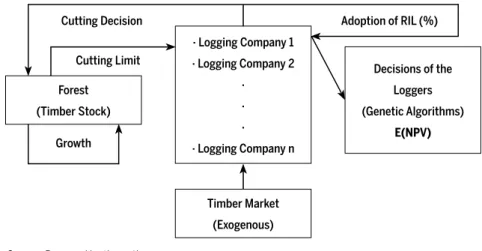
logging an area, such that at the end of the period the producer returns to the fi rst plot logged, which may or may not be recomposed, given that the model is a dynamic model for the forest that depends on the decisions of the loggers
themselves6. Each model year can be summarized as shown in Figure 1.
The cases analyzed were as follows: the default (“Def” in the
refer-ence of Figures 2 and 3), in which there is no form of bonus or fi nes7 and
the parameters from the literature mentioned are maintained; a scenario involving the existence of recognition of the superior quality of the timber extracted using RIL, and an additional payment for RIL timber of 15% for all size and species groups (the “BP” case, which may also be an ap-proximation of good practice remuneration policies); the case that can be considered as one of similar amounts of waste in the two logging models, RIL and CL, (the “SW” case – the waste value for RIL is the same as that of CL, i.e., 0.261); and fi nally, a context in which fi nes are paid at a lower value ($100) and another in which the value is higher ($700) – the “Lfee” and “Hfee” cases, respectively).
Figure 1 Representation of the model in a time period “t ”
Source: Prepared by the authors.
6 The forest regeneration capacity is – as indicated by the equations – a function of the quantity and diversity available in the area, such that the intensity and type of species logged may compromise – to a greater or lesser degree – the capacity for maintenance and growth of the future stock of timber.
7 The absence of fi nes is explained by the consideration that the model resembles the cur-rent context of low imposition of control mechanisms, since these are imperfectly applied and too costly, as noted in the discussion section.
Forest
(Timber Stock)
Decisions of the
Loggers
(Genetic Algorithms)
E(NPV)
· Logging Company 1
· Logging Company 2
·
·
·
· Logging Company n Cutting Decision
Growth Cutting Limit
Adoption of RIL (%)
Timber Market
4
Results
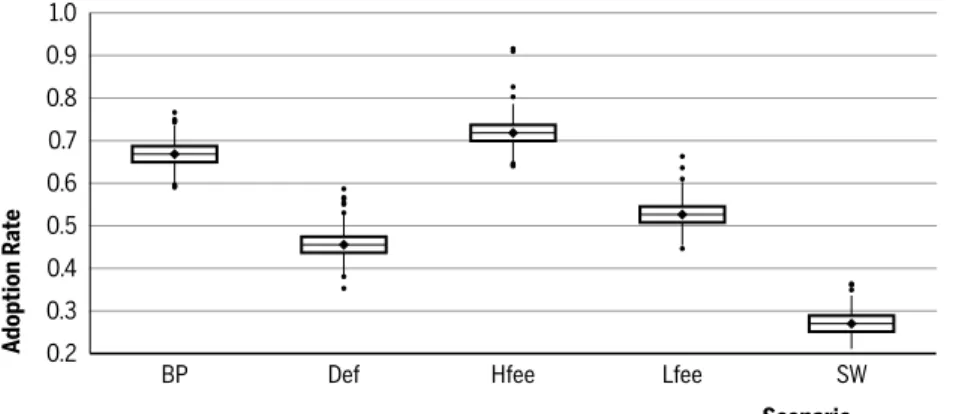
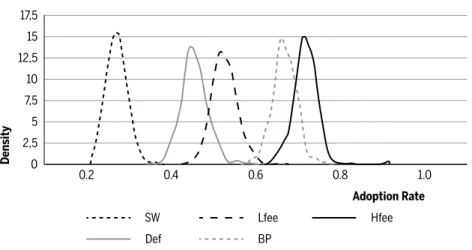
The results obtained from the simulations help to understand the level of existence and/or permanence of the lock-in surrounding a technological log-ging standard with lower loglog-ging quality and greater environmental impacts. The understanding of the results involves comparing data from the de-fault case to others, which will be analyzed with higher statistical rigor via Table 1 but which can already be interpreted based on the images in this present section. The values observed in the “Adoption Rate” axis refer to the percentage of entrepreneurs who decide to adopt the RIL standard, which in the default case corresponds to an average of 45.54%; that is, in the base scenario, more than half of the agents did not adopt RIL. It is worth considering that this information refers only to the aggregate of the adoption and does not exempt it from illegality, both on the side of the overexploitation of the area and by the use of techniques that do not cor-respond to the legal standard for use of RIL. However, the value can still be considered representative in terms of technological adoption initiative and probable impacts on the environment.
The only value lower than the default in terms of adoption is the case in which the two exploratory standards are considered as having equal waste, with adoption rate falling to 27.10%. In this scenario, the presence of superior operational effi ciency in the RIL case (waste minimizer) is one of the main reasons for its adoption and makes it attractive, as will be bet-ter observed in the discussion of the problem in the labet-ter section.
On the other hand, the other cases exhibit increased adoption of RIL. They are divided into two groups: one with a bonus for the higher envi-ronmental quality owing to its recognition by the demand, the “PB” case, and another with punishment for illegality – “Lfee” and “Hfee”. In these scenarios, what can be observed is that the adoption motivated by a 10% bonus on the sale price – which is within the margin that, in the literature, is considered to be viable (Pearce; Putz; Vanclay, 2003) – indicates an adop-tion rate of 66.90% and is closer to the “Hfee” case (71.87%) – of more prohibitive fi nes – than the “Lfee” case (52.66%).
– and the risk aversion characteristic among agents in the sector.
It should be clarifi ed that in cases of imposing fi nes for illegality, in ad-dition to the increased adoption effect, what may occur – considering the existence of other sectors for utilization of the capital – is a situation in which the profi tability of logging can be more easily surpassed by alterna-tive use of the land, such as for agricultural and cattle-breeding practices. These aspects were not included in the simulation but are relevant, as the discussion section of this article clarifi es.
In the case of positive reinforcement of the sector through recognition of the quality derived from RIL, in addition to an increase in the adoption of RIL, there is the improvement in the profi tability of the sector, mak-ing it more attractive while simultaneously makmak-ing it possible to improve profi tability with the adoption of more sophisticated techniques, which can initiate a more sustainable trajectory for logging in the region, thus providing this industry with possibilities for future scale gains.
The relationship between the adoption rate and the NPV expected for the undertaking in each of the cases can be observed in Table 1. From this table, it can be observed that although the cases of negative incentives may represent progress towards greater adoption of the less predatory technique, they do so in a manner that reduces the profi tability of the ac-tivity (see “NPV in relation to the default case”column) thus demonstrating that such incentives do not describe real progress in terms of sustainability of the activity, which will be discussed in more detail in the next section.
Figure 2 Boxplot for the adoption of RIL in each simulation scenario
Source: Prepared by the authors.
0.9 0.8 1.0
0.7 0.6 0.5 0.4 0.3 0.2
BP Def Hfee Lfee SW
A
doption R
ate
Figure 3 Density graphs for the adoption of RIL in each simulation scenario
Source: Prepared by the authors.
Table 1 Compilation of results for the simulation model regarding adoption of RIL and NPV
Scenario RIL adoption (%)
Standard deviation RIL (%)
Min NPV (R$) (α=95%)
Max NPV (R$) (α=95%)
NPV in relation to the Default scenario* (R$)
Def 0.4554 0.0317 3930.853 3972.445
SW 0.2710 0.0250 3285.255 3322.145 -647.9489
Lfee 0.5266 0.0303 3779.641 3829.828 -146.9144
Hfee 0.7187 0.0312 2972.710 3055.903 -937.3424
BP 0.6690 0.0282 6595.728 6655.173 2673.802
Source: Prepared by the author. *All values have a p-value <2.2e-16.
5
Discussion
To better understand and contextualize the results, we must consider that studies on the possibility of wide adoption of RIL in the Brazilian Ama-zon are not incipient – despite being still a current discussion – given the diffi culty of progressing in the implementation of this technique in log-ging ventures in the region. Within the scope of discussions regarding the conciliation of environmental conservation and economic sustainability of the ventures, it is argued that RIL is capable of being both profi table and sustainable while maintaining a substantial part of the carbon stock,
bio-SW
BP
Hfee Def
Lfee 17,5
15 12,5 10 7,5 5 2,5 0
0.2 0.4 0.6 0.8 1.0
D
ensity
diversity, and transpiration of the forest. Thus, the timber industry can be developed in an economically effi cient manner, thereby achieving greater sustainability in underdeveloped economies.
Additionally, conservation strategies for the Amazon are based around biodiversity and protected areas. However, it is still necessary to think about the economic value of the forest, and RIL reveals that sustainable management can occur even outside protected areas, although the balance between conservation and profi tability (where public intervention is
nec-essary) is delicate (Merry et al., 2009).
The discussion in defense of RIL starts from the fi ndings that this log-ging strategy is profi table for producers and helps to guarantee the future availability of timber for cutting. These gains are associated with greater operational effi ciency rather than increased preservation of future timber
stocks (Macpherson et al., 2012), which is also one of the results obtained
by the simulation performed in the present work. Although it is argued in relation to the possibility of this type of model generating a different confi guration in the timber stock, reducing the presence of trees of greater commercial value, it is necessary to understand it in relation to its impact reduction, and quality and cost effi ciency in terms of carbon sequestration and operational effi ciency, given that a reduction in fi xed logging costs would not be expected from CL practice because traditional types of man-agement do not involve good infrastructure planning for production, espe-cially that of roads for the fl ow of forest production (Boltz; Holmes; Cart-er, 2003; Boscolo; Buongiorno; Panayotou, 1997; Boscolo; Vincent, 2003).
The present article provides methodological contribution owing to moving away from the analysis of a single agent to understand how the institutional ordering affects a whole set of agents (under the assumptions of bounded rationality and heterogeneity), in addition to addressing sce-narios closely linked to the specifi c discussion for the region, particularly in the case of the real results from negative incentives for the timber industry. It also contributes theoretically, owing to corroborating and substantiating the discussion involving institutions and technical change in the indus-try studied, emphasizing criticisms of the enforcement, and considering policy instruments (especially the price bonus mentioned).
guarantee greater profi tability and sustainability of the system is the weakness of legal enforcement for infractions in the sector in the Legal Amazon region. So, when we design the policies for fi nes, we are con-sidering their regular enforcement, which may not refl ect what actually happens, thus further damaging the results in terms of sustainability, given the understanding that there is no linear relationship between increase in fi nes and enforcement.
This relationship would occur in part – as addressed by Boscolo and Vincent (2007) – because there is a context of low impact from institu-tional decisions that lead to a problematic and degrading functioning of the timber industry, thus creating incentives to increase the annual cutting area. Even in cases where a cutting restriction is present, there could be a change in the focus of logging to trees of greater commercial value (which could make them scarce). Some enforcement gaps may become critical points of transposition of interests in favor of predatory logging and the maintenance of conventional techniques, which do not have at their core a concern with sustainable logging of the forest.
Another aspect to be highlighted is discussed in Brito and Barreto (2011)
and Pereira et al. (2010), according to whom there is a bias of scarce
super-vision of human and fi nancial resources for environmental control, which adds to the diffi culty in detecting illegal logging and also generates impu-nity because there is a low level of timber harvested per area of exploita-tion (with 3 to 7 trees cut per hectare) and a bias of shortages in human resources (on the producer side), specifi cally a shortage of professionals trained in forest management, which becomes a critical element in the context of forest concessions.
Accordingly, Macpherson et al. (2012) confi rmed that current policies
do not guarantee the sustainability of the cut – even with the long-term benefi ts from the implementation of RIL – owing to elements of corrup-tion, government ineffi ciency, and insecurity regarding the maintenance of property rights (which are essential for long-term planning of managed logging), which are genuine pathways towards illegality.
a negative incentive structure – could undermine sustainability, both in environmental and economic terms, in addition to being a costly element (from supervision) for the public entity, thus indicating the ineffi ciency of increasing punishments without there being an offset to benefi t good practices (as in BP case).
Although simulations were performed independently (with the criteria altered in each one), it can be observed that the cases that had the best benefi ts at a low cost, in terms of industry profi tability, were those of moderate fi nes (Lfee) together with bonuses for good practices (with the perception that the product of sustainable origin has a quality differential, as in BP) – the scenarios in which the public entity would not have to confront so intensely the cost pressures and human resources diffi culties mentioned in this section and therefore are more likely be implemented. All these considerations are necessary to envisage the logging issue as per-meated by high-complexity elements.
Similarly, the discussion on the subject in Boscolo and Vincent (2007) also indicates that enforcement may include the depletion of the timber stock, as long as there is a perception of this among producers, which could be accomplished by strengthening legal institutions, having more monitoring, issuing more penalties (which faces restrictions in the Ama-zon case) and, in particular, having a performance bonus (which could be represented by the BP scenario as an approximation).
When analyzing the context of incentives to reduce illegal logging
prac-tices, Conrad et al. (2005) highlighted the particularities and complexity of
tropical forests in assessing the different consequences of each incentive mechanism. These authors consider that the high degree of heterogeneity of native forests creates greater cutting complexity, adds different growth rates by harboring differentiated stocks of wood per area, and creates a need to evaluate the determination of economically recoverable cuts. It is necessary to mention here the SW case, where the effect of waste reduction on the cut with RIL is removed, which drastically affects its adoption and the NPV, given that one of the greatest advantages of using the mentioned technique is its sustainable profi le of ensuring timber production for long periods, ow-ing to maintenance and greater capacity to recover the exploited stock.
Macpherson et al. (2010) also argue that the cutting of timber causes
necessari-ly include recovery of the economic value of the area, i.e., the sustainability of the activity. Advocating in this direction, Fearnside (2010) indicated that imposing the use of RIL does not necessarily affect the portion of illegally logged timber (and its greater collateral damage). Fearnside (2010) also in-dicated a need for management projects that think deeply about the resil-ience capacity of the forest and are in realistic terms of participation (by the government and producers), with strict monitoring (going beyond imposi-tions that simply specify the minimum width of the trees for the cut and the minimum periods for cutting cycles). This reinforces the lock-in aspect that surrounds CL, from which there will be no escape without great effort and losses if the only alternative followed is that of negative incentives.
Giving greater emphasis to the role played by society, Ros-Tonen et al.
(2008) observed that the complexity of logging in the Legal Amazon region would be restricted not only by the ecosystem heterogeneity but also by social and political characteristics. For the authors, it would be necessary to go beyond simple implementation of RIL, with greater stimulus given to the involvement of local communities, because the ecosystem complex-ity would coexist with the diverse agents involved in the decisions affect-ing the forest loggaffect-ing in the Legal Amazon region. Along this line, Brito and Barreto (2011) also made proposals for institutional planning in the region, considering the need to increase the transparency of law applica-tion, which must follow a different strategy, prioritizing punishment of the biggest violators.
However, the issue of technological transition is complex in that it goes beyond the discussion of the benefi ts and reservations of the new technol-ogy, and there also remain concerns about the effects that exacerbate lock-in surroundlock-ing technology that is environmentally more harmful.
Given the narrowness of the methodologically studied scenarios, other elements need to be better elaborated in the present discussion. First, it is important to understand what would motivate the maintenance of tradi-tional logging or the depletion of the area in the case of change in land use.
gains from the international demand for agroindustrial commodities and from new gains created by markets and the creation of new opportuni-ties, which are accompanied by loss of adaptive capacity, increases in the vulnerability of the affected areas, and generation of changes in social
or-ganization (Klimas et al., 2012; Lambin; Geist; Lepers, 2003; Nepstad, D.
C. et al., 2008; Nepstad, D. et al., 2009; Valle et al., 2007).
Thus, the imposition of fi nes for illegal logging, in addition to similar control mechanisms, may represent a risk to the forest because they could both reduce the profi tability of logging – which would remove the produc-ers from the sector – and accelerate a possible change in land use, which
would eliminate the forest coverage8. To reinforce this idea, it may also be
considered that the profi tability of agriculture, if suffi ciently high, will be a barrier to the implementation of the valorization of the standing forest, even when considering risks in terms of costs associated to illegality.
The methodology used is within the context that even with the pos-sibility of sustainable use of the forest, including as a guarantor of income, there remains a lock-in pattern surrounding the technology of convention-al logging. We can think of changes in land use as an emergent property of complex adaptive systems – land use is not static but is rather constantly changing as a result of changes in attitudes and feedback derived from the behavior of the agents that act on land use. Thus, adaptive systems are worked on because the presence of expectations can be observed from internal and external conditions of the agents – something that changes their future behavior based on the reality they come to know (Lambin; Geist; Lepers, 2003).
In the set of factors for the system property of revealing patterns of low-sustainability land use, we can consider elements that are not directly in the model but that are already the result of a dynamics observed during the measurement of parameters employed in the methodological treat-ment conducted. This begins by considering the cost factor, or the
ence between cutting costs and revenue, with valorization of the wood price, derived from illegal exploitation, which, for being smaller, favors the expansion of illegal logging areas (Gutierrez-Velez; Macdicken, 2008).
It could be argued that forest overexploitation with deteriorating car-bon-stocking techniques would still be associated to differences between income from land – in terms of agricultural development – and income from the forest, composed of both forest products and services of the eco-system provided by the forest, so that the latter would still have to over-come a number of obstacles to beover-come competitive against the former; for example, it would be necessary to overcome weak, poorly defi ned, and contested property rights and lack of assistance to the communities, which results in fi rms avoiding investing in better environmental practices. Additionally, there is an argument about initiatives for internalizing
ex-ternalities9 (with the creation of markets for public goods, including forest
services), community forest management, reduction of emissions through REDD, and the use of protected areas (Angelsen, 2010; García-Fernández;
Ruiz-Pérez; Wunder, 2008; Macpherson et al., 2012).
Analyzing the more traditional economic intervention policies as well, one can see that the sensitivity of better environmental management re-gimes to the discount applied to the NPV is higher for higher rates, such that in scenarios with very high interest rates, the discount makes it un-competitive to use environmentally friendlier logging (Boltz; Holmes; Carter, 2003; Pearce; Putz; Vanclay, 2003). Additionally, the use of logging rates – aimed at creating government revenue in tropical forests – may have as a secondary effect the valuation of resources, with the consequent reduction in waste and addition of value to the products, provided that there is control of illegality, given that in addition to the loss of govern-ment royalties, illegal logging generates ineffi ciencies in timber cutting operations, productivity losses, and unemployment (Gutierrez-Velez;
Macdicken, 2008; Macpherson et al., 2012).
A fi nal analysis is performed regarding fi nes and change in land use, which may induce loggers to accelerate the logging and be more selective with the cuts in the areas (to remove trees of higher commercial value
more quickly). If fi nes are too high, they discourage production in areas where there are predominantly trees of lesser commercial value, in ad-dition to discouraging risk-averse producers from investing. What is un-derstood is that the fi nes could stimulate – in an imperfect enforcement environment, as in the case of the Amazon – faster conversion of forest areas into pastures and plantations because these alternatives are more profi table in terms of future profi tability, and the deforestation required for their transition would not pose such a high risk to the decision-maker. It is not necessary to put aside this type of instrument (as already men-tioned); however, it is still incomplete – it needs to be accompanied by measures that decelerate the depletion of the areas (motivated by the en-forcement of the rate) (Boscolo; Vincent, 2007). In fact, what is perceived is that all instruments can complement each other, which opens up room for different measures that can work together to reduce illegal deforestation and also progressively improve the logging techniques used in the Brazil-ian Amazon, with a focus on increasing the profi tability of forest products and reducing the impacts on the environment.
6
Conclusions
Among the conclusions reached in the present work are the following items:
The assumption of the existence of a low-technology lock-in with high environmental impact – associated with the propensity for illegality among loggers in the Brazilian Amazon – cannot be ruled out.
When thinking about the strategic duality of adopting CL and RIL, it can be observed that CL has the advantage of lower costs, whereas RIL has better results in terms of operational effi ciency, which favors its adoption, even in institutional contexts that do not favor it in any manner, especially as a result of the reduced waste of extracted wood resulting from RIL.
Timber producers in the region can be characterized as averse to the risk of fi nes, and this instrument is capable of reducing the adoption of CL; however, this change would be associated with lower profi tability in the sector, which could favor changes in land use in the region to agricultural or cattle production, which would in turn eliminate the forest coverage of the land.
∆
∆
The results of the simulation conducted reveal that an environmental bonus, which favors the recognition of the differentiated environmental quality of products derived from sustainable strategies, would generate both greater profi tability for the sector and higher values in the case of adoption of RIL.
In general, what is perceived is a need to go beyond simple legal mecha-nisms of punishment and instead start to embrace the incentive for techni-cal change through policies that involve producers, government agents, and the community, to create control mechanisms and encourage pro-duction within legal standards and through a management model that is concerned not only with the profi tability and sustainability of economic exploitation but also with the maintenance of timber stocks and forest di-versity in the region, which are inseparable for the long-term of the timber industry in the Amazon.
The employed approach has some limitations, which are predominant-ly related to non-measurement of the environmental quality in the region resulting from the adoption of one or another strategy – an instrument necessary for the argument in favor of a policy measure in the reckoning of an environmental bonus for producers who adopt RIL. Moreover, the results were presented in mean terms for the whole period, which does not allow for analysis of the evolution of the adoption trajectory of RIL in a dynamic context, as was simulated.
Thus, in future work, verifi cation of the environmental quality associ-ated with the context of adopting each logging regime will be conducted, both in terms of carbon stock and forest diversity, to observe the risks of adopting RIL, especially regarding the loss of diversity with accelerated cutting of higher-value trees.
It is also necessary to test the effects of sensitivity to discount rates and changes in relative prices for the timber sector – which are not captured in the current model – because the uncertainty would be due to the inability to know the best cutting alternative (owing to the bounded rationality of the agents).
Additionally, it is important to move away from positive analysis of the sector and move towards a context of simulations that allow analysis of the impacts of economic policies that avoid simple imposition of fi nes and similar mechanisms of control, to think more clearly about policies
with an environmental bonus, proposing and testing the impacts of this type of measure, and to observe how it is able to act in the trajectory of the decision-making for the timber industry in the Legal Amazon region.
A fi nal qualifi cation to be made is a defense of the choice for Java pro-gramming language as a modeling tool for the simulation used in this text. It was chosen owing to its ease of use and diffusion, in addition to having a library (set of predefi ned functions) for the implementation of genetic algorithms, the Java Genetic Algorithms Package (JGAP), for understand-ing the relationships between companies in the sectors, the role of inno-vations, and the role of the state in conducting economic activity in the region for a more sustainable trajectory. Additionally, Java serves as a basis for simulation platforms based on more robust agents, such as Java ap-plets in Netlogo or with the Repast platform, specifi cally directed to the construction of agents (Bandini; Vizzari, 2009). It is also noted that the lan-guage has a positive future outlook, for being a powerful lanlan-guage, widely used, and for becoming a standard for simulations in the social sciences (Tobias; Hofmann, 2004).
References
AMACHER, G. S.; KOSKELA, E.; OLLIKAINEN, M. Royalty reform and illegal reporting of harvest volumes under alternative penalty schemes. Environmental and Resource Economics, v. 38, n. 2, p. 189–211, 27 fev. 2007. Disponível em: <http://link.springer.com/10.1007/ s10640-006-9070-7>. Acesso em: 26 jan. 2014.
ANGELSEN, A. Policies for reduced deforestation and their impact on agricultural produc-tion. Proceedings of the National Academy of Sciences of the United States of America, v. 107, n. 46, p. 19639–44, 16 nov. 2010. Disponível em: <http://www.pubmedcentral.nih.gov/ articlerender.fcgi?artid=2993393&tool=pmcentrez&rendertype=abstract>. Acesso em:
21 jan. 2014.
ASSUNÇÃO, J.; GANDOUR, C.; ROCHA, R. DETERring Deforestation in the Brazilian Amazon:
Environmental Monitoring and Law enforcement. Rio de Janeiro: [s.n.], 2013. Disponível em: <http://climatepolicyinitiative.org/brazil/fi les/2013/05/DETERring-Deforestation-in-the-Brazilian-Amazon-Technical-Paper-Only-%E2%80%93-English.pdf>. Acesso em: 11 set. 2014.
ARTHUR, W. B. Competing Technologies, Increasing Returns, and lock-in by Historical Events. The Economic Journal, v. 99, n. 394, 1989. p. 116-131.
BANDINI, S.;MANZONI, S.; VIZZARI, G. Agent Based Modeling and Simulation: An Infor-matics Perspective. Journal of Artifi cial Societies and Social Simulation, v. 12, n.4, 2009. BOLTZ, F.; HOLMES, T. P.; CARTER, D. R. Economic and environmental impacts of
con-ventional and reduced-impact logging in Tropical South America: a comparative review.
Forest Policy and Economics, v. 5, n. 1, p. 69–81, jan. 2003. Disponível em: <http://linking-hub.elsevier.com/retrieve/pii/S1389934101000752>.
BOSCOLO, M.; BUONGIORNO, J.; PANAYOTOU, T. Theory and Applications Simulating options for carbon sequestration tropical rainforest. v. 2, p. 241–263, 1997.
BOSCOLO, M.; VINCENT, J. R. Area fees and logging in tropical timber concessions. Environ-ment and DevelopEnviron-ment Economics, v. 12, n. 04, p. 505, 25 jul. 2007. Disponível em: <http:// www.journals.cambridge.org/abstract_S1355770X0700366X>. Acesso em: 3 jun. 2014. BOSCOLO, M.; VINCENT, J. R. Better Logging Practices in Promoting Analysis of Tropical Forests:
A Simulation Alternative Regulations. v. 76, n. 1, p. 1–14, 2000.
BOSCOLO, M.; VINCENT, J. R. Nonconvexities in the production of timber, biodiver-sity, and carbon sequestration. Journal of Environmental Economics and Management, v. 46, n. 2, p. 251–268, set. 2003. Disponível em: <http://linkinghub.elsevier.com/retrieve/pii/ S0095069602000347>. Acesso em: 3 jun. 2014.
BRITO, B.; BARRETO, P. Enforcement against illegal logging in the Brazilian Amazon. In: PADDOCK, L. Compilance and enforcement in Environmental Law. Cheltenham Glos: Edward Elgard Publisging, 2011.
COE, M. T. et al. Deforestation and climate feedbacks threaten the ecological integrity of south − south-eastern Amazonia. 2013.
CONRAD, R. F.; GILLIS, M.; MERCER, D. E.. Tropical forest harvesting and taxation: a dynamic model of harvesting behavior under selective extraction systems. Environment and Development Economics, v. 10, 2005, p. 689-709.
DOSI, G.; NELSON, R. R. Evolutionary Economics An introduction to evolutionary theories in econom-ics. p. 153–172, 1994.
DOSI, G.. Mudança Técnica e Transformação Industrial. Campinas: Unicamp, 2006.
FABER, A.; FRENKEN, K. Models in evolutionary economics and environmental policy: Towards an evolutionary environmental economics. Technological Forecasting and Social Change, v. 76, n. 4, p. 462–470, maio 2009. Disponível em: <http://linkinghub.elsevier. com/retrieve/pii/S004016250800084X>. Acesso em: 5 out. 2012.
FEARNSIDE, P.M. Recursos madeireiros na Amazônia brasileira: Impactos e sustentabili-dade da exploração. In: VAL, A.L.; SANTOS, G. M. dos (Eds.) Grupo de Estudos Estratégicos Amazônicos (GEEA) Tomo 3. Instituto Nacional de Pesquisas da Amazônia (INPA), Manaus, Amazonas, 2010.
GARCÍA-FERNÁNDEZ, C.; RUIZ-PÉREZ, M.; WUNDER, S. Is multiple-use forest manage-ment widely implemanage-mentable in the tropics?Forest Ecology and Management, v. 256, n. 7, p. 1468–1476, set. 2008. Disponível em: <http://linkinghub.elsevier.com/retrieve/pii/ S0378112708003721>. Acesso em: 21 jan. 2014.
BF02512229>.
GUTIERREZ-VELEZ, V. H.; MACDICKEN, K. Quantifying the direct social and governmen-tal costs of illegal logging in the Bolivian, Brazilian, and Peruvian Amazon. Forest Policy and Economics, v. 10, n. 4, p. 248–256, fev. 2008. Disponível em: <http://linkinghub.elsevier. com/retrieve/pii/S138993410700072X>. Acesso em: 3 jun. 2014.
KARSENTY, A. Forest taxation regime for tropical forests: lessons from Central Africa. Inter-national Forestry Review, v. 12, n. 2, p. 121–129, jun. 2010. Disponível em: <http://www. ingentaconnect.com/content/cfa/ifr/2010/00000012/00000002/art00001>.
KLIMAS, C. A. et al. Viability of combined timber and non-timber harvests for one species: A Carapa guianensis case study. Ecological Modelling, v. 246, p. 147–156, nov. 2012. Dis-ponível em: <http://linkinghub.elsevier.com/retrieve/pii/S0304380012003535>. Acesso em: 3 jun. 2014.
LAMBIN, E. F.; GEIST, H. J.; LEPERS, E. D Ynamics of L and -U Se and L and -C Over C Hange in T Ropical R Egions. Annual Review of Environment and Resources, v. 28, n. 1, p. 205–241, nov. 2003. Disponível em: <http://www.annualreviews.org/doi/abs/10.1146/annurev. energy.28.050302.105459>. Acesso em: 26 jan. 2014.
MACPHERSON, A. J. et al. A Model for comparing reduced impact logging with conven-tional logging for an Eastern Amazonian Forest. Forest Ecology and Management, v. 260, n. 11, p. 2002–2011, nov. 2010. Disponível em: <http://linkinghub.elsevier.com/retrieve/ pii/S0378112710005219>. Acesso em: 26 jan. 2014.
MACPHERSON, A. J. et al. The sustainability of timber production from Eastern Amazonian forests. Land Use Policy, v. 29, n. 2, p. 339–350, abr. 2012. Disponível em: <http://linking-hub.elsevier.com/retrieve/pii/S026483771100072X>. Acesso em: 26 jan. 2014.
MERRY, F. et al. Balancing conservation and economic sustainability: the future of the Ama-zon timber industry. Environmental management, v. 44, n. 3, p. 395–407, set. 2009. Disponí-vel em: <http://www.ncbi.nlm.nih.gov/pubmed/19636609>. Acesso em: 26 jan. 2014. NEPSTAD, D. et al. Environment. The end of deforestation in the Brazilian Amazon. Science
(New York, N.Y.), v. 326, n. 5958, p. 1350–1, 4 dez. 2009. Disponível em: <http://www. ncbi.nlm.nih.gov/pubmed/19965742>. Acesso em: 26 jan. 2014.
NEPSTAD, D. C. et al. Interactions among Amazon land use, forests and climate: prospects for a near-term forest tipping point. Philosophical transactions of the Royal Society of Lon-don. Series B, Biological sciences, v. 363, n. 1498, p. 1737–46, 27 maio 2008. Disponível em: <http://www.pubmedcentral.nih.gov/articlerender.fcgi?artid=2373903&tool=pmcentrez
&rendertype=abstract>. Acesso em: 23 jan. 2014.
PEARCE, D.; PUTZ, F. E.; VANCLAY, J. K. Sustainable forestry in the tropics: panacea or folly?Forest Ecology and Management, v. 172, n. 2-3, p. 229–247, jan. 2003. Disponível em: <http://linkinghub.elsevier.com/retrieve/pii/S0378112701007988>.
PEREIRA, D.; SANTOS, D.; VEDOVETO, M.. GUIMARÃES, J.; VERÍSSMO, A. Fatos fl orestais da Amazônia 2010. Belém: Imazon, 2010.
SCHUMPETER, J. A.. Teoria do Desenvolvimento Econômico: uma investigação sobre lucros, capital, crédito, juro e ciclo econômico. São Paulo: Nova Cultural, 1997.
SIST, P.; FERREIRA, F. N. Sustainability of reduced-impact logging in the Eastern Amazon.
Forest Ecology and Management, v. 243, n. 2-3, p. 199–209, maio 2007. Disponível em: <http://linkinghub.elsevier.com/retrieve/pii/S0378112707001582>. Acesso em: 26 jan. 2014.
TESFATSION, L. Agent-Based Computational Economics: Growing Economies from the Bottom Up. n. October 2001, p. 1–31, 2002.
TOBIAS, R.; HOFMANN, C. Evaluation of free Java-libraries for social-scientifi c agent based simulation. Journal of Artifi cal Societies and Social Simulation, v. 7, n.1, 2004.
VALLE, D. et al. Adaptation of a spatially explicit individual tree-based growth and yield model and long-term comparison between reduced-impact and conventional logging in eastern Amazonia, Brazil. Forest Ecology and Management, v. 243, n. 2-3, p. 187–198, maio 2007. Disponível em: <http://linkinghub.elsevier.com/retrieve/pii/S0378112707001417>. Acesso em: 26 jan. 2014.
VAN DEN BERGH, J. C. J. M. et al. Survival of the greenest: evolutionary economics and policies for energy innovation. Environmental Sciences, v. 3, n. 1, p. 57–71, mar. 2006. Disponível em: <http://www.tandfonline.com/doi/abs/10.1080/15693430500481295>. Acesso em: 11 set. 2014.
YOUSEFPOUR, R.; HANEWINKEL, M. Modelling of forest conversion planning with an adaptive simulation-optimization approach and simultaneous consideration of the val-ues of timber, carbon and biodiversity. Ecological Economics, v. 68, n. 6, p. 1711–1722, abr. 2009. Disponível em: <http://linkinghub.elsevier.com/retrieve/pii/S0921800908005351>. Acesso em: 26 jan. 2014.
ZARIN, D. J. et al. Beyond reaping the fi rst harvest: management objectives for timber pro-duction in the Brazilian Amazon. Conservation biology: the journal of the Society for Con-servation Biology, v. 21, n. 4, p. 916–25, ago. 2007. Disponível em: <http://www.ncbi. nlm.nih.gov/pubmed/17650242>. Acesso em: 21 jan. 2014.
About the authors
Hilder André Bezerra Farias - [email protected] Universidade Federal do Pará, Belém, Pará.
Sérgio Luiz de Medeiros Rivero - [email protected] Universidade Federal do Pará, Belém, Pará.
Márcia Jucá Teixeira Diniz - [email protected] Universidade Federal do Pará, Belém, Pará.
This research received fi nancial support from Rede Biomassa Florestal project, which is fi nanced by the Research Support Foundation of the State of Pará (FAPESPA), Edict 014/2008. This present article was elaborated as part of the Postgraduate Economics Program of Pará Federal University (PPGE/UFPA), with the aid of its resources.
About the article