A Work Project, presented as part of the requirements for the Award of a Master Degree in Management from the NOVA – School of Business and Economics.
Psycap and Amotivation to search for a job: the
role of need frustration and family support
Bernardo Lança Cirnes Nogueira de Oliveira #2382
A Project carried out on the Master in Management Program, under the
supervision of: Filipa Castanheira
PsyCap and amotivation to search for a job:
the role of need frustration and family support
This work analyses unemployed individuals’ psychological capital (Psycap), and the
mediating and moderation developments through which this resource is related with
amotivation to search for a job. We tested, in particular, whether need frustration of
autonomy, relatedness and competence mediated the relationship between Psycap
and amotivation, by using a questionnaire that was applied to a sample of 298
unemployed people. Additionally, we also tested whether individuals’ family support
would moderate the negative relationship between Psycap and amotivation to search
for a job, and if the strength of the hypothesized indirect effects were conditional on
the perception of family support. Results revealed that the relationship between
Psycap and amotivation was mediated by need frustration of relatedness and
competence. Moreover, family support was confirmed to moderate the relationship
between need frustration of competence and amotivation, such that the high levels of
amotivation was found in individuals who demonstrated high levels of need
frustration of competence and low family support. Ultimately, results have supported
a conditional indirect and negative effect of the Psycap on forecasting amotivation
through need frustration of competence when levels of family support were high, but
not when the support was low. Overall, the results obtained show that need
frustration of autonomy, relatedness and competence, and family support embody key
elements in explaining how Psycap is associated with amotivation to search for a job.
Introduction
The Horizon 2020 Challenges, which are part of the European Union Framework for
Research and Innovation, resumes the top priorities and the major concerns of the
Europe 2020 strategy that are shared by the majority of the citizens. Among all of
them, unemployment is tackled as being a crucial challenge for the future generations,
because if its rate is high then it can jeopardize the economic growth of each
particular country, and the overall European Union. In 2015, the unemployment rate
in Portugal was 12,4%. A rate that is lower than the 16,2% registered in 2013 and the
13,9% registered in 2014, however, still higher than the OECD average of 6,8%. It
can be seen also that the unemployment rate of the average of the OECD countries, is
improving its values, comparing with the 7,9% in 2013 and the 7,3% in 2014 (OECD,
2014). According to this information, and in about two decades, Portugal had moved
from being one of the countries with the lowest values of unemployment rate in the
European Union (i.e. registering 4% in 2000, and having only Austria and The
Netherlands in that year with lower values) to become one of the countries with the
highest values (i.e. having only Spain and Greece with higher values, registering
22,1% and 24,9% in the year of 2015, respectively) (OECD, 2014). The constantly
growth of the unemployment in Portugal throughout the years have risen social
inequalities, and consequently the access to healthcare treatment (Horizon 2020). The
unemployment growth in Portugal increased social inequalities that compromise
health equity, and in part explains the high prevalence of mental ill health among
Portuguese (23% according to the report from the Ministry of Health from 2015),
which is a really important factor that needs to be taken into account, because it’s a
direct consequence of the fact that people are unemployed, and therefore, increases
their lack of motivation in searching for a new job. Earlier research has demonstrated
that Psychological Capital ((“PsyCap” which represents each person’s positive state
of psychological development and is represented among four intrinsic characteristics
of the individual: Hope, Efficacy, Optimism and Resiliency (Luthans, Avolio, Avey
& Norman, 2007; Luthans & Youssef, 2004) has a positive impact in motivation, and
consequently a negative impact in amotivation (Luthans, Avolio et al., 2007).
Individuals who are more hopeful, optimistic, and resilient, and have more efficacy
are less likely to be frustrated regarding the three basic needs of autonomy,
positive psychological capital is crucial to tackle unemployment, because it will lead
to lower levels of frustration, however, there was no empirical evidence on PsyCap on
Need Frustration on amotivation. According to Murphy and Athanasou (1999), when
people are unemployed or just had the experience of losing a job, it has a negative
impact on their levels of psychological well-being, meaning that they isolate
themselves, are less willing to be involved in the social activities of the society, and
this calls into question the satisfaction of the basic needs (Deci & Ryan, 2000). For
example, when people that are unemployed are compared with those that currently
have a job, the unemployed ones show high levels of psychological distress,
especially in the long-term unemployment in which has damaging consequences on
the emotional well-being (Kokko & Pulkkinen, 1997), as well as lower self esteem
and higher levels of depression. Following this reasoning, the “deprivation model” for
unemployment has come from studies that indicated that unemployed individuals are
less willing to have access to the so called “latent benefits of employment”, and
consequently, they have an inferior well-being (Creed & Klisch, 2005), and so feeling
more frustrated and less motivated. This paper characterizes the psychological need
frustration for the basic needs of autonomy, relatedness and competence as a mediator
between Psychological Capital) and amotivation which is characterized by the
nonexistence of motivation in searching for a job. Unemployed people are more
isolated and they feel less control over their actions, leading to the frustration of needs
of autonomy, relatedness and competence, which contributes to amotivation in
finding a new job. (Deci & Ryan, 2000). In addition, this paper is also going to focus
on the moderated effect of the family support into the mediation effect, meaning that
it is going to have an impact, either positive or negative, on how the need frustration
of the basic needs (autonomy, relatedness and competence) affect amotivation. The
role of the family seems to have a crucial impact as lack of motivation is strongly
impacted by the need frustration of autonomy, relatedness and competence, which in
turn is highly impacted by the psychological capital of individuals. Following this
assumption, Vrućinić (2012) has documented the role of family and social support to
unemployment. However, having a family doesn’t mean automatically having high
social support, because unemployment can jeopardize relationships within the family,
especially due to increasing psychological stress, children’s mental health problems
and lack of good performances at school, loss of motivation to find a new job in the
PsyCap
Need Frustration of
Autonomy
Need Frustration of
Relatedness
Need Frustration of
Competence
Amotivation
Family Support a positive Psychological Capital aligned with greater and positive family support are
crucial to reduce the frustration of the individuals, and so, the amotivation to find a
job. This study gives an important contribution to the study of unemployment,
especially through the focus on psychological capital and amotivation, and the
relationship of mediation of need frustration of autonomy, relatedness and
competence to reduce such adversity. Furthermore, it contributes also to see the
impact of family support between the need frustration and amotivation, when
individuals are unemployed. So the main idea of this study is to investigate if the
family support can mitigate the impact of the frustration of the needs of autonomy,
relatedness and competence in the amotivation to search for a new job.
Figure 1. The Research Model
Literature Review and Hypothesis
According to several studies, psychological reflexes, needs, drivers, ability to
experience pleasure and pain, perceptions are all really important to boost the
behavior of the human beings (Gastil, 1961). However, following Latham and Pinder
(2005) reasoning, needs are the essential elements that influence human behavior.
According to the Self Determination Theory (SDT) if people want to reach a positive
psychological state of mind, they have to fulfill several needs (Deci & Ryan, 2000),
named as need for autonomy, relatedness and competence. And according to Welters,
Mitchell and Muysken (2014), when people are employed, developing a paid work
competence at work, develop relationships with other employees and with the job
itself, so they can tackle the need of relatedness, and being the job a paid activity,
each worker can have its own autonomy in life. Furthermore, SDT defends that if
people are employed and working to achieve goals, they build positive psychological
mindset, and so they achieve needs satisfaction, and therefore, they are not frustrated,
and so more motivated in every life sector and having a more positive psychological
capital/ well being. So it’s crucial to study how the satisfaction of the needs of the
unemployed individuals is affected. Explanations on how unemployment can impact
negative psychological capital and lower levels of psychological well being (Murphy
& Athanasou, 1999), causing poor mental health, has come from the “deprivation
model” (Jahoda, 1982). According to this model, being unemployed contributes to the
fact that people have less time structure, social contact, collective purpose, status and
activity, which are the five latent functions of employment (Jahoda, 1982). Also
related to the theme of unemployment, the role of the family is crucial because it can
give material and psychological support for the ones that are unemployed, and give
them the right motivation and boost to find a new job, either friends or family
members (Mitchell, Billings & Moos, 1982; Cohen & Wills, 1985). When facing
stressful situations, such as not having a job and feeling their autonomy, relatedness
and competence jeopardized, people with a stronger family and social support are less
anxious, stressful and less willing to suffer from a depression, so feeling more
motivated to pursue their lives and search for a job (Mitchell, Billings et al., 1982;
Cohen & Wills, 1985). Inside a family each individual always receive emotional
support, but when a person is unemployed, this feeling of belonging, warmth and
material support is even more important and valued in such a situation of crisis
(Sarason, Sarason & Shearin, 1986).
Link between PsyCap and Amotivation
The Psychological Capital has emerged from the positive psychology movement
(Luthans, Youssef & Avolio, 2007), and is made up by four constructs or resources
(hope, self-efficacy, optimism and resiliency) (Luthans, Luthans, & Luthans, 2004;
Luthans & Youssef, 2004; Luthans, Youssef, Avolio et al., 2007). Previous research
has shown that PsyCap has a positive impact in individuals’ attitudes and behaviors
their jobs, or when they are unemployed, they feel more motivated to find a job
(Luthans, Avolio, et al., 2007; Avey, Reichart, Luthans, & Mhatre, 2011; Walumbwa,
Luthans, Avey, & Oke, 2011). It has been demonstrated that PsyCap is about what
each individual is or in what wants to become in. It goes beyond human, economic
and social capital, because it aggregates the heart and soul part of each individual
(Luthans, Luthans et al., 2004). It covers each person’s path and faith, and that’s why
it improves group and individual performances and motivation (Luthans, Avolio, et
al., 2007), because it touches their hearts through optimism, self-efficacy, hope and
resiliency, all aligned in order to succeed (Luthans, Youssef, et al., 2007). By
analyzing the four constructs of PsyCap more deeply, there is a direct relationship to
amotivation. Optimism is related to all the positive emotions and state of mind
towards motivation (Luthans, 2002a), hope assumes a great will to succeed and high
degree of energy and motivation to pursue a goal and find a job (Snyder, 2000, 2002),
self-efficacy is the individuals’ ability to surpass an obstacle towards success
(Bandura, 1998), or in other words, their confidence in succeed and being motivated
(Stajkovic & Luthans, 1998). Being resilient is also crucial, in a way that, the
individual develops a positive psychological capital to go through the adversity and
turnaround negative situations, and being motivated to succeed (Bandura, 1998;
Fredrickson & Joiner, 2002; Luthans, 2002a). On the other hand, amotivation is
characterized by the nonexistence of motivation to pursue any activity, like finding a
job (Deci & Ryan, 2000). Therefore, we assume that Psychological Capital has a
negative relationship with amotivation, because all of the PsyCap constructs are
driving our minds to a positive state of mind (Luthans, 2002a, 2002b; Luthans, Avolio
et al., 2007), and therefore, more motivated people.
Thus, we expect that:
Hypothesis 1: Psychological Capital is negatively associated with amotivation to
Need Frustration of Autonomy, Relatedness and Competence as mediators
According to Luthans (2007), the positive psychological concepts determined to
represent what is called psychological capital or PsyCap include hope (e.g. will to
believe when pursuing several goals), resilience (e.g. keep believing it’s going to
reach success even when facing problems and the adversity), optimism (e.g. being
positive about success) and self-efficacy (e.g. being convicted that is going to succeed
in successful challenges). When the individuals are positive in all these four
constructs of the PsyCap, it can be seen as direct relationship to performance,
satisfaction and motivation, therefore, less frustration by the individuals (Luthans,
Avolio et al., 2007). As explained by the “deprivation model” (Jahoda, 1982),
individuals that are unemployed are deprived from several important resources, as
well as the benefits of employment related to income and psychological needs.
However, it is important to understand if individuals with a stronger PsyCap are less
vulnerable to this “deprivation period”, and therefore, perceive less frustration of
needs. Since PsyCap builds on positive and constructive relationships, making
individuals suffering less during unemployment tackle unemployment (Sutcliffe &
Vogus, 2003). It can constitute a resource against adversity, through hope, resilience,
optimism and self-efficacy, because they feel more convicted about their capabilities
and skills, and so less frustrated regarding the needs (Deci & Ryan, 2000). Therefore,
it has a negative association towards Need Frustration of Autonomy, Relatedness and
Competence because a positive psychological capital improves satisfaction of these
three needs (Deci & Ryan, 2000; Luthans, 2002a, 2002b; Luthans & Youssef, 2004;
Luthans, Avoilo et al., 2007). As stated previously, according to Self Determination
Theory individuals have to fulfill several needs, in order to feel secure and
accomplish psychological welfare (Ryan & Deci, 2000). And if individuals are
employed all the three needs are more probably satisfied at the same time (Welters,
Mitchell & Muysken, 2014). This theory also discusses the fact that satisfying
individuals’ needs is crucial in order to develop positive outcomes, so when a person
is employed he will benefit from psychological wellbeing (Warr, Jackson, & Banks,
1988; Winefield, Winefield, Tiggeman, & Goldney, 1991), meaning that people are
less frustrated in terms of autonomy, relatedness and competence (Welters, Mitchell
et al., 2014), and so more motivated either to find a job or to accomplish goals (Ryan
& Deci, 2000). As a result, individuals are more goals oriented and so the satisfaction
performance and motivation in finding a job (Welters, Mitchell et al., 2014). So when
need frustration of autonomy, relatedness and competence are high, it has a positive
association to amotivation, because if individuals feel frustrated because they cannot
show their competence at work, cannot develop relations with other workers
(relatedness and cannot generate income to have their own autonomy, as they simply
don’t have a job, their motivation to search for a new one is willing to be low (Deci &
Ryan, 2000; Welters, Mitchell et al., 2014). They feel stressed, anxious, less confident
towards their abilities and skills, depressed or even resignated in the situation they are
(Muller, Hicks & Winocur, 1993; Kokko & Pulkkinen, 1997; Waters & Moore, 2002)
Nevertheless, “studies linking SDT to job search are surprisingly rare” (Welters,
Mitchell et al., 2014, p. 35).
Thus, we expect that:
Hypothesis 2a: Need Frustration of Autonomy mediates the relationship between
PsyCap and Amotivation.
Hypothesis 2b: Need Frustration of Relatedness mediates the relationship between
PsyCap and Amotivation.
Hypothesis 2c: Need Frustration of Competence mediates the relationship between
PsyCap and Amotivation.
Family Support as a moderator of this mediated relationship
Studies on unemployment identified several factors such as gender, relationship
status, age, and duration of unemployment that decreases the negative impact of
unemployment (Paul & Moser, 2009). Following this idea, the most important factor
is the role of the family, and its support, in a way that provide psychological resources
that work as a key contributor for the psychological well being (Mitchell, Billings et
al., 1982; Leavy, 1983; Cohen & Wills, 1985) of the individuals that are unemployed.
Family support is, therefore, crucial against adversity that unemployment creates in
individuals; however, no empirical studies have been developed.
And the role of the family, is therefore, contribute for the reduction of the feelings of
frustration of the individuals and provide them psychological, material, emotional
support for them to feel calm and with strength to search for a job (Cohen & Wills,
1985; Sarason, Sarason et al., 1986). For example, the positive interactions
of a family) and will provide the opportunity to cultivate the relationships that help
people find the resources they need when they need them, and when they are
unemployed (Lyubomirsky, Sheldon, & Schkade, 2005). Therefore, family support is
really important in favoring psychological safety (at the individual level) and positive
interactions (at the family level) will reinforce motivation in finding a job
(Vansteenkiste, Lens, De Witte, De Witte, & Deci, 2004; Welters, Mitchell et al.,
2014)
Hence, we expect that:
Hypothesis 3a: Family Support moderates the relationship between Need Frustration
of Autonomy and Amotivation such that when individuals report higher family
support, the association between need frustration of autonomy and amotivation lower
when compared to individuals with low family support.
Hypothesis 3b: Family Support moderates the relationship between Need Frustration
of Relatedness and Amotivation such that when individuals report higher family
support, the association between need frustration of relatedness and amotivation
lower when compared to individuals with low family support.
Hypothesis 3c: Family Support moderates the relationship between Need Frustration
of Competence and Amotivation such that when individuals report higher family
support, the association between need frustration of competence and amotivation
lower when compared to individuals with low family support.
Assuming family support moderate the relationship between need frustration of
autonomy, relatedness and competence, and amotivation, it is also likely that psycap
should affect amotivation through an increase in need frustration of autonomy,
relatedness and competence, conditional on family support. Therefore, the following
is expected:
Hypothesis 4a: The indirect effect of PsyCap to Amotivation through Need
Frustration of Autonomy will be stronger when family support is low.
Hypothesis 4b: The indirect effect of PsyCap to Amotivation through Need
Frustration of Relatedness will be stronger when family support is low.
Hypothesis 4c: The indirect effect of PsyCap to Amotivation through Need
Method
Participants and Procedure
Participants were Portuguese unemployed citizens (N=298) coming from different
parts of Lisbon. The questionnaire was made online allover the country and on paper
in the city of Lisbon, specially in hospitals, shopping centers, companies of temporary
work and outside of the employment institute, which was our major source. The total
number of surveys received was 298. The sample comprised 190 female (63.8
percent) and 108 male (36.2 percent) respondents with an average age of 35.80 years
(standard deviation (SD) = 12.02). The average time, in months, respondents are
unemployed is 20.07 months (SD = 27.64). Concerning the Marital Status of the
respondents, the majority is Single (52.7 percent). We found also some respondents
that are Married (22.1 percent), in a Civil Partnership (10.4 percent), Divorced (11.1
percent) and Widow (er) (3.7 percent). Concerning education levels, 2.7 percent
finished 4th grade, 3.7 percent finished second cycle (5th-6th grade), 11.7 percent
finished the third cycle (7th-9th grade), 35.6 percent have finished high school, 3.4
percent had a university frequency, 2.7 percent had a bachelor, 29.2 percent had an
undergraduate, 10.1 percent had a master degree, 0.7 percent a post-graduation and
0.3 percent a PhD. Other important fact, was that 40.6 percent of the respondents
were unemployed for the first time, 29.9 percent had been unemployed once before,
15.1 percent was unemployed twice before, 8.4 percent three times, 3.7 percent four
times, 1 percent five times and 0.7 had been unemployed six and ten times before.
Respondents’ participation was totally voluntary and the fact that all their responses
would remain confidential was communicated straight away before they even started
answering the questionnaire.
Measures
Psychological Capital was assessed using the original 24-item from the Psychological
Capital Questionnaire (PCQ; Luthans, Youssef & Avolio, 2007), which were all
translated into Portuguese and represented the four constructs of the PsyCap. Example
questions were “I feel confident that I can accomplish my work goals” (
Self-Efficacy), “I'm optimistic about what will happen to me in the future as it pertains to
work” (Optimism), “At the present time, I am energetically pursuing my work goals”
The Cronbach’s alpha of PsyCap is 0.95, and for the consistency of this measure we
inverted one of the questions related to PsyCap in the questionnaire. Taking into
account Basic Psychological Need Theory, both the frustration and the satisfaction of
the basic psychological needs of autonomy, relatedness and competence are
considered vital in predicting individuals’ problems, behaviors and well being (Ryan
& Deci, 2000; Vansteenkiste & Ryan, 2013). Therefore, in order to capture the
frustration component, we used the Basic Psychological Need Satisfaction and
Frustration Scale (Chen, Vansteenkiste, et al., 2015), but only the 12 questions related
to Need Frustration. Example questions were “I feel forced to do many things I
wouldn’t choose to do” (Need Frustration of Autonomy), “I feel that people who
are important to me are cold and distant towards me” (Need Frustration of
Relatedness) and “I feel disappointed with many of my performances” (Need
Frustration of Competence). The Cronbach’s alpha of these three measures is 0.77
(Need Frustration of Autonomy), 0.80 (Need Frustration of Relatedness) and 0.73
(Need Frustration of Competence). Family Support was assessed using the scale from
King, Mattimore, King and Adams (2006). Example question was “For my family it’s
a shame that I am unemployed”(Cronbach’s alpha = 0.83). A simple 5-point Likert
scale ranging from “strongly disagree” (1) to “strongly agree” (5), and for the
consistency of the Cronbach’s alpha, we inverted some of the questions related to
family support in our questionnaire. On the other hand, Amotivation was assessed
with the Multidimensional Work Motivation Scale (MWMS; Gagné, Forest et al.,
2010). Example question was “I do not know why I search for a job, it is useless”
(Cronbach’s alpha = 0.93). Respondents answered on a 7-point scale ranging from
“strongly disagree” (1) to “strongly agree” (7).
Controlled Variables
Gender, age and education levels can be related to the way PsyCap is influenced
(Luthans, Luthans & Jensen, 2012), to the way need frustration of the basic needs is
influenced (Gropel & Kuhl, 2009) and to amotivation (Gagné et al., 2014).
Accordingly, gender was coded as a dummy variable; in which 0 represented a female
respondent and 1 represented a male one. Age was controlled as an ordinal variable,
Statistical Analysis
We used a regression-based path analysis using PROCESS software, in order to test
our hypotheses, which is a computational tool for estimating and probing multiple
mediators in parallel, interactions and the conditional indirect effects of mediated
moderation models (Hayes, 2012; Preacher, Rucker, & Hayes, 2007). PROCESS is a
SPSS software macro that allows the test of the indirect effects ab, with a normal
theory approach, in which we computed the “Sobel (1982) provided an approximate
significance test for the indirect effect of the independent variable on the dependent
variable via the mediator” (Baron & Kenny, 1986, p 5). In addition, a bootstrap
approach to calculate Confidence Intervals (CI) was used, and according to
MacKinnon, Lockwood, and Williams (2004) bootstrapping is recommended.
Through the application of bootstrapped Confidence Intervals, it is possible to avoid
power problems that can be introduced by asymmetric and other non-normal sampling
distributions of an indirect effect. The hypotheses were tested in two interlinked steps,
in which we examined, first, a simple Model 4 in PROCESS using 1.000 bootstrap
samples, with 95% bias-corrected bootstrap confidence intervals for all indirect
effects. This model also incorporates the multistep approach proposed by Baron and
Kenny (1986), in which a series of hypotheses were displayed. The relationship
between PsyCap and Amotivation was tested first (H1). Then, Need Frustration of
Autonomy, Relatedness, and Competence were introduced in the model as mediators
of the relationship between PsyCap and Amotivation (H2a, H2b and H2c). In
addition, we integrated the proposed moderator variable into the model (H3a, H3b
and H3c) and we empirically tested the overall mediated moderation hypotheses
(H4a, H4b and H4c). Accordingly, the procedures used to test all the hypotheses 3
and 4 were integrated such that we considered the possibility of a statistically
significant indirect effect being contingent on the value of the proposed moderator. To
test for these Hypotheses, we estimated Model 14 in PROCESS, which accounts for a
conditional indirect effect of PsyCap on Amotivation to search for employment
through the frustration of the three needs with 1.000 bootstrap samples and with a
95% bias-corrected bootstrap confidence intervals for all indirect effects. Following
Aiken and West’s (1991) proposals, predictor variables were mean-centered, and the
conditional indirect effect was analyzed at different values of the moderator variable:
Results
Descriptive Statistics
All means, standard deviations, and correlations of the necessary variables used in
this study are presented in Table 1. Following this table, as expected, PsyCap is
negatively related to Need Frustration of Autonomy (r = -0.41, p < 0.05), to Need
Frustration of Relatedness (r = -0.32, p < 0.01) and to Need Frustration of
Competence (r = -0.48, p < 0.01), all supported for different levels of significance.
Still meeting up the expectations, the Need Frustration of Autonomy (r = 0.45, p <
0.01), Relatedness (r = 0.49, p < 0.01) and Competence (r = 0.57, p < 0.01) are all
positively related to Amotivation, supported for 1% of significance. In addition, also
as expected Family Support is positively related to PsyCap (r = 0.37, p < 0.01) and
negatively related to Need Frustration of Autonomy (r = -0.49, p < 0.01), Relatedness
(r = -0.39, p < 0.01) and Competence (r = -0.39, p < 0.01), meaning that the support
of our familiar relatives is going to improve individuals hope, resilience, efficacy and
optimism, as well as reduce the frustration associated with the basic needs of
autonomy, relatedness and competence.
Test of Mediation
The first hypothesis proposed that PsyCap was associated with less Amotivation to
search for a job, as the second hypotheses proposed that this relationship was
mediated by Need Frustration of Autonomy (H2a), Need Frustration of Relatedness
(H2b), and Need Frustration of Competence (H2c).
PsyCap is negatively associated with amotivation to search for a job (r = -0.34, p <
0.01), thereby these results support H1. On the opposite side, and contrary of the
expectations, Need Frustration of Autonomy was not significantly associated with
amotivation (B = 0.12, t = 0.97, p = 0.33; Table 2), thereby precluding the test of
Hypothesis H2a. Furthermore, Table 2 indicates that PsyCap is negatively associated
with Need Frustration of Autonomy (B = -0.53, t = -7.66, p < 0.001), Need
Frustration of Relatedness (B = -0.44, t = -5.88, ρ < 0.001), and Need Frustration of
Competence (B = -0.75, t = -9.48, ρ < 0.001); and that Need Frustration of
Relatedness and Need Frustration of Competence were positively associated with
amotivation (B = 0.34, t = 3.00, ρ < 0.01 and B = 0.58, t = 5.55, ρ < 0.001,
respectively). Following this reasoning, we also observed two significant indirect
effects of PsyCap on amotivation through Need Frustration of Relatedness (indirect
effect = -0.15; with 95% CI from -0.32 to -0.05) and Need Frustration of
Competence (indirect effect = -0.43; with 95% CI from -0.63 to -0.26). Also, the
normal theory tests (Sobel tests) confirmed the indirect effects stated previously,
through Need Frustration of Relatedness (z = -2.64, p < 0.01) and through Need
Frustration of Competence (z = -4.77, p < 0.001). Therefore, results support H2b and
Test of Mediated Moderation
The results for the moderator effect of Family Support over the relationship between
the Need Frustration of the three needs and Amotivation (H3a, H3b and H3c), and the
conditional indirect effects of Psycap on Amotivation (H4a, H4b and H4c) are all
displayed in Table 3. Results indicated that the cross-product terms between Need
Frustration of Autonomy and Family Support on Amotivation and Need Frustration of
Relatedness and Family Support on Amotivation were not significant (B = 0.05, t =
0.28, p = 0.78 and B = -0.09, t = -0.62, p = 0.54), thereby not supporting H3a and
H3b, and precluding the test of H4a and H4b. More interestingly, the cross-product
term between Need Frustration of Competence and Family Support on Amotivation
was significant (B = -0.31, t = -2.25, p < 0.05).
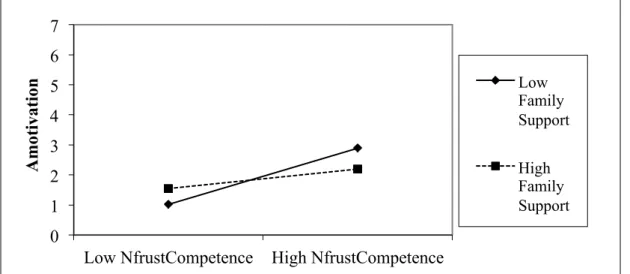
These interaction effects are represented in Figure 1. As expected, the association
between need frustration of competence and amotivation is higher in individuals with
low family support. On the other hand, when family support is high, need frustration
of competence has a weaker effect on amotivation. With this in mind, we can see that
results indicate that the highest level of amotivation to search for a job is found in
individuals who report high need frustration of competence and low family support,
Figure 2. Interaction effects of Family Support on the relationship between Need
Frustration of Competence and Amotivation
Although results show that need frustration of competence interacted with family
support to influence amotivation, they do not directly assess the proposed mediated
moderation. Therefore, we examined the conditional indirect effect of PsyCap on
Amotivation (through Need Frustration of Competence) at three levels of family
support (Table 3): the mean (0.00), one standard deviation above the mean (0.71), and
one standard- deviation below the mean (-0.71). Results supported a conditional
indirect effect of PsyCap on predicting amotivation via Need Frustration of
Competence when individuals reported higher levels of family support (Table 3).
They indicated that the three conditional indirect effects (based on moderator values
at mean, and +1 and -1 standard deviation) were negative and significantly different
from zero. Thus Hypothesis 4c was supported, such that the indirect and negative
effect of PsyCap on amotivation (through Need Frustration of Competence) was
stronger when levels of family support were higher.
Discussion
The main goal of this article was to study the mediated and conditional indirect
effects through which unemployed individuals’ psychological capital relate to
Amotivation to search for a job. Furthermore, this work also analyzed the mediation
effect of need frustration of autonomy, relatedness and competence, and included
family support as a relevant moderator variable in the hypothesized mediated
relationship. Though, this is the first study to include family support as an effective
tool to reduce Amotivation as a result of need frustration of autonomy, relatedness
and competence. Results have demonstrated that PsyCap is related to Amotivation. It
0 1 2 3 4 5 6 7
Low NfrustCompetence High NfrustCompetence
A
moti
vati
on Low Family
Support
was found a direct relationship through the combination of the positive psychological
constructs (Luthans, Avolio et al., 2007; Luthans, Youssef et al., 2007) and three
indirect ones via need frustration of autonomy, relatedness and competence. As
expected, individuals with high levels of PsyCap may be more satisfied, and so more
motivated to search for a new job (Luthans, Avolio et al., 2007). Generally,
individuals that show high levels of hope, optimism, self-efficacy and resilience to
succeed against adversity (Luthans, Avolio et al., 2007; Youssef & Luthans, in press),
show less levels of frustration of autonomy, relatedness and competence, because
according to SDT, they achieve a positive psychological state of mind that help them
to fulfill these three basic needs (Deci & Ryan, 2000). Need frustration of autonomy,
relatedness and competence, in turn, are positively associated with higher
Amotivation to search for a new job. Following this idea, results have demonstrated
that PsyCap is indirectly associated with amotivation through need frustration of
autonomy, relatedness and competence. When individuals are unemployed, they are
deprived from the satisfaction of the needs of autonomy, relatedness and competence
because they cannot receive the benefits from paid work (Jahoda, 1982; Creed &
Klisch, 2005). Therefore, they cannot establish a positive psychological well being, so
feeling more frustrated because of the non satisfaction of the basic needs, increasing
the amotivation to find a new job. And during these situations of crisis, family is
normally the one that helps other family members, without even anyone ask to do so,
because family can identify the need of help or support just by simply feeling
(Sarason, Sarason et al., 1986; Vrucinic, 2012). In this study, we follow the idea that
individuals with a stronger family support would be more protected from the negative
effect of the need frustration of autonomy, relatedness and competence, because the
role of the family members is to provide psychological and material resources, so that
the unemployed people feel more supported and more motivated (Mitchell, Billings et
al., 1982; Broadhead, Kaplan, James, Wagner, Schoenbach, Crimson, Heyden,
Tibblin & Gehlbach, 1983; Leavy, 1983; Cohen & Wills, 1985). However, results
indicate that only the positive association between need frustration of competence and
amotivation is attenuated when individuals report higher levels of family support.
Based on these interaction effects, we can assume that individuals acknowledge that
the amotivation to search for a new job they are experiencing is happening in part due
to having a negative PsyCap (lack of hope, optimism, resilience and self-efficacy),
autonomy, relatedness and competence, leading also, on the other hand, to the
amotivation in finding a new job. Therefore, the active effort of the family in
supporting their relatives that are in this situation of unemployment and frustration,
contributes positively to buffer the association between need frustration of
competence and amotivation. This can be explained by the fact that competence is
something that can be triggered by the family, because they can relate the competence
of their relatives by showing them other ways of demonstrating that they are
competent. On the other hand, relationships established at the workplace and feeling
autonomous by earning their own income are two needs much more difficult to be
triggered by the family, because are much more difficult to be satisfied when
individuals are not employed, and therefore, reducing the positive association of need
frustration of autonomy and relatedness in amotivation, not enhancing the
psychological well-being in the long term (Fredrickson, 2000). On the other hand,
contrary to what was expected, our results demonstrate that need frustration of
autonomy is not significantly associated with amotivation. According to SDT (Deci &
Ryan, 2000), the frustration of all the three needs should be associated with
performance and motivation, however, in our case, for autonomy this is not verified.
The absence of a significant association between need frustration of competence and
amotivation can be explained because when individuals are frustrated regarding
autonomy, they get more motivated to find a new job, because they need to have a
paid work in order to have a livelihood and feel useful in the society. So having no
financial autonomy is more than enough for not being significantly related to
amotivation. Future studies should analyze the relationship of the three needs for
autonomy, relatedness and competence regarding amotivation.Also contrary to what
was expected, family support doesn’t play an important role regarding the association
between need frustration of autonomy and relatedness, with Amotivation, and
regarding the indirect effect of PsyCap to Amotivation through need frustration of
autonomy and relatedness, because family can trigger idea of competence, but not the
relationships established at work neither the feelings of autonomy when having a paid
work. Therefore, future studies should focus on family support as a separate buffer
Limitations
The results obtained from this study should be interpreted taking into account some
weaknesses. Firstly, it can be verified a problem of cross sectional design, meaning
that, it was not developed a longitudinal study because the data was collected in one
single moment, which doesn’t allow establishing casual connections between the
research variables. Secondly, data were collected using self-reported questionnaires,
which can cause problems such as common method variance. However, since this
study aims to understand unemployed individuals emotional feelings related to
PsyCap, needs of autonomy, relatedness and competence, motivation to search for a
new job and perceptions of family support, self-reported data seem to be the most
appropriate way of applying the questionnaires, so that we managed to capture
individuals perceptions and considerations of these variables. Moreover, researchers
should be encouraged to develop longitudinal studies and gather information from
different sources, so that connections between variables can be effective. On the other
hand, regarding the respondents, the sampled group collected was not representative,
raising queries about generalization of the results. As a fourth limitation of this
present study is the nature of the family ties that couldn’t be measured, meaning that
we couldn’t distinguish if the respondents were referring to family support from
parents, siblings, spouse or other relatives or type of social support (Cohen & Wills,
1985). And given the relevance of the deprivation model regarding the psychological
well-being and benefits of employment, we were unable to control possible
confounding effects of the variables. Accordingly, since each need frustration should
be determinant for Amotivation, the moderator variable should be clearly defined as a
mitigating buffer. Future studies should, therefore, include variables to provide a
more reliable analysis of the role of family as a moderator variable. Researchers
should work towards examining this link in an empirical way. Furthermore, picking
up other division of needs, like for example the ones from Abraham Maslow (1943)
or David McClelland (1965), it would be really interesting to investigate if individuals
with those different natures of needs frustrated could be different in terms of the
Implications for Practitioners and Theory
This study posits important implications for practitioners. From our results, it seems
that psychological capital is associated with need frustration of autonomy, relatedness
and competence; however, no empirical studies have related this with unemployment.
Therefore, this would be a major contribution for practitioners, because when hiring
people, employers should pay more attention not only to the candidates’ curriculum
vitae but also to their soft skills and psychological capital and promote the
development of these additional skills. So it is important to understand which are the
factors and actions that help unemployed people to create a positive psychological
capital mindset to create a more inclusive and sustainable society, as well as reducing
the inequalities unemployment generates (Horizon 2020).
Another important plus of this study is the contribution of the role of the family for
the relationship between the frustration of the three basic needs and amotivation,
working as a moderator to reduce or increase the strength of this relationship. Would
be relevant to study the clear contribution of the support from the family individually
in each frustrated need regarding the lack of motivation, and demonstrate if there are
some differences in the impact of the family depending on the need that we are
referring to.
On the other hand, this study also posits important implications for theory. Using the
SDT to explain the amotivation to find a new job has never been studied before,
though making the bridge between these two fields would be a major contribution for
the literature of unemployment. What SDT defends is that individuals work towards
goals and challenges, and not having a positive psychological mindset means
frustration of the needs for autonomy, relatedness and competence, and therefore, not
motivated to pursue the goals (Warr, Jackson & Banks, 1988; Winefield, Winefield,
Tiggeman & Goldney, 1991; Welters, Mitchell et al., 2014), like searching for a job.
Following this idea, the relationship between psychological capital and need
frustration of the three needs regarding unemployed people, meaning that individuals
with positive PsyCap constructs (more hope, optimism, resilience and self-efficacy
(Luthans & Youssef, 2004; Luthans, Avolio et al., 2007)) are referred to have less
need frustration of autonomy, relatedness and competence, because with these
positive constructs unemployed individuals are willing to overcome this frustration
and motivate themselves to find a new job (Luthans, Avolio et al., 2007; Luthans &
resource and psychological capacity for unemployed individuals, in order to boost
performance and motivation (Luthans, 2002b) through the reduction of frustration of
the basic needs.
Conclusion
The purpose of our research was in the beginning to build an integrative framework
linking psychological capital and amotivation to search for a job literature with need
frustration of autonomy, relatedness and competence, and family support. The first
conclusion taken was that a positive psychological capital constructs are vital in
affecting individuals motivation to search for a job. However, this article advances the
existing literature by putting upfront a theoretical model and considering the study of
a mediated moderation effects through which positive psychological capital leads to
lower levels of amotivation to search for a job. In addition, we feature the importance
of family support, and the strategies they use to support their relatives, in order to
reduce the positive association between need frustration of autonomy, relatedness and
competence, with amotivation. Part of those strategies, are considered material and
psychological resources, emotional support, feelings of belonging, warmth (Sarason,
Sarason et al., 1986). We confirmed that role of the family have the potential to buffer
the negative effect of need frustration of competence on amotivation, and condition
the indirect effects of Psycap on amotivation through the frustration of the need for
competence.
References
Aiken, L. S., & West, S. G. (1991). Multiple regression: Testing and interpreting
interactions. Newbury Park, CA: Sage.
Avey, J. B., Reichart, R., Luthans, F., & Mhatre, K. (2011). Meta-analysis of the
impact of positive psychological capital on employee attitudes, behaviors and
performance. Human Resource Development Quarterly, 22, 127–152.
Bandura, A. (1998). Personal and collective efficacy in human adaptation and change.
In Adair JG, Belanger D, Dion KL (Eds.), Advances in psychological science (Vol.
Baron, R. M., & Kenny, D. A. (1986). The moderator–mediator variable distinction in
social psychological research: Conceptual, strategic, and statistical considerations.
Journal of Personality and Social Psychology, 51, 1173–1182.
Broadhead, W. E., Kaplan, B. H., James, S. A., Wagner, E. H., Schoenbach, V. J.,
Crimson, R., Heyden, S., Tibblin, G., & Gehlbach, S. H. (1983). The
epidemiologic evidence for a relationship between social support and health.
American Journal of Epidemiology, 117, 521- 537.
Chen, B., Vansteenkiste, M., Beyers, W., Boone, L., Deci, E. L., Duriez, B., Lens,
W., Matos, L., Mouratidis, A., Ryan, R. M., Sheldon, K. M., Soenens, B., Van
Petegem, S., & Van der Kaap-Deeder, J., Verstuyf, J (2015). Basic psychological
need satisfaction, need frustration, and need strength across four cultures.
Motivation and Emotion.
Cohen, S., & Wills, T. A. (1985). Stress, Social Support, and the Buffering
Hypothesis. Psychological Bulletin (Vol. 98, No 2, pp. 310-357).
Creed, P. A., & Klisch, J. (2005). Future Outlook and Financial Strain: Testing the
Personal Agency and Latent Deprivation Models of Unemployment and
Well-Being. Journal of Occupational Health Psychology (Vol. 10, No. 3, pp. 251–260).
Deci, E., & Ryan, R. (2000). The ‘‘What’’ and ‘‘Why’’ of goal pursuits: Human
needs and the self-determination of behavior. Psychological Inquiry, 4, 227–268.
Fredrickson, B. L. (2000). Cultivating positive emotions to optimize health and
wellbeing. Prevention & Treatment, 3. Retrieved from
http://dx.doi.org/10.1037//1522 -3736.3.1.31a (Article 1).
Fredrickson, B. L., & Joiner, T. (2002). Positive emotions trigger upward spirals
toward emotional wellbeing. Psychological Science, 13, 172–175.
Gagné M., Forest J., Vansteenkiste M., Crevier-Braud L., Van den Broeck A., Aspeli
A. K., Bellerose J., Benabou C., Chemolli E., Güntert S. T., Halvari H., Indiyastuti
D. L., Johnson P. A., Molstad M. H., Naudin M., Ndao A., Olafsen A. H., Roussel
P., Wang Z., & Westbye C. (2014). The Multidimensional Work Motivation Scale:
Validation evidence in seven languages and nine countries. European Journal of
Work and Organizational Psychology (Vol. 24, No 2, pp. 178-196).
Gagné, M., Forest, J., Gilbert, M. H., Aubé, C., Morin, E., & Malorni, A. (2010). The
Motivation at Work Scale: Validation evidence in two languages. Educational and
Gastil, R. D. (1961). The Determinants of Human Behavior. American
Anthropologist, New Series (Vol. 63, No 6, pp. 1281-1291)
Gropel, P., & Kuhl, J. (2009). Work-life balance and subjective well-being: The
mediating role of need fulfillment. British Journal of Psychology (2009), 100, 365–
375
Hayes, A. F. (2012). An analytical primer and computational tool for observed
variable moderation, mediation, and conditional process modeling. Retrieved from
http:// www.afhayes.com/public/process2012.pdf
Horizon (2020). Societal Challenges
Jahoda, M. (1982). Employment and unemployment: A social-psychological analysis.
Cambridge, England: Cambridge University Press.
King, L. A., Mattimore, L. K., King, D. W., & Adams, G. A. (1995). Family Support
Inventory for Workers: A new measure of perceived social support from family
members. Journal of Organizational Behavior (Vol. 16, No 3, pp. 235-258).
Kokko, K., & Pulkkinen, L. (1997). Economical and psychological well-being of the
unemployed. Psykologia, 32, 349–359.
Latham, G., & Pinder, C. (2005). Work motivation theory and research at the dawn of
the twenty- first century. Annual Review of Psychoiogy, 56, 485-516.
Leavy, R. L. (1983). Social support and psychological disorder: A review. Journal of
Community Psychology, 11, 3-21.
Luthans, B. C., Luthans, K. W., & Jensen, S. M. (2012). The Impact of Business
School Students’ Psychological Capital on Academic Performance. Journal of
Education for Business, 87, 253-259.
Luthans, F. (2002a). The need for and meaning of positive organizational behavior.
Journal of Organizational Behavior, 23, 695-706.
Luthans, F. (2002b). Positive organizational behavior: Developing and managing
psychological strengths. Academy of Management Executive, 16(1), 57-72.
Luthans, F., & Youssef C. M. (2004). Human, social, and now positive psychological
capital management. Organizational Dynamics, 33, 143–160
Luthans, F., & Youssef C. M. (2007). Emerging positive organizational behavior.
Journal of Management, 33, 321–349.
Luthans, F., Avolio, B. J., Avey, J. B., & Norman, S. M. (2007). Positive
Psychological Capital: Measurement and Relationship with Performance and
Luthans, F., Luthans, K., & Luthans, B. (2004). Positive psychological capital: Going
beyond human and social capital. Business Horizons, 47(1), 45-50.
Luthans, F., Youssef C. M., & Avolio B. J. (2007). Psychological capital. New York:
Oxford University Press.
Lyubomirsky, S., Sheldon, K. M., & Schkade, D. (2005). Pursuing happiness: The
architecture of sustainable change. Review of General Psychology, 9, 111-131.
MacKinnon, D. P., Lockwood, C. M., & Williams, J. (2004). Confidence limits for
the indirect effect: Distribution of the product and resampling methods.
Multivariate Behavioral Research, 39, 99–128.
Maslow, A. (1943). A theory of human motivation. Psychological Review, 50, 370.
McClelland, D. C. (1965). Achievement and entrepreneurship: A longitudinal study.
Journal of Personality and Social Psychology, 14, 389-392.
Ministry of Health Report (2015)
Mitchell, R. E., Billings, A. G., & Moos, R. H. (1982). Social support and well-being:
Implications for preven- tion programs. Journal of Primary Prevention, 3, 77- 98.
Muller, L., Hicks, R., & Winocur, S. (1993). The effects of employment and
unemployment on psychological well-being in Australian clerical workers: Gender
differences. Australian Journal of Psychology, 45(2), 103-108.
Murphy, G. C., & Athanasou, J. (1999). The effects of unemployment on mental
health. Journal of Occupational and Organizational Psychology, 72, 83–100.
OECD (2015). Unemployment
Paul, K. I. & Moser, K. (2009). Unemployment impairs mental health: Meta-analyses.
Journal of Vocational Behavior, 74, 264-282.
Preacher, K. J., Rucker, D. D., & Hayes, A. F. (2007). Assessing moderated
mediation hypotheses: Theory, method, and prescriptions. Multivariate Behavioral
Research, 42, 185–227.
Ryan, R. M., & Deci, E. L. (2000). Self-determination theory and the facilitation of
intrinsic motivation, social development, and well-being. American Psychologist,
55, 68–78.
Sarason, I. G., Sarason, B. R., & Shearin, E. N. (1986). Social Support as an
individual difference variable: Its stability, origins and relation aspects. Journal of
Personality and Social Psychology, 50, 1222-1225.
Snyder, C. R. (2002). Hope theory: Rainbows in the mind. Psychological Inquiry,
13(4), 249–276.
Sobel, M. (1982). Asymptotic confidence intervals for indirect effects in structural
equations models. In S. Leinhart (Ed.), Sociological methodology, 290–312
Stajkovic, A. D., & Luthans, F. (1998). Self-efficacy and work-related performance:
A meta-analysis. Psychological Bulletin, 124, 240– 261.
Sutcliffe, K. M., & Vogus, T. A. (2003). Organizing for resilience. Positive
organizational scholarship: Foundations of a new science, 94-110.
Vansteenkiste, M., & Ryan, R. M. (2013). On psychological growth and vulnerability:
Basic psychological need satisfaction and need frustration as an unifying principle.
Journal of Psychotherapy Integration, 3, 263-280.
Vansteenkiste, M., Lens, W., De Witte, S., De Witte, H., & Deci, E. L. (2004). The
“why” and “why not” of job search behaviour: Their relation to searching,
unemployment experience, and well-being. European Journal of Social
Psychology, 34, 345–363.
Vrucinic, Z. (2012). Social Support and Unemployment. doi:10.5570/dfnd.en.1231.06
Walumbwa, F. O., Luthans, F., Avey, J. B., & Oke, A. (2011). Authentically leading
groups: The mediating role of positivity and trust. Journal of Organizational
Behavior, 32, 4–24.
Warr, P., Jackson, P., & Banks, M. (1988). Unemployment and mental health: Some
British studies. Journal of Social Issues, 44, 47–68.
Waters, L. E., & Moore, K. A. (2002). Reducing latent deprivation during
unemployment: The role of meaningful leisure activity. Journal of Occupational
and Organizational Psychology, 75, 15–32.
Welters, R., Mitchell, W., & Muysken, J. (2014). Self determination theory and
employed job search. Journal of Economic Psychology, 44, 34–44.
Winefield, A., Winefield, H., Tiggeman, M., & Goldney, R. (1991). A longitudinal
study of the psychological effects of unemployment and unsatisfactory
employment on young adults. Journal of Applied Psychology, 76, 424–431.
Youssef, C. M., & Luthans, F. (in press). Positive organizational behavior in the