The impact of excess choice on deferment of decisions to volunteer
Lauren S. Carroll
∗Mathew P. White
†Sabine Pahl
‡Abstract
Excess choice has previously been shown to have detrimental effects on decisions about consumer products. As the number of options increases, people are more likely to put off making an active choice (i.e., defer) and show less satisfaction with any purchase actually made. We extend this line of enquiry to choosing a charitable organisation to volunteer for. The issue is important because the number of voluntary organisations is enormous and the impact of such a decision may be greater than for consumer decisions in terms of time commitment and benefits to the volunteer and society. Study 1 asked students to examine a real volunteering website and record how many organisations they considered, decision difficulty and whether or not they would like to sign up for a chosen organisation or prefer to defer a decision. Study 2 presented either a relatively small (10) or large (30) choice set of hypothetical organisations and measured deferment likelihood and decision difficulty. In both studies the more options considered, the greater the likelihood to defer. This effect was mediated by decision difficulty. This research is the first to find that detrimental effects of excess choice extend to volunteering. Implications for volunteer recruitment are discussed.
Keywords: choice, volunteering, excess, defer, recruitment.
1
Introduction
Western societies place great value on the provision of extensive choice (Schwartz, 2004). Choice, it is argued, enhances the ability to match individual preferences to outcomes (Botti & Iyengar, 2004), is associated with feel-ings of personal autonomy and well-being (Ryan & Deci, 2001), and people tend to react negatively when choice is restricted (Fitzsimons, 2000). However, the benefits of extensive choice need to be considered alongside po-tential costs. Research suggests, for instance, that too much choice may encourage confusion and choice de-ferment (Arunachalam, Henneberry, Lusk & Norwood, 2009; Iyengar & Lepper, 2000; Shah & Wolford, 2007; Tversky & Shafir, 1992) as well as a reduction in satisfac-tion with chosen opsatisfac-tions (Haynes, 2009; Iyengar & Lep-per, 2000). Moreover, economic theory has long recog-nised that as options become more similar the opportunity costs of the next best alternative foregone also rise. This tension between wanting more options but finding them difficult to deal with has been referred to as the Paradox
This research forms part of the first author’s PhD, funded by a Uni-versity of Plymouth Faculty of Science and Technology studentship and supervised by the second and third authors. We are grateful to Lynne James and Anthony Mee for help with programming, and to Ali Evans for helping to recruit additional subjects in Study 2.
∗Link 301, School of Psychology, University of Plymouth, Drake
Circus, PL4 8AA, Devon, UK. Email: [email protected]
†European Centre for Environment and Human Health, University
of Exeter
‡University of Plymouth
of Choice (Schwartz, 2004).
To date, however, much of this research has focused on consumer decision making for products such as jams, chocolates, pens, soft drinks, sweets, gift boxes and mu-sic (see Scheibehenne, Greifeneder & Todd, 2010, for a review) and we still know very little about whether the paradox of choice exists for more consequential decisions (although see Iyengar, Huberman & Jiang, 2004). The aim of the current research was to investigate whether extensive choice undermines decision making with re-spect to a potentially more meaningful decision context, namely choosing an organisation to volunteer for. Vol-unteering one’s time without concern for financial gain is a serious time commitment for many individuals, which has been linked to a range of volunteer benefits such as greater life satisfaction, improved health, skill develop-ment and better job prospects (Borgonovi, 2008; Meier & Stutzer, 2008), as well as obvious benefits for others. Consequently, the implications for the individual of de-ciding which organisation to volunteer for are potentially much larger than for many of the consumer contexts ex-plored previously.
Like many of these consumer contexts, however, the charity and volunteer sector is one where excess choice abounds. For example 164,000 charities are registered in the UK alone (Cabinet Office, 2008). Moreover, the National Centre for Social Research and the Institute for Volunteering Research (NCSR, 2007) estimates that the economic benefit of UK volunteering is around £40
lion annually. The current UK government has placed in-creased volunteering at the heart of its Big Society agenda (Cabinet Office, 2010). If this plethora of organisations is indeed detrimental for volunteer recruitment this could have a major effect on service delivery and the success of the Big Society and other similar initiatives. Understand-ing how people make decisions about selectUnderstand-ing volunteer organisations and how best to structure these choices to aid people’s decision making could therefore have con-siderable policy implications.
For research into volunteer recruitment, students are a very important population to investigate. This is an age and stage of life when many people begin volunteering for the first time. In the UK, for instance, around 15% of first year students (Holdsworth, 2010) and more than 42,000 students in total volunteer each year through or-ganised volunteering programmes at their Higher Educa-tion InstituEduca-tions (Student Volunteering England [SVE], 2004). Key motivations include wanting to learn new skills (55.9%) and to gain experience for their future ca-reer (44.5%; SVE, 2004). The contribution to the econ-omy is estimated to be around £34 million pounds (wage equivalent at 2003 values, SVE, 2004). Importantly stu-dents also tend to continue volunteering after leaving col-lege. In the US, College graduates were more likely to volunteer (24.4%) than people without college experi-ence (8.3%) and were also more likely to still be volun-teering later in life (Marcelo, 2007a, 2007b).
The present studies focus on the potential of exten-sive choice to increase the likelihood that individuals will put off making an immediate decision and instead defer a decision to later. Given the general propensity not to revisit deferred decisions (Ariely & Wertenbroch, 2002) this could have important implications forvolunteer re-cruitment. Our primary hypothesis was that as the num-ber of organisations considered by potential volunteers increases, the likelihood that they will state a preference to defer the decision will also increase. In Study 1, sub-jects were asked to explore one of the main UK volunteer-ing websites and choose which organisation they would most like to volunteer with. The association between the number of options considered and deferment likeli-hood was then tested. Study 2 presented subjects with either a large or relatively small choice set of hypotheti-cal organisations, and deferment preferences were again recorded. Our secondary hypothesis was that feelings of confusion, difficulty and lack of confidence during the de-cision process might mediate this effect (Chernev, 2003; Scheibehenne, Greifeneder, & Todd 2009).
2
Study 1: The association between
number of options considered and
decision deferment for real
volun-teer organisations
Study 1 asked students who were not currently volunteer-ing to explore the Volunteervolunteer-ing England website. The website is one of the leading sources of information about volunteering in the UK and at the time of the study pre-sented detailed information on over 100 organisations. Subjects were asked to record the number of organisa-tions they looked at and short listed and asked several questions about the decision process. Our key dependent variable was whether website viewers felt, by the end of their exploration, that they were ready to make a decision or would prefer to put it off until later. Our main hypoth-esis was that the more organisations people considered the less likely they would be willing to choose any spe-cific organisation. The secondary hypothesis was that this process would be mediated by how difficult subjects re-ported the decision making process to be.
2.1
Method
2.1.1 Subjects
Fifty-two undergraduate Psychology students at the Uni-versity of Plymouth (43 females, 9 males;Mage = 20yrs) took part in the study. They were recruited via the Univer-sity’s participation points system which encourages stu-dents to take part in studies in return for course credit. Students were eligible to take part in the study only if they were not currently volunteering (to eliminate the possi-bility that current volunteers would just pick the organi-sation they were already volunteering with).
2.1.2 Procedure and materials
Subjects entered a lab in the psychology department and were briefed. They were then sat in front of a PC screen showing the Volunteering England website (www.volunteering.org.uk), specifically the Volunteering in the UK section (to avoid them selecting exotic but un-realistic opportunities overseas). They were requested to stay in the Volunteering in the UK section and not fol-low links to the individual organisations websites. On the website there were one hundred and fifteen different volunteering opportunities arranged across nine different categories (e.g., environmental, social care etc.)1. Within each category, volunteering organisations were listed al-phabetically, the organisation name in bold followed by a
1Since this study was conducted the format of the website has
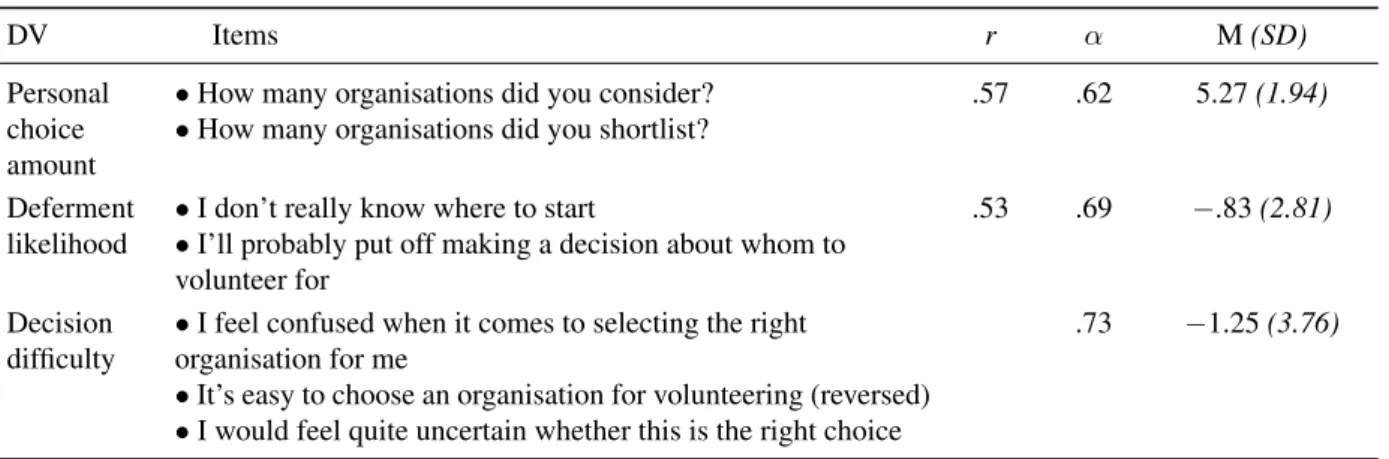
Table 1: Items,α’s and means for Personal Choice Amount, Deferment Likelihood and Decision Difficulty scales
DV Items r α M(SD)
Personal choice amount
•How many organisations did you consider? •How many organisations did you shortlist?
.57 .62 5.27(1.94)
Deferment likelihood
•I don’t really know where to start
•I’ll probably put off making a decision about whom to
volunteer for
.53 .69 −.83(2.81)
Decision difficulty
•I feel confused when it comes to selecting the right
organisation for me
•It’s easy to choose an organisation for volunteering (reversed) •I would feel quite uncertain whether this is the right choice
.73 −1.25(3.76)
Note: All items (apart from personal choice amount) were presented on a scale ranging from -3 (totally disagree) to 3 (totally agree)
description of the organisation and what volunteers could do. Subjects were given 5 minutes to explore the web-site, to consider as many options as they liked and pick the organisation they would most like to volunteer with. Choosing time was limited to 5 minutes as we believed this would be sufficient time for subjects to reach their decision. Boyce, Dixon, Fasolo and Reutskaja (2010) found that even for an important decision such as choos-ing which hospital to get treated at for a serious non-urgent knee problem needing surgery, people only took 2.7 minutes to make their decision. They were then asked a series of questions.
First, subjects were asked “How many organisations did you consider” and “How many organisations did you shortlist”. The majority of people said they looked at between 10–15 options. Nevertheless there was consid-erable variance around this mean with 21% of subjects looking at fewer than 10 and 38% looking at more than 15 options. Thirty nine per cent shortlisted between 0–3 options, 45% shortlisted between 3–5 and 15.69% short-listed between 5–8 options. Since the number of options considered and the number shortlisted were highly corre-lated (r= .57;α= .622) these two scores were collapsed to form a single “Personal Choice Amount” variable such that higher scores indicated more options in the person’s own choice set.
Our key dependent variable was deferment likelihood; how likely people were to say that they were not sure which organisation they would choose and would there-fore put off making a decision about which organisation to volunteer with. We were also interested in how diffi-cult people found the decision making process. Items for
2Cronbach’s
α(alpha) is a coefficient of reliability used to measure the extent to which items in a scale correlate with one another (Cron-bach, 1951).
Figure 1: Regression models predicting Deferment Like-lihood for volunteering in Study 1 (Solid Lines, top) and Study 2 (Dashed lines, bottom).
Choice Amount
Decision Difficulty
Decision Difficulty
Deferment Likelihood .31*
.16*
.30* (.08ns
)
.14* (.07ns
)
.68***
.43*** ns
= not significant * = p < .05 *** = p < .001 Study 1
Study 2
deferment likelihood and decision difficulty, their means and reliabilities are presented in Table 1.3
2.2
Results and discussion
In line with our main hypothesis, there was a significant positive correlation, r = .30, p = .03 between personal choice amount and deferment likelihood. The more op-tions subjects considered and shortlisted the more likely they were to say they did not know where to start and to want to defer a decision. To test the potential medi-ating role of Decision Difficulty we carried out a three step regression model (Baron & Kenny, 1986). Personal Choice Amount predicted both deferment likelihood in Step 1 (β = .30, p = .03), replicating the correlational analysis, and also decision difficulty in Step 2 (β = .31,
p = .03). When both variables were entered in Step 3, the effect of personal choice amount was reduced to non-significance while that of decision difficulty was highly significant (see Table 2 and Figure 1).
These findings support our contention that the more volunteering options that people consider, the more
dif-3Additional exploratory items not directly related to the current
Table 2: Summary of the unstandardised Bs (Standard Errors), and standardised beta weights and p values for Choice Amount and Decision Difficulty regressed against Deferment Likelihood in Study 1.
Step 1
(Predicting deferment)
Step 2
(Predicting difficulty)
Step 3
(Predicting deferment)
B (SE) β p B (SE) β p B (SE) β p
Choice Amount .39 (.18) .30 .03 36 (.16) .31 .03 .11(.14) .08 .43
Decision Difficulty − − − − − − .77 (.12) .68 <.001
F 4.79 5.30 25.52
R2adjusted .07 .08 .49
ficult they find the decision making process and the more likely they are to want to put off making any decision. This is further supported by comments made by a num-ber of subjects after the main part of the study was over about how their decision could have been made easier, for instance; “Fewer options”, “The organisations could have been put in a more specific category”, “What made my decision difficult was the fact that many organisations were quite similar, so it was difficult to choose one out of the many ones you could choose from”, “By putting the organisations into more specific categories so there was less to look at and take in at one time” and “Simple step by step choices suiting your attributes to a volunteering option”.
Despite these early indications of the potential prob-lem of too much choice when faced with the real vol-unteering sector, the study had a number of limitations in terms of testing our hypotheses. First, all subjects had the opportunity to view up to 115 organisations and while there was considerable variation in the number people said they considered we had no objective way of checking this. Second, the relationship between this self-reported number and deferment likelihood may be accounted for by a third variable such as perceived decision impor-tance which might have influenced both search strat-egy and deferment. Third, individual differences may have caused subjects to view and deal with the amounts of organisations differently. For instance, according to Schwartz, Ward, Monteroso, Lyubomirsky, White and Lehman (2002) some people are maximisers and will strive to find the best possible option for them. They find choosing from large choice sets difficult and time-consuming. Other people are satisficers and make-do with the first option that meets their expectations. They do not find choosing from large choice sets as difficult as maximisers as once they have found an option that meets their criteria they stop searching. With regards to Study 1, maximisers would be more likely to consider a greater number of organisations than satisficers essentially
con-founding individual differences and choice set size in this cross-sectional approach. Finally, we took no account of people’s prior familiarities or preferences for differ-ent real world organisations (Scheibehenne et al., 2009; Soyer & Hogarth, 2011). For these reasons we conducted a second, more controlled, experimental study that pre-sented subjects with either a relatively small (10) or large (30) number of different organisations (Iyengar & Lep-per, 2000). Moreover, the organisations presented were hypothetical rather than real to reduce the potential effect of prior preferences (e.g., Chernev, 2003).
3
Study 2: Deferment likelihood for
few versus many hypothetical
vol-unteer organisations
Study 2 experimentally manipulated the number of or-ganisations seen by subjects so that they saw either a relatively small choice set (10 options) or a large choice set (30 options). We predicted that subjects who could choose from 30 hypothetical volunteer organisa-tions would be more likely to want to defer any decision than those presented with 10 options and that again this process would be mediated by the self-reported decision difficulty.
3.1
Method
3.1.1 Subjects
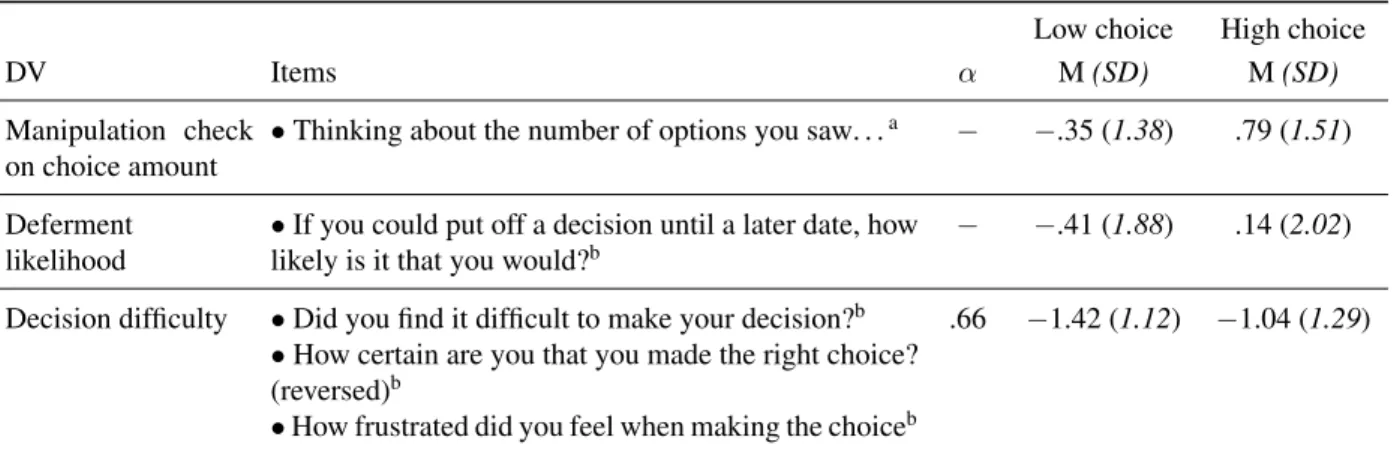
Table 3: Items,α’s and means for Manipulation check, Deferment Likelihood and Decision Difficulty scales.
Low choice High choice
DV Items α M(SD) M(SD)
Manipulation check on choice amount
•Thinking about the number of options you saw. . .a − −.35 (1.38) .79 (1.51)
Deferment likelihood
•If you could put off a decision until a later date, how
likely is it that you would?b − −
.41 (1.88) .14 (2.02)
Decision difficulty •Did you find it difficult to make your decision?b •How certain are you that you made the right choice?
(reversed)b
•How frustrated did you feel when making the choiceb
.66 −1.42 (1.12) −1.04 (1.29)
a
Presented on a scale ranging from -3 (I felt that I had too few options to choose from) to +3 (I felt that I had too many options to choose from).
bPresented on a scale ranging from -3 (not at all) to +3 (extremely).
3.1.2 Procedure and materials
Following an introductory brief, subjects sat in front of a computer and were logged into the study. There they were asked to imagine that they had four hours spare a week that they had decided to use to volunteer for a lo-cal charity. It should be noted that different amounts of time allocated to volunteering as well as the number of volunteering organisations on offer may elicit differences in deferment likelihood. However, for the purposes of this first experimental study investigating the relationship between the amount of options and deferment likelihood we thought it best to standardise the expected amount of time spent volunteering per week for all subjects. The amount of four hours was based on the actual require-ment for various volunteer organisations such as Samar-itans (Pahl, White & Carroll, 2010). Subjects were in-structed that they would be presented with some volun-teering organisations and should look through the differ-ent volunteering opportunities for as long as they wanted and should choose which organisation they would most like to volunteer with. On proceeding, the programme randomly allocated them to either the relatively low (10) or high (30) choice condition.
Though the organisations were hypothetical they aimed to replicate the diverse range of real world teering opportunities in Study 1. Specifically ten volun-teering categories were created (Animal Welfare, Cam-paigning, Charity, Companionship, Disability, English Heritage, Environmental, Food, Support and Young Peo-ple) with three organisations in each category. Subjects were not made aware of these underlying categories as this can affect choosing behaviour (Mogilner, Rudnick & Iyengar, 2008).
In the high choice condition subjects saw the names
of all 30 organisations on the screen and were invited to click as many as they liked to reveal information about the aims or the organisations and what roles/activities volun-teers could expect to carry out. Each time a name was clicked it was recorded by the programme, to monitor how many organisations were considered in more depth. The location of the organisations on the screen was allo-cated randomly for each subject. A similar process oc-curred for subjects in the relatively low choice condition but only 10 organisations (one from each of the ten cate-gories, to ensure variety within the choice set) were ran-domly selected and displayed on the screen.4 There was no time limit on how long subjects could take to make their decision. These hypothetical organisations appeared to be a good representation of those in the real world since twenty-nine of the thirty were selected by at least one subject.
Subjects were asked to select their preferred organisa-tion but were also asked several other quesorganisa-tions (Table 3).
3.2
Results and discussion
A manipulation check confirmed that subjects in the rel-atively low choice condition viewed 10 options as “too few” compared to zerot(102) =−2.56,p< .01 and
sub-jects in the high choice condition viewed 30 options as “too many”, compared to zerot(102) = 5.28, p< .001. Subjects in the high choice condition (M = 108.58s,SD
4Subjects were further divided into those that either had to make the
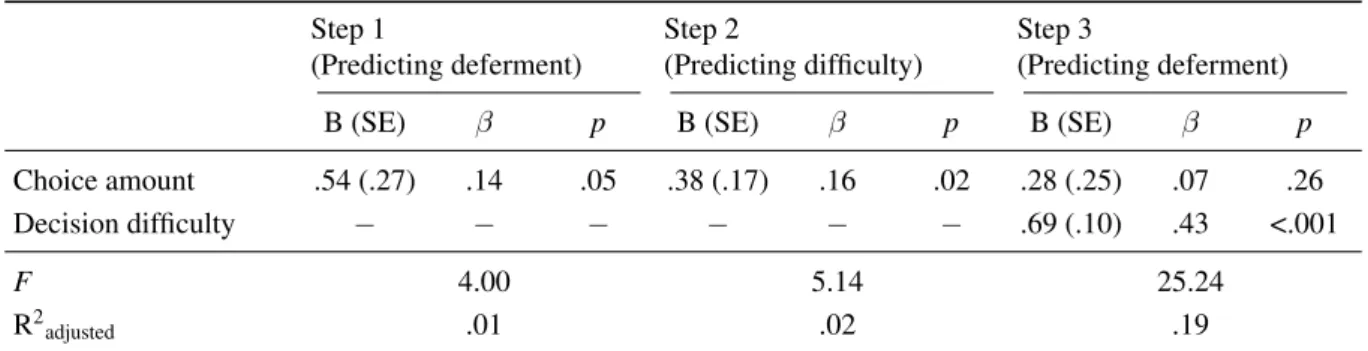
Table 4: Summary of the unstandardised Bs (Standard Errors), and standardised beta weights and p values for Choice Amount and Decision Difficulty regressed against Deferment Likelihood in Study 2.
Step 1
(Predicting deferment)
Step 2
(Predicting difficulty)
Step 3
(Predicting deferment)
B (SE) β p B (SE) β p B (SE) β p
Choice amount .54 (.27) .14 .05 .38 (.17) .16 .02 .28 (.25) .07 .26
Decision difficulty − − − − − − .69 (.10) .43 <.001
F 4.00 5.14 25.24
R2adjusted .01 .02 .19
= 46.06s) also took longer to make their choice than sub-jects in the relatively low choice condition (M= 82.18s,
SD= 38.52),F(1, 194) = 19.07,p< .001,ηp2= .09.5
Fur-ther, subjects in the relatively low choice condition (M= 7.92, SD = 4.35) looked at fewer organisations (including re-looks) than subjects in the high choice condition (M= 13.71, SD = 12.26), F(1,204) = 20.38, p < .001, ηp2 =
.09.
Supporting predictions subjects presented with 30 op-tions were more likely to want to defer their decision than those shown 10 options,t(204) = 1.99,p = .05. More-over, subjects reported greater decision difficulty when presented with 30 than 10 options,t(204) =−2.27,p =
.02. As with Study 1, subjects’ responses as to how their choices could have been made easier indicated the prob-lems of choosing from unstructured choice sets, similar options and large numbers of options. Intriguingly these issues were raised in both the relatively low and high choice conditions.
As with Study 1 a regression analysis was carried out to examine the extent to which decision difficulty medi-ated the effect of choice amount on deferment likelihood (Table 4). The first two steps are analogous to the two t-tests presented above. When both variables were en-tered in Step 3, the effect of choice amount was reduced to non-significance while that of decision difficulty was highly significant (see Table 4 and Figure 1).
4
General discussion
Most research into the excess choice effect has examined the impact of choice amount on people’s reactions to sim-ple material products such as pens and chocolates and concluded that people tend to be more likely to put off
5This analysis excludes ten subjects whose mean decision time was
more than two standard deviations from their condition mean. The comparison remains significant with the inclusion of these ten subjects (F(1,204) = 19.56,p< .001,ηp2= .09) but provides less meaningful
estimates of mean decision time due to the negative skew.
making a decision or are less satisfied with their choice if faced with more options (Arunachalam et al., 2009; Iyengar & Lepper, 2000; Shah & Wolford, 2007). More recently, researchers have tried to understand why the ef-fect has been hard to replicate and have begun to inves-tigate potential moderators (Scheibehenne et al., 2009; 2010). The current research extends this literature by fo-cusing not on a choice about material possessions but on a choice concerning how one spends one’s time, mak-ing it an “experiential” choice (Van Boven & Gilovich, 2003). Specifically, we wondered whether being faced with the large number of charitable organisations seek-ing volunteers might adversely affect an individual’s de-cision process when considering volunteering options. Volunteering has a number of benefits both for society and the volunteer themselves (Borgonovi, 2008; Meier & Stutzer, 2008; NCSR, 2007). Understanding whether excess choice in this context interferes with volunteer re-cruitment may be important in the success of initiatives to encourage greater social participation.
Study 1 found that the more options subjects examined on the Volunteering England website, the more likely they were to want to defer making any concrete decision. This hesitation seemed to be related to increased levels of confusion and difficulty when considering and short-listing many vs. relatively few options. To reduce poten-tial confounds and prior preferences associated with the real organisations used in Study 1, Study 2 presented ei-ther 10 (relatively few) or 30 (many) hypothetical organ-isations. Results replicated Study 1. Subjects presented with 30 options reported greater decision difficulty and a higher desire to defer making a decision than those pre-sented with 10 options. As far as we are aware this is the first time that the excess choice effect has been clearly demonstrated for an experiential choice (Van Boven & Gilovich, 2003; Carter & Gilovich, 2010).
Iyengar and Lepper (2000, Study 2) demonstrated that students presented with many vs. few essay titles wrote objectively poorer essays. Further, Iyengar et al. (2004) reported that deferment of decisions about pension in-vestment was more likely the higher the number of po-tential funds. Of particular relevance to the current stud-ies, Scheibehenne et al. (2009) examined people’s will-ingness to donate to charity. In one study (Study 2c) they found that subjects were less likely to donate a Euro when they had seen 40 or 80 organisations than 5. In part this seemed to be because subjects found it harder to justify their selection from more options. Two further studies failed to replicate this effect.
Soyer and Hogarth (2011) extended Scheibehenne et al.’s (2009) research by considering how individuals might split a larger donation (50 Euros) among multi-ple organisations (or multimulti-ple campaigns of a single or-ganisation). Replicating Scheibehenne et al. (2009) they found that organisation familiarity was correlated with donation amount: Better known organisations received larger donations. Of particular relevance to the current findings they also found that more people donated at least something, i.e., chose at least one organisation to give something to, as the number of organisations increased. This appears to contrast with our own finding that de-ferment may be more likely as the number of charities increases. There are a number of possible reasons for this discrepancy. First, in Soyer and Hogarth’s study peo-ple simply decided to donate any winnings or not, they were not asked whether they might want to defer a deci-sion. Second, the number of options in their large choice sets (16/13) were closer to our small choice set (10) and it may be that decision paralysis would be more likely with 30 organisations to donate to (see Scheibehenne et al., 2009). Finally, although both studies concern choices regarding charitable organisations we still do not know how donations of time (volunteering) and money differ psychologically, a question which further research could address.
Our findings raise the more general question of whether there are simply too many volunteer organisa-tions now. The answer is that it probably depends. Diehl and Poynor (2010) for instance argue that when people have strong prior preferences they are able to deal with a large choice set, precisely because they are more likely to be able to find a match for these preferences. None of the subjects in Study 1 were currently volunteering, which suggests that they did not have clear prior prefer-ences and may have found the decision process more dif-ficult than potential volunteers with clearer preferences. Secondly, volunteer organisations are often grouped into categories and it is possible that this process could aid de-cision making (Mogilner et al., 2008). Nonetheless cat-egories were present in Study 1 and the effect was still
found. We are currently exploring how best to categorise and structure volunteer choices in order to aid the deci-sion process and reduce deferment likelihood. Of course there are other additional factors that may affect both de-cisions to give time or money to charitable organisations. For example, Dickert, Kleber, Peters and Slovic (2011) found that monetary donation decisions depended on in-dividuals’ numeracy levels as well as the mental imagery evoked by different presentation formats.
Despite the consistency of our findings across two studies, a number of limitations should be recognised. Firstly, all of our subjects in Study 1 and most in Study 2 were students and it remains to be seen whether other potential sectors of the volunteering community would show similar effects. As noted above however, students are an important part of the volunteer community so the use of students in this research seems justifiable. Sec-ond, we asked our subjects to consider volunteering for a specific amount of time (4 hrs per week), based on the actual requirements of a leading charity we had worked with (Pahl et al., 2010). We are unsure at this stage what effect this level of specificity had on subjects’ responses and whether the pattern would generalise to different or unspecified, self-directed amounts of time.
Third, as noted above, we did not record differences in individual’s choice making strategies. Schwartz and colleagues (Schwartz et al., 2001) for instance argue that large choice sets might not affect “satisficers” as much as “optimisers” and it may be that our sample in Study 1 largely consisted of optimisers as the satisficers had al-ready chosen an organisation to volunteer for. Although this would not account for the results in Study 2, consid-eration of this in future research would be useful. Fourth, we also recognise that it may not simply be the number of organisations, but the number of features relating to each organisation that may be important for decision dif-ficulty and deferment (Greifeneder, Scheibehenne & Kle-ber, 2010).
needed to follow up volunteers exposed to different ar-rays of volunteer options to see whether it affects their long-term satisfaction and retention.
In sum, the findings from two studies suggest that the more volunteer organisations individuals consider, the less likely they may be to firmly commit to any of them. Since people often fail to revisit deferred decisions (Ariely & Wertenbroch, 2002), this could have significant implications for volunteer recruitment. Given that in-creasing volunteer numbers is a crucial part of the policy for delivering public services, the current growth rate of the voluntary sector may actually be self defeating. Not only may it be splitting the volunteer community thinly across even more organisations but it may also discour-age others from volunteering altogether. Future research is needed to see whether increasing options may also lead to growing dissatisfaction among current volunteers who may be more likely to think about other organisations they could switch to.
References
Ariely, D., & Wertenbroch, K. (2002). Procrastination, deadlines, and performance: Self control by precom-mitment.Psychological Science, 13, 219–224. Arunachalam, B., Henneberry, S. R., Lusk, J. L., &
Nor-wood, F. B. (2009). An empirical investigation into the excessive-choice effect.American Journal of Agricul-tural Economics, 91, 810–825.
Baron, R. M., & Kenny, D., A. (1986). The moderator-mediator variable distinction in social psychological research: Conceptual, strategic and statistical consider-ations. Journal of Personality and Social Psychology, 51, 1173–1182.
Borgonovi, F. (2008). Doing well by doing good. The relationship between formal volunteering and self-reported health and happiness. Social Science and Medicine, 66,2321–2334.
Botti, S., & Iyengar, S. S. (2004). The psychological pleasure and pain of choosing: When people prefer choosing at the cost of subsequent outcome satisfac-tion.Journal of Personality and Social Psychology, 87, 312–326.
Boyce, T., Dixon, A., Fasolo, B., & Reutskaja, E (2010).
Choosing a high-quality hospital: The role of nudges, scorecard design and information. The King’s Fund, London, UK.
Cabinet Office (2008). Key third sector statis-tics. Retrieved November 9, 2009 from http://www.cabinetoffice.gov.uk/third_sector/Research _and_statistics/Key_statistics.aspx.
Cabinet Office (2010). Building the Big So-ciety. Retrieved March 5, 2011 from
http://www.cabinetoffice.gov.uk/news/building-big-society.
Carter, T. J., & Gilovich, T. (2010). The relative relativ-ity of material and experiential purchases. Journal of Personality and Social Psychology,98, 146–159. Chernev, A. (2003). When more is less and less is
more: The role of ideal point availability and assort-ment in consumer choice. Journal of Consumer Re-search,30,170–183.
Cronbach, L. J. (1951). Coefficient alpha and the internal structure of tests.Psychometrika, 16, 297–334. Dickert, S., Kleber, J., Peters, E., & Slovic, P. (2011).
Numeracy as a pre-cursor to pro-social behaviour: The Impact of numeracy and presentation format on the cognitive mechanisms underlying donation decisions.
Judgment and Decision Making, 6, 638–650.
Diehl, K., & Poynor, C. (2010). Great expectations?! As-sortment size, expectations and Satisfaction. Journal of Marketing Research, XLVII,312–322.
Fitzsimons, G. (2000). Consumer response to stockouts.
Journal of Consumer Research,27, 249–266.
Greifeneder, R., Scheibehenne, B., & Kleber, N. (2010). Less may be more when choosing is difficult: Choice complexity and too much choice. Acta Psychologica, 133,45–50.
Hafner, R. J., White, M. P., & Handley, S. J. (in press). Spoilt for choice: The role of counterfactual think-ing in the excess choice and reversibility paradoxes.
Journal of Experimental Social Psychology. doi: 10.1016/j.jesp.2011.06.022.
Haynes, G. A. (2009). Testing the boundaries of the choice overload phenomenon: The effect of number of options and time pressure on decision difficulty and satisfaction.Psychology & Marketing, 26, 204–212. Holdsworth, C. (2010). Student Volunteers: A National
Profile. Volunteering England and Institute for Vol-unteering Research: London. Accessible to download from www.volunteering.org.uk.
Iyengar, S. S., & Lepper, M. (2000). When choice is de-motivating: Can one desire too much of a good thing?
Journal of Personality and Social Psychology, 79,995– 1006.
Iyengar, S. S., Huberman, G., & Jiang, W. (2004). How much choice is too much: determinants of individual contributions in 401K retirement plans. In Mitchell, O. S., & Utkus, S. (Eds.). (2004).Pension design and structure: New lessons from behavioral finance(pp. 83–95). Oxford: Oxford University Press.
Iyengar, S. S., Wells, R. E., & Schwartz, B. (2006). Do-ing better but feelDo-ing worse. LookDo-ing for the “best” job undermines satisfaction. Psychological Science, 17,143–150.
Re-search on Civic Learning and Engagement: University of Maryland. Downloadable from: http://www.civicyouth.org/featured-three-new-volunteering-fact-sheets/.
Marcelo, K. B. (2007b). Volunteering Among Non-College Youth. Centre for Information and Research on Civic Learning and Engagement: University of Maryland. Downloadable from: http://www.civicyouth.org/featured-three-new-volunteering-fact-sheets/.
Meier, S., & Stutzer, A. (2008). Is volunteering reward-ing in itself?Economica, 75,39–59.
Mogliner, C., Rudnick, T., & Iyengar, S. S. (2008). The mere categorization effect: how the presence of cat-egories increases choosers’ perceptions of assortment variety and outcome satisfaction.Journal of Consumer Research, 35,202–215.
National Centre for Social Research and the Institute for Volunteering Research. (NCSR 2007). Helping out: a National Survey of Volunteering and Charitable Giv-ing. Downloadable from www.volunteering.org.uk. Pahl, S., White, M. P. & Carroll, L. (2010).
Volunteer-ing for Samaritans. Report April 2010. University of Plymouth.
Ryan, R.M., & Deci, E.L. (2001). On happiness and hu-man potentials: A review of research on hedonic and eudaimonic well-being.Annual Review of Psychology, 52, 141–166.
Sagi, A., & Friedland, N. (2007). The cost of richness: The effect of the size and diversity of decision sets on post-decision regret.Journal of Personality and Social Psychology, 93, 515–524.
Scheibehenne, B., Greifeneder, R., & Todd, P. M. (2009). What moderates the too-much-choice effect? Psychol-ogy & Marketing, 26,229–253.
Scheibehenne, B., Greifeneder, R., & Todd, P. M. (2010). Can there ever be too many options? A meta-analytic review of choice overload. Journal of Consumer Re-search, 37,409–425.
Schwartz, B. (2004).The Paradox of Choice: Why More is Less.New York: Harper Collins Publishers. Schwartz, B., Ward, A., Monteroso, J., Lyubomirsky, S.,
White, K., & Lehman, D. R. (2002). Maximising ver-sus satisficing: Happiness is a matter of choice. Jour-nal of PersoJour-nality and Social Psychology, 83, 1178– 1197.
Shah, A. M., & Wolford, G. (2007). Buying behaviour as a function of parametric variation of number of choices.Psychological Science, 18,369–370.
Soyer, E. & Hogarth, R.M. (2011). The size and distri-bution of donations: Effects of number of recipients.
Judgment and Decision Making, 6, 616–628.
Student Volunteering England (2004).Student Volunteer-ing: The National Survey. Student Volunteering Eng-land Publications: London. Accessible to download from: www.studentvolunteering.org.uk.
Tversky, A., & Shafir, E. (1992). Choice under conflict: The dynamics of deferred decision.Psychological Sci-ence, 3, 358–361.