Doi :10.14486/IJSCS110
Copyright©IntJSCS (www.iscsjournal.com) - 391
EFFECTS OF SWIMMING PERFORMANCES OF SWIMMERS WITH
DIFFERENT UNDERTAKINGS ON THE GLUCOSE AND INSULIN
Aykut DÜNDAR1
, Cengiz ARSLAN2, Abdullah ARPACI1,
Zait Burak AKTUĞ1
, Fatih Murathan1
1 Adiyaman University, School of Physical Education and Sports, Adiyaman, TURKEY
2 Fırat Üniversity,School of Physical Education and Sports, Elazığ, TURKEY
Abstract
This research is made with the participation of elite male swimmers and it is aimed to determine effects of undertakings in different distances on the glucose and insulin.
Our research was performed with 20 healthy male swimmers in elite level and actively realizing swimming trainings. Subjects made short, middle and long distance swimming trainings on different days, and their complete blood values were obtained at the end of these undertakings and their glucose and insulin levels were determined. Data was evaluated by means of SPSS package program, and significance level was taken as p<0.05.
At the end of the applications, it was established that glucose levels of the research group significantly increased in the 2nd, 3rd and 4th tests (short, middle and long distance) in comparison to the results of 1st test which was the pretest (p<0.05). It was also determined at the end of the same measurements that insulin levels significantly decreased. Differences was statistically significant (p<0.05).
As a result fo the research it may be stated that swimming performances of swimmers with different undertakings have caused significant changes in the values of glucose and insulin out of complete blood values.
Copyright©IntJSCS (www.iscsjournal.com) - 392
1. Introduction
Some researches define sports and exercise that have an important place in the community health care, as overall activities that enhance health of individuals and support
continuation of this good state (Aygün, 1989).
Today, status of the organism during exercise is known in most aspects. Functioning of systems that are directly influenced by the exercise such as respiration, circulatory, motion systems can be high above normal; and when exercising is realized continuously these
systems may adapt themselves to this new situation (Aygün, 1989).
Lots of experimental findings show that increasing formation of reactive oxygen types and weakening antioxidant defense system constitute the basis of these complex mechanisms. Regular physical activity is used in modern medicine for many diseases including diabetes for treatment and protection purposes. Regular exercise programs have an important role in the protection of general health together with the antioxidant defense, even though acute physical exercise increases oxidative stress (Atalay et al., 2002).
“Glucose” is one of the substances vital for the human organism. As it is known,
glucose is a carbohydrate and it is the energy raw material that is used most frequently and easily. Glucose is burned off in the body cells and converted into carbon dioxide, water and energy. Glucose intensity is 90-110 mg in 10 ml blood. This intensity should be kept in this
range continuously (Bostancı, 2011).
Insulin is a hormone that is secreted by the beta cells in pancreas which is an organ located at the back of the stomach in our body. It enables separation of sugar in the blood and entrance of it into the cells. In this way, sugar level in blood decreases. Pancreas of an individual who does not have diabetes, produces insulin to convert the foods eaten into energy after each food intake. Thus, it means that everybody is dependent on insulin. In people with diabetes, pancreas can not produce sufficient insulin or insulin produced can not be utilized by the target cells (muscle, fat, hepatic cells). In this case we have to take the insulin that has a vital importance for our body from outside. High insulin level causes some degenerative diseases including cardiac diseases, diabetes mellitus and cancer. Physical inactivity is one of the most important environmental reasons of insulin resistance (Stoll, 1996; Zimme,1993).
This study made with the participation of elite male swimmers, aims to investigate effects of different undertaking exercises (short, middle and long distance) on Glucose and Insulin.
2. Instrument and Method
Subjects
20 healthy male swimmers in elite level and between ages 18 and 22 participated in the
study. Swimmers who are living in Malatya/Adıyaman provinces, in elite level and have
similar nutritional habits and are doing swimming exercise actively, constituted our study group.
Measurement of Swimming Performances in Different Distances
Copyright©IntJSCS (www.iscsjournal.com) - 393
Specialist health care teams were present before and after the tests implemented in the
semi-olympic indoor pool in Adıyaman province, and blood samples were taken by the health care
teams in the custody of specialist biochemistry doctor after required hygiene conditions were provided, and swimming scores were recorded by means of chronometer after the distances
were swum. Temperature of the pool water was 26°C, and swimmers were subjected to
warming up exercises before these undertakings. Pretest-posttest model was utilized in this study.
Determination of Glucose and Insulin
Blood samples of subjects were centrifuged at 3000 rpm for 5 minutes, and plasma samples were eluted; then glucose measurement was made by spectro-photometric method on Roche trade mark C501 device; and insulin measurements were realized by means of electro-chemiluminescence method on Kabaz 601 Roche trade mark E601 device in the laboratory of
Adıyaman University Training and Research Hospital.
Statistical Analyses
Quantitative data obtained from the study is summarized by average ± standard
deviation. Kolmogorov-Smirnov (K-S) test was used for normality hypothesis. Variance
analysis for repeated measures (One-Way ANOVA for Repeated Measures) was used to
determine significance of difference between repeated trials (pretest, short, middle and long distances). Bonferroni test was used for multiple comparisons. Significance was evaluated in the level of p<0.05.
3. Findings
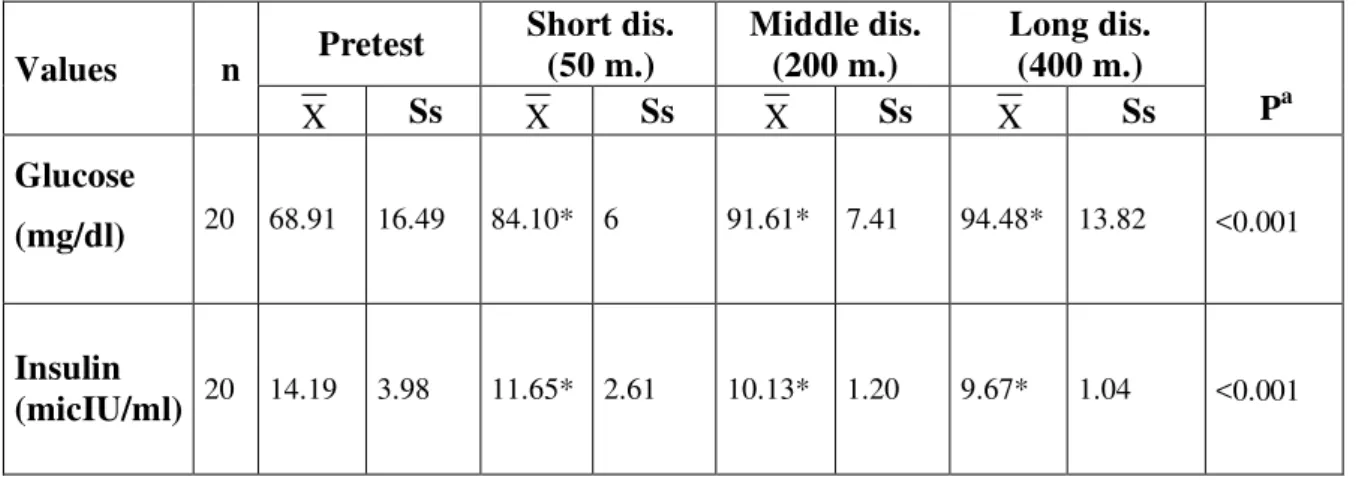
Table 1. Glucose, Insulin Measurements of Research Group for Undertakings at Short, Middle and Long Distances.
*: Statistically different according to pretest (p<0.05, Bonferroni test); a: Variance analysis for repeated measurements
Values n Pretest
Short dis. (50 m.)
Middle dis. (200 m.)
Long dis. (400 m.)
X Ss X Ss X Ss X Ss Pa
Glucose
(mg/dl) 20 68.91 16.49 84.10* 6 91.61* 7.41 94.48* 13.82 <0.001
Insulin
Copyright©IntJSCS (www.iscsjournal.com) - 394
Glucose, Insulin measurements of 20 swimmers at short, middle and long distance undertakings are investigated in the table above (Table 2). It is observed that distribution was normal according to the results of Kolmogorov-Smirnov test that was performed to establish whether or not data obtained had a normal distribution. Data obtained from statistical processes performed accordingly is given in the table above.
It is seen that differences between the result of pretest Glucose 1 (=68.91) and values of Glucose 2 (=84.10), Glucose 3 (=91.61) and Glucose 4 (94.48) are significant (p<0.05). As the results reveal, increase in the related values in comparison to the result of Pretest is significant.
It is also seen from the same table that there is significant difference between the result of pretest Insulin 1 (=14.19) and the values of Insulin 2 (=11.65), Insulin 3 (=10.13) and Insulin 4 (9.67) (p<0.05). It is established that decrease in the measurements made is significant in comparison to the result of pretest.
4. Discussion and Conclusion
In the light of the findings, it is observed that there is significant increase in the glucose and insulin levels as the intensity of the acute exercising increases. In their study realized on
sporters in taekwondo branch, Çınar et al have reported that glucose values of the sporters
increased as a result of the regular trainings, and reached 90.70 miclU/ml in relaxation status
(Çınar at al., 2008). Results of various researchers (Çınar at al., 2008; Kılıç, 2003; Adlercreutzh at al., 1976; Moğulkoç at al., 1997) show similarity with out findings.
Glucose oxidation increases rapidly and glycogen storages are consumed away rapidly
during high intensity exercising. Glucose intake from circulatory system aşso increases. If
glycogen storages of liver are sufficient, balance is established among the liver glycogen production and peripheral utilization, and blood glucose is kept within normal limits as much
as possible (Aydın at al., 2000). Dehydration is observed when blood glucose level increases
very much (1000–1200 mg%) and water is drawn from the tissues and cells to the blood. Since glucose can not penetrate from the pores of cell membranes, body water is lost together with the osmotic diuretic, because extracellular fluid osmotically sweeps away glucose water
discharged in urine (Koloğlu., 1996).
Cicioğlu et al. (2002) have investigated effects of high intensity exercise on the blood
parameters of wrestlers related with the blood gasses and glucose utilization; and subjected sporters to bicycle ergometry test at a speed of 60 rpm and at a maximum work load that was determined by taking maximal oxygen consumption capacities of the subjects as basis until they were tired, and established statistically significant decrease in the insulin level and significant increase in the blood glucose according to the data obtained at the end of the study
(Cicioğlu at al., 2002).
Sütken et al.(2006) aimed to examine leptin levels of professional sporters during long
Copyright©IntJSCS (www.iscsjournal.com) - 395
Decrease in insulin level after exercising is believed to be caused by blood glucose level that increases together with exercising. Insulin level and blood glucose level differ in accordance with the duration and intensity of exercising (Guyton, 1989). Insulin hormone
prevents transfer of glucose from liver to the blood and speeds its storage in liver (Gökhan at
al., 1986).
As a result of studies made, it can be stated that glucose level of sporters increased and their insulin levels decreased after acute exercising; on the other hand long duration and regular exercise regulated their glucose and insulin levels.
REFERENCES
Adlercreutzh H, Hakönem M, Kouppasalmi K (1976). Physical Activity and Hormones.
Advenced Cardiol, (18):144-157
Akgün N (1989). Egzersiz Fizyolojisi. Ankara: Gökçe Ofset Matbaacılık, 56-62.
Atalay M, Laaksonen D (2002). Diyabet, oksidatif stres ve fiziksel aktivite. Journal of Sports Science and Medicine, 1: 1-14.
Aydın C, Gökdemir K, Cicioğlu İ (2000). Aerobik ve Anaerobik Egzersiz Sonrası İnsülin ve
Kan Glikoz Değerlerinin İncelenmesi. Hacettepe Üniversitesi Spor Bilimleri Dergisi, (6):47
-55
Bostancı N (2011). Diabetus mellitus/ http://www. saglik.im /insulin-ve-glikoz accessed
11/4/2011
Cicioğlu İ, Onay M (2002). Yüksek Yoğunluktaki Egzersizin Güreşçilerde Kan Gazları ve Glikoz Kullanımı İle İlgili Kan Parametreleri Üzerine Etkisi. Beden Eğitimi ve Spor Bilimleri
Dergis,i 3:216
Cochran B, (1985). Effects of exercise on İnsülin Binding to Human Muscle. Am J.Physiol,
248
Çınar V, Polat Y, Moğulkoc R, Baltacı AK (2008). The Effect Of Magnesium
Supplementation On Glucose And Insulin Levels Of Sportsmen And Sedanter. Pak J Pharm Sci, 21(3):237-40.
Gökhan N, Çavuşoğlu H, Kayserilioğlu A (1986). Solunum Fizyolojisi. İstanbul: Filiz
Kitapevi. 67
Guyton AC, (1989). Tıbbi Fizyoloji, İstanbul: Nobel Kitapevi. 1332-1347 Çeviri: Gökhan N,
Çavuşoğlu H
Kılıç M, (2003). Çinko Takviyesinin Sporcularda Fiziksel Performanslarına Laktik Asit Düzeylerine ve Hematolojik Parametrelerine Etkisi. Ankara: G.Ü. Sağlık Bilimleri Enstitüsü Yayımlanmamış Doktora Tezi,
Koloğlu S, (1996). Endokrinoloji ve Temel Klinik. İstanbul: Nobel Tıp Kitabevleri Ltd. Sti.
Copyright©IntJSCS (www.iscsjournal.com) - 396
Moğulkoç R, Baltacı AK, Üstündağ B, Merdivenli R, Kutlu M (1997). Sporun Erkek
Çocuklarda Bazı Hemetolojik ve Biyokimyasal Parametreler Üzerine Etkisi. Spor Hekimliği
Dergisi, (31):1-10
Stoll BA (1996). Diet and exercise regimens to improve breast carcinoma prognosis. Cancer, 78: 2465- 2470
Sütken E, Balköse E, Özdemir F, Alataş Ö, ve diğ. (2006). Uzun ve Kısa Süreli Egzersizde Profesyonel Sporcularda Leptin Seviyelerinin İncelenmesi. Türk Klinik Biyokimya Dergisi,
4(3): 115-120
Zimmet PZ (1993). Hyperinsulinemia- how innocent a bystander. Diabetes Care16 Suppl, 3: 56- 70
Corresponding author:
Aykut DÜNDAR
Adıyaman University, School of Physical Education and Sports, Adiyaman, Turkey
Phone: +90 416 223 38 00- 2693
Fax:+90 416 223 14 26