32
EFFECT OF EXERCISE ON SPECIFIC INDICATORS OF PHYSICAL FITNESS AND PHYSICAL DEVELOPMENT OF MILITARY STUDENT ARTILLERYMAN
Klimovich V.B., Romanchuk S.V.
Army Academy named after Hetman Petro Sahaydachyi
Annotation. The features of professional roles ground artillery ground forces in peacetime. Presented educational experiment on the application of special physical exercises to improve performance standards for the combat work of students. In the experiment were involved 52 students. Students also performed the test - bringing gun D - 30 from traveling to combat. Found that special training exercise significant influence on the performance of physical fitness of students. It is noted that the physical exercises for strength and power endurance develop gunners in precisely those physical qualities that are necessary for the performance of their direct duties. It is noted that the exercises for strength and strength endurance is necessary to give priority to the preparation of artillery of the Army.
Keywords: special, exercise, cadets, performance, physical qualities.
Introduction1
Experience of local wars and military conflicts proved that sub-units of ground artillery of land forces fulfill tasks of defeating of highly precise weapon’s elements, artillery, tanks, IFVs, antitank and other fire means, military personnel, helicopters on landing sites, anti-aircraft defense, control posts, radio-electronic means, ruining of enemy’s fortifications, distant undermining, light provision, installation of smokescreens and other tasks. In such conditions quickness of actions, concentration, coordination and comprehensive professional readiness of artillerymen acquire special importance [3].
Officer-gunner, as main figure in ensuring of land troops’ combat actions shall meet requirements, which are determined by modern peculiarities of general combat operations.
In time of peace military-professional activity of cadets-gunners implies training of combat operations as well as conducting of firing practice that require continuous maintaining of comprehensive readiness and which is one of urgent problems of military officers’ physical training.
In the works by G.I. Sukhorada (2003), S.V. Romanchuk (2006), M.F. Pichugin, G.P. Gryban, V.M. Romanchuk (2011), Arcala Hall R. (2012) [9], Delaine D.A. (2010) [11], Farrelly N. (2013) [12], Harris J.J. (2013) [14] and other[10, 13, 15] it is proved that military-professional activity of gunners take place in conditions of unfavorable factors, such as enormous noise effect, dustiness of air, rain, snow, etc, which require mobilization of military officer organism’s resources in order to maintain professional workability [6, 7, 9-12].
In compliance with such circumstances the aim of teaching is changed: the main system-formation element of didactic physical training’s system of cadets-gunners. The purpose of teaching acquires special orientations and settings: formation of personality, who could be capable for physical self-development in the process of training, and as a resulting bench-mark – formation of physical readiness for effective execution of combat tasks [1].
At the same time analysis of higher school’s and military experience showed insufficient level of physical condition of young officers-gunners [8].
Scientists have already proved that level of professional workability of gun military officers can be increased at the cost of physical exercises, oriented on formation of professional-applied physical readiness of gunners [5]. The problem of high-level training of specialists for land forces’ gun sub-units has still been remaining an urgent one at present level of development of weapons, tactic and operative art. All these require from military officers not only high level of professional preparedness but also maximally effective development of physical and mental qualities, optimal indicators of functional and physical state. Which ensure high level of professional workability in conditions of low motion activity in time of peace and in stressful combat situations.
The research has been fulfilled as per plan of scientific & research works of General Headquarters of Land Forces of Ukraine by topic “Formation of future officer’s professional qualities by means of physical training during his studying”, code “Interconnection”.
Purpose, tasks of the work, material and methods
The purpose of the article is researching of influence of physical training on professional readiness of cadets-gunners.
As per the purpose the following tasks of the research were imposed:
1. To determine specificities of professional activity of ground artillery specialists in land forces.
2. To prove effectiveness of professional-applied physical exercises in maintaining of cadets-gunners’ professional workability.
The research has been carried out on the base of gun Д – 30, which is used in artillery of land forces. Results of the research
In order to solve the tasks of the work we carried out pedagogic experiment. For experiment we chose two groups of cadets of rocket forces and artillery faculty of Academy of land forces (control and experimental), 26 persons
33
in each one. Gun Д - 30 is the main and the most spread sample of tractor-drawn artillery of Land forces of Ukraine. Mass of gun is 3.28 tons; gun crew – 6 persons. As per normative on combat training of land force artillery time for Д - 30 gun’s bringing from marching state in combat one is: 1.30 хв – відмінно, 1.35 min -good, 1.55 min -satisfactory. From combat position – in march one: 1.50 min -excellent, 2.00 min -good, 2.20 min -satisfactory. Before experiment cadets of both groups executed normative confidently with same results. Bringing of Д - 30 gun from march state in combat one was executed by experimental group cadets for 1.40 min. and by control group – for 1.38х min. (p > 0.05). Bringing from combat state in march one experimental group fulfilled for 2.05 min. and control – for 2.03 min. (p > 0.05).
Bringing of gun from march state in combat one and vice versa imposes significant load on back, thigh and forearm muscles, because during fulfillment of normative maximal expenses of forces and time are connected with work with gun carriage’s cheeks. Weight of every cheek is 300 kg (gun has three cheeks). For increasing of strength and endurance of appropriate muscles it is necessary to fulfill exercises for strength and endurance. Experimental group was trained by special methodic with application of such exercises (pressing of 40 kg weight from chest upward in lying position, pulling of 80 kg weight from the floor up to knees, jerk of two weights of 24 kg each, snatch of one separate weight of 24 kg, lifting of two separate weights (24 kg each) by long cycle). Control group was trained in compliance with academic programs. Experiment took 6 months (semester).
In order to determine influence of special exercises we examined groups for physical condition indicators (lifting of two separate weights (24 kg each) by long cycle, 100 meter run, 1000 meters run).
Table 1
Physical condition indicators of experimental and control groups before and after experiment
Exercises Experimental group Before After Control group Before After Lifting of two separate weights (24
kg each) by long cycle 7.0±0.4 12±0.4 7.2±0.4 7.5±0.4
100 meter run, sec. 14.4±0.01 13.8±0.09 14.2±0.04 14.0±0.05
1000 meters run, sec. 3.40±1.5 3.35±1.5 3.36±1.5 3.22 ±1.3
The research showed that physical condition indicators of experimental and control groups’ cadets became different in the course of experiment. For example control group cadets, who were trained by academic program during one month, improved significantly results of 1 km run (p < 0.05). But results of lifting of two separate weights (24 kg each) by long cycle remained the same as before experiment (p > 0.05). Experimental group’s cadets, who trained exercises for strength and power endurance, insignificantly worsened results of 1 km run, but results of 100 meters run (p < 0.05) and especially lifting of two separate weights (24 kg each) by long cycle (p < 0.05) increased significantly (see table 1) (p < 0.05).
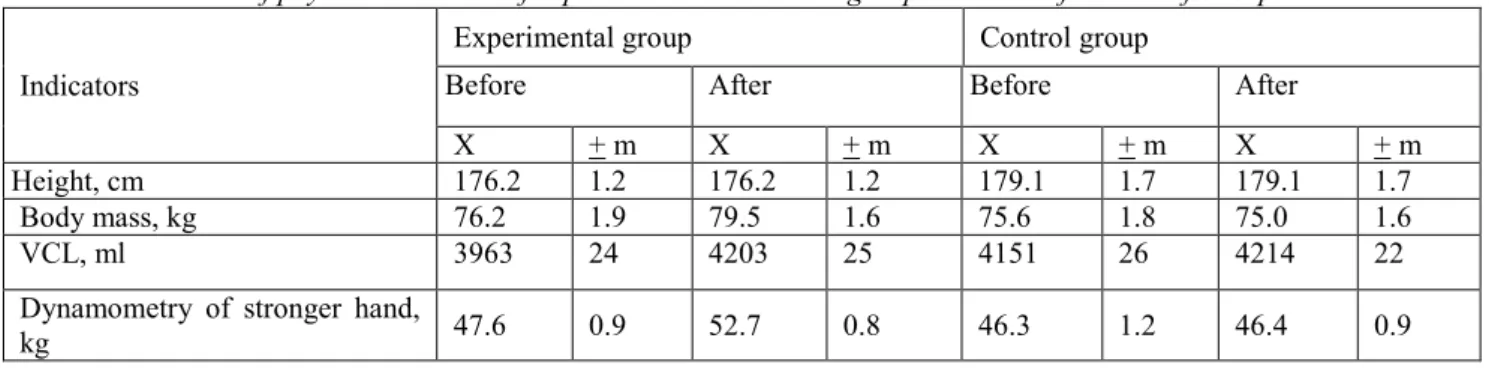
In order to determine influence of combat work conditions on cadets’ physical readiness, we examined them by the following indicators (height, body mass, vital capacity of lungs (VCL), hand dynamometry). From results of examinations it can be seen that for the period of combat work all indicators of physical condition of gun crews of experimental and control groups significantly changed (Р > 0.05) (see table 2).
Table 2
Indicators of physical condition of experimental and control groups’ cadets before and after experiment
Indicators
Experimental group Control group
Before After Before After
X + m Х + m X + m Х + m
Height, cm 176.2 1.2 176.2 1.2 179.1 1.7 179.1 1.7
Body mass, kg 76.2 1.9 79.5 1.6 75.6 1.8 75.0 1.6
VCL, ml 3963 24 4203 25 4151 26 4214 22
Dynamometry of stronger hand,
kg 47.6 0.9 52.7 0.8 46.3 1.2 46.4 0.9
The research has showed that for the period of experiment indicators of experimental and control groups cadets’ physical condition became different, especially in dynamometry of stronger hand and body mass. For example body mass of control group’s cadets, who were trained as per academic program, reduced in average by 0.6 kg. Their dynamometry of stronger hand increased only by 0.1 kg and vital capacity of lungs – by 63 ml. Body mass of experimental group’s cadets, who additionally trained exercises for strength and power endurance, increased in average by 2.7 kg, vital capacity of lungs – by 240 ml and dynamometry of stronger hand – by 3.1 kg. It witnesses that experimental groups’ cadets significantly increased mass of muscles and strength of hands.
34
Moreover, normative “from combat state in march one” was fulfilled by 6 seconds quicker and “from march state in combat one” - by 4 seconds quicker) Control group fulfilled both normative with mark “good”.
Difference between indicators of experimental and control groups’ cadets in fulfillment of combat work (bringing of gun from march state in combat one and vice versa) is of 24 seconds that witness about positive influence of special physical exercises on professional readiness.
Experimental results show that after 6 month fulfillment of exercise for strength and power endurance, experimental group fulfilled combat normative exceeding requirements to mark “excellent”, while control group, which, during month, was trained as per academic program, fulfilled combat normative with mark “good”.
Conclusions:
Results of experimental group’s cadets after fulfillment of both combat exercises are confidently better than results of control group’s cadets (DXkg=50sec) (p < 0.01).
Systemic training of general exercises, as per academic program, influences insufficiently on development of professionally important physical skills of cadets-gunners.
Physical exercises for strength and power endurance develop just those gunners’ physical qualities, which are required for them to fulfill their direct functions.
Training of special physical exercises influences more effectively on physical condition of cadets-gunners than general exercises.
Exercise for strength and power endurance shall be of priority in training of gunners for land forces. References:
1 Riabokon' V.M. Bojovij statut artileriyi sukhoputnikh vijs'k [Battle charter artillery army], Kiev, Ministry of
Defence of Ukraine, 2007, 120 p.
2 Borins'kij I.O. Nastanova z fizichnoyi pidgotovki u Zbrojnikh Silakh Ukrayini [Guidelines for physical training in
the Armed Forces of Ukraine], Kiev, Ministry of Defence of Ukraine, 2009, 124 p.
3 Riabokon' V.M., Rudenko P.J., Polenicia P.V., Smernov O.V. Pravila stril'bi i upravlinnia vognem nazemnoyi
artileriyi [Terms of shooting and ground artillery fire control], Kiev, Printing GSH, 2009, 128 p.
4 Sviderok S.M., Iakovenko V.V., Podliesnij O.V. Diyi artilerijs'koyi (minometnoyi) batareyi v boiu [Actions
artillery (mortar) battery in battle], Lviv, ACB, 2010, 120 p.
5 Anokhin IE.D., Lojko O.M., Klimovich B.V., Iena M.O. Metodichni rekomendaciyi z organizaciyi ta provedennia
navchal'nikh zaniat' z fizichnoyi pidgotovki [Guidelines on the organization and conduct training sessions on fitness], Lviv, ICB, 2008, 120 p.
6 Pichugin M.F., Griban G.P.. Romanchuk V.M. Fizichna pidgotovka vijs'kovosluzhbovciv [Physical training
personnel], Zhitomir, ZhHINAU, 2011, 120 p.
7 Sukhorada G. I. Sportivno - masova robota u vishchikh vijs'kovikh navchal'nikh zakladakh [Sports - mass work in
higher military educational institutions], Cand. Diss., Lviv, 2003, 20 p.
8 Romanchuk S. V. Formuvannia motivaciyi do zaniat' fizichnoiu pidgotovkoiu i sportom kursantiv tekhnichnikh
vijs'kovikh navchal'nikh zakladiv [Formation of motivation in physical training and sports engineering cadets of military schools], Cand. Diss., Lviv, 2006, 17 p.
9 Arcala Hall R. Modern soldiery interrogated: cataloguing the local military’s tasks and their perception of local
civilian actors. Philippine Political Science Journal. 2012. vol.33(1), pp. 1–21. doi:10.1080/01154451.2012.684514.
10 Bartone P.T., Snook S.A., Forsythe G.B., Lewis P., Bullis R.C. Psychosocial development and leader performance of military officer cadets. The Leadership Quarterly. 2007, vol.18(5), pp. 490–504. doi:10.1016/j.leaqua.2007.07.008.
11 Delaine D.A., Seif-Naraghi S.B., Al-Haque S., Wojewoda N., Meninato Y., DeBoer J. Student involvement as a
vehicle for empowerment: a case study of the student platform for engineering education development. European Journal of Engineering Education. 2010. vol.35(4), pp. 367–378. doi:10.1080/03043797.2010.483277.
12 Farrelly N. Discipline without democracy: military dominance in post-colonial Burma1. Australian Journal of
International Affairs. 2013. vol.67(3), pp. 312–326. doi:10.1080/10357718.2013.788122.
13 Göktan B., Akbağ M. An investigation on Turkish military school students: Are there associations among big
five personality factors, perceived family environment and hopelessness? Procedia - Social and Behavioral Sciences. 2010, vol.2(2), pp. 5458–5462. doi:10.1016/j.sbspro.2010.03.890.
14 Harris J.J., Berry S. A Brief History of the Military Training of the Enlisted Mental Health Worker. Journal of
Human Behavior in the Social Environment. 2013. vol.23(6), pp. 800–811. doi:10.1080/10911359.2013.795087.
15 Singh S.K.S., Nasir A.Q. binti A. Code-Switching among Military Cadet Officers During Group Interaction.