Artigo
*e-mail: [email protected]
CHEMICAL STABILITY OF ENALAPRIL MALEATE DRUG SUBSTANCE AND TABLETS BY A STABILITY-INDICATING LIQUID CHROMATOGRAPHIC METHOD
Marta de Diego*, Gloria Godoy, Sigrid Mennickent and Ricardo Godoy
Pharmacy Department, Pharmacy School, University of Concepción, PO Box 237, Concepción, Chile
Recebido em 22/6/10; aceito em 1/10/10; publicado na web em 26/1/11
The chemical stability of enalapril drug substance and tablets was studied by a stability-indicating liquid chromatographic method. Stress testing was performed on drug substance under various conditions. Accelerated stability testing was carried out for different formulations of enalapril tablets. Chromatographic separation was achieved on a RP-18column, using a mobile phase of methanol - phosphate buffer at 1.0 mL min−1 and UV detection. Degradation of the drug substance was greater under hydrolytic conditions. After 180 days of accelerated stability testing most enalapril tablets showed more than 10% of degradation. Enalapril drug substance and tablets showed instability under stress and accelerated testing respectively, with possible implications on the therapeutic activity. Keywords: enalapril; stability; liquid chromatography.
INTRODUCTION
The stability of a pharmaceutical preparation is in relation with its potency, therefore, with its therapeutic properties. Chemical degrada-Chemical degrada-tion of the active constituent often results in a loss of potency, or in a few instances the degradation products may be toxic, so that clinical use of a pharmaceutical preparation can not be recommendable if the degradation is relatively high.1
Different factors can affect the stability of drug substances and dosage form; these include intrinsic factors such as the molecular structure of the drug itself and environmental factors, such as tem-perature, light, humidity and oxygen.1-3 For many pharmaceutical
preparations, 90% of labelled potency is generally recognized as the minimum acceptable potency level.4
Enalapril (Figure 1) is an angiotensin-converting enzyme (ACE) inhibitor used in the treatment of hypertension. It is a prodrug which has an ester group in their molecular structure therefore it is suscepti-ble to degradation, it is rapidly absorbed after oral administration as its maleate salt and has little pharmacologic activity until hydrolyzed in the liver to enalaprilat.5
It is reported that enalapril degrades to two major degradation products; enalaprilat and diketopiperazine derivative (DKP).6-11
Most of the reported methods for quantitative determination of enalapril in pharmaceutical samples,6-14 including oficial method,2 are
by liquid chromatography with UV detection using a high column temperature. Other techniques include liquid chromatography-mass spectrometry for analysis in biological samples.15,16
The objectives of this study were to develop and validate a sim-ple stability-indicating LC method for enalapril, to determine the chemical stability of enalapril maleate drug substance under various ICH (International Conference on Harmonization) stress testing, and to evaluate the stability of different formulations of enalapril tablets under accelerated storage conditions according to the ICH stability testing guidance.17
EXPERIMENTAL
Reagents and chemicals
Standard of enalapril maleate and salicylic acid (> 99.0% purity) were obtained from Sigma (St. Louis, MO, USA). Standard of enal-aprilat was obtained from USP (Rockville, MD, USA). Methanol LC grade, KH2PO4, sodium hydroxide, hydrochloric acid and hydrogen peroxide p.a. grade were from Merck (Darmstadt, Germany). Enal-april maleate drug substance was obtained from Diprolab (Santiago, Chile). Seven commercial products of enalapril maleate tablets 10 mg were studied; three registered trade (RA, RB, RC) and three generic products (GA, GB, GC) were purchased from a Chilean pharmacy, and reference product (S) was purchased from the Argentine market. RA and GA were from the same manufacturer.
Instrumentation
For stability studies a climate chamber KBF-115 Binder (Tuttlin-gen, Germany) was used. Chromatography was performed by using a Perkin Elmer Series 200 liquid chromatograph (Norwalk, CT, USA) equipped with a manual injector, a 7125 Rheodyne injection valve (Cotati, CA, USA), and a 20-µL loop. An Applied Biosystems Model 785A programmable absorbance detector (Foster, CA, USA), and a Perkin Elmer Nelson Model 1022 data processor (Norwalk, CT, USA). Chromatographic conditions
All analyses were performed at room temperature (23 ± 2 ºC) under isocratic conditions. The separation was carried out using a
Figure 1. Molecular structure of enalapril. The structure enclosed within box is
Purospher RP-18column (150 mm x 4.6 mm, 5 µm; Merck, Darm-stadt, Germany). The mobile phase consisted of methanol - phosphate buffer (pH 2.2; 0.01M) (55:45, v/v). The UV detection was made at 215 nm and the low rate was 1.0 mL/min. Salicylic acid (60 µg/mL) was used as the internal standard.
Preparation of standard solutions
A stock solution of enalapril maleate and a stock solution of sali- sali-cylic acid were independently prepared at about 2.0 and 3.0 mg/mL respectively in methanol. Standard solutions were prepared from the stock solution after adequate dilution with water. A stock solution of enalaprilat was prepared in methanol at 1 mg/mL. Diketopiperazine degradation product was produced from standard of enalapril maleate according to the USP method.2
Sample preparation
Ten tablets of enalapril maleate 10 mg were weighed and powered. A portion equivalent to 10 mg of enalapril maleate was accurately weighed and transferred to a 50 mL volumetric lask. A portion of 1 mL of internal standard (3 mg/mL) was added (inal concentration of 60 µg/mL), and diluted with water to volume (inal concentration of enalapril; 200.0 µg/mL). Then they were vortexed for 15 s, iltered and centrifuged for 5 min, and the supernatant was chromatographed. Stability-indicating capability of the LC assay
It was established by chromatographic analysis of all stressed samples (as explained in section stress testing) and standard solutions of the main degradation products of enalapril (enalaprilat and dike-topiperazine). The composition, pH and the low rate of the mobile phase were changed to optimize separation between enalapril, internal standard and the degradation products.
Method validation
The method was validated according to the ICH guidelines for validation of analytical procedures.18 The parameters validated were
lin-earity, precision, accuracy, selectivity, detection and quantitation limits. Stability studies
Stress and accelerated stability testing were carried out according to the ICH stability testing guidance.17
Stress testing
Enalapril maleate was stressed under various conditions; until to facilitate approximate 5-20% degradation.19 For each condition, a
blank solution was prepared and was subjected to stress in the same manner as the drug, also it was prepared a control solution of enal-april maleate, which was stored without the stress condition. Prior to analysis, samples were diluted to 200 µg/mL.
Hydrolysis
It was established by forced decomposition of enalapril maleate 2 mg/mL in 0.1 N hydrochloric acid, water and 0.1 N sodium hy- 0.1 N sodium hy-0.1 N sodium hy-droxide. Samples of 5 mL for each time point were kept on a hot plate at 60 ºC for basic hydrolysis and at 80 ºC for acid and neutral hydrolysis, (total time for basic hydrolysis 30 min. Total time for acid and neutral hydrolysis 24 h), after which they have been cooled to room temperature, then they were transferred to a 50 mL volumetric lask, a 1 mL of internal standard (3.0 mg/mL) was added, then they
were diluted to volume and analyzed by the LC method. In order to determine de degradation kinetics, graphs of the log% residual versus time were obtained.
Oxidation
Oxidation of enalapril maleate was carried out in 3% H2O2 at a
concentration of 2 mg/mL, at room temperature (25 ± 2 ºC) for 8 days and 80 ºC for 6 h, in the dark.
Temperature
Solid enalapril maleate was exposed to dry heat at 70 ºC in an oven and under controlled temperature of 40 ± 2 ºC and relative humidity of 75 ± 5% in a climate chamber, for 27 days.
Photostability
An aqueous solution of enalapril maleate 2 mg/mL and solid drug in 1 mm layer in a petri-plate, were exposed to UV and VIS radiation for 7 days. Dark controls were run simultaneously.
Accelerated stability testing
Enalapril maleate tablets 10 mg in their original packaging were stored under controlled temperature of 40 ± 2 ºC and relative humidity of 75 ± 5% in a climate chamber. Samples were taken at 0, 30, 90 and 180 days and analyzed by LC to determine the enalapril amount. Each sample was analyzed in duplicate.
RESULTS AND DISCUSSION
Stability-indicating LC method development and optimization
The main target of the stability-indicating chromatographic method is to get the separation between enalapril and their degrada-tion products. Reported LC methods for enalapril, used gradient and/ or a high column temperature, which requires more sophisticated instrumentation and/or long stabilization times.2,6-11,13,14 These
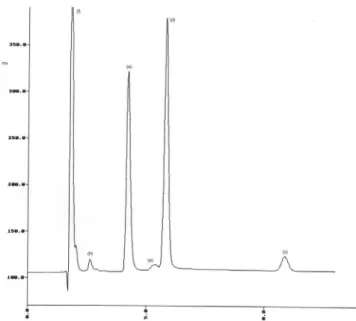
meth-ods mainly used acetonitrile and phosphate buffers of various pH in the mobile phase, therefore, different proportions of acetonitrile and change in pH were tested (50:50, 40:60, 30:70 v/v; pH 2.2, pH 2.4, pH 2.6), but under these conditions peak shapes were not good. Then methanol was tested instead of acetonitrile, obtaining good peak shapes. Interference with methanol absorption at 215 nm was not ob-served. After that, different proportions of methanol using phosphate buffers of various pH and different low rate, at room temperature of the column, were evaluated before the i nal chromatographic condi- were evaluated before the inal chromatographic condi-tions were selected. The mobile phase that best resolved enalapril maleate, degradation products of enalapril and salicylic acid, with sharp peaks was methanol - phosphate buffer (pH 2.2; 0.01M) (55:45, v/v) at 1.0 mL/min. Figure 2 shows a chromatogram of stressed sample and internal standard, witch prove the stability-indicating capability of the assay.
Method validation
Linearity
The calibration curve of enalapril maleate was linear over the con-centration range of 50.0 to 300.0 µg/mL (6 different concon-centrations were used and each solution was injected 5 times). The equation of the standard curve based on the ratio of the peak heights of enalapril maleate / internal standard to the enalapril maleate concentration was y = 0.0048 ± 0.0001 x + 0.0088 ± 0.0048; r2= 0.9989 ± 0.0003.
Precision
preparations in concentrations of 150.0, 200.0 and 250.0 µg/mL on the same day. The inter-day precision was studied by comparing the assays on 3 different days. The results are shown in Table 1. The obtained values show a suitable precision for the analytical method.
Accuracy
To evaluate the accuracy of the method, recovery test were perfor-med by adding know amounts of standard of enalapril maleate in the level 75, 100 and 125% of the enalapril maleate levels in the tablets (3 replicates of each level) to common tablet excipients (lactose, starch and magnesium stearate). The accuracy of the assay was determined by comparing the found amount with the added amount. The results obtained are shown in Table 2. The obtained values conirm the accuracy of the proposed method.
Selectivity
The method is selective towards enalapril, degradation products, internal standard, and maleic acid (from maleate salt) as shown in Figure 2. The selectivity was also evaluated by observing any
interfer-ence from excipients used in the tablets; therefore a sample of each commercial product was analyzed without degradation, showing no peaks that interfered with enalapril, degradation products or internal standard. These results proved the selectivity of the proposed method. Detection and quantitation limits
The DL and QL were calculated by using the equations: DL = 3.3 x σ/ S; QL = 10 x σ/ S, where σ is the standard deviation of the response and S is the slope of the calibration curve. DL was 0.18 µg/mL and QL was 0.56 µg/mL. These values are adequate for the enalapril determination in pharmaceutical samples.
Stability studies
Stress testing
Stress testing showed the formation of two principal degradation products identiied as enalaprilat and diketopiperazine by compar-diketopiperazine by compar-ing the chromatograms of stressed samples with chromatograms of standard solution of these compounds.
Hydrolysis
In all the studied stress conditions, the degradation of enalapril was higher under hydrolytic conditions, especially under alkaline stress; therefore degradation kinetics was obtained: After 30 min of hydrolysis in 0.1 N sodium hydroxide, the percentage of enalapril remaining was 7.5%. After 24 h of hydrolysis in water and 0.1 N hydrochloric acid, the percentage of enalapril remaining was 95.2 and 80.4% respectively. In the three studied conditions the degradation followed i rst-order kinet-degradation followed irst-order kinet-ics. The degradation rate constant and the time at which concentration fell to 90% of the original concentration (t90) are shown in Table 3.
Under alkaline stress, enalapril degraded to enalaprilat, under neutral condition, enalapril degraded to enalaprilat and especially to diketopiperazine and under acidic stress enalapril degraded to enalaprilat, diketopiperazine and a degradation product with that appeared between enalapril and salycilic acid (the major degradation product was DKP).
Oxidation
Enalapril was found to be stable under oxidative stress. Temperature
No decomposition was seen on exposure of solid drug powder to dry heat at 70 ºC or 40 ± 2 ºC/75 ± 5% RH for 27 days.
Photostability
The exposure of an aqueous solution of enalapril to UV and VIS radiation for 7 days resulted in a slight degradation to enalaprilat. In solid state, no degradation was observed.
Accelerated stability testing
The results obtained in the accelerated testing showed that most enalapril maleate tablets 10 mg are highly susceptible to de-enalapril maleate tablets 10 mg are highly susceptible to
de-Table 1. Precision determined during method validation
Concentration (µg/mL)
Relative standard deviation (%) intra-day a) inter-day b)
150.00 0.68 1.62
200.00 1.59 1.19
250.00 0.96 1.30
a) Analyzed on the same day (n=3). b) Analyzed on 3 different days (n=9).
Table 2. Recovery percentage of enalapril determined during method validation
Sample level
(%)
Added amount (mg)
Found amount
(mg) a)
Recovery (%) b)
75 7.50 7.63 ± 0.05 101.75 100 10.00 9.90 ± 0.16 99.02 125 12.50 12.70 ± 0.12 101.63 a) Mean ± SD (n= 3). b) (Found amount/Added amount) x 100.
Table 3. Degradation kinetics of enalapril under hydrolytic conditions
Stress condition
Temperature (ºC)
Ka) t
90 b)
0.1 N NaOH 60 0.0914 1/min 1.15 min
Water 80 0.0018 1/h 57.20 h
0.1 N HCl 80 0.0090 1/h 11.73 h a) Degradation rate constant. b) Time at which concentration fell to 90% of the original concentration
Figure 2. Representative chromatogram of stressed sample: enalapril (a),
Table 4. Accelerated stability testing of enalapril maleate tablets 10 mg
Product Enalapril
0 days 30 days 90 days a) 180 days a)
(mg) a) (%) (mg) a) (%) (mg) a) (%) (mg) a) (%)
S 9.97±0.05 99.7 9.82±0.08 98.2 9.80±0.01 98.0 9.79±0.08 97.9 RA 9.77±0.12 97.7 9.52±0.21 95.2 9.13±0.07 91.3 9.09±0.05 90.9 RB 9.23±0.13 92.3 8.69±0.13 86.9 7.99±0.08 79.9 7.77±0.19 77.7 RC 9.30±0.09 93.0 7.28±0.14 72.8 5.88±0.09 58.9 4.87±0.20 48.7 GA 9.22±0.15 92.2 9.12±0.09 91.2 9.07±0.02 90.7 9.03±0.19 90.3 GB 8.89±0.12 88.9 7.28±0.19 72.8 5.77±0.13 57.7 4.79±0.14 47.9 GC 9.13± 0.08 91.3 8.09±0.16 80.9 5.01±0.14 50.1 3.19±0.08 31.9 S= reference product. R= registered trade products. G= generic products. Mean ± SD (n= 4).
gradation. According to the United States Pharmacopeia,2 enalapril
maleate tablets must contain between 90-110% of the labelled amount, which corresponds to 9-11 mg. As show in Table 4, only reference product (S), registered trade product RA and generic product GA (both from the same manufacturer) are within these limits throughout the study. Even product GB is outside of speci-ications at the beginning of the study (day 0). These results are in accordance with previous work,10 but the study was in tablets from
the Brazilian market.
Under accelerated conditions, enalapril tablets degraded gradu-ally to enalaprilat and especigradu-ally to diketopiperazine as a function of the time of exposure to higher temperature and humidity. Figure 3 shows chromatograms of product GB showing the gradual increase of enalapril degradation during the study.
CONCLUSIONS
A simple stability-indicating LC method to determine the chemi-cal stability of enalapril maleate drug substance and tablets has been developed and validated.
The results obtained from the stress testing show that the degrada-stress testing show that the degrada- show that the degrada-tion of enalapril maleate drug substance in soludegrada-tion is higher under hydrolytic conditions especially under alkaline stress, whereas in solid state (powder) is highly stable.
The results obtained in the accelerated testing show that most enalapril maleate tablets 10 mg are highly susceptible to degrada-tion under moderate temperature and humidity (40 ºC and 75% RH). Therefore, care should be taken in the manufacturing process and during storage of this product in order to avoid degradation, because amounts lower than 90%, the product does not accomplishes with the pharmacopeial requirements, and thus, it could result in diminution of the therapeutic activity and safety.
ACKNOWLEDGEMENT
This work was supported by research project DIUC 208.074.039-1.0, Research Department, University of Concepción.
REFERENCES
1. Lund, W.; The Pharmaceutical Codex, 12th ed., the Pharmaceutical Press: London, 1994.
2. Farmacopea de los Estados Unidos de América, 30th ed., United States Pharmacopeial Convection, Inc: Rockville, 2007.
3. Yoshioka, S.; Stella, V.; Stability of Drugs and Dosage Forms, Kluwer Academic Plenum Publishers: New York, 2000.
4. Carstensen, J.; Rhodes, C.; Drug Stability, Principles and Practices, 3rd ed.,Taylor & Francis: New York, 2000.
Figure 3. Representative chromatograms of enalapril maleate tablets 10 mg,
5. Mc Evoy, G. K.; AHFS Drug Information, American Society of Health– System Pharmacists: Bethesda, 2006.
6. Bhardwaj, S.; Singh, S.; J. Pharm. Biomed. Anal.2008,46, 113. 7. Stanisz, B.; J. Pharm. Biomed. Anal. 2003, 31, 375.
8. Al-Omari, M.; Abdelah, M.; Badwan, A.; Jaber, A.; J. Pharm. Biomed. Anal.2001,25, 893.
9. Stanisz, B.; Acta Pol. Pharm.2004,61, 415.
10. Lima, D.; Dos Santos, L.; Lima, E.; J. Pharm. Biomed. Anal.2008,47, 934.
11. Roskar, R.; Simoncic, Z.; Gartner, A.; Kmetec, V.; J. Pharm. Biomed. Anal.2009, 49, 295.
12. Bhushan, R.; Gupta, D.; Singh, S.; Biomed Chromatogr.2006,20, 217. 13. Bonazzi, D.; Gotti, R.; Andrisano, V.; Cavrini, V.; J. Pharm. Biomed.
Anal.1997,16, 431.
14. Toporisic, R.; Mlakar, A.; Hvala, J.; Prislan, I.; Zupancic-Kralj, L.; J. Pharm. Biomed. Anal. 2010,52, 294.
15. Gu, Q.; Chen, X.; Zhong, D.; Wang, Y.; J. Chromatogr., B: Anal. Tech-B: Anal. Tech-nol. Biomed. Life Sci.2004, 813, 337.
16. Lu, S.; Jiang, K.; Qin, F.; Lu, X.; Li, F.; J. Pharm. Biomed. Anal. 2009, 49, 163.
17. ICH Q1 A (R2), Stability Testing of New Drug Substances and Products, International Conference on Harmonization, 2003.
18. ICH Q2B, Validation of Analytical Procedures: Methodology, International Conference on Harmonization, 1996.