0103 - 5053 $6.00+0.00
Short Report
*e-mail: [email protected]
3D Hydrogen-Bonded Network Built from Copper(II) Complexes of 1,3-Propanediamine
Alexandre O. Legendre,a Fabiana C. Andrade,a Sandra R. Ananias,a Antonio E. Mauro,*,a Adelino V. G. Netto,a Regina H. A. Santos,b Janaina G. Ferreirab and
Fabiane R. Martinsb
a
Instituto de Química de Araraquara, Universidade Estadual Paulista, CP 355, 14801-970 Araraquara-SP, Brazil
b
Instituto de Química de São Carlos, Universidade de São Paulo,CP 780, 13560-970 São Carlos-SP, Brazil
A reação entre Cu(NO3)2.3H2O e 1,3-propanodiamina (pn), na presença de NaN3, conduziu à obtenção de um co-cristal 1:1 formado por [Cu(NO3)2(pn)2]e [Cu(N3)(NO3)(pn)2] (1 e 2), os quais foram caracterizados por análise elementar, espectroscopia no IV e difração de raios X por monocristal. Em ambos os compostos, os átomos de cobre(II) encontram-se em um ambiente octaédrico distorcido, com quatro ligações no plano basal formadas por quatro átomos de N de dois ligantes pn bidentados enquanto que as ligações axiais são formadas por dois átomos de O do ligante nitrato em 1 e por um átomo de O do ligante nitrato e um átomo de N do íon azida em
2. A estrutura cristalina consiste em dois complexos (1 e 2)cristalograficamente independentes,
que se unem por uma série de ligações de hidrogênio do tipo N–H···O e N–H···N bem como interações por C–H···O. Novos synthons supramoleculares foram identificados pela ocorrência de dois modos geometricamente distintos de reconhecimento molecular envolvendo o íon NO3–
e grupos amino dos ligantes pn.
The reaction of Cu(NO3)2.3H2O with 1,3-propanediamine (pn), in the presence of NaN3, afforded a 1:1 co-crystal formed by [Cu(NO3)2(pn)2] and[Cu(N3)(NO3)(pn)2] (1 and 2), which were characterized by elemental analysis, IR spectroscopy and single crystal X-ray diffraction. In both compounds, the copper(II) centers are in a distorted octahedral environment, formed by four N atoms of two bidentate pn ligands in the basal plane, whereas the axial bonds are formed by two O atoms from the nitrate ligands in 1 and one O atom from the nitrate ligand and one N
atom from the azide ion in 2. The asymmetric unit of the crystal consists of two crystallographically independent 1 and 2 complexes, which are held together in a 3D network
by a series of N–H···O and N–H···N hydrogen bonds, as well C–H···O interactions. New supramolecular synthons are identified by the occurrence of two geometrically distinct molecular recognition patterns involving the NO3– ion and amino groups from pn ligands.
Keywords: copper(II) complexes, hydrogen bonds, supramolecular chemistry
Introduction
Much attention has been devoted to the investigation of transition metal-based supramolecular frameworks due to theoretical and challenging aspects in controlling the self-assembly processes, as well the potential uses of such materials in sensing, gas adsorption, magnetic devices, molecular electronics, porous and nanosized materials.1
Among the non-covalent interactions, which play a significant role in the molecular self-recognition of the components, within the crystal, the hydrogen bonding is
the most important interaction type, since it combines directionality with strength.2 Within this context, a large
number of well-ordered architectures has been successfully built up by assembling discrete coordination compounds via hydrogen bonding motifs.3
In our recent works,4 we have obtained a series of
multidimensional supramolecular systems based on the self-assembly of discrete [Pd(SCN)2(3,5-dimethylpyrazole)2], and [M(NCS)2(pyrazole)4] (M = Co, Ni) by means of intermolecular hydrogen bonds, type N–H···NCS-Pd and N–H···SCN-M, respectively.
preparation and crystallographic studies on the co-crystal of [Cu(NO3)2(pn)2] [Cu(N3)(NO3)(pn)2].
Experimental
Synthesis of [Cu(NO
3)2(pn)2][Cu(N3)(NO3)(pn)2]
To a solution of Cu(NO3)2.3H2O (0.29 g, 1.20 mmol) in ethanol (6.0 cm3) was added 1,3-propanediamine (0.23
cm3, 2.76 mmol), followed by dropwise addition of an
aqueous solution of NaN3 (0.16 g, 2.43 mmol). The obtained deep blue solution was stirred for 30 min and then kept at 4 °C. After five days, blue crystals suitable for X-ray analysis were collected. Yield: 40%. The results of C, H, N and Cu elemental analysis were in agreement with the formula. (Calc. for C12H40N14Cu2O9: C, 22.12; H, 6.19; N, 30.09; Cu, 19.50%, Found: C, 21.94; H, 6.49; N, 29.89; Cu, 19.45).
Instrumentation
The IR spectrum of the co-crystal was recorded as KBr pellets on a Nicolet IMPACT 400 spectrophotometer in the 4000-400 cm-1 wavelength range, at a resolution of
4 cm-1. C, H, and N analysis were carried out with a CE
Instruments EA1110 CHNS-O microanalyzer. The Cu content was determined following the literature procedure.6
Crystal structure determination
The data collections for a single crystal were carried out on an Enraf Nonius CAD4 diffractometer, using graphite monochromated MoKα (λ = 0.71073Å) radiation. Twenty five reflections (12.41 < θ < 18.06) were used to determine the cell parameters, at room temperature. During the data collection 3 standard reflections were used with no significant decay. Intensities were corrected by absorption factors [µ(MoKα) = 1.643 mm-1] using the PSISCAN method.7
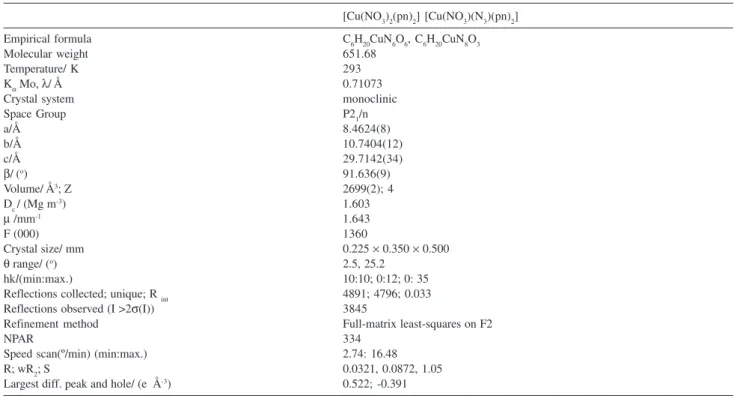
Information concerning crystallographic data collection and refinement of the structure are given in Table 1. The structures were solved using the WinGX system8 by SIR92,9 and refined
by full matrix least squares and difference Fourier synthesis using SHEL97.10 The final residual electronic density, is
located around the copper atom. The hydrogen atoms were located in their ideal positions and not refined, with the thermal vibration parameters equal to 1.3 times the isotropic equivalent U of the attached atom. All non-hydrogen atoms were refined anisotropically. The structural analysis was performed by PLATON system.11
Results and Discussion
During our attempts to synthesize new CuII
azido-complexes from the reaction between copper(II) nitrate and 1,3-propanediamine (pn) with two equivalents of NaN3, in an ethanol:water mixture, we have obtained
Table 1. Summary of data collection and refinement conditions
[Cu(NO3)2(pn)2] [Cu(NO3)(N3)(pn)2]
Empirical formula C6H20CuN6O6, C6H20CuN8O3
Molecular weight 651.68
Temperature/ K 293
Kα Mo, λ/ Å 0.71073
Crystal system monoclinic
Space Group P21/n
a/Å 8.4624(8)
b/Å 10.7404(12)
c/Å 29.7142(34)
β/ (o) 91.636(9)
Volume/ Å3; Z 2699(2); 4
Dc / (Mg m-3) 1.603
µ /mm-1 1.643
F (000) 1360
Crystal size/ mm 0.225 × 0.350 × 0.500
θ range/ (o) 2.5, 25.2
hkl(min:max.) 10:10; 0:12; 0: 35
Reflections collected; unique; R int 4891; 4796; 0.033
Reflections observed (I >2σ(I)) 3845
Refinement method Full-matrix least-squares on F2
NPAR 334
Speed scan(º/min) (min:max.) 2.74: 16.48
R; wR2; S 0.0321, 0.0872, 1.05
physical and analytical evidences of the formation of an unusual compound. Repeated elemental analysis results of the sample were consistent with a C12H40N14Cu2O9 formulation. The X-ray structural determination of this species was undertaken in order to get a better knowledge of its structure.
X-ray crystallographic studies
The co-crystallization of two different monomeric compounds in the asymmetric unit, [Cu(NO3)2(pn)2] (1) and [Cu(N3)(NO3)(pn)2] (2), was definitely proved by the crystal and molecular structure X-ray analysis, corroborating the important structural features suggested by IR spectroscopy.
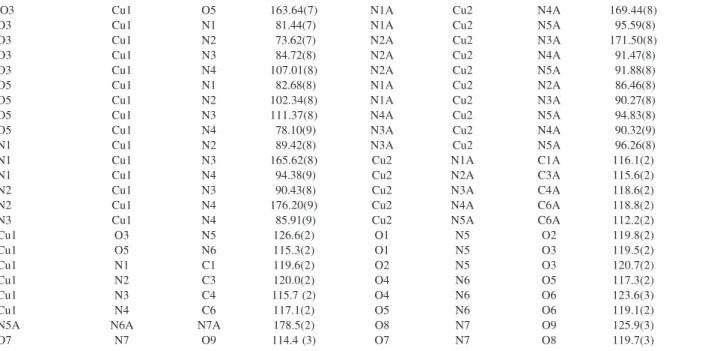
The molecular structures of the complexes [Cu(NO3)2(pn)2] (1) and [Cu(N3)(NO3)(pn)2] (2), together with the crystallographic labeling scheme, are shown in Figures 1 and 2, respectively. Selected bond lengths and
angles with their estimated standard deviations in parentheses are listed in Table 2 and 3, respectively.
In both compounds, the metal ion exhibits an elongated and distorted trans-octahedral geometry. The coordination
polyhedron is defined by four nitrogen atoms at the equatorial plane from two chelating 1,3-propanediamine ligands: N1, N2, N3 and N4 at Cu1, for complex 1 and N1a, N2a, N3a and N4a at Cu2, for 2, with average Cu-N distances of 2.023(2) and 2.031(2) Å, respectively. The six-membered chelate rings formed by 1,3-propanediamine adopt the expected chair conformation. The atoms that constitute the basal plane do not deviate significantly from planarity, with the largest deviations being -0.133(3) Å for N1 and N3 and 0.137(2) Å and 0.129(2) Å for N2 and N4 respectively. The Cu1 and Cu2 ions are displaced from the basal planes by -0.1232(3) Å and 0.1657(3) Å, respectively. The axial positions of 1 are occupied by the O5 and O3 atoms of the monodentate nitrate (Cu1-O3 = 2.927(3) and Cu1-O5 = 2.458(3) Å) and, for the compound 2, they are
Table 3. Selected angles (°) for the co-crystal
O3 Cu1 O5 163.64(7) N1A Cu2 N4A 169.44(8)
O3 Cu1 N1 81.44(7) N1A Cu2 N5A 95.59(8)
O3 Cu1 N2 73.62(7) N2A Cu2 N3A 171.50(8)
O3 Cu1 N3 84.72(8) N2A Cu2 N4A 91.47(8)
O3 Cu1 N4 107.01(8) N2A Cu2 N5A 91.88(8)
O5 Cu1 N1 82.68(8) N1A Cu2 N2A 86.46(8)
O5 Cu1 N2 102.34(8) N1A Cu2 N3A 90.27(8)
O5 Cu1 N3 111.37(8) N4A Cu2 N5A 94.83(8)
O5 Cu1 N4 78.10(9) N3A Cu2 N4A 90.32(9)
N1 Cu1 N2 89.42(8) N3A Cu2 N5A 96.26(8)
N1 Cu1 N3 165.62(8) Cu2 N1A C1A 116.1(2)
N1 Cu1 N4 94.38(9) Cu2 N2A C3A 115.6(2)
N2 Cu1 N3 90.43(8) Cu2 N3A C4A 118.6(2)
N2 Cu1 N4 176.20(9) Cu2 N4A C6A 118.8(2)
N3 Cu1 N4 85.91(9) Cu2 N5A C6A 112.2(2)
Cu1 O3 N5 126.6(2) O1 N5 O2 119.8(2)
Cu1 O5 N6 115.3(2) O1 N5 O3 119.5(2)
Cu1 N1 C1 119.6(2) O2 N5 O3 120.7(2)
Cu1 N2 C3 120.0(2) O4 N6 O5 117.3(2)
Cu1 N3 C4 115.7 (2) O4 N6 O6 123.6(3)
Cu1 N4 C6 117.1(2) O5 N6 O6 119.1(2)
N5A N6A N7A 178.5(2) O8 N7 O9 125.9(3)
O7 N7 O9 114.4 (3) O7 N7 O8 119.7(3)
Table 2. Selected bond lengths (Å) for the co-crystal
Cu1 O3 2.927(3) Cu2 O9 2.990(4) N1 C1 1.464(4)
Cu1 O5 2.458 (3) Cu2 N1A 2.020(2) N2 C3 1.478(4)
Cu1 N1 2.019(2) Cu2 N2A 2.035(2) N3 C4 1.466(3)
Cu1 N2 2.031(2) Cu2 N3A 2.040(2) N4 C6 1.468(4)
Cu1 N3 2.007(2) Cu2 N4A 2.028(2) N1A C1A 1.467(4)
Cu1 N4 2.036(2) Cu2 N5A 2.333(2) N2A C3A 1.477(3)
O1 N5 1.248(3) O6 N6 1.219(3) N3A C4A 1.477(3)
O2 N5 1.239(3) O7 N7 1.252(3) N4A C6A 1.479(3)
O3 N5 1.232(3) O8 N7 1.199(4) N5A N6A 1.171(3)
O4 N6 1.224(4) O9 N7 1.196(4) N6A N7A 1.169(3)
occupied by the N5a atom of the terminal azide and O9 of the other monodentate nitrate (Cu2-N5a = 2.333(2) and Cu2-O9 = 2.990(4) Å).
The average Cu-N(pn) distances of 2.023(2) (1) and 2.031(2) Å (2) are comparable with those found12 for
[Cu(NO3)2(dmpn)2] (dmpn = bis(1,3-diamino-2,2-dimethylpropane), 2.018 Å and slightly longer than the values found13 for [Cu
2(N3)4(pn)2], 2.000 Å. The Cu-N(azido) length
of compound 2 of 2.333(2) Å is significantly longer than
those found14 for [Cu(N
3)(NCO)(tmen)]2 (tmen = N,N,N´,N´
-tetramethylethylenediamine), 2.000(1) Å; [Cu(N3)(L)4]ClO4 (L = β-collidine)15, 2.141(6) Å; but comparable with the axial
Cu-N(azide) bond distances found16 for [Cu(N
3)2(diEten)]2
(diEten = N,N,-diethylethylenediamine), 2.333(3) Å and
[Cu(N3)2(tmen)]n, 2.346(3) Å.14 The azide group is essentially
linear (N5a-N6a-N7a = 178.5(2)º).
In compound 1, the two axial Cu-O bond distances are very different from each other: Cu1-O3 = 2.927(3) Å and Cu1-O5 = 2.458(3) Å. The former apical Cu-O bond distances for 1 as well that found for 2 (Cu2-O9 = 2.990(4) Å) indicated the existence of very weak covalent interactions between one of the oxygen atom from the nitrate and Cu(II) ion. Despite the fact that these bond lengths are slightly longer than the sum of van der Waals radii of copper and oxygen (2.90 Å), Cu-O values within the range of 2.5-3.0 Å have been considered as long coordination distances for copper(II) complexes.17 For instance, Valdéz-Martinez et al.18 considered the coordination of the NO3– groups at
the axial positions of [Cu(NO3)2(MeTSC)2], which exhibited Cu-O bond length of 2.864(3) Å. Copper-oxygen bond of 2.906(7) Å was also considered significant in the molecular structure of [Cu(NO3)2(py)2]2·py (py = pyridine).19 Anyway,
if one takes into account that Cu1-O3 and Cu2-O9 are non-bonding distances, the metal coordination polyhedron in 1 and 2 could alternatively be described as distorted square pyramidal.
The azide and nitrate groups participate in a series of hydrogen bonds which are responsible for the stabilization of the crystal structure. Table 4 lists the distances and angles of hydrogen bonds and C–H···O interactions in the co-crystal.
Table 4.Hydrogen bonds distances and angles for the co-crystal (Å, °)
D–H····A D–H/ Å H····A/ Å D····A/ Å D–H····A/ ( °)
N1 – H1N1… N7A 0.90 2.30 3.17(4) 166
N1 – H2N1… N7Aa 0.90 2.61 3.33(4) 138
N2 – H2N2… O1b 0.90 2.14 3.00(3) 161
N4A – H1A4… O7c 0.90 2.22 3.07(4) 159
N4A – H2A4… O4d 0.90 2.28 3.02(4) 139
N2A – H1A2… O7c 0.90 2.58 3.32(4) 140
N2A – H2A2… O1a 0.90 2.24 3.09(3) 159
N2 – H1N3… O7 0.90 2.14 3.02(4) 166
N3 – H2N3… O1b 0.90 2.57 3.39(3) 152
N3 – H2N3… O3b 0.90 2.36 3.19(4) 154
N3A – H1A3… O9d 0.90 2.25 2.92(4) 130
N1A – H11A… O2a 0.90 2.44 3.33(4) 169
N3A – H2A3… O5 0.90 2.47 3.33(4) 160
N4 – H1N4… N7A 0.90 2.07 2.97(4) 178
N4 – H2N4… O8 0.90 2.57 3.46(5) 171
N1A – H21A… O5 0.90 2.27 3.16(4) 168
C4A – H2B4… O8 0.97 2.53 3.28(5) 134
C1 – H1C1… O2a 0.97 2.51 3.12(4) 120
Symmetry code: a = -1-x,-y,1-z; b = 1-x,-1-y,1-z; c = x,1+y,z; d = 3/2-x,1/2+y,-z;
Figure 1. The ORTEP representation of the molecular structure with
la-beling scheme for [Cu(NO3)2(pn)2] 1. Ellipsoids are shown at 50% prob-ability level.
Figure 2. The ORTEP representation of the molecular structure with
As can be observed in Figure 3, each molecule of [Cu(NO3)2(pn)2] (1) and [Cu(N3)(NO3)(pn)2] (2) of the asymmetric unit are assembled by N–H···O and N–H···N intermolecular hydrogen bonds. One oxygen atom from the NO3– group of 1 takes part in two hydrogen bonds with two
amino groups from distinct pn ligands of 2, leading to the formation of R12 (6) rings (N1a···O5 = 3.16(4) Å, N3a···O5 =
3.33(4) Å). Similarly, the N1 and N4 atoms from 1,3-propanediamine ligands in 1 form two hydrogen bonds with N7a atom from the N3– group of 2, affording the
hydrogen-bond pattern R12 (6).
The association of [Cu(NO3)2(pn)2] molecules via
N–H···O intermolecular hydrogen bonds (Figure 4) is also noticed. The hydrogen-bonding motif R22(8) is formed by
the O1* and O3* atoms from the NO3- group of a monomer
involved in two hydrogen bonds with H2(N2) and H2(N3), respectively, from pn ligands of the adjacent monomer and
vice-versa (N2···O1* = 3.00(3) Å, N3···O3* = 3.19(4)).
These molecules are also connected by bifurcated hydrogen bonds between O1* and O3* and H2(N3) atoms.
Hydrogen bonding motifs of the type R22(8) are also
present in the assembly of [Cu(NO3)2(pn)2] (1) and [Cu(N3)(NO3)(pn)2] (2) molecules (Figure 5). The O1 and O2 atoms from a nitrate group of 1 take part in two intermolecular hydrogen bonds between H2(N2a*) and H1(N1*a) atoms, respectively, of two pn ligands of a neighboring molecule of 2 (N2a*···O1 = 3.09(3) Å, N1a*···O2 = 3.33(4)). In addition, monomers of 1 are connected by intermolecular contacts of the type C1*–H1···O2 (C1*···O2 = 3.12(4) Å, C1*–H···O2 = 120o).
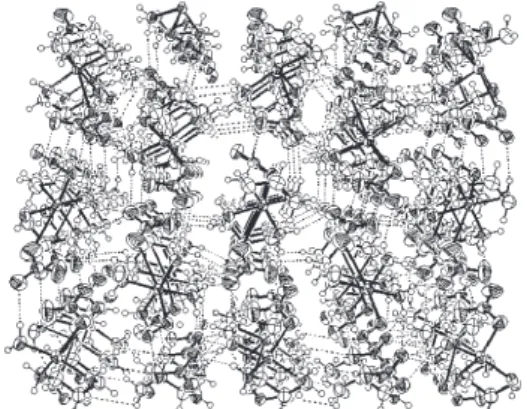
These intermolecular forces are responsible for the self-assembly of the 1D chains of 1 and 2 into a three-dimensional supramolecular network, which is illustrated in Figure 6.
Figure 3. Packing view of the asymmetric unit of the co-crystal [Cu(NO3)2(pn)2][Cu(NO3)(N3)(pn)2].
Figure 4. ORTEP representation of two molecules of 1 and 2 showing
N–H···O intermolecular hydrogen bonds.
From the crystal engineering point of view, the crystal structure described in this paper clearly demonstrated two geometrically distinct supramolecular synthons (synthons I and II) which are generated from the molecular recognition between the hydrogen bond donating NH2 groups from chelating 1,3-propanediamine ligands and HB-accepting site of nitrate group (Scheme 1).
IR spectroscopy
The IR spectrum of the co-crystal [Cu(NO3)2(pn)2]and [Cu(N3)(NO3)(pn)2] (1 and 2) displayed a number of absorption bands attributed to vibrational modes of 1,3-propanediamine at 3262 cm-1 (ν
asNH2), 3157 cm-1 (νsNH2)
and 1580 cm-1 (δNH
2).However, the main interest in IR
spectrum of the compounds 1-2 lies in the bands associated with the vibrational modes of N3 and NO3– groups as they
can be very useful for the diagnosis of their coordination mode. The first feature of the IR spectrum of the co-crystal was the occurrence of a strong band at 2032 cm-1 assigned
to νassN3 and indicative of azide group terminally coordinated to the copper atom.17 The presence of the Figure 5. ORTEP representation of four molecules of 1 and 2 showing N–H···O intermolecular hydrogen bonds and C–H···O interactions.
Figure 6. Perspective view of the 3D supramolecular network in the co-crystal.
nitrate group is evidenced by the appearance of a strong and narrow band at 1383 cm-1 (νONO).
Conclusions
In this work, we describe the X-ray structural characterization of an unusual 1:1 co-crystal of [Cu(NO3)2(pn)2] (1) and [Cu(N3)(NO3)(pn)2] (2). The crystal structure consists of 1D hydrogen-bonded chains of 1 and 2 which are interconnected by N–H···O and N–H···N hydrogen bonds and C–H···O contacts to yield a three-dimensional supramolecular array.
In the context of supramolecular chemistry and crystal engineering of the transition metal-based species, it is of vital importance to identify and understand the role played by new inorganic supramolecular synthons in the molecular aggregation within the crystal since they can be important tools in the rational construction of well-ordered structures. A systematic work on the creation of novel supramolecular architectures is currently underway in our laboratory.
Acknowledgments
The authors wish to acknowledge CNPq, FAPESP and CAPES for financial support.
Supplementary Information
Additional materials, consisting of atomic coordinates and equivalent isotropic displacement parameters for nonhydrogen atoms, H-atom coordinates and isotropic displacement parameters, bond lengths and interbond angles have been deposited with the Cambridge Crystallographic Data Centre, CCDC, No. CCDC 276281. Copies of available material can be obtained on application to CCDC, 12, Union Road, Cambridge CB2 IEZ, UK (fax 44-1223-336033 or e-mail:[email protected]).
References
1. Chae, H. K.; Siberio-Pérez, D. Y.; Kim, J.; Go, Y.; Eddaoudi, M.; Matzger, A. J.; O’Keeffe, M.; Yaghi, O. M.; Nature2004, 427, 523;
Takamizawa, S.; Nakata, E.; Saito, T.; Inorg. Chem. Commun.2004,
7, 125; Li, M.; Cai, P.; Duan, C.; Lu, F.; Xie, J.; Meng, Q.; Inorg.
Chem. 2004, 43, 5174; Balzani, V.; Ceroni, P.; Ferrer, B.; Pure Appl.
Chem.2004, 76, 1887; Barnett, S. A.; Champness, N. R.; Coord.
Chem. Rev.2003, 246, 145; Dinolfo, P. H.; Hupp, J. T.; Chem. Mater.
2001, 13,3113; Kahn, O.; Acc. Chem. Res.2000, 33, 647.
2. Braga, D.; Maini, L.; Polito, M.; Tagliavini, E.; Grepioni, F.;
Coord. Chem. Rev.2003, 246, 53; Tadokoro, M.; Nakasuji, K.;
Coord. Chem. Rev.2000, 198, 205.
3. Moulton, B.; Zaworotko, M. J.; Chem. Rev. 2001,101,1629.
4. Takahashi, P. M.; Melo, L. P.; Frem, R. C. G.; Netto, A. V. G.; Mauro, A. E., Santos, R. H. A.; Ferreira, J. G.; J. Mol. Struct.
2006, 783, 161; Netto, A. V. G.; Frem, R. C. G.; Mauro, A. E.;
Almeida, E. T.; Santana, A. M.; Souza Jr., J.; Santos, R. H. A.;
Inorg. Chim. Acta2003, 350, 252.
5. Netto, A. V. G.; Frem, R. C. G.; Mauro, A. E.; Polyhedron2005,
24, 1086; Silva, P. B.; Frem, R. C. G.; Netto, A. V. G.; Mauro,
A. E.; Ferreira, J. G.; Santos, R. H. A.; Inorg. Chem. Commun.
2006, 9, 235; Almeida, E. T.; Santana, A. M.; Netto, A. V. G.;
Mauro, A. E.; Santos, M. P.; Santos, R. H. A.; Z. Kristallogr.
-New Cryst. Struct. 2002, 217, 366; Sargentelli, V.; Benedetti,
A. V.; Mauro, A. E.; J. Braz. Chem. Soc.1997, 8, 271.
6. Oliveira, C. N.; Ionashiro, M.; Graner, C. A. F.; Eclet. Quim.
1985, 10, 7.
7. North, A. C. T.; Phillips, D. C.; Mathews, F. S.; Acta Crystallogr.
1968, A24, 351.
8. Farrugia, L. J.; J. Appl. Crystallogr.1999, 32, 837.
9. Altomare, G.; Cascarano, C.; Giacovazzo, C.; Guagliardi, A.;
J. Appl. Crystallogr.1993, 26, 343.
10. Sheldrick, G. M.; SHELX97,Programs for Crystal Structure
Analysis (Release 97-2), University of Göttingen:
Germany,1997; Sheldrick, G. M.; Institüt für Anorganische
Chemie der Universität, Tammanstrasse 4, D-3400 Göttingen,
Germany, 1998.
11. Speck, A. L.; PLATON, A Multipurpose Crystallographic Tool,
Utrecht University: Utrecht, The Netherlands, 1998. 12. Stergiou, A. C.; Papastephanou, S.; Tsiamis, C.; Polyhedron
1994, 13, 2285.
13. Luo, J.; Zhou, X. G.; Gao, S.; Weng, L. H.; Shao, Z. H.; Zhang, C. M.; Li, Y. R.; Zhang, J.; Cai, R. F.; Polyhedron2004, 23, 1243.
14. Mauro, A. E.; Haddad, P. S.; Zorel Júnior, H. E.; Santos, R. H. A.; Ananias, S. R.; Martins, F. R.; Tarrasqui, L. H. R.; Transition
Met. Chem.2004, 29, 893.
15. Mautner, F. A.; Goher, M. A. S.; Polyhedron1996, 15, 1133.
16. Casagrande Jr., O. L.; Klein, S. I.; Mauro, A. E.; Tomita, K.;
Transition Met. Chem. 1989, 14, 45.
17. Hathaway, B. J.In Comprehensive Coordination Chemistry;
Wilkinson, G., ed., Pergamon: Oxford, 1987, ch. 53. 18. Valdés-Martínez; Toscano, R. A.; Ramirez-Ortíz, J.; Polyhedron
1995, 14, 579.
19. Cameron, A. F.; Forrest, K. P.; Taylor, D. W.; Nuttall, R. H.; J.
Chem. Soc.A1971, 2492.
20. Nakamoto, K.; Infrared and Raman Spectra of Inorganic and
Coordination Compounds, 4th ed., John Wiley & Sons: New
York, 1986.
Received: June 7, 2006 Published on the web: November 10, 2006
![Figure 2. The ORTEP representation of the molecular structure with la- la-beling scheme for [Cu(N 3 )(NO 3 )(pn) 2 ] 2](https://thumb-eu.123doks.com/thumbv2/123dok_br/18991069.460666/4.892.70.800.781.1085/figure-ortep-representation-molecular-structure-beling-scheme-cu.webp)