LEARNING ENVIRONMENT
Ana Augusta F. de Freitas1 and Luiz Fernando M. Heineck2
ABSTRACT
The main purpose of this paper is to understand technological capabilities accumulation associated with lean activities observed in a group of 11 building companies participating in a collaboration schema established among firms with focus on learning - a learning network. These companies have been mastering new managerial concepts as a group for the last 12 years, mainly devoted to learn about and implement lean construction in Fortaleza, a three million population city in the northeast of Brazil.
A field survey was conducted in order to identify technological trajectories. Further specific analysis was developed focusing on production management function evolution and lean concepts contribution to knowledge accumulation in this area are highlighted. Results indicate that (1) technological accumulation varies in mode and speed among apparently very similar companies and (2) learning networks might be taken as an appropriate locus for knowledge accumulation provided that building companies decide to take an active role on them. In a word, just to participate in a learning environment does not add to the organization capabilities to improve its production management function. This research work extends theoretical understanding about the impact of learning networks on innovative and productive capability of building companies in developing countries, especially in connection to lean production.
KEYWORDS
Technological capability, learning, alliancing, lean environment, production planning, collaboration,
INTRODUCTION
Organizational models based on association mechanisms, collaboration, sharing and mutual learning appear as concrete possibility for managerial development. Cooperation established among firms within the same industrial sector with focus on learning is an example of association that might be beneficial. This arrangement is characterized by Bessant and Tsekouras (1998) as a learning network. Learning networks might be conceptualized as locus of knowledge production and dissemination, that is, an environment such as organizations and their agents might take part but whose presence does not guarantee per se knowledge acquisition. They might be suitable for Lean Construction implementation since this novel approach to
1
Professor, Civil Engineering, Estate Univ. of Ceará, Brazil, Phone +55 (85) 31019940,
Professor, Civil Engineering, Federal Univ. of Ceará, Brazil, Phone +55 (85) 32670096,
management requires development of new managerial abilities related to learning both within and outside the enterprise (Koskela 1992). A paradigmatic change from conversion to flow management requires new organizational capabilities. Capabilities are those abilities derived from knowledge that are successfully put into use.
Learning processes allow company to accumulate technological capability along time. Technological capabilities are resources to generate and to manage technological changes. In spite of several studies depicting the importance of companies joining networks to improve competitive advantages, researchers (e.g., Romijn and Albadejo 2000) still raise questions in connection to the causal link between technological capability and learning processes promoted in networks. Besides, it is necessary to recognize that not all companies acquire technological capabilities in the same way. Notwithstanding, Keast and Hampson (2007) suggest that interorganizational networks can facilitate the flow of information and resources in order to spread innovations. Association mechanisms are also suggested by Ruikar et al. (2009) and by Alarcon et al. (2001) in the form of practice communities, an important locus for knowledge sharing. Following that it was decided to further investigate this particular form of technological capability accumulation.
Technological capability accumulation is the process of unidirectional increase in the ability of acquiring new levels of technological performance, where previous stages might foster the speed, breadth or complexity of each new step. Giving those definitions, the main purpose of this paper is to understand technological capabilities accumulation associated with lean activities observed in a group of 11 building companies participating in a collaboration schema established among firms with focus on learning - a learning network.
THEORETICAL BASIS
Companies’ networks can be understood as an environment where capabilities are generated by a collective process of learning. Bessant and Tsekouras (1998) define learning networks as a group of companies that join formally, in order to increase their stocks of knowledge. Besides the exchange of knowledge, learning networks could also contribute to innovation process and technological diffusion, with companies sharing common objectives and open themselves for new questions and experimentations.
This thought is not consistent among researchers. According to Slaughter (1999), although there is a general perception that building construction is a backward industry, innovation occurs and it has in the construction site employees its main source. Formoso and Ino (2003) remember that National Quality Programs for the construction sector, a Brazilian government initiative promoted by the 90´s, were important for upgrading construction processes. Theory thus set questions that range from if innovation occurs, main agents up to the mechanisms that trigger their development. An analytical model might provide answer to those questions.
ANALYTICAL MODELS
In order to measure technological capabilities, a model proposed by Lall (1992) was adapted for the building sector. Model adaptation was accomplished through three stages, where the first one consisted of bibliographical review, through a comprehensive survey of national and international literature that might provide a chronological synthesis of building technological development during the last 30 years. The second stage consisted of interviews with two specialists, which made up about fourteen hours of conversation. Interviews were initially used to propose activities that are consistent with different levels of technological development for three managerial functions (project design, use of equipments and production management). Model validation with three construction companies’ management leaders was the next stage. This allowed checking and correcting information contained in the adapted model by means of verifying if activities were coherent with the local, national and international reality of the building industry. All those involved were conversant with lean management concepts and reputed design, use of equipment and production management as potentially highly influenced by this new philosophy over the last 20 years.
Trajectories of technological capabilities accumulation encompassing all three functions are first presented. Thereafter, only the production management function is analyzed with their activities classified into five technological levels: (1) basic routine; (2) advanced routine; (3) basic innovative; (4) intermediate innovative; and (5) advanced innovative. Table 1 describes items connected to lean production that are addressed in each level of the proposed model.
Table 1: Variability of Available Dies
Levels Activities
5 New logistic models (e.g. modular consortium),
4 Variability management, long, medium and short term planning integration
3 Stock control, lean production adaptation, cells production
2 Quality management, short term labor allocation to building activities
1 Long term planning, 5S, basic stock control
external acquisition of knowledge (e.g. hiring professionals with expertise from outside), b) internal process of acquiring knowledge (e.g. learning by doing/experimenting), c) socialization of knowledge (e.g. team formations); d) codification of knowledge (padronization of building activities through a procedure’s manual); and e) learning process acquired into networks (e.g. visiting construction sites of associated firms).
A learning network of building companies known as INOVACON (Programa de
Inovação da Indústria da Construção Civil do Estado do Ceará - Innovation Program
for the Construction Industry of Ceará) was investigated. These companies have been working together as a group for the last 12 years. During this time they have engaged in some 18 development modules, each taking roughly a 4 months period of learning and implementation. Learning modules were associated with hard technological issues as formwork, rendering and façade ceramic tiling and soft managerial issues, like labor motivation, productivity measurement, economical feasibility analyses of new developments, and marketing. Out of these 18 modules, the very first one held in 1998 and more two respectively in 2000 and 2005 were devoted to lean construction. By the end of the theoretical modules, concepts were implemented in building offices and sites that volunteer to experiment new technologies in practice.
It might be taken that companies are still under the influence of the 2005 lean construction module that fostered a significant development of the production management function undertook by the leading firms out of the 11 companies’ group. A number of IGLC papers have been published describing new management technologies that were implemented. Offices and sites have been visited freely by the INOVACON participants during all this period and each new module is an opportunity for sharing experiences not only on the subject under investigation but also on previous ones. The most noticeable advance on those construction companies was lean implementation, an issue that was recurrently discussed about even in modules of a different technological or managerial nature. Building companies’ directors undertake not only business meetings to buster their commercial interests but also social and political ones. INOVACON flagship is the apparently successful lean implementation that occurred among the associated companies. This is what the authors take as a lean learning environment.
A four months field survey was conducted during 2010 both with engineers and managers of all companies, positioning through interviews their reactions to the proposed technological capability accumulation model. In parallel appropriate documents were also investigated (e.g. ISO 2000 quality manuals). Construction sites were visited to check if activities that would classify firms into the different accumulation levels were actually implemented. As the model emphasizes technological abilities accumulation through long periods of time evidences about capabilities and learning processes were gathered along the companies’ lifetime (for some companies spreading a time period of more than 30 years), even if they were participating in INOVACON only from 1998 upwards, when this program was inaugurated.
RESULTS FOR TECHNOLOGICAL CAPABILITY ACCUMULATION
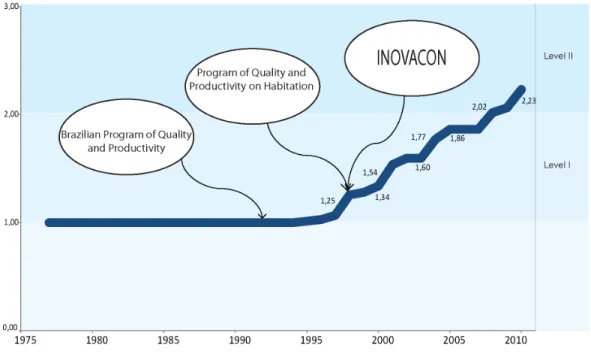
improvements for all eleven companies taken as a group (Figure 1). Average scores for the 11 building companies are depicted throughout the 1975-2010 period. They indicate the technological capability accumulation level they were able, on average, to reach for each year. Maximum score is 5 and minimum is 1. Final 2010 score of 2.23 means that for this latter year the 11 companies just passed level 2 of technology accumulation (advanced routine) and are on their way to arrive at level 3 (basic innovative).
Some important milestones on national dwelling constructions history could explain the timely occurrence of facts associated to this curve. For example, according to Formoso and Ino (2003), Quality Programs implemented during 1990´s had significant impact, especially on process standards (padronization) and quality measurement. Keast and Hampson (2007) and Ruikar et al. (2009) also remember that growth on the sector was associated with academic links with universities which can allow information flow and technological capability accumulation, what did occur in Brazil from the 90’s.
Figure 1 –Technological Capabilities Trajectories in all eleven building companies
complementary PBQPh managerial effort, with greater emphasis on gemba operational activities as opposed to the official national quality program more bureaucratic in nature.
Secondly, it can be stated that although companies are evolving together, especially in recent years, they have not yet reached as a group innovative levels (grades 3, 4 and 5). Moreover their history points out that they maintained a basic routine level (grade 1) for quite a long period of time: this is not to be taken as a trivial pursuit, since failure to perform activities that would classify them in level 1 automatically means that they are stagnant at level zero. Being classified as basic routine means that something has been done to differentiate them from the ongoing building culture. In practice it means that companies are doing their job in a more proficient way and that they did some home work to better engineer their activities. The mere fact that those 11 companies decided to join and kept working together ever since can be taken as a testimony of their better than average will to improve.
The fact that level one of technology capability was maintained for a long period before 1998 might also mean that there methodological difficulties to ascertain facts so far away in the past, as interviews and field observations were conducted recently (2009 and 2010). For the oldest building companies interviews demanded testimony on building developments for the last 30 years, that is, since 1980, a daunting task. Thirdly, in spite of the fact that improvement shows a linear trend, it can be taken that after a somehow stationery period between 2002 and 2004, momentum was recovered from 2005 onwards, what coincides with the apparently successful third INOVACON module on lean production. A fourth avenue of discussion in expressed in Figure 2.
Figure 2 – Number of years for moving between technological capabilities levels
started their operations in routine basic level and only one company (Theta) had not evolved to level 2. At level 1, production management activities are associated with a minimum of engineering conditions put into use. Over time, 54% of the sample reached level three (basic innovation) and only two companies achieve innovative intermediate level (level 4) for this function. It is worth pointing out that even at level 4 those companies continues to practice very basic hard technology activities, like in-situ concreting, masonry walls, manpower intense internal and external rendering, manual floor screeding and tiling. As an example of high levels of management ability coexisting with low technology is the fact that the use of tower cranes is still in its infancy. Despite that, managing site using level 4 abilities means mastering the use of cell production, kanban ordering of materials and andon signalling, as far as lean production concepts goes.
Specifically in terms of speed, a fifth observation goes in the direction of ascertain that that there is no relationship between company's age and accumulation rate. Furthermore technological capability rate increases with each tier, which means that companies accelerate accumulation as they reach higher levels of capability. Exception to this is company Zeta which took only one year to move from advanced routine (level 2) to basic innovative level (level 3) but needed four years to go from there to level 4.
RESULTS FOR LEARNING MECHANISMS, INTERNAL AND EXTERNAL SOURCES OF KNOWLEDGE
A group of qualitative findings derived from interviews with directors, supervisors and site engineers might also be addressed in order to explain how it was possible to follow capability trajectories depicted earlier on. Just a few of them are produced here and conclusions at the end of this report summarizes the whole set of conclusions that were arrived at. For example, as far as the sort of learning mechanism that were employed, company Gamma stated that their close association with building component’s suppliers (an external learning mechanism) helped them adjust technological solutions embedded in those components to the operational requirements of each particular site. This learning mechanism helped, among other activities, to grant level 3 for technological capability accumulation in the production management function for Gamma. In the same company, long, medium and short planning integration (level 4) was a capability developed through the learning mechanism propitiated by training conducted by an external consultant.
On the other hand Company Alpha provided evidence that taking part in seminars, congresses and technical events help them to identify and recruit consultants and even site engineers with better managerial training. An external activity ended up by incorporating an internal learning mechanism through exploitation of abilities brought by newly recruited employees. Capability accumulation outcomes were related to the creation of a quality management system what contributed to a level 2 for the production management function.
processes or contrary wise lessen their effects if no complimentary learning mechanisms were in action. The strongest evidence on that is the much better performance associated with building companies that always volunteered to participate in new implementation modules, as opposed to the ones that never did so.
Moreover, Alfa director, although an active participant in the Program, fail to show technological capability accumulation as a result of no knowledge sharing with its employees and also as a lack of organizational structure to codify knowledge. Despite that stagnant position in terms of accumulation, it has been noted that hiring a new open minded site engineer helped to strengthen Alfa director leading position as an experienced site supervisor within the building company. That is, internal knowledge was boosted by a combination of the director’s site experience with the willingness to share knowledge demonstrated by the new site engineer. Moreover, company Alfa has not deemed important to volunteer in experimenting with new management techniques, instead, relying solely on the experience that might be gained from their ongoing project’s portfolio. A deeply routed belief in generating abilities only within company’s boundaries, with no further organizational structuring and coding of knowledge, might explain their somehow stagnant position.
A different perspective was found in company Beta. Besides participating actively in the network, this company formalizes knowledge dissemination through on the job training, weekly meetings with engineers, employees and whenever possible with consultants and external observers. It volunteers for all INOVACON activities and participate enthusiastically in seminars, courses, speeches, academic meetings and awards. Employees from all levels are encouraged to take further steps in their formal education, including attendance to Msc. Programs in Construction Management. This research work found a positive combination between external and internal learning, both in terms of socializing and coding knowledge. Lean production became part of the company’s quality system. This might explain better than average speed to go from level 1 to level 2 and then from there to level 3
Evidences also showed that a greater variety of learning processes previously experienced by the building company increases knowledge assimilation. As example, integration between short, medium and long term planning can only be assimilated after company mastering long-term planning through a series of learning mechanisms like initially hiring external consultants, them training internal employees and further jointly developing planning programs along an external software house. Not only a variety of learning mechanisms were in action, but also it seems that each step helped to absorb knowledge with greater complexity, what is in line with what capability accumulation means.
the contrary, uncertainty related to what sort of projects to embrace in the future led Alpha to face internal resistance as far as searching for new knowledge goes.
An additional example may be found in company Iota. Choosing a specific building market is taken by company’s directors as an antecedent to get acquainted (or not) with new techniques. Iota decides to engage in a series of learning processes only after deciding to act primarily in apartment building for medium income. Previously, this company worked with small high-income luxury residential condominiums, where each 250 sqmt. house was taken as an independent project due to specific clients’ requirements for each building unit. For this latter type of construction, rationalization techniques, standardization, planning and control were difficult to implement and not regarded important by directors and site engineers.
Company’s portfolio also explains learning engagement. Theta, for example, has been building the same sort of apartment building for upper middle class in the last 20 years. According to a site engineer, on going technological capabilities are sufficient to engage in every new development. In addition, the company settled into a comfort zone where the company’ reputation and brand mark are sufficient to keep them in business. Non enthusiastic Theta remarks supports the view that company’s director plays a central role in learning as related to technological capability accumulation. A positive example is to be found in Eta, with a strong leadership worried about continuously improving production processes. For that he established a technical room with highly qualified human resources constantly trained for this purpose.
CONCLUSIONS
This research work deals with two analytical models, a quantitative one to measure technological capabilities accumulation and a qualitative one to explore learning mechanisms that made possible such trajectories. Learning was addressed both in terms of what has been achieved independently and what has been gained through participation in a learning network. It can be concluded that both learning occurs and it can be associated with the existence of network. Lean concepts were the most noticeable production management function technological capability accumulation.
follow such routes, active participation both within each building company and within the learning network should be experienced.
REFERENCES
Alarcón, L.F., Grillo, A., Freire, J., Diethelm, S. (2001). “Learning from Collaborative Benchmarking in the Construction Industry.” International
Conference of the International Group for Lean Construction, Singapore, Hong
Kong. 407-415.
Bayer, S., Gann, D. (2006). “Innovation and the Dynamics of Capability Accumulation in Project Based Organizations.” Druid Summer Conference on Knowledge, Innovation and Competitiveness: Dynamics of Firms, Networks,
Regions and Institutions, Copenhagen, Denmark. 1-25.
Bessant, J., Tsekouras, G. (1998). Learning Networks. Working Paper, CENTRIM, Brigthon: University of Brighton.
Cardoso, F. (1996). “Estratégias Empresariais e Novas Formas de Racionalização da Produção no Setor de Edificações no Brasil e na França – parte 1.” Estudos
econômicos da construção –SINDUSCON, São Paulo, 2 97-156.
Dantas, E., Giuliani, E., Marin, A. (2007). “The Persistence of Capabilites as a Central Issue in Industrialization Strategies: How the Relate to MNC Spillovers, Industrial Clusters and Knowledge Networks.” Asian Journal of Technology
Innovation, 15 (2) 19-43.
Formoso, C; Ino, A. (2003). “Inovação, Gestão da Qualidade & Produtividade e Disseminação do Conhecimento na Construção Habitacional.” Coleção Habitare. Gradhvol, R., Freitas, A., Heineck, L. (2011). “Desenvolvimento de um Modelo para
Análise da Acumulação de Capacidades Tecnológicas na Indústria da Construção Civil: Subsetor de Edificações.” Ambiente Construído, 11 (1) 55-67.
Keast, R., Hampson, K. (2007). “Building Constructive Innovation Networks: The Role of Relational Management.” Journal of Construction Engineering and
Management, 133 (5) 364-373.
Koskela, L. (1992). “Application of New Production Philosophy to Construction.”
Technical Report No,72, Center for Integrated Facility Engineering, Department
of Civil Engineering, Stanford University, Stanford, CA.
Lall, S. (1992). “Technological Capabilities and Industrialization.” World
Development, 20 (2) 165- 186.
Romijn, H., Albadejo, M. (2000). “Determinants of Innovation Capability in Small UK Firms: An Empirical Analysis.” QEH Working Paper, 40 1-27, June Issue. Ruikar, K., Koskela, L., Sexton, M. (2009). “Communities of Practice in
Construction Case Study Organisations: questions and insights.” Construction
Innovation: Information, Process, Management, 9 (4) 434- 448.