RBGN
Review of Business Management
DOI: 10.7819/rbgn.v0i0.2831
Received on 11/06/2015 Approved on 12/20/2016
Responsible editor: Prof. Dr. J. Ignacio Canales
Evaluation process: Double Blind Review
375
Dynamic capabilities, operational capabilities
(educational-marketing) and performance
Adriana Roseli Wünsch Takahashi
Federal University of Paraná, Department of Administration, Curitiba, PR, Brazil
Sergio Bulgacov
Getúlio Vargas Foundation, Administration School, São Paulo, SP, Brazil
Mônica Maier Giacomini
Federal University of Paraná, Department of Administration, Curitiba, PR, Brazil
Abstract
Purpose – To verify the relationship between dynamic capabilities (DCs) and their impact on performance mediated by operational capabilities, considering educational technological capabilities and marketing capabilities in private higher education institutions (HEIs) in Brazil.
Design/methodology/approach – A survey was carried out in 1.932 higher education institutions, resulting in 316 valid insertions. Research involved dynamic capabilities, operational capabilities, performance and environmental dynamism constructs.
Findings – he research revealed the emergence and explanation of a competitor model containing relationships that had not been considered by previous models, i.e., the direct inluence of technological educational capabilities on marketing capabilities.
Originality/value – he results revealed greater managerial complexity when referring to the relationship between DCs and performance, and contribute to research concerning HEIs in Brazil and to academic management itself.
1
Introduction
Research about organizational performance has long been published by management literature, as well as about its relationship with various categories, such as competencies, strategies and innovation, among others. Currently, in an attempt to understand what we can call ‘irm reinvention theory’, the concept of dynamic capabilities (DCs), originating from the concept of competencies and the resource based view (RBV), has shown promise in explaining why and how organizations change, adapt and reconigure themselves through environmental dynamism; in short, they reinvent themselves to survive and maintain competitive advantages.
Although the concept of DCs has already been well explored theoretically, there is still a lack of studies about the organizational processes imbricated in the development and use of these capabilities. One of the gaps is precisely to understand how the relationship between DCs and performance occurs – a relationship that needs empirical studies that investigate the presence of mediators in diferent environmental contexts, cultural settings and ields of activity. Some studies have already been carried out, such as Wu (2007), Hung, Yang, Lien, McLean and Kuo (2010), Prange and Verdier (2011), Protogerou, Caloghirou and Lioukas (2011), Pavlou and Sawy (2011) Wilden, Gudergan, Nielsen and Lings (2013) and Giacomini (2013). Empirically, the absence of papers that deal with the relationship between capabilities and performance is noticeable. However, these studies have focused on industry sectors, which justiies and makes relevant the choice of a services sector for this research.
he sector chosen was the educational one – speciically private higher education, which is unprecedented research in consulted literature, both nationally and internationally. his sector has undergone many changes over recent years, with changes in operating logic, expansion of the number of institutions and competition in
the face of strong competitive intensity. his scenario has increasingly demanded from them the ability to ‘reinvent’ themselves, be it through acquisitions or innovations, turning it into a relevant locus for studying DCs and performance. he results of this study provide new indings on the relationship between DCs and performance and bring contributions to ield studies and to HEIs’ academic management.
So, the general objective of this work is to verify how the relationship between dynamic capabilities and performance occurs, through marketing and educational technology operational capabilities applied to the private higher education sector in Brazil.
2
heoretical foundations
In this section, the concepts of dynamic capabilities, marketing and educational operational capabilities, and performance are presented and referring in order to support the hypotheses proposed for this research.
2.1
Dynamic capabilities
less predictable and linear. Within these markets, efective DCs rely heavily on existing knowledge and routines that enable them to take advantage of opportunities (Einsenhardt & Martin, 2000). However, analyzing how this occurs empirically is a challenge that is still present (Easterby-Smith, Lyles, & Peteraf, 2009) in various contexts, and further studies are needed, regardless of the line of study adopted.
As an analytical category, the DCs concept has been understood as made up by the following capabilities: to sense (to monitor and identify opportunities), to seize (to assess existing and emerging capabilities, and possible investments) and to reconigure (to create, extend, and modify the resource base when a company grows and the market changes), according to Teece et al. (1997) and Teece (2007). Other capabilities that have been pointed out as constituting DCs are the capability to learn, to integrate and to coordinate. hus, according to Zahra, Sapienza and Davidsson (2006), DCs are focused on the strategic changes and the alignment of the organization with the environment, and one of the ways in which this relationship has been studied is precisely through organizational performance. In an efort to understand this relationship, authors such as Spring and Araujo (2014) investigated the mediation of indirect or operational capabilities (Protogerou et al 2011, Wilden et al, 2013), which are described below. It is worth mentioning that operational capabilities are necessary so that dynamic capabilities can exist, since they are responsible for the operationalization of the knowledge.
2.2 Operational capabilities
O p e r a t i o n a l c a p a b i l i t i e s e n a b l e organizations to carry out “an activity on an ongoing basis, using more or less the same technique on the same scale to support existing products and services for the same consumer population” (Helfat & Winter, 2011, p. 1244). It should be noted that this deinition covers both industrial organizations and services, according
to the authors, and highlights the possibility of studying them in both contexts. Two operational capabilities have received special attention in the literature of both capabilities and DCs: technological and marketing.
According to Takahashi (2005, p. 258), an “operational capability consists of the skills and information necessary to operationalize, maintain and repair technology, i.e. know-how.” he capabilities referring to technology are those that allow for the development and production of technology, enabling response to rapid changes in the technological environment. To Takahashi (2005, p. 257), technological capability is “conceptualized as accumulated knowledge and the ability to make, understand, use and develop this knowledge to produce new technologies.” In this way, as a technological capability, it concerns the ield of technology for operationalization.
Marketing capabilities, on the other hand, are those that provide relationships with consumers, allowing for competition when predicting changes in their preferences, as well as for creating and sustaining long-lasting relationships (Song, Droge, Hanvanich, & Calantone, 2005).
Protogerou et al. (2011) studied the relationship between DCs and performance through marketing and technological capabilities, considering them superior technical capabilities, and validated the model that proposes that dynamic capabilities have an impact on performance, and are also mediated by marketing and technology capabilities. Giacomini (2013) studied the same relationships, but in other sectors and context, and her model revealed that dynamic capabilities have an impact on performance through the relationship between marketing capabilities and technological capabilities. To the authors of both articles, these capabilities are idiosyncratic resources that allow for gaining competitive advantages, and are positively related, although diferently in each paper.
based on the quest for opportunities in the environment, by combining strategic resources and market needs through the use of new technologies (Jiao, Alon, Koo, & Cui, 2013). Therefore, DCs involve both operational, technological and marketing capabilities. his assumption is supported by the proposition that irms with a strong innovation technology base improve the sales force by the inluence of their consumers on their product-related expectations (Dutta, Narasimhan, & Rajiv, 1999). Trainor, Rapp, Beitelspacher and Schillewaert (2010) also veriied that technological resources support market orientation.
In short, the relationship between the two operational capabilities – technological and marketing – has been sustained in literature since the work of Dutta et al. (1999), as well as the relationship between them and performance (Song et al., 2005; Trainor, Rapp, Beitelspacher, & Schillewaert, 2010), among others. More recently, operational capabilities have been incorporated into conceptual models of research on DCs and performance (Protogerou et al., 2011; Giacomini, 2013), a relationship which we explore in more detail in the next session.
2.3
Performance and dynamic capabilities
Eisenhardt and Martin (2000) argue that DCs are not guaranteed sources of superior performance, but their development represents a possibility, a potential. Teece (2007) states that there is a need for complementary structures, so that DCs may generate performance improvements (Wilden et al., 2013). herefore, the relationship between DCs and performance may not be direct or even contextual and situational.
If DCs are a dynamic process and vary over time, then the relationship between process indicators and the organizational results (performance) can be analyzed at a given point in time (transversely) and over time (longitudinally). A static perspective and a dynamic perspective. Given the shortage of studies on the relationship between DCs and organizational performance,
studies of both natures are relevant and may bring potential contributions to the ield. From a theoretical point of view, this work assumes the assumption that DCs represent an attribute of the organization and are developed over time, and therefore they are variables and represent an organizational process, able to be maintained, potentialized and created, and even atrophied. his is because competences are also developed and atrophied, as Takahashi (2007) has shown. Moreover, DCs involve renewal of competencies.
The first theoretical-empirical studies about DCs and performance were initiated by Wu (2007), highlighting their signiicance in the performance of start-ups. Hung et al. (2010) demonstrated that organizational learning directly afects performance through the mediation of DCs. Prange and Verdier (2011) validated a model that deals with the relationship between DCs exploratory processes and performance. However, Protogerou et al. (2011) were the ones who studied for the irst time, theoretically and empirically, the impact of DCs on performance, mediated by marketing and technological operational capabilities, as this work proposes. THus, this model was selected as reference for this work, along with other contributions such as Pavlou and Sawy (2011), Wilden et al. (2013), and Giacomini (2013).
hese articles are mentioned in the next session, which deals with the hypotheses.
3
Hypotheses
DCs and performance. To analyze DCs and performance, the authors considered that renewal and reformulation by DCs according to environmental needs may be a prerequisite to sustainable competitive advantages. he authors used the following subdimensions for DCs: coordination, learning and competitive response.
However, Teece et al. (1997) and Teece (2007) argue that the dimensions of DCs are sense, seize and reconigure, while Pavlou and Sawy (2011) consider the following capabilities: sensing, learning, integration and coordination. In order to make the DC variable more robust and to investigate it comprehensively, we considered the following dimensions already investigated in literature: sense, seize, reconiguration, learning, coordination and integration.
Assuming DCs of this magnitude, we considered them to be of higher order or meta-capability that allow a irm to exploit lower-order operational capabilities that are important in identifying and acquiring new marketing and technological capabilities (Protogerou et al, 2011). For the purposes of this study, technological capabilities were considered educational technological capabilities in order to show that they were treated both in the data collection instrument and in the sector-speciic analysis, with due language adaptations and previous tests. hus, H1 is:
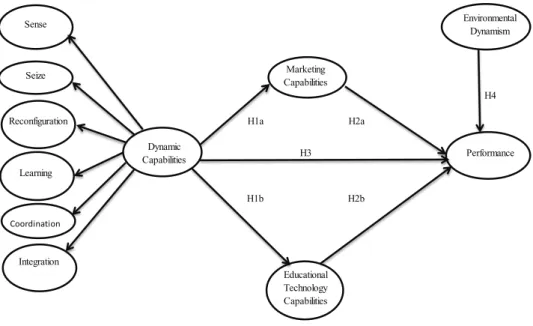
H1: he presence of dynamic capabilities has a positive impact on the development of operational capabilities.
H1a: he presence of dynamic capabilities has a positive impact on the development of marketing capabilities.
H1b: he presence of dynamic capabilities has a positive impact on the development of technological educational capabilities.
Marketing capability empowers irms to better understand customers and their needs, gain new customers and effectively analyze
competition and competitors. Technological capabilities enable firms to develop systems and procedures to seek solutions to problems, implement and develop prototypes, and import and absorb external knowledge. hus, the more a irm is endowed with capabilities that enable it to produce superior or low-cost market supplies, the more these capabilities can be translated into a position of competitive advantage and superior performance. hus, H2 is:
H2: Operational capabilities have a positive impact on irm performance.
H2a: Marketing capabilities have a positive impact on irm performance.
H2b: Technological capabilities have a positive impact on irm performance.
To Protogerou et al. (2011), this relationship is not theoretically new, but it is relevant to the completeness of the model, which is reairmed in this study. he objective was to consider a positive relationship between operational capability and performance in order to examine the efect of DCs on competitive advantage, through the mediation of operational capabilities. his indirect efect indicated in H1 and H2 happens because the superior performance at some point of time is directly inluenced by the coniguration of operational capabilities (H2), which are conigured by DCs (H1). hus, H3 is:
H3: Dynamic capabilities have a positive impact on performance.
detailed routines, and in analytical processes to produce mostly predictable results, while in highly dynamic environments they are simple, experiential, and unstable, geared to the rapid creation of knowledge to produce adaptive but unpredictable results. In stable or less dynamic environments, changes are slower and more predictable. herefore, DCs do not transform operational capabilities, but support their adaptive change through small incremental improvements.
Environmental dynamism and competitive intensity are present in the various theoretical-empirical studies on DCs, and research has considered them both as context and as mediator (Eisenhardt & Martin, 2000, Helfat et al., 2007,
Protogerou et al., 2011, Teece, 2007, Wilden et al., 2013, Zahra, Sapienza, & Davidsson, 2006, among others). here is consensus in literature that, in one way or another, it is essential to consider the environment and the sector to which the studied organization belongs. In this way, new studies such as this paper are relevant in order to investigate the relationship between DCs and performance. hus, H4 is:
H4: Environmental dynamism has a positive impact on irm performance.
he following igure shows the model that supports the four hypotheses:
Sense Environmental
Dynamism
Seize Marketing
Capabilities
H4
Reconfiguration H1a H2a
Dynamic
Capabilities H3 Performance
Learning
H1b H2b
Coordination
Integration
Educational Technology Capabilities
Figure 1. Proposed Model
Source: Adapted from Protogerou, A., Caloghirou, Y., & Lioukas, S. (2011). Dynamic capabilities and their indirect impact on irm performance. Industrial Corporate Change, 21(3), 615-647.doi: 10.1093/ icc/dtr049
4
Methodology
his study’s approach is quantitative; it was carried out through a questionnaire survey. he model adopted was that of Protogerou et al. (2011), but with some changes in the composition of DCs based on studies by Teece (2009), Pavlou and Sawy (2011) and Wilden et al. (2013). Unlike the original model by Protogerou et al
(2011), which analyzed the companies in groups of diferent levels of environmental dynamism, the Environmental Dynamism construct was used as an exogenous variable, since the authors already demonstrated that the impact of DCs on performance occurs in the same way at both levels of environmental dynamism.
educational, speciically private higher education. his sector was chosen because it has undergone significant changes over recent years, both through mergers and acquisitions, as well as in intensiied competition and price wars. he ofer of educational services has been diversiied, showing signs of frequent changes. his segment has speciics because it is a knowledge intensive sector, which can bring new knowledge to the ield of DCs both because it belongs to the service sector and because of the type of service it ofers. It is noteworthy that no research on DCs and performance in this sector was identiied, neither in national nor international literature.
Brazilian private higher education has undergone several changes over the last two decades and has increased signiicantly (Takahashi, 2007). National Institute of Educational Studies and Research Anísio Teixeira (Instituto Nacional de Estudos e Pesquisas Educacionais Anísio Teixeira/INEP, 2014) data shows the same: in 2013, the total number of students enrolled in Brazilian higher education institutions reached 7.3 million, almost 300 thousand enrollments over 2012; enrollments increased by 3.8%, 1.9% in the public network and 4.5% in the private network; there are 32 thousand undergraduate courses ofered by 2,4 thousand HEIs, of which 301 are public and 2,000 are private; between 2003 and 2013, the number of students enrolled in undergraduate courses increased by 76.4%.
With the growth of the sector, several mergers and acquisitions have occurred due to competitive intensity, either for survival or growth. As an example of the changes that have occurred in the operation of HEIs, both in terms of managerial professionalization and of market logic, we can mention the case of an HEI which, in 2007, for the irst time, opened capital in the stock exchange. his context demanded from HEIs new administrative and academic systems and procedures, to act more intensely in the allocation of resources, innovations, strategic renewal and capability development. Both universities and university centers and colleges need a complex enough structure to have their activities regulated, guaranteeing adequacy for the study of capabilities. In addition, the regulation of the operation of HEIs by the Brazilian Ministry of Education has also pressured organizations to professionalize their activities.
4.1
Sample and data collection
The HEIs sample n = 316 (return of 16.36%) was based on a cross-sectoral approach to ensure a suicient sample for the generalization of data from the population of 1,932 private HEIs. Primary data was used for all categories of the research to test the hypotheses, since there are no public reports from HEI allowing for the evaluation of inancial performance and of the sale of educational services based on secondary data.
he questionnaire was elaborated based on articles that have already developed and applied scales for studies of DCs and performance (Protogerou et al., 2011, Pavlou & Sawy, 2011, Wilden et al), as well as on authors such as, for example, Eisenhardt & Martin, 2000, Helfat et al., 2007; Teece et al., 1997; Teece, 2009. We included questions about DCs and their components, operational capabilities, performance and environmental dynamism. he questionnaire also included questions on respondents’ and institutions’ proiles. A 5-point Likert scale was used, varying from “totally disagree” to “totally agree”, since this is a well accepted practice in this type of research, and appropriate to the application context. he questionnaire was applied through Qualtrics software.
4.1.1
Constructs
The constructs used in the study are described below, considering the dimensions used in each one of them.
4.1.1.1
Dynamic capabilities
changes (reconiguring). hese components are not interchangeable and represent diferent DC processes (Teece, 2009). In addition to these components, we also considered the dimensions of learning, which is understood as the low of knowledge and experiences, present in the studies of Protogerou et al. (2011) and Pavlou and Sawy (2011); integration which refers to new resources and assets, present in the study of Pavlou and Sawy (2011); and coordination, of organizational and administrative processes, present in the studies of Protogerou et al. (2011) and Pavlou and Sawy (2011). hese items were validated in the mentioned research. In summary, we obtained six subdimensions that compose DCs, each with speciic items: sense, seize, reconiguration, learning, coordination and integration. Special attention was given to the learning dimension, since the questions were out of date in relation to literature.
4.1.1.2
Operational capabilities
Based on the study by Protogerou et al. (2011) and Giacomini (2013), the items of marketing and technological capabilities were adapted for the educational higher education sector. Marketing capability remained with external emphasis and reflected collective knowledge, skills and resources referring to the needs of the market and consumers, sales force and marketing department. Technological capability focused on educational development, new educational methods, courses and practices, and service processes, with emphasis on the relationship with stakeholders, cooperation with sector associations, with regulatory agencies and educational planners in the country, and with the department academic institution. herefore, technological capability was hereby named an educational technological capability. In-depth interviews and a pretest allowed us to adjust language and items.
4.1.1.3
Performance
Performance was evaluated based on respondents’ answers regarding the sale of educational services and inancial results, such as in the study of Protogerou et al. (2011)
and Giacomini (2013), with the appropriate adaptations to the sector. Educational services included an increase in the number of students, courses and services, investments in sales of educational materials and services, and dropout rates. Financial performance was evaluated in terms of return on investments, market shares, debt ratios, repayment capabilities, and the inancial capability to expand with own resources. his performance data was evaluated based on primary data, since there is no national public information database in these categories for HEIs.
4.1.1.4
Environmental dynamism and
competitive intensity
Based on the scale items of Wilden et al. (2013); Protogerou et al., 2011; Pavlou and Sawy (2011), the questions were created and adapted to the educational sector context. Respondents were asked to assess environmental turbulence, price competition and promotion ‘wars’, the competitive situation of the higher educational context, competitors’ strategies, threats and opportunities in the industry, and marketing practices.
4.1.2
Adaptation of questionnaire language
and pretests
After the questionnaire was created, we adapted its language to the educational context. To this end, we used the authors of this paper’s experience of over 10 years in research, teaching and management in the educational sector. In addition, ive in-depth face-to-face interviews were conducted with private HEI managers, each an average one-and-a-half hours long. he respondents provided suggestions on the clarity of the questions and on the structure of the questionnaire; both were then analyzed and inserted into the new version of the research instrument.
improvements to the questionnaire, which were incorporated, resulting in a third version of the sample data collection – conducted in 2014 – instrument. hus, the language of the questions of the research instrument was considered appropriately adjusted to the Brazilian higher education sector.
All 1,932 HEIs were initially contacted by telephone for the email or telephone of managers. Then managers were contacted and asked to answer the questionnaire. Emphasis on managers as respondents was a way of ensuring that a single response per organization could represent the reality of the HEI in the categories investigated. Several connections were made between July and September 2014, until the sample was large enough to ensure the validity and generalization of the study (316 respondents, one per institution). he positions of the respondents are as follows: dean, vice dean, director, vice director, president and vice president. Regarding the proile of the sample, we found that 38% of HEIs have been in activity during 11 to 25 years, and 39.9% during more than 26 years in the market. Regarding the size of HEIs, 77% are considered medium-sized, according to criterion used by Brazil’s Support Service for Micro and Small Companies (Serviço Brasileiro de Apoio às Micro e Pequenas Empresas, SEBRAE), between 100 and 499 employees.
4.1.3
Validation of measures
he validity of content was ensured by using scales developed and applied by Protogerou et al., 2011, Pavlou and Sawy (2011), Wilden et al., (2013), and on literature on DCs from the seminal work of Teece (1997). Language adaptation was ensured through the mentioned in-depth interviews, and scale adjustments were performed through a pretest conducted with private HEI managers. hese procedures aimed at minimizing measurement errors.
We veriied through the use of SPSS that the normal distribution of all indicators presented plausible normality. he standard deviation of the mean demonstrated homogeneity in the evaluation of the respondents, that is, the indexes were below and close to 1. he construct validity
was assured through exploratory factor analysis, which veriied the internal consistency of the metrics and extraction of the factors, and by using conirmatory factor analysis (CFA) to ensure the adequacy of the indicators.
he software used in the collection and analysis were SPSS 20th version and AMOS 21st
version. Following exploratory factorial analysis and CFA, structural equation modeling (SEM) was performed.
5
Analysis and discussion of results
Initially, all dimensions were evaluated by exploratory factor analysis using the principal components method, in which the unidimensionality of the scale was veriied. From there on, CFA was carried out, evaluating the relationships between the following constructs: DCs (sense, seize, reconfiguration, learning, coordination and integration), marketing capabilities, educational technological capabilities, performance and environmental dynamism.
5.1
Conirmatory factor analysis
CFA carried out in this study made use of the Maximum Likelihood estimation method, which is the most commonly used estimation method in the Structural Equation Modeling (Hair, Black, Babin, Anderson, & Tatham, 2005). We veriied in the CFA which model had higher signiicance; the irst option was with the construct of one-dimensional DCs, and the second option was with the construct of 2nd order
DCs. We obtained better signiicance results in the 2nd order model, as shown in Table 1; this is
Review of Business Management, São Paulo, V
ol. 19, No. 65, p. 375-393, Jul./Sep. 2017
Adriana Roseli Wünsch T
akahashi / Sergio Bulgacov / Mônica Maier Giacomini
Table 1
Conirmatory factor analysis
Construct Indicators Scale Mean SD Sig. de 1ª
order
Sig. de 2ª
order AVE CC α
Dynamic Capabilities (Construct of second order, items repeated below)ª
Sense We often monitor educational, economic, and legal changes in our environment. 1-5 4.28 0.80 0.51* 0.75* 0.54 0,76 0,76
We often use the information we monitor to identify new opportunities for educational courses and services.
1-5 4.22 0.81 0.54* 0.79*
We use established processes to identify the target market, changes in consumer needs, and possible innovations to ofer services.
1-5 3.99 0.85 0.62* 0.66*
Seizeª
We often review our eforts in developing courses and services to ensure they are aligned
with what the market wants. 1-5 4.31 0.77 0.47* 0.64* 0.52 0,81 0,81 We spend a lot of time implementing new
service ideas to improve our existing services. 1-5 4.09 0.89 0.53* 0.71* We are constantly trying to implement new
administrative methods. 1-5 3.94 0.93 0.65* 0.77* We have signiicantly renewed our business
processes (administrative and academic management practices) according to market demands, to achieve our goals and objectives.
1-5 3.85 0.88 0.60* 0.74*
Reconigurationª We have fast and efective communication between departments and sectors to enable
changes in processes and services. 1-5 3.48 0.99 0.63* 0.72* 0.51 0,80 0,80 We formulate long-term strategies. 1-5 3.80 1.02 0.65* 0.66*
We can modify administrative systems and procedures (recruitment and selection, procurement, reward system, performance evaluation, academic system) at headquarters and units whenever we implement changes.
1-5 4.01 0.79 0.57* 0.76*
Integrationª
We are accessible and efective in
communicating our new management decisions
ol. 19, No. 65, p. 375-393, Jul./Sep. 2017
Dynamic capabilities, operational capabilities (educational-marketing) and performance
Construct Indicators Scale Mean SD
order order AVE CC α
Dynamic Capabilities (Construct of second order, items repeated below)ª We have a global understanding of the tasks and responsibilities of each person in the
administrative ield. 1-5 3.94 0.86 0.59* 0.71*
In case of a change, we are able to relate our actions very well to those of other administrative staf.
1-5 3.83 0.88 0.62* 0.70*
Coordinationª he HEI can appropriately allocate resources for
each of the services it ofers. 1-5 3.78 0.96 0.70* 0.73* 0.51 0,80 0,80 he organization has been fully successful in
implementing new educational services. 1-5 3.87 0.88 0.63* 0.71* he organization has standardized
administrative processes and techniques. 1-5 3.74 0.98 0.62* 0.68* here is strong formal control in most
administrative activities, through sophisticated
means of control and information system. 1-5 3.49 1.00 0.63* 0.72*
Learningª We ofer new knowledge to technicians, to develop new skills and abilities. 1-5 3.84 0.91 0.60* 0.62* 0.54 0,78 0,77
We are eicient in inding and creating new administrative and academic knowledge of the
educational sector. 1-5 3.70 0.91 0.71* 0.79*
We are efective in getting new academic and administrative knowledge to be used in teaching
and administrative practices. 1-5 3.73 0.90 0.71* 0.77*
Marketing Capabilityª We carry out a lot of market research referring to our marketing plans for courses and services. 1-5 3.50 1.03 0.69* 0.67* 0.57 0,87 0,86
We invest heavily in having high market
visibility. 1-5 3.57 1.10 0.75* 0.76*
We can easily market new courses and services,
emphasizing the sales force. 1-5 3.34 1.04 0.79* 0.81* We have a well-structured marketing and / or
sales department or group. 1-5 3.41 1.14 0.72* 0.74* When we ofer a new course or service, we are
Review of Business Management, São Paulo, V
ol. 19, No. 65, p. 375-393, Jul./Sep. 2017
Adriana Roseli Wünsch T
akahashi / Sergio Bulgacov / Mônica Maier Giacomini
Construct Indicators Scale Mean SD Sig. de 1ª
order
Sig. de 2ª
order AVE CC α
Dynamic Capabilities (Construct of second order, items repeated below)ª
Educational Technological Capability
We have strong formal control of most teaching activities, through sophisticated means and an
information system. 1-5 3.70 0.95 0.64* 0.68* 0.53 0,77 0,77 We have developed indicators, systems,
procedures to monitor the administrative
activities in the institution. 1-5 3.79 0.95 0.65* 0.73* We have developed indicators, systems
procedures to monitor teaching activities. 1-5 3.85 0.91 0.67* 0.77*
Performanceª Leader’s perception as to increase in the number of students over the last three years. 1-5 3.75 1.10 0.74* 0.74* 0.55 0,83 0,82
Leader’s perception as to increase in the number
of courses and services. 1-5 3.69 1.00 0.69* 0.69* Leader’s perception as to sales of courses and
services. 1-5 3.61 1.01 0.83* 0.83*
Leader’s perception as to degree of investment in
sales mechanisms. 1-5 3.34 1.09 0.70* 0.71*
Environmental Dynamism ª Competition in this sector is intense and aggressive. 1-5 4.01 1.03 0.80* 0.81* 0.52 0,80 0,80
here are many ‘promotional wars’ in this
sector. 1-5 3.89 1.07 0.83* 0.83*
In courses which attend lower classes A and B,
price competition is a trademark in this sector. 1-5 3.83 1.06 0.63* 0.63* Someone hears about a new competitor’s
movement almost every day. 1-5 3.72 0.98 0.57* 0.57*
Note. < 0.001. References: Cronbach’s Alpha (0.70); Composite reliability (0.70); AVE- (0,50).
In relation to Cronbach’s alpha, all the model’s construct indicators presented reliability, considering α ≥ 0.7 as appropriate reliability (Marôco, 2010). he next step was to evaluate
discriminant validity, in which all the AVE constructs were shown to be larger than the squared correlation, with all other constructs, according to Table 2.
Table 2
Correlation between constructs
(1) (2) (3) (4) (5) (6) (7) (8) (9) (10)
(1) Sense 1 0.53 0.32 0.27 0.39 0.34 0.22 0.14 0.11 0.03
(2) Seize 0.73** 1 0.32 0.28 0.43 0.49 0.26 0.23 0.19 0.04
(3) Reconiguration 0.57** 0.57** 1 0.50 0.48 0.48 0.47 0.43 0.30 0.01
(4) Integration 0.52** 0.53** 0.71** 1 0.47 0.44 0.26 0.30 0.11 0.00
(5) Coordination 0.62** 0.66** 0.69** 0.69** 1 0.48 0.47 0.39 0.33 0.02
(6) Learning 0.58** 0.7** 0.69** 0.67** 0.70** 1 0.39 0.43 0.17 0.05
(7) Marketing
Capabilities 0.47* 0.51** 0.69** 0.51** 0.69** 0.62** 1 0.35 0.43 0.01
(8) Educational Technological
Capabilities 0.36* 0.47* 0.65** 0.55** 0.63** 0.66** 0.59** 1 0.17 0.01
(9) Performance 0.33* 0.40* 0.54** 0.33* 0.58** 0.41* 0.65** 0.40* 1 0.00
(10) Environmental
Dynamism 0.17 0.21 0.09 -0.01 0.14 0.22 0.12 0.08 0.05 1
Note. * Signiicant at 0.01; ** Signiicant at 0.05.
From these analyzes, it can be veriied that the model used in this study is consistent, allowing us to advance to the structural equation modeling (SEM), as shown in the correlation matrix in Table 2.
5.2
Structural equation modeling
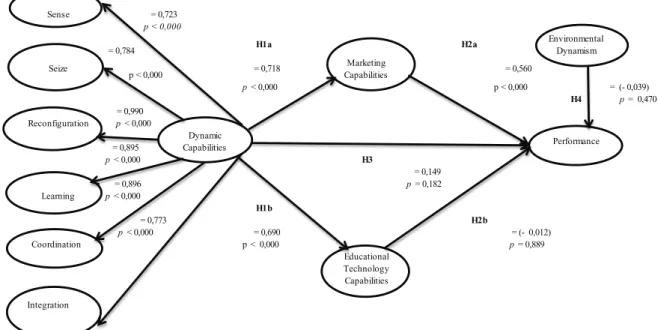
Structural equation modeling analysis (Marôco, 2010) indicates that the adjustment measures of the proposed model are within the recommended limits (x² = 1114, 84, df = 590, x² / df = 1.88, CFI = 0.90, GFI = 0.84, AGFI = 0.81, RMSEA = 0.053), ensuring the good quality of overall model adjustment by estimated coeicient.
Figure 2 shows the model measured through Amos software, which represents each
Sense = 0,723 p < 0,000
= 0,784 H1a H2a
Environmental Dynamism Seize
p < 0,000 = 0,718
Marketing
Capabilities = 0,560
p < 0,000 p < 0,000 = (- 0,039)
H4 p = 0,470
= 0,990 Reconfiguration p < 0,000
= 0,895
Dynamic
Capabilities Performance p < 0,000 H3
= 0,149
= 0,896 p = 0,182
Learning p < 0,000
H1b
= 0,773 H2b
p < 0,000 = 0,690 = (- 0,012) Coordination p < 0,000 p = 0,889
Educational Technology Capabilities
Integration
Figure 2. Proposed Model Source:Research data (2014).
Hypotheses H1a and H1b, which deal with the presence of DCs that positively impact the development of marketing and and educational technological operational capabilities were accepted. his shows the explanatory character attributed to DCs, which are considered higher order or meta-capability, allowing a irm to exploit operational capabilities, and identify and acquire new marketing and technological capabilities (Protogerou et al., 2011). his study adds three dimensions of the untreated DCs in the previous model, which in turn had great signiicance in the relationships, which points to the complexity of DCs, since they are not only composed by the capabilities of sense, seize and reconiguration and involve other relevant processes: learning, coordination and integration.
he H2a hypothesis, which deals with the impact of marketing capabilities on performance, was accepted, reinforcing this previously supported relationship. his conirms the proposition of Protogerou et al. (2011), which states that the more a irm is endowed with operational capabilities, the more these capabilities can be translated into a
performance position. However, hypothesis H2b, which also deals with an operational capability, of educational technology, was not corroborated in its impact on performance, which brings to the theory an uncertainty in this direct relationship. hat is, for the sector analyzed, DCs do not afect the performance through the technological capability, being necessary to investigate how this relationship occurs, which is presented later.
Hypothesis H3 – that DCs have a direct impact on performance – was rejected, which reinforces the role of DCs in transforming and reconiguring their operational capabilities to achieve superior performance applied to the education sector. his result is not relevant, since, given the complexity of DCs and the existence of different operational capabilities in the organizations, one can expect that the relationship with the performance occurs indirectly.
in literature. What we could verify is restricted to one sector, unlike previous studies that considered several sectors where it is possible to compare results from environments with diferent levels of dynamism.
Diferently from the study by Protogerou et al. (2001) that found positive results in the hypotheses formulated, in this study some hypotheses were rejected. he study by Giacomini (2013) also rejected some hypotheses, but not the same ones as this study. As there is evidence in the literature about the relationships between the operational, technological and marketing capabilities, we tried to develop a Competitor Model that could explain the indirect impact of DCs on performance in the context of private HEIs, as proposed in the work of Giacomini (2013) with industries from diferent sectors.
5.3
Competing model
To create the competing model, we considered that no model is unique in the level of adjustment achieved, and that for any model with acceptable it there are some alternative models with the same level of it, as suggested by Hair et al. (2005). he competing model presented the following adjustment measures (x² = 1156, 75, df = 590, x² / df = 1.95, CFI = 0.89, GFI = 0.83, AGFI = 0.81, RMSEA = 0.055) which shows good quality of general adjustment of the model by estimated coeicient, within the recommended limits.
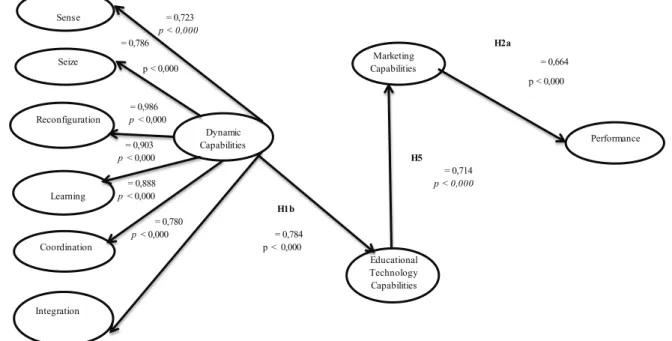
he evaluation of the competing model revealed a path of diferentiated explanation, in which the evaluation of the relationships presented acceptable results according to Hair et al. (2005), because all indicators presented signiicance p > 0.000 in the relationships between DCs and educational technological capabilities; educational technological capabilities and marketing capabilities, and marketing capabilities and performance, respectively. Hypothesis H1b was accepted, which means that the six dimensions of DCs of the model characterized by the monitoring of the educational sector,
identiication of new opportunities for educational courses and services, implementation of new ideas regarding the ofer of services, formulation of long term strategies, and communication about administrative decisions relect in the creation and coniguration of educational technological capabilities in a positive and meaningful way.
he competing model evidences a new relationship between operational capabilities not previously addressed in the literature, which is the impact of educational technological capabilities on marketing capabilities, as shown in Figure 3. With the theoretical support that states that organizations with a strong base of innovation technology improve the sales force through the inluence of their consumers on their product-related expectations (Dutta et al., 1999), the competing model suggests hypothesis H5:
H5: Educational technological capabilities have a positive impact on marketing capabilities.
Hypothesis H2a – that states that marketing capabilities have an impact on performance – was accepted, which points to two important results: (a) it conirms the direct and signiicant connection with irm performance results, (b) it demonstrates that a HEIs’ well structured investments in market visibility, sales of new courses and services, sales force, marketing and sales result in the increase of students, courses and services.
Sense = 0,723 p < 0,000
= 0,786 H2a
Seize
p < 0,000
Marketing
Capabilities = 0,664
p < 0,000
= 0,986 Reconfiguration p < 0,000
= 0,903
Dynamic
Capabilities Performance
p < 0,000 H5 = 0,714
= 0,888 p < 0,000
Learning p < 0,000
H1b
= 0,780
p < 0,000 = 0,784 Coordination p < 0,000
Educational Technology Capabilities
Integration
Figure 3. Competing ModelSource: Data base (2014).
6
Final considerations
he main objective of the article was the validation of the model adapted from Protogerou et al. (2011) in the Brazilian educational sector, speciically in private higher education, because it is a context that is little explored from the DCs approach, and which presents high price competition and ofer of courses.
hree of the six hypotheses in the proposed model were rejected; it explained the impact of DCs on performance through the mediation of marketing capabilities. However, the model did not conirm the direct impact of DCs on performance, and of educational technological capabilities on performance. In addition, there was rejection of the environmental dynamism construct on performance, which demonstrates that competition alone does not directly impact performance, but can be better explained by other factors. From these results, we veriied through SEM the existence of a relevant, diferentiated explanation path, which was suggested in this study as a competing model.
he competing model suggests that DCs impact performance through the mediation of
operational capabilities, marketing capabilities and educational technological capabilities, for a diferent course in the case of private HEIs. A new relationship not treated in previous models was found in this study, which was the direct impact of educational technological capabilities on marketing capabilities. The theoretical assumptions identiied in literature allowed for the creation of hypothesis H5, which conirmed this relationship in a positive and signiicant way.
the development of market research and the marketing of courses and services, are able to place more emphasis on the sales force of private HEIs. his course relects HEI eforts to achieve superior sales performance and service oferings.
Educational technological capabilities issues that have remained after the adjustment reflect that these refer to the formal control of teaching activities, and the development of indicators, systems and procedures to monitor administrative and teaching activities. hat is, the efect of DCs on educational technological capabilities relates to a positive efect centered on these dimensions of technological operational capability, not on issues specifically linked to innovation. What do DCs refer to in this segment of activity in the private context? he six dimensions validity for DCs point out that the DCs of the HEIs are composed, in addition to the capabilities of sense/seizing, for coordination, learning, integration and reconiguration capabilities.
From the point of view of DCs, the results seem to show signiicant eforts by HEIs to monitor the environment, seize opportunities, reconigure their resources, integrate and coordinate activities, and efficiently use new administrative and academic knowledge. However, these efforts are having a positive impact on educational technological capabilities focused on controlling and monitoring activities predominantly to which marketing capabilities can positively impact performance.
In sum, this study brings some relevant contributions, such as: (a) the validation of a more complete DCs construct and for the educational services sector, which could be used in future researches, (b) the evidence of how the mediation of DCs and performance in private HEIs in Brazil; (C) the development of a new operational capabilities hypothesis. As for the practical aspects of private HEIs, some results deserve to be highlighted, since they can help in the management of organizations: the configuration of the sector’s educational technological capabilities, the coniguration of DCs that reveals the bases of innovation in the
sector, and elucidation of the bases on which superior performance has been sought after.
Finally, it is worth mentioning an analysis, or at least a doubt, concerning the bases on which the performance and competitive advantage among private sector HEIs have occurred. Given the scenario of accelerated increase in the supply of higher education in the national scenario of recent years, and that the relationship of the search for performance has been given by the evidence, what would be the tendency of a ‘dispute’ among HEIs whose educational technological capabilities are based predominantly in the control and monitoring of educational activities? It is not a matter of questioning the pertinence of this control, necessary in several organizations. Facing the recent mergers and acquisitions that are occurring and which may change the industry landscape, however, would there be scope for technological changes geared to other dimensions beyond these? New studies are needed to analyze educational technological capabilities and to understand in more depth.
We considered that future research can cover other service-related sectors, even in the public and private educational sector, to verify the consistency of these results in the models tested. he main limitation found in the research was the diiculty of respondents to ill in all its ields, because there was an approximate 14% loss of questionnaires. his may have been caused by the great number of questions requiring some relection, or even by lack of time.
References
Dutta, S., Narasimhan, O., & Rajiv, S. (1999). Success in high-technology markets: is marketing capability critical? Marketing Science, 18(4), 547–568. doi:10.1287/ mksc.18.4.547
Eisenhardt, K. M., & Martin, J. A. (2000). Dynamic capabilities: what are they? Strategic Management Journal, 21(10/11), 1105–1121. doi: 10.1002/1097-0266(200010/11)21: 10/11<1105::AID-SMJ133>3.0.CO;2-E
Giacomini, M. M. (2013). Capacidades dinâmicas e suas inluências no desempenho de irma (Dissertação de mestrado). Pontifícia Universidade Católica do Paraná, Curitiba, PR, Brasil.
Hair, J. F., Jr., Black, W. C., Babin, B. J., Anderson, R. E. & Tatham, R. L. (2005). Análise multivariada de dados. 5. ed. Porto Alegre: Bookman, 2005. 593 p.
Helfat, C. E., Finkelstein, S., Mitchell, W., Peteraf. M. A., Singh, H., Teece, D. J., & Winter, S. G. (2007). Dynamic capabilities: understanding strategic change in organization. Malden, MA: Blackwell Publishing.
Helfat, C. E., & Winter, S. G. (2011). Untangling dynamic and operational capabilities: strategy for the ever-changing world. Strategic Management Journal, 32(11), 1243-1250. doi: 10.1002/smj.955
Hung, R. Y. Y., Yang, B., Lien, B. Y-H., McLean, G. N., & Kuo, Y-M. (2010). Dynamic capability: impact of process alignment and organizational learning culture on performance. Journal of World Business, 45(3), 285-294. doi: 10.1016/j.jwb.2009.09.003
Jiao, H., Alon, I., Koo, C. K., & Cui, Y. (2013). When should organizational change be implemented? The moderating effect of environment dynamism between dynamic capabilities and new venture performance. Journal of Engineering and Technolog y Management, 30(2), 188-205. doi: 10.1016/j. jengtecman.2013.01.005
Marôco, J. (2010). Análise de equações estruturais: fundamentos teóricos, Software & Aplicações. Pêro Pinheiro: Report Number.
Pavlou, P. A., & Sawy, O. A. (2011). Understanding the elusive black box of dynamic capabilities.
Decision Sciences Journal, 42(1), 239‐273. doi: 10.1111/j.1540-5915.2010.00287.x
Peteraf, M., Stefano, G. D., & Gianmario, V. (2013). The elephant in the room of dynamic capabilities: bringing two diverging conversations together. Strategic Management Journal, 34(12), 1389-1410. doi: 10.1002/ smj.2078
Prange, C., & Verdier, S. (2011). Dynamic capabilities, internationalization processes and performance. Jo u r n a l o f Wo rl d Business, 46(1), 126-133. doi: 10.1016/j. jwb.2010.05.024
Protogerou, A., Caloghirou, Y., & Lioukas, S. (2011). Dynamic capabilities and their indirect impact on firm performance. Industrial Corporate Change, 21(3), 615-647. doi: 10.1093/icc/dtr049
Portal INEP: site: http://portal.inep.gov.br/ visualizar/-/asset_publisher/6AhJ/content/ matriculas-no-ensino-superior-crescem-3- <acesso em 20.09.2015>.
Song, M., Droge, C., Hanvanich, S., & Calantone, R. (2005). Marketing and technology resource complementarity: an analysis of their interaction efect in two environmental contexts. Strategic Management Journal, 26(3), 259–276. doi: 10.1002/smj.450
Spring, M., & e Araujo, L. (2014). Indirect capabilities and complex performance. International Journal of Operations & Production Management, 34(2), 150-173. doi: 10.1108/IJOPM-01
Takahashi, V. P. (2005). Transferência de conhecimento tecnológico: estudo de múltiplos casos na indústria farmacêutica. Gestão e Produção, 12(2), 255-269. doi: 10.1590/S0104-530X2005000200009
Teece, D. J. (2007). Explicating dynamic capabilities: the nature and microfoundations of enterprise performance. Strategic Management Journal, 28(13), 1319–1350. doi: 10.1002/smj.640
Teece, D. J. (2009). Dynamic capabilities and strategic management. Oxford: Oxford University Press.
Teece, D. J., Pisano, G., & Shuen, A. (1997). Dynamic capabilities and strategic management. Strategic Management Journal, 18(7), 509–533. doi: 10.1002/ (SICI)1097-0266(199708)18:7<509::AID-SMJ882>3.0.CO;2-Z
Trainor, K. J., Rapp, A., Beitelspacher, L. S., & Schillewaert, N. (2011). Integrating information technology and marketing: an examination of the drivers and outcomes of e-marketing capability. Industrial Marketing
Management, 40(1), 1-13. doi: 10.1016/j. indmarman.2010.05.001.
Wilden, R., Gudergan, S. P., Nielsen, B. B., & Lings, I. (2013). Dynamic capabilities and performance: strategy, structure and environment. Long Range Planning, 46(1/2), 72-96. doi: 10.1016/j.lrp.2012.12.001
Wu, L-Y. (2007). Entrepreneurial resources, d y n a m i c c a p a b i l i t i e s a n d s t a r t - u p performance of Taiwan´s high-tech irms. Journal of Business Research, 60(5), 549-555. doi: 10.1016/j.jbusres.2007.01.007
Zahra, S. A., Sapienza, H. J., & Davidsson, P. (2006). Entrepreneurship and dynamic capabilities: a review, model and research agenda. Journal of Management Studies, 43(4), 917–955. doi: 10.1111/j.1467-6486.2006.00616.x
Supporting agencies:
Brazil’s National Council for Scientiic and Technological Development (Conselho Nacional de Desenvolvimento Cientíico e Tecnológico, CNPq)
About the authors:
1. Adriana Roseli Wünsch Takahashi, PhD in Management, Federal University of Paraná, Brazil. E-mail: [email protected]
2. Sergio Bulgacov, PhD in Management, Getúlio Vargas Foundation, São Paulo Business Administration School, Brazil. E-mail: [email protected]
3. Mônica Maier Giacomini, MSc in Management, Pontiical Catholic University of Paraná, Brazil. E-mail: [email protected]
Contribution of each author:
Contribution Adriana Roseli Wünsch
Takahashi Sergio Bulgacov
Mônica Maier Giacomini
1. Deinition of research problem √ √ √
2. Development of hypotheses or research questions
(empirical studies ) √ √ √
3. Development of theoretical propositions (theoretical Work) √ √ √
4. heoretical foundation/ Literature review √ √ √
5. Deinition of methodological procedures √ √ √
6. Data collection √ √ √
7. Statistical analysis √ √ √
8. Analysis and interpretation of data √ √ √
9. Critical revision of the manuscript √ √ √