Special Feature
A RETROSPECTIVE STUDY OF THE PAHO FELLOWSHIPS PROGRAM
IN THE CARIBBEAN, 1970-1979’
Betty A. Locket? and Benedict I. Truman3
In the past, lack of information about international fellowship programs for health workers raised questions about such programs’ effectiveness, especially about whether the trained
fellows found jobs when they returned to their home countries or whether they returned at all. The account that follows reports the results of a pilot survey
that examined the PAHO fellowships program in the Caribbean for the purpose of answering these questtons.
Introduction
Since 1947 the World Health Organization has provided fellowships as one means of help- ing member states meet their needs for health personnel. Financial assistance has been ex- tended in order for individuals to follow an ad- vanced study program, usually abroad, with the understanding that nominating governments will employ the returhing fellows in appropriate capacities. Participation in this fellowships pro- gram has been high since its inception, but its effectiveness is essentially unknown. A 1981 report entitled “Health Manpower Development: Use of Fellowships” (I) reviewed monitoring and evaluation efforts since 1947 and made the following observations:
“Monitoring and evaluation of fellowships to date have been unsatisfactory.. .
“One obstacle to evaluation is the widespread lack of national health manpower development plans to provide criteria for judging the selec- tion and use of ex-fellows...
“Although utilization reports are expected from sending governments and reports are re-
‘Also appearing in Spanish in the El&fin de la Oficina Sanifarin Pannmericana. 97( I), 1984.
‘Regional Adviser for Human Resources Development, Pan American Health Organization, Washington, D.C., U.S.A.
‘Short-term Consultant for the Pan American Health Or-
ganization, Washington, D.C., U S.A.
quired of each fellow at the end of the fellow- ship and after one year, about one-third of the participants are nonresponsive.. .”
Unfortunately, this dearth of evaluative infor- mation tends to create uncertainty and specula- tion about whether governments have fulfilled their obligations to provide suitable positions for returning fellows, and about whether former fellows have returned home and placed their services at the disposal of their national health systems. It has been claimed, for example, that professionals who receive fellowship training outside of their home countries are likely to leave the area. Because such assertions can influence future policy, it is important that basic docu- mented information about results of the fellow- ships program be provided to national and Re- gional policymakers-so that they will have a firm basis for making decisions and planning future strategies.
In response to this need for information, the Pan American Health Organization conducted a pilot study of PAHO fellowship recipients from the Commonwealth Caribbean whose fellow- ships had been awarded during the period 197 l- 1979. The major goals of this pilot study, which was conducted in 1982, were as follows:
l to help determine the feasibility of using a ques-
tionnaire survey approach for gathering follow-up
282 PAHO BULLETIN l vol. 18, no. 3, 1984
data about the PAHO fellowships program in the entire Region of the Americas;
l to develop a profile of the ten-year cohort of
former Caribbean fellows;
l to ascertain any pattern of migration exhibited
by the former fellows after completion of their train- ing;
l to identify factors related to effective utilization of the skills and knowledge gained from the fellow- ship experience.
Study Methods
The Survey Population
All people who had received long-term PAHO fellowships (those with a duration of six months or more) in I97 I- 1979 and who had been spon- sored by one of the 19 Commonwealth Carib- bean countries and territories4 were included in the survey. It was recognized that these nations and associated territories had strong historic, geographic, cultural, and economic ties (the em- bodiment of these being the Caribbean Commu- nity and Common Market, CARICOM, formed in 1974); that they could be regarded in combi- nation as one large sociodemographic unit; and that they were not necessarily representative of other areas. It was also recognized, however, that the group of 606 former fellows surveyed was heterogeneous with regard to age, sex, year of the fellowship award, stated profession at the time of the fellowship award, field of fellowship study, number of months of fellowship study, country of origin, country of fellowship study, and number of years elapsed since completion of the fellowship.
A, a self-administered form sent out to the former PAHO fellows for completion, asked 18 questions requesting 30 items of information. These included information about the subject’s current work situation, whether the training had proved of value in performing present job func- tions, and the extent of utilization of the training. Questionnaire B, also a self-administered form, was dispatched to a responsible official in the Ministry of Health of the government sponsoring each former fellow. It included 12 of the 18 questions asked in Questionnaire A; however, questions asked former fellows about the value and use of their fellowship training were not included in Questionnaire B.
Data Collection
Questionnaire A, accompanied by a self-ad- dressed stamped envelope, was mailed to the last known address of each former fellow. After 30 days, nonresponders were sent a reminder notice and a duplicate questionnaire. Question- naire B was mailed to the health authorities of the governments involved. Individual ministries of health received anywhere from two to 90 questionnaires, depending on the number of fel- lows they had sponsored. Reminders were pro- vided to government officials by telephone, telex, and PAHO staff members on duty travel.
Questionnaire
Two questionnaires, designated “A” and “B,” were employed. Both were pretested and revised before being used in the study. Questionnaire
4 Anguilla. Antigua and Barbuda, Bahamas, Barbados, Belize. Bermuda, British Vwgin Islands, Cayman Islands, Domimca, Grenada, Guyana, Jamaica, Montserrat, Saint Lucia, St. Kitts-News, St. Vincent and the Grenadmes, Suriname, Trinidad and Tobago, and Turks and Caicos Islands.
Between November 1981 and April 1982, eight of the 19 countries and territories involved in the study were visited. These visits were made so as (a) to expedite completion and return of the “B” questionnaires by national health au- thorities; (b) to determine the present country of residence and employment of all members of the study population; and (c) to expedite comple- tion and return of the “A” questionnaires by former fellows. For these purposes, the needs of the study were discussed personally with health ministry officials, and the matter was also discussed (either in person or by telephone) with a small number of former fellows.
l SPECIAL FEATURE 283
Findings
PAHO Data
A demographic profile and other characteris- tics of the study population were extracted from the fellowship program’s stored data base at PAHO Headquarters in Washington, D.C. These data showed that 58.6% of the 606 Carib- bean fellowship recipients in 1971- 1979 were women (Table 1). They also showed that the former fellows’ ages at the time the fellowships were awarded covered a broad range (from ages 21 to 55), with the highest percentages (19.8% and lS.O%, respectively) being found in the 3 l- 35 and 36-40 age groups (Table 2).
The 606 study subjects were awarded their fellowships for pursuit of learning in seven major fields, the specific subjects involved being dis- tributed among 59 subcategories. The number of fellows in each major field and the sub- categories most commonly involved are shown in Table 3.
Table 1. Men and women in the study population.
Men Women
Total
No. %
249 41.1
357 58.9
606 100
Table 2. The ages of the 606 former fellows at the time of the fellowship award, by five-year age groups.
Age group NO. % (In years)
21-25 28 4.6
26-30 88 14.5
31-35 120 19.8
36-40 109 18.0
41-45 84 13.9
46-50 76 12.5
51-55 96 15.8
56-99 0 0.0
Unknown 5 0.8
Total 606 100
The years in which fellowships were awarded are shown in Table 4. The increase in awards (from 68 to 90) in 1976 reflects extrabudgetary funds made available that year by the Canadian International Development Agency and the United Nations Development Program.
Table 3. The survey subjects’ fields of study, showing the major fields involved and selected subcategories.
Mqorfieldsofstudy and selected subcategones
Survey SubJects NO. %
Administration planmng 56 9.1
Public health administration 47
Dental services 30 50
Dental hygiene I5
Environmental services 82 13.5
Sanitary inspection 19
Water works 21
Laboratory services 74 12.2
Medicine/medical specialties 14 2.5
Nursing services 134 22.1
Education/teaching 32
Public health nursing 43
Other allied fields 216 35.6
Medical records librarianship 33
Nutrition/public health nutrition 67
Veterinary services 16
Teaching (alliedhealthfields) 46
Total 606 loo
Table 4. The years in which PAHO fellowships were awarded to the 606 survey subjects.
.%IrVey SubJects NO 7c
1971 78 12.9
1972 59 9.7
1973 75 12.4
1974 33 5.4
1975 68 11.2
1976 90 14.9
1977 57 9.4
1978 85 14.0
1979 56 9.2
Unknown 5 0.8
284 PAHO BULLETIN l vol. 18, no. 3, 1984
Questionnaire Data
Responses to Questionnaire A were received from 409 (67.5%) of the former fellows, and responses to Questionnaire B concerning 388 (64%) of the former fellows were received from government officials. The combined response to the 12 common questions of the two question- naires provided data on 501 subjects constituting 82.7% of the total study population (Table 5).
Current residences. The combined informa- tion from questionnaires A and B showed that 414 (82.6%) of the 501 fellows for whom re- sponses were received were in their countries of origin at the time of the survey, and were potentially available to the health system; 81 (16.2%) were overseas; 4 (0.8%) had died; and 2 (0.4%) had retired. According to government information provided to visiting consultants and responses to Questionnaire B, only 10 of the 606 fellows in the total study population had never returned home from fellowship training. In this same vein, 78 (nearly 40%) of those 197
subjects not responding to Questionnaire A were known to be overseas at the time of the survey. However, an unspecified number of these 78 fellows were engaged in the pursuit of further studies under government sponsorship.
Current employment. The combined question- naire A and B data also showed that some 392 (78.1%) of the 501 fellows for whom data were provided had been retained within the health system. In this same vein, of the 409 fellows responding to Questionnaire A, 374 (91.4%) were employed by a government ministry and
13 (3.2%) by a university or college almost en- tirely funded by the government. Four of those
13 were also working in hospitals.
In all, 369 of the 409 former fellows respond- ing to Questionnaire A reported that they had returned to work for the same organization that had employed them prior to fellowship training, and 243 (65.9%) reported that they had been promoted. Relatively few of those who studied “teaching in allied health fields” reported promo- tions, however, and the difference between their
Table 5, The numbers of A and B questionnaires returned, respectively, by former fellows and health ministry ofkials, by country.
country or place
Completed questionnaires received NoA,
NOB A only B only A and B
Anguilla
Antigua and Barbuda Bahamas
Barbados Belize Bermuda
British Virgin Islands Cayman Islands Dominica Grenada Guyana Jamaica Montserrat Saint Lucia St. Kitts-Nevis St. Vincent Suriname Trinidad andTobago Turks and Caicos Islands
2 1 4 7 - 1 1 - - - 17 32 2 16 1 1 3 14 3
Total 105
2 1 6 10 1 - - - 2 1 13 33 4 14 2 - 2 22 - 113 - 3 - 9 15 - - 1 9 17 4 - 4 4 2 13 4 5 2 - 64 25 2 2 28 16 30 2 10 15 28 21 3 12 6
92 296”
24
0 SPECIAL FEATURE 2x5
rate of promotion and that of the other fellows was found to be statistically significant.
Value of training. Of the 409 respondents to Questionnaire A, over 60% said that the training had met their expectations completely in terms of knowledge and skills acquired; 158 (38.6%) said their expectations had been partly met; and 0.2% (one person) said his expectations had not been met at all. Regarding the importance of the fellowship training to their current jobs, 163 (39.9%) said it was of fundamental importance, 209 (5 1.1%) said it was important, 10 (2.4%) said it was of little importance, and 1 (0.2%) said it was of no importance.
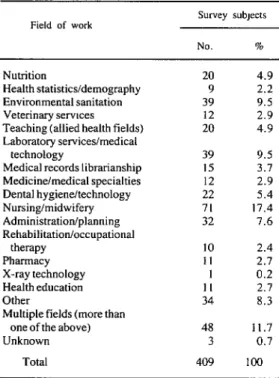
Utilization of training. Table 6 shows the cur-
rent fields of work reported by the former fellows responding to Questionnaire A. Some 86.1% of these fellows appeared to have been retained within the field of fellowship study, while 12.2% appeared to be working outside that field; the status of the remaining 1.7% was uncertain. Overall, those fellows who had studied nutrition
Table 6. Current fields of work reported by the 409 former fellows responding to Questionnaire A.
Field of work hT’ey SubJeCtS
NO. %
Nutrition
Health statistics/demography Environmental sanitation Veterinary serwces Teaching (allied health fields) Laboratory services/medical
technology
Medical records librarianship Medicine/medical specialties Dental hygiene/technology Nursing/midwifery Administration/planning Rehabilitation/occupational
therapy Pharmacy X-ray technology Health education Other
Multiple fields (more than one of the above) Unknown
Total
20 4.9
9 2.2
39 9.5
12 2.9
20 4.9
39 9.5
15 3.1
12 2.9
22 5.4
71 17.4
32 7.6
IO 2.4
I1 2.7
1 0.2
11 2.1
34 8.3
48 11.7
3 0.7
409 loo
appeared the most likely to change fields. -some 150 (37%) of the 409 respondents claimed to be utilizing their fellowship training completely, 245 (59.9%) said they used it only partially, and 7 (1.7%) said they did not use it at all. Those who reported utilizing their training partially or not at all were asked to select the single most important factor that inhibited full utilization of the acquired skills. As Table 7 indicates, the most common single causes cited were inappropriate job assignments and inade- quate equipment and supplies. Besides these and the three other causes listed, 8 1 respondents cited more than one of the five listed causes; also, 38 respondents cited “other” causes including bud- getary constraints, restricted authority or respon- sibility, inadequate training, poor planning, ex- cessive workloads, interpersonal conflicts, in- adequate office space, lack ofjob specifications, frequent changes of personnel at the policy- making and supervisory levels, and restrictive laws (in dentistry) governing clinical practice.
Table 7. Factors cited by the 409 Questionnaire A respondents as inhibiting utilization
of their acquired skills.
Cause cited survey SUbJects
NO. 9
Inappropriate job assignment 50 12.2
Inadequate equipment or supplies 49 12.0
Inadequate personnel support 19 4.6
Inadequate transportation 6 1.5
Inappropriate training 4 I .o
Multiple factors 81 19.8
Other (specify) 38 9.3
Not applicable 143 35.0
Section left blank 19 45
Total 409 loo
Conclusions
Feasibility of the Survey Method
286 PAHO BULLETIN l vol. 18, no. 3, 1984
securing responses from health and other profes- sionals who have studied abroad. For this reason, questionnaires A and B were kept brief and were designed so as to include many of the same questions. In addition, provisions were made for having a consultant visit certain of the member states involved, interview health minis- try officials and former fellows to whom ques- tionnaires had been sent, and thereby encourage completion of the questionnaires. As already noted, this approach succeeded in obtaining at least some coverage of 501 subjects, over 82% of the survey population, as well as personal responses (to Questionnaire A) from 409 (67.5%) of the former fellows. These unusually high response rates were facilitated by the rela- tively close proximity of the Commonwealth Caribbean’s member states, which made the vis- iting consultant’s itinerary feasible; by the small number of former fellows living in several of the smaller island states, which made it easy for health ministry officials to identify and locate them; and by the decision to enclose self-addressed postage-paid envelopes with the questionnaires. Thus, personnel seeking to apply this study method to all the PAHO Member Countries in the Americas would need to consider budgeting additional funds for consultants traveling greater distances, and should anticipate that it could prove relatively difficult to locate the larger number of former fellows residing in the larger and more populous countries of the Region.
The Cohort of Former Fellows
As previously noted, over half the ten-year cohort of former PAHO fellows surveyed was comprised of women. This circumstance appears associated with the high percentage of fellows pursuing studies in nursing and allied health fields, in which women tend to predominate. Overall, these two fields of study accounted for more than 57% of the participants. It should also be noted, however, that of the 39 physicians in the cohort, 12 were women.
Another relevant point is that only 14 (2.5%) of the former fellows were awarded their fellow- ships to study medicine or medical specialties.
This small number of fellowship awards to physicians for training of this sort is consistent with the policies and priorities of the Pan Amer- ican Health Organization.
Emigration of Former Fellows
Although there has been much speculation and anecdotal data about the migration of health professionals who have had an opportunity to study outside of their home countries, our survey shows that the great majority (82.6%) of the PAHO fellows described in questionnaires A or B did return to their countries of origin. Moreover, an unspecified number of those found to be overseas at the time of the survey were still studying under a PAHO fellowship or had received another type of fellowship for addi- tional study.
The survey findings thus strongly indicate that PAHO fellowships awarded in the Caribbean area have not encouraged or facilitated emigra- tion. This low emigration rate can be partly at- tributed to the PAHO policy of awarding very few fellowships in medical specialties. It should also be noted that the high rate of return observed among former PAHO fellows in the Caribbean cannot necessarily be extrapolated to other fel- lowship programs or to other subregions of the Americas. Conceivably, this phenomenon could be characteristic only of the PAHO program or the Caribbean subregion. However, the finding that an overwhelming majority of the PAHO fellows surveyed did in fact return to their home countries and have been working in their fields of study should be regarded as very significant for future policy development in the Caribbean area.
Utilization of Training
. SPECIAL FEATURE 287
health care systems of the Caribbean and the limited private sector opportunities available for health personnel, with the possible exception of physicians and nurses involved in curative medicine.
Less than 1% of the responding fellows said that their training had been inappropriate and therefore could not be used. However, many fellows cited one or more factors in the work environment as preventing full utilization of the training they had received. This information suggests that future studies should focus on the work conditions and support systems encoun-
tered by returning fellows after their fellowship training is complete.
In recent years there has been a proliferation of training programs in the Caribbean area for all types of health personnel. Any future follow- up study for the Caribbean should therefore in- clude not only former PAHO fellows but person- nel who studied under fellowships provided by other international agencies, private founda- tions, and other sources. Such a study would provide a better understanding of how fellow- ships and fellowship training are being used in the Caribbean and would help to reveal areas where duplication of effort may exist.
BIBLIOGRAPHIC REFERENCES
(1) World Health Organization. Health Manpower Development: Use of Fellowships. Report by the Di- rector-General, Sixty-Ninth Session of the WHO Executive Board, Provisional Agenda Item 23, WHO Document EB69/26, 5 November 1981. Geneva, 1981.
(2) Committee on the International Migration of Talent. The International Migration of High-Level Manpower: Its Impact on the Development Process. Praeger, New York, 1970.
(3) Gollin, A. E. Educationfor National Develop- ment: Effects of U.S. Technical Training Programs. Praeger, New York, 1969.
(4) Organizaci6n Panamericana de la Salud. Evaluation de1 Programa de Betas de la OPSlOMS. Unpublished working document. Washington, D.C., 1970.