Technical
Discussions
Mexico, D.F. October 1976
Provisional Agenda Item 18 CD24/DT/1
25 August ORIGINAL:
INDEXED
(Eng.) 1976
SPANISH
DEVELOPMENT OF THE HEALTH SERVICES INFRASTRUCTURE WITH DUE REGARD TO THE NEED FOR EXTENSION OF COVERAGE
BACKGROUND DOCUMENT AND ANALYTICAL GUIDE
EXTENSION OF HEALTH SERVICES COVERAGE Infrastructure Programming
and Development
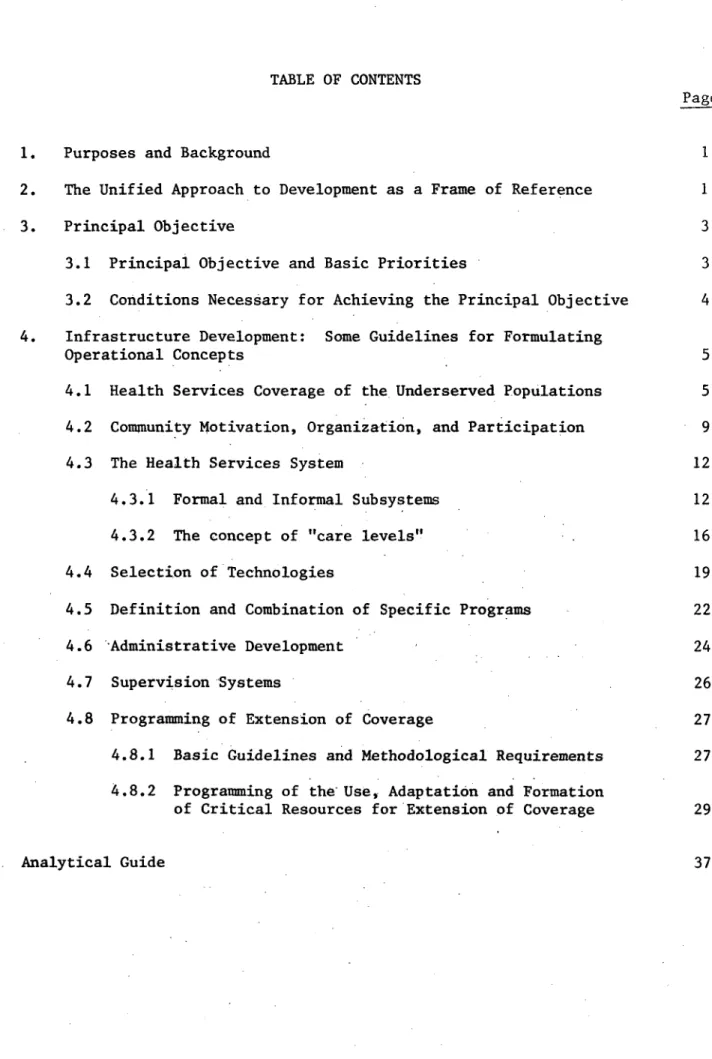
TABLE OF CONTENTS
Page
1. Purposes and Background 1
2. The Unified Approach to Development as a Frame of Reference 1
3. Principal Objective 3
3.1 Principal Objective and Basic Priorities 3
3.2 Conditions Necessary for Achieving the Principal Objective 4 4. Infrastructure Development: Some Guidelines for Formulating
Operational Concepts 5
4.1 Health Services Coverage of the Underserved Populations 5 4.2 Community Motivation, Organization, and Participation 9
4.3 The Health Services System 12
4.3.1 Formal and Informal Subsystems 12
4.3.2 The concept of "care levels" 16
4.4 Selection of Technologies 19
4.5 Definition and Combination of Specific Programs 22
4.6 'Administrative Development 24
4.7 Supervision Systems 26
4.8 Programming of Extension of Coverage 27
4.8.1 Basic Guidelines and Methodological Requirements 27 4.8.2 Programming of the Use, Adaptation and Formation
of Critical Resources for Extension of Coverage 29
1. PURPOSES AND BACKGROUND
The Governments of the countries of the Americas have undertaken to center their efforts on achieving maximum health service coverage for the vast underserved masses in the rural areas and the shanty towns of the cities.
In this endeavor, valuable experience has been gained and, given the present development of these processes, this experience must be analyzed systematically if it is to be used in the reorientation and adjustment of concepts, approaches, methods and instruments conducive to the success of that endeavor, including maximum use and output of the resources available to the countries.
This was recognized by the Member Governments of the Pan American Health Organization when, at the XXIII Meeting of the Directing Council, they chose, as the topic for the Technical Discussions to be held at the next meeting in 1976, "Development of the Health Services Infrastructure with Due Regard to the Need for Extension of coverage."
As part of that task, the Secretariat has prepared this background document which orders and selects certain strategic and operational concepts that an analysis of the development of these processes in the countries and their present status singles out as the most important.
It is hoped that this document will assist the national experts in analyzing the present situation and that that examination will subsequently serve as a basis for guiding the above-mentioned Technical Discussions.
2. THE UNIFIED APPROACH TO DEVELOPMENT AS A FRAME OF REFERENCE
Although health activities are necessarily determined by the economic and social development of each country, it is essential to analyze the prin-cipal characteristics that define their nature.
There may be several styles of development, depending on the importance assigned in each process to its various components. Obviously, each style of development reflects the system of values prevailing in the society concerned. If the unified approach1
is adopted as a basic interpretation of development, it may be clearly seen that development does not consist primarily in the growth of the GNP*; it also consists "in various structural and institutional
1Given the scope of this document, it is deemed appropriate to comment on two concepts of the theory of development that have been recently developed: that of the need for a "unified approach to development, analysis and planning," and
the complex concept of "capacitation" which covers the transformation of insti-tutions and social systems and subsystems to adapt them to the real needs of the development processes together with what might be called the "capacitating participation" of the human groups (communities and institutions) involved. These concepts are taken from the United Nations report on a "Unified Approach to Development, Analysis and Planning," E/CN.5/519 - December 1974, with some further refinement.
-2-changes and in individual and social transformations that together sustain and raise the capacity of society and its individuals to achieve high levels of production and well-being."
If we move from the field of development analysis to development planning, the unified approach provides two supplementary and additional possibilities to that of traditional economicist planning:
- to plan the structure and institutional changes and the individual and social transformations that help determine development and in which this is partially expressed; and -- to plan the "combination" ormix of the various factors
involved.
These changes require the institutions, social systems and subsystems and individuals themselves to adapt to the reality of their responsibilities and functions in the process of development and for the individuals and groups to increase their capacity to promote their own development and consequently that of the society in which they live. This can only be achieved through a process of capacitation.
"Capacitation" means a concerted effort to identify and promote: - the structural changes in the social and institutional
systems and subsystems that are necessary for the de-velopment of a society;
- the transformation that individuals and society must undergo if the aims of individual and social development are to be attained.
Combined with the concept of "unified approach," that of "capacitation" is also concerned with helping to define the appropriate style of development which is decided upon in each case in accordance with the prevailing value system.
In the light of this conceptual frame of work it is possible to identify the role of community organization, development and participation in national development and therefore in the development of health services.
-3-- its institutions and the social systems and subsystems are usually poorly adapted and can even function in a manner counter to the growth of the GNP and consequently to national development;
- this applies to a certain extent to the attitudes of individuals and social groups with like effects;
- efforts are normally made to put into effect the structural and institutional changes inherent in the style adopted, by means of legal, regulatory and administrative measures; but these measures only serve as a starting point; the changes themselves, i.e., the transformation of the nature and functions of an institution and the restructuring of a system or subsystem to tailor it to different needs, with combinations of resources that are necessarily
dif-ferent and with rhythms of operation that are also differ-ent, cannot be brought about by mere legal or regulatory decisions. If these changes are to be brought about, the
individuals that operate the systems or institutions must replace their values and activities by others that are favorable to the change and its results.
In this conceptual framework, development planning is an endeavor whose primary purpose is to bring about a change in the values and atti-tudes of individuals in a process of dialectical interaction parallel to a change in the systems and institutions such individuals operate. This process is in essence a process of capacitation of the individuals and of
their institutions and systems, the purpose of which is to increase the capacity of the population and of society to solve its problems, and that can only be done through the committed and active participation of the community.
3. PRINCIPAL OBJECTIVE
3.1 Principal Objective and Basic Priorities
-4-The substantive content of this principal objective is expressed in terms of five priority areas.
The first priority postulates the reduction of mortality and morbidity caused by the prevalent communicable diseases, particularly those that can be controlled by immunization, and by malaria.
The second consists in the active and programmed care of mothers and children who are considered the most vulnerable group and the critical compo-nent of the family unit.
The third is the reduction, through the adoption of national food and nutrition policies, of protein-calorie malnutrition, which is held to be the principal associated cause of the complex problem of infectious and gastro-intestinal parasitic diseases, particularly in children under five years of age.
The fourth priority is the care of the sick at a primary level and their systematic referral for care, in accordance with their needs, to other defined levels of each national health system.
The fifth is basic sanitation of the environment, especially the provision of water supply and sewage disposal services.
3.2 Conditions Necessary for Achieving the Principal Objective
To translate the above-mentioned purposes into reality, the Govern-ments decided to formulate and adopt realistic health policies, both sec-toral and intersecsec-toral, to guide the development of their health
infrastructures and especially to increase their operational capacity. For that purpose, it is necessary to define national health service delivery systems by levels of increasing complexity, which coordinate the various components of the sector; to improve programming, administration, control and evaluation to ensure maximum productivity and effectiveness of existing and additional resources; and to enlist the active and systematic participation of the communities themselves.
Because of the varied nature of the communities and therefore of the possible solutions to their problems, each needs to be treated separately. Nevertheless, the experience gained in the Region indicates that efforts should be made to enable the communities to develop the capacity to produce certain health services, properly based on technical and logistic aspects and the planned capacitation of the community. Another requisite is that all the members of the community have guaranteed access to all levels of the institutional system.
-5-and the preparation -5-and adaptation of all health workers -5-and personnel training institutions. This adaptation must be aimed at obtaining their informed and conscious participation in the change that an approach of this kind implies.
To do this, a multidisciplinary perspective is required, as is ef-ficient participation in and knowledge of initiatives taken by other sectors in the comprehensive development of the communities.
In the living conditions characteristic of populations without health service coverage, the mere extension of such services brings about an improve-ment that quickly disappears under the pressure of malnutrition, lack of
basic sanitation, unhealthy housing, poverty, and inability to take advantage of the scant resources available. The success of this approach depends pri-marily on the fact that health activities will serve as a support and sup-plement to those that must be conducted simultaneously by other sectors. Efforts must be focused on solving the most pressing needs, through the use of creative multisectoral solutions that enable individuals and the groups they form to aid themselves and simultaneously to alleviate their immediate
shortages by making use of the existing and potential resources of the communities.
The countries have also recognized the importance of obtaining sup-plementary financial resources from international lending agencies. When well selected and carefully programmed and used, these resources will
un-doubtedly bolster the national and hemispheric efforts to expand health service coverage, and especially to support communities organized for their own development. Finally, this intensive and systematic effort must be coordinated and integrated with national development policies and plans to ensure its viability.
4. INFRASTRUCTURE DEVELOPMENT: SOME GUIDELINES FOR FORMULATING OPERATIONAL CONCEPTS
4.1 Health Services Coverage of the Underserved Populations
The concept of coverage and the different definitions given it in the Hemisphere have evolved over time, primarily since the enunciation of the Ten-Year Health Plan for the Americas, whose principal goal is to extend health services to the unserved or underserved population of rural areas and
the shanty towns of the cities.
The experience gained in this endeavor has made it necessary to revise and update the concept of coverage. The document entitled "Provision of Health Services to the Rural and Underserved Population of Latin America and the Caribbean"* explains the origin and the characteristics of the new
Provision of Health Services to the Rural and Underserved Population of Latin America and the Caribbean. XXIII Meeting of the Directing Council, October 1975.
-6-approach. In it the term "coverage" is used to mean "the concrete expression, in terms of the extent and minimum level of complexity, of the health serv-ices received by all the individuals of a given country according to their needs." This and other formal definitions may be acceptable; however,
guidelines are necessary to enable any formal definition accepted to be put into effect and make it possible both to analyze and to spell out the
meaning of the coverage policy and guide its formulation and programming, with due regard to the special features of the country in which it is
formulated.
If our starting point is that health is a component of the level of living of the communities, and that the purpose of health promotion and de-velopment is to raise that level, we are justified in concluding that the level of living of the population and the consequent improvement in its well-being can only be obtained within the framework of national, social and
economic development plans, and with the active participation of each community.
Therefore, the incorporation of health policy into national development plans is a prerequisite for ensuring its viability, since the resources
available in each country for achieving the various goals society sets it-self are limited. This means that they must be allocated among the sectors
in accordance with priorities or more important aims. The active participa-tion of the community both in the programming and in the implementaparticipa-tion of the policy for the extension of coverage is also an essential requirement.
The extension of coverage, as now understood, therefore has three fundamental aspects: access of the population to services; relative availa-bility of resources; and the technical administrative system for producing services by combining the resources available for satisfying the health needs of the population it is decided to cover and community participation.
The problem of access to services has three principal elements: - the existence of a continuing and regular supply of services
produced by a set of combined resources located geographically, economically, temporarily and culturally within the effective reach of the communities
- the adjustment of the amount and structure of the services to the volume and structure of the population and of their
health problems (or needs)
- the acceptance by the communities of the type of services offered them
-
7-- the organization of the system, its administrative management, and the technological combination of available resources must ensure their maximum productivity. This maximization of
productivity must be limited by the necessary effectiveness of the services that can be produced to solve the priority health problems.
Since both the nature of the health problems and the known techniques for serving them have different degrees of complexity that permit different technical and administrative solutions in terms of different real and social costs, health service delivery systems may be organized by care levels, properly linked by referral systems that ensure the optimization of their productivity within the accepted bounds of efficiency and access by the com-munities to the different care levels.
In almost all countries two health service delivery systems exist side by side and at different levels of development: the institutional "formal" subsystem and the community "informal" system, the connection or linkage of which is usually piecemeal, erratic, or nonexistent. An ex-haustive analysis of the structure, conditioning factors, and operation of these two subsystems is essential if the feasibility and viability of any form or redesign of a given health system is to be defined. These analyses must be based on the political context of each national society and the particular characteristics economic and social development programs and cultural factors impose on the organization of each of the communities involved. This necessarily implies an intersectoral and politico-cultural approach both when health policies are being formulated and when they are being programmed and implemented. Consideration of these elements is
es-sential if any proposed change is to be made viable.
Consequently, and solely for the purpose of facilitating these
analyses, the following categories, which are considered to be the main ones, are suggested, among others:
1. Population
1.1 Number and structure by sex and age
1.2 Special distribution (concentration and dispersion) 1.3 Educational level
1.4 Occupational structure 1.5 Health status
-8-2. Environment
2.1 Physical and climatic characteristics; communications 2.2 Community organization
2.3 Structure and modes of production 2.4 Cultural patterns
2.5 Political organization and operation 3. Supply of Health Services
3.1 Production of services, i.e., volume and structure of services 3.2 Adaptation to health problems and needs considered to be
priorities
3.3 Accessibility (geographical, temporal, economic and cultural) 3.4 Effectiveness, efficiency, and viability of technical and
administrative solutions 3.5 Organization of the system
3.6 Administrative management of the system 3.7 Human, material and financial resources
- volume and structure - possibilities of increase
- training, adaptation, distribution and use - productivity and costs
An analysis of the present national policies for the extension of coverage makes it possible to make a general statement about the basic con-ditions a policy of this kind should satisfy:
- universality (accessibility for the entire population) - equity (equal opportunity for access to health services at
all levels)
-9
- the delivery of services must be continuous (instead of sporadic), timely, significant, and pertinent (consistent with the problems of the community) and capable of being controlled and evaluated To this end, the program for the extension of coverage must be organi-zationally incorporated into the overall development of the community. It is important to emphasize that the possibility of satisfying these requirements is determined by the relative scarcity of the resources. It is therefore necessary to devise technical and administrative solutions that will maximize productivity (maximum efficiency of resources established) within the
techni-cally accepted bounds of effectiveness for producing the desired impact on health problems. These solutions must also be viable. This approach adds two further criteria:
- maximum efficiency with technically acceptable efficiency - acceptance by the community
Both criteria refer not only to substantive technical solutions but also to the administrative procedures necessary for applying them. The relative scarcity of resources, compared with the problems, necessitates a political definition of priorities and a definition of strategies for
implementing them, relating fundamentally to the reorganization, adaptation and expansion of the institutional service systems (formal subsystem) and, in addition, to the organization and participation of the community (informal subsystem) and to the coordination of the two subsystems.
In dealing with the problem of the availability of resources, account must be taken of the fact that every program for making coverage universal soon becomes a process with its own dynamics that give rise to alternative solutions and additional resources that could not be foreseen when it began; thus, although it is essential to achieve a balance of resources before embarking on those porgrams, the results and transformations must be revised as and when the process moves ahead, and the necessary decisions must be taken to maintain or increase their relevancy, effectiveness, efficiency, feasibility and viability.
Consequently, very careful consideration must be given to programming the training and use of the resources and of their systematic adaptation to the continuing change the process induces.
4.2 Community Motivation, Organization, and Participation
- 10
-the traditional study in terms of national magnitudes and averages.* Conse-quently, to enable the groups or regions that are bypassed by development or are making little progress to participate, it is necessary to know which
groups and regions are involved and their sociocultural, economic and eco-logical characteristics, as well as to diagnose their causes as a basis for formulating policy and monitoring future changes.
If the population is to be able to participate effectively in the extension of coverage with primary health services, the following are essential, among other things:
- organization of the community, which will facilitate the conscious and sustained support of the individuals, groups and institutions that make it up and whose structures, attitudes and purposes must be geared to the aims of the program
- training of the human groups that will act either as agents of change or as recipients of the benefits of the programs to enable them better to understand their conditions and to learn to relate the improvement of their environment to the economic and social progress of other human groups in their countries; to assume their responsibility as motors of this development and to create in them a predisposition to solve their common health problems
- multisectoral coordination of local activities by public and private, national, regional and local agencies that provide
serv-ices in order to create comprehensive joint systems for pro-viding coverage
One of the characteristics of the communities is that the members recognize their common needs and interests. As a result, each community adopts a specified form of organization and is able to mobilize and use its own resources when properly motivated and oriented towards the solution of its priority problems.
Experience shows that, in most cases, the communities have been used solely as a means of achieving objectives pre-established by the technical personnel of the development program, in disregard of needs and aspirations as perceived and interpreted by the communities themselves, and without re-gard to the internal dynamics that generate the attitudes and behavior of the members towards improving their living conditions. This last mentioned fact, together with the frequent failure to fulfill promises made for dif-ferent reasons, has helped create in communities a sense of distrust which often amounts to a frustration of expectations, which is usually interpreted by the technical personnel as apathy or indifference of the communities to progress.
Programs for the extension of coverage with community participation will be more effective if they are linked to the other sectors involved in
- 11
-the overall development of -the community, if -they are closely related with the regional and national economic and social development plan, and if the efforts and resources of the government are added to those of the community.
In other words, the unified approach to development emphasizes that health programs must be closely linked to other local development sectors, and therefore health goals must be based on, and achieved with the support of, the appropriate policies of the other sectors, as well as on the direct activities of the health services. In turn, health programs must help in-crease the productivity of the lower income groups, open up new areas to land settlement and farming, and provide a social environment more conducive to general development. Therefore, primary health services must be an es-sential component of the overall community development.
The term "community development" means the use of approaches and spe-cific techniques whose selection and application is determined by the diag-nosis of a given community, for the purpose of combining the assistance of the state-organized local self-determination and effort in order to deliber-ately stimulate local initiative and leadership as primary instruments of social change.* The final goal of community development is the training of capable, responsible individuals, with a critical attitude towards their own conditions, interested in the cultural progress and well-being of their community and in the overall development of their country.
The involvement of the community in the extension of health services to the rural population is not a new concept in the Americas. However, despite the praiseworthy efforts made in this regard by the governments with the assistance of PAHO/WHO and other international agencies, the results have not been satisfactory; this is due among other things to the partial and uni-lateral approach often based on methods taken over from the developed countries that are not always consistent with the political and cultural framework of the style of development adopted by the country. In this approach, the com-munity was normally used as an instrument for installing health services or programs or for the purpose of experimentation to collaborate the effective-ness and efficiency of specified techniques, without regard to the fact that man is the subject and object of development.
In every community there is a health subsystem that might be called the informal system, which has its own resources and modes of operation and
is also integrated with the life style of the community.
The investigations already made must be urgently supplemented by oper-ational studies designed to identify the internal dynamics of the elements of the subsystem as regards their role, organization, operation and the link-ages of the subsystem to other aspects of the life of the community. This
12
-will make it possible to coordinate the informal subsystem with the institu-tional health system as well as to use tradiinstitu-tional health practitioners to enlist greater community participation in the programs. The enlistment, capacitation, and use of the community would also make for more rapid and ex-tensive dissemination of new health ideas and technologies geared to the characteristics of the primary health care level.
This points up the value of a diagnosis of the community as a starting point for the capacitation both of the personnel of the program and of the beneficiary population. This capacitation would permit a change in attitudes and behavior, which is essential if there is to be effective joint work between the personnel engaged in the program and the local population. A dialogue between them must be initiated to harmonize points of view and activities in favor of the program. This dialogue will enable the program personnel to take the pulse of the community, gain a better knowledge of the reasons for its attitudes, life style and aspirations.
Through this continuing dialogue the popultion learns to interpret its environment and real needs more soundly as well as to participate ef-fectively in improving its own well-being.
This participative process, in which both parties are involved, per-mits the structural transformation and changes in the aims of the community institutions that are essential if the overall objective of development, namely the well-being of the individual and of the group, is to be achieved. 4.3 The Health Services System
4.3.1 "Formal" and "informal" subsystems
As stated earlier, an analysis made at the regional level justifies the generalization that the national health services systems consist of two major components, which are not always well defined or easily recognized: the institutional (or formal) subsystem and the community (or informal) subsystem.l
To form a system, the two subsystems must be coordinated. This calls first for a definition of subsystems and second for the specification of the mechanisms which will ensure their linkage or coordination.
These coordination mechanisms are governed by the principle of acces-sibility and operate primarily through referral that ensures the community
(informal) subsystem access to the various care levels of the institutional (formal) subsystem through clearly defined "portals of entry." The technical and logistic support given by the "formal" system to the "informal" system completes the mechanisms that ensure effective coordination.
- 13
-The harmonious operation of these components of the system is a prerequisite for the effectiveness and efficiency of health activities and is determined by the capacity to develop a systematic technical support and supervision for the dual purposes of:
- evaluating and monitoring the process in the light of its objectives, goals, and standards
- capacitating the personnel and the community and adapting the remaining resources in order to correct abnormalities
The foregoing components interact within the organizational frame-work determined by the particular definition and combination of the
spe-cific programs both in the community (informal) subsystem and in the various health care levels that make up the technical structure of the
institutional (formal) subsystem.
The care levels are defined by the way in which the resources are organized, both quantitatively and qualitatively, to produce a specified volume and structure of health services of different degrees of complexity designed to satisfy all needs and demands.
These levels, which vary according to the particular situation, are determined by the needs they are to satisfy and by the technological com-position of the resources; this determination is basically independent of the type of unit or establishment through which the service is provided, although logically the determination of care levels conditions the selection and systematization of the most appropriate types of establishment for the efficient and effective operation of the system.
Given the characteristics of the underserved populations of the Region of the Americas and the relative scarcity of resources and the con-sequent need for efficiency and effectiveness in the use of those various resources, the definition and development of primary health care levels be-comes an imperative. Primary levels (or minimum services) means those in which care is technologically elementary but appropriate (effective) as a result of a combination of simple resources in terms of organization and real and social cost.
The primary care level must be the "portal of entry"1 to the "in-formal" system as well as to each of the steps of the formal system.
In structuring the system for the extension of coverage, different "portals of entry" must be included, and mechanisms for the timely rechan-neling of those cases that require it must be provided in order to regulate
the demand and thus ensure the best possible use of resources.
1"Portal of entry" means the initial contact of the individual or of the
- 14
-To guarantee the continuity in the delivery of health services and to ensure that each member of the community has access to the different combinations of the resources offered by the system, according to his need
for care, the various care levels established must be properly linked through an efficient referral system.
The proper development of the referral system is largely determined by the extent of the technical and administrative linkage between the sub-systems and between the care levels and by the quality of the information system, and calls for consideration of such aspects as cultural and economic accessibility and real or physical demand, as well as the development of positive attitudes, the establishment of simple standards and procedures for ensuring attention at the level to which the patient is referred, and the exchange of the necessary information between the different levels involved. The referral system is conceived as a mechanism for coordinating and and integrating the two subsystems and their components (real accessi-bility, portals of entry, and care levels) and is consequently a key element
in the system together with the mechanisms for technical support and super-vision and the administrative development, since it is one of the instru-ments by which the health service system tends to ensure continuity and equitable access to the different care levels and therefore to satisfy the needs of the population.
This conception of levels of complexity and of referral systems, con-ditioned by the need to maximize the productivity of the relatively scarce resources of the supply systems, determines the incorporation of "primary care" as the portal of entry to the system.
At the levels of minimum complexity, generally located in rural com-munities which for the most part are scattered, the concept of "portal of entry" to the system is the same as that of "primary care" and, in practice,
is equivalent to the concept of "minimum" or "basic" services. In contrast, at the levels of increasing complexity, these concepts are clearly differen-tiated, which makes it necessary to particularize the concept of primary care as a portal of entry to levels of greater complexity.
Experience shows that levels of greater complexity show an increasing work load as and when the referral system is improved and the programs
- 15
Therefore, the already mentioned relative scarcity of resources and the consequent need to ensure their maximum productivity makes it necessary at these levels to organize screening arrangements, using personnel of the lowest possible social cost of the corresponding level to take care of and orient the demand of the population of the zone of direct influence of those
levels. Thus the concept of primary care as the portal of entry becomes valid even for the levels of the highest complexity.
The undoubted complexity of health service systems makes it necessary to systematize its principal components both in order to facilitate analysis and to program them. These components or categories may be arranged as follows:
- Institutional (formal) system - organization
- care levels
- portals of entry to the system - administrative development
- technical support and supervision - definition and combination of programs
- election of technical solutions (including the use of different types of personnel) and administrative alternatives
- programs for the development of resources - Community (informal) system
- capacity of the community to recognize its problems - capacity to organize to solve these problems
- capacity of the community to produce health activities by type of activity
- requirements for its coordination with the formal system (tech-nico-administrative support and access to the different care
- 16
-- support capacity of the informal system to the formal system both in identifying problems and in solving them, within the frame of reference of its overall development effort
- relations and degree of coordination of the two subsystems with the activities of other sectoral programs of the community
- evaluation of the support of the informal system as regards addi-tional resources to the overall system of health services
4.3.2 The concept of "care levels"
The application of the concept of "care levels" is a critical element in the design and operation of health service systems for the reasons already mentioned in the foregoing section. Therefore, it is advisable to specify some of the concepts and characteristics that define them in most of the countries of the Region.
In the first place, it must be emphasized that the concept of "care level" is a complex notion in which need and supply are related.
There are two underlying assumptions: in the first place, it is postulated that the nature of the specified "need" is directly correlated with the "complexity" of the combination of resources needed to satisfy it; and secondly, that "simple needs" are more frequent. In other words, the most frequent needs require the least complex combinations of resources.
In addition, in most of the young and developing countries the acute needs that obviously require immediate attention are the most frequent; this means that the resources necessary for satisfying them must be promptly
avail-able for a relatively short period of time. In contrast, chronic needs gene-rally, which are less frequent, have a "waiting time" that is relatively long, but they call for the use of resources for a longer period and a more complex
combination.
The other basic assumption is that there is also a direct correla-tion between the complexity of resources and their combinacorrela-tions and their social and real cost.
The combination of these two assumptions is what makes it theoreti-cally possible to define care levels in terms of an increasing complexity of the combination of resources and of the needs and the aspirations.*
A care level may therefore be considered as a need-supply function.
- 17
-Hence the possibility of defining a primary care level as that at which simple needs, usually acute and very frequent, are satisfied by the combination of simple resources that are easily accessible and used for short periods. The care or satisfaction of the needs that successively require combinations of more complex resources, due primarily to their relatively lesser frequency, validates the organization of successive care levels, which are defined not only in terms of the complexity of the combination of resources but also in terms of the complexity of the need they are intended to satisfy.
This continuum of needs and resources with different degrees of com-plexity, distributed spatially according to the size and structure of the population and linked by a referral system, constitutes the essence of the
technical regionalization of the health service system.** This regionaliza-tion (which conceptually is independent of any administrative centralizaregionaliza-tion- centralization-descentralization model) is structured through the sizing and distribution of the supply for meeting various needs in accordance with a given order of priority. Its spatial and population location determines accessibility (in quantity and structure) to the system or the possibility of satisfying the
needs, and is therefore the key to the organization of the health service system for extension of coverage.
**Since in practice the design of a technical regionalization system does not take place in a vaccuum, but must be inserted into a system in operation, there are constraints that must be taken into account. For the sole pur-pose of facilitating an analysis of them, these constraints have been sys-tematized as follows:
- already installed capacity - location
- type of establishment and current production functions - attitude of pressure groups
- cultural patterns of demand
- availability and capacity of forming real, financial, and technological resources
- 18
-DIAGRAM No. 1
HEALTH SERVICE SYSTEMS AND EXTENSION OF COVERAGE
RELATIONS BETWEEN THE INSTITUTIONAL AND THE COMMUNITY SUBSYSTEMS
The organized rural community is conceived as a (informal) subsystem for the production of primary care services and the institutional (formal) subsystem is conceived as the technical and logistic support to the community subsystem, which ensures access to its different levels of complexity, according to care needs, by a referral system. The portal of entry to both subsystems is primary care. This conception is intended to satisfy the requirements of universality, equity, effectiveness and efficiency that define the notion of coverage in the Region of the Americas.
Primary care: portal of entry to subsystems and to each care level
- 19
-When the problem is viewed from this angle, the obvious conclusion is that what are called "rural health programs" or "primary care programs" cannot be considered independently or outside the context of the technical regionalization system thus defined, and invariably need to be coordinated with the service system through referral and technical and logistic support.
The definition of the care levels that make up a given system must therefore be governed by the simultaneous consideration of the package of needs that it is decided to satisfy at this level and the characteristics of the production function pertinent to this purpose, which must necessar-ily satisfy the condition of maximum effectiveness in terms of a given efficiency. Efforts must be made to achieve the most efficient groups of needs-supply by minimizing the number of levels for obvious reasons of ad-ministrative and technical efficiency.
4.4 Selection of Technologies1
The need to obtain a minimum productivity from the scarce resources and to ensure the best allocation of them, with the appropriate effectiveness and intensity to produce the desired impact on the priority problems,
con-stitutes an essential condition for making a volume of services available to the broad masses of the population which are generally difficult to reach. This means in most cases an exponential increase in the present operational capacity of the systems in a relatively short time and in a new cultural and economic context which is different from the traditional context.
It is the responsibility of the health system, and particularly of its policy-making components in each country, to undertake an analytical and systematic review of procedures, standards and patterns, composition and combination of specific programs and their activities, patterns of use and functions of different types of personnel, equipment and buildings that are at present widely accepted without criticism both by the formal and by the informal system. This review is a basic condition for orienting the develop-ment of more efficient technological solutions and facilitating their viability.
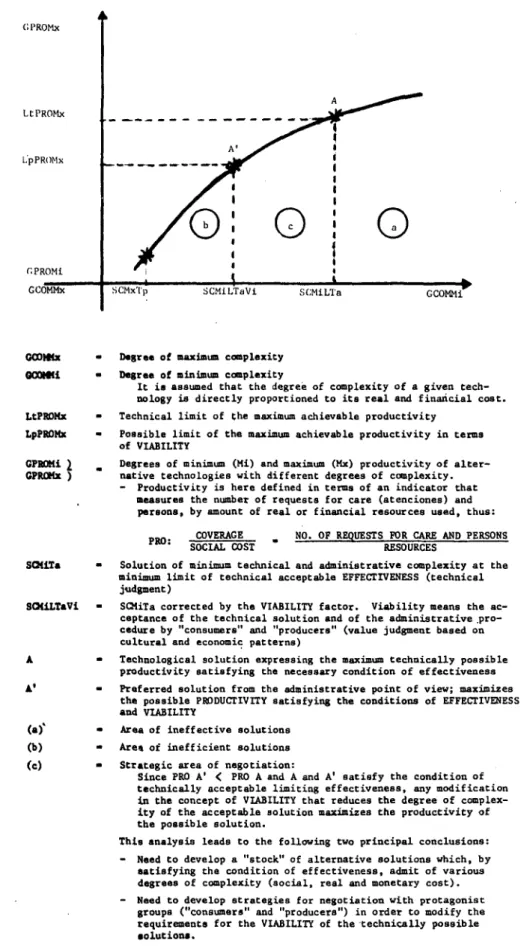
The systematic analysis of alternative technical and administrative solutions and their social, real and monetary costs, which are effective and viable, is a basic need in the process of the extension of coverage. (See Diagram No. 2.)
1Solely to facilitate discussion and without claiming to enter into semantic
and epistemological considerations, technology is provisionally defined as a combination of resources (human, inputs, equipment and buildings) inter-related by a set of techniques (specific ways of doing things) and adminis-trative procedures, capable of producing a product that meets given
20
-The present situation in the countries points up the need for inven-torying, adapting, and developing new ad hoc technologies for each particular case.
Despite the clear national characteristic of this enterprise, its magnitude requires close links between the countries based on the collec-tion and disseminacollec-tion of informacollec-tion on the development of methods and patterns. This will facilitate the systematic treatment of countries both individually and by group when common problems and solutions are being
identified.
This interchange of knowledge and experience between the countries may also be the chosen instrument for facilitating the viability or accept-ance of efficient and sufficiently effective solutions which, because of local tradition, are rejected by groups participating in the organization, programming and production of health service systems, both on the side of
the "producers" and on the side of the "consumers." The examination analy-sis of the validity of concepts and precepts for their general acceptance and application must be defined, organized and programmed jointly by the coun-tries as a priority activity. It is a necessary condition precedent to the adoption, adaptation and creation of the technology required for the exten-sion of service coverage to the unserved populations of the Region. It is urgently necessary to design a hemispheric strategy for introducing and mounting a regional program of technological development, primarily aimed at meeting the needs of the national processes for the extension of cover-age. That strategy and its programming must include not only the so-called
"specific technical" aspects relating to the knowledge of individual and collective health problems and their treatment, but must also cover aspects relating to the organization, programming, and administrative development of service systems, their financing, and the formation and adaptation of the critical resources. A tactical approach to that strategy from the re-gional standpoint may be the definition of various "model situations" which will make it possible to evaluate the efficiency-effectiveness of various technological solutions and their viability in different cultural-economic and ecological contexts. It must be recognized that the develop-ment of new solutions is an ardous task, costly in resources and time, which cannot from a realistic point of view be considered a short-term activity. However, an analysis of the present situation indicates that in
21
-DIAGRAM No. 2
ALTERNATIVE TECHNOLOGICAL SOLUTIONS. RELATIONS BETWEEN
EFFICIENCY, EFFECTIVENESS, AND VIABILITY
(: PROMx
LtPROMx l:pPROMx CPROMi GCOMMx A
Oi
ol
SCMxTp SCMiLTaVi S(MiLTa GCOMMi
GCOMix - Degree of maximum complexity
GOCQ#i - Degree of minimum complexity
It is assumed that the degree of complexity of a given tech-nology is directly proportioned to its real and financial cost.
LtPROHx - Technical limit of the maximum achievable productivity
LpPROMx - Possible limit of the maximum achievable productivity in terms of VIABILITY
GPRoMi 2 . Degrees of minimum (Mi) and maximum (Mx) productivity of alter-GPRCix ) native technologies with different degrees of complexity.
Productivity is here defined in terms of an indicator that measures the number of requests for care (atenciones) and persons, by amount of real or financial resources used, thus:
PRO: COVERAGE NO. OF REQUESTS FOR CARE AND PERSONS
SOCIAL COST RESOURCES
S(fiTa - Solution of minimum technical and administrative complexity at the minimum limit of technical acceptable EFFECTIVENESS (technical judgment)
SOCiLTaVi - SC1iTa corrected by the VIABILITY factor. Viability means the ac-ceptance of the technical solution and of the administrative pro-cedure by "consumers" and "producers" (value judgment based on cultural and economic patterns)
- Technological solution expressing the maximum technically possible productivity satisfying the necessary condition of effectiveness
A' - Preferred solution from the administrative point of view; maximizes the possible PRODUCTIVITY satisfying the conditions of EFFECTIVENESS and VIABILITY
(a) - Area of ineffective solutions
Area of inefficient solutions
Strategic area of negotiation:
Since PRO A' < PRO A and A and A' satisfy the condition of technically acceptable limiting effectiveness, any modification in the concept of VIABILITY that reduces the degree of complex-ity of the acceptable solution maximizes the productivity of the possible solution.
This analysis leads to the following two principal conclusions:
- Need to develop a "stock" of alternative solutions which, by satisfying the condition of effectiveness, admit of various degrees of complexity (social, real and monetary cost).
- 22
-As a particular case of this approach, the still isolated attempts to prepare "care modules" in various possible situations, at primary care levels, should be systematically continued and constitute a starting point for the regional program which is required.
4.5 Definition and Combination of Specific Programs1
The problem of the definition and combination of the specific programs is in essence a particular case of the problem of selecting technologies treated above and, therefore, the same categories are appropriate for its analysis and treatment as regards requirements or conditions of efficiency, effectiveness and availability.
An analysis of the present situation indicates a trend towards the isolated design of each specific program, which leads to definitions of activities, goals, standards and technical and administrative procedures that are not always consistent with the priorities established or with the actual production capacity of the health service system. These programs are usually prepared by the specific units of the policy-making levels of the sector with insufficient participation of the various executive levels, which militates against their realism and, consequently, the achievement of the specifications and goals.
The decision to extend the coverage of services with emphasis on levels of minimum complexity compounds the need to design specific programs based on technical and administrative solutions that ensure the consistency and compatibility of the programs with one another and with the production
capac-ity of the pertinent health service systems and therefore guarantee the feasibility of the whole.
1With respect to the significance and consequences of what are called
"ver-tical" and "horizontal" programs, it is clear that it is neither possible nor advisable to make a priori judgments on the "value" of either approach. The decision to design and execute a "vertical" program must be based on
23
-A pragmatic approximation to the solution of the problem of combining and aligning these specific programs might be as follows:
- To program, in a first approximation, the possible supply of "gross" production of services by segments of population and levels of com-plexity, in terms of alternative hypotheses concerning availability and output of physical resources, and to estimate the theoretical coverage that these hypotheses presuppose.
- Taking as a basis the foregoing theoretical capacity to produce activities at each given level of complexity, to analyze the various consequences, as regards coverage of the population and additional critical resources needed of the application of the specific pro-grams considered to be priorities, according to the standards of activity and of concentration prepared in the first approximation by the specific policy-making units.
- On the basis of this analysis, to define alternative solutions, as regards new combinations of activities among the various specific programs, for maximizing productivity and, if necessary,
modifica-tions of standards within acceptable ranges of effectiveness, which is equivalent to an analysis of the feasibility and availability of efficient and effective technical and administrative solutions until a satisfactory adjustment is achieved in a second approximation. Initially, it is advisable to focus this activity on the minimum care levels where the production and productivity possibilities of the critical resources may be determined in a more simple and straightforward technical manner.
This would provide a firm basis for deciding on the most efficient and effective combinations of specific programs, as well as the adjustment of priorities, which would facilitate a subsequent analysis at the various
levels of complexity that make up the supply system being programmed.
This type of approach requires a revision of the "traditional" prac-tices and attitudes of the so-called "policy making units" that make up the administrative-technical apparatus of the institutions:
- It requires a systematic dialogue between these units specialized in specific aspects, with one another and with the "service pro-ducing apparatus," both as regards the "formal" subsystem and the "informal" subsystem.
- It demands a systematic and joint analysis of the validity of stand-ards and combination of activities either proposed or in operation. - It makes it necessary to focus the activity of these units on the
24
-procedures for dealing with concrete situations of various degrees of scarcity of critical resources both in quantity and as regards the limitation of their structure (type, capacity, etc.). There-fore, the principal responsibility of these units should be centered on the development of technical strategies in terms of various
constellations of resources and possible circumstances.
- From the organizational and administrative standpoint, it involves change in the function of the policy-making units, by which the emphasis of their activity is shifted to systematic exploration of more efficient effective solutions and the evaluation of their
application, their role as technical advisor to the various levels of execution is strengthened and the role as direct or indirect executing agencies of the programs, which is usually vicarious, is abolished or minimized.
In the field of budgetary programming, experience shows that the most usual "program openings" reflect and accentuate the already mentioned incon-sistency and lack of complementarity of the specific programs, which reduces efficiency and hampers the achievement of the objectives these programs are intended to reach. If this situation is to be overcome, it is necessary to use the above-mentioned pragmatic approach in programming the service system.
The expansion of coverage demands that the definitions of the specific programs be adjusted and combined in strict subordination both to the pri-orities decided upon and to the real production possibilities of the different levels of the "formal" and "informal" service systems programmed to achieve the principal objective of coverage.
4.6 Administrative Development
Administrative development is defined as the process that helps in-crease the operational capacity of the health services for extending cover-age. It is, therefore, clear that the effort made to achieve this adminis-trative development is decisive in the operation, improvement and expansion of health services since:
- It intervenes from the time policy is formulated, from which policy its own content and ambit is fixed, and it mobilizes all the stages of development of the program.
- It contributes to the diagnosis, design and assembly of the neces-sary infrastructure for operation and growth.
25
-- In the execution stage, it activates the general system, maintains the flow of communication and information for facilitating decision-making at all the levels and providing logistic support in terms of
the requirements.
- It stimulates the development of "sensor" mechanisms that make it possible to control and maintain the harmonious growth of the
gen-eral system in terms of the program and within the financing strategy.
- It contributes substantially to the recruitment, development, stimulation and maintenance of human resources as the principal factor of the program.
- It is present in the organization and participation of the community and in its coordination with the institutional (formal) system of health services.
- It provides the necessary links and the dynamics that enable insti-tutional development in the health sector to take place in a pro-grammed and systematic manner and at the same time to be maintained within the context of the national development system.
Within this general conceptual framework, the strategy for promoting administrative development must be designed, in all cases, in terms of the requirements the program for the expansion of coverage itself imposes. The systematic identification of critical points in the design stage and throughout the process of implementing the program for the extension of coverage which reorients that strategy is a necessary condition for ensuring the effectiveness and realism of administrative development. In any event, the recognition and analy-sis of these critical points must determine the concrete
activ-ities for their solution, which constitute prioractiv-ities and can be considered portals of entry for the initiation of the program within the general framework of administrative development.
26
-4.7 Supervision Systems
The readjustment, reorientation and development of supervision sys-tems is a key element in ensuring the necessary connection between the dif-ferent administrative levels and levels of complexity of care of the
institutional (formal) subsystem and particularly between this and the com-munity (informal) subsystem.
The need to develop supervision systems is pressing and acquires special characteristics in a situation in which coverage is being expanded due to the fact that the sometimes sudden expansion of the frontiers of institutional health services and their coordination with the communities in most cases presupposes:
- new approaches and strategies for the production of services
- use of technical solutions and administrative procedures different from the traditional ones
- adjustment or change of functions which usually entail new respon-sibilities for the personnel at different levels
- the sometimes massive incorporation of new agents into both sub-systems
- increase in the geographical-administrative distances between the agents of the various subsystems, with a consequent tendency to-wards isolation of the parts that make up the systems.
To these factors that undoubtedly compound the need for efficient systematic supervision is added the fact that the necessary empirical ap-proach with which the processes of expanding coverage are developed calls for a "permanent alert" to control the new unexpected situations that arise from the very development of the process and which must be discussed and analyzed promptly either in order to correct them or to incorporate,
stand-ardize and generalize them as positive elements of the process.
The present definitions of the concept of supervision are not suffi-ciently operational for a situation of expansion of coverage and, for this particular case, it is suggested that the following criteria be accepted:
27
-- development of previously programmed functions, activities and tasks in quantity, structure, time and output
- adoption and development of previously established technical, standard, and administrative procedures
- evaluation of results of the activities of the system in terms of clearly defined objectives and goals
- analysis of the behavior of the various agents that make up the systems
This substantive control-analysis-decision making component of the supervision system should be designed in such a way that the instrument is also effective and efficient in channeling the changes, connections or ad-justments considered necessary. This implies that the supervision systems must incorporate, in addition to the control component, the education and
updating component of the participating agencies. On the basis of this conception, it may be concluded that the present forms and practices of supervision must be revised in the light of special requirements presupposed by situations of extension of coverage. A supervision system is designed on the basis of its feasibility as regards available resources, communica-tion problems, quality of personnel, and characteristics of the funccommunica-tions and responsibilities assigned to it. This design, in the same way as that of the design of information systems and of other systems that make up the administrative development, is an integrated activity dependent on the pro-gramming of the extension of coverage.
4.8 Programming of Extension of Coverage
4.8.1 Basic guidelines and methodological requirements
If it is recognized that the basic and substantive elements for en-suring the implementation and subsequent sustained development of the pro-cess of programming extension of coverage are based on:
- the political decision, the broad participation in the process of all the members of the national teams
- the realism and consistency of the proposed changes in the health sector with the general policy of development, economic-cultural and ecological characteristics, and the political time-periods of the programming
28
-The full and sustained participation of these groups in the process demands that both the concepts and the concrete instruments of programming be understood and handled by the various levels involved. This need deter-mines the selection and adaptation of approaches and instruments to the
pos-sibilities of the components of the group and signifies among other things: - revision of the content of the programming and inclusion of the
necessary administrative development of the critical resources and of the financing in terms of the proposed changes
- analysis and definition of the technical solutions and administra-tive procedures appropriate to the national characteristics and those proposed changes
- adaptation and creation of programming instruments in accordance with the absorptive capacity of the components of the team
- formulation and conduct of programs for the continuing training and adaptation of health personnel, consisting in the content, intensity periods and pace of the programming process
- redefinition of the role of what is known as "planning units," which must be transformed into elements giving support and tech-nical orientation to the health team at all levels and throughout all the stages of the process
The decision-making, policy setting and executing team must be the motor of the programming. Because of this concept of a "participating and capacitating" planning there must be an active commitment on the part of all the national team, and it presupposes that the improvement of the processes is a consequence of their development and of the extent of the knowledge available about technical solutions and possible strategies for dealing with different situations.
The development of concepts and criteria about various aspects they make of the processes of extending coverage in order to increase knowledge and understanding of the characteristics of the behavior of those processes must be supplemented by the development of methods and instruments. This is essential if this knowledge is to be applied to the program of activities and the necessary effectiveness and efficiency of the combinations of
re-sources assigned to them is to be ensured.
29
-These guides must take the form of schemes that facilitate the rec-ognition of each of the components which, from a general conceptual stand-point, make up the process and order in a logical sequence the treatment of
those components and establish their general linkages.
A guide built up in this way, as a frame of reference of general validity, would facilitate the selection or design of the most efficient
instruments for the specific and particular handling of each component. This selection, adaptation and utilization must be analyzed and decided upon in accordance with characteristics and the stage of the programming process of each country.
These developments of planning and administration instrumental packages must be systematically incorporated into the above-mentioned exchange of tech-nological knowledge between the countries of the Region because it is a
sub-stantive part of this knowledge.
4.8.2 Programming of the use, adaptation and formation of critical resources for extension of coverage
The relative shortage of material, financial, technological and human resources is a universal situation for all the different sectors involved in the process of national development. This relative shortage of resources that may be assigned alternatively to different objectives constitutes the essence of the subject matter of social economics, and more specifically of its planning. This competition between objectives and sectors for the alloca-tion of resources entails a rigorous selecalloca-tion of priorities among the many desirable objectives for a given situation and style of development and the consequent allocation of combinations of resources to these priorities, and the fulfillment of the condition of maximizing their effectiveness and ef-ficiency. It consequently calls for rigorous programming in both the alloca-tion and the formaalloca-tion of the resources considered to be critical. This programming demands as a frame of reference a clear definition of policies, precise designs of strategies by sector and their programming in the short, medium and long term.
Historical experience shows that the relative shortage of resources is a basic assumption of any planning model, regardless of the level of development to which it is applied; the principal categories both for the analysis and for the programming of resources may be summarized as follows:
- definition of policy, priorities and intersectoral and sectoral strategies
- identification of the resources deemed critical from the inter-sectoral or intrainter-sectoral standpoint
30
-- adaptation of the resources to the situation of change entailed by the priority objectives
- identification of the most efficient and effective combinations of resources for each priority
- estimate of the quantity and structure of the resources required for the objectives in terms of the best technical and administrative combinations selected (maximization to the effectiveness-efficiency ratio)
- analysis of the present use of the resources and definition of the assumed increases in output and intensity of use
- analysis of the possibility of adapting existing resources to the new demands of the objectives and of the consequent combinations of resources decided upon
- analysis of the capacity to build up resources in amount, structure, adaptation, rhythm and periods of training, in accordance with the
requirements of national and sectoral plans and programs
- programming of the formation of new additional resources, of the adaptation of existing resources, and of the use of both
An analysis of the countries of the Region, from the standpoint of a significant extension of coverage with health services, indicates that in most of them the problem of the real shortage of the critical resources is
becoming particularly acute.
Despite the considerable progress made by the health sectors of the countries in the last two decades, this acute shortage of resources is be-coming even more pronounced because of unsatisfactory programming, poor use and lack of adaptation of existing resources and lack of alternative tech-nical solutions and administrative procedures tailored to the characteris-tics of the systems, which keep the health sectors at a low operating capacity and low levels of productivity. In some cases there is a paradoxical
situa-tion in which the relative shortage of resources exists side by side with idle capacity at some levels of the system--in other words, the coexistence of waste with shortage.