MALARIA CONTROL WORK IN CHIMBOTE, PERU
LT. COL. EDWARD
A.
WESTPHAL AND MAJOR ROBERTK.
HORTONDuring the past two years an extensive and a very interesting program
of malaria control has been in progress in the town of Chimbote, Peru.
Chimbote lies on the cost of Perú about 250 miles north of Lima, and is,
at the present time, a small fishing village of about 4,000 persons. Plans
have been made to develop the Chimbote area into a large industrial
center, and it is in connection with this industrial development that the
malaria control work has been carried out.
Industrial development of the Chimbote area is feasible because of the
existence of certain natural resources. One of the most important re-
sources is the harbor, which has been termed the “finest natural harbor
of the West coast of South America.” The other principal resources in
the region are an abundance of coal, and the availability of hydroelectric
power which is being developed on the near by Santa River. In the
southern part of Peru, about 400 miles from Chimbote, iron ore deposits
are available. This ore, which will be shipped to Chimbote by boat,
will make possible the development of a steel plantand will be a funda-
mental factor in the industrialization program.
Of vital importance to this program of industrial development is the
improvement of sanitary conditions through the area and particularly in
the town of Chimbote. Therefore, one of the initial undertakings has
been a comprehensive program directed towards public health improve-
ment and an elevation of sanitary standards in Cbimbote. This public
health program has included development of an adequate and safe water
supply, construction of a sanitary sewer system, construction of a 42 bed
hospital, and the malaria control work which is described in this report.
The public health program has been carried out by the Servicio Coopera-
tivo Interame-ricano de Salud Pública
(Inter-Ameritan
Cooperative
Public Health Service). This Service is an agency of the Ministry of
Public Health of Perú which has been established by agreement between
the Governments of Peru and the United States.
THE PROBLEM
In beginning the malaria control work, the first consideration of course
was the gathering of certain fundamental information.
Medical and
entomological surveys were required to determine malaria incidence, the
vector or vectors, speciflc and potential breeding areas, and other perti-
nent data. Engineering surveys were required to determine elevations
of lagoons, grades available for drainage, the amount of continuous runoff
from each of the lagoons, and other data bearing on the design of a
drainage system.
[September 19.461 CHIMBOTE
797
In arder to determine the malaria incidence, both parasite and spleen
surveys were made. The month of May (1942) was selected as the time
for these surveys because information from inhabitants of the area indi-
cated that this was one of the months during which greatest intensity of
the disease occurred. At this time some of the other phases of the
program were already in progress. The engineering surveys had been
almo& fmished and a considerable amount of designing had been done.
However, no permanent control work was started until after the surveys
had been completed. Examinations were confined to school children
between the ages of 5 and 12. Results of the surveys showed that of a
total of 472 children examined, 9.1% had parasites in their blood and
24.6% had enlarged spleens. These percentages, although not excep-
tionally high, indicated that a serious malaria problem existed in
Chimbote. Even though the amount of clinical malaria actually present
at the time may have been relatively low, the results of the surveys
demonstrated that there was ample opportunity for the outbreak of
severe epidemics under favorable conditions. In view of the fact that
there was to be a large influx of population from non-malarious areas,
the opportunity for malaria epidemics was a hazard of the first mag-
nitude.
The malaria vector in Chimbote was found to be Anopheles pseudopunctipennis. One other Anopheline was found breeding within the area: Anopheles punctima- cula. However, only a very small number of A. Punctimacula larvae were ever encountered, and al1 of these were found to breed in one small isolated spot. Fur- thermore, adults of A. punctimacula were captured only on one or two occasions throughout the entire program; this in spite of the fact that adult catches were made almost continually. Because of the evidente of such small numbers of A. punctimacula, it was concluded that the part this species played in the transmission of malaria was insignificant .
í’98
PAN AMERICAN
SANITARY
BUREAU
[Septemberrespect to the ground water table.
There is a continuous
flow from t,hese lagoons
Rainfall,
of about
8.5sec.-ft.; the water enters from underground
along the eastern edge.
which is pract,ically
zero in Chimbote,
played no part in the problem.
The group of lagoons on the north side of t,own extended over an area approsi-
mately
0.3mile wide by 1.5 miles long, and contained originally
a water surface
area of around 6,800,000 sq. ft.
(156acres).
The distance from the center of town
to the farthest
point of these lagoons was very nearly 2 miles.
Because there
it was felt that it would not be necessary t’o carry the control program to thc
were constant prevwiling winds to t,he north (i.e. in the direction away from t,own),
extreme north end of this group of lagoons.
radius of 1.5 miles was set as a practica1 limit to the estent of the control program.
Therefore, for the north lagoons, a
. G . .
FIG. 1.- kiERIrlL VIEW OF CHIMBOTE ASI) jylcl~l~y
On the east side of town there were a t,otal of seven individual
lagoons in which
cont,rol work was done.
These lagoons varied in size from 43,OOO
sq. ft. to 1 YOO
000
sq. ft. of surface area; the total surface area for al1 seven lagoons was 2’&‘000
sq. ft.
The distance from the center of town to t,he seventh lagoon was a fra&on
more than 2 miles.
H owever, because there was heavy breeding in this Iagoon
and because prevailing
winds in this case were towards t,own, it was considere;
necessary to include the sevent,h lagoon in the control program.
,4lthough there
were additional
lagoons further eastf, at a distance of 3 miles and more from toivn
it was considered impractical
to extend the control program beyond f& seventh
lagoon.
Larvae of
Anopheles pseudopunctipenn.ismere found breeding throughout
prac-
tically all of the nort.h and east lagoons.
Post of t.he lagoons afforded breeding
places which were highly typical for
Anopheles pseudopunctipennis:areas of fresh
water wholly esposed tIo the sun, and filled with algae or other aquatic vegetation.
The density of breeding varied considerably
t.hroughout t.he lagoons. holvever
in
some of the areas of heaviest breeding esaminations
showed con&nt.rations’
of
20 to 25 larvae per dipper full.
19461
CHIMBOTE
799
In order to determine whether or not drainage could be employed as
a method of permanent malaria control in Chimbote, detailed topo-
graphic surveys were required. Differences in elevation between the
otean and the lagoons were very small, and it was not known until after
the surveys had been completed whether or not sufficient grades for a
drainage system would be available. Topographic surveys were started
during the month of January, 1942. A horizontal coordinate system
was established by means of transit and tape surveys. This coordinate
system was a continuation of the system which had been previously
established by the Frederick Snare Corporation, the company engaged
on the construction of port works. Elevations were determined by
means of numerous leve1 circuits; al1 elevations were referred to a low-
low tide datum, which had been established by Snare Corporation.
From the coordinate system al1 lagoon areas were mapped by means of
planetables. In doing this mapping numerous shots were taken on the
shorelines and on the bottoms of the lagoons; very little dry land to-
pography was taken in order to conserve time and energy. After the
surveys had been finished and detailed maps of each of the lagoons had
been drawn, it was found that adequate grades for the drainage of al1
lagoons were available . However, grades available in the north lagoons
were much less t,han those in the east lagoons, and therefore for the
north lagoons lower design velocities had to be used. The personnel
used for making these initial surveys consisted of six students from the
National Engineering School who were hired to do the job during their
summer vacation.
TEMPORARY CONTROL PROGRAM
In view of the fact that severa1 construction programs (port works,
hospital, water supply, and others) had already been started or were
scheduled to be started immediately, it was desirable to put into oper-
ation an effective malaria control program as soon as possible. There-
fore, a temporary mosquito control program, which consisted of a
larvicidal campaign, was inaugurated at the time when the original
survey work was being done. An effort was made to obtain Paris green
from this larvicidal work; however, Paris green in the quantities required
was not available at the time.
800
PAN AMERICAN SANITARY BUREAU [Ssptemberaddition to tricalcium arsenite, kerosene was used for general larvicidal
work. Tricalcium arsenite was not available throughout the entire
program, and when the supply became exhausted, kerosene, which could
be obtained cheaply in Chimbote, was used.
The tricalcium arsenite was applied as a spray, which was composed of a mixture of tricalcium arsenite, kerosene, and water. The most commonly used proportions consisted of one volume of tricalcium arsenite mixed with two volumes of kerosene. One volume of this tricalcium arsenite-kerosene mixture was thcn diluted with water at the breeding places in proportions varying from 1:150 to 1:300; the amount of water used depended upon the amount of breeding and the amount of vegetation and debris present in the area to be treated. After dilution, the larvicide was applied by hand by means of liquid sprayers. This method of larvicidal application was the same as a method described by Barber for applying Paris green (Human Malaria, p. 338). The actual concentration of tricalcium arsenitc per unit of surface area varied considerably; however, the range was from 6 to 17 CC. per 100 sq. meters. In a few instances the tricalcium arsenite was applied as a dust, the diluent being a fine road dust collected locally. Dusting operations were never employed as general practice, but were carried out solely for experimental purposes. Although results obtained with the dust were reason- ably comparable to those obtained with the spray, it appeared that the spray was slightly more effective.
One of the features of the larvicidal program consisted of the continuous re- moval of vegetation am1 debris from the lagoons. In the north lagoons one of the most serious difficulties encountered was the widespread growth of reeds six to eight feet high. This vegetation of course prevented the distribution of larvicide, and also prevented the numerous fish from feeding on the larvae. The cleaning program, for which as many as 60 men were employed at one time, was started early in the project, severa1 weeks before the larvicide and spraying equip- ment were available.
At the beginning of the larvicidal program, the personnel in addition to the cleaning crews consisted of 14 sprayers and two inspectors. Al1 areas in which larvae were found breeding were sprayed once a week. The amount of larvicidal work was decreased gradually as construction of the permanent drainage channels proceeded. During the month of November, 1944, the permanent program had become far enough advanced so that al1 larvicidal work could be stopped.
The effectiveness of the larvicidal program was measured in two ways: by weekly inspection of al1 lagoon areas to determine anopheline larvae counts, and by regular collection of adult anophelines. As mentioned previously, larvae counts in some places before the temporary program was started were as high as 20 or more larvae per dip; however, the average count throughout most of the lagoons was around 8 to 10 larvae per dip. During the time in which the tempo- rary program was in progress, average counts showed only a fraction, e.g. 0.2-0.3, of a larva per dip; and in many cases counts were zero for 20 dips. Two methods were used for collecting adult anophelines, the first of which was house catches. Three houses in town were designated as catching stations. On one day out of every week each house was visited early in the morning, and catches were made for a period of 30 minutes by means of a chloroform tube. Before starting control work, as many as 30 and as few as 5 anopheline mosquitoes were caught during one 30 minute period. After control work had been started, for many of the catching periods it was impossible to find any anophelines, and never did a catch show more than 6 anophelines. The second method employed for collecting adult anophelines
19461
CBIMBOTE801
was the use of an animal trap. The animal most commonly used was a burro, although calves and sheep were used occasionally. Severa1 catching stations were established in the vicinity of the lagoons, and the trap was placed at one of these stations every night. Every morning the trap X-X examined and the number of anophelines which had been caught during the previous night was recorded. Re- sults of these catches showed reductions in adults varying from 60 to 100 per cent.
Prophylactic Atabrine.-One
other measure taken for the temporary
control of malaria was the use of prophylactic atabrine. A dispensary
was established and the community advised of this service. Atabrine
was made available free of charge to all persons living in Chimbote who
cared to cal1 at the dispensary twice a week. The prophylactic dose
given was 0.40 gms. per person per week. This preventive measure
proved very popular, and during the peak of the construction program
atabrine was dispensed at the rate of around 50 gms. per week.
PERMANENT CONTROL PROGRAM
Drainage is of course the most effective permanent method of reducing
or controlling malaria. Therefore, when the engineering surveys showed
that drainage of al1 lagoons within a radius of 14 to 2 miles from the
center of town was possible, this method mas selected as the principal
means of permanent control. Some filling was done in conjunction with
the drainage operations; however, the fiUing was of secondary importance
and mas done only in those places mhere drainage could not be effected.
As indicated previously, the problem of draining the east Iagoons was
very different from the problem encountered in the north lagoons. With
the east lagoons, the principal difficulty lay in the construction of a
satisfactory outlet through the beach. In the north lagoons the outlet
did not present any great problem; however, the question of grades was
very difficult because of the slight difference in elevation between the
lagoons and the otean.
Outlet Structures.-The outlet structures builtin the east lagoons consisted of concrete pipe lines of 24 in. in diameter which extended from the shoreline back through the beach to the lagoons proper. Each of these outlets was made up of two structurally different sections. The first section, which was at the shoreline, was designed to resist heavy wave action and undermining. This section con- sisted of a very heavy reinforced concrete pipe, 33 ft. long, which was cast in place, and which was mounted on twelve piles. The piles used were of reinforced con- crete and were 10 in. square by 20 ft. long. The second section of each outlet consisted of precast concrete pipe which ran from the structure on piles through the remainder of the beach. The total length of each outlet varied for the differ- ent lagoons; the shortest outlet was 130 ft. and the longest 210 ft.
PAN AMERICAN
SANITARY
BUREAU
[SeptemberAfter the sheeting had been placed, the twelve reinforced piles were driven with
the aid of a drop hammer pile-driving
rig.
only a minimum amount of driving with the hammer.
By using jets it was necessary to do
In most cases the weight of
the pile and the weight of the hammer, which was rested on top of the pile w-ere
sufficient with jetting to bring the pile near final grade.
However
in al1 cases the
pile was driven for the last few inches in order to consolidate the sand.
After the
piles had been brought to grade, the top 12 in. of concrete were broken away from
each pile in order to expose hooks in the vertical
reinforcing;
later these hooks
were tied into the reinforcing
of the pipe barre1 which was built on the piles.
In
casting the pipe barre1 two pours were made; the first pour consisted of t,he lower
half or invert
section of the pipe and the second pour of the upper half.
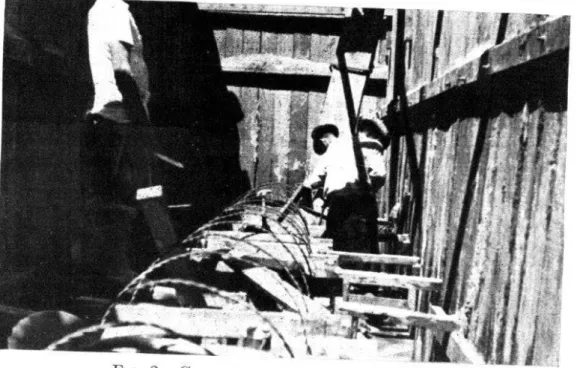
Fig. Rshows a picture taken during construction
of one of the outlets. in the figure can
be seen the sheeting and.part of the form work and reinforcing’st.eel
for the pipe
barre].
FIG.~.-CONSTRUCTION
OF LAGOON OCTLET
After the outlet structures
on piles had been finished
the pipe lines through
the remainder of the beach were laid using precast secti;ns 3 ft. in length.
By
laying the precast pipe sections during periods of low tide, it was not necessary
to use sheeting.
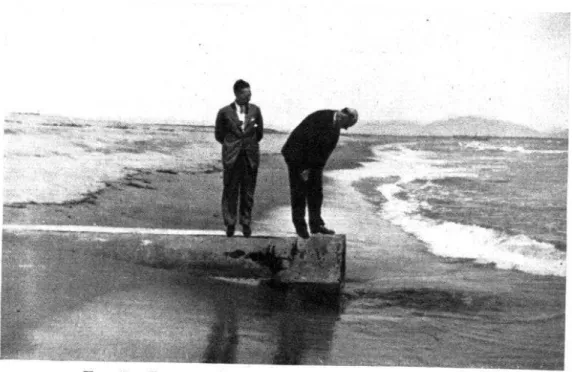
Fig.
3 shows a picture of one of the outlet structures
in operation.
seen that the structure juts out into the otean for only a few feet.
.
1946J
CHIMBOTE
803
stroyed.
Before any locations were made, severa1 profiles of the beach were run.
Then on the basis of these profiles the structures were located
as close in as possible
with reasonable assurance that the beach would never build
up
beyond t.he mout,h.
As mentioned above, invert elevations at the mouth of al1 structures were at or
near mean tide level.
The lowest invert was placed 0.7 ft. below mean tide, and
the highest invert 1.3 ft. above mean tide.
The factors controlling
these eleva-
tions were of course the elevations of the bottoms of the lagoons and the grades
necessary for the drainage channels and outlet struct.ures.
Grades for t’he outlet
structures
were chosen so as to give a minimum
velocity
of 4 ft. per sec. when
flowing full.
At the time of design it was believed that this velocity
would be
sufficient to keep the outlet open at al1 times regardless of any temporary deposi-
tion of sand in the mouth of the pipe during periods of high tide.
has been t,he case.
Actually
this
Al1 outlet structures have now been in operation for more than
a year, and there has never been the slightest tendency toward clogging.
Although
there were seven lagoons on the east side of town included in the con-
trol program,
only six outlet
structures
were required.
The sevent,h lagoon
(furthest from town) mas located almost a mile from the beach.
It was possible
to drain this lagoon into the upper end of the sisth lagoon and therefore eliminate
a separate outlet structure.
FIG. 3.-LAGOON OLTLET STRWTCRE IN OPERATIOS
For the main north lagoons the construction
of an outlet was not necessary.
Here it was possible to use a concrete culvert over an esisting channel at the beach
for the outlet structure;
the floor of this culvert was at an elevation of 1 ft. below
high tide (1.3 ft. above mean tide).
This outlet has also been in operation
for
more than a year, and has proved completely satisfactory.
Drainage Channels.-The
permanent drainage system for the
entire
area consisted
of 6.4
miles
of
concrete
lined channels, of which half mere
constructed in the seven east lagoons and half in the north lagoons.
length of channels in each of the east lagoons varied considerably.
804
PAN AMERICAN
SANITARY
BUREAU
[Septemberfor the other three lagoons it was necessary to build one main channel
and one or more branches. The shortest channel in the east lagoons
was 846 ft. in length, and the longest, including branches was 4 700 ft.
As has already been mentioned, runoff from the sevenih lago& was
drained into the head end of the sixth lagoon. An 18 in. concrete pipe
line 1050 ft. long was used to connect the channels in these two lagoons.
A picture of the drainage channels in the sixt’h ea.st lagoon is shown in
Fig. 4. The picture was taken looking towards the pipe outlet through
the beach, and shows the main channel on t,he left and a branch channel
on the right.
FIG. i,--COXCRETE LIEEL) DRUXAGE CHASSELS IX THE ,531~~~ E:AST LAGOON
The channels constructed
in the north lagoons consisted of one main channel
9,850 ft. in length, and three branches.
1,600 ft.,
19431
CHIMBOTE
805
Al1 of the main channels and branches were lined with precast concrete blocks. Lining was necessary in order to prevent the channels from filling with sand, and to reduce the prolific growth of weeds. A tongue and groove type of lining block was used. The tongue and groove design gave stability to the channel, and at the same time by allowing water to enter through the joints, made it possible to have the water table in the surrounding soil near the leve1 of water flowing in the chánnel .
The sise of each lining block was 19.7 in. long by 13.8 in. wide by 3.1 in. thick. Two types of blocks, curved and fiat, were employed. Fig. 6 shows a cross section of a lined channel; the section shown is that of the main channel in the north lagoons. Since the section shown contained seven lining blocks, it was designated as Type 7; this was the largest cross section used throughout the project. As can be seen in the diagram, the lining blocks were designed so that the two outside blocks, when placed in an inverted position, would meet a 1 on 3 slope of earth on each side of the channel. Two other sizes of cross sections were usedforchan- nels of lesser capacity : a five block section and a three block section. The five block section was constructed by leaving out the two flat blocks on either side of the center curved block of the seven block section. The three block section was the same as the five block section with the two top inverted blocks left off. In the north lagoons no three block sections were used; seven block sections were used for about 70% of the total length of channels, and five block sections for the remaining 30%. In the east lagoons it mas not necessary to use any seven block sections; here 75% of the total length of channels consisted of five block sections and 25ye of three block sections.
For lining the 6.4 miles of channels 110,000 blocks were required. Blocks were made in wooden forms at the rate of 400 per day during the peak of production. A 1:2:3 concret mix mas used, with a water cement ratio of 0.80. AI1 blocks were cured under water for two weeks.
The minimum design velocity used for channels in the east lagoons was 4 ft. per sec. Higher velocities were used wherever su6icient grade was avàilable. Channel slopes in the east lagoons varied from 0.0032 to 0.00989. In the north lagoons it was impossible to design for a minimum velocity of 4 ft. per sec. Theré were points on the bottom of these lagoons which were only4.9 ft. above mean tide level, or only 2.6 ft. above high tide. In the final design for the north lagoon slopes of 0.00044 for seven block sections and 0.00080 for five block sections were used. These slopes gave a minimum velocity of 2 ft. per sec.
The alignment on al1 channels was kept as straight as possible. In many cases the alignment was strictly controlled by already existing culverts and bridges. Fiat curves were used to connect al1 tangents, and to connect al1 branch channels with main channels. In a few cases a curve radius 80 ft. was necessary; however, on most of the curves radii of 350 to 500 ft. were used.
806
PAN AMERICAN SANITARY BUREAU
[SeptemberJ9461
CHIMBOTE807
terial was spread evenly on each side; wherever spreading was impractieal, short lateral ditches were cut through the spoil banks at frequent intervals.
One of the features of construction of channels in the north lagoons was the discharge of stored water. During construction of the outlet channel it was neces- sary to dam the lagoons, with the result that a tremendous volume of water in addition to that normally contained in the lagoons was accumulated. Normal runoff from these lagoons was 8.5 sec. ft.; however, the outlet ehannel was designed for a capacity of 14.5 sec. ft. It was necessary to discharge the stored water gradually in order to prevent overflowing of the concrete lining and filling of the channel with sand. Gradual discharge was accomplished by means of a temporary adjustable weir and spillway which mere built out of the concrete lining blocks. After the outlet channel had been finished, discharge of al1 stored water required a period of about two months.
Miscellaneous Earth Ditches and Filling.-An essential part of the drainage program included the construction of a secondary system of earth ditches and a small amount of filling. Small earth ditches were dug in al1 lagoons to connect isolated areas of water with the lined channels. The great majority of these ditches were only of temporary use, for once the standing water had been elim- inated, flow from the ditches ceased. At the time of writing, sufticient time has not yet been allowed to realize the ful1 benefit of the main channels. After stabil- ity of the ground water table has been reached, it will be possible to know which of the earth ditches will have a permanent flow. It may therefore prove advisable at a later date to line some of these earth ditches. Filling was resorted to wherever bodies of water were too deep to be drained. Also, small isolated holes were filled wherever this proved more economical than drainage.
Actually, filling operations and construction of temporary earth ditches have not yet been finished. These measures will be continued until existing and po- tential breeding areas have been eliminated to a practica1 degree.
Evaluation of Results.-The only rea1 measure of effectiveness of the
control program of course lies in the reduction of malaria incidence. Un-
fortunately, no medical survey has been made since completion of the
main drainage channels. Such a survey is to be made within a short
while. A survey made during construction of the drainage channels and
after the temporary control program. has been in operation severa1
months, showed a reduction in blood parasites from the original 9.1%
of those examined to 5.9%, and a reduction in enlarged spleens from
24.6% to 19.7%. These reductions are obviously attributable to the
temporary program. Another important consideration in appreciating
effects of the control programs is that there has been no epidemic out-
break of malaria in Chimbote since control work was started; this in
spite of the fact that severa1 thousands of new persons have moved into
the area, a large percentage of whom have come from nonmalarious
regions.
As a result of the drainage program there has been a reduction
inbreeding
areasof the malaria vector of 90 to 95 per cent. As pointed
out above, the elimination of residual breeding areas is still in progress
and will be carried on so long as practical.
808
PAN AMERICAN SANITARY BUREAU [September should be neither difficult nor expensive; it should be possible to do all maintenance work with a permanent crew of a very few men. Steps are being taken at the present time to set up a competent program of main-tenance; this program
willbe carried out by the Anti-malaria1 Service
of the
Peruvian Ministry of Ilealth. It is realized that if such a program is not followed, the efficiency to the drainage system will be graduallylessened until the effectiveness of
al1 work which has been done will be lost completely.ACENOWLEDGEMENT
The work in Chimbote was carried out under the general direction of the Division of Health and Sanitation of the Institute of Inter-American Affairs. Major General George C. Dunham is President of the Institute, and Colonel Harold B. Gotaas is Director of the Division of Health and Sanitation. Lt. Col. Edward A. Westphal is Chief of the Health and Sanitation Field Party assigned to Per&
At the beginning of the work in Chimbote Major Benjamin A. Whisler, Sn.C., was Project Director, with Major Robert K. Horton second in charge. Later Major Whisler served as Chief Engineer and Associate Chief of Party for the entire health and sanitation program in Per& Major Whisler was responsible for most of the planning in Chimbote, and much of the information contained in this article has been taken from his reporta. When Major Whisler was made Associate Chief of Party, Major Horton became Project Director in Chimbote.
After a year in Per&, Major Whisler left for reassignment . He was replaced by Major W. Allen Stone, who has remained in Perd as Associate Chief of Party during the remainder of the work in Chimbote.
Appreciation is expressed for the work of Captain Jo B. McLellan, Sn.C., and Mr. Harold E. Rankin. These men were in charge of construction during various phases of the program. Their contributions toward the success of the work have been invaluable.
Appreciation is also expressed to Lt. Colonel W. H. W. Komp of the United States Public Health Service, who spent some time in Chimbote as a consulting entomologist.
OBRAS ANTIMALARICAS EN CHIMBOTE (Sumario)
* . . .
we1
&1MB0;rE . .809
y que era el mayor, se desaguó al mar por medio de un canal de 2 m de ancho y 53 cm de profundidad, y con una longitud de 5,200 m2. Entre los problemas que hubo que resolver figuraron los derivados del estancamiento del agua que brotaba del subsuelo, el terreno fangoso y la continua afloración de dichas aguas. Bajo las baldosas de concreto que forman el revestimiento de los canales hubo que colocar, como refuerzo, una capa de cascajo, hasta un promedio de 30 cm de profundidad. Las siete lagunas situadas al sur de la población tambi6n se desaguaron al mar por medio de canales revestidos de baldosas y de tubos de concreto armado. La elimi - naci6n del 95% de los criaderos de zancudos reforzada por la utilización de putve:i- zaciones antimosquito, ya ha hecho disminuir apreciablemente los casos de paludismo, a pesar de haberse casi duplicado en los titimos años la población.
El lenguaje técnico.-El progreso de las ciencias exige constante renovación y, a veces, radicales cambios de palabras, supuesto que vocablos gastados por antiguos, ya pueden no corresponder en SU connotación a hechos que vemos ahora bajo el brillo de aquel progreso. Más no conviene incurrir en torpe exageraci6n novadora, siempre nociva a la claridad indispensable en la definición de objetos y fenómenos. “La creación de palabras nuevas-a lo que dice Alejandro Bai&- es inbtil e inoportuna algunas veces; y cuando no hay sentido absolutamente nuevo de generalizaci6n, la invención de palabras no puede justificarse; porque adem&s de que se recarga el peso ya considerable del lenguaje, se arrastra al vulgo a creer en significados distintos.” Por otra parte, el mismo afsn renovador puede verse en el uso de neologismos, lo cual entraña serios inconvenientes, dado que el lenguaje se expone a caer en silos de corrupción. Pero no tan sólo en lo referente a la invención de palabras arraigadas en el latín o el griego, es aplicable el con- cepto, sino que, por infausta ironía, los galicismos, anglicismos y barbarismos, juegan indecorosamente en revistas más o menos afamadas de la AmBrica Latina. Veamos: “conducta o procedimiento a seguir”; “dosar” por dosificar; o lo peor: “dosaje”; “viciaci6n” por enviciamiento; “obstétrica” en lugar de partera o comadrona.-EVERAIZDO LANDA: Revista Médica, 22, jun. 30,1946.
El libro.-Cultivad el amor intenso al libro, que si la barbarie en épocas aún de actualidad ha querido desterrar y quemar el libro, no lo ha logrado, ni lo lograr&, porque es él, no en balde, el modelador por excelencia de la personalidad y si es para nosotros en los días felices en que se goza de las bellezas de vivir un deleite suave, dulce y grande del espíritu humano, es también este libro en los días aciagos en que las tinieblas del infortunio entriskecen nuestra alma, su bálsamo, su con- suelo y siempre y en todo momento nuestro fiel y agradable compañero.-Ra- II~UNDO DE CASTRO y B.: Anales de la Academia de Ciencias de la Habana, 315, 1944-45.