Sepsis-associated organ dysfunction and increased
supportive care are associated with high serum
interleukin-6 levels
Disfunção orgânica associada à sepse e aumento de suporte assistencial
relacionados com níveis séricos elevados de interleucina 6
Adriana Carta; Maria Gabriela de Lucca; Milton D. Pires; Suzana Margareth Lobo
Faculdade de Medicina de São José do Rio Preto (FAMERP), São Paulo, Brazil.
First submission on 02/05/16; last submission on 09/05/16; accepted for publication on 03/10/16; published on 20/12/16
ABSTRACT
Introduction: Detection of sepsis and septic shock is essential, since any delay in initiating a proper treatment is associated with a worse prognosis. Objective: To evaluate levels of interleukin-6 (IL-6) early in the onset of the evolution of sepsis associated-organ dysfunction and its relation to the need for more advanced supportive therapies. Methods: This is a prospective study at a 43-bed mixed Medical-surgical Intensive Care Unit (ICU) in a university hospital. Patients admitted to the ICU, over 18 years of age, with severe sepsis or septic shock and who presented the irst organ dysfunction in less than 48 hours of admission to the ICU were included. We monitored in a daily basis the advanced supportive therapies, need for vasopressors, mechanical ventilation, or renal replacement therapy (RRT), until hospital discharge or death. Blood samples to measure the serum IL-6 levels were collected at the time of inclusion in the study, at 12 and 24 hours later. Patients were divided into two groups according to serum IL-6 levels at admission (Low IL-6: < 1,000 pg/ml or High IL-6: > 1,000 pg/ml). Results: The need for norepinephrine was signiicantly higher in the group with High IL-6 (100%) than in the group with Low IL-6 (62.5%) (p = 0.009). RRT was also more frequent in patients with High IL-6 than in those with Low High IL-6 (87.5% vs. 55.5%, respectively, p = 0.056). Conclusion: These indings suggest that the evaluation of serum IL-6 level is useful in the early phase of the severe sepsis and septic shock in order to identify higher-risk patients.
Key words: sepsis; septic shock; biological markers; multiple organ failure; interleukin-6; hospital mortality.
INTRODUCTION
Sepsis has been defined as a clinically apparent systemic inflammatory response syndrome (SIRS) induced by a localized or generalized infection(1). Detection of sepsis and septic shock is essential, because any delay in initiating a proper treatment is associated with a worse prognosis(2). The patophysiological process during sepsis is determined by the activation of pro- and anti-inflammatory cascades that are controlled by cytokines, mediators, and cellular elements of the immune system(3).
Cytokines are proteins that are secreted by components of the innate and adaptive immune systems. They act as effectors or modulators of inlammatory response, which in turn play prominent roles in the development of sepsis(4). Raised levels of many cytokines, including the tumor necrosis factor-α (TNF-α), interleukin (IL)-6, IL-8, and IL-10 are indeed present in many sepsis patients and some have been associated with a worse outcome(5, 6). Indeed, IL-6 has been used as an entry criterion for clinical trial of an antisepsis therapy(7).
Early severity assessment and timely interventions can optimize sepsis patient’s care. Ideally, biomarkers should provide
valuable information regarding diagnosis and prognosis, and should permit monitoring patients responding to treatment(8). Nevertheless, under certain limitations, only C-reactive protein (CRP) and pro-calcitonin have been used at the bedside to evaluate prognosis or to guide therapy. Our aim was to evaluate the levels of IL-6 early in the onset of the evolution of sepsis associated-organ dysfunction and its relation to the need for more advanced supportive therapies.
METHODS
This is a prospective study carried out between January 2006 and March 2007 at a 43-bed mixed Medical-surgical intensive care unit (ICU) in a university hospital. The local research ethics committee approved this study, and a written consent was obtained from the patients or the next of kin. Patients in the ICU with severe sepsis or septic shock, deined according to the criteria of the American College of Chest Physicians (ACCP)(1), and over 18 years of age, who presented the irst organ dysfunction in less than 48 hours of admission to the ICU were included. Patients with terminal illnesses or with an expectation of life lower than three months were excluded.
Collections of cultures and resuscitation measures were left to the discretion of the attending physician. The Acute Physiologic and Chronic Health Evaluation (APACHE) II score was used to evaluate the severe condition of patient’s admission in the study(9). Organ function was evaluated daily during the irst week by the Sepsis-related Organ Failure Assessment (SOFA) score(10). Cardiovascular, respiratory, renal, central nervous system, coagulation, and liver failure were deined as a SOFA score of more than 2 for those systems.The need for vasopressors, mechanical ventilation or renal replacement therapy (RRT) was considered advanced supportive therapies. These therapies were monitored in a daily basis until hospital discharge or death.
The concentrations of CRP in serum were estimated by nephelometry (Behring, Berlin-Germany). Blood samples for IL-6 measuring were collected at the time of study inclusion (D1-0 h), 12 hours (D1-12 h) and 24 hours later (D1-24 h). The samples were centrifuged and stored in a freezer at -80ºC for the subsequent preparation of laboratory tests. The IL-6 was quantitatively determined by the enzyme immunoassay
technique (Quantikine® HS – High-Sensitivity ELISAs),
and assays were performed according to the manufacturer’s instructions. Dilutions were carried out to a level of 1000 pg/ml,
if necessary. Patients were then divided into two groups according to serum IL-6 levels (Low IL-6: ≤ 1,000 pg/ml or High IL-6: > 1,000 pg/ml).
STATISTICS
The Minitab Statistical Software 17 was used for statistical analysis. The categorical variables were treated as proportions and analyzed using the chi-square test. The Kolmogorov-Smirnov test was used for normality test. The continuous variables that presented normal distribution were represented as means and standard deviations and evaluated using the t-test, while the variables that did not present normal distribution were evaluated using the Kruskal-Wallis test and presented as medians and interquartile ranges (IQRs). A p-value < 0.05 was considered statistically signiicant.
RESULTS
Thirty-three consecutive patients, nine with severe sepsis (27.3%) and 24 with septic shock (72.7%), were included in the study. Mean age was 59.2 ± 18.9 years and median SOFA score and APACHE II at day 1 were 8 and 14, respectively. Overall hospital death rate was 45.5%.
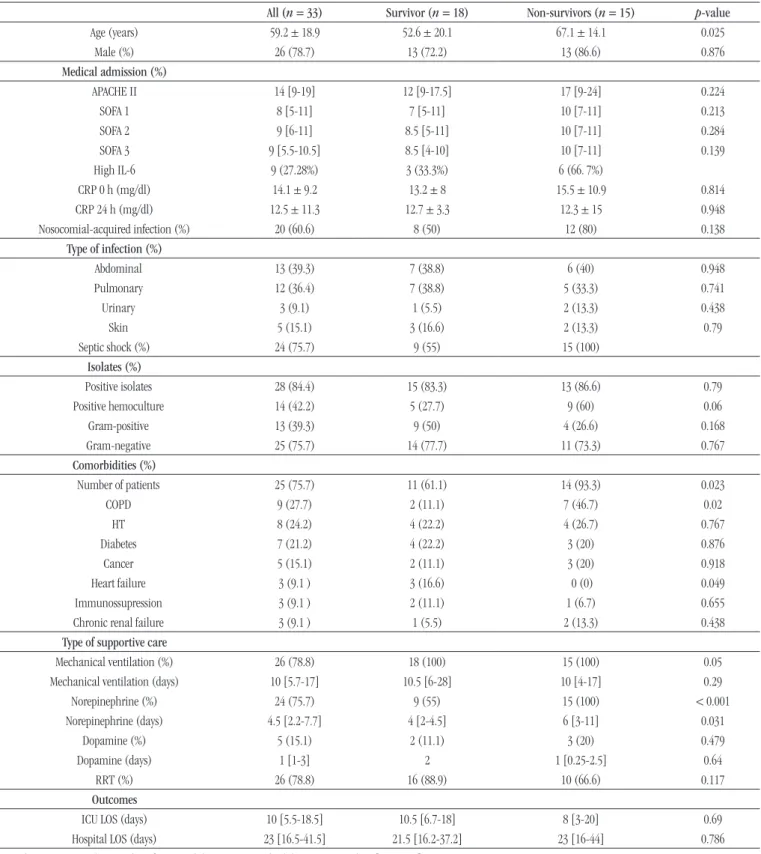
The characteristics of all cohorts, survivors, and non-survivors, are shown in Table 1. Non-survivors were signiicantly
older (67.1 ± 14.1 vs. 52.6 ± 20.1 years; p = 0.025), and had more comorbidities (93.3% vs. 75.5%; p = 0.023).
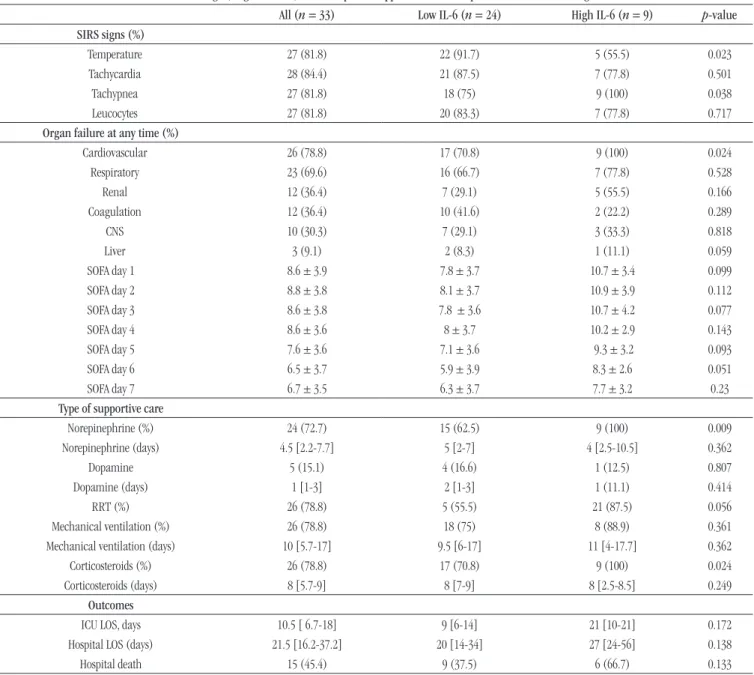
Table 2 shows the pattern of SIRS signs, organ failure and
therapeutic support in the groups with Low and High IL-6 at 0 h. Hyperthermia or hypothermia was more frequent in the Low IL-6 group (91.7%) than in the High IL-6 group (55.5%) (p = 0.023). However, tachypnea was more frequent in High IL-6 group (100%) in comparison to Low IL-6 group (75%) (p = 0.038).
The prevalence of cardiovascular failure was signiicantly higher in the group High IL-6 (100%) than in the group Low IL-6 (71%) (p = 0.023). The need for norepinephrine was also signiicantly higher in the group with High IL-6 (100%) than in the group with Low IL-6 (62.5%) (p = 0.009). Corticosteroids were given more frequently to High IL-6 group
TABLE 1 − Characteristics of the patients
All (n = 33) Survivor (n = 18) Non-survivors (n = 15) p-value
Age (years) 59.2 ± 18.9 52.6 ± 20.1 67.1 ± 14.1 0.025
Male (%) 26 (78.7) 13 (72.2) 13 (86.6) 0.876
Medical admission (%)
APACHE II 14 [9-19] 12 [9-17.5] 17 [9-24] 0.224
SOFA 1 8 [5-11] 7 [5-11] 10 [7-11] 0.213
SOFA 2 9 [6-11] 8.5 [5-11] 10 [7-11] 0.284
SOFA 3 9 [5.5-10.5] 8.5 [4-10] 10 [7-11] 0.139
High IL-6 9 (27.28%) 3 (33.3%) 6 (66. 7%)
CRP 0 h (mg/dl) 14.1 ± 9.2 13.2 ± 8 15.5 ± 10.9 0.814
CRP 24 h (mg/dl) 12.5 ± 11.3 12.7 ± 3.3 12.3 ± 15 0.948
Nosocomial-acquired infection (%) 20 (60.6) 8 (50) 12 (80) 0.138
Type of infection (%)
Abdominal 13 (39.3) 7 (38.8) 6 (40) 0.948
Pulmonary 12 (36.4) 7 (38.8) 5 (33.3) 0.741
Urinary 3 (9.1) 1 (5.5) 2 (13.3) 0.438
Skin 5 (15.1) 3 (16.6) 2 (13.3) 0.79
Septic shock (%) 24 (75.7) 9 (55) 15 (100)
Isolates (%)
Positive isolates 28 (84.4) 15 (83.3) 13 (86.6) 0.79
Positive hemoculture 14 (42.2) 5 (27.7) 9 (60) 0.06
Gram-positive 13 (39.3) 9 (50) 4 (26.6) 0.168
Gram-negative 25 (75.7) 14 (77.7) 11 (73.3) 0.767
Comorbidities (%)
Number of patients 25 (75.7) 11 (61.1) 14 (93.3) 0.023
COPD 9 (27.7) 2 (11.1) 7 (46.7) 0.02
HT 8 (24.2) 4 (22.2) 4 (26.7) 0.767
Diabetes 7 (21.2) 4 (22.2) 3 (20) 0.876
Cancer 5 (15.1) 2 (11.1) 3 (20) 0.918
Heart failure 3 (9.1 ) 3 (16.6) 0 (0) 0.049
Immunossupression 3 (9.1 ) 2 (11.1) 1 (6.7) 0.655
Chronic renal failure 3 (9.1 ) 1 (5.5) 2 (13.3) 0.438
Type of supportive care
Mechanical ventilation (%) 26 (78.8) 18 (100) 15 (100) 0.05
Mechanical ventilation (days) 10 [5.7-17] 10.5 [6-28] 10 [4-17] 0.29
Norepinephrine (%) 24 (75.7) 9 (55) 15 (100) < 0.001
Norepinephrine (days) 4.5 [2.2-7.7] 4 [2-4.5] 6 [3-11] 0.031
Dopamine (%) 5 (15.1) 2 (11.1) 3 (20) 0.479
Dopamine (days) 1 [1-3] 2 1 [0.25-2.5] 0.64
RRT (%) 26 (78.8) 16 (88.9) 10 (66.6) 0.117
Outcomes
ICU LOS (days) 10 [5.5-18.5] 10.5 [6.7-18] 8 [3-20] 0.69
Hospital LOS (days) 23 [16.5-41.5] 21.5 [16.2-37.2] 23 [16-44] 0.786
Numbers are presented as number of patients (%); mean ± standard deviation or median [25%-75%].
APACHE II: Acute Physiology and Chronic Health Evaluation II; SOFA: Sepsis Organ Failure Assessment; IL: interleukin; CRP: C-reactive protein; COPD: Chronic Obstructive Pulmonary Disease; HT: hypertension; RRT: renal replacement therapy; ICU: intensive care unit; LOS: length-of-stay.
respectively, p = 0.056). Mortality rate was higher for patients with High levels of IL-6 (66.7%) at 0 h in comparison to
TABLE 2 − SIRS signs, organ failure, and therapeutic support measures in patients with Low and High IL-6
All (n = 33) Low IL-6 (n = 24) High IL-6 (n = 9) p-value
SIRS signs (%)
Temperature 27 (81.8) 22 (91.7) 5 (55.5) 0.023
Tachycardia 28 (84.4) 21 (87.5) 7 (77.8) 0.501
Tachypnea 27 (81.8) 18 (75) 9 (100) 0.038
Leucocytes 27 (81.8) 20 (83.3) 7 (77.8) 0.717
Organ failure at any time (%)
Cardiovascular 26 (78.8) 17 (70.8) 9 (100) 0.024
Respiratory 23 (69.6) 16 (66.7) 7 (77.8) 0.528
Renal 12 (36.4) 7 (29.1) 5 (55.5) 0.166
Coagulation 12 (36.4) 10 (41.6) 2 (22.2) 0.289
CNS 10 (30.3) 7 (29.1) 3 (33.3) 0.818
Liver 3 (9.1) 2 (8.3) 1 (11.1) 0.059
SOFA day 1 8.6 ± 3.9 7.8 ± 3.7 10.7 ± 3.4 0.099
SOFA day 2 8.8 ± 3.8 8.1 ± 3.7 10.9 ± 3.9 0.112
SOFA day 3 8.6 ± 3.8 7.8 ± 3.6 10.7 ± 4.2 0.077
SOFA day 4 8.6 ± 3.6 8 ± 3.7 10.2 ± 2.9 0.143
SOFA day 5 7.6 ± 3.6 7.1 ± 3.6 9.3 ± 3.2 0.093
SOFA day 6 6.5 ± 3.7 5.9 ± 3.9 8.3 ± 2.6 0.051
SOFA day 7 6.7 ± 3.5 6.3 ± 3.7 7.7 ± 3.2 0.23
Type of supportive care
Norepinephrine (%) 24 (72.7) 15 (62.5) 9 (100) 0.009
Norepinephrine (days) 4.5 [2.2-7.7] 5 [2-7] 4 [2.5-10.5] 0.362
Dopamine 5 (15.1) 4 (16.6) 1 (12.5) 0.807
Dopamine (days) 1 [1-3] 2 [1-3] 1 (11.1) 0.414
RRT (%) 26 (78.8) 5 (55.5) 21 (87.5) 0.056
Mechanical ventilation (%) 26 (78.8) 18 (75) 8 (88.9) 0.361
Mechanical ventilation (days) 10 [5.7-17] 9.5 [6-17] 11 [4-17.7] 0.362
Corticosteroids (%) 26 (78.8) 17 (70.8) 9 (100) 0.024
Corticosteroids (days) 8 [5.7-9] 8 [7-9] 8 [2.5-8.5] 0.249
Outcomes
ICU LOS, days 10.5 [ 6.7-18] 9 [6-14] 21 [10-21] 0.172
Hospital LOS (days) 21.5 [16.2-37.2] 20 [14-34] 27 [24-56] 0.138
Hospital death 15 (45.4) 9 (37.5) 6 (66.7) 0.133
Numbers are presented as number of patients (%) or median [25%-75%]. Note: day 4 and 5 (n = 32); day 6 (n = 29); day 7 (n = 28).
IL-6: interleukin-6; SIRS: systemic inlammatory response syndrome; CNS: central nervous system; SOFA: Sepsis Organ Failure Assessment; RRT: renal replacement therapy; ICU: intensive care unit; LOS: length-of-stay (only in survivors).
DISCUSSION
Cytokines are potential inlammatory markers that may be useful to help recognizing and guiding certain treatments of patients with septic shock. However, currently, only a few had a suitable proile for use at the bedside. In our study, we found the presence of higher levels of IL-6 early in the evolution of
severe sepsis or septic shock signiicantly associated with need for vasopressor therapy and death.
Plasma concentrations of IL-6 are increased in sepsis and are related to the progression to shock and death(11).
necrosis factor-alpha monoclonal antibody(7). We chose
to use the cut-off used in their study (> 1000 pg/dl) to categorize our sample of patients in groups with Low and High serum IL-6 levels.
Cardiovascular failure, that means the use of dopamine in doses higher than 5 (g/kg/min) or norepinephrine in any dose, and the need for norepinephrine were signiicantly more frequent in patients with High serum IL-6 levels at 0 h than in patients with Low IL-6 levels. All patients in the group High IL-6 needed vasopressor therapy with norepinephrine, including one patient initially not responding to dopamine. The purpose of vasoactive drug therapy in the ICU setting is to restore tissue perfusion in shock states. In vasodilatory shock such as sepsis, there is a complex interaction between pathologic vasodilatation, which is the failure of the vascular smooth muscle to contract, relative and absolute hypovolemia, myocardial depression and altered blood low distribution, which occur as a consequence of the inlammatory response
to injury(12). Our clinical indings do support those of
Hartenmink et al. (2010) in which peripheral vasodilatation was strongly and independently associated with IL-6 signaling and release in human sepsis(13). In addition, the role of IL-6
in triggering vascular leakage in vascular endothelial cell may contribute to hypovolemia(14). Furthermore, myocardial
dysfunction is an important component of septic shock(15).
It was elegantly demonstrated by Parrillo et al. (1985) a depressive effect on the contractile property of isolates rat myocytes(16). IL-6, among other cytokines, was later related to
these effects(12, 15-18).
SOFA scores were consistently higher in the High IL-6 group, although not signiicantly due to the limited number of patients included in the study. Development of multiple organ dysfunction syndrome (MODS) has a well-known
impact in survival, and is very likely associated with increased resource utilization as demonstrated by the increased need for ventilatory support and intensive care unit length of stay. Likewise, Cuschieri et al. (2010) found increased IL-6 levels associated with higher risk of developing organ failure, more days on ventilator and more time spent at the hospital of patients admitted with hemorrhagic shock(19). Machado et al.
(2011)(20) found higher baseline IL-6, IL-8 and IL-10 levels
associated with unfavorable organ dysfunction outcomes in patients with septic shock, and Vincent et al. (2011)(21)
reported worsening and more importantly persistent organ
failure, the more common pattern before death, associated with increased IL-6 levels. Indeed, high plasma IL-6 concentrations in patients receiving sustained low-eficiency dialysis (SLED) were found to be associated with death in a small cohort of sepsis patients(22).
Tachypnea was associated with High IL-6 levels and abnormal temperature with Low IL-6 levels. Tachypnea may be an early clinical sign of pulmonary, cardiovascular or metabolic dysfunction. Fever is a non-speciic acute phase response occurring in approximately 90% of patients with severe sepsis(23). In our study, 81.8% had abnormal temperature, mostly hyperthermia. The role of fever in the pathophysiology of sepsis is still not completely understood, and it has been associated with improved survival and shortened disease duration in some infections(23).
Our study adds some important clinical indings to the growing body of knowledge related to the use of biomarkers during severe sepsis and septic shock. However, several limitations of the study deserve consideration. First, the small number of patients in addition to the limited number of IL-6 tests only allows us to evaluate possible associations. Second, we only measured IL-6 levels, and other cytokines were not studied. Third, in eight patients the IL-6 values higher than 1000 pg/dl were unknown and were arbitrarily considered as 1000 pg/dl. Finally, another potential confounder was the use of corticosteroids that can induce anti-inlammatory cytokines and inhibit pro-inlammatory cytokines at the transcriptional level(24). However, the number of patients
receiving corticosteroids was similar in low and high level IL-6 groups. In addition, corticosteroids are frequently used in patients with septic shock due to the high incidence of patients presenting relative adrenal insuficiency(25). The
strength of this study is the prospective design and the enrollment of consecutive patients in the onset of sepsis-associated organ dysfunction.
CONCLUSION
REFERENCES
1. Levy MM, Fink MP, Marshall JC, et al. 2001 SCCM/ESICM/ACCP/ATS/SIS International Sepsis Deinitions Conference. Crit Care Med. 2003; 31(4): 1250-6.
2. Kumar A, Roberts D, Wood KE, et al. Duration of hypotension before initiation of effective antimicrobial therapy is the critical determinant of survival in human septic shock. Crit Care Med. 2006; 34: 1589-96. 3. Shimaoka M, Park EJ. Advances in understanding sepsis. Eur J Anaesthesiol Suppl. 2008, 42: 146-53.
4. Cohen J. The immunopathogenesis of sepsis. Nature. 2002; 420: 885-91. 5. Pinsky MR, Vincent JL, Deviere J, et al. Serum cytokine levels in human septic shock. Relation to multiple-system organ failure and mortality. Chest. 1993; 103: 565-75.
6. Damas P, Canivet JL, Groote D, et al. Sepsis and serum cytokine concentrations. Crit Care Med. 1997; 25: 405-12.
7. Reinhart K, Menges T, Gardlund B, et al. Randomized, placebo-controlled trial of the anti-tumor necrosis factor antibody fragment afelimomab in hyperinlammatory response during severe sepsis: the RAMSES study. Crit Care Med. 2001 Apr; 29(4): 765-9.
8. Marshall JC. Biomarkers of sepsis. Curr Infect Dis Rep. 2006; 8: 351-7. 9. Knaus WA, Draper EA, Wagner DP, Zimmerman JE. APACHE II – a severity of disease classiication system. Crit Care Med. 1985 Oct; 13(10): 818-29.
10. Vincent JL, Moreno R, Takala J, et al. The SOFA (Sepsis-related Organ Failure Assessment score described for organ dysfunction/failure). On behalf of the Working Group on Sepsis-Related Problems of the European Society of Intensive Care Medicine. Intensive Care Med. 1996 Jul; 22(7): 707-10.
RESUMO
Introdução: É primordial identiicar a sepse e o choque séptico, uma vez que qualquer atraso no início do tratamento adequado associa-se ao pior prognóstico. Objetivo: Avaliar níveis de interleucina 6 (IL-6) no início da evolução da disfunção orgânica na sepse e sua relação com a necessidade de terapias de suporte avançado. Métodos: Estudo prospectivo em uma unidade de terapia intensiva (UTI) médico-cirúrgica com 43 leitos em um hospital universitário. Pacientes com sepse grave ou choque séptico internados na UTI com idade ≥ 18 anos que apresentaram a primeira disfunção orgânica em menos de 48 horas de admissão na UTI. Foram monitoradas diariamente, até a alta hospitalar ou o óbito, terapias de suporte avançado, necessidade de vasopressores, ventilação mecânica e terapia de substituição renal (TSR). Amostras de sangue para medir os níveis séricos de IL-6 foram coletadas no momento da admissão no estudo, 12 e 24 horas depois. Os pacientes foram divididos em dois grupos de acordo com níveis séricos de IL-6 na admissão (Baixa IL-6: < 1.000 pg/ml ou Alta IL-6: > 1.000 pg/ml).
Resultados: A necessidade de norepinefrina foi signiicativamente maior no grupo com altos níveis de IL-6 (100%) do que no grupo com baixa IL-6 (62,5%) (p = 0,009). TSR também foi mais frequente em pacientes com alta IL-6 do que naqueles com baixa IL-6 (87,5% vs. 55,5%, respectivamente, p = 0,056). Conclusão: Os resultados sugerem que a avaliação dos níveis séricos de IL-6 seja útil na fase inicial do choque séptico e da sepse grave a im de identiicar pacientes de maior risco.
Unitermos: sepse; choque séptico; marcadores biológicos; falência múltipla de órgãos; interleucina 6; mortalidade hospitalar.
11. Bozza FA, Salluh JI, Japiassu AM, et al. Cytokine proiles as markers of disease severity in sepsis: a multiplex analysis. Crit Care. 2007; 11(2): R49.
12. Beale RJ, Hollenberg SM, Vincent JL, Parrillo JE. Vasopressor and inotropic support in septic shock: an evidence-based review. Crit Care Med. 2004; 32: S455-65.
13. Hartemink KJ, Groeneveld AB. The hemodynamics of human septic shock relate to circulating innate immunity factors. Immunol Invest. 2010; 39(8): 849-62.
14. Kruttgen A, Rose-John S. Interleukin-6 in sepsis and capillary leakage syndrome. J Interferon Cytokine Res. 2012; 32(2): 60-5.Epub 2011 Dec 2. 15. Boyd JH, Mathur S, Wang Y, et al. Toll-like receptor stimulation in cardiomyoctes decreases contractility and initiates an NF-kappa B dependent inlammatory response. Cardiovasc Res. 2006; 72: 384-93. 16. Parrillo JE, Burch C, Shelhamer JH, Parker MM, Natanson C, Schuette W. A circulating myocardial depressant substance in humans with septic shock. Septic shock patients with a reduced ejection fraction have a circulating factor that depresses in vitro myocardial cell performance. J Clin Invest. 1985; 76(4): 1539-53.
17. Kumar A, Thota V, Dee L, Olson J, Uretz E, Parrillo JE. Tumor necrosis factor alpha and interleukin 1 beta are responsible for in vitro myocardial cell depression induced by human septic shock serum. J Exp Med. 1996; 183(3): 949-58.
18. Pathan N, Hemingway CA, Alizadeh AA, et al. Role of interleukin 6 in myocardial dysfunction of meningococcal septic shock. Lancet. 2004; 363(9404): 203-9.
20. Machado FR, Sanches LC, Azevedo LCP. Association between organ dysfunction and cytokine concentrations during the early phases of septic shock. Rev Bras Ter Intensiva. 2011 Dec; 23(4): 426-33.
21. Vincent JL, Nelson DR, Williams MD. Is worsening multiple organ failure the cause of death in patients with severe sepsis? Crit Care Med. 2011 May; 39(5): 1050-5.
22. McGuire TR, Reardon NT, BogardK, et al. IL6 plasma concentrations in patients with sepsis receiving SLED and antibiotics: a predictor for survival. In Vivo. 2014; 28(6): 1131-4.
23. Hasday JD, Garrison A. Antipyretic therapy in patients with sepsis. Clin Infect Dis. 2000; 31(Suppl 5): S234-41.
24. Bruhn A, Verdant C, Vercruysse V, et al. Effects of dexamethasone on macrophage migration inhibitory factor production in sepsis. Shock. 2006; 26(2): 169-73.
25. Annane D, Cariou A, Maxime V, et al. Corticosteroid treatment and intensive insulin therapy for septic shock in adults: a randomized controlled trial. JAMA. 2010; 303(4): 341-8.
CORRESPONDING AUTHOR
Suzana Margareth Lobo