Fisioter. Mov., Curitiba, v. 29, n. 1, p. 103-12, Jan./Mar. 2016 Licenciado sob uma Licença Creative Commons DOI: http://dx.doi.org.10.1590/0103-5150.029.001.AO11
[T]
Prevalence of musculoskeletal pain and impact on physical
function and health care services in Belterra/PA
[I]
Prevalência de dor musculoesquelética, impacto na funcionalidade
e implicações no serviço de saúde de Belterra/PA
[A]
Paulo Henrique dos Santos Mota, Bruna Leite Gaudereto, Maria Regina Alves Cardoso, Ana Carolina Basso Schmitt*
Universidade de São Paulo, (USP), São Paulo, SP, Brazil
[R] Abstract
Introduction: Musculoskeletal pain worth being investigated for being a multidimensional prevalent phe-nomenon, difficult to be understood which may have as main factors: tissue injury as well as emotional, social and environmental aspects. It is essential to know the specificity of the pain to define strategies for disease prevention and health promotion of the population. Objective: To estimate the prevalence of musculoskel-etal pain, describing its features and functional implications in population from Belterra/Pará. Method:
In a descriptive study, there were evaluated subjects who participated in activities of the project Bandeira Científica. Prevalence of pain was estimated with a confidence interval of 95%. Descriptive measures were used to characterize pain and consequences for functionality. Results: 453 subjects were interviewed, the
mean age was 44.3 years old (SD = 18.0) and 69.6% were women. Prevalence of chronic pain was 62.5% and of back pain was 55.0%. Almost daily pain was felt by 67.9% and by 69.6% the intensity was strong or unbearable during crisis. Individuals with unbearable intensity and daily frequency of symptoms reported
* PHSM: MSc, email: [email protected] BLG: grad, email: [email protected] MRAC: PhD, email: [email protected]
difficulty to perform heavy activities (91.5%) and to remain in the same position (82.9%). Conclusion: The prevalence of pain was high, of chronic feature, with high intensity and high frequency, long duration, most frequently in the vertebral column. The pain had interference in the performance of heavy activities and maintaining the same posture in people with greater intensity and frequency of pain.
Keywords: Pain. Epidemiology. Health services.B]
Resumo
Introdução: A dor musculoesquelética merece ser investigada por ser um fenômeno prevalente, multidimensional
e de difícil compreensão, podendo ter como fatores principais: lesões teciduais, aspectos emocionais, socioculturais e ambientais. Assim, conhecer a especificidade da dor é essencial para definir estratégias de prevenção da doença e de promoção de saúde da população. Objetivos: estimar a prevalência de dor musculoesquelética e descrever as
características da dor, o impacto na funcionalidade na população de Belterra/Pará e suas implicações no serviço de saúde municipal. Método: Em estudo descritivo foram avaliados indivíduos que participaram das atividades desenvolvidas pelo projeto Bandeira Científica. A prevalência de dor foi estimada com intervalo de confiança de 95%
e medidas descritivas foram usadas para caracterizar a dor e as consequências para funcionalidade. Resultados: Foram entrevistados 453 indivíduos, a idade média foi de 44,3 ± 18,0 anos, 69,6% eram mulheres. A prevalência de dor crônica foi de 62,5% e de dor na coluna 55,0%. A dor era sentida quase diariamente por 67,9% dos indivíduos e em 69,6% a intensidade era forte ou insuportável na crise. Indivíduos com intensidade insuportável e frequência di
-ária do sintoma relataram maior dificuldade para atividades pesadas (91,5%) e para manter-se na mesma posição (82,9%). Conclusão: A prevalência de dor foi alta, de caráter crônico, com elevada intensidade e frequência, longa duração e maior frequência na coluna. A dor teve interferência na realização de atividades pesadas e manutenção
da mesma postura em pessoas com maior intensidade e frequência de dor. [K]
Palavras-chave: Dor. Epidemiologia. Serviços de saúde.
Introduction
Musculoskeletal pain is a prevalent multidimen-sional phenomenon which has difficulty understand -ing. Tissue injury as well as emotional, social and envi -ronmental aspects might be involved in this problem (1). Several diseases may result in chronic pain, de -fined as those occurring during a period greater than three months (2, 3, 4). Chronic pain may be caused by intense mechanical injury, short and repeated over -loads, joint immobilization, as well as inflammatory, degenerative and neoplastic diseases, birth defects, muscular weakness, rheumatic predisposition and others (5, 6). The prevalence of chronic pain in the population is around 20% (7). It may be considered a public health problem due to frequent absences from work, temporary or permanent disability and high healthcare costs (8). However, it has been reported that the cost-efficacy of pain care is highly favorable when complementary resources and therapies are used, with intervention and follow-up by a pain care multidisciplinary team (9). Therefore, it is essential
to know the pain specificity to define strategies for disease prevention and health promotion.
The prevalence of musculoskeletal pain varies de-pending on the age and specificity of the population. In the SABE study, a cohort of elderly people in the city of São Paulo, chronic pain (especially musculo -skeletal pain) was reported by 29.7% of the elderly (11). For nurses, the prevalence of musculoskeletal pain in the limbs was 65.6% (11) and for truck driv -ers the referred pain was 53.5% (12). Specifically, low back pain is the most common musculoskeletal disorder in industrialized societies, affecting 70% to 80% of adults at some point in life. It has predilection for young adults in economically active phase, being one of the most common reasons for total or partial disability retirement (13).
105 suffering (14). Sardá Junior et al. (7) point out that
there is no direct and linear relationship between le-sion location, pain intensity and disability levels or suffering. Thus, it is necessary to increase the under -standing of this process beyond the pain pathophysiol -ogy to fully understand this disability.
Functional capacity is related to autonomy and independence of the individual in performance of daily activities. Functional incapacity is understood as the presence of difficulty or impossibility in the performance of certain gestures and certain daily activities (15).
In Brazil, the care of chronic pain is described in the Clinical Protocol and Therapeutic Guidelines for Chronic Pain (16), which considers diagnosis, treat -ment criteria and control of service flows established in the health care system under responsibility of states and municipalities. Musculoskeletal pain is a type of pain referred in that protocol, though it is still necessary to know its demand to structure the offer of actions and services in the Brazilian Health System.
Nowadays, one of the strategies for population as -sistance for musculoskeletal pain could occur through a line of care in healthcare network. Given the chronic nature of the pain, networks need to be established through the integration of health care in a continu-ous and coordinated manner for a given population, considering time, cost, quality and adequate location (17, 18). Being so, it is necessary to understand the epidemiology of musculoskeletal pain and its implica -tions in people’s everyday lives.
Therefore, the purpose of this study was to es -timate the prevalence of musculoskeletal pain, to describe the characteristics of the pain and its im-pact on functionality in the population of Belterra/ Pará, as well as the implications for the municipal health service.
Materials and Methods
This descriptive study was conducted in the con -text of actions of a university extension project from the Faculty of Medicine/University of São Paulo — Bandeira Científica — in the city of Belterra, state of Pará, North Brazil, in December 2011. The city was selected due to its size in number of inhabit-ants (16.318 according to the Instituto Brasileiro e Geografia e Estatística (IBGE, 2010) (9), its low Human Development Index of 0.647 (PNUD, 2000),
and the coverage by the Family Health greater than 70% of the population. Six municipal strategic loca -tions were selected to conduct data collection, consid-ering the number of inhabitants and facility of access for the residents: two points in the urban area, two in the highlands (rural area), and two on the banks of Tapajós River. Data collection was previous to any activity performed by the subjects within the Project.
Historically, a high prevalence of musculoskeletal complaints has been reported in the appointments made by the extension project Bandeira Científica, from the University of São Paulo. Therefore, the phys -iotherapy team conducted a screening on musculoskel -etal pain in this expedition to Belterra/Pará, in 2011. Two aspects were considered as eligibility criteria in this study: demand for participation in any activity of the project in joint action with the Secretariat of Health and individual’s ability to answer, indepen -dently, the questionnaire. Data from the individuals who refused to participate in the study were not in -cluded in the analysis presented herein. Therefore, we investigated the reports of musculoskeletal pain and its consequences. All participants or their legal guardians, when minors, signed an informed consent.
Convenience sampling was used, i.e., study par -ticipants were those individuals who looked for the activities of the Project Bandeira Científica as they were interested in taking care of their own health.
Thus, 453 individuals were investigated, number enough to meet the proposed objectives, considering the lower prevalence of musculoskeletal symptoms in the population (36.5%) (19) with a margin of error of 0.04 in 95% of the possible samples.
This study was authorized by the Department of Municipal Health of Belterra/PA and approved by the Ethics Committee of the Faculty of Medicine, University of São Paulo (Process nº 461/11).
estimated with the respective confidence interval of 95% and descriptive measures of central tendency and dispersion were used for pain characteristics and consequence to the functionality.
Results
Table 1 describes the sociodemographic char -acteristics of people with and without pain who sought the “Bandeira Científica” program in the city of Belterra/PA and of the city's population informed by the Brazilian Institute for Geography and Statistics. 453 individuals aged 13-84 years old were inter -viewed, with mean age of 44.3 ± 18.0 years, being that 69.6% were women. Almost half the population had monthly family income of up to one minimum wage (44.5%) and most did not complete elementary school (56.5%).
The prevalence of musculoskeletal pain was 64.5% (95% CI: 60.0%-68.9%). Out of 292 (64.5%) people who complained of pain, 63.1% (95% CI: 57.4%-68.6%) reported having sought care in the “Bandeira Científica” program because of this problem.
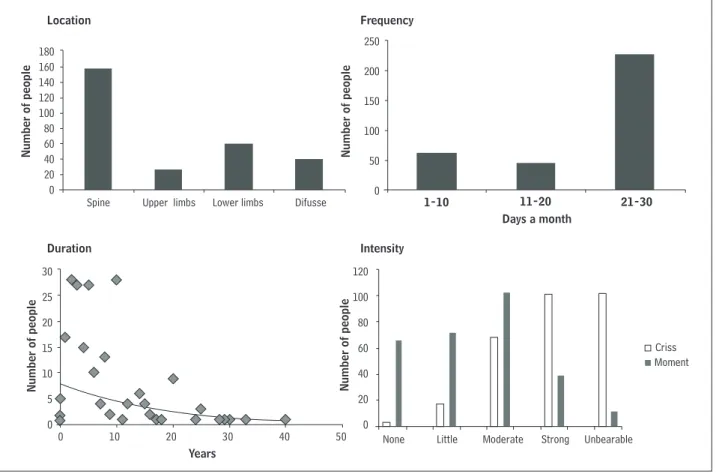
Figure 1 shows the locations, the frequency, the duration and the intensity during the crisis and at the moment of musculoskeletal symptoms. When they were asked about the location of the pain, the spine (cervical, thoracic and lumbar) was the most cited (158 persons, 55.0%), followed by lower limbs (62 persons, 21.6%).
Regarding pain intensity at the time of the in -terview, the majority of respondents reported little (71 persons, 24.5%) or moderate pain (102 people, 35.7%). However, the pain reached strong or un -bearable intensity in the crisis in 202 (69.6%) re -spondents. Many people, 226 (67.9%), reported pain almost every day (from 21 to 30 days per month).
Chronic pain, characterized by being present for at least three months, had a prevalence of 62.5 % (283 persons), being that 208 (45.9 %) reported the existence of the pain for more than six months.
Among people with pain, 142 (32.2%) reported that they have already been or are away from their labor occupations because of the pain, being that 68 (47.9%) remained away for at least a day. When they were asked about the cause of the onset of musculo-skeletal complaints, 108 (38.4%) respondents men -tioned the work carried out and 8.9% poor posture. distribution regarding socio-demographic variables
being close to that of the total population, as seen mainly in the distribution of age and household in -come. However, we cannot discard the possibility of having overestimated the prevalence.
Dependent variable
The presence of musculoskeletal pain was investi-gated through an adapted Nordic Questionnaire, con-taining the report of the respondent on the site of pain (body, upper limbs and lower limbs) (14) and with questions about the pain characteristics: intensity - verified by using the visual analogue scale of pain in crisis and at the moment of the interview (20); the frequency - indicated by the number of days with pain in a month; and duration - how long they report having musculoskeletal pain. Complaints lasting for more than three months were considered as chronic pain (2 – 4).
Independent variables
Besides investigating the reason for seeking the assistance of the Bandeira Científica, the individu -als were asked about age, gender, place of residence, income, education, receiving Bolsa Família (govern -ment financial assistance), visit of community health -care agent, physical activity and use of integrative and complementary practices. Questions related to labor activity as: current work, hours of work per day and sick leave due to referred pain were also made. Finally, it was used an adaptation of the Roland Morris Disability Questionnaire (8) to check the func -tional capacity, by using questions about daily ac -tivities such as: heavy, moderate and light ac-tivities; climbing stairs; kneel down; walk less and more than five minutes; take a shower; remain in the same posi -tion; sleep; carry out transfer and stay in the standing posture. The possible answers for these questions were: not difficult, little difficulty, much difficulty or lack of performance because of the pain.
Data analysis
107
Table 1- Distribution of people with and without pain who sought the "Bandeira Científica" and of population of Belterra, according to sociodemographic characteristics and habits, Belterra, PA, 2011
Characteristics # Pain Without Pain Total Municipal population*
n (%)** n n(%) N(%)
Entrevistados 292 (64.5) 161 (35.5)
Age 13-19 17 (39.5) 26 43 (10.2) 2452 (21.4)***
20-29 21 (38.2) 34 55 (12.9) 2485 (21.7)
30-39 52 (61.9) 32 84 (19.8) 2143 (18.8)
40-49 52 (69.3) 23 75 (17.6) 1587 (13.9)
50-59 62 (81.6) 14 76 (17.9) 1255 (11.0)
60-69 32 (76.2) 10 42 (9.9) 804 (7.0)
70-84 37 (74.0) 13 50 (11.7) 701 (6.2)
Gender Male 88 (66.2) 45 133 (30.4) 8481 (52.0)
Female 194 (63.6) 111 305 (69.6) 7837 (48.0)
Education Level Incomplete Elementary School
178 (69.0) 80 258 (62.5) 8660 (79.2)
Elementary School 36 (50.0) 36 72 (17.4) 1842 (16.8)
High School 37 (60.7) 24 61 (14.8) 186 (1.7)
College 14 (63.6) 8 22 (5.3) 241 (2.2)
Place of residence
Urban 111 (68.5) 51 162 (35.8) 6852 (42.0)
Rural 181 (62.2) 110 291 (64.2) 9466 (58.0)
Physical Activity Yes 90 (60.4) 59 149
-No 186 (65.9) 96 282
-Profession Farm worker 115 (70.6) 48 163
-Others 65 (57.0) 49 114
-Housewife 66 (58.4) 47 113
-Unemployd/ retired 42 (72.4) 16 58
-Monthly family income (one minimum wage)
0 ≤ 1/2 65 (63.1) 38 103 (25.8) 1018 (25.7)
1/2 – 1 62 (62.6) 37 99 (24.9) 731 (18.4)
1 – 2 91 (66.9) 45 136 (34.2) 1154 (29.1)
2 – 5 22 (59.5) 15 37 (9.3) 815 (20.6)
> 5 15 (65.2) 8 23 (5.8) 244 (6.1)
"Bolsa Família" government
inancial
assistance
Yes 120 (57.1) 90 210
-No 156 (70.6) 65 221
-Community health worker
Yes 238 (63.8) 135 373
-No 38 (65.5) 20 58
-Integrative and complementary practice
Yes 188 (69.9) 81 269
-No 88 (54.3) 74 162
-Note: # number of respondents 453. The total number of people for each variable was not the same due to lack of answers * IBGE/2013
reported pain. In a similar study, Elliott et al. (22) found pain among 61% of the users of the health system in Scotland. In the population of Southern Brazil, such prevalence reached 61.4% (23). However, considering chronic pain as the presence of the pain for a period longer than three months, Verhaak et al. (2) found in a literature review prevalences ranging from 7% to 40%, values lower than that found in our study of 62.5%.
The body location most affected in the individuals interviewed in our study was the vertebral column, as also observed in other studies (21, 22). This can be justified because it is a region vulnerable to repeated patterns of movements and to mechanical overhead related to labor activities, mainly those that require great physical demand (24).
By analyzing the intensity of pain, 60.2% of the indi -viduals interviewed in this study had little or moderate pain in the day of the interview, but in times of crisis, 69.6% reported strong or unbearable intensity. In a study from 2010, Sardá Junior et al. (8) observed that 47.3% of subjects had severe pain and 30.2% moderate. With regard to the functional activities of individu
-als in pain, the majority did not present great diffi -culty in performing them, but 238 (84.1%) had de -creased functionality to heavy activities, 173 (60.28%) to stay up and 199 (69.58%) to crouch (Figure 2A). Individuals with unbearable pain intensity and daily frequency of the symptom (56 persons) reported great difficulty to perform heavy activities (43; 91.5%) as walking (32; 66.7%), kneeling (32; 66.7%), stand up (38; 79.2%), carry out transfer (31; 63.4%), climb stairs (28; 63.6%), and remain at the same position (39; 82.9%) and less trouble in light activities (14; 29.2%) and bathing (17; 36.2%) (Figure 2B).
Discussion
As this study, several others have found high prev -alence of musculoskeletal pain, even with variations in the definition of pain, methods, study populations and instruments used. Brattberg et al. (21) inves -tigated the residents of Sweden by mail and 66%
Location
Duration Intensity
Frequency
250
200
150
100
50
0 180
160 140 120 100 80 60 40 20 0
Spine Upper limbs Lower limbs Difusse
Years
Days a month
Criss Moment
Unbearable Strong
Moderate Little
None
21-30 11-20
1-10
30
25
20
15
10
5
0
120
100
80
60
40
20
0
0 10 20 30 40 50
109
limits the recreational activities, social and family re -lationships. Due to pain, approximately 50% to 60% of patients become partially or completely disabled, transiently or permanently (27).
Having been held in a distant region of the main Brazilian cities and with inclusion of residents of dif-ferent localities of the city with difficult access, this study brings a vision of a little-known population. This achievement was only possible through the encounter between external health practices at the municipal reality and the individual active search for assistance. Thus, a limiting and disabling aspect as musculoskel-etal pain made it possible the rise of important aspects of the health status and care of this population.
The importance of the findings of this study further increases when verified that for many people the pain occurred for several years, being that 63.1% sought the “Bandeira Científica” program presenting that pain as the primary complaint. Thus, one can ask whether these individuals: (1) seek help, but the problem is not solved, generating a new search for professional or (2) have difficult access to health facilities in the region or (3) believe that professionals from a large urban center such as São Paulo have better technical and scientific resources to care for their complaints.
The piece of information that may contribute to the answer this question is that 86.5% of the respondents reported that they receive visits from community health agents, thus showing that there is some access to health care. However, there is no information whether this ac-cess is complete in the care networks, since adequate services and professionals might not assist these in-dividuals. This fact can also be observed in Canadian and Australian studies, which show that in the country -side access to health services are unevenly distributed The osteoarticular pain and the functionality are
elements connected to the health of the individuals and, thus, they influence the mode of interaction be -tween themselves and be-tween them and the envi-ronment (25).
For James (26), it is of great importance to es -tablish the relationship between the presence of pain for a considerable period of time and the limi-tation to the functionality, mainly in activities that require great energy expended as: walking, kneeling, standing, perform transfer and heavy activities. Such functional implications appear more frequently in individuals who report daily pain and moderate and unbearable intensities. We found that 32.2% of the study persons justified sick leave by pain, besides, most have presented difficulties in various activities of everyday life.
We can highlight the musculoskeletal pain and its association with musculoskeletal disorders re-lated to work as generators of varying degrees of functional disability, being considered one of the most serious problems in the field of occupational health. Musculoskeletal diseases have become the leading cause of illness at work, within the ten most prevalent diagnoses nine are musculoskeletal dis-eases. These disorders are responsible for most of the work absenteeism and of the severance costs, both in the Brazilian population and in the world population (25).
Individuals with chronic pain become a significant burden for health services, social security institutions and insurance companies. According to a population survey conducted in Brazil, more than 1/3 of our pop -ulation believes that chronic pain commits the usual activities and over 3/4 considers that the chronic pain
5 Min Walk Kneel Climb Stairs Light activity Moderate activity Heavy activity Stand up
Change of positions
Slepping
Staying the same...
Take Shower
5 min or more walk
Any Difficulty
Much Difficulty
Little Difficulty
Can’t do
5 Min Walk Kneel Climb Stairs Light activity Moderate activity Heavy activity Stand up
Change of positions
Slepping
Staying the same...
Take Shower
5 min or more walk
Any Difficulty
Much Difficulty
Little Difficulty
Can’t do
reported unbearable pain and daily frequency, there was great difficulty in daily activities such as walk -ing, kneel-ing, stand-ing, performing transfer, climb-ing stairs and remainclimb-ing in the same position. We emphasize the importance of these results for plan-ning a physical therapy care line in the health care network for musculoskeletal pain in Belterra/PA, and in other similar municipalities, and we recommend new studies in other cities and analysis of causality relationship between pain and functionality.
References
1. Almeida ICGB, Sá KN, Silva M, Baptista A, Matos MA, et al. Chronic low back pain prevalence in the population of the city of Salvador. Rev Bras Ortop. 2008;43:96–102.
2. Frølund F, Frølund C. Pain in general practice. Pain as a cause of patient-doctor contact. Scand J Prim Health Care. 1986;4:97–100.
3. Croft P, Rigby AS, Boswell R, Schollum J, Silman A. The prevalence of chronic widespread pain in the general population. J Rheumatol. 1993;20:710–3.
4. Verhaak PF, Kerssens JJ, Dekker J, Sorbi MJ, Bensing JM. Prevalence of chronic benign pain disorder among adults: a review of the literature. Pain 1998;77:231–9. 5. Camanho GL, Imamura M, Arendt-Nielsen L. Gênese
da dor na artrose. Rev Bras Ortop. 2011;46:14–7. 6. Zavarize SF, Wechsler SM, Lima AB, Martelli A. Dor
Lombar Crônica: Implicações do Perfil Criativo como estratégia de enfrentamento. JMPHC J Manag Prim Heal Care 2014;5:188–94.
7. Fonseca JC, Lopes MJ, Ramos AF. Pessoas com dor e necessidades de intervenção: revisão sistemática da literatura. Rev Bras Enferm. 2013;66:771–8. 8. Sardá Júnior JJ, Nicholas MK, Pimenta CA de M, Asghari
A, Thieme AL. Validation of the Roland Morris disabil-ity questionnaire for general pain. Rev Dor. 2010;11. 9. Dellaroza MSG, Pimenta CA de M, Matsuo T. Preva -lence and characterization of chronic pain among the elderly living in the community. Cad Saúde Pública. 2007;23:1151–60.
compared to urban areas due to poor distribution of health professionals and equipment throughout the ter-ritory (28, 29). This difficulty regarding the complete access to health care might be motivated by structural barriers and lack of information about services (29).
We believed that a follow-up of patients with mus -culoskeletal pain already exists, however the municipal health system cannot resolve this type of complaint for not having an organized network care and sufficient professionals for this demand, maybe because they are not used to this type of question. Associated to this is the fact described by Sibley and Weiner (29) that resi -dents of inland areas report lower health care needs when compared with individuals from central areas, and postpone the search for health services when they are not in economic and social favorable moments.
The results show high prevalence of pain among the study population. This great demand for public health in Belterra/PA is important to generate reflections on the profile of people with pain, its associated factors and the consequences for the population in order to rethink the planning of an articulating line to pain care network and its human resources. Mata et al. (25) also warned that health services direct their actions towards these problems, identifying them, in everyday life, by listen -ing to individuals and families covered by the Brazilian primary care, and then trying to solve them creatively, especially focusing on promotion and prevention ac -tions to avoid further illness in these individuals.
Finally, the pain characteristics and the implica -tion on the func-tionality observed in this study may be similar in many cities in Brazil, as the majority of these cities, 4,037 out of 5,575 municipalities, has up to 20,000 inhabitants and is located in the coun -tryside (30). The knowledge of the facts mentioned here is important for the physical therapist and man -ager as it permits understanding and qualifying the demand, enabling the creation of actions and better organization of human resources looking at compre-hensive health care by actions in collective health.
Conclusion
111
22. Elliott AM, Department of General Practice Aberdeen and Department of Public Health U of AMS, Smith BH, Penny KI, Medical Statistics Unit Edinburgh, UK U of EMS, Smith WC, et al. The epidemiology of chronic pain in the community. Lancet 1999;354:1248–52. 23. Kreling MCGD, USP, Londrina UE de, Cruz D de ALÉM
da, Pimenta CA de M. Prevalence of chronic pain in adult workers. Rev Bras Enferm. 2006;59:509–13. 24. Matos MG, Hennington ÉA, Hoefel AL, Dias-da-Costa
JS. Dor lombar em usuários de um plano de saúde: prevalência e fatores associados. Cad Saude Publica. 2008;24:2115–22.
25. Mata M de S, Costa FA da, Souza TO de, Mata ÁN de S, Pontes JF. Pain and functionality in primary health care. Ciênc Saúde Coletiva. 2011;16:221–30.
26. James FR, Large RG, Bushnell JA, Wells JE. Epidemiol -ogy of pain in New Zealand. Pain 1991;44:279–83. 27. Teixeira MJ, Teixeira WGJ, Santos FP de S, Andrade
DCA de, Bezerra SL, Figueiró JB, et al. Epidemiologia clínica da dor músculo-esquelética. Rev Med 2001;1. 28. Briggs AM, Slater H, Bunzli S, Jordan JE, Davies SJ,
Smith AJ, et al. Consumers’ experiences of back pain in rural Western Australia: access to information and services, and self-management behaviours. BMC Health Serv Res. 2012;12:357.
29. Sibley LM, Weiner JP. An evaluation of access to health care services along the rural-urban continuum in Canada. BMC Health Serv Res. 2011;11:20.
30. IBGE. IBGE Cidades;2013. [Cited in Aug. 2013]. Avail -able from: http://www.ibge.gov.br/home/presiden -cia/noticias/noticia_visualiza.p hp?id_noticia=345.
Recebido: 09/08/2013
Received: 08/09/2013
Aprovado: 06/07/2015
Approved: 07/06/2015
10. Dellaroza MSG, Pimenta CA de M, Duarte YA, Lebrão ML. Dor crônica em idosos residentes em São Paulo, Brasil: prevalência, características e associação com capacidade funcional e mobilidade (Estudo SABE). Cad Saude Publica. 2013;29:325–34.
11. Ribeiro NF, Fernandes R de CPF. Distúrbios muscu -loesqueléticos em membros inferiores em trabal-hadores de enfermagem. Rev Baiana Saúde Pública. 2014;35.
12. Lemos LC, Marqueze EC, Moreno CR de C. Prevalên -cia de dores musculoesqueléticas em motoristas de caminhão e fatores associados. Rev Bras Saúde Ocup. 2014;39:26–34.
13. Andrade SC de, Araújo AGR de, Vilar MJP. Back School: historical revision and its application in chronic low back pain. Rev Bras Reum. 2005;45:224–8.
14. Pinheiro FA, Tróccoli BT, Carvalho CV De. Validação do Questionário Nórdico de Sintomas Ósteomuscula -res como medida de morbidade. Rev Saúde Pública. 2002;36:307–12.
15. Grimley Evans J. Prevention of age-associated loss of autonomy: epidemiological approaches. J Chronic Dis. 1984;37:353–63.
16. BRASIL. Portaria No 1.0083. Brasilia: Ministério da Saúde; 2012.
17. Mendes EV. As redes de atenção à saúde. Cien Saúde Colet. 2010;15:2297–305.
18. PAHO. Integrated Health Service Delivery Networks: Concepts, Policy Options and a Road Map for Imple -mentation in the Americas. Washington: 2011. 19. Silva VRL da, Menezes AMB, Noal RB. Sintomas
articu-lares crônicos em adultos de Pelotas, Rio Grande do Sul, Brasil: prevalência e determinantes. Cad Saúde Pública. 2009;25:2571–81.
20. De Leon SP, Lara-Muñoz C, Feinstein AR, Wells CK. A comparison of three rating scales for measur-ing subjective phenomena in clinical research: II. Use of experimentally controlled visual stimuli. Arch Med Res 2004;35:157–62.