w w w . r b o . o r g . b r
Original
Article
Correct
use
of
safety
belts
and
child
restraint
devices
in
cars
among
children
in
Goiânia
夽
,
夽夽
Roberto
Medeiros
de
Sousa,
Pedro
Felisbino
Júnior,
Felipe
de
Moura
Braga,
Sílvio
Dias
da
Costa
Neto,
Felipe
Marques
Belo,
Sandro
da
Silva
Reginaldo,
Frederico
Barra
de
Moraes
∗SchoolofMedicine,UniversidadeFederaldeGoiás,Goiânia,GO,Brazil
a
r
t
i
c
l
e
i
n
f
o
Articlehistory:
Received23April2013 Accepted10September2013 Availableonline25April2014
Keywords:
Trafficaccidents Children
Accidentprevention Childprotectionsystems Physicalrestraint
a
b
s
t
r
a
c
t
Objective:toconductanobservationalstudy,bymeansofcampaigns,regardingtheuseof childrestraintdevicesincarsinGoiânia.
Methods:thiswasa cross-sectionalstudyusinga conveniencesamplebuiltupascases arose.ThedataweregatheredintoanExcelspreadsheetandwereanalyzeddescriptively andstatistically(SPSS16.0),usingchi-squareandtakingp<0.05assignificant.
Results:in2006,410carswereevaluated,andin2010,544carswereevaluated.Around85% oftheoccupantswereusingseatbeltscorrectlyatbothtimes(p=0.650).In2006,itwas observedthatatotalof273passengerswereoccupyingtherearseats,whilein2010there were226.Amongthese,178and170wereusingseatbelts,respectively,i.e.65.2%and75.22% (p=0.001).In2006,fivechildrenwereoccupyingthefrontseatwithoutusingtheseatbelt, whilein2010,thisnumberwas42(p<0.001).In2010,itwasobservedthat458vehicleswere transportingchildrenontherearseats,andthiswasbeingdonecorrectlyin214vehicles, i.e.46.72%.In2006,ofthe410vehiclesanalyzed,only90ofthem(21.95%)weretransporting childrencorrectly(p<0.001).Inaddition,therewasadifferenceinthevariableswithinthe yearevaluated,inwhichtransportationdonecorrectlyinthefrontseatwasmuchmore frequentthantransportationdonecorrectlyintherearseats,inbothyears(p<0.001).Cars transportedonetofourchildren,whilevanstransportedonetoninechildren.In2006,one vantransportingchildrenirregularlywasobserved,whilein2010itwasdonecorrectlyin allcases.
Conclusion:comparingthesetwoyears(2006and2010)inwhichdataweregathered,we canconcludethatchangesinbehavioramongdriversinGoiâniahavebegun,withregard tosafetywhentransportingchildreninvehicles,withanimprovementof25%(p<0.001). Alargepartofthishascomethroughchangesinknowledgeamongthissegmentofthe population,throughcampaignsthathavebeencarriedout,includingthroughthemedia, andbecauseoflegalobligations.
©2014SociedadeBrasileiradeOrtopediaeTraumatologia.PublishedbyElsevierEditora Ltda.Allrightsreserved.
夽Pleasecitethisarticleas:deSousaRM,FelisbinoJúniorP,BragaFM,daCostaNetoSD,BeloFM,ReginaldoSS,etal.Usocorretodo
cintodeseguranc¸aedosdispositivosderestric¸ãoinfantilemautomóveisdeGoiânia.RevBrasOrtop.2014;49:340–344.
夽夽WorkperformedintheDepartmentofOrthopedicsandTraumatology,HospitaldasClínicas,UniversidadeFederaldeGoiás,Goiânia,
GO,Brazil. ∗
Correspondingauthor.
E-mail:[email protected](F.B.deMoraes).
Uso
correto
do
cinto
de
seguranc¸a
e
dos
dispositivos
de
restric¸ão
infantil
em
automóveis
de
Goiânia
Palavras-chave:
Acidentesdetrânsito Crianc¸as
Prevenc¸ãodeacidentes Sistemasdeprotec¸ãopara crianc¸as
Restric¸ãofísica
r
e
s
u
m
o
Objetivo: fazerumestudoobservacional,pormeiodecampanhas,sobreousodos disposi-tivosderestric¸ãoinfantilemautomóveisdeGoiânia.
Métodos: estudotransversalporamostradeconveniênciaconformesurgimentodoscasos. OsdadosforamcoletadosemumatabelaExcel,analisadosdeformadescritivaeestatística (SPSS16.0),comousodoqui-quadrado,comp<0,05comosignificativo.
Resultados: em2006,foramavaliados410automóveis,enquantoqueem2010foram avali-ados544,nosquaiscercade85%daspessoasusavamocintodeformacorretanosdois períodos(p=0,650).Em2006,foramobservados273passageirosnobancodianteiroeem 2010,226.Usavamcintodeseguranc¸a178e170,respectivamente,ou65,2e75,22%(p=0,001). Em2006,cincocrianc¸asocupavamobancodafrentesemousodocintodeseguranc¸a. Em2010,essenúmerofoide42(p<0,001).Em2010,foramobservados458veículosque transportavamcrianc¸asnobancotraseiro,214demaneiracorreta,ou46,72%.Em2006, dos410veículosanalisados,apenas90(21,95%)transportavamcrianc¸asdemaneira cor-reta(p<0,001).Alémdisso,houvediferenc¸aentreasvariáveisdentrodoanoavaliado,no qualotransportecorretonobancodafrentefoibemmaisfrequentedoqueonobancode trás,nosdoisanos(p<0,001).Carrostransportavamdeumaaquatrocrianc¸aseasvans,de umaanovecrianc¸as.Em2006foiobservadaumavanquetransportavacrianc¸asdemaneira irregular,enquantoqueem2010todasestavamcorretas.
Conclusão: nacomparac¸ãodessesdoisperíodos,podemosavaliarquehouveuminíciode mudanc¸anocomportamentodomotoristagoianiensenoquetangeàseguranc¸ano trans-portede crianc¸asem automóveis,commelhoriade25%(p<0,001).Grandepartedisso decorreudamudanc¸adeatitudedapopulac¸ãoapósascampanhasfeitas,atépelamídia,e daobrigatoriedadedalei.
©2014SociedadeBrasileiradeOrtopediaeTraumatologia.PublicadoporElsevier EditoraLtda.Todososdireitosreservados.
Introduction
Accordingtothe National TrafficDepartment(DENATRAN), trafficaccidentsarethemaincauseofdeathsamongchildren agedonetofourteenyearsinBrazil.In2008,22,472casesof injuriesamongchildrenuptothe ageof12years,and802 deathsin the same age group, were recorded.1 TheWorld
HealthOrganization(WHO)hasestimatedthatin2015traffic accidentswillbethe maincauseofmorbidityand mortal-ityamongchildren.This situationgenerates highcosts for thehealthcaresystem,especiallyfordevelopingcountries.2
Accordingtothemortalityinformationsystem(SIM)of DATA-SUS(InformaticsDepartmentoftheNationalHealthSystem, SUS),therewere5309deathsduetoexternalcauses(asthe maincauseofdeath)intheagegroupfromonetofourteen yearsin2010, thusrepresenting 31.5%ofthe totalforthat year.3
With the aim of diminishing these high accident rates amongtheyoungestagegroups,campaignshavebeen con-ducted overrecent years.Special attentionhas been given tothe use of child restraint devices (CRDs) invehicles. In Brazil,inconformitywithwhathasalreadybecomethe real-ity in other countries, a law regulating the use of these CRDswascreated.Resolutionno.277oftheNationalTraffic Council(CONTRAN),ofMay28,2008,4establishedminimum
safetyconditionsfortransportingpassengersundertheage
of10 years in vehiclesand clarified the use ofCRDs. This law cameinto force inits year ofpublication, onan edu-cationalbasis,andcompliancebecameobligatoryfrom2010 onwards.
CRDsarepopularlyknownas“childseats”and,according totheCONTRANresolution,theyinclude“babycomfortseats” or“convertibleseats”,whichareuseduptotheageofoneyear, “childseats”fortheagesofonetofouryears,“boosterseats” fortheagesoffourtosevenandahalfyears,andfinally,the vehicle’sownseatbeltforchildrenovertheageofsevenanda halfyears.4Theaimofthisstudywastoconductobservations,
throughcampaigns,regardingCRDuseincarsinthecityof Goiânia.
Material
and
methods
StudentTraumaAssociationoftheSchoolofMedicine,Federal UniversityofGoiás.
AnewcampaignwasconductedinMay2010,inexactlythe sameformatatthefirstsurvey.Itsaimwastoassesswhether, afterthelawbecameanobligationandsafetyconceptshad beenintroducedthrougheducational campaignson correct andnecessaryuseofCRDs,therehadbeenany changesin behavioramongdriversinGoiânia.
ThedataweregatheredandstoredinanExcel2007 spread-sheet,andwereanalyzeddescriptivelyandbymeansofthe SPSSsoftware,version 16.0,using thechi-squarestatistical test.Differenceswithp≤0.05wereconsideredtobe
signifi-cant.
Results
In2006,410carswereassessedandin2010,544.Therewasno significantdifferenceregardingthedrivers’useofseatbelts (p=0.650).Around85%wereusingtheseatbeltcorrectlyon bothoccasions(Fig.1).
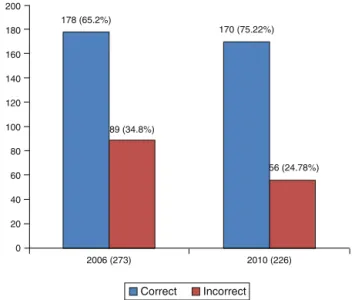
In2006,therewere273front-seatpassengersandin2010, 226.Ofthese,178and170,respectively,wereusingtheseat belt,i.e.65.2and75.22%(Fig.2).Thisdifferencewassignificant (p=0.001).Itisimportanttohighlightthatin2006,fivechildren wereusingthefrontseatwithoutusingtheseatbelt,whilein 2010,42weredoingso(p<0.001).
In2010,458vehicleswereseentobetransportingchildren ontherearseats,ofwhich214weredoingthiscorrectly,i.e. 46.72%.In2006,ofthe410vehiclesanalyzed,only90(21.95%) weretransportingchildrencorrectly(Fig.3).Thisimprovement wassignificant(p<0.001).Inaddition,therewasadifference betweenthevariableswithintheyearevaluatedsuchthat cor-recttransportationonthefrontseatwasmuchmorefrequent thanontherearseats,inbothyears(p<0.001).
Amongthesevehicles,carstransportedonetofour chil-dren and vans, one to nine children. In 2006, one van transportingchildreninanirregularmannerwasobserved, whilein2010,allofthemwerecorrectlylicensed(Fig.4).There wasnosignificantdifference.
350 (85.36%)
470 (86.4%)
60 (14.63%) 74 (13.6%)
0 50 100 150 200 250 300 350 400 450 500
2006 (410) 2010 (544)
Correct Incorrect
Fig.1–Driverswhousedseatbeltsinthetwoevaluations in2006and2010,withoutanysignificantchange.
178 (65.2%)
170 (75.22%)
89 (34.8%)
56 (24.78%)
0 20 40 60 80 100 120 140 160 180 200
0 1 0 2 )
3 7 2 ( 6 0 0
2 (226)
Correct Incorrect
Fig.2–Front-seatpassengerswhousedseatbelts,witha significantimprovement(p=0.001).
90 (21.95%)
214 (46.72%) 320 (78.05%)
244 (53.27%)
0 50 100 150 200 250 300 350
2006 (410) 2010 (458)
Correct Incorrect
Fig.3–Childrenintherearseatofthecarusingabeltor CRDcorrectly.
394
530
16 14
0 100 200 300 400 500 600
0 1 0 2 6
0 0 2
Cars School vans
Fig.4–Typesofvehicleanalyzed.
Discussion
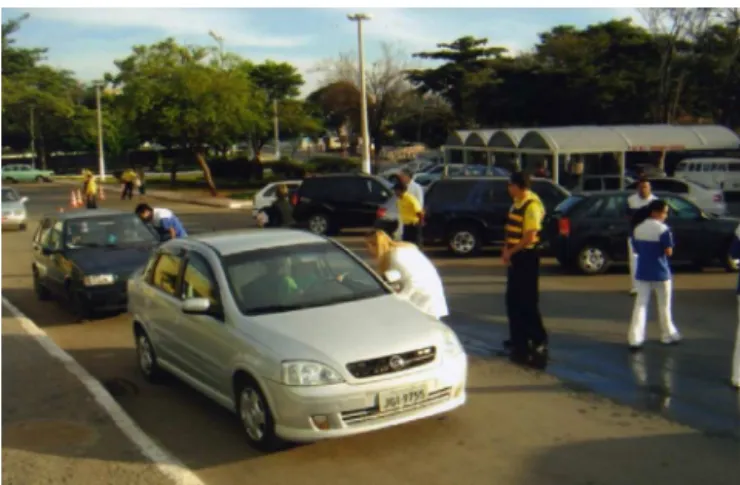
Fig.5–Informationcampaignamongthepopulation,at schoolgates,withtrafficagents,whonotedandgave adviceregardingthecorrectuseofCRDsandseatbelts.
2011–2020astheDecadeofActionforRoadSafety,withthe aimofavoiding increasesand then achieving decreases in thenumbersofdeathsintrafficaccidentsaroundtheworld. AccordingtoWHO,1.3millionpeopledieeveryyearintraffic accidents,i.e.morethan3000perday,and90%oftheminpoor ordevelopingcountries. Morethan30millionpeoplesuffer injuriesandhavesequelaeandincreasedexpenditureon recu-perationeveryyear,whichmayreach3%ofthesecountries’ grossdomesticproduct(GDP).2
Correctuseofseatbeltsdecreasestheriskofdeathincases ofcaraccidentsbyupto40%.5,6However,thisdoesnot
ade-quatelypreventinjuriesamongchildrenundertheageof10 years,whosufferabdominalandhighthoracicinjuriescaused byincorrectpositioningoftheseatbelt,andalsoincreased mortality.7–9
Inothercountries,compulsoryuseofCRDsdatesfromthe 1980s,andtheeffectrelatingtoreductionsindeathsand seri-ousinjuriesisalreadyknown.Thisplacesthesedevicesasthe mostefficientmethodforreducing mortality.Astudy con-ducted inthe stateofNorth Carolina,USA, wherethe law making use of CRDscompulsory datesfrom 1985, showed thattherewasa42%reductionindeathsandseriousinjuries amongchildrenagedfourto15yearsfrom1985to1994,in comparisonwiththefiveyearsjustbeforethelawcameinto force.10
Tomonitortrafficaccidentsrelating tochildren,studies needtobeconductedfrequently, inaddition tocampaigns, sincethe strategies that havean impact on adultsdo not haveasimilareffectamongchildren(Fig.5).Whenchildren areundertheageofsixyears,theydependonadultsusing CRDsintheircarsandmakingthechildrenusethem.After reachingthisage,theybecomecapableoffasteningtheirseat belts alone, but the adult driving the car does notalways set an example and,in such situations,the child remains unprotected.11–13
Studiesontheimpactofusingsafetydevicesonchildren insidecarshaveonlyrecentlybeenconductedinBrazil,inthe samewaythatthelawregulatingthisisrecent.Itisnot pos-sibletocalculatetheimpactthatthesemeasureswillhave onBrazilianpublichealth.Apreliminarystudyconductedby
theInstituteofAppliedEconomicResearch(IPEA)showedthat therewasa23%reductionintheabsolutenumberofdeaths, comparingthefirstyearinwhichthelawwasinforcewith pre-viousyears.However,itwasemphasizedthatthelawwould needtobeinforceforalongerperiod,withgreatermonitoring ofcompliance,fordataofgreatersignificancetobeobtained inthefuture.14
Foroursurvey,westartedfromtheideathatdriverswho were awareofthe potentialrisksthat theirpassengersrun would takesafety measurestominimize theserisks. How-ever,large-scalemeasurescanonlybeimplementedifthere areeducationalcampaignsandlawsinthisregard.Theeffects thatseatbeltuseprovides,withregardtopreventionoffatal injuriesorevenimportantsequelae,havelongbeenknown.In oursurvey,onbothoccasions,thereseemedtobehighratesof seatbeltuseamongdrivers(85%in2006and86%in2010)and amongfront-seatpassengers(65%in2006and75%in2010). Nonetheless,eventhoughthesenumbersmaydemonstrate thatthepopulationisawareoftheimportanceofusingseat belts,theyarenotidealandarereflectedinthedegreeof con-cernthattheseparentshaveregardingtransportationoftheir childrenandwhethertheyadheretousingCRDs.
In2006,weobservedthecorrectuseofCRDsinonly90of the410vehiclesanalyzed,andin2010,in214ofthe458 vehi-clesthatweretransportingchildrenontherearseats.This showedthattherehadbeenanincreaseinCRDuseof25.3%. However,westillobservedthat132childrenwerebeing trans-portedonthefrontseatand42withoutusingtheseatbelt. Inrelationtoschooltransportvans,wenotedahighconcern forsafety,evenbeforetheadventofthelawandthe educa-tionalcampaigns.Asimilarchangeoccurreddecadesearlier withtheapplicationofseatbeltuseamongdriversand pas-sengers,withcampaignsinthemediathatarenowknownby thepopulation.Untilthen,muchhadbeensaidaboutseatbelt useandlittleabouttheimportanceofCRDs.
WetaketheviewthattheadherencetoCRDusewillbe high,partlybecause ofthecompulsionofthelaw.Evenso, therewillalwaysbetheneedforeducationalcampaigns,given that thesedevices arenotan integralpartofvehicles, like seatbelts,andtheyplaceanadditionalfinancialburdenon thepopulation.Theimpactrelatingtoreductionofmorbidity andmortalityisdirectlyproportionaltothe adherencerate andawarenessofthebenefitofusingCRDs.Evidenceforthis, intheBraziliancontext,willhavetoawaitalongertimeof applicationofthesedevices.
hospital,emergencyservices,operatingtheaters,orthopedists andrehabilitationcenterstocareforsomanyinjuries.Brazil isallowingagenerationofvictimswithsequelaefromtraffic violencetoappearandourfutureasadevelopednationmay becompromised.
Conclusion
Incomparingthetwoperiods(2006and2010)duringwhich dataweregathered,wecanmaketheassessmentthatthere werethebeginningsofchangesinthebehaviorofdriversin Goiânia,withregardtosafetyintransportingchildreninside cars,withanimprovementof25%(p<0.001).Alargepartof thiswasduetochangesinthepopulation’sknowledge, com-ingfromthecampaignsconducted,includinginthemedia, andbecauseoftheobligatorynatureofthelaw.Webelieve thatgreatermonitoringoftrafficbytheauthorities,alongwith bettereducationandexplanationsforthepopulationthrough campaigns,mayfurtherimprovetheratesofuseofCRDsand seatbelts.
Conflicts
of
interest
Theauthorsdeclarenoconflictsofinterest.
R
e
f
e
r
e
n
c
e
s
1. DepartamentoNacionaldeTrânsito.SemanaNacionalde Trânsito.CintodeSeguranc¸aeCadeirinha,2010.Disponível em:www.denatran.gov.br/campanhas/semana/2010/snt2010. htm
2. Organizac¸ãoMundialdeSaúde.UnitedNationsRoadSafety Collaboration.Disponívelem:http://www.who.int/roadsafety/ decade of action/plan/planen.pdf
3.Brasil,MinistériodaSaúde.BancodedadosdoSistemaÚnico deSaúde(Datasus).Disponívelem:http://www2.datasus. gov.br/DATASUS/index.php?area=0205[Acessadoem20de abrilde2013].
4.ConselhoNacionaldeTrânsito.Resoluc¸ãono.277.Disposic¸ões
sobretrânsito.Disponívelem:http://www.denatran. gov.br/download/Resolucoes/ResolucaoContran277.pdf
5.OsbergJS,DiScalaC.Morbidityamongpediatricmotor vehiclecrashvictims:theeffectivenessofseatbelts.AmJ PublicHealth.1992;82(3):422–5.
6.RutherfordWH,GreenfieldAA,HayesHRM,NelsonJK.The medicaleffectsofseatbeltlegislationintheUnitedKingdom. London:HMSO;1985.
7.BarancikJI,ChatterjeeBF,Greene-CraddenYC,MichenziEM, KramerCF,ThodeJrHC,etal.Motorvehicletraumain northeasternOhio.I:Incidenceandoutcomebyage,sex,and road-usecategory.AmJEpidemiol.1986;123(5):846–61.
8.BurdiAR,HuelkeDF,SnyderRG,LowreyGH.Infantsand childrenintheadultworldofautomobilesafetydesign: pediatricandanatomicalconsiderationsfordesignofchild restraints.JBiomech.1969;2(3):267–80.
9.AgranPF,DunkleDE,WinnDG.Injuriestoasampleof seatbeltedchildrenevaluatedandtreatedinahospital emergencyroom.JTrauma.1987;27(1):58–64.
10.MargolisLH,BrackenJ,StewartJR.EffectsofNorthCarolina’s mandatorysafetybeltlawonchildren.InjPrev.1996;2(1):32–5.
11.MargolisLH,KotchJ,LaceyJH.Childreninalcohol-related motorvehiclecrashes.Pediatrics.1986;77(6):870–2.
12.MargolisLH,WagenaarAC,MolnarLJ.Useandmisuseof automobilechildrestraintdevices.AmJDisChild. 1992;146(3):361–6.
13.MargolisLH,RunyanCW.Accidentalpolicy:ananalysisofthe problemofunintendedinjuriesofchildhood.AmJ
Orthopsychiatry.1983;53(4):629–44.