Infant Motor Scale of Alberta: validation for a population of Southern Brazil
Escala Motora Infantil de Alberta: validação para uma população gaúcha
Escala motora infantil de Alberta: validación para una población de Rio Grande do Sul (Brasil)
Nadia Cristina Valentini1, RaquelSaccani2
Instituição: Escola de Educação Física da Universidade de Federal do Rio Grande do Sul (UFRGS), Porto Alegre, RS, Brasil
1PhD em Health and Human Performance pela Auburn University, Alabama, Estados Unidos; Professora Adjunta da UFRGS; Porto Alegre, RS, Brasil 2Doutoranda em Ciências do Movimento Humano na Escola de Educação Física da UFRGS; Professora da Universidade de Caxias do Sul (UCS), Porto Alegre, RS, Brasil
ABSTRACT
Objective: To translate, adapt and verify the validity of the motor criteria and the construct (internal consistence, discriminatory validity, correlation with other tests and predicted validity) of the Portuguese version of the Alberta Motor Infant Scale.
Methods: Cross-cultural validation study that enrolled 21 professionals and 561 children from the South of Brazil aged zero to 18 months (291 boys). The Alberta Infant Motor Scale, the Developmental Scale of Child Behavior and a questionnaire to control variables were used. Alberta Infant Motor Scale was translated, adapted and the content validity was analyzed. Professionals were then trained and the data were collected in daycares and participants’ home. Scale’s objectivity, reliability, criterion and construct were analyzed.
Results: The Portuguese version of Alberta Infant Motor Scale contained clear and pertinent motor criteria; it was reliable (total score, p=0.88; prone, p=0.86; supine, p=0.89; sitting, p=0.80 and standing, p=0.85), it had discriminative power (typical versus atypical development; score, p<0.001;
percentile, p=0.04; classification criteria, chi-square:
p=0.047) and, also showed temporal stability (p=0.07; rho=0.85; p<0.001) and predictive power (p<0.001). The scale was moderately correlated with the Developmental
Scale of Child Behavior (rho=0.342; p=0.03), considering
that the McNemar-Bowker proof showed differences between
both methods (p=0.047).
Conclusions: The Portuguese version of Alberta Infant Motor Scale showed validity and reliability. It is a suitable tool for the assessment of motor acquisitions of Brazilian children, being valuable for researchers and practitioners.
Key-words: validation studies; motor skills; child de-velopment.
RESUMO
Objetivo: Traduzir, adaptar e veriicar a validade de crité-rios motor e de constructo (consistência interna, validade dis-criminante, correlação com outros testes e validade preditiva)
da versão em Português da Alberta Motor Infant Scale.
Métodos: Estudo de validação transcultural. Participaram 21 proissionais e 561 crianças do Rio Grande do Sul, com idades de zero a 18 meses (291 meninos). Foram utilizados
os instrumentos: Alberta Infant Motor Scale, Escala do
Desen-volvimento do Comportamento da Criança e um questionário para controle de variáveis. O estudo compreendeu as fases de tradução e adaptação da escala; análise da validade de conteúdo; treinamento de proissionais; coleta de dados no ambiente familiar e em creches; análise da objetividade e idedignidade, e validade de critério e construto.
Resultados: A versão portuguesa da Alberta Infant Motor Scale continha critérios motores claros e pertinentes; apresen-tou ótima coniabilidade (escore total, p=0,88; prono, p=0,86;
supino, p=0,89; sentado, p=0,80 e em pé, p=0,85) e poder
discriminativo (desenvolvimento típico versus atípico; escore,
Endereço para correspondência: Nadia Cristina Valentini
Rua Felizardo Furtado, 750 – Jardim Botânico CEP 90670-090 – Porto Alegre/RS
E-mail: [email protected]
Fonte financiadora: CNPq, com bolsa produtividade em pesquisa
Conflito de interesse: nada a declarar
p<0,001; percentil, p=0,04; critério de classiicação,
qui-quadrado: p=0,047). Demonstrou correlação moderada com
a Escala do Desenvolvimento do Comportamento da Criança
(rho=0,342; p=0,03), sendo que a prova de McNemar-Bowker
demonstrou diferenças entre os dois métodos (p=0,047). Foi
ainda observada estabilidade temporal da escala (p=0,07; rho=0,85, p<0,001) e poder preditivo (p<0,001).
Conclusões: A versão em português da Alberta Infant Motor Scale demonstrou ser válida e idedigna na avaliação das aquisições motoras de crianças brasileiras, o que a torna um instrumento útil a várias áreas da pesquisa cientíica e da clínica.
Palavras-chave: estudos de validação; destreza motora; desenvolvimento infantil.
RESUMEN
Objetivo: Traducir, adaptar y veriicar la validez y clareza de criterios motor y constructo (consistencia interna, vali-dez discriminante, correlación con otras pruebas y valivali-dez
predictiva) de la versión en Portugués de la Alberta Motor
Infant Scale.
Métodos: Estudio de validación transcultural, descriptivo y transversal. Participaron 21 profesionales y 561 niños de Rio Grande do Sul, con edades entre 0 y 18 meses (291 niños y 270 niñas). Se utilizaron los instrumentos: Alberta Infant Motor Scale (AIMS), Escala del Desarrollo del Comporta-miento del Niño (EDCC) y un cuestionario para control de variables. El estudio comprendió las etapas de traducción y adaptación de la escala; análisis de la validez de contenido; entrenamiento de profesionales; recolección de datos en el ambiente familiar y en guarderías; análisis de la objetividad y idedignidad, validez de criterio y constructo.
Resultados: Los resultados indican que la versión portugue-sa de la AIMS contiene criterios motores claros y pertinentes;
presenta óptima coniabilidad (escore total α=0,88) (prono,
α=0,86; supino, α=0,89; sentado, α=0,80 y en pie, α=0,85) y poder discriminativo (típicas x atípicas - escore, p<0,001; per-centil, p<0,04; criterio de clasiicación, Chi2=6,03; p=0,047).
Demostró correlación moderada con la EDCC (rho=0,342;
p=0,03), siendo que la prueba de McNemar Bowker
demos-tró diferencias entre los dos métodos (p=0,047). Se observó
además estabilidad temporal de la escala (p=0,07) (rho=0,85;
p<0,001) y poder predictivo (p<0,001).
Conclusiones: La versión en portugués de la AIMS demostró ser válida y idedigna en la evaluación de las
ad-quisiciones motoras de niños brasileños, lo que la convierte en un instrumento signiicativamente útil a varias áreas de la investigación cientíica y clínica.
Palabras clave: estudios de validación; destreza motora; desarrollo infantil.
Introduction
During the irst years of life, motor behaviors provide in-formation on the integrity and functionality of other systems,
and changes in these systems become apparent over time(1).
Motor delays are the irst signs of possible developmental disorders. Vulnerable children exposed to risk factors may resist the negative effects of this exposure if diagnosed early, since learning is enhanced as a result of brain plasticity(2).
Early identiication of development and motor function levels and introduction of intervention strategies may opti-mize the outcome for patients, allowing for proper decision
making about strategies for optimal performance(3).
The evaluation of development is ineffective when clini-cal investigation is the only method used(4,5). Reliable scales,
with good sensitivity and speciicity, should be used to detect neuropsychomotor abnormalities(5,6). In Brazil, the challenge of
diagnosing developmental changes is aggravated by the lack of normative data and instruments standardized and validated for early childhood. The Alberta Infant Motor Scale (AIMS) is an example of an instrument used for Brazilian children with-out proper validation(5,7-9). The use of this instrument without
considering the required cross-cultural adaptations may lead to erroneous categorizations of motor developmental delays(10).
The AIMS is an observational assessment tool used to measure gross motor maturation that evaluates the sequence of motor development and postural control of antigravity muscles in term and preterm infants in four positions: prone, supine, sitting, and standing(11). The clinical feasibility and
psychometric properties of the AIMS have made it a valuable tool for identifying motor delays and abnormalities, provid-ing information to health professionals and family about acquisition of motor skills, monitoring motor performance over time, detecting subtle changes, and evaluating the ef-fectiveness of interventions in children with neuropsychomo-tor delays or disorders(11,12). The theoretical construct of the
AIMS establishes this scale as a supporting tool for research, clinical practice, and intervention actions(10,13-22).
to assess motor development, standardized in the source country, may have their results affected due to adaptation to other environments and diverse socioeconomic, ethnic, and cultural backgrounds(18,21). In general, researchers tend
to employ international norms and standards when assessing motor development in Brazilian children, thus hindering the generalization of results. There is a need for studies verifying the psychometric properties of the AIMS, since satisfactory levels of validity and reliability may not be achieved when the scale is used in culturally distinct populations. The ob-jective of this study was to translate, adapt, and verify the validity of motor and construct criteria (internal consistency, discriminant validity, correlation with other tests, and pre-dictive validity) of the Brazilian version of the AIMS.
Method
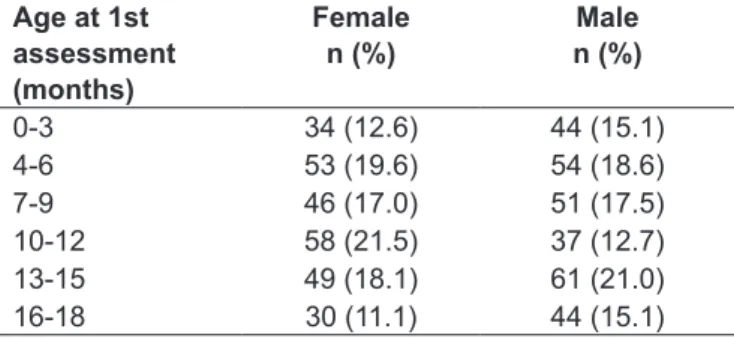
This study was approved by the Research Ethics Commit-tee of Universidade Federal do Rio Grande do Sul, Brazil. A total of 21 professionals (4 translators, 9 physiotherapists, 6 physical educators, 1 nurse, and 1 pediatrician) participated in the process of translation, adaptation, and content valid-ity of the Brazilian version of the AIMS. The sample was composed of 561 preterm and term children (291 boys and 270 girls) from nursery schools and primary health care units who were divided in a representative manner according to age group (Table 1).
Children were selected consecutively after permission was received from the institutions and informed consent was obtained from the parents/legal guardians. Inclusion criteria were age between 0 and 18 months and no previous participation in intervention programs. Exclusion criteria were musculoskeletal disorders, such as fractures, peripheral nerve injury, and musculoskeletal infection, among others. Sample size calculation was performed using Programs for Epidemiologists, version 4.0. For a 95% conidence level, a response rate of 50% and a 4% margin of error, approxi-mately 600 children should be evaluated.
The AIMS is an observational assessment tool used to measure the development of term and preterm infants, from 38 weeks gestational age to 18 months corrected age(11),
comprising 58 items divided into subscales (prone, supine, sitting, and standing) that describe spontaneous movement and motor skills. The examiner observes the child, taking into account aspects related to weight bearing, posture, and antigravity movements(11,12). The scale presents raw
scores, percentiles, and categorization of motor performance
classiied as: normal (above 25%); suspect (between 25 and
5%); and abnormal (below 5%)(11,12). We also applied the
Child Behavior Development Scale (CBDS)(23), standardized
for Brazilian children aged 1 to 12 months, in which behav-iors are classiied as: axial and appendicular; spontaneous and stimulated; and communicative and non-communicative. This scale allows an estimate of the degree to which the child’s behavior is consistent with expectations for his or her age level.
Translators and specialists in motor behavior translated and evaluated AIMS motor criteria. The translators worked irst individually and then as a committee. The raters as-signed scores for clarity and relevance individually.
After permission was received from the institutions, the parents/legal guardians were sent a consent form. The ap-plication of the scale took approximately 20 minutes per child in their homes or institutions of origin, with minimal manipulation. The sessions were videotaped for later analysis by independent evaluators. To analyze the temporal stability of the scale, part of the sample was retested (n=259) within 15 days.
To ensure an accurate and valid version of the instru-ment, a preliminary version (translation) was prepared, evaluated, and adapted to the Brazilian culture, includ-ing the analysis of content validity, objectivity, reliability, construct validity, and criterion validity(24-28). Translations
were performed (two independent bilingual translators) that resulted in two Portuguese-language versions. Based on the two translations, the instrument was back-translated into English by two other bilingual professionals, resulting in two new English-language versions of the test. The inal version was established in consultation with the translators and the researchers.
Content validity was established by three raters with ex-pertise in the area. Content validity index (CVI) and kappa coeficient of agreement were calculated and face validity
Age at 1st assessment (months)
Female n (%)
Male n (%)
0-3 34 (12.6) 44 (15.1) 4-6 53 (19.6) 54 (18.6) 7-9 46 (17.0) 51 (17.5) 10-12 58 (21.5) 37 (12.7) 13-15 49 (18.1) 61 (21.0) 16-18 30 (11.1) 44 (15.1)
was determined by health professionals (4 PhDs, 4 Masters, 1 specialist, 8 graduates). Each rater received the adapted version and used a 5-point Likert scale to assign scores re-garding clarity and relevance of motor criteria.
Regarding reproducibility, well trained evaluators, expe-rienced in the use of the instrument for more than two years, analyzed inter and intrarater agreement using the intraclass cor-relation coeficient (ICC), Friedman test, and Wilcoxon test.
As for test-retest reliability, 259 children were retested, within a 15-day interval, and scoring stability was evaluated
after some period of time using the Wilcoxon t test,
Spear-man’s correlation coeficient, kappa coeficient of agreement, and McNemar-Bowker test.
For the analysis of criterion validity, expressed as predic-tive validity, 28 children were longitudinally followed up monthly, including 5 assessments (G1: 5 boys and 3 girls aged 1 to 6 months at 1st assessment); 20 children were evaluated with the AIMS and retested after 6 months (G2: 11 boys and 9 girls aged 1 to 11 months). Data were ana-lyzed using the Friedman test, chi-square test, and Pearson’s correlation coeficient.
For construct validity, the following procedures were performed: (1) Analysis of internal consistency using the Cronbach’s alpha index as an indicator for the test and items (n=561); (2) Analysis o discriminant validity using the
Student t test, Pearson’s chi-square test, and Pearson’s
cor-relation coeficient to compare preterm infants (n=124, aged 0 to 15 months, including 62 atypical – extreme premature – infants) with typical infants (born at term), matched for chronological age; (3) Correlation of AIMS with CBDS rating criteria of 40 children, 36 preterm and 4 term infants aged 0 to 12 months, using Spearman’s correlation coeficient, Kendall’s coeficient, kappa coeficient of agreement, and McNemar-Bowker test.
The tests were selected according to data distribution (parametric or nonparametric data) and type of variable (qualitative or quantitative variables). For correlation co-eficients, values were considered as follows: above 0.60 (strong); 0.30-0.60 (moderate); and below 0.30 (poor)(29).
For Cronbach’s alpha, values above 0.80 were considered excellent, above 0.70 good, and 0.60-0.70 acceptable(27).
Signiicance level was set at p≤0.05.
Results
In the uniied version, the semantics of the items was maintained and only a few changes were necessary, such as the
replacement of some words with more commonly used syn-onyms. Correction of technical terms used in the translations and adaptation of motor descriptors for each item were required to allow a better understanding by the target public.
As for content validity, with respect to face validity, 100% of health professionals assigned a Likert scale score of 5 in the analysis of AIMS items. Regarding content validity
(Table 2), CVI agreement values ranged from α=66.7 to
α=92.8 for clarity, with values above 0.98 for relevance. For
both clarity and relevance, a signiicant and strong
agree-ment was observed among raters (kappa coeficient, p<0.05).
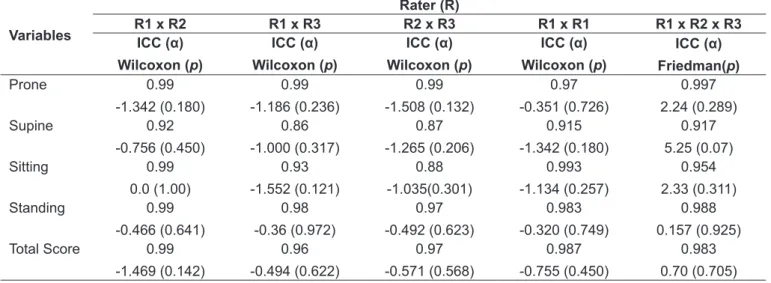
Regarding objectivity, ICC ranged from α=0.86 to α=0.99,
indicating strong agreement among raters (Table 3). No
sig-niicant differences (p<0.05) were found among raters. The
analysis of intrarater reliability showed strong agreement,
with ICC ranging from α=0.915 to α=0.993.
Regarding test-retest reliability, percentiles ranged from 0 to 100 in the test and retest, with no signiicant changes
(p=0.07); a signiicant and strong positive correlation was
detected (rho=0.85; p<0.001). The rating of motor
perfor-mance ranged from 1 to 3 in the test and retest, and a sig-niicant and strong agreement was detected (kappa=0.680;
p<0.001). The McNemar-Bowker test revealed no differences
in test-retest ratings (p=0.40). Regarding internal
consis-tency, Cronbach’s alpha coeficient for the four postures
showed excellent reliability (α=0.88). Values remained high
in each posture, as follows: prone, α=0.86; supine, α=0.89;
sitting, α=0.80; and standing, α=0.85. According to raw
scores and percentiles, reliability was conirmed in the four
postures (α=0.72) (Table 4).
In the analysis of discriminant validity, term infants had signiicantly higher scores than preterm infants, both in total score (p<0.001) and percentiles (p=0.04).A signiicant and strong correlation was found between scores and percentiles
in both groups (p<0.001).When comparing rating criteria,
the term group was signiicantly associated with the normal range, whereas the preterm group was associated with
sus-pected delay or delay (p=0.047).
A signiicant and moderate positive correlation was also detected between the AIMS and CBDS, conirmed by
Ken-dall’s coeficient (W=0.319; p=0.02) and kappa coeficient
(0.309; p=0.003). The McNemar-Bowker test (p=0.047)
revealed signiicant differences between instruments: the
AIMS rated a greater number of children as “normal” and the CBDS rated signiicantly more cases as “delay”.
Table 4 – Median (25th; 75th percentile) of total score, percentile, and categorization for reliability and predictive, discriminant, and concurrent validity of the Brazilian version of the Alberta Infant Motor Scale
Total score Percentile Categorization
Reliability Test - 43 (14; 71) 3 (2; 3)
(n=259) Retest - 61 (23; 71) 3 (2; 3)
Predictive validity G1 (n=8)
A1 9 (7.25;17.75) 51.5 (23.5; 64.5) 3 (2.25; 3) A2 15 (10; 27.75) 42 (22.25; 81) 3 (2; 3) A3 29 (21.25; 37.5) 60.5 (17.75; 95) 3 (2.25; 3) A4 37.5 (31; 49.25) 86.5 (26.5; 92.75) 3 (2.25; 3) A5 49.5 (39; 52) 73.5 (62.25; 87.75) 3 (3; 3) G2 (n=20) A1 22 (10.25; 33.75) 34.50 (22; 60) 3 (2; 3) A2 51.5 (48.25; 58) 67.50 (48; 71) 3 (3; 3) Discriminant validity (n=124) AT 32.50 (22; 48.25) 52.50 (23.50; 71.50) 3 (2.75; 3)
PT 18 (11; 27.75) 36.40 (11.50; 63.25) 3 (2; 3)
Concurrent validity (n=80) AIMS - - 2 (2;3)
CBDS - - 2 (1; 2)
AIMS = Alberta Infant Motor Scale; CBDS = Child Behavior Development Scale.
Table 3 – Intra and interrater analysis of the objectivity of the Brazilian version of the Alberta Infant Motor Scale
Variables
Rater (R)
R1 x R2 R1 x R3 R2 x R3 R1 x R1 R1 x R2 x R3
ICC (α) Wilcoxon (p)
ICC (α) Wilcoxon (p)
ICC (α) Wilcoxon (p)
ICC (α) Wilcoxon (p)
ICC (α) Friedman(p)
Prone 0.99
-1.342 (0.180)
0.99 -1.186 (0.236)
0.99 -1.508 (0.132)
0.97 -0.351 (0.726)
0.997 2.24 (0.289) Supine 0.92
-0.756 (0.450)
0.86 -1.000 (0.317)
0.87 -1.265 (0.206)
0.915 -1.342 (0.180)
0.917 5.25 (0.07) Sitting 0.99
0.0 (1.00)
0.93 -1.552 (0.121)
0.88 -1.035(0.301)
0.993 -1.134 (0.257)
0.954 2.33 (0.311) Standing 0.99
-0.466 (0.641)
0.98 -0.36 (0.972)
0.97 -0.492 (0.623)
0.983 -0.320 (0.749)
0.988 0.157 (0.925) Total Score 0.99
-1.469 (0.142)
0.96 -0.494 (0.622)
0.97 -0.571 (0.568)
0.987 -0.755 (0.450)
0.983 0.70 (0.705)
ICC = intraclass correlation coeficient.
Table 2 – Content validity index (CVI) and kappa coeficient of agreement regarding clarity and relevance of the Brazilian version of the Alberta Infant Motor Scale
Comparisons CVI Kappa (95%CI) p
Clarity
Rater 1 x Rater 2 x Rater 3 66.7% -
-Rater 1 x -Rater 2 92.8% 0.870 (0.746; 0.994) <0.001 Rater 1 x Rater 3 73.2% 0.752 (0.579; 0.925) 0.002 Rater 2 x Rater 3 67.8% 0.514 (0.278; 0.745) 0.028 Relevance
Rater 1 x Rater 2 x Rater 3 98.2% -
-Rater 1 x -Rater 2 100.0% 0.935 (0.845; 1.023) <0.001 Rater 1 x Rater 3 98.2% 0.824 (0.685; 0.973) <0.001 Rater 2 x Rater 3 98.2% 0.824 (0.685; 0.973) <0.001
positive joint correlation for the following variables:inal
score (ICC=0.96, range: 0.89-0.99; p<0.0001); percentile
(ICC=0.88, range: 0.67-0.97; p<0.0001); and performance
rating (ICC=0.83, range: 0.49-0.96; p=0.001), indicating
that increased values in the 1st assessment were correlated with increased values in the subsequent assessment, and so
on.In the comparative analysis, the Friedman test revealed
a signiicant difference in scores from assessments 1 to 5 (p<0.001). Scores from assessment 5 were higher than those from assessment 4, which in turn were higher than those from assessment 3, which in turn were higher than
those from assessments 1 and 2.The percentile values in all
assessments showed a signiicant and progressive increase
(p=0.049). No statistically signiicant differences were
ob-served when ratings from assessments 1 to 5 were compared (p=0.37).
The analysis of children (n=20) evaluated twice within a 6-month interval revealed a signiicant and strong positive correlation between scores 1 and 2 (r=0.730; p<0.0001).
The analysis of percentiles (r =0.22; p=0.347) and ratings
(rho=0.26; p=0.269) revealed no signiicant results in both
assessments. A signiicant difference was found between
mean values of scores 1 and 2 (p<0.001):the mean value
observed in total score 2 was higher than that of total score
1.All children had higher values at assessment 2 than at
as-sessment 1.When comparing percentiles 1 vs. 2, percentiles
at assessment 2 were signiicantly higher (p<0.01) than those
at assessment 1.A direct comparison of percentiles at both
assessments revealed that, out of 20 children, 18 (90.0%) had higher percentiles at assessment 2 and 2 (10.0%) had lower scores at assessment 2. The agreement analysis of performance rating (1x2) showed good (kappa=0.458) and signiicant (p=0.03) results.
Discussion
The analysis of the psychometric properties of the scale indicated good reliability, similar to that obtained in the
Canadian population(11). The independent back-translation
resulted in a uniied version in Portuguese of the AIMS, the Escala Motora Infantil de Alberta (EMIA). A comparison among the four translated versions, discussion, and analysis in consultation with all translators allowed a reduction of biases inherent in the process carried out with only one translator.
Regarding face validity, there was unanimous opinion among the professionals involved that the content was
appropriate to assess motor skills of children in different postures. In the analysis of content validity, in relation to agreement among raters regarding CVI for clarity and relevance, there was strong agreement among raters, conirmed by kappa coeficient of agreement with simi-lar responses(29). The results indicate that the Brazilian
version of the AIMS (EMIA) showed excellent content validity, with clear and relevant criteria, adequate repre-sentation of items in relation to concepts, and theoretical relevance.
The results also demonstrated strong agreement among raters (ICC: 0.86-0.99), high reliability, and agreement with values proposed by the author of the scale, who
sug-gests values above 0.80(12), which appears to be suficient to
classify our results as correct(27).
Regarding temporal stability of the scale, percentiles and performance rating criteria remained constant after some period of time. High percentiles and ratings in the test were signiicantly associated with high values in the retest. The Brazilian version of the AIMS (EMIA) has reliability and temporal stability, with data showing high correlation and no signiicant differences between test and retest(29).
The phenomenon of acquiescence (whether positive or
negative) was not observed, indicating reliable data(25). The
correlation values for percentiles (rho=0.85) and rating cri-teria (kappa=0.68) could have been even higher if a shorter time interval between test and retest had been employed, considering a 7-day period as a reference interval between assessments(11).
The Brazilian version of the AIMS (EMIA) has high inter-nal consistency; the values obtained using Cronbach’s alpha (0.72-0.89) relect a proile of high homogeneity among
variables.The Cronbach’s alpha coeficient should be at least
0.60, and the larger the sample, the more dificult it becomes
to obtain consistent results(27).Given the sample size, our
results show homogenous items representing a same trait, measuring the same construct.
The Brazilian version of the AIMS (EMIA) was shown to be valid to distinguish atypical behaviors, because percentiles and total score were signiicantly different in the groups of
preterm and term infants investigated.The results indicate
that a high total score was associated with high percentile values, with a positive correlation between two measure-ments of a same construct, thus conirming convergent validity(27).Considering rating criteria, discriminant validity
was conirmed, establishing a difference between term and
ability of the scale to diagnose motor disorders during the irst years of life(15,16,18,22,30).
A comparison between the Brazilian version of the AIMS (EMIA) and CBDS categorizations revealed a moderate correlation (rho=0.34; kappa=0.30; W=0.31), indicating poor concurrent validity, which is consistent with indings from studies comparing the AIMS with the Test of Infant
Performance (correlations between 0.20 and 0.67)(17) and the
AIMS with the Daily Activities of Infant Scale(30). Campos et
al observed moderate agreement of the AIMS with the Bayley
scale at 5 months (k=0.503) and poor agreement at 10 months (k=0.209)(5). In contrast, international studies(11,13,15,21) and a
Brazilian study(14) showed a high correlation of the AIMS with
other motor scales.In the present study, the results obtained
may be due to the fact that the CBDS has fewer items related to motor function (15 items) compared to the Brazilian version of the AIMS (EMIA) (58 items), thus compromising the
reli-ability of results.Although the CBDS is applied with similar
goals, this scale also evaluates social and cognitive aspects, thus providing a reduced number of items in the motor
sub-scale.Both instruments have advantages and disadvantages.
Therefore, professionals should be able to determine which one better meets their needs.
Our results suggest that the Brazilian version of the AIMS (EMIA) has predictive validity, since ratings were similar longitudinally (G1) and pre- and post-tests (G2). These indings are consistent with a study for validation of
the instrument in the Canadian population(12), but different
from a study conducted in Taiwan, which found limited pre-dictive validity for this scale to evaluate preterm infants(21).
The increase in percentile values over time, within the age groups studied, highlights a greater sensitivity and accuracy of the Brazilian version of the AIMS (EMIA) to evaluate children aged 3 to 9 months, as demonstrated in a previous study(17).
It can be concluded that the procedures performed to analyze the psychometric properties of the Brazilian version of the AIMS (EMIA) showed that the back-translation was eficient to avoid biases resulting from misunderstandings in English. In addition, the scale was recognized by experts as an eficient tool to evaluate motor function in children and proved to be a reliable and consistent instrument, with signiicant predictive and discriminant power. It is notewor-thy, however, that the results for concurrent validity were limited, thus warranting a comparison of the AIMS with motor tests other than the CBDS. Regarding predictive validity, a longer follow-up period could have yielded differ-ent results, favoring the predictive power of the instrumdiffer-ent analyzed in this study.
The results obtained can be reproduced in daily prac-tice, conirming the reliability and content, criterion, and construct validity of the Brazilian version of the AIMS (EMIA), thus encouraging professionals to use this scale in the evaluation and planning of intervention programs. We highlight the need for normative studies involving Brazil-ian children, since the use of categorizations from other populations may not be suitable to interpret data obtained in Brazilian children, assuming that these categorizations may vary given the diversity of socioeconomic and cultural factors in the country.
References
1. Wijnhoven TM, de Onis M, Onyango AW, Wang T, Bjoerneboe GE, Bhandari N
et al. Assessment of gross motor development in the WHO Multicentre Growth Reference Study. Food Nutr Bull 2004;25:S37-45.
2. Mahoney G, Robinson C, Perales F. Early motor intervention: the need for new treatment paradigms. Infants and Young Children 2004;17:291-300.
3. Valentini NC. A inluência de uma intervenção motora no desempenho motor e na percepção de competência de crianças com atrasos motores. Rev Paul
Educ Fis 2004;16:61-75.
4. Santos RS, Araújo AP, Porto MA. Diagnóstico precoce de anormalidades no
desenvolvimento em prematuros: instrumentos de avaliação. J Pediat (Rio J) 2008;84:289-99.
5. Campos D, Santos DC, Gonçalves VM, Goto MM, Arias AV, Brianeze AC et al. Agreement between scales for screening and diagnosis of motor development
at 6 months. J Pediat (Rio J) 2006;82:470-4.
6. Spittle AJ, Doyle LW, Boyd RN. A systematic review of the clinimetric properties of neuromotor assessments for preterm infants during the irst year of life. Dev
Med Child Neurol 2008;50:254-66.
7. Campos D, Santos DC, Gonçalves VM, Montebelo MI, Goto MM, Gabbard
C. Postural control of small for gestational age infants born at term. Rev Bras Fisioter 2007;11:7-12.
8. Chagas PS, Mancini MC, Fonseca ST, Soares TB, Gomes VP, Sampaio RF.
Neuromuscular mechanisms and anthropometric modiications in the initial
stages of independent gait. Gait Posture 2006;24:375-81.
9. Zajonz R, Müller AB, Valentini NC. The inluence of environmental factors in
motor and social performance of children from the suburb of Porto Alegre. Maringá 2008;19:159-71.
10. Lopes VB, Lima CD, Tudella E. Motor acquisition rate in Brazilian infants. Inf
Child Dev 2009;18:122-32.
11. Piper MC, Darrah J. Motor assessment of the developing infant. Philadelphia:
Saunders; 1994.
12. Piper MC, Pinnell LE, Darrah J, Maguire T, Byrne PJ. Construction and validation of the Alberta Infant Motor Scale (AIMS). Can J Public Health
1992;83:S46-50.
13. Uesugui M, Tokuhisa K, Shimada T. The reability and validity of the Alberta
14. Almeida KM, Dutra MV, Mello RR, Reis AB, Martins PS. Concurrent validity
and reliability of the Alberta Infant Motor Scale in premature infants. J Pediatr (Rio J) 2008;8:442-8.
15. Heineman KR, Bos AF, Hadders-Algra M. The Infant Motor Profile: a
standardized and qualitative method to assess motor behaviour in infancy.
Dev Med Child Neurol 2008;50:275-82.
16. Tse L, Mayson TA, Leo S, Lee LL, Harris SR, Hayes VE et al. Concurrent validity of the Harris Infant Neuromotor Test and the Alberta Infant Motor Scale.
J Pediatr Nurs 2008;23:28-36.
17. Campbell SK, Kolobe TH, Wright BD, Linacre JM. Validity of the Test Infant
Motor Performance for prediction of 6-, 9- and 12-month scores on the Alberta Infant Motor Scale. Dev Med Child Neurol 2002;44:263-72.
18. Fleuren KM, Smit LS, Stijnen T, Hartman A. New reference values for
the Alberta Infant Motor Scale need to be established. Acta Pædiatr 2007;96:424-7.
19. Charitou S, Simitsopoulou A, Kontogianni V, Skordilis EK, Koutsouki D. Application of the Alberta Infant Motor Scale in Greece: a preliminary study.
Inq Sport Phys Ed 2007;5:273-82.
20. Bartlett DJ, Fanning JE. Use of the Alberta Infant Motor Scale to characterize
the motor development of infants born preterm at eight months corrected age. Phys Occup Ther Pediatr 2003;23:31-45.
21. Jeng SF, Yau KI, Chen LC, Hsiao SF. Alberta infant motor scale:
reliability and validity when used on preterm infants in Taiwan. Phys Ther 2000;80:168-78.
22. Darrah J, Piper M, Watt MJ. Assessment of gross motor skills of at-risk infants:
predictive validity of the Alberta Infant Motor Scale. Dev Med Child Neurol 1998;40:485-91.
23. Pinto EB, Vilanova LC, Vieira RM. O desenvolvimento do comportamento da criança no primeiro ano de vida: padronização de uma escala para a avaliação e o acompanhamento. São Paulo: Casa do Psicólogo; 1997.
24. Beaton DE, Bombardier C, Guillemin F, Ferraz MB. Guidelines for the process of cross-cultural adaptation of self-report measures. Spine (Phila Pa 1976) 2000;25:3186-91.
25. Cronbach LJ. Fundamentos da testagem psicológica. 5ª ed. Porto Alegre:
Artes Médicas; 1996
26. Fachel JM, Camey S. Avaliação psicométrica: a qualidade das medidas e o entendimento dos dados. In: Cunha JA (Org). Psicodiagnóstico-V. 5ª ed. Porto
Alegre: Artmed; 2003. p. 159-70.
27. Pasquali L. Parâmetros psicométricos dos testes psicológicos. São Paulo:
Casa do Psicólogo; 2001.
28. Vallerand RJ. Vers une méthodologie de validation trans-culturelle de questionnaires psychologiques: implications pour la recherché en langue française. Can Psychol 1998;30:662-80.
29. Callegari-Jacques SM. Bioestatística: princípios e aplicações. Porto Alegre:
Artmed; 2003.
30. Bartlett DJ, Fanning JK, Miller L, Conti-Becker A, Doralp S. Development of the