RAC, Rio de Janeiro, v. 20, n. 3, art. 6, pp. 368-388, Maio/Jun. 2016
http://dx.doi.org/10.1590/1982-7849rac2016140035
International Financial Reporting Standards and Earnings
Management in Latin America
Alex Augusto Timm Rathke1 Verônica de Fátima Santana1 Isabel Maria Estima Costa Lourenço2 Flávia Zóboli Dalmácio1
Universidade de São Paulo1
Instituto Universitário de Lisboa 2
Resumo
Essa pesquisa analisa o nível de gerenciamento de resultados na América Latina após a adoção das International Financial Reporting Standards (IFRS), em comparação aos países anglo-saxões e europeu-continentais. Ela também analisa o efeito da listagem de ações nos Estados Unidos sobre a comparação do nível de gerenciamento de resultados das empresas latino-americanas com empresas estrangeiras. A literatura sobre gerenciamento de resultados considerando países menos desenvolvidos ainda está em construção, e poucos estudos focam esse tema, especialmente na América Latina, apesar de sua relevância para a economia global. A presente pesquisa preenche essa lacuna por meio do exame do nível de gerenciamento de resultados nos principais países latino-americanos que adotam as IFRS (Brasil e Chile), em comparação com os principais países anglo-saxões com tradição em IFRS (Reino Unido e Austrália), e com as principais economias da Europa Continental (França e Alemanha). Os resultados demonstram que os latino-americanos apresentam um maior nível de gerenciamento de resultados que os anglo-saxões e europeu-continentais, e esse comportamento oportunista se mantém significativo quando apenas
global players com listagem de ações nos Estados Unidos são analisados. Logo, mesmo com um conjunto único de padrões contábeis de elevada qualidade (IFRS) e fortes incentivos à divulgação, as características específicas dos países produzem forte influência na forma como as IFRS são implementadas em cada país.
Palavras-chave: IFRS; gerenciamento de resultados; América Latina.
Abstract
This study analyzes the level of earnings management in Latin America after the adoption of the International Financial Reporting Standards (IFRS) and analyzes the role of cross-listing in the United States. The literature on earnings management in less developed countries is still under construction, and few studies focus on this issue, especially with respect to Latin America, despite its relevant role in the global economy. This paper fills this gap in the literature as it analyzes the level of IFRS earnings management regarding the first and main Latin American countries applying IFRS (Brazil and Chile), when compared to the main Anglo-Saxon countries with IFRS tradition (United Kingdom and Australia), and with the main Continental European economies (France and Germany). The results show that Latin American firms present a higher level of earnings management than Continental European and Anglo-Saxon firms, and this opportunistic behavior remains significant when only global players with cross-listing in the United States are analyzed. Thus, even with a unique set of high quality accounting standards (IFRS) and strong reporting incentives, countries’ specific characteristics still play an important role in the way IFRS is implemented in each country.
Introduction
This paper examines the level of earnings management in Latin American IFRS adopters, when compared to the main Anglo-Saxon and Continental European firms that have also adopted IFRS. Furthermore, we compare the level of earnings management of these groups of countries regarding only those firms that are cross-listed in the United States (U.S.), usually referred to as global players and identified as firms with stronger reporting incentives. Our findings show that even with a unique set of high quality accounting standards (IFRS) and strong reporting incentives (cross-listing in the U.S.), countries’ specific characteristics still play an important role in the way IFRS are applied.
It is largely argued that IFRS increase accounting information quality due to their requirements of accounting recognition and measurement, which are structured to better reflect the economic and financial position of the firm. Hence, IFRS adoption can reduce information asymmetry and the cost of capital, and increase the capital flow across countries. However, IFRS application tends to be distinct for each country, on the basis that cultural and environmental characteristics influence domestic accounting practices. A single global accounting standard might not be able to eliminate this influence, thus specific local characteristics are likely to affect the way the IFRS are adopted in each country.
Previous studies find evidence of country-specific characteristics that affect the relation between IFRS adoption and earnings management (e.g. Ahmed, Chalmers, & Khlif, 2013; Aubert & Grudnitski, 2011; Barth, Landsman, & Lang, 2008; Chen, Tang, Jiang, & Lin, 2010; Gebhardt & Novotny-Farkas, 2011; Jeanjean & Stolowy, 2008; Lara, Torres, & Veira, 2008; Paananen, 2008; Paananen & Lin, 2009; Soderstrom & Sun, 2007). Besides country factors, there are firm-specific characteristics that reflect managers’ incentives to prepare high-quality financial statements. According to Ball, Robin and Wu (2003), firms face external incentives affecting financial statements, which are strongly based on market and political forces, and the amount of publicly traded equity assumes a critical factor affecting accounting disclosure. In this line, some authors argue that the effect of share cross-listing in the United States is associated with a better informational environment (Lang, Lins, & Miller, 2003) and higher accounting quality (Lang, Raedy, & Yetman, 2003), thus it becomes an incentive for managers and auditors to increase transparency in financial statements (e.g., Barth et al., 2008; Chen et al., 2008). Global player firms which operate in many countries and seek to raise funds internationally, especially in the United States, have stronger incentives to report transparent financial statements reflecting their real economic activity and financial position. Thence, these firms have incentives to disclose financial statements with lower levels of earnings management, since country-specific characteristics tend to be less relevant, and a unique global accounting language, as intended by the IFRS, is likely to carry pronounced effects on financial statements for this group of firms.
Based on cultural and environmental differences reflected in accounting systems, the traditional accounting literature segregates countries into three groups: Anglo-Saxon, Continental European and Latin American countries (Frank, 1979). Recent researches, which did not consider Latin America, provide evidence that the Anglo-Saxon and Continental European segregation remains the same, despite the widespread adoption of IFRS in these countries (Nobes, 2011). This indicates that IFRS produce different consequences on distinct accounting systems, depending on specific cultural and environmental factors in each country.
Some Latin American countries have adopted IFRS in recent years, but the relationship with earnings management has not yet been extensively examined. The importance of Latin America for the global economy is a growing issue in current years. This region has presented a significant real gross domestic product (GDP) growth up to the third quarter of 2013 of near 3.0%, together with a prominent increase of its own participation in worldwide economic development (International Monetary Fund, 2013).
enterprises. Treviño and Mixon (2004) split this reform into two phases. In the first one, the interest rates are determined by market forces, allowing the development of areas such as leasing and factoring, brokerage underwriting and pension fund management. The second phase comes with reforms in the regulatory environment, creating a less uncertain investment climate, opening the door for foreign resources. As a consequence, the amount of foreign direct investment has increased substantially (Mortimore, 2000; Treviño, Thomas, & Cullen, 2008; Zhang, 2001), in particular from North American firms (Tuman & Emmert, 2004). Capital inflow into Latin America also happens through the growing number of firms issuing American Depositary Receipts, particularly in the 1990’s (Karolyi, 2004). In 2013, Latin American firms represented 21% of the total amount of the American Depositary Receipt (ADR) trading volume (J. P. Morgan, 2013).
The importance of the Latin American countries for the global economy underlines the need for including them in IFRS literature. In this study, we analyze earnings management in Brazil and Chile, the most representative Latin American countries that have adopted IFRS as their official accounting standards. Chilean listed firms have been required to apply IFRS since 2010, and Brazil reached full IFRS convergence in that same year, which is the result of a transition phase initiated in 2007.
We compare the level of earnings management in these two Latin American countries, with the main Anglo-Saxon countries carrying IFRS tradition (United Kingdom and Australia), and also with the two main European Continental economies (France and Germany)(1). Given the dissimilarities in the country-specific variables, including the level of enforcement and investor protection, and their effect on accounting practice, we expect to find dissimilarities with respect to the level of earnings management across these three groups of countries. Regarding the firms that are cross-listed in the U.S., it is not very clear if these dissimilarities arise.
The empirical analysis relies on listed firms from Brazil, Chile, France, Germany, Australia and the United Kingdom. We analyze data from 2011 and 2012, in order to guarantee that all firms applied IFRS. We estimate absolute discretionary accruals based on the Modified Jones Model (Dechow, Sloan, & Sweeney, 1995), as a proxy of earnings management, and we model the regression estimative including a country variable in order to capture the differences among the groups of countries. We use a set of firm-level variables in order to control for other factors influencing earnings management. Thereafter, we perform a similar analysis considering only those firms from the six countries that are cross-listed in the US, i.e., firms with American Depositary Receipts (ADR). We aim to analyze whether eventual differences remain for firms with greater incentives for transparent financial reporting.
The empirical findings for the entire sample allow us to suggest that firms from Latin American countries present a higher level of earnings management, when compared to firms from Continental European and Anglo-Saxon countries. We also find that the Latin American and the European Continental firms that are cross-listed in the U.S. (global players) present a lower level of earnings management, when compared to local players. Finally, differences on the level of earnings management across the three groups of countries remain when the analysis is applied on the sub-sample composed only of global players. Hence, we observe that the influence of country-level backgrounds are not overcome by the extra reporting incentives, since Latin American global players also present a higher level of earnings management, when compared to global players from Continental European and Anglo-Saxon countries.
The most important contribution of this study is to indicate that institutional-specific characteristics remain relevant for the implementation and application of accounting practices even under incentives to prepare high quality financial statements. This result highlights the relevance of country-level factors influencing IFRS adoption, and indicates that full convergence is unlikely to happen, even among global players, despite overall efforts in order to achieve a unique set of accounting standards (Leuz, 2010).
(Bengoa & Sanchez-Robles, 2003), IFRS adoption becomes a relevant factor contributing to increased capital flows in Latin America.
The paper is structured as follows. Literature Review shows the motivation behind this research and how the hypotheses have been developed. Research Design explains the research strategy, presenting the variables and their interpretation. Empirical Results shows the analysis, and the final section concludes.
Literature Review
IFRS adoption and earnings management
It is chiefly concurred that IFRS have the potential to improve the quality of accounting information, since they are recognized to be a set of principles-based financial reporting standards that allow firms to prepare and disclose information that better reflect their financial and economic reality. The IFRS are more rigorous about accounting alternatives and measurement requirements, which reduces the range for accounting options and limits management opportunistic discretion in determining accounting amounts. Consequently, restricting opportunistic behavior implies a reduction of eventual manipulations and increases the extent to which financial statements reflect firms’ real economic positions (Ashbaugh & Pincus, 2001; Ball, Robin, & Wu, 2003).
Relevant studies examine the association between IFRS adoption and measures of earnings management, assuming that the latter is a component of accounting quality. Barth, Landsman and Lang (2008) examine whether IFRS adoption is associated with an increase in accounting quality in financial statements of firms from 21 countries. The authors explain that the adoption of IFRS reflects combined effects of factors, which materially affects the financial reporting system, including the standards themselves, their interpretation, enforcement and litigation. The study finds a general increase in accounting quality after IFRS adoption, as firms display less earnings management, more timely loss recognition and more value relevance of accounting amounts. Jeanjean and Stolowy (2008) analyze the level of earnings management before and after mandatory IFRS adoption in Australia, France and the United Kingdom, and find that the management of earnings did not decrease following the adoption. This result suggests that management incentives and embedded institutional factors play a relevant role in the IFRS adoption for these countries. Aharony, Barniv and Falk (2010) analyze the impact of mandatory IFRS adoption on the price and return-based value-relevance models, in order to evaluate how accounting standards affect accounting information to investors. The evidences indicate that the effect of IFRS on information quality is higher in countries with larger differences between domestic standards and IFRS.
Several studies focus on examining the effect of local business environments and institutional frameworks on accounting standards. Burgstahler, Hail and Leuz (2006) show that rigid enforcement and strong legal systems are associated with reduced levels of earnings management. Higher accounting quality is attributed to incentives related to institutional factors engaged in reporting earnings that reflect economic reality. Ball et al. (2003) find that firms located in common-law countries present the same level of accounting quality when compared with firms in code-law countries, with respect to the timeliness of loss recognition. Authors explain that the incentives related to market and political forces affect the incentives of preparers of financial information. Similar implications are observed in the findings of Bradshaw and Miller (2008) and Lang, Raedy and Wilson (2006), suggesting that the regulatory environment is important in the application of accounting standards.
Some studies comparatively examined the application of IFRS in different countries, considering that local characteristics might affect the implementation and application of the international standards. Kvaal and Nobes (2010) examine the systematic differences among countries, regarding the accounting policies adopted by firms under IFRS, in order to identify national IFRS patterns. The authors identified different national versions of the international standards in each country, which are strictly related to pre-adoption accounting practices originated in their domestic GAAP. The results show an inertial maintenance of local traditional accounting practices after the adoption of IFRS.
Nobes (2011) studies the classification of accounting systems after IFRS adoption, analyzing specifically the dichotomous segregation of countries into Anglo-Saxon and Continental European countries. The classification is prepared based on the accounting policy choices made by the largest IFRS adopters in eight countries. The author verifies that the classification of countries is the same as the classification drawn up on 1983, which divides countries between Anglo-Saxon and Continental European groups. The author argues that these differences in accounting practices are possibly due to the intrinsic flexibility within IFRS.
IFRS adoption and firm-level incentives: the role of global players
Earnings management is strictly related to manager incentives to report transparent financial statements. Ball et al. (2003) argue that financial information is sensitive to the incentives borne by managers and auditors, and these incentives depend on the interplay between market and political forces. While the market demands high-quality financial reporting according to factors such as the amount of publicly traded equity, size and the amount of public debt, there are political forces related to the involvement of the Government and political incentives to reduce volatility of reported income. Daske, Hail, Leuz and Verdi (2013) assess some of these firm-level incentives, including the effect of size, profitability, foreign sales, financial needs, growth opportunities and ownership concentration. Barth et al. (2008) examine additional variables identifying firms audited by one of the Big Four, the number of stock exchanges in which the firms’ shares are listed, and if they are cross-listed in the United States.
Based on the fact that the United States’ stock market is highly developed and strongly significant to the global economy, companies listed in the American market are considered to be pursuing international recognition, and thus these firms are recognized as global players. Firms issuing ADR face different enforcement and institutional incentives – i.e. extra enforcement by American Securities and Exchange Commission (SEC) – tending to present more transparent disclosure (Coffee, 2002), and to improve investor protection (Benos & Weisbach, 2004; Reese & Weisbach, 2002). The impact of country specific factors on the level of earnings management of global players is not clear, since these factors might not be as relevant as for those firms that are only traded in their domestic markets.
Therefore, we may assume two possible scenarios for firms that are cross-listed in the United States. The first one is that they present similar levels of earnings management, regardless of the location of the firms, since these firms are equally influenced by the American capital market. In this case, market forces overcome the country-level characteristics. In the second scenario, global players might still exhibit different levels of earnings management, since these firms are located in different countries and are affected by different specific characteristics, and the market incentive is not strong enough to overcome these characteristics. In this second scenario, domestic political forces are stronger than the demand for higher quality financial statements from the American market.
IFRS in Latin America
The importance of Latin America to the global economy is a growing issue in current years, since the impact of late 2008 world economic instability. In the third quarter of 2013, the real GDP growth of countries located in Latin America amounts to 3.0%, with a pronounced influence of Chilean production (4.5%), while Anglo-Saxon countries presented a near 2.0% growth and the European Union remained virtually stagnated. Besides that, based on the October 2013 World Economic Outlook from the International Monetary Fund (IMF), there is a clear growth in the participation of Latin America in the worldwide economic development, with an increase in economic activity supported by the strength of external demand.
Several Latin American countries have assumed the compromise to adopt IFRS as their official accounting standard, from which Chile and Brazil are the most representative ones. Since 2010, Brazilian and Chilean listed firms apply IFRS. The adoption of IFRS by Chile began in 2009, when the IFRS were required for major listed firms, including 2008 comparative information. By 2010, IFRS were applied for smaller listed companies, insurance companies, mutual and pension funds, stockbrokers, dealers and insurance agents. In Brazil, changes in local accounting rules began in 2007, in order to converge the Brazilian accounting system with the IFRS. In 2008 the first lot of accounting standards based on IFRS were issued by a specific Accounting Committee established for this purpose. Beginning in 2010, IFRS is completely adopted (Carvalho & Salotti, 2012).
While most studies analyze the effect of IFRS adoption on several countries around the world, there is limited literature about this effect in Latin American countries, and salient researches on Brazilian firms are among few exceptions. Lourenço, Branco and Curto (2013) suggest that Brazilian firms managed their earnings to avoid losses before but not after the mandatory adoption of IFRS by 2008. R. L. Silva (2013) provides evidences that the level of earnings management in Brazil has decreased in the period of full IFRS adoption, although conditional conservatism has increased in this period. Analysis in Martinez (2008) provides evidence that Brazilian firms manage earnings to increase, sustain or reduce (big bath write-off) current reported earnings, depending on firms’ incentives. A. Silva, Weffort, Flores and Silva (2014) find that Brazilian firms present relevant evidences of earnings management in the period concerning 2008 world economic instability, indicating that macroeconomic factors and institutional characteristics potentially influenced earnings management incentives in this period.
are no comparative studies considering the implementation of IFRS in Latin America and in other countries.
It is important to assess if, and to which extent, these improvements have led Latin America to present a level of earnings management that is equivalent to the level of earnings management observed in Continental European and Anglo Saxon countries.
Research Design
Sample and data
This study analyzes the level of earnings management under IFRS in Latin American firms, when compared to Anglo-Saxon and Continental European firms. Further, we analyze the level of earnings management in firms from these three groups of countries, but considering only those firms with stocks listed in the U.S. stock market.
The empirical analysis relies on the listed firms located in the main Latin American countries applying IFRS (Brazil and Chile), the main Continental European countries (France and Germany), and main Anglo-Saxon countries (Australia and United Kingdom) with IFRS tradition, as identified by Nobes (2011). We use financial information from 2011 and 2012, available on the Datastream database, in order to include only firms applying IFRS. Since some variables are defined in terms of variation, data from 2010 is also collected for the analysis.
The sample comprises 3,164 firm-year observations. Table 1 presents the sample distribution across countries and industries, aggregated by Standard Industrial Classification (SIC) codes. We exclude financial firms, since our empirical model is not able to capture the specific characteristics of this industry.
Table 1
Sample Distribution across Countries and Industries
Countries SIC 0 SIC 1 SIC 2 SIC 3 SIC 4 SIC 5 SIC 7 SIC 8 Total
Brazil 8 22 66 71 87 27 10 12 303
Chile 5 14 44 23 50 21 9 3 169
Latin America 13 36 110 94 137 48 19 15 472
France 1 28 94 130 47 57 105 29 491
Germany 4 14 84 224 46 45 71 26 514
Continental Europe 5 42 178 354 93 102 176 55 1005
United Kingdom 19 140 142 187 101 124 231 75 1019
Australia 15 200 57 94 75 61 94 72 668
Anglo-Saxon 34 340 199 281 176 185 325 147 1687
Total 52 418 487 729 406 335 520 217 3164
Note. SIC 0: Agriculture, Forestry and Fishing; SIC 1: Mining and Construction; SIC 2: Manufacturing; SIC 3: Manufacturing;
SIC 4: Transportation and Public Utilities; SIC 5: Wholesale Trade and Retail Trade; SIC 7: Services; SIC 8: Health Services.
Measuring earnings management
We use the magnitude of absolute discretionary accruals as a proxy for earnings management, which is an operational concept for accounting quality. According to Leuz, Nanda and Wysocki (2003), managers can use reporting discretion to misstate their firm’s economic performance. They can overstate reported earnings in order to reach a target or report extraordinary performance in specific situations. For the authors, the magnitude of discretionary accruals measures the extent to which managers exercise discretions in reporting earnings. For Warfield, Wild and Wild (1995), larger discretionary accruals reflect difficulties in accounting numbers for effectively measuring economic performance. Since income-increasing accruals and income-decreasing accruals can be exercised to manipulate earnings, it is a regular practice to manage the magnitude of absolute discretionary accruals in an opportunistic manner. Greater magnitudes indicates greater level of earnings managements and lower accounting quality (Chen et al., 2010).
Discretionary (abnormal) accruals are measured as total accruals minus estimated non-discretionary (normal) accruals. Several models are applied to estimate normal accruals. This study applies a modified version from the model proposed by Jones (1991), which is developed by Dechow, Sloan and Sweeney (1995).
Dechow et al. (1995) analyze alternative accrual-based models for detecting earnings management. They find that the most powerful is the modified version of the model developed by Jones (1991). The original model is built upon a regression approach to identify non-discretionary factors by a linear relation between total accruals and change in sales and in property, plant and equipment (McNichols, 2001).
The model proposed by Jones (1991) starts with an expectation model for total accruals to control for changes in the economic circumstances, as seen in Equation (1):
(1)
Where:
= Total accruals for firm in year ;
= Total assets for firm in year ;
= Revenues for firm in year less revenues for firm in year ;
= Gross property, plant and equipment for firm in year ;
= Error term for firm in year .
One can apply the coefficients estimates by Equation (1) on Equation (2) to estimate non-discretionary accruals.
(2)
Based on the results of Equation (2), it is possible to calculate the discretionary accruals by taking the difference between total accruals and non-discretionary accruals.
, , ,
1 2 3 ,
, 1 , 1 , 1 , 1
1
.
i t i t i t
i t
i t i t i t i t
TA REV PPE
A
A
A
A
, i t
TA
it
, 1 i t
A
i t
1
, i t
REV
it
i t
1
, i t
PPE i
t
, i t
it
, ,
, 1 2 3
, 1 , 1 , 1
1 i t i t
i t
i t i t i t
REV PPE
NDA a a a
A A A
The model by Jones (1991) assumes that revenues are non-discretionary. However, in the case where managers accrue revenues at year-end, cash from sales has not yet been received. Thus, it is questionable whether the revenues have been earned. Increase in revenues and total accruals occurs through an increase in accrued receivables (Dechow et al., 1995).
Therefore, Dechow et al. (1995) propose a modified version of this model, eliminating its tendency to measure discretionary accruals with errors when revenues are opportunistically managed. In this model, the non-discretionary accruals are estimated as Equations (3) and (4):
(3)
(4)
Where:
= Net receivables for firm in year less net receivables for firm in year
Following this strategy, we calculate total accruals as the difference between the variation of current assets and the variation of current liabilities, minus variation in cash flow from operations and depreciation, plus the variation in debt in current liabilities. We use subsamples in order to calculate the absolute discretionary accruals, i.e. we calculate them for each group of countries and for each industry.
Our choice for the Modified Jones Model relies in two main reasons. First, this study aims to be a complement of the international literature about IFRS and earnings management. Considering that the main studies in the literature rely on this model or some versions based on it, such as Barth et al. (2008), Chen, Tang, Jiang, and Lin (2010) and Daske et al. (2013), we consider that our study should also be conducted using this model.
Second, although some may consider other models to be more appropriate for the Brazilian environment (for instance, Martinez, 2008, argues that the model proposed by Kang & Sivaramakrishanan, 1995, is more appropriate for Brazilian firms), we prefer to use the Modified Jones Model to achieve comparison with the Continental European and the Anglo-Saxon firms. Notwithstanding, we do recognize that Modified Jones Model may carry limitations, thus we conduct sensibility tests in order to assess robustness of our findings. Sensitivity tests consist of variations of the accruals models, which are explained in the empirical analysis.
Empirical model
In order to compare the amount of absolute discretionary accruals in Latin American firms with that of Continental European firms and Anglo-Saxon firms, we regress the absolute discretionary accruals on a country dummy variable, which states the value 1 for the Latin American firms and 0 for the Continental European (or Anglo-Saxon) firms. We also use a set of firm-level variables in order to control for other factors influencing the level of earnings management. Equation (5) presents the empirical model used in this research:
(5)
, , , ,
1 2 3 ,
, 1 , 1 , 1 , 1
1
;
i t i t i t i t
i t
i t i t i t i t
TA REV REC PPE
A
A
A
A
, , ,
, 1 2 3
, 1 , 1 , 1
1
.
i t i t i t
i t
i t i t i t
REV REC PPE
NDA a a a
A A A
, i t
REC
it
i t1, 0 1
1 , 2 , 3 , 4 , 5 , 6 ,
7 , 8 , 9 , ,
1
.
i ti t i t i t i t i t i t
i t i t i t i i t
DA G
ROA MTB SIZE LEV GROW CFO
LOSS AUD ADR Industry
This empirical model is analyzed in a pooled regression approach, and the analysis is made separately for two subsamples. The first one comprises firms from Latin American and Continental European countries, and the second one comprises firms from Latin American and Anglo Saxon countries.
The parameter of interest in Equation (5) is : if is positive and statistically significant, it indicates that firms from Latin America have greater amounts of discretionary accruals when compared with Continental European countries and with Anglo-Saxon countries, although all the firms apply IFRS.
We control for firm incentives to disclose transparent accounting information, since differences in absolute discretionary accruals can be sensitive to these incentives, rather than to the country classification. Several studies identify firm-level variables that are likely to influence earnings management (Barth et al., 2008; Chen et al., 2010; Francis, Khurana, Martin, & Pereira, 2008; Lang, Raedy et al., 2003). Dechow et al. (1995) argue that firms’ profitability affects management incentives to manipulate earnings (e.g. to manage top executive bonus plans). Durnev and Kim (2005) argue that firms that are expanding and facing growth opportunities have higher incentives to disclose more transparent financial accounting statements, due to the need for higher external capital to exploit these opportunities. The authors also emphasize that larger firms are more susceptible to higher scrutiny by the public opinion, and this is expected to affect the quality of their financial reporting. The type of debt structure also affects financial transparency. More leveraged firms may manipulate their accounting amounts to prevent violation of debt covenants or to achieve more favorable conditions from creditors (A. Silva, Weffort, Flores, & Silva, 2014). In line with the view of growth opportunities, firms with growing sales are seen as firms who are facing investment opportunities. Thus, these firms are more likely to react to public pressure (Lee & Hutchison, 2005) and, therefore, they are expected to engage less in earnings management. There is also extensive literature regarding the association between loss reporting, cash flow patterns and earnings management (see Dechow, Richardson, & Tuna, 2003, and Larcker & Richardson, 2004 for analysis).
Moreover, characteristics related to firms’ auditors are also likely to affect management incentives to manipulate their financial statements. Francis and Wang (2008) argue that big audit firms need to protect the reputation carried by their brand name, so firms audited by them are expected to present lower level of earnings management.
We control for firms’ profitability (ROA, defined as the ratio between net income and total assets), growth potential (MTB, defined as the ratio between the market value and book value of equity), size (SIZE, defined as the natural logarithm of total assets), leverage level (LEV, defined as the ratio between total liabilities and total assets), investment opportunities (GROW, defined as the annual percentage change in sales), and cash flow from operations scaled by total assets (CFO). Additionally, we use dummy variables to indicate if the firm is audited by a Big Four audit firm (AUD), if it presents losses in the period analyzed (LOSS) and if it is considered a global player issuing ADR (ADR). We also control for the firm industry sector.
From this analysis, we address the question of whether the differences across countries can still be found when comparing only those firms from the six countries that are cross-listed in the U.S., referred to as global players. If firms operate in many countries and seek to raise funds internationally, they have stronger incentives to be transparent, and country-level factors might not be relevant for explaining the amount of discretionary accruals.
Finally, we expect that firms from Latin American countries present a different level of earnings management, in contrast with Anglo-Saxon and Continental European countries. Specific features related to cultural and economic environment might be strong enough to produce differences in the application of IFRS, thus giving rise to different levels of earnings management across countries. Regarding firms cross-listed in the U.S., differences may not persist, depending on whether the influences from the American stock market are strong enough to guarantee a similar level of earnings management across firms.
1
Empirical Results
Descriptive statistics
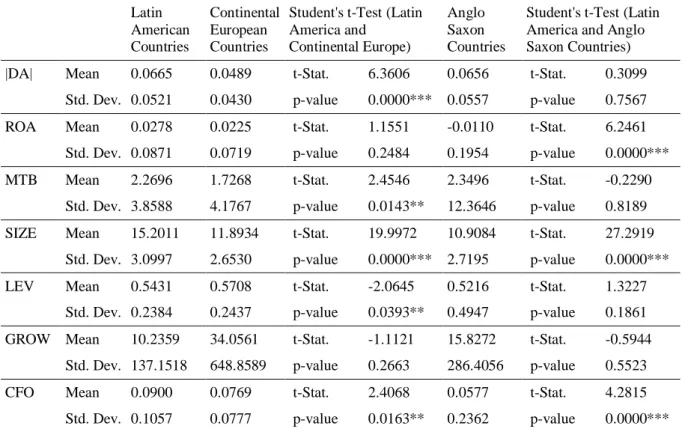
Table 2 presents the descriptive statistics for the variables in the empirical analysis and statistical tests for mean differences between the groups of countries. Brazil and Chile present higher level of absolute discretionary accruals than France and Germany (at 1% significance). However, firms from these two groups present different characteristics. Firms from Continental Europe are smaller (at 1% significance) and slightly more leveraged (at 5% significance) than the Latin American firms. Firms from Brazil and Chile present higher market value proportional to their book value (at 5% significance) and a greater potential to generate cash flows (at 5% significance) than firms from Germany and France.
Table 2
Descriptive Statistics for All Firms
Note. |DA|: Absolute Discretionary Accruals; ROA: return on assets; MTB: market-to-book ratio; SIZE: natural logarithm of
total assets; LEV: ratio between total liabilities and total assets; GROW: annual percentage change in sales; CFO: cash flow from operations scaled by total assets. The null hypothesis of the Two Sample Student's t-Test is that the true difference in means is equal to zero. The alternative hypothesis states that the true difference is not equal to zero.
*** Significant at the 1% level; ** significant at the 5% level; * significant at 10% level.
When comparing the level of absolute discretionary accruals of Latin American and Anglo Saxon firms, we find no statistical differences. Table 2 also indicates that the mean profitability of firms from the Anglo Saxon group is negative, while firms from Latin America have positive profitability (difference statistically significant at 1%). Cash flow from operations is also different between these two groups (at 1% significance).
Table 3 presents the descriptive statistics and mean tests for the subsample of global players. Latin American and Continental European global players shape a more homogenous group. There are still differences in the level of absolute discretionary accruals, but all other variables present the same mean, except for SIZE.
Latin American Countries
Continental European Countries
Student's t-Test (Latin America and
Continental Europe)
Anglo Saxon Countries
Student's t-Test (Latin America and Anglo Saxon Countries)
|DA| Mean 0.0665 0.0489 t-Stat. 6.3606 0.0656 t-Stat. 0.3099
Std. Dev. 0.0521 0.0430 p-value 0.0000*** 0.0557 p-value 0.7567
ROA Mean 0.0278 0.0225 t-Stat. 1.1551 -0.0110 t-Stat. 6.2461
Std. Dev. 0.0871 0.0719 p-value 0.2484 0.1954 p-value 0.0000***
MTB Mean 2.2696 1.7268 t-Stat. 2.4546 2.3496 t-Stat. -0.2290
Std. Dev. 3.8588 4.1767 p-value 0.0143** 12.3646 p-value 0.8189
SIZE Mean 15.2011 11.8934 t-Stat. 19.9972 10.9084 t-Stat. 27.2919
Std. Dev. 3.0997 2.6530 p-value 0.0000*** 2.7195 p-value 0.0000***
LEV Mean 0.5431 0.5708 t-Stat. -2.0645 0.5216 t-Stat. 1.3227
Std. Dev. 0.2384 0.2437 p-value 0.0393** 0.4947 p-value 0.1861
GROW Mean 10.2359 34.0561 t-Stat. -1.1121 15.8272 t-Stat. -0.5944
Std. Dev. 137.1518 648.8589 p-value 0.2663 286.4056 p-value 0.5523
CFO Mean 0.0900 0.0769 t-Stat. 2.4068 0.0577 t-Stat. 4.2815
Table 3
Descriptive Statistics for the Global Players
Latin American Countries
Continental European Countries
Student's t-Test (Latin America and
Continental Europe)
Anglo Saxon Countries
Student's t-Test (Latin America and Anglo Saxon Countries)
|DA| Mean 0.0585 0.0397 t-Stat. 4.0859 0.0563 t-Stat. 0.4788 Std. Dev. 0.0460 0.0371 p-value 0.0001*** 0.0485 p-value 0.6325
ROA Mean 0.0194 0.0258 t-Stat. -1.0076 0.0275 t-Stat. -0.9886 Std. Dev. 0.0643 0.0506 p-value 0.3147 0.1286 p-value 0.3234
MTB Mean 1.9189 2.0387 t-Stat. -0.4615 3.0910 t-Stat. -3.4917 Std. Dev. 2.6292 2.0145 p-value 0.6449 5.2480 p-value 0.0005***
SIZE Mean 15.1540 14.1433 t-Stat. 3.5876 13.0857 t-Stat. 7.8620 Std. Dev. 2.7755 2.3657 p-value 0.0004*** 2.3327 p-value 0.0000***
LEV Mean 0.5622 0.5906 t-Stat. -1.5983 0.5484 t-Stat. 0.8519 Std. Dev. 0.1522 0.1894 p-value 0.1109 0.2017 p-value 0.3950
GROW Mean 0.4427 14.8479 t-Stat. -0.2073 -6.4460 t-Stat. 0.3195 Std. Dev. 93.2418 1093.3250 p-value 0.8359 423.6369 p-value 554.4710
CFO Mean 0.1033 0.0898 t-Stat. 1.5983 0.1046 t-Stat. -0.1376 Std. Dev. 0.0877 0.0589 p-value 0.1115 0.1208 p-value 0.8907
Note. |DA|: Absolute Discretionary Accruals; ROA: return on assets; MTB: market-to-book ratio; SIZE: natural logarithm of
total assets; LEV: ratio between total liabilities and total assets; GROW: annual percentage change in sales; CFO: cash flow from operations scaled by total assets. The null hypothesis of the Two Sample Student's t-Test is that the true difference in means is equal to zero. The alternative hypothesis states that the true difference is not equal to zero.
*** Significant at the 1% level; ** significant at the 5% level; * significant at 10% level.
Comparing the group of Latin American firms with the group of Anglo Saxon firms, we observe that the difference between the levels of absolute discretionary accruals remains non-significant. There are no differences in profitability among global players of these two groups, although the difference in the size of the firms is still significant, but smaller than the result obtained from the comparison of all firms of the sample.
Regression results
Table 4 presents the regression results for the sample comprising all the firms, divided into two sub-groups: the Latin American versus Continental European firms, and the Latin American versus Anglo-Saxon firms.
Table 4
Regression Results for All Firms
Dependent Variable: |DA| Latin American versus Continental European countries
Latin American versus Anglo-Saxon countries
Intercept 0.0657*** 0.0817***
G1 0.0222*** 0.0152***
ROA -0.0181 0.0172
MTB 0.0002 0.0001
SIZE -0.0013** -0.0018***
LEV 0.0004 0.0041
GROW 0.0000 0.0000
CFO 0.0244 -0.0175
LOSS 0.0166*** 0.0069*
AUD -0.0033** -0.0060*
ADR -0.0092** -0.0044
N: 1,477 N: 2,159
Adj. R2: 0.074161 Adj. R2: 0.058008
F Stat.: 9.10778*** F Stat.: 10.231***
Note. Obs.: The results are from a pooled regression. The significances are computed through Arellano robust standard errors.
We also conducted the analysis through panel data with random effects, which resulted in very similar results to the pooled analysis, with a coefficient of interest slightly smaller (0.0219 for the comparison with the Continental European countries and 0.0144 for the comparison with the Anglo-Saxon countries) and are within the same levels of significance. The data were winsorized relatively to the level of absolute discretionary accruals. |DA|: Absolute Discretionary Accruals; ROA: return on assets; MTB: market-to-book ratio; SIZE: natural logarithm of total assets; LEV: ratio between total liabilities and total assets; GROW: annual percentage change in sales; CFO: cash flow from operations scaled by total assets; LOSS: if the firm presents losses; AUD: if the firm is audited by a Big Four audit firm; ADR: if the firm issues American Depositary Receipts.
*** Significant at the 1% level; ** significant at the 5% level; * significant at 10% level.
Our findings provide evidence that firms from Latin American countries engage in a higher level of earnings management when compared with the Anglo-Saxon and Continental European firms. Although all these firms adopt full IFRS, results suggest that local features related to cultural, economic and legal environment might still influence domestic accounting practices and may affect the way as the IFRS are applied.
It is important to notice that Latin America and Continental Europe are two regions immersed in a code-law system, with hard and structured regulations, and with relatively limited range for principle-based interpretations. Although both groups share similarities with respect to legal system, differences in levels of earnings management arise. Some authors identify an association between lower levels of accounting quality and the type of legal system (Paananen, 2008; Van Tendeloo & Vanstraelen, 2005). Since Brazil and Chile present lower levels of enforcement, as observed in La Porta, López-de-Silanes, Shleifer and Vishny (1998) and Kaufmann, Kraay and Mastruzzi, (2007), the higher level of earnings management found in Latin American firms might be explained by these two general influences.
Regarding our control variables, Table 4 indicates that firms’ size, presence of losses, Big Four auditing, and ADR issuing are characteristics significantly associated with the level of discretionary accruals. In line with current literature, it demonstrates that larger firms tend to present lower levels of earnings management, as well as firms who are audited by Big Four companies and firms that are cross-listed in the U.S., while firms who report losses during the period present higher levels of earnings management.
Finally, Table 5 presents the regression results for the sample comprising only those firms from the six countries that are cross-listed in the U.S. and recognized as global players.
Table 5
Regression Results for Global Players Firms
Dependent Variable: |DA| Latin American versus Continental European countries
Latin American versus Anglo-Saxon countries
Intercept 0.0748*** 0.1067***
G1 0.0187*** 0.0114**
ROA 0.0557 0.0602
MTB 0.0008 0.0007*
SIZE -0.0022** -0.0035***
LEV -0.0047 0.0041
GROW 0.0000 0.0000
CFO 0.0179 -0.0239
LOSS 0.0227** 0.0219**
AUD -0.0116 -0.0208**
N: 386 N: 583
Adj. R2: 0.10239 Adj. R2: 0.11304
F Stat.: 3.68373*** F Stat.: 6.21007***
Note. Obs.: The results are from a pooled regression. The significances are computed through Arellano robust standard errors.
We also conducted the analysis through panel data with random effects, which resulted in very similar results to the pooled analysis, with a coefficient of interest slightly smaller (0.0186) for the comparison with the Continental European countries and slightly bigger (0.0116) for the comparison with the Anglo-Saxon countries, and are within the same levels of significance. The data were winsorized relatively to the level of absolute discretionary accruals. |DA|: Absolute Discretionary Accruals; ROA: return on assets; MTB: market-to-book ratio; SIZE: natural logarithm of total assets; LEV: ratio between total liabilities and total assets; GROW: annual percentage change in sales; CFO: cash flow from operations scaled by total assets; LOSS: if the firm presents losses; AUD: if the firm is audited by a Big Four audit firm; ADR: if the firm issues American Depositary Receipts.
*** Significant at the 1% level; ** significant at the % level; * significant at the 10% level
Findings demonstrate that, although ADR issuance is an important incentive inside Latin America, it is not strong enough to overcome the country-level incentives. Even among global players that are more exposed to capital markets, which result in strong incentives to produce financial information with better accounting quality, domestic institutional factors still play an important role in earnings management. It indicates that national characteristics, potentially linked to culture, enforcement and legal systems, remain important and still influence the level of earnings management.
Chen et al., 2010; Leuz, Nanda, & Wysocki, 2003). Nonetheless, our variable of interest (G1) captures all these factors. Regardless of the common financial reporting system across countries, factors related to economic and cultural aspects could potentially affect the level of earnings management, and all these factors are adequately captured by G1. Notwithstanding, despite our best efforts to control for firm and industry factors, there may still be omitted variables not captured by our country-group variable.
Sensibility tests
In order to control for potential limitations in the Jones Modified Model, we entertain the empirical model (for all subsamples) using absolute discretionary accruals estimated by different models, namely the versions based on Larcker and Richardson (2004) and Kothari, Leone and Wasley (2005).
Larcker and Richardson (2004) added the current operating cash flows (CFO) and the book-to-market ratio (BTM) as proxies for expected growth in the firm’s operations, since they expect growing firms to have larger accruals. The model is estimated according to Equations (6) and (7), and it is expected to control for these additional factors. Despite these authors introduce the ratio between the book value and the market value of the firm, the present study applies the opposite ratio between the market value and the book value (MTB), simply to ease interpretation:
(6)
(7)
Kothari et al. (2005) include the current ROA as a performance measure on the calculation of accruals, as in Equations (8) and (9), as a mean for firms’ performance:
(8)
(9)
None of these two alternative versions of the Jones Model provides significantly different results, which are not reported in this study for brevity purposes.
Concluding Remarks
This paper examines the level of earnings management of Latin American IFRS adopters, when compared to Anglo-Saxon and Continental European firms that also adopted IFRS. The results indicate that Latin American firms have, in general, higher levels of earnings management in comparison with the other two groups of countries. It demonstrates that Latin American firms have a higher amount of discretionary accruals, despite the adoption of a global set of accounting standards worldwide, which suggests that country-specific factors related to cultural and economic characteristics may have a significant influence in the way IFRS is applied in each country.
, , ,
1 2 3 4 , 5 , ,
, 1 , 1 , 1 , 1
1
;
i t i t i t
i t i t i t
i t i t i t i t
TA REV PPE
MTB CFO
A
A
A
A
, ,
, 1 2 3 4 , 5 ,
, 1 , 1 , 1
1
.
i t i t
i t i t i t
i t i t i t
REV PPE
NDA a a a a MTB a CFO
A A A
, , ,
1 2 3 4 , ,
, 1 , 1 , 1 , 1
1
;
i t i t i t
i t i t
i t i t i t i t
TA REV PPE
ROA
A
A
A
A
, ,
, 1 2 3 4 ,
, 1 , 1 , 1
1
.
i t i t
i t i t
i t i t i t
REV PPE
NDA a a a a ROA
A A A
Furthermore, we find that Latin American firms that are cross-listed in the U.S. also present higher level of earnings management in comparison to Anglo-Saxon and Continental European firms. Hence, even with strong incentives to reach high quality financial information, domestic characteristics still play a relevant role in influencing earnings management incentives. These results highlight the importance of the country-level factors related to institutional characteristics, enforcement and economic influences, which can affect the way IFRS is applied.
It is important to mention that Latin American firms have adopted full IFRS since 2010, so these results may change in the future, after a period of transition and learning experience. Nonetheless, Latin American global players are more likely to apply IFRS more thoroughly, despite the recent adoption, for no differences among groups would be expected. In this sense, our preliminary findings confirm that IFRS adoption by all the examined firms and the strong inducements to disclose high quality information by ADR issuers do not represent sufficiently strong incentives to improve the level of earnings management, at least in the short term. These findings are consistent with the accounting literature explaining that management incentives and national institutional factors affect the preparation of financial information to a substantial degree. The success of the global accounting standards, as proposed by Leuz (2013), might not be limited to the accounting standards themselves, but may lie in the efforts for the convergence of enforcement mechanisms and disclosures incentives.
Note
1 Nobes (2011) identifies that Germany and France present the most similar accounting practices inside the Continental
European group, while Australia and United Kingdom have close and comparable accounting practices, generating an Anglo-Saxon country group most differentiable from Continental Europeans. Thus, Germany and France are considered the most representative countries for the Continental European group, and Australia and United Kingdom are the most representative countries for the Anglo-Saxon group.
References
Aharony, J., Barniv, R., & Falk, H. (2010). The impact of mandatory IFRS adoption on equity valuation of accounting numbers for security investors in the EU. European Accounting Review, 19(3), 535-578. doi: 10.1080/09638180.2010.506285
Ahmed, K., Chalmers, K., & Khlif, H. (2013). A meta-analysis of IFRS adoption effects. The International Journal of Accounting, 48(2), 173-217. doi: 10.1016/j.intacc.2013.04.002
Ashbaugh, H., & Pincus, M. (2001). Domestic accounting standards, international accounting standards, and the predictability of earnings. Journal of Accounting Research, 39(3), 417-434. doi: 10.1111/1475-679X.00020
Aubert, F., & Grudnitski, G. (2011). The impact and importance of mandatory adoption of international financial reporting standards in Europe. Journal of International Financial Management & Accounting, 22(1), 1-26. doi: 10.1111/j.1467-646X.2010.01043.x
Ball, R., Robin, A., & Wu, J. S. (2003). Incentives versus standards: properties of accounting income in four East Asian countries. Journal of Accounting and Economics, 36(1), 235-270. doi: 10.1016/j.jacceco.2003.10.003
Bengoa, M., & Sanchez-Robles, B. (2003). Foreign direct investment, economic freedom and growth: new evidence from Latin America. European Journal of Political Economy, 19(3), 529-545. doi: 10.1016/S0176-2680(03)00011-9
Benos, E., & Weisbach, M. S. (2004). Private benefits and cross-listings in the United States. Emerging Markets Review, 5(2), 217-240. doi: 10.1016/j.ememar.2004.01.002
Bradshaw, M. T., & Miller, G. S. (2008). Will harmonizing accounting standards really harmonize accounting? Evidence from non-US firms adopting US GAAP. Journal of Accounting, Auditing & Finance, 23(2), 233-264. doi: 10.1177/0148558X0802300206
Burgstahler, D. C., Hail, L., & Leuz, C. (2006). The importance of reporting incentives: earnings management in European private and public firms. The Accounting Review, 81(5), 983-1016. doi: 10.2308/accr.2006.81.5.983
Carvalho, L. N., & Salotti, B. M. (2012). Adoption of IFRS in Brazil and the consequences to accounting education. Issues in Accounting Education, 28(2), 235-242. doi: 10.2308/iace-50373
Chen, H., Tang, Q., Jiang, Y., & Lin, Z. (2010). The role of international financial reporting standards in accounting quality: evidence from the European Union. Journal of International Financial Management & Accounting, 21(3), 220-278. doi: 10.1111/j.1467-646X.2010.01041.x
Coffee, J. C., Jr. (2002). Racing towards the top? The impact of cross-listing and stock market competition on international corporate governance. Columbia Law Review, 102(7), 1757. doi: 10.2139/ssrn.315840
Daske, H., Hail, L., Leuz, C., & Verdi, R. (2013). Adopting a label: heterogeneity in the economic consequences around IAS/IFRS adoptions. Journal of Accounting Research, 51(3), 495-547. doi: 10.1111/1475-679X.12005
Dechow, P. M., Richardson, S. A., & Tuna, I. (2003). Why are earnings kinky? An examination of the earnings management explanation. Review of Accounting Studies, 8(2/3), 355-384. doi: 10.1023/A:1024481916719
Dechow, P. M., Sloan, R. G., & Sweeney, A. P. (1995). Detecting earnings management. The Accounting Review, 70(2), 193-225.
Durnev, A., & Kim, E. (2005). To steal or not to steal: firm attributes, legal environment, and valuation. The Journal of Finance, 60(3), 1461-1493. doi: 10.1111/j.1540-6261.2005.00767.x
Fernandes, N., & Ferreira, M. A. (2008). Does international cross-listing improve the information environment. Journal of Financial Economics, 88(2), 216-244. doi: 10.1016/j.jfineco.2007.06.002
Francis, J. R., Khurana, I. K., Martin, X., & Pereira, R. (2008). The role of firm-specific incentives and country factors in explaining voluntary IAS adoptions: evidence from private firms. European Accounting Review, 17(2), 331-360. doi: 10.1080/09638180701819899
Francis, J. R., & Wang, D. (2008). The joint effect of investor protection and Big 4 audits on earnings quality around the world. Contemporary Accounting Research, 25(1), 157-191. doi: 10.1506/car.25.1.6
Frank, W. G. (1979). An empirical analysis of international accounting principles. Journal of Accounting Research, 17(2), 593-605. doi: 10.2307/2490520
International Monetary Fund. (2013, October). World economic outlook: transitions and tensions. Retrieved from http://www.imf.org/external/pubs/ft/weo/2013/02/pdf/text.pdf
Jeanjean, T., & Stolowy, H. (2008). Do accounting standards matter? An exploratory analysis of earnings management before and after IFRS adoption. Journal of Accounting and Public Policy, 27(6), 480-494. doi: 10.1016/j.jaccpubpol.2008.09.008
Jones, J. J. (1991). Earnings management during import relief investigations. Journal of Accounting Research, 29(2), 193-228. doi: 10.2307/2491047
J. P. Morgan. (2013). Year in review 2013: depositary receipts. Retrieved from https://www.jpmorgan.com/directdoc/is_dr_year_in_review_2013.pdf
Kang, S.-H., & Sivaramakrishanan, K. (1995). Issues in testing earnings management and an instrumental variable approach. Journal of Accounting Research, 33(2), 353-367. doi: 10.2307/2491492
Karolyi, G. A. (2004). The role of American depositary receipts in the development of emerging equity markets. The Review of Economics and Statistics, 86(3), 670-690. doi: 10.1162/0034653041811699
Kaufmann, D., Kraay, A., & Mastruzzi, M. (2007). Governance matters VII: aggregate and individual governance indicators, 1996-2007 (Research Report VII). Washington, DC, World Bank.
Kothari, S. P., Leone, A. J., & Wasley, C. E. (2005). Performance matched discretionary accrual measures. Journal of Accounting and Economics, 39(1), 163-197. doi: 10.1016/j.jacceco.2004.11.002
Kvaal, E., & Nobes, C. (2010). International differences in IFRS policy choice: a research note. Accounting and Business Research, 40(2), 173-187. doi: 10.1080/00014788.2010.9663390
Lang, M., Lins, K. V., & Miller, D. P. (2003). ADRs, analysts, and accuracy: does cross listing in the United States improve a firm's information environment and increase market value? Journal of Accounting Research, 41(2), 317-345. doi: 10.1.1.201.5463
Lang, M., Raedy, J. S., & Wilson, W. (2006). Earnings management and cross listing: are reconciled earnings comparable to US earnings? Journal of Accounting and Economics, 42(1), 255-283. doi: 10.1016/j.jacceco.2006.04.005
Lang, M., Raedy, J. S., & Yetman, M. H. (2003). How representative are firms that are cross‐listed in the United States? An analysis of accounting quality. Journal of Accounting Research, 41(2), 363-386. doi: 10.1111/1475-679X.00108
La Porta, R., López-de-Silanes, F., Shleifer, A., & Vishny, R. W. (1998). Law and finance. Journal of Political Economy, 106(6), 1113-1155. doi: 10.1086/250042
Lara, J. M., Torres, J. A., & Veira, P. J. (2008). Conservatism of earnings reported under international accounting standards: a comparative study. Spanish Journal of Finance and Accounting / Revista Española de Financiación y Contabilidad, 37(138), 197-210. doi: 10.1080/02102412.2008.10779642
Larcker, D. F., & Richardson, S. A. (2004). Fees paid to audit firms, accrual choices, and corporate governance. Journal of Accounting Research, 42(3), 625-658. doi: 10.1111/j.1475-679X.2004.t01-1-00143.x
Leuz, C. (2010). Different approaches to corporate reporting regulation: how jurisdictions differ and why. Accounting Business Research, 40(3), 229-256. doi: 10.1080/00014788.2010.9663398
Leuz, C. (2013). A new approach to global reporting convergence: the global player segment. Retrieved from http://www.iasplus.com/de/publications/research-and-education/leuz-gps/at_download/file/GPS%20Proposal.pdf
Leuz, C., Nanda, D., & Wysocki, P. D. (2003). Earnings management and investor protection: an international comparison. Journal of Financial Economics, 69(3), 505-527. doi: 10.1016/S0304-405X(03)00121-1
Licht, A. N. (2003). Cross-listing and corporate governance: bonding or avoiding. Chicago Journal of International Law, 4(1), 141-163.
Lourenço, I., Branco, M. C., & Curto, J. D. (2013). Do IFRS matter in emerging countries? An exploratory analysis of Brazilian firms [Working Paper]. Lisbon University Institute, University of Porto, Lisbon, Portugal.
Martinez, A. L. (2008). Detectando earnings management no Brasil: estimando os accruals discricionários. Revista de Contabilidade & Finanças, 19(46), 7-17. doi: 10.1590/S1519-70772008000100002
McNichols, M. F. (2001). Research design issues in earnings management studies. Journal of Accounting and Public Policy, 19(4), 313-345. doi: 10.1016/S0278-4254(00)00018-1
Mortimore, M. (2000). Corporate strategies for FDI in the context of Latin America’s new economic model. World Development, 28(9), 1611-1626. doi: 10.1016/S0305-750X(00)00048-6
Nobes, C. (2011). IFRS practices and the persistence of accounting system classification. Abacus, 47(3), 267-283. doi: 10.1111/j.1467-6281.2011.00341.x
Paananen, M. (2008). The IFRS adoption’s effect on accounting quality in Sweden [Working Paper]. University of Hertfordshire, Hertfordshire, United Kingdom. doi: 10.2139/ssrn.1097659
Paananen, M., & Lin, H. (2009). The development of accounting quality of IAS and IFRS over time: the case of Germany. Journal of International Accounting Research, 8(3), 31-55. doi: 10.2308/jiar.2009.8.1.31
Reese W. A., Jr., & Weisbach, M. S. (2002). Protection of minority shareholder interests, cross-listings in the United States, and subsequent equity offerings. Journal of Financial Economics, 66(1), 65-104. doi: 10.1016/S0304-405X(02)00151-4
Silva, A., Weffort, E. F. J., Flores, E. S., & Silva, G. P. (2014). Earnings management and economic crises in the Brazilian capital market. Revista de Administração de Empresas, 54(3), 268-283. doi: 10.1590/S0034-759020140303
Silva, R. L. (2013). Adoção completa das IFRS no Brasil: qualidade das demonstrações contábeis e o custo de capital próprio (Tese de doutorado). Universidade de São Paulo, São Paulo, SP, Brasil.
Soderstrom, N. S., & Sun, K. J. (2007). IFRS adoption and accounting quality: a review. European Accounting Review, 16(4), 675-702. doi: 10.1080/09638180701706732
Treviño, L. J., Thomas, D. E., & Cullen, J. (2008). The three pillars of institutional theory and FDI in Latin America: an institutionalization process. International Business Review, 17(1), 118-133. doi: 10.1016/j.ibusrev.2007.10.002
Tuman, J. P., & Emmert, C. F. (2004). The political economy of US foreign direct investment in Latin America: a reappraisal. Latin American Research Review, 39(3), 9-28. doi: 10.1353/lar.2004.0060
Van Tendeloo, B., & Vanstraelen, A. (2005). Earnings management under German GAAP versus IFRS. European Accounting Review, 14(1), 155-180. doi: 10.1080/0963818042000338988
Warfield, T. D., Wild, J. J., & Wild, K. L. (1995). Managerial ownership, accounting choices, and informativeness of earnings. Journal of Accounting and Economics, 20(1), 61-91. doi: 10.1016/0165-4101(94)00393-J
Zhang, K. H. (2001). Does foreign direct investment promote economic growth? Evidence from East Asia and Latin America. Contemporary Economic Policy, 19(2), 175-185. doi: 10.1111/j.1465-7287.2001.tb00059.x
Dados dos Autores
Alex Augusto Timm Rathke
Av. Professor Luciano Gualberto, 908, FEA3, Sala 15, 05508-010, São Paulo, SP, Brasil. E-mail: [email protected], [email protected]
Verônica de Fátima Santana
Av. Professor Luciano Gualberto, 908, FEA3, Sala 15, 05508-010, São Paulo, SP, Brasil. E-mail:[email protected]
Isabel Maria Estima Costa Lourenço
Av. Professor Aníbal de Bettencourt, 1600189, Lisboa, Portugal. E-mail:[email protected]
Flávia Zóboli Dalmácio