Invaded Invaders: Infection of Invasive
Brown Treesnakes on Guam by an Exotic
Larval Cestode with a Life Cycle Comprised of
Non-Native Hosts
Elden T. Holldorf1☯*, Shane R. Siers2☯, Jonathan Q. Richmond3☯, Page E. Klug4‡ , Robert N. Reed4‡
1Cherokee Services Group LLC, contracted to U.S. Geological Survey, Yigo, Guam, United States of America,2Department of Fish, Wildlife, and Conservation Biology, Colorado State University, Fort Collins, Colorado, United States of America,3Western Ecological Research Center, U.S. Geological Survey, San Diego, California, United States of America,4Fort Collins Science Center, U.S. Geological Survey, Fort Collins, Colorado, United States of America
☯These authors contributed equally to this work. ‡These authors also contributed equally to this work. *[email protected]
Abstract
Background
Multiple host introductions to the same non-native environment have the potential to com-plete life cycles of parasites incidentally transported with them. Our goal was to identify a recently detected parasitic flatworm in the invasive Brown Treesnake (Boiga irregularis) on the remote Pacific island of Guam. We considered possible factors influencing parasite transmission, and tested for correlations between infection status and potential indicators of host fitness. We used genetic data from the parasite and information about the native ranges of other possible non-native hosts to hypothesize how it arrived on Guam and how its life cycle may be currently supported.
Methods
We identified the parasite by comparing larval morphology and mtDNA sequences with other Pseudophyllid tapeworms. We assessed probability of infection in individual snakes using logistic regression and examined different factors influencing presence of parasites in hosts.
Results
We identified the parasite as the pseudophyllid cestodeSpirometra erinaceieuropaei, with all sampled worms from multiple snakes sharing a single mtDNA haplotype. Infection appears to be limited to the only freshwater watershed on the island, where infection preva-lence was high (77.5%). Larger snakes had a higher probability of being infected, consistent
OPEN ACCESS
Citation:Holldorf ET, Siers SR, Richmond JQ, Klug PE, Reed RN (2015) Invaded Invaders: Infection of Invasive Brown Treesnakes on Guam by an Exotic Larval Cestode with a Life Cycle Comprised of Non-Native Hosts. PLoS ONE 10(12): e0143718. doi:10.1371/journal.pone.0143718
Editor:Richard Culleton, Institute of Tropical Medicine, JAPAN
Received:April 2, 2015
Accepted:November 9, 2015
Published:December 23, 2015
Copyright:This is an open access article, free of all copyright, and may be freely reproduced, distributed, transmitted, modified, built upon, or otherwise used by anyone for any lawful purpose. The work is made available under theCreative Commons CC0public domain dedication.
Data Availability Statement:All relevant data are within the paper and its Supporting Information files.
with the chronic nature of such infections. While infection status was positively correlated with body condition, infected snakes tended to have lower intra-peritoneal fat body mass, potentially indicating a negative effect on energy stores.
Conclusions
We discovered thatB.irregularisinhabiting a small area of forested habitat in a freshwater watershed on Guam are often infected by a novel parasite of Asian origin. While further work is needed, this species ofSpirometra, itself a non-native species, likely depends on a suite of recently introduced hosts from different parts of the world to complete the life cycle. This baseline study provides little evidence of any effects on host fitness, but additional data are needed to more thoroughly explore the consequences of infection in this invasive snake population.
Introduction
Non-native species that have invaded areas outside their historic range often escape their
co-evolved parasites [1–2]. While there are many ways that introduced hosts might escape
para-sites, two common, non-mutually exclusive pathways for parasite escape may be that (1) a small number of founder individuals harbored few or none of the parasites from the native range during their initial transportation, or (2) the various hosts and environments required
for a parasite to complete its life cycle may not be available in the invader’s new range. In
addi-tion to this escape from parasites, the time to which an invasive host acquires new parasites will vary depending on a variety of factors. Hosts experiencing longer bouts of a parasite-free existence may ultimately have enhanced ecological and reproductive success in the introduced range [2–3].
Unlike the native range where parasite and host diversity are closely linked by their co-evo-lutionary history, a host that invades a new area may experience a shift in this association such
that it becomes a new resource for different parasites in the introduced range [4]. Hosts that
invade new areas also have the potential to alter trophic links within food webs, particularly if
they harbor parasites whose life cycles can be supported in the introduced range [5].
Few studies have documented parasite infection in Brown Treesnakes (Boiga irregularis), an
iconic invasive species due to its ecological and economic impacts on the island of Guam [6–7].
Boiga irregularisis native to Indonesia, coastal Australia, and islands throughout northwest
Melanesia, and was presumably introduced to Guam via military cargo during the 1940s [8].
Recent research has confirmed a longstanding hypothesis that the invasive population ofB.
irregularisoriginated from Manus Island in the Admiralty Islands archipelago of Papua New
Guinea and was likely established by fewer than 10 individuals [9].
Although the most notorious invasive species on Guam is theB.irregularis, the island’s
ter-restrial community is currently dominated by a diversity of introduced species, from flora to
invertebrates to mammals, and has been cited as an example of invasional meltdown [10–13].
Guam provides a clear example of the consequences of increasing global transportation of goods and people, as it is an air and sea transportation hub in the Pacific. On occasion, this movement has resulted in the concurrent transportation of plants and animals from outside areas, and over time has produced a novel assemblage of invasive species on the island. This in turn has provided novel habitat for introduced parasites to exploit.
Parasites have important implications for invasion biology as they may regulate population
densities, negatively affect host fitness, mediate competition, and alter food webs [3,14–16]. A
survey of blood, fecal and ectoparasites from 33 native, terrestrial snake species in Australia and
the Solomon Islands (includingB.irregularis) recovered at least one species of parasite in 100%
of Colubrid species (N = 5), 100% of Boidae species (N = 10), and 50% of Elapidae species
(N = 18), with prevalence in wet tropical regions exceeding 80% of individuals sampled [17]. In
this study, nativeB.irregularis(N = 87) harbored at least two species of ectoparasites, three or
more species of haemogregarine-like blood protozoa, two types of fecal protozoa, and numerous
nematode and cestode species. No parasites were found in samples of invasiveB.irregularison
Guam (N = 22), however researchers did not collect fecal samples from the invasive population.
Richmondet al. [18] compared parasite abundance and diversity in native populations ofB.
irregularis(Papua New Guinea and the Admiralty Islands) to the invasive population on Guam and reported fewer infected snakes and notably lower infection intensities on Guam (24% of individuals positive for helminth infections on Guam compared to 88% in the native range), conditions consistent with the hypothesis of enemy release. Both studies found no evidence of
haemogregarine infections inB.irregularison Guam, compared with native infection prevalence
as high as 75% in some areas of Australia. With a reduced rate and intensity of parasitism,B.
irregularison Guam have likely enjoyed fitness benefits; however, circa 60 years after its intro-duction to Guam, this alien population may now be accumulating novel parasites.
Starting in 2010, we began to observe a species of cestode (Class: Cestoda) inB.irregularis
collected from a geographically isolated area on Guam that contains freshwater habitat. In this study we offer the first report on the species identity of this cestode and present data on its prevalence and distribution based on an island-wide sample of snakes. We also conducted a more rigorous screening of a subsample of snakes collected from the known area of infection on Guam. For this subsample, we investigated individual and environmental factors influenc-ing whether or not snakes were infected and made preliminary assessments of the association between infection and body condition or reproductive status. We conclude by discussing the geographic source of the parasite and how the various stages of its life cycle could be currently supported on Guam.
Methods
Brown Treesnake Sampling and Screening
Since the first observations of cestode infections in 2010, field protocols for snake captures have included a visual screening for external signs of parasite infection (i.e. presence or absence
of blister-like raised nodules under the skin; e.g.,Fig 1a). During the course of a study
investi-gating snake predation on the endangered Mariana Swiftlet (Aerodramus bartschi) within the
Naval Ordnance Annex, Naval Base Guam, we collected a large sample of snakes from within the known region of cestode occurrence examined these individuals for external and internal signs of infection. We also compared field-screened data with in-lab necropsy data to deter-mine rates of false positives and negatives in field-collected data. Necropsy observations
revealed that 14 of 222B.irregularisinfections detected in the lab went undetected in the field
(i.e. a 6% false negative rate), and there were no cases where field-detected infections were not verified by necropsy. Therefore we used necropsy records for all analyses. Because our survey efforts for parasites were curtailed by the Swiftlet study, we recorded only parasite presence or absence for each snake for this initial study.
We collected snakes via trap or hand capture using headlamps or night vision goggles [19–
20]. For each necropsied snake we measured snout-vent length (SVL) and weight prior to
collection and euthanization techniques were approved by the Institutional Animal Care and Use Committee (IACUC) of the U.S. Geological Survey Fort Collins Science Center (Protocol
2014–02) in accordance with humane practices for reptiles as outlined by the American
Veteri-nary Medical Association (AVMA). We identified infected snakes based on the presence of
blister-like nodules beneath the skin, which signaled the presence of cestodes (Fig 1a). We then
removed the skin off the entire body and examined the musculature (Fig 1b), body cavity, and
viscera for parasites.
We hypothesized that infected snakes might suffer reduced reproductive output. Although any one of several traits could potentially signal this effect (e.g. relative clutch size, clutch mass, ovarian follicle size), we measured testis volume in males and mean diameter of previtellogenic
or vitellogenic ovarian follicles (>5mm) in females and compared these traits in infected vs.
non-infected snakes. We corrected for body size in our measure of testis volume by using resid-uals from a regression of log(testis volume) by log (SVL). We did not correct follicle diameter for snake length, as follicular development is a function of reproductive status rather than body size. We hypothesized that parasitized individuals would have smaller testis volume and smaller mean follicle diameter on average compared to non-parasitized individuals, perhaps
due to hormonal suppression (e.g. testosterone and estrogen) as a response to acute stress [21].
Although limited data show no effect of some forms of parasitism on the reproductive output
of female snakes [14], at least one malarial form of parasitism has been shown to decrease testis
volume in male lizards [21]. Given that variation in testis volume has been linked to fitness in
some taxa (i.e. males with large testes have higher reproductive success than those with small
testes [22–23]), our comparative approach and the choice of traits examined here represents a
reasonable starting point for investigating potential reproductive effects of infection in the
invasiveB.irregularispopulation.
Specimen Collection, Sequencing, and Phylogenetic Analysis
We collected several individual larvae from snakes within an hour of euthanasia and extracted
specimens’muscle tissue by gently pulling along the strobila until the embedded head of the
worm released. We preserved worms individually in 95% ethanol or 10% formalin for later morphological identification and DNA sequencing.
All specimens collected for this study were plerocercoid larvae and lacked a true scolex. This complicates species identification based on morphology because virtually all distinguishing
Fig 1. Pathological signs ofSpirometra erinaceieuropaeiinfection inBoiga irregularis.(a) External blister-like nodules indicating presence of cestodes in subcutaneous space. (b) Internal lesions associated with the plerocercoid scolex revealed upon removal of the skin.
taxonomic characters are drawn from the scolex. Therefore, we compared DNA sequence data
from the mitochondrial cytochrome c oxidase subunit 1 gene (cox1) in our samples to
pub-lishedcox1 sequences from other Pseudophyllid cestodes. We sequencedcox1 because this
has been the most widely used marker in previous phylogenetic studies on these worms. We extracted genomic DNA from whole larval specimens using a Qiagen DNeasy Blood &
Tissue Kit and amplified a portion ofcox1 using the universal primers JB3 and JB4.5 [24–26].
We followed Liuet al. [25] for PCR reagent concentrations, volumes and cycling conditions.
DNA sequencing was performed using Sanger methods and Big Dye v3.1 chemistry on an
ABI3730XL DNA analyzer at Genewiz (La Jolla, CA). We edited the data using SEQUENCHER
v5.1 (Gene Codes Corporation, Ann Arbor, MI) and manually aligned sequences by eye. The
cox1 sequences are available on GenBank (seeS1 Appendixfor accession numbers).
To examine the placement of our samples within the broader phylogenetic context of Pseu-dophyllid cestodes, we aligned our data with 68 published sequences from GenBank and
reduced the dataset to unique haplotypes only for phylogenetic analysis (seeS1 Appendixfor a
summary of the haplotypes). In addition toSpirometra, we included sequences from species in
the following genera as outgroups:Sparganum,Diphyllobothrium,Ligula,Echinococcusand
Taenia. We selected the best-fit nucleotide substitution models and different codon partitioning
schemes using Bayes Information Criterion (BIC) scores in PARTITIONFINDERv1.1.0 [27] and
per-formed phylogenetic analyses using BEAST v2.1.3 [28]. Phylogenetic analyses consisted of two
separate runs of 3 X 10⁷generations each (10% of the initial samples discarded as burn-in). We
used an uncorrelated relaxed clock model [29–30] and a Yule Process tree prior. After verifying
that model parameters had converged to similar values between runs and that effective sample sizes exceeded 200, we combined data from the posterior distributions of each run to generate a
maximum clade credibility tree. Convergence statistics were evaluated in TRACER[31].
Prevalence and Individual Probability of Infection
We report prevalence as the proportion of infected individuals from a sample. We use‘
proba-bility of infection’in a statistical sense, i.e., the probability that a sampled individual had a
posi-tive infection status, as opposed to predicting the probability of an uninfected snake becoming
infected. An individual snake’s probability of being infected may be influenced by factors
intrinsic or extrinsic to the snake. We assessed probability of infection using logistic regression; potential covariates and hypotheses for their effects include:
1. Snake body size: Since growth is indeterminate in snakes, body size is often a proxy for age.
These cestode infections are chronic in nature—once an individual is infected it tends to
remain infected indefinitely. Therefore, older or larger snakes are more likely to have been exposed and infected. We measured snake snout-vent length (covariate: SVL) by gently stretching snakes along a tape measure.
2. Sex: We tested for any potential sex-bias in infection rates. Sex determination was made by visual examination of the internal reproductive anatomy upon necropsy.
3. Residual body mass: Deviations from a model predicting the relationship between body
length and body mass are commonly considered to be an index of an individual’s body
con-dition [32–33]. Snakes that are heavy relative to their length are considered to be in better
stomach content and intraperitoneal fat masses. We then measured each individual’s resid-ual body mass (RBM) as the standardized residresid-uals from a fourth-order polynomial regres-sion of log (mass) by log (SVL).
4. Fat mass ratio: In addition to RBM, mass of intraperitoneal fat masses relative to body mass may be an indicator of access to short-term energy stores resulting from more recent feeding success, which can translate to increased growth rates, activity, reproductive success, and
survivorship [34–36]. Fat mass ratio (FMR) was calculated as the ratio of the log of the mass
of fat bodies recovered from the coelomic cavity during necropsy (+1 to avoid taking the log of zero values) to the log of the adjusted mass (minus stomach contents and fat bodies). We hypothesized a negative relationship between FMR and infection, suggesting poorer short-term energy stores for infected snakes as a fitness cost associated with infection.
5. Site: While all snakes undergoing rigorous screening were sampled from within the Naval Ordnance Annex, they were collected at nine different sampling foci. As minor ecological heterogeneity exists among these sites, we hypothesized that this could lead to site-by-site variability in infection prevalence. We included a categorical covariate for site (SIT) to investigate whether sampling location had an explanatory relationship with prevalence.
6. Season: Guam’s annual climatic regime is characterized by a rainy wet season (June through
November) and a warmer dry season (December through May). Given the role of standing water in the typical life cycle of spirometrid cestodes, we considered a possible effect of sea-son (SEA) on infection prevalence.
Based on these candidate covariates we considered our global (most highly-specified) logis-tic regression model to be:
logitð^pÞ ¼b
0þbSVLþbSEXþbRBMþbFMRþbSITþbSEA
wherep^is the predicted probability of infection for an individual snake. To achieve the benefits
of a balanced model set [37–38], including comparisons of relative variable importance (RVI)
values, all possible combinations of model terms were compared using Akaike’s Information
Criteria corrected for small sample size (AICc). RVI is calculated as the sum of the AICc model weights for all models including the respective term; therefore, a term that was included in models carrying 100% of AIC model weights would have an RVI of 1.0. A top model was then
selected based upon model comparisons and relative significance of component terms.
We also hypothesized that infection status may influence reproductive condition as a poten-tial fitness cost of parasitism. Using the top prevalence model, we created sex-specific data sub-sets and tested relationships between infection status and residual testes volume (RTV) for males and presence of enlarged follicles (FOL) for females.
Results
Parasite Identification
Nodules under the skin were composed of one to several individual worms. Although we did not quantify individual infection intensity throughout the screening process, we removed as
many as 157 individual cestodes from oneB.irregulariswith a particularly high number of skin
nodules. Scanning electron micrographs of the gross morphology of specimens (seeS1 Figin
Supporting Information) confirmed that the life history stage of the worm infectingB.
irregu-larisis a plerocercoid larva in the genusSpirometra.
Sequencing five larvae from three differentB.irregularison Guam revealed a single COX1
identity match between this haplotype and six isolates ofS.erinaceieuropaei(>94% query cov-erage) from southern China. A single haplotype recovered in Thailand also had a 100% match to the Guam haplotype, but the query coverage was substantially lower (83%) due to the
shorter length of the Thai sequence. The remaining closest matches (94% identity) were all
isolates ofS.erinaceieuropaei, thus we had high confidence that species identity of the larvae
wasS.erinaceieuropaei.
For phylogenetic analysis, the best-fit model-partitioning scheme favored separate
substitu-tion models for each codon posisubstitu-tion (seeS2 Appendix). Assigned models and summary
statis-tics are provided in the Supporting Information. Our tree shows strong support for the
monophyly of all haplotypes attributed toS.erinaceieuropaei, and that members of the genus
Sparganumare sister toSpirometra(but with low posterior probability; seeS2 Fig). We
recov-ered two well-supported clades withinS.erinaceieuropaei, but neither showed any clear
pat-terns based on geography. The Guam haplotype was nested among several others from the Guangdong Province of southern China, but the limited number of substitutions
distinguish-ing the different haplotypes did little to resolve the relationships among them (S2 Fig).
None-theless, it is clear that the source ofSpirometraon Guam is in Asia, most likely southern China.
Range and Prevalence of Infection in Brown Treesnakes
Screening of more than 2,700 snakes from 77 sites throughout the island between 2010 and 2014 failed to document the occurrence of this parasite in any region other than the Naval Ord-nance Annex, with the exception of two sites where a single infected snake was found in each sample of 100 snakes (prevalence = 1%). These exceptions were the Pago River ravine forest site in east-central Guam and a savanna grassland site neighboring the Naval Ordnance Annex (Fig 2). Among 222 rigorously-screenedB.irregularisfrom nine sites within the Ordnance
Annex (X= 24.6 snakes per site, SD = 13.6, range = 1 to 44), the overall prevalence of infection
was 77.5%. Among the seven sites providing samples of 24 snakes or greater, prevalence ranged from 54.2% to 96.7%.
Variation in the Probability of Infection
The top 12 models describing per capita probability of infection for the Naval Ordnance
Annex sample carried 95% of all AIC model weights (Table 1). The top model, carrying 40% of
the model weights, included only body size (SVL), residual body mass (RBM) and relative fat mass (FMR) terms. The next three models, which included coefficients for sex or season (or both), comprised an additional 40.5% of the model weights. As each of these latter terms was
added to the model, theΔAICc value increased by ~2 AICc units, the penalty for addition of a
single parameter. This indicated that neither sex nor season coefficients added explanatory
value to the models [39]. This conclusion is supported by the non-significantP-values
associ-ated with model-averaged coefficients (PSEX= 0.42, PSEA= 0.87).
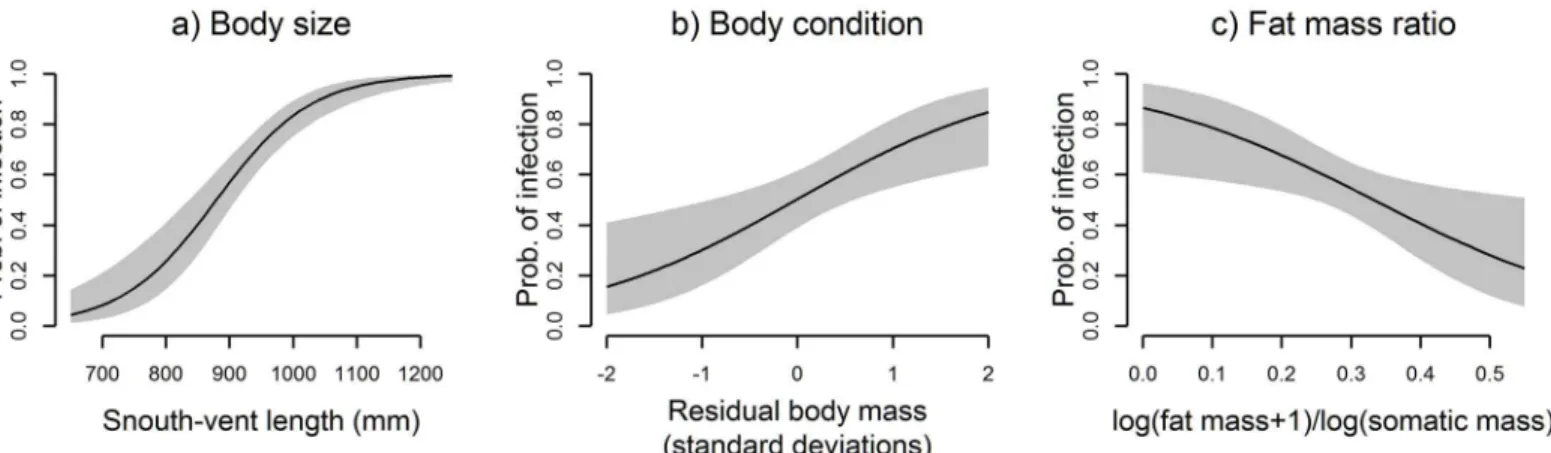
Body size (SVL) had the most explanatory value, with a RVI of 1.0 (included in all top
mod-els) and a model-averaged P-value of<<0.001. As predicted, larger snakes were more likely to
Table 1. Top AICc model results for factors associated withSpirometrainfection (models carrying 95% of model weights).
Model K AICc ΔAICc Weight
SVL+RBM+FMR 4 160.9 0.00 0.398
SVL+RBM+FMR+SEX 5 162.3 1.43 0.195
SVL+RBM+FMR+SEA 5 162.9 2.06 0.142
SVL+RBM+FMR+SEX+SEA 6 164.4 3.54 0.068
SVL+RBM 3 165.3 4.44 0.043
SVL+RBM+FMR+SIT 12 166.5 5.65 0.024
SVL+RBM+SEX 4 167.1 6.20 0.018
SVL+RBM+SEA 4 167.2 6.36 0.017
SVL 2 167.3 6.42 0.016
SVL+RBM+FMR+SEX+SIT 13 167.7 6.85 0.013
SVL+SEX 3 168.4 7.56 0.009
SVL+FMR 3 168.5 7.59 0.009
K = number of parameters; SVL = snout-vent length; RBM = residual body mass; FMR = fat mass ratio; SEX = sex; SEA = season; SIT = site.
doi:10.1371/journal.pone.0143718.t001
Fig 2.Spirometra erinaceieuropaeiInfection Prevalence Map of Guam.(a) Locations of 77 samples ofB.irregularisscreened for parasite infection (N = 4 to 103 per site). White symbols denote locations where no infected snakes were found and black symbols represent locations with high infection rates. The two gray symbols represent samples of 100 snakes that contained a single infected specimen each. (b) Inset map depicting distribution of sampling sites within the area of high occurrence (Naval Ordnance Annex). Non-infected samples depicted by white spots are on an elevated limestone forest plateau, while the highly infected sites depicted by black symbols are in low-lying ravine forests. The low-infection gray symbol denotes a sample collected in savanna grassland habitat. The hatched polygon represents Fena Reservoir, the only large body of fresh water on Guam.
Based upon these results, the most parsimonious model describing factors significantly linked to infection prevalence is:
logitð^pÞ ffi b
0þbSVLþbRBMþbFMR
Under this model, all terms have significant P-values (PSVL<<0.001, PRBM= 0.004, PFRM
= 0.017). Effect sizes of predictor variables are depicted inFig 3. Additional terms describing
reproductive development to models based on sex-specific data subsets (residual testes volume,
presence of enlarged follicles) revealed no relationship with infection status (PRTV= 0.359;
PFOL= 0.991).
Discussion
Our findings offer a possible example of how purely ecological processes involving serial intro-ductions of multiple invasive host species, rather than the more typical shared co-evolutionary or historical biogeographic processes between hosts and their parasites, may be shaping new host-parasite dynamics on the Pacific Island of Guam. While it is possible that the interaction
betweenSpirometraandB.irregularisrepresent an‘evolutionary reunion’rather than a novel
interaction, the amount of time since the snakes’introduction on Guam and the genetic
evi-dence showing that the source populations of both the host and parasite are from different
geo-graphic areas and thatB.irregularishas experienced a severe bottleneck (as a consequence of a
founder event), suggests that co-evolutionary ties between the two have been disrupted.
Fur-thermore, although the effects ofSpirometraon the fitness of introducedB.irregularishave yet
to be thoroughly explored, our findings suggest that a natural population control mechanism (i.e., parasite challenge) may be in progress for at least one small portion of the island that sup-ports freshwater habitat. The circumstances leading to this control mechanism may involve a fortuitous set of additional, non-native host introductions, with the founder(s) of at least one
of these host species likely harboringSpirometra. It is possible that infection inB.irregularis
represents a spill-over and is not a necessary part of the parasite’s life cycle, but completion of
ongoing studies are needed to confirm whether this is the case.
The gross morphology of plerocercoid larvae recovered from snakes was consistent with
cestodes in the genusSpirometra. Spirometrid cestodes have a worldwide distribution, with
most human infections (manifesting as the condition“sparganosis”) recorded in Southeast
Fig 3. Effect sizes for model terms under the top model.(a) Effect of SVL at mean values of body condition and fat mass ratio; probability of infection = 0.5 at 880 mm SVL. (b) Effect of residual body mass at 880 mm SVL and mean fat mass ratio. (c) Effect of fat mass ratio at 880 mm SVL and mean residual body mass.
Asian countries [40]. They are also known to infect wild snake species across Asia, but have
not been formally documented inB.irregularis. Most investigations ofSpirometraprevalence
in snakes have focused on food markets in China—where wild-caught snakes are a popular
tra-ditional food—to assess risk of sparganosis [41–42]. Little is known about the ecological and
physiological effects ofSpirometrainfection in wild snakes, particularly as intermediate hosts,
with most studies focusing on mammalian intermediate hosts [43–45].
While we expectedSpirometrainfection to adversely affect body condition in invasiveB.
irregularis, evidence from otherSpirometraspecies in rodent intermediate hosts indicate that infection may have the potential to stimulate body growth via the release of a mammalian
hor-mone-like substance called plerocercoid growth factor (PGF) [43–45]. Additional studies are
needed to test whether this cesode impedes, increases, or has no effect on growth in a snake host. We found mixed evidence that infected snakes suffered fitness consequences, at least based on the limited set of traits we measured here. The only potential fitness measure that was negatively influenced by infection was the fat mass ratio, which showed that infected snakes, on average, had smaller intra-peritoneal fat reserves. This observation could be the result of the
parasite diverting nutrients that might otherwise contribute to the host’s fat reserves or may
cause lipodystrophy in the host, although further studies are needed to determine whether that is the case and if so, the mechanism by which it might do this.
In contrast to fat mass, we found that body condition, as represented by residual body mass, was positively associated with infection, the opposite of what we predicted for snakes under physiological duress but consistent with studies of intermediate mammalian hosts. However, for two snakes of the same length, the more robust one has likely had more lifetime feeding success, therefore exposing it to more opportunity for infection. Similarly, as we had hypothe-sized, longer and presumably older snakes had more lifetime feeding opportunity than shorter snakes, resulting in the predicted positive correlation with infection. These findings are consis-tent with some studies that have shown that high parasite infection intensities appear to have
negligible fitness cost to the host [46].
In this study we focused on the association ofS.erinaceieuropaeiinfection and fitness traits
ofB.irregularis. However, it is possible that physiological or behavioral traits of snakes affect their susceptibility to infection. Snakes exhibiting high individual foraging success may have more opportunity for infection via infected intermediate hosts, and snakes of differing body conditions may occupy different niches within a heterogeneous habitat (e.g. larger snakes may
forage on the ground more than smaller snakes [47]). Behavioral modification has also been
documented in several helminth species, which is presumably advantageous for trophic trans-mission when behavioral modification by a parasite increases the likelihood a host will be
preyed on [48–49]. Behavioral modification in intermediate hosts infected withSpirometrahas
not been documented among herpetofauna but some species ofSpirometramay activate
growth hormones in infected mammalian hosts, potentially affecting behavioral characteristics
through indirect effects on host phenotypes [43–45]. Mortality associated with infection could
also influence the demography of infected snakes but we have little reason to believeS.
erina-ceieuropaeiis causing mortality inB.irregularison Guam, given that we have not observed any
dead snakes during trap or search efforts and invasiveB.irregularishave no natural predators
on the island.
As we only recorded parasite presence and not parasite intensity, there may be fitness costs associated with high parasite intensity that were not reflected in our analysis. For example, we found no relationship between infection status and residual testes volume or the presence of enlarged follicles; however, many other aspects of reproductive success could be influenced by
the degree ofSpirometrainfection, such as mating vigor, courtship, mate selection, or offspring
success on both sexes suggests that infection may come at a reproductive cost in this invasive snake population, particularly if the parasite is recently introduced to Guam, and suggests
merit for further investigation in this system [55].
There is keen interest in applying new management tools to control the invasive snake pop-ulation on Guam. Investigations into potential pathogens for biological management have
been under recent consideration, given that numerous aspects of the snake’s population
biol-ogy on Guam and other attributes of the island itself (e.g. size, location and absence of native
snake species) are favorable for this form of management [9,18,56–58]. Nevertheless, use of
this parasite for island-wide biological management would most likely not be effective given
that freshwater is necessary to complete theSpirometralife cycle. To date,Spirometra
infec-tions are restricted to the low-lying, moist ravine forests within the Naval Ordnance Annex region due to a unique topography and hydrology that supports freshwater year-round. Natu-ral spread of this parasite across the island is unlikely because most of the habitat on Guam consists of elevated limestone plateaus devoid of perennial freshwater.
Future studies are needed to determine the full suite of hosts sustaining the life cycle ofS.
erinaceieuropaeion Guam, and whether these hosts are native or introduced. However, based on the generalist life cycle of this genus, along with their isolated distribution on Guam, we can
make hypotheses about which species may support the parasite (Fig 4).Boiga irregularislikely
ingest infected frogs that contain the developing plerocercoids, as frogs are a typical
intermedi-ate host forSpirometra. The life cycle is complete when the definitive host (F.catusorC.lupus
familiaris) eats an infected intermediate host [42,57]. We have observed frog remains (>3 individual frog skulls) in the stomach of a vehicle-killed feral cat that was collected on the
Naval Ordnance Annex. No adultS.erinaceieuropaeiwere found in the intestine of this
indi-vidual, but it is quite possible that cats are ingesting infected frogs or snakes.
The larval stage, host pathology, and complex life cycle ofS.erinaceieuropaeifound inB.
irregularissuggest that these snakes are second intermediate hosts [40,57]. Field observations, including a plerocercoid parasitic cyst found in the hind limb muscle tissue of an invasive frog
species,Fejervarya cancrivora, collected from the Naval Ordnance Annex indicate that frogs
also host the flatworm (seeS3 Fig).Spirometrahave also been observed in frogs in parts of Asia
[25,56]. BothF.cancrivoraand another invasive frog species,Hylarana(Sylvirana)guentheri,
are abundant in the area whereS.erinaceieuropaeioccurs on Guam. Predation on these frogs
byB.irregularishas been observed through stomach necropsy, and frogs may be the pathway by which snakes become infected.
BothH.guentheriandF.cancrivorahave been introduced to Guam, presumably via the aquaculture trade (fish, crustacean, and mollusc shipments for human consumption) from
China and the Philippines in 2001 and 2005, respectively [11].Spirometrahas a global
distribu-tion and is known to occur in the highest frequency in these regions of Asia [40,42]; however
for this system, further work in the native range ofS.erinaceieuropaeiis needed to better
pin-point the geographic origin of the introduction, a task that could be aided by simultaneously
identifying a source for the introduced frog species. Although it is unknown whetherB.
irregu-laristranslocated this parasite to Guam during the founder event(s), it seems highly unlikely
given thatS.erinaceieuropaeiwas only detected in 2010, despite several decades of intensive
study on this population and the conspicuous signs of even minor infection in snakes. Our study supports the hypothesis that novel assemblages of exotic species can result in a shift from parasite-host interactions driven by long-term evolutionary processes, to
interac-tions driven by ecological processes developing on short temporal scales [4]. In no instance has
introduced species. Since the aquacultural trade has been implicated in the introduction of
frogs to Guam [11] it seems possible that the copepods accompanied the frogs in shipments of
the same materials. Therefore, we consider it entirely plausible that the establishment and life cycle of this recently discovered parasite was enabled by multiple introductions of different non-native species to this remote Pacific island.
Supporting Information
S1 Appendix. Summary ofcox1 haplotypes.Numbers in brackets following the different hap-lotype labels are GenBank accession numbers.
(DOCX)
S2 Appendix. Results of analyses for substitution model selection and model partitioning schemes for phylogenetic reconstruction.Analyses were performed using PartitionFinder v1.1.0.
(DOCX)
Fig 4. Proposed Life Cycle Diagram ofSpirometra erinaceieuropaeion Guam.Blue arrows show hypothesized hosts’geographic source population, green arrows indicateS.erinaceieuropaeilife cycle stages as represented by hosts, and life history stages are labeled under each host. Eggs hatch in fresh water where they are ingested by copepods, which are in turn ingested by aquatic vertebrates such as frogs and fish.Spirometramature into adult worms when a second intermediate host is consumed by a carnivorous mammal (typically feral cats (Felis catus) and dogs (Canis lupus familiaris), both of which occur on the Naval Ordnance Annex), and the life cycle is completed when mammals shed feces containing ova into fresh water. Photo credits listed in Acknowledgments.
S1 Dataset. Logistic regression prevalence dataset.Original data used in infection prevalence analyses.
(XLSX)
S1 Fig. Scanning electron microscope (SEM) images of plerocercoid larvae ofSpirometra erinaceieuropaeicollected from three differenctBoiga irregularison Guam.(a) Inverted dis-tal tip of the strobili, which lacks the true scolex of adult worms. (b) Close-up image showing the inverted distal tip. (c) Close-up image of the plerocercoid strobila shown in (a)-(b). (d) Strobila of a second plerocercoid where beginnings of segmentation are apparent. (e) Strobili of a third plerocercoid individual. (f) Close-up showing specialized microvilli (i.e. microtriches) covering the entire surface of the tegument of the worm and used for nutrient uptake. Scale
bars: (a) 500μm; (b) 50μm; (c)-(d) 200μm; (f) 5μm.
(TIF)
S2 Fig. Maximum clade credibility tree forcox1 haplotypes ofSpirometraand outgroup species.Bullets indicate well-supported branches with posterior probabilities0.90. Numbers
in parentheses following the outgroup names are Genbank accession numbers for thecox1
haplotypes. (TIF)
S3 Fig. Plerocercoid parasitic cyst found in the hind limb muscle tissue of an invasive frog species,Fejervarya cancrivora, collected from the Naval Ordnance Annex.
(TIF)
S1 Metadata. Meta data for logistic regression prevalence dataset.Metadata file forS1 Data-set.
(TXT)
Acknowledgments
Steve Mosher and Kevin Brindock of Naval Facilities Marianas partnered in Naval Ordnance Annex ecological research and facilitated access to secure facilities. Numerous field biologists
and logistics personnel at the U.S. Geological Survey‘s Brown Treesnake research laboratory
on Guam assisted with the collection and screening of snakes (Mary Jo Mazurek, Thomas Hin-kle, Matt Cook, Rebecca Lechalk, Meredith Palmer, Kevin Donmoyer, McKayla Spencer, Jus-tine Kasemen, Charlotte Robinson, Patrick Barnhart, and Michael Hogan). We are especially
grateful for Victoria Matey’s (San Diego State University) assistance with imaging the larval
worms. We would also like to thank Kevin Lafferty who provided constructive comments on
an earlier draft of the manuscript. Photo credits fromFig 4: Shane R. Siers (Brown Treesnake);
Nancy Wong, Slick, Thomas Brown (cat, dog, frog, under a Creative Commons license via Wikimedia Commons); NOAA (copepod). Any use of trade, product or firm name is for descriptive purposes only and does not imply endorsement by the U.S. Government.
Author Contributions
Conceived and designed the experiments: ETH SRS JQR PEK RNR. Performed the experi-ments: ETH SRS JQR PEK. Analyzed the data: SRS JQR. Contributed reagents/materials/analy-sis tools: JQR PEK. Wrote the paper: ETH SRS JQR PEK RNR.
References
2. Torchin ME, Lafferty KD, Dobson AP, McKenzie VJ, Kuris AM. Introduced species and their missing parasites. Nature. 2003: 421: 628–630. PMID:12571595
3. Colautti RI, Ricciardi A, Grigorovich IA, MacIsaac HJ. Is invasion success explained by the enemy release hypothesis? Ecol Lett. 2004; 7: 721–733.
4. Poulin R, Mouillot D. Host introductions and the geography of parasite taxonomic diversity. J Biogeogr. 2003; 30: 837–845.
5. Amundsen PA, Lafferty KD, Knudsen R, Primicerio R, Kristoffersen R, Klemetsen A, et al. New para-sites and predators follow the introduction of two fish species to a subarctic lake: implications for food-web structure and functioning. Oecologia. 2013; 171: 993–1002. doi:10.1007/s00442-012-2461-2 PMID:23053223
6. Savidge JA. Extinction of an island forest avifauna by an introduced snake. Ecology. 1987; 68: 660– 668.
7. Rodda GH, Fritts TH, McCoid MJ, Campbell EW III. An overview of the biology of the Brown Treesnake (Boiga irregularis). In: Rodda GH, Sawai Y, Chiszar D, Tanaka H, editors. Problem Snake Manage-ment: The Habu and the Brown Treesnake. Ithaca: Cornell University Press; 1999. p. 44–80.
8. Rodda GH, Savidge JA. Biology and impacts of Pacific island invasive species:Boiga irregularis, the Brown Tree Snake (Reptilia: Columbridae). Pac Sci. 2007; 61: 307–324.
9. Richmond JQ, Wood DA, Stanford JW, Fisher RN. Testing for multiple invasion routes and source pop-ulations for the invasive brown treesnake (Boiga irregularis) on Guam: implications for pest manage-ment. Biol Invasions. 2015; 17: 337–349.
10. Rodda GH, Fritts TH, Chiszar D. The Disappearance of Guam’s Wildlife: New insights for herpetology, evolutionary ecology, and conservation. Bioscience. 1997; 47: 565–574.
11. Christy MT, Savidge JA, Rodda GH. Multiple pathways for invasion of anurans on a Pacific island. Divers Distrib. 2007; 13: 598–607.
12. Mankin RW, Moore A. Acoustic detection ofOryctes rhinoceros(Coleoptera: Scarabaeidae: Dynasti-nae) andNasutitermes luzonicus(Isoptera: Termitidae) in palm trees in urban Guam. J Econ Entomol. 2010; 103: 1135–1143. PMID:20857720
13. Marler TE, Moore A. Military threats to terrestrial resources not restricted to wartime: A case study from Guam. J Environ Sci Eng. 2011; 5: 1198–1214.
14. Brown GP, Shilton CM, Shine R. Do parasites matter? Assessing the fitness consequences of haemo-gregarine infection in snakes. Can J Zool. 2006; 84: 668–676.
15. Liu H, Stiling P. Testing the enemy release hypothesis: a review and meta-analysis. Biol Invasions. 2006; 8: 1535–1545.
16. Prenter J, MacNeil C, Dick JTA, Dunn AM. Roles of parasites in animal invasions. Trends Ecol Evol. 2004; 19: 385–390. PMID:16701290
17. Whittier J, O’Donoghue P (University of Queensland, Center for Conservation Biology, Queensland, AU). A survey of the parasites and diseases of the Brown Tree Snake in its native range. Final report. Honolulu (HI): Hawaii Department of Agriculture (US); 1998 Jul.
18. Richmond JQ, Stanford JW, Wood DA, Fisher RN (U.S. Geological Survey, Western Ecological Research Center, San Diego, CA). An evolutionary approach to the biological management of invasive Brown Treesnakes (Boiga irregularis) on Guam. Final report. Alexandria (VA): Department of Defense, Strategic Environmental Research and Development Program (SERDP). 2012 Mar. Project No.: 10SISEED01-007 (SI-1733).
19. Tyrrell CL, Christy MT, Rodda GH, Yackel Adams AA, Ellingson AR, Savidge JA, et al. Evaluation of trap capture in a geographically closed population of brown treesnakes on Guam. J Appl Ecol. 2009; 46: 128–135.
20. Christy MT, Yackel Adams AA, Rodda GH, Savidge JA, Tyrrell CL. Modelling detection probabilities to evaluate management and control tools for an invasive species. J Appl Ecol. 2010; 47: 106–113.
21. Dunlap KD, Schall JJ. Hormonal alterations and reproductive inhibition in male fence lizards ( Scelopor-ous accidentalis) infected with the malarial parasitePlasmodium mexicanum. Physiol Zool. 1995; 68: 608–621.
22. Preston BT, Stevenson IR, Pemberton JM, Coltman DW, Wilson K. Overt and covert competition in a promiscuous mammal: the importance of weaponry and testes size to male reproductive success. Proc R Soc Lond B. 2003; 270: 633–640.
24. Li MW, Lin RQ, Song HQ, Sani RA, Wu XY, Zhu XQ. Electrophoretic analysis of sequence variability in three mitochondrial DNA regions for ascaridoid parasites of human and animal health significance. Electrophoresis. 2008; 29: 2912–2917. doi:10.1002/elps.200700752PMID:18546167
25. Liu W, Zhao GH, Tan MY, Zeng DL, Wang KZ, Yuan ZG, et al. Survey ofSpirometra erinaceieuropaei
sparangana infection in the frog Rana nigromaculata of the Human Province of China. Vet Parasitol. 2010; 173: 152–156. doi:10.1016/j.vetpar.2010.06.005PMID:20609520
26. Zhu X.Q., Beveridge I., Berger L., Barton D. & Gasser R.B. (2002) Single-strand conformation polymor-phism-based analysis reveals genetic variation within Spirometra erinacei (Cestoda: Pseudophyllidea) from Australia. Mol Cell Probe; 16: 159–165.
27. Lanfear R, Calcott B, Ho SYW, Guindon S. PartitionFinder: combined selection of partitioning schemes and substitution models for phylogenetic analyses. Mol Biol Evol. 2012; 29: 1695–1701. doi:10.1093/ molbev/mss020PMID:22319168
28. Drummond AJ, Suchard MA, Xie D, Rambaut A. Bayesian Phylogenetics with BEAUti and the BEAST 1.7. Mol Biol Evol. 2012; 29: 1969–1973. doi:10.1093/molbev/mss075PMID:22367748
29. Drummond AJ, Ho SYW, Phillips MJ, Rambaut A. Relaxed phylogenetics and dating with confidence. PLoS Biol. 2006; 4: e88. PMID:16683862
30. Lemey P, Rambaut A, Welch JJ, Suchard MA. Phylogeography takes a relaxed random walk in continu-ous space and time. Mol Biol Evol. 2010; 27: 1877–1885. doi:10.1093/molbev/msq067PMID: 20203288
31. Rambaut A, Drummond AJ. Tracer v1.4; 2007; Program: graphical [Internet]. Available:http://beast.bio. ed.ac.uk/Tracer.
32. Jakob EM, Marshall SD, Uetz GW. Estimating fitness: a comparison of body condition indices. Oikos. 1996; 77: 61–67.
33. Stevenson RD, Woods WA. Condition indices for conservation: new uses for evolving tools. Integ Comp Biol. 2006; 46: 1169–1190.
34. Congdon JD, Dunham AE, Tinkle DW. Energy budgets and life histories of reptiles. In: Gans C., editor. Biology of the Reptilia. New York: Academic Press; 1982, pp. 233–271.
35. Hadley NF. The Adaptive Role of Lipids in Biological Systems. New York: John Wiley and Sons; 1985.
36. Weatherhead PJ, Brown GP. Measurement versus estimation of condition in snakes. Can J Zool. 1996; 74: 1671–1621.
37. Burnham KP, Anderson DR. Model selection and multimodel Inference: A practical information-theo-retic approach. 2nd ed. New York: Springer; 2002.
38. Doherty PF, White GC, Burnham KP. Comparison of model building and selection strategies. J Ornithol. 2012; 152: S317–S323.
39. Arnold TW. Uninformative parameters and model selection using Akaike’s Information Criteria. J Wildl Manage. 2010; 74: 1175–1178.
40. Centers for Disease Control and Prevention [Internet]. Atlanta: DPDx—Laboratory identification of par-asitic diseases of public health concern: sparganosis. [updated 2013 Nov 29; cited 2014 Jul 7]. Avail-able:http://www.cdc.gov/dpdx/sparganosis.
41. Wang F, Zhou L, Gong S, Deng Y, Zou J, Wu J, et al. Severe infection of wild-caught snakes with Spiro-metra erinaceieuropaeifrom food markets in Guangzhou, China involves a risk for zoonotic spargano-sis. J Parasitol. 2011; 97: 170–171. doi:10.1645/GE-2519.1PMID:21348631
42. Wang F, Li W, Hua L, Gong S, Xiao J, Hou F, et al.Spirometra(Pseudophyllidea, Diphyllobothriidae) severely infecting wild-caught snakes from food markets in Guangzhou and Shenzhen, Guangdong, China: Implications for public health. Sci World J. 2014; article ID 874014: 5 pages.
43. Mueller F, Reed P. Growth stimulation induced by infection withSpirometra mansonoidesspargana in propylthiouracil-treated rats. J Parasitol. 1968; 54: 51–54. PMID:5641051
44. Phares K, Kubik J. The growth factor from plerocercoids ofSpirometra mansonoidesis both a growth hormone agonist and cysteine proteinase. J Parasitol. 1996; 82: 210–215. PMID:8604085
45. Song CY, Chappell CL. Purification and partial characterization of cysteine proteinase fromSpirometra mansoniplerocercoids. J. Parasitol. 1993; 79: 517–524. PMID:8331472
46. Mayer M, Brown GP, Zimmermann B, Shine R. High infection intensities, but negligible fitness costs, suggest tolerance of gastrointestinal nematodes in a tropical snake. Austral Ecol. 2015 Mar 25. In press.
48. Shaw JC, Hechinger RF, Lafferty KD, Kuris AM. Ecology of the brain trematodeEuhaplorchis califor-niensisand its host, the California killifish (Fundulus parvipinnis). J. Parasitol. 2010; 96: 482–490. doi: 10.1645/GE-2188.1PMID:20557191
49. Klein SL. Parasite manipulation of host behavior: mechanisms, ecology, and future directions. Behav Process. 2005; 68: 219–221.
50. Hamilton W, Zuk M. Heritable true fitness and bright birds: a role for parasites? Science. 1982; 218: 384–387. PMID:7123238
51. Moller AP. Parasites and sexual selection: current status of the Hamilton and Zuk hypothesis. J Evol Biol. 1990; 3: 319–328.
52. Moore J. Parasites and Behavior of Animals. Oxford: Oxford University Press; 2002.
53. Sorci G, Clobert J. Effects of maternal parasite load on offspring life-history traits in the common lizard (Lacerta vivipara). J Evol Biol. 1995; 8: 711–723.
54. Kennedy CEJ, Endler JA, Poynton SLT, McMinn H. Parasite load predicts mate choice in guppies. Behav Ecol Sociobiol. 1987; 21: 291–295.
55. Popovic V, Casanueva FF. Leptin, nutrition and reproduction: new insights. Hormones. 2002; 1: 204– 217. PMID:17018449
56. Caudell JN, Whittier J, Conover MR. The effects of haemogregarine-like parasites on brown treesnakes (Boiga irregularis) and slatey-gray snakes (Stegonotus cucullatus) in Queensland, Australia. Int Biod-eter Biodegr. 2002; 49: 113–119.
57. Lee SH, We JS, Sohn WM, Hong ST, Chai JY. Experimental life history ofSpirometra erinacei. Korean J Parasitol. 1990; 28: 161–173.