© D. S. Zakharova, 2015
Zakharova D. S. The optimization model of organic production in agricultural enterprises [Internet source] / D. S. Zakharova // Economic Processes Management: International Scientific E-Journal. – 2015. – № 2. – Access mode: http://epm.fem.sumdu.edu.ua/download/2015_2/2015_2_11.pdf
Received 05.04.2015
УДК 338.432
JEL Classification: Q12
THE OPTIMIZATION MODEL OF ORGANIC PRODUCTION IN AGRICULTURAL ENTERPRISES
Zakharova Daryna Sergijivna
Postgraduate Student of the Management Department,
National University of Water Management and Nature Resources Use, Ukraine The analysis of the factors that affect the organic production efficiency are considered in the article. The optimization model of organic production in agricultural enterprises is done. It will increase organic production efficiency, provide the rational use of resource potential and maximize profit for agricultural enterprises. The volume of organic production will be increased.
Keywords: optimization model, organic production, agricultural enterprises, productive efficiency.
Introduction. Ukrainian organic farming has now reached a territory of 393 thousand hectares [10]. With the volumes of organic production still relatively low for such a big country as Ukraine, local organic farmers already produce most of the popular crops for the domestic market as well as for exports [12]. However, the economic efficiency of organic production isn't very high. Largely it depends on the balance of two complex areas − crop and livestock production. The current production structure in most agricultural enterprises doesn't correspond the rational use of resource potential. Therefore, there is a need to optimize organic production in such enterprises.
Previously unsettled problem constituent. However, the factors that affect the organic production efficiency aren't well established. They play an important role in increasing of organic production profitability.
Main purpose of the article is to study main factors that affect the organic production efficiency and to find ways to increase it.
Results and discussions. Organic agriculture produces products using methods that preserve the environment and avoid most synthetic materials, such as pesticides and antibiotics [8]. The philosophy of organic food production maintains certain principles: biodiversity, ecological balance, sustainability, natural plant fertilization, natural pest management, and soil integrity. Since farms vary in product and practice, there is also a wide variety in how these principles are applied [11]. Organic agricultural enterprises receive annual onsite inspections and have to separate organic food from non-organic if they produce both.
Organic agricultural enterprises:
– preserve natural resources and biodiversity; – use only approved materials;
– support animal health and welfare;
– do not use genetically modified ingredients.
Organic production efficiency depends on complex of natural, technological, social, organizational and economic factors. Natural factors include landscape, climate, soil and biological processes. Technological factors in crop production include cropping pattern, crop rotation system, tillage systems; in livestock − cattle feeding system, animal records keeping system. Social factors include high wages in organic farming, special education and ecological awareness.
Organizational and economic factors play special role in organic farming. Organic production efficiency depends on such economic factors, as saving resources, pricing and market formation. Organic farming systems rely on the management of soil organic matter to enhance. Organic farming generally falls within the accepted definition of sustainable agriculture. However, it is important to distinguish between the two, since organic products can be (unsustainably) produced on large industrial farms, and farms that are not certified organic can produce food using methods that will sustain the farm’s productivity for generations. Some organic dairy farms, for example, raise cows in large confinement facilities but are able to meet the bare minimum requirements for organic certification, while a non-organic certified small farm could use organic guidelines and be self-sufficient by recycling all the farm’s waste to meet its fertility needs [11].
used most effectively. It helps to maximize the number of products with limited resources, to achieve the maximum possible economic efficiency increase by reducing costs conditions of scarce resources.
We investigated Two Ukrainian agricultural enterprises − Private Enterprise «Galeks-Agro» and Ltd. «Agrowest Group». The main focus of this companies is the production of organic certified livestock and crop production, the development of the organic market in Ukraine. From 2011 to 2013 the crop production had been certified the Swiss certification body Institute for Marketecology (IMO). According to the Standard Equivalent to Council Regulation (EC) 834/2007 and Commission Regulation (EC) 889/2008 products of company are approved by Bio Swiss additionally.
Specialization of Private Enterprise «Galeks-Agro» and Ltd. «Agrowest Group» is production of cereals and leguminous plants (seed, food and forage crops). Basic grown culture are spelt, wheat, millet, rye, oats, barley, buckwheat, maize, soybeans etc. Specialization of livestock isbreeding of Simmental cattle for meat and dairy.
We suggest to build a mathematical model for these enterprises. The task is to optimize the structure under seed, food and forage crops, and to optimize the herd structure in two agricultural enterprises − Private Enterprise «Galeks-Agro» and Ltd. «Agrowest Group».
Development of optimization model is phased in a particular order [5, 7]: 1) problem statement and justification optimality criterion;
2) variables and constraints determination;
3) information collection and development of technical and economic factors and constants;
4) construction of a mathematical model; 5) economic analysis of different options.
Optimality criterion in our case is profit maximization.
= ∑ → (1) where Z − objective function to be maximized; j − number of crop, livestock industry; і − number of resource or limitation; − unknowns (crops area, number of livestock); − gross output in money terms.
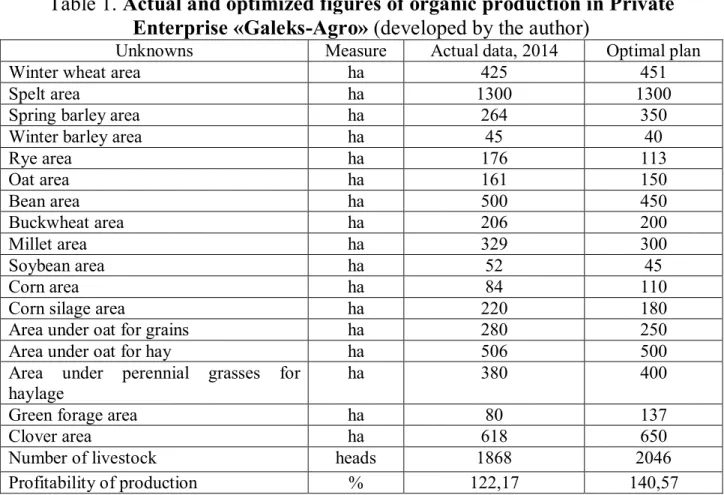
Table 1. Actual and optimized figures of organic production in Private Enterprise «Galeks-Agro» (developed by the author)
Unknowns Measure Actual data, 2014 Optimal plan
Winter wheat area ha 425 451
Spelt area ha 1300 1300
Spring barley area ha 264 350
Winter barley area ha 45 40
Rye area ha 176 113
Oat area ha 161 150
Bean area ha 500 450
Buckwheat area ha 206 200
Millet area ha 329 300
Soybean area ha 52 45
Corn area ha 84 110
Corn silage area ha 220 180
Area under oat for grains ha 280 250
Area under oat for hay ha 506 500
Area under perennial grasses for
haylage ha 380 400
Green forage area ha 80 137
Clover area ha 618 650
Number of livestock heads 1868 2046
Profitability of production % 122,17 140,57
We made an economic analysis that shows the best way to maximize profit. Number of livestock has to be increased to 2046 heads. Area under winter wheat, spring barley, corn, perennial grasses for haylage, green forage and clover has to be increased. Area under winter barley, rye, oat, bean, buckwheat, millet, soybean, corn silage, oat for grains and for hay has to be reduced. It will increase profitability of production up to 140,57%.
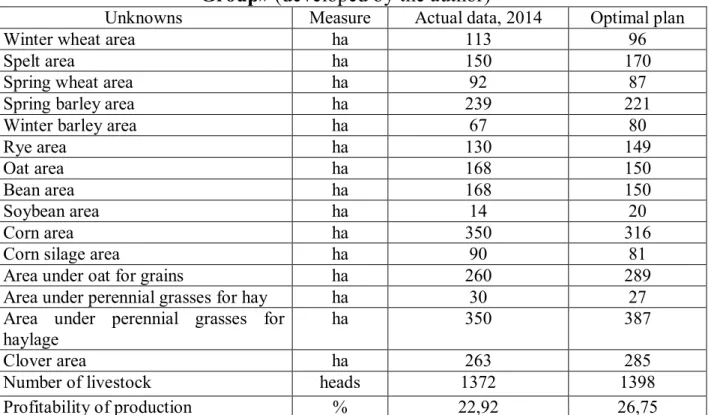
Let's consider the mathematical model built for Ltd. «Agrowest Group» (table 2). It contains 32 unknowns and 56 limitations.
In Ltd. «Agrowest Group» the number of livestock has to be increased to 1398 heads. Area under spelt, winter barley, rye, soybean, oat for grains, perennial grasses for haylage and clover has to be increased. Area under winter wheat, spring wheat, spring barley, oat, bean, corn, corn silage and perennial grasses for hay has to be reduced. It will increase profitability of production up to 26,75%.
Table 2. Actual and optimized figures of organic production in Ltd. «Agrowest Group» (developed by the author)
Unknowns Measure Actual data, 2014 Optimal plan
Winter wheat area ha 113 96
Spelt area ha 150 170
Spring wheat area ha 92 87
Spring barley area ha 239 221
Winter barley area ha 67 80
Rye area ha 130 149
Oat area ha 168 150
Bean area ha 168 150
Soybean area ha 14 20
Corn area ha 350 316
Corn silage area ha 90 81
Area under oat for grains ha 260 289
Area under perennial grasses for hay ha 30 27 Area under perennial grasses for
haylage ha 350 387
Clover area ha 263 285
Number of livestock heads 1372 1398
Profitability of production % 22,92 26,75
Conclusions and further researches directions. We have analyzed that the use of economic and mathematical methods for agricultural enterprises allows redistribution of existing production resources in the most profitable industry. It makes possible to increase profitability of organic production. Using the optimization models for individual agricultural enterprises provides not only profitability maximization, but also helps to achieve additional environmental and economic effect − soil fertility renewal and preservation.
References
1. Andriichuk, V. (2005). Efektyvnist diialnosti ahrarnyh pidpryiemstv: teoriia, metodyka, analiz [The efficiency of agricultural enterprises: theory, methodology, analysis]. Kyiv [in Ukrainian].
2. Artysh, V.I. (2009) Rozvytok svitovoho rynku orhanichnoi produktsii [The development of the global market of organic products]. Ekonomika APK − Ecomomics of agrobusiness, 3, 113-116 [in Ukrainian].
3. Berezivska, O. Efektyvnist funktsionuvannia silskohospodarskyh formuvan u Lvivskii oblasti [Effectiveness of agricultural enterprises in Lviv region] Ekonomika APK − Ecomomics of agrobusiness, 4, 56- 61 [in Ukrainian].
5. Braslavets, M.E. (1971). Ekonomiko-matematicheskiie metody v orhanizatsii i planirovanii selskokhoziaistvennoho proizvodstva [Economic and mathematical methods in the organization and planning of agricultural production]. Мoskva: Ekonomika [in Russian].
6. Dudar, O. (2009) Orhanizatsiino-ekonomichni osnovy formuvannia i rozvytku orhanichnoho ahrovyrobnytstva [Organizational and economic bases of formation and development of organic agricultural production]. Visnyk TNEU, 3, 80-86. [in Ukrainian].
7. Hataulin, A.M., Havrilov, H.V. & Sorokina, T.M. (1990). Matematicheskoe modelirovanie ekonomicheskikh protsessov v selskom khoziaistve [Mathematical modeling of economic processes in agriculture]. Мoskva: Ahropromizdat [in Russian].
8. Organic Agriculture. Retrieved from
http://www.usda.gov/wps/portal/usda/usdahome?contentidonly=true&contentid=organic-agriculture.html
9. Jansky J., Zivelova I., Novak P. (2003). Economic efficiency of agricultural enterprises in the system of organic farming. Agriculural Economics, 49, 242-246.
10. Organic Federation of Ukraine. Official site. Retrieved from http://www.organic.com.ua [in Ukrainian].
11. Sustainable Table – Organic Agriculture. Grace communications Foundation. Retrieved from http://www.sustainabletable.org/253/organic-agriculture
12. Willer, H. & Lernoud, J. (2015). The World of Organic Agriculture. Statistics and Emerging Trends 2015. FiBL-IFOAM Report, Frick and Bonn. Retrieved from http://www.organic-world.net/yearbook/yearbook2015.html
13. Kornitska, O.I. (2008) Perspektyvy rozvytku rynku orhanichnoi produktsii v Ukraini Корніцька О. І. [Prospects for the development of the organic market in Ukraine] / Visnyk Poltavskoi derzhavnoi ahrarnoi akademii, – № 3, 131–137 [in Ukrainian].
14. Skrypchuk, P.M & Shpak, H.M. Ekoloho-ekonomichne obhruntuvannia rozvytku orhanichnoho zemlerobstva u Rivnenskij oblasti [Ecological and economic assessment of organic agriculture in Rivne region]. Visnyk NUVHP – NUWMNRU, Issue 4(60), 189-196 [in Ukrainian].
МОДЕЛЬ ОПТИМІЗАЦІЇ ВИРОБНИЦТВА ОРГАНІЧНОЇ ПРОДУКЦІЇ У СІЛЬСЬКОГОСПОДАРСЬКИХ ПІДПРИЄМСТВАХ
Захарова Дарина Сергіївна аспірант кафедри менеджменту,
Національний університет водного господарства та природокористування, Україна У статті проведено аналіз факторів, що впливають на ефективність виробництва органічної продукції. Побудовано модель оптимізації структури виробництва органічної продукції рослинництва та тваринництва у сільськогосподарських підприємствах, що сприятиме підвищенню ефективності їх виробництва. Це забезпечить раціональне використання ресурсного потенціалу сільськогосподарських підприємств, збільшення обсягів виробництва органічної продукції та максимізацію прибутку.
МОДЕЛЬ ОПТИМИЗАЦИИ ПРОИЗВОДСТВА ОРГАНИЧЕСКОЙ ПРОДУКЦИИ В СЕЛЬСКОХОЗЯЙСТВЕННЫХ ПРЕДПРИЯТИЯХ
Захарова Дарина Сергеевна аспирант кафедры менеджмента,
Национальный университет водного хозяйства и природопользования, Украина В статье проведён анализ факторов, которые влияют на эффективность производства органической продукции. Построена модель оптимизации структуры производства органической продукции растениеводства и животноводства в сельскохозяйственных предприятиях, что будет способствовать повышению эффективности их производства. Это обеспечит рациональное использование ресурсного потенциала сельскохозяйственных предприятий, увеличение объёмов производства органической продукции и максимизации прибыли.