analysis of general audiovisual legislation at national level
DOI: 10.1590/1809-5844201833
Marina Hernández Prieto1
http://orcid.org/0000-0001-9674-6883
Ángel Badillo Matos1
https://orcid.org/0000-0002-4865-0462
María de la Peña Pérez Alaejos1
http://orcid.org/0000-0001-9022-9922
1(Universidad de Salamanca, Facultad de Ciencias Sociales, Departamento de Sociología y Comunicación. Salamanca, Espanha).
Abstract
Despite plenty of literature on public communication policies and the need for regulation in the audiovisual sector to promote the development of pluralistic and democratic societies, it becomes evident that there is a certain lack of precision from the methodological point of view. For the purpose of contributing to the improvement of the elaboration processes of new public policies in this field, and starting on the basis of other authors’ previous models, this paper aims to propose a valid methodological tool in order to analyze general audiovisual legislation at national level in a compared and systematic manner.
Keywords: audiovisual regulation. public communication policies. Methodology. comparative analysis.
Introduction
Assuming that communication is a strategic framework to debate on the reconfiguration
of the world, in general, and social transformations, in particular, resulted in an initial boost of communication policies from macro economics and political sciences arena to later on move
to the cultural sector under the influence of cultural studies. In this field, and from a
media-centered perspective, government intervention was considered a necessity in order to guarantee the democratization of communication systems and the participation of social actors.
However, despite the increasing general interest, determination on how to study public communication policies has been ambiguous, with different authors having different approaches. This has consequently hampered the evaluation of the public policies already
in force and the identification of factors affecting their evolution. It is therefore essential to
Public Communication Politics and Policymaking
In order to approach this issue and considering the complexity of the concept, it is necessary to clarify the difference between the two English terms “politics” and “policy”,
non-existent in Spanish language. The former (‘politics’) refers to the customary government action (translated into Spanish as ‘la política’). In other words, the government action in the traditional representation and election domains. The latter (‘policies’) refers to the specific government action (translated into Spanish as ‘las políticas’), that is to say, all the actors
and mechanisms to formulate and implement public policies and social regulation processes (SUBIRATS; KNOEPFEL; LARRUE; VARONE, 2008). Therefore, when approaching the
study of politics (‘la política’), the object of study is the political forces and government and parliamentarian institutions. On the contrary, the analysis of policies (‘políticas públicas’) focuses on the programmatic role of the government in a specific area of public action
(KAUFFER, 2002).
Public policy analysis as a social science discipline has grown focusing on two
fields of research. One of them is instrumental or prescriptive, while the other one is more
analytic, targeting the causes and consequences of public policies, rather than exploring
better options and policymaking. The first one has two dimensions: (a) the descriptive
dimension to study the performance of actors and organizations; (b) the prescriptive dimension aimed at not only searching for good alternatives of public action but also to analysing its feasibility allowing policymakers to choose the best public policy available (DROR, 1971; LASSWELL, 1951; MELTSNER, 1972). In the words of Meltsner (1972), it is about “bridging the gap between the desirable and the possible,” not only helping to
define which is the best option available but also to guarantee that the government chooses
and implements this option.
In the second field of research, closer to the object of study of this paper, the aim is
to understand and explain – by using theoretical-methodological approaches from social science – the activity of public and private actors. From this perspective, public policies can be regarded mostly as dependent variables, as a result of the adjustment and balance of forces within the system (DUNN, 1994; DYE, 1976; MAJONE, 2001). Unquestionably, the distinctive features of political regimes and systems become a key element. Their
configuration determines how formal and informal rules are structured, how different
groups have access to resources, their interests and loyalties, symmetric or asymmetric
relations, as well as their role and influence on policymaking and implementation.
Two other classical definitions frequently quoted are the one by Dye (1976, p.1 - Our translation), who defined public policies as “whatever governments choose to do or not
to do” and whose research study aims to “explain as well as describe the actions and consequences of government.” The one by Thoening (1985) indicates that it is about “what
governments choose to do or not to do”(cited in KAUFFER, 2002, p.3 - Our translation).
These two definitions pose a problem, since public policies are not limited to (explicit)
regulations, they also cover government inaction in a given area.
As Lindblom (1991) argues, any decision made by the State cannot be explained without taking into consideration the policies implemented by other actors. In other words, although the State may start addressing a particular problem on its own, the decisions
made afterwards regarding implementation and change of contents will be influenced by
the potential response of other actors and the stances taken by them during action. Thus, different stakeholders will take a stance regarding this social process, changing the map of social relations and the set of problems in the political arena in a particular historical
moment (OSZLAK; O’DONNELL, 1981).
In its influential work on the subject, Freedman (2006) concludes that the greatest
threat to transparency in policymaking comes from the constant and tight relationship between sectoral interests and government policymakers. The idea that contemporary media policymaking is a model of transparency and accountability is mistaken, he states. Government participation and parliamentarian debate are neglected by the relationship between industry and government, a relationship characterised by intimacy, lack of transparency and common goals. Therefore, it could be argued that public policy structure is determined by the following factors: how governments make use of government resources and cultural practices to achieve the desired results; the extent to which power distribution gets distorted in bureaucracy, and the extent to which government relations become or not a conveyor of the decisions and actions of those governing and those governed (MARINO, no date).
Within the debate on National Communication Policies in Latin America from 1970s onwards, there are some remarkable contributions in the revision of the audiovisual
sector (BOLAÑO; MASTRINI, 2001; CAPRILES, 1996; GRIFEU, 1986). In the first place, the need of government and civil society intervention to define audiovisual policies
the context of NWICO claims. The debate led to a discussion on important concepts such as access, participation and public service. What is more, it highlighted the key political
role of communication in policymaking and communication planification, especially after
the emergence of the new information and communication technologies. It is precisely this emphasis what renders this work meaningful.
This raises the question of how traditional public communication policies are being transformed and which rationale they are following. Should the same regulatory model be applied to the new media? Many voices point out that traditional communication policies are not needed because there is no longer spectrum scarcity – formerly used to justify those policies – and that in fact the greater offer would render public media unnecessary to guarantee diversity (GOLDBERG et al, 1998, p.16). The globalization of capitalism (CHAKRAVARTTY; SARIKAKIS, 2006) or the rise of neoliberalism (MCCHESNEY,
1999) have been identified by the most relevant actors as drivers of the contemporary changes
in public communication policies (FREEDMAN, 2008). In such a highly deregulatory context, the concept of the role of public communication policies in some Latin American countries is changing. The objective is, therefore, to design methodological tools for a systematic policy study of general audiovisual legislation at national level in order to identify the rationale behind each case and debate on its coherence and its implementation. The intention is to contribute to improving the design of general audiovisual legislation elaborated by Nation States.
A methodological approach to the study of communication policies
As previously explained, this proposal aims at contributing to the design of an operative analysis model of audiovisual legislation based on indicators for comparative evaluation of different regulatory frameworks. Our proposal of a methodological design is described below, having considered previous proposals and recommendations by other authors and adapted them to the object of study, namely, general audiovisual legislation at national level.
One of the methodological challenges faced by social science are the dilemmas to
confront, due to the specific characteristics of the object of study. Social phenomena cannot
be constructed by researchers by way of an experiment; on the contrary, real historical moments in which phenomena under consideration really occurred should be the basis for study. In this sense, comparative analysis is another tool in social research that allows to state sensibilities regarding differences and similarities, consequently contributing to concept formation.
out, comparative analysis has the “capacity to render the invisible visible.”, to draw our
attention to certain media system aspects which could be taken for granted and are difficult
to be detected when the focus is on just one country.
This methodological tool is nowadays highly used in social science, mostly in those research studies aimed at analysing social phenomena at system level, where a research
study of just one country would not reflect certain differences. Research studies such as
those by Hallin and Mancini (2008, 2012), Humphrey (1996) or Levy (1999) highlight how useful this method is to shed light on the existing relationship between media systems and their social and political frameworks.
Additionally, it seems appropriate to operationalize the analysis considering public policies as a process, a set of decisions made and actions implemented by both public and
private actors, being those actions aimed at addressing a public problem clearly defined.
The focus is therefore on the analysis of the performance of stakeholders in the different stages of a public policy. Graph 1 illustrates the cycle of public policies, from the moment the issue to be addressed by public action arises until the time to evaluate the implications of a given public policy. It is understood that the content and institutional characteristics of a public action (dependent variable) are the result of the interactions between the political and administrative authorities and social groups causing and/or facing the negative effects of a given collective problem (independent variable).
Graph 1 – Public policy cycle
Issue arises (again)
Identification of public and private issues
Government agenda setting
Formulation of alternatives Decision and
adoption of a legislative programme Action plan implementation
Evaluation of the implications of
public policy
It is necessary to make clear that this cyclical process is not designed to be a
fixed sequence of the different stages of a policy, but an indicative framework to gather knowledge and reflection to be used in the analysis. In this way, the first question that
arises is the inclusion of a problem or potential problem on the political agenda. Being
the first stage in the life of a public policy, it is the time to make a first selection of those
problematic questions or situations – as of now or potentially – that could be considered as objects of intervention, issues to be covered by a policy. But what are the reasons to include or not certain questions on the government agenda? Specialists agree on the idea that “the capacity of citizens or groups to include questions in the political agenda is not evenly distributed” (PALLARÉS, 1988, p.152 – Our translation). Political agendas are, consequently, the result of the mobilization of demands and advocacy rather than of a rational assessment of needs, values and objectives. Therefore, deeper knowledge of
this issue should be gained by studying activities and the influence of groups of concern,
political parties, top politicians and media representatives in each case, in order to conduct a comparative analysis.
Besides, analysts must study the context in which public policies are formulated,
considering context as “the set of extrinsic factors of the most specific object of study
(government policies) which is essential to understand, describe and explain the object and
its effects on other variables” (OSZLAK; O’DONNELL, 1981, p.21). Thus, the authors establish three different levels of context to be analysed: a first level related to the social
process around the emergence, treatment and solution of the problem; a second level including “the agenda of issues”, that is to say, the number of situations considered as a problem by society in a given moment in history; and a third level which implies knowing
the social structure which would allow analysts to predefine, for example, who the potential actors in a specific issue are and which resources could be mobilized.
Political, social and media contexts
Hallin and Mancini (2008) conclude their research on media systems proposing three theoretical models which explain the relationship between media and political forces. In order to allocate each one of the 18 countries under consideration to one of these three models, they use a series of indicators resulted from combining theories of political and media studies with empirical observations. They introduce four main media system variables: the development of the media market, focusing on mass-circulation press; political parallelism, in the broad sense of the extent to which the media are partisan and
reflect the major political positions; the development of journalistic professionalization and
The aspects on which Hallin and Mancini (2008) focus are: the degree of neutrality or partiality of the media (“political parallelism”), the degree of professionalization (degree of autonomy, ethical principles and practical routines, public service orientation) or in reverse, the degree of media instrumentalization, and the impact related to the degree of government intervention in the media system. Unquestionably these are important issues, but comparative analysis must involve as well the study of the degree of media freedom and pluralism in different systems, carefully exploring the different historical, political, legal conditions, both regulatory and economic, for media freedom in every country (CZEPEK; HELLWIG; NOWAK, 2009).
Following Humphrey (2012), Comparing Media Systems undoubtedly provides an excellent basis for discussion about future comparative research. However, the broad-brush inclusiveness of the Hallin and Mancini (2008) model is problematical, given the market
heterogeneity of liberal-democratic media systems (HUMPHREY, 2012, p.164). This
author makes a thorough review of the study methodology of Hallin and Mancini (2008)
commenting on some of the errors identified. He makes his own proposal on the variables to
be evaluated in the analysis of a given media system, which could also serve as a matrix for comparative analysis-based research. Humphrey (2012) argues that comparative analysis could explore interesting topics of media policies, besides the already mentioned, such as national regulatory styles and models and their implications on democratic representativity and accountability.
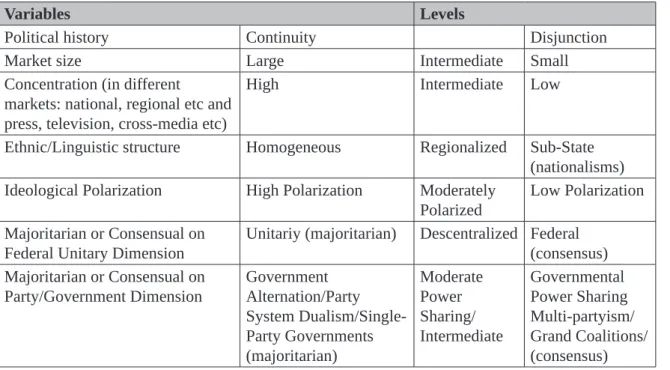
Table 1 – Key variables of national policy and economic policy related to media system
Variables Levels
Political history Continuity Disjunction
Market size Large Intermediate Small
Concentration (in different
markets: national, regional etc and press, television, cross-media etc)
High Intermediate Low
Ethnic/Linguistic structure Homogeneous Regionalized Sub-State (nationalisms) Ideological Polarization High Polarization Moderately
Polarized
Low Polarization
Majoritarian or Consensual on Federal Unitary Dimension
Unitariy (majoritarian) Descentralized Federal (consensus) Majoritarian or Consensual on
Party/Government Dimension
Government Alternation/Party System Dualism/Single-Party Governments (majoritarian)
Moderate Power Sharing/ Intermediate
Variables Levels Majoritarian or Consensual on
Interest Intermediation
Pluralism (majoritarian) Clientelism Corporatism (consensus)
State Tradition Strong (dirigism) Intermediate Weak (liberal)
Influence of Judicial Law Making/ Constitutional-Legal Rulings
Strong Intermediate Weak
Legal Tradition Common Law Civil (code) Law
Source: Humphrey (2012, p.167).
In fact, the point is that Hallin and Mancini (2008) proposal underplayed the importance of the analysis of public policies, focusing instead on the relationship between politics and journalism, mostly written press. That is why, while the general structure used in their comparative study to analyse general audiovisual legislation at national level could be the starting point, Humphrey (2012) proposal seems more appropriate for a complete analysis of the political, social and media systems in each case.
Policies characterisation:
As a prerequisite for comparative analysis, and with the aim to fulfil the requirement that
“comparison is invalid unless made between facts of the same type, with a similar structure.” (DUVERGER, 1976, p.413), we propose to analyse the cases under consideration taking as a reference an adaptation of the multivariable typology by Exeni (1998) for public communication policies. The purpose is to verify the validity of the comparative study proposed.
In order to adapt the analysis to this characterisation, we propose to use the
following criteria in policy analysis: identification of the scope of the policy, or level of government issuing the policy, identification of the policymaker and the implementing body, identification of the specific denomination of the policy, if applicable, identification of the political or technical content covered by the policy and which reflects the interest on the issue, identification of the policy tools – all those norms, organizations, mechanisms, plans,
programmes, projects and the corresponding budgets, allowing to gauge the priority and institutional efforts made by the State when implementing a policy – and the stage at which the policy is: design, formulation, enactment, implementation, evaluation or adjustment.
Actors characterisation
According to the proposal by Oszlak and O’Donell (1981), a complete a posteriori analysis of public policies implies tracing back the steps taken by public authorities. The idea
is to examine relationships, alliances and conflicts among stakeholders in the political process
under consideration, and the different representation forms and procedures agreed upon. It is
Thus, the actors are not observed or analysed from a general perspective on their activity
or their belonging to one trend or social stance or the other, but in relation to their specific
performance in developing and implementing a given action plan (LINDBLOM, 1991). At this point, it seems relevant to use the adaptation of the Analysis of Policy Networks. “Network” is a concept to refer to a set of elements organised to reach a goal. As Díaz Moure (no date – Our translation) points out
to get organised implies the institutionalization of a structure in which several actors – public and private – with unequal resources interact in order to attain common interests. That is to say, the ‘network’ portrays a map of power distribution representing the stakeholders and the resource distribution among them.
For actor’s characterisation, it could also be convenient to apply the methodology
proposed by Mitchell, Agle and Wood (1997). It presents a theory to identify stakeholders based on the assessment of their relative importance, regarding not only the media system but also other actors within power structures and relations in a particular social context. This methodology offers two main advantages. On the one hand, it consists in a political analysis, since both policies and actions by the stakeholders are considered to be the result of the interaction of unequal and controversial forces and interests. On the other hand, it
is variable, not a steady state, because it considers that the result of a conflict of interests
varies according to the social space and time, depending on the praxis of the actors.
Why and how to regulate media
McQuail (2010) concludes that six are the reasons to regulate media, as follows: (1) management of what is arguably the key economic resource in the emerging `information
society’; (2) protection of public order and support for government and justice tools; (3) protection of individual rights and interests; (4) promotion of the efficiency and development
of the communication system, by way of technical standardization, innovation, connectivity and universal provision; (5) promotion of access, freedom to communicate, diversity and universal provision and (6) maintaining conditions for effective operation of free markets in media services, especially consumer competition, access and protection.
Having said that, once the decision to regulate is taken, how is it articulated? What type of factors are considered in policymaking? In this section, we analyse a series of different parameters, considering the interest sparked during the fruitful period of communication policies analysis in Latin America in mid-1970s, following the principles of the European Convention on Human Rights and the InterAmerican Commission of Human Rights, and
taking into account the key aspects defined by UNESCO (2008) in favour of freedom of
First, the fundamental principles on which audiovisual law is based are freedom of expression, information and communication, fundamental human rights recognised by international treaties, and to be safeguarded by all democratic states. These rights, including fair and equal access to the media, must be preserved and extended to the context of rapid changes in information and communications technologies. That is why regulation in this
field nowadays should provide for audiovisual communication services on a broad sense,
beyond the traditional concept of radio spectrum.
Besides, it is worth to analyse how a law provides for different typologies of service depending on the diversity of operators: public services, commercial services, community services and third sector services. In principle, it would seem advisable in terms of pluralism and diversity to have an audiovisual law providing for three different types of operators and
entrusting specific tasks to public operators, as well as limits and conditions to commercial operators. Eventually, there should be a specific section for non-profit private operators, third sector operators and community operators, basically, operators serving the specific
cultural and social needs of certain social groups.
It is similarly important to study the access requirements to fall under the category of operator. Being granted a licence or authorization is a pre-condition for broadcasting, since it is a prerogative of public authorities to regulate the activities of the private sector in case of limited or scarce resources. Considering the area covered by the licence (the exercise of fundamental freedoms of democracy) it is easier to understand why this power has been vested in independent authorities in some European Union Member States.
Licence allocation via a system guaranteeing advertising and competition (that is to say, transparency in allocation criteria and competitiveness of the process) leads to attaching importance to the proposals submitted by applicants. Later on, operators granted a licence are bound by the proposals submitted by themselves, which become agreements or obligations, being binding and having to be respected. Accordingly, the regulatory authority must be endowed with the power of ensuring compliance of these agreements. These agreements normally include more obligations than those set by the legislator, related not only to the shareholder structure but also to certain contents (from a qualitative and
quantitative perspective, children’s programme, in-house production, type of news bulletin,
contribution to cultural industry, genres, among others). Similarly, the temporary nature of the licence and the conditions for its renewal should be guaranteed, being a necessary condition with a view to preserve the openness of the public space.
A specific strategy for effective guarantee of pluralism consists in limiting the level
of concentration, irrespective of the norms set by competition law (MASTRINI; BECERRA,
2006). Cultural diversity is assured by establishing the obligation to produce or finance
public communication space in a democratic society. In the case of Europe, as private operators emerged in the wake of the disappearance of public broadcasting monopolies, authorities were created to be independent from the government ruling powers and media and economic powers.
Considering the specificities of the sector, the authority to be created should be
one in which all decision makers turn to a collegiate body (RALLO LOMBARTE, 2000), composed of renowned people with relevant and proven professional experience in media sector. This collegiate body should be diverse in terms of expertise, political and social pluralism and gender equality; a body to be gradually renewed and whose members are subject to a regime of incompatibilities and have a limited mandate. A body which meets in plenary session in the case of adjudicative competencies, regardless of whether there are other commissions which can previously study and analyse the decisions to make. An authority with competencies to guarantee pluralism, monitor the mission of public service of public operators, and eventually those competencies required to ensure compliance of the game rules, to guarantee an open and plural public space. That is to say, regulatory powers
– instructions –, licence allocation powers – to set specific requirements, open tenders and
allocate licences – and renewal, monitoring powers of the private activity – cease orders for prohibited activities, power of inspection and penalty –, powers to control concentration, capacity to coregulate and promote self-regulation.
Additionally, in public audiovisual space, freedom of expression and freedom of information are in constant confrontation with another group of rights and freedoms. Balance in this case implies limiting the scope of both to prevent and solve potential controversies. In this respect, there are certain aspects to be included in any audiovisual law such as limits on content, in general; prohibition of incitement to hatred on the basis of race, religion, ethnic origin, national origin; duty to provide truthful information; safeguarding fundamental rights to privacy and intellectual property; protection of consumers by limiting advertising, compelling to separate editorial content from advertising, setting conditions for product placement, prohibiting sponsorship of certain programmes. Regarding protection of children from advertising, pornography and gratuitous acts of violence should be explicitly prohibited and programme rating or time slots for other types of programmes should be established.
With a view to assess all variables mentioned in the possible case studies, it is advisable to use the proposal of Media Development Indicators (MDIs), published by UNESCO (2008). By indicator, one should understand a quantitative or qualitative factor or variable, measured over time, that provides a simple and reliable basis for assessing
achievements, change or performance in a country’s media landscape. For each indicator, the MDI framework suggests various means of verification as well as potential data sources.
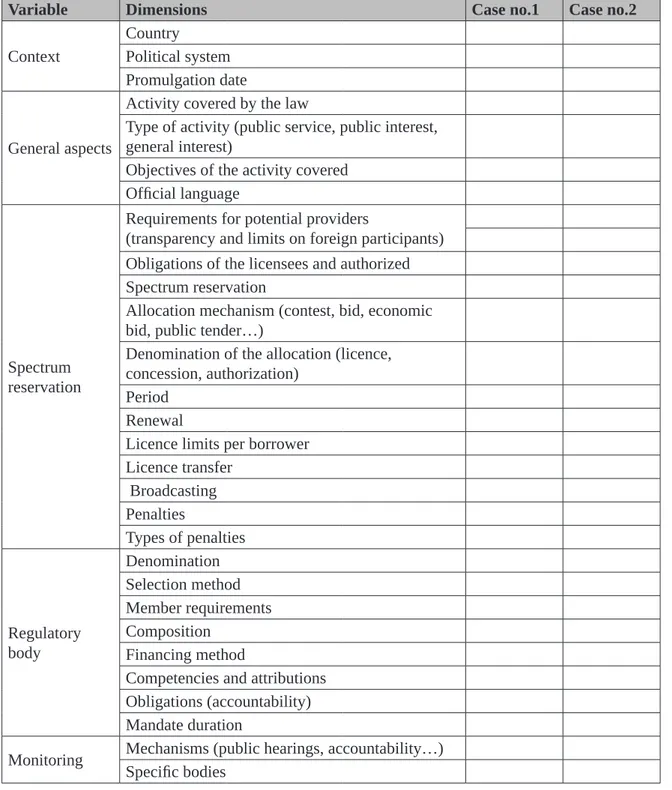
national level, only indicators applicable to national rules were considered. In this connection, the analysis matrix to be used could include the following variables and dimensions:
Table 2 – Matrix proposed for comparative analysis
Variable Dimensions Case no.1 Case no.2
Context
Country
Political system Promulgation date
General aspects
Activity covered by the law
Type of activity (public service, public interest, general interest)
Objectives of the activity covered Official language
Spectrum reservation
Requirements for potential providers
(transparency and limits on foreign participants) Obligations of the licensees and authorized Spectrum reservation
Allocation mechanism (contest, bid, economic bid, public tender…)
Denomination of the allocation (licence, concession, authorization)
Period Renewal
Licence limits per borrower Licence transfer
Broadcasting Penalties
Types of penalties
Regulatory body
Denomination Selection method Member requirements Composition
Financing method
Competencies and attributions Obligations (accountability) Mandate duration
Variable Dimensions Case no.1 Case no.2
Concentration
Legal limits on concentration Disinvestment mechanisms Actors recognition (small and big)
Contents
Content regulation
Programme quota
By sex By origin (national/ foreign) Children
Access Regulation
Advertising
Regulation Time slots/limits Official
advertisements Obligations
Relevant content Content
restrictions
Schedule classification Prohibitions
Measures to support production (national, local, regional, independent)
Penalties
Types of penalties
Community media
Legal recognition
Promotion methods
Capacity-building
Production and distribution Direct financing
Limits Technical
Finantial
Source: prepared by the authors.
The cases included in the matrix in Table 2 are countries eligible for comparative
analysis, provided that as each country has a specific audiovisual media legislation. In any
case, we consider that adapting the matrix is easy if there is more than one law related to audiovisual services in countries under consideration. Comparative analysis methodology
is aimed at, first of all, making an exploratory research of the national audiovisual rules in
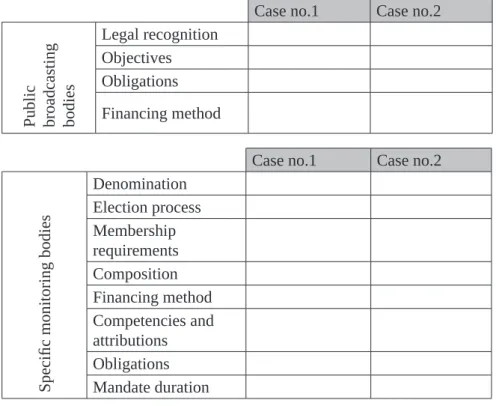
order to compare both countries. Additionally, we propose applying two analysis matrices
in key structures in any media system: public broadcasting systems and specific monitoring
Table 3 – Matrix proposed for regulatory body analysis
Case no.1 Case no.2
Public broadcasting bodies
Legal recognition Objectives Obligations
Financing method
Case no.1 Case no.2
Specific monitoring bodies
Denomination Election process Membership requirements Composition Financing method Competencies and attributions
Obligations Mandate duration
Source: prepared by the authors.
Subsequently, it is appropriate to approach the implementation process of legislation in each country in order to obtain, as far as possible, a deeper understanding and a global picture of the public policy cycle. The general objective of this section is drawing conclusions on the analysis conducted and putting forward recommendations in order to improve the design and implementation of public communication policies.
Ultimately, what we propose is a thorough study of each case, following a systematic protocol for analysis, in order to conduct the comparative analysis. With that purpose, the study should be conducted in six phases: (1) analysis of the political and social systems of the countries under consideration, as well as a thorough study of the media systems following
Humphrey’ (2012) proposal; (2) identification in each case of the factors intervening in the
formulation of a new law; (3) characterisation of laws; (4) characterisation and deliberation of stakeholders in policymaking; (5) legal analysis of the general audiovisual laws, using an adaptation of the key variables compiled by UNESCO (2008) in its Media Development Indicators and (6) assessment of the implementation process of legislations and their consequences in the media systems within each country. The proposal made in this paper is aimed at serving as a guideline for researchers who would like to conduct a comparative
in a key are of public space. We understand that moving forward in this line of research is essential for the development of new public policies in the mid-term.
Technological changes, increase in distribution channels, intellectual property
and creation of governance institutions appear as key aspects having an influence on
public policymaking in audiovisual media sector. One of the clearest consequences is the reluctancy to regulate, based on the argument that nowadays there are alternative media, including those on the Internet. Other arguments are that there is no threat to information diversity, provided that market freedom and innovation can coexist. It is to be noted that rules restricting media (on public interest grounds) are being weakened or deconstructed. In general terms, since mid-1980s, the aim of politics has been to encourage media for self-regulation and accountability on a voluntary basis. This is directly related to how media conglomerates systematically have recourse to the right of freedom of expression and the right to communicate, in favour of the concept of business freedom, in order to avoid by all means any regulation in the sector hindering their interests. Thus, it is necessary to claim once more the importance of the State role to safeguard – having set the mechanisms guaranteeing transparency in decision making – the right to communicate and the balance
between commercial interests and citizens’ interests, not always matching.
References
BLUMLER, J. G.; GUREVITCH, M. Towards a comparative framework for political communication research. In: CHAFEE, Steven H. (ed.). Political communication. London/Beverly Hills: Sage, 1975.
BOLAÑO, C.; MASTRINI, G. Economía Política de la Comunicación: un aporte marxista a la constitución del campo comunicacional. Eptic. Revista de Economia Política das Tecnologias da Informação e Comunicação, v.III, n.3, p.58-78, 2001.
CAPRILES, O. Poder político y Comunicación. Caracas: Anauco Ediciones, 1996.
CHAKRAVARTTY, P.; SARIKAKIS, K. Media policy and globalization. New York: Palgrave Macmillian, 2006.
CZEPEK, A.; HELLWIG, M.; NOWAK, E. (eds.). Press Freedom and Pluralism in Europe: concepts and conditions. Bristol/Chicago: Intellect, 2009.
DÍAZ MOURE, L. Nuevos temas en el análisis de políticas públicas. Available at: http://campus.usal. es/~dpublico/areacp/materiales/6.3.nuevasperspectivas.pdf. Accessed on: 13 may 2013.
DROR, Y. Design for Policy Sciences. Nueva York: Elsevier, 1971.
DUNN, W. Public Policy Analysis. An introduction. New Jersey: Prentice Hall, 1994.
DUVERGER, M. Métodos de las ciencias sociales. (9 ed.), Barcelona: Ariel, 1976.
DYE, T. R. Policy analysis: what governments do, why they do it and what difference it makes. Alabama: University of Alabama Press, 1976.
FREEDMAN, D. Dynamics of power in contemporary media policy-making. Media Culture & Society, v.28, p.907-923, 2006.
______. The Politics of Media Policy. Cambridge: Polity, 2008.
GOLDBERG, D.; PROSSER, T.; VERHULST, S. Regulating the changing media a comparative study. Oxford/New York: Clarendon Press, Oxford University Press, 1998.
GRIFEU, J. El debate internacional de la comunicación. Barcelona: Ariel, 1986
HALLIN, D. C.; MANCINI, P. Sistemas mediáticos comparados: tres modelos de relación entre los medios de comunicación y la política. Barcelona: Hacer, 2008.
______. Comparing media systems beyond the Western World. Cambridge: Cambridge University Press, 2012.
HUMPHREY, P. Mass Media and Media Policy in Western Europe. Manchester: Manchester University Press, 1996.
______. A Political Scientist´s Contribution to the Comparative Study of Media Systems in Europe: A Response to Hallin and Mancini. In: JUST, N.; PUPPIS, M. (eds.), Trend in Communication Policy Research: New Theories, Methods and Subjects. Bristol: Intellect, 2012.
KAUFFER, E. Las políticas públicas: algunos apuntes generales. Ecofronteras, v.16, México: Colegio de la Frontera Sur, 2002.
LASSWELL, H. D. The policy orientation. In: LERNER, D.; LASSWELL, H. (eds.). The policy sciences. Recent developments in scope and methods. Stanford, CA: Stanford University Press, 1951.
LEVY, D. A.. Europe´s Digital Revolution: Broadcasting Regulation, the EU and the Nation State. Londond and New York: Roatledge, 1999.
LINDBLOM, C. E.. El proceso de elaboración de políticas públicas. México: Miguel Ángel Porrúa, 1991.
MAJONE, G. Políticas Públicas y Administración: Ideas, Intereses e Instituciones. In: GOODIN, R. E.; KLINGEMANN, H. (eds.). Nuevo Manual de Ciencia Política. Madrid: Akal, 2001.
MARINO, Santiago. Estado, Políticas Públicas y Políticas Públicas de Comunicación. Available at: http://
politicasyplanificacion.sociales.uba.ar/. Accessed on: 13 feb. 2015.
MASTRINI, G.; BECERRA, M. Periodistas y magnates: estructura y concentración de las industrias culturales en América Latina. Buenos Aires: Prometeo Libros/Instituto de Prensa y Sociedad (IPyS), 2006.
MCCHESNEY, R. Rich media, poor democracy: communications politics in dubious times. Urbana/ Champagne, III.: University of Illinois Press, 1999.
MCQUAIL, D. Media regulation (module 2, unit 11). Unpublished manuscript, 2010.
MELTSNER, A. J. Political Feasibility and Policy Analysis. In: Public Administration Review, 32 (6), 1972.
MITCHELL, R. K.; AGLE, B. R.; WOOD, D. J. Toward a theory off stakeholders identification and salience: defining the principle of who and what really counts. Academy of Management Review, 22, 1997.
OSZLAK, O.; O’DONELL, G. Estado y políticas estatales en América Latina: hacia una estrategia de
investigación. Centro de Estudios de Estado y Sociedad (CEDES), Documento G.E. CLACSO (v.4). Buenos Aires, 1981.
PALLARÉS, F. Las Políticas Públicas: el sistema político en acción. Revista de Estudios Políticos (Nueva Época), 62, 1988.
SUBIRATS, J.; KNOEPFEL, P.; LARRUE, C.; VARONE, F. Análisis y gestión de políticas públicas. Barcelona: Ariel, 2008.
THOENING, J. C. Présentation. In: LECA, J.; GRAWITZ, M. (eds.). Traité de Science Politique. Les politiques publiques, v.4, París: PUF, 1985.
UNESCO. (2008). Indicadores de Desarrollo Mediático: Marco para evaluar el desarrollo de los medios de comunicación social. Available at: http://unesdoc.unesco.org/images/0016/001631/163102S.pdf. Accessed on: 18 sep. 2015.
Marina Hernández Prieto
She holds a PhD in Audiovisual Communication from the University of Salamanca (Spain) since 2015 and has been adjunct professor of the Department of Sociology and Communication at this University since 2013. Having graduated in Audiovisual Communication from the same University in 2006, she received the Grade of Salamanca Mention for academic year 2008-2009. Between 2009 and 2013, she was a recipient of the University of Salamanca Teacher Training Program, financed by the Santander Group. She has participated as researcher in competitive research projects such as “Diversidad de la industria audiovisual en la era digital” (Diversity in the Audiovisual Industry in the Digital Age) (AECID Código A/020846/08) in the period 2015-2017, “Industria cinematográfica latinoamericana: políticas públicas y su impacto en un mercado digital II” (“Latin American Cinema Industry: public policies and their impact on digital market II) (AECID Código A/024079/09). She is currently part of the working team for the project “Audiovisual diversity and online platforms: the Netflix case”, financed by Spain’s Ministry of Finance and Competitiveness (ref. CSO2017-83539-R). Her main line of research is focused on the study of public policies in regard to communication from the perspective of political economy. E-mail: [email protected].
Ángel Badillo Matos
María de la Peña Pérez Alaejos
She joined the Department of Sociology and Communication at the University of Salamanca (Spain) in 1999, after having graduated in both Sociology and Communication. She holds a PhD from the University of Salamanca since 2007 and has a vast lecturing experience in subjects related to radio included in the syllabus of first degrees and postgraduate courses. She is currently working as a hired lecturer in the Department of Audiovisual Communication and Advertising. Being a researcher in the field of sound content production and cultural industries, she is specialized on radio, and has a vast professional career on media. Similarly, she has extensive experience in management, having hold job positions as secretary of the Department, of which she is currently the Vice director, or having been Vice-Dean of the Faculty of Social Sciences. E-mail: [email protected].
Received on: 10.31.2016 Accepted on: 11.16.2018