EXTRACTION FROM THE SPINACH SUBSTITUTE
COMMONLY USED IN BRAZIL
(Tetragonia expansa)
1Luciane M. KAWASHIMA , Lucia M.VALENTE SOARES2 2 , *
SUMMARY
The true spinach does not grow well in warm climates and for that reason is not commercialized in Brazil. Instead, a spinach substitute , originally from New Zealand, is widely used in the country. There is scant information on the mineral profile and none on the soluble mineral fraction of this vegetable. The solubility of a mineral is one of the important factors for its absorption. For this reason, the calcium, magnesium, iron, manganese, copper, zinc, potassium, and sodium soluble fractions in the raw spinach substitute were determined and the effect of blanching times on the solubility of these minerals was investigated. Blanching times of 1, 5, and 15 minutes were employed. The magnesium, manganese, potassium, and sodium soluble fractions increased sizably with shorter blanching time. Longer blanching time (15 minutes) caused large losses of minerals. The soluble mineral fractions can contribute poorly to diet in terms of potassium, magnesium, manganese, and zinc. The spinach substitute cannot be considered a dietary source of calcium, iron and copper due to the insolubility of these minerals in the vegetable, possibly caused by the large oxalate content.
spinach substitute; effect of blanching; mineral elements.
(Spinacia oleracea)
(Tetragonia expansa)
Keywords:
1
2
*
Recebido para publicação em 11/09/2002. Aceito para publicação em 06/04/2005 (000993).
Department of Food Science, State University of Campinas, C.P. 6121, CEP: 13081-970 - Campinas, SP, Brazil.
A quem a correspondência deve ser enviada. RESUMO
EFEITO DO TEMPO DE BRANQUEAMENTO NA EXTRAÇÃO SELETIVA DE ELEMENTOS MINERAIS DO SUBSTITUTO DE ESPINAFRE COMUMENTE EMPREGADO NO BRASIL. O verdadeiro espinafre não se de-senvolve bem em climas quentes e por esta razão não é comercializado no Brasil. Em seu lugar, um substituto de espinafre
, originário da Nova Zelândia, é amplamente utilizado. A informação sobre o perfil mineral é resumida e inexistente sobre a fração solúvel de minerais deste vegetal. A solubilidade de um mineral é um dos fatores importantes para sua absorção. Por esta razão, as frações solúveis de cálcio, magnésio, ferro, manganês, cobre, zinco, potássio e sódio foram determinadas no substituto de espinafre cru, e o efeito dos tempos de branqueamento na solubilidade destes minerais foi investigado. Tempos de branqueamento de 1, 5, e 15 minutos foram empregados. As frações solúveis de magnésio, manganês, potássio, e sódio, aumenta-ram consideravelmente com o menor tempo de branqueamento. Um período mais prolongado de branqueamento (15 minutos) cau-sou perdas sensíveis de minerais. As frações solúveis dos minerais podem ter pequena contribuição para a dieta em termos de po-tássio, magnésio, manganês, e zinco. O substituto de espinafre não pode ser considerado como uma fonte de cálcio, ferro e cobre para a dieta devido à insolubilidade destes minerais no vegetal, possivelmente causada pelo elevado teor de oxalato.
substituto de espinafre; efeito de branqueamento; elementos minerais.
(Tetragonia expansa) (Spinacia oleracea)
(Tetra-gonia expansa)
Palavras-chave:
1 - INTRODUCTION
In Brazil, a spinach substitute
is used for salads and cooking. It originated in New Zealand and is a succulent belonging to the Aizoaceae family. It grows well in tropical climates and for that reason it well adapted in this country. The true spinach , on the other hand, a leafy vegetable of the Chenopodiaceae family, is commonly consumed in the temperate regions of the globe [5] and does not grow well in warm climates. The true spinach is not commercialized in Brazil. The concentrations of a few nutritionally important minerals and their absorbability have been studied for the true spinach
[2,8,14]. Recently, the mineral composition for the New Zealand spinach substitute used in Brazil and of other leafy vegetables has been published [9].
The presence of a nutrient in the food does not mean availability. The absorption of mineral nutrients is
(Tetragonia expansa)
(Spinacia oleracea)
(Spinacia oleracea)
dependent upon their chemical form and the presence of enhancers or inhibitors within the food as well as the nutritional status and requirements of the individual
ingesting the food [3,4,6]. and tests have
been used to measure mineral availability.
methods involve a simulation of the digestive process and the information supplied is partial because it does not include the utilization of the mineral by the human
organism. studies measure either radioactive or
stable isotopes in human subjects or animals [1,3,12]. They are closer to the natural absorption process although lengthier and more expensive to be conducted
than methods. Estimates of availability through
mathematical models that take into account the concentrations of minerals and those of absorption inhibitors and enhancers have also been proposed [20].
Solubility of the mineral is one of the conditions for absorption by the digestive tract and its knowledge provides initial information about its potentiality for absorption [2,10]. Solubility measurements are simpler
and less costly to be conducted than and
studies. In this line TESSIER, CAMPBELL & BISSON [18] proposed an interesting protocol first used for the study of river sediments. It consists of a simplified method by extracting selectively minerals under soluble form,
In vitro in vivo
In vitro
In vivo
in vitro
in vivo in vitro
bound to ligands with pK 5, bound to ligands with pK 2, bound to organic insoluble ligands, and residual. This approach has been applied to experimental animal diets and gastrointestinal contents in the study of iron digestion and absorption in rats [17]. REYKDAL & LEE [14] followed another approach and measured dialyzable calcium in milk and true spinach in samples submitted
to HCl and pepsin digestion and non-digested
samples. The dialyzable calcium content was more than twice as large in digested samples when compared with non-digested samples. SCHMIDT, MACDONALD & KELLY [16], by their turn, measured iron, calcium, and magnesium in water extracts and in extracts submitted
to peptic digestion obtained from raw and cooked
amaranth and collard leaves. The results from both procedures were close for the raw samples, but in the case of the cooked samples the results were twice as large in the peptic digested extracts when compared with the water extracts.
Oxalates are an important inhibitor to mineral absorption because they form insoluble salts with calcium, iron, and magnesium. The presence of oxalates in foods is of concern, especially for calcium, as they reduce the absorbability of this mineral [19]. Calcium absorbability from true spinach, a high oxalate food, has been shown to be low for human subjects [8]. The amount of oxalate present in the raw New Zealand spinach substitute, also used in Brazil, has been determined and it was approximately 5 times higher (1764.7 ± 95.7mg/100g) than that of the true spinach (329.6 ± 0.8mg/100g) [15]. Note that the standard deviation indicates the variability encountered in nature and not the uncertainty of the determination.
The present research aimed at (a) fractionating six nutritionally important minerals (Ca, Mg, Mn, Fe, Zn and Cu) and two electrolytes (K and Na) in the spinach substitute used in Brazil in order to verify the distribution profile of the minerals in the soluble fraction (extractable at pH 7.0), in the fraction bound to insoluble ligands (capable of solubilization by a mild peroxide and acid treatment), and in the residual fraction (resistant to mild peroxide and acid treatment) and (b) the effect of increasing blanching times on the mineral profile of these fractions and on possible losses by leaching.
Three bunches of spinach substitute
were acquired in markets in the city of Campinas, state of São Paulo, five times during the period of six months. The bunches of leaves were washed under running water to remove sandy particles and then washed with de-ionized water, dried in a hand spinning kitchen vegetable drier, and patted dry with paper towels. Hard stems and wilted leaves were removed. The leaves and tender stems were comminuted, well mixed by hand and about 250g were removed and further
≥ ≥
in vitro
in vitro
(Tetragonia expansia)
2 - MATERIAL AND METHODS 2.1 - Sample preparation
homogenized with the help of a food processor. The food processor parts in contact with samples were treated with a hot aqueous solution of 2% EDTA and 2% citric acid [13] in order to remove any trace of metals, washed with de-ionized water and air dried before use.
After washing and drying and before comminuting, 250g portions of the samples, leaves and tender stems, were separated for blanching. The leaves and stems were heated in a glass pan containing 2L of boiling de-ionized water for periods of 1, 5, and 15 minutes, respectively. The blanched vegetable was then dried in a hand spinning kitchen vegetable drier and homogenized in a food processor as described above.
Duplicate determinations were conducted in raw and blanched samples by drying the ground sample in an aluminum dish in an atmospheric oven at 105 C until constant weight. Fifteen mg/cm of diatomaceous earth were added to each aluminum dish for better heat distribution. The total solids determination was used to calculate the minerals concentration on dry basis and to compare the levels of elements among the sequentially extracted fractions.
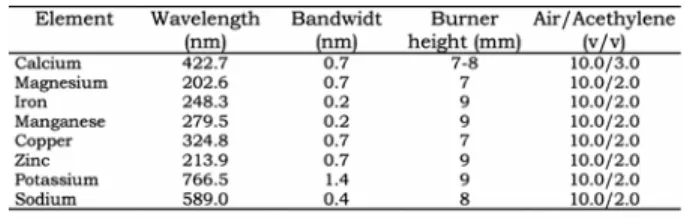
Total contents of each mineral were determined in duplicates after digestion of the samples with nitric acid. After complete destruction of organic matter, the residue was dissolved with enough nitric acid and lanthanum solution in order to reach a final concentration of 1% HNO + 0.5% lanthanum in a volumetric flask of appropriate size. The solution was used to determine potassium, sodium, calcium, magnesium, iron, copper, manganese, and zinc by flame atomic absorption spectrometry on a microprocessor controlled Perkin-Elmer instrument, model 5100 PC with deuterium background correction lamp. The instrument operating conditions used in determining each element can be
found in . An air acetylene flame was used and
standards for calibration were from Carlo Erba, Merck and J.T. Baker. The standards were prepared with the same concentration of nitric acid and lanthanum as the samples. De-ionized water (Milli-Q) with 18 megaohm of resistivity was used whenever water was need. Glassware and polyethylene flasks were soaked 24 hours in nitric acid 10% and then washed with de-ionized water before use. The individual concentrations of each mineral in each sample were calculated on wet and dry weight basis. The data on dry basis was used to calculate the concentration of each element in each extraction fraction as well as losses to blanching water for each individual sample.
The soluble fractions of individual minerals and individual minerals bound to insoluble ligands were
2.2 - Total solids
2.3 - Determination of individual minerals
2.4 - Sequential extraction of minerals
o
2
3
Table 1
Effect of blanching on spinach mineral elements, Kawashima & Valente Soares
TABLE 1 - Operating conditions used for determining each element
determined [18]. The soluble fraction was defined as the relationship between the concentrations of the element extractable at pH 7.0 and its total concentration in the spinach substitute. For the soluble fraction of minerals, three replicates were prepared for each sample. The sample was weighed (10g) into a polypropylene centrifuge tube and shaken one hour with 8mL 0.15M ammonium acetate solution (pH 7,0). After centrifuging 30 minutes at 10,000rpm the supernatant was separated and the residue in the tube washed with 10mL de-ionized water. The tube with water and residue was again centrifuged at 10,000rpm for 15 minutes. The second supernatant was collected and added to the first and this was labeled soluble fraction. Each mineral was determined in the soluble fraction by atomic absorption spectrometry as described for the total minerals content determination.
The fraction bound to insoluble ligands was defined as the relationship between the concentration of the element extractable after mild peroxide and acid treatment and its concentration in the spinach substitute. The minerals bound to insoluble ligands were determined in the residue from the previous extraction by adding 3mL of 0.02M HNO and 5mL of 30% H O adjusted to pH 2 with HNO . The mixture was heated to 85 C for two hours in a water bath and shaken occasionally. After that period, another 3 mL portion of 30% H O was added. The mixture was kept at 85 C for another period of 3 hours with occasional shakings. After that the mixture was allowed to cool and 5 mL of 3.2 M ammonium acetate in 20% HNO were added. The mixture was diluted to 20mL with de-ionized water and shaken for 30 minutes. The contents of the flask were allowed to settle and the supernatant was collected for the minerals determination as described above.
The residual fraction was defined as the relationship between the concentration of the element not extractable after mild peroxide and acid treatment and its total concentration in the spinach substitute. The residual fraction for each element was calculated subtracting the values of soluble and insoluble fractions from the total concentration of the respective element.
Losses of a mineral to the blanching water by leaching were calculated as the difference between the total amount of the element found in the raw sample and the total amount found in the blanched sample. The results were calculated for each individual sampling and averaged.
3 2 2
3
2 2
3 o
o
2.5 - Analytical quality control
3 - RESULTS AND DISCUSSION
The detection limits for each element were determined preparing two solutions of the element, one 5 times and the other 2 times the expected detection limit. Twenty readings were made of each solution in alternation with a blank. The detection limit was calculated multiplying the concentration of the standard by 3 times the standard deviation obtained. The result was divided by the mean of the determinations.
A blank and an internal reference sample were added to each batch of samples analyzed as an every day quality control check. The certified reference material 1573a Tomato Leaves (NIST, Gaithersburg, U.S.A.) was used to check the accuracy of the instrument and of the procedure employed to determine the total values of the elements being studied.
The limits of detection and the analytical uncertainties under the experimental conditions are
presented in . The average standard deviation for
duplicates of the same sample expresses the analytical uncertainties of the analyses and indicates the number of significant digits of each individual result.
Table 2
TABLE 2 - Limits of detection and analytical uncertainty under the conditions employed during the present work
Five samplings were conducted during six months and the variation was expressed as the standard
deviation among samples . A great variability in
the concentration of the minerals was found among the samples of the vegetable throughout the six months of study. This variability between samples is of one or two orders of magnitude greater than the analytical
uncertainty , except in cases the mineral present
in the fraction analyzed is at trace level (Fe, Mn, Cu and Zn). Such data gives support to the analytical results and to the conclusions to be derived. Interestingly, the total solids content varied among samples from 4.82 to 7.60g/100g, with an average and standard deviation of 6.08 ± 1.14g/100g. The variation among samples was smaller than the one found also among samples for the minerals present in higher content (Ca, Mg, K and Na).
The concentration of soluble calcium was very low in the spinach substitute. A lengthy blanching
time such as 15 minutes did not improve the
solubility of this mineral. The fraction bound to insoluble ligands but capable of sulubilization by mild acidic and
oxidizing conditions was also low . The residual
fraction in the raw vegetable contained 98% of the total
content of calcium and varied little with
(Table 3)
(Table 2)
(Table 3)
(Figure 1)
(Figure 2)
(Figure 3)
Effect of blanching on spinach mineral elements, Kawashima & Valente Soares
TABLE 3 - Individual element concentrations in the fractions of the raw spinach substitute (Tetragonia expansa)
blanching. In such situation it is expected that calcium in the spinach substitute would not contribute to the diet. The high insolubility of calcium in this vegetable might be explained by the high content of insoluble oxalate as reported for the New Zealand spinach [15].
FIGURE 2 - Average changes in the fraction of minerals bound to insoluble ligands caused by increasing blanching time. The fraction bound to insoluble ligands (%) was defined as the ratio between the concentration of the element extractable after mild peroxide and acid treatment and its concentration in the raw spinach substitute
FIGURE 1 - Average changes in the soluble fraction of minerals caused by increasing blanching time. The soluble fraction (%) was defined as the ratio between the concentrations of the element extractable at pH 7.0 and its total concentration in the raw spinach substitute
FIGURE 3 - Average changes in the residual fraction of minerals caused by increasing blanching time. The residual fraction (%) was defined as the ratio between the concentration of the element not extractable after mild peroxide and acid treatment and its total concentration in the raw spinach substitute
Magnesium was mostly in soluble form. The soluble fraction of magnesium in the raw vegetable contained
20mg/100g and represented about 37% of the
total content of the mineral . The RDA for
magnesium for adults of both sexes is 4.5mg/kg of body weight [11]. The data obtained on solubility indicated that the contribution of magnesium by the spinach substitute is small. Blanching for 1 or 5 minutes
increased the soluble amounts of the mineral .
But a noticeable decrease in the soluble fraction occurred with blanching for 15 minutes due to losses of
over 50% to the water by leaching .
(Table 2)
(Figure 1)
(Figure 1)
(Table 4)
For iron, another mineral with solubility affected by the presence of oxalates, a concentration of 0.06mg/100g was found in the soluble fraction of the
raw edible parts . The soluble fraction
represented 8% of the total iron concentration in the raw (Table 2)
TABLE 4 - Average mineral losses (%) in the spinach substitute to the water by leaching
(Tetragonia expansa)
Effect of blanching on spinach mineral elements, Kawashima & Valente Soares
vegetable and this fraction doubled with 1 minute blanching. The soluble fraction did not exhibit further
increase after 5 or 15 minutes blanching .
Losses due to leaching were low with any
blanching time.
The soluble fraction of manganese
contained 0.3mg/100g. The recommended daily intake for manganese for adults ranged from 2.0 to 5.0mg [11], independently of body weight, what pointed to a rather low possible contribution to diet by this spinach substitute. The soluble fraction of manganese represented 34% of this mineral in the raw vegetable. The data indicated that blanching caused losses of about 14% when the vegetable was submitted up to 5 minutes blanching and higher (42%) for 15 minutes blanching from the total amount of manganese initially present in
the raw vegetable .
The levels of copper (0.02mg/100g) in the soluble fraction (45%) of the raw vegetable could only contribute
poorly to diet . The recommended daily intake for
copper ranges from 1.5 to 3mg daily for adults of any body weight [11] and consequently the spinach substitute does not qualify as a source for copper in the diet. The soluble fraction increased with blanching at the expense of the residual and organic bound fractions
. Calculated losses to the blanching water were small and did not increase much with
blanching time .
The concentration of solubIe zinc in the raw
vegetable was 0.12mg/100g , too low to make
any sensible contribution to diet. Zinc deficiency has been a matter of concern for developing countries [7]. The recommended daily intakes for zinc are 12 and 15mg for women and men, respectively, independent of body weight [11]. Zinc was present in the soluble fraction of the raw vegetable at about 34% of the total concentration of the element. Blanching decreased the amount of the
element in the soluble fraction . The losses of
zinc to the blanching water increased with longer
blanching times .
The raw vegetable contained 200 mg of soluble
potassium /100g . The RDA for potassium is
3500mg for adults of any body weight [11] and so the contribution of this element to diet by this spinach substitute is marginal. Surprisingly the soluble fraction contains 39% of the total amount of the mineral indicating that part of the mineral is connected to insoluble structures and is not readily accessible in the raw vegetable. Blanching for 1 minute and 5 minutes increased the concentration of potassium in the soluble fraction to 54 and 44%, respectively, of the total amount of element initially present. At the same time, the fraction bound to insoluble ligands and the residual fraction
decreased . Losses of potassium to the
blanching water increased from 25 to 53% with longer blanching times.
The concentration of soluble sodium in the raw (Figure 1) (Table 4)
(Table 3)
(Table 4)
(Table 3)
(Figures 1, 2 and 3)
(Table 4)
(Table 3)
(Figure 1)
(Table 4)
(Table 3)
(Figures 2 and 3)
vegetable was 28mg/100g and represented 44% of the
total sodium present . The concentrations of
soluble sodium increased with blanching times . Longer blanching times increased losses of sodium to the blanching water and these losses ranged from 26 to
57% . Longer blanching times reduced the
residual fraction and the fraction bound to insoluble ligands was smaller in the blanched vegetable when compared with the same fraction in the raw spinach substitute, suggesting both fractions served as the source of sodium for the soluble fraction
as leaching increased due to longer blanching.
For the New Zealand spinach substitute commonly used in Brazil, a shorter blanching time of one minute is the most beneficial in yielding higher concentrations of soluble minerals. However, the vegetable is a poor source for soluble potassium, magnesium, and manganese; an even meager source for zinc and cannot be considered a dietary source for calcium, iron, and copper.
(Table 3)
(Figure 1)
(Table 4)
(Figures 2 and 3)
4 - CONCLUSIONS
5 - REFERENCES
BARBERÁ, R.; FARRÉ, R. Biodisponibilidad de los elementos traza.
, v. 34, n. 4, p. 381-399, 1992. BENWAY, D.A.; WEAVER, C.M. Assessing chemical form of calcium in wheat, spinach, and kale.
, v. 50, n. 3, p. 605-608, 1993.
COZZOLINO, S.M.F. Biodisponibilidade de minerais. , v. 10, n. 2, p. 87-98, 1997.
EKMEKCIOGLU, C. Intestinal bioavailability of minerals and trace elements from milk and beverage in humans.
, v. 44, n. 6, p. 390S-397S, 2000. ENCYCLOPAEDIA BRITANNICA, INC.
. 15 edition, Chicago, v. 3, p. 375, 1979. FAIRWEATHER-TAIT, S.J. Bioavailability of dietary minerals. , v. 24, p. 775-780, 1996.
GIBSON, R.S. Zinc nutrition in developing countries. , v. 7, p. 151-173, 1994. HEANEY, R.P.; WEAVER, C.M.; RECKER, R.R. Calcium absorbability from spinach.
, v. 47, p. 707-709, 1988.
KAWASHIMA, L.M.; VALENTE SOARES, L.M. Mineral profile of raw and cooked leafy vegetables consumed in Southern Brazil.
, v. 16, p. 605-611, 2003.
KIM, H.; ZEMEL, M.B. In vitro estimation of the potential bioavailability of calcium from sea mustard
, milk, and spinach under simulated normal and reduced gastric acid conditions.
, v. 51, n. 4, p. 957-959, 1986. NATIONAL RESEARCH COUNCIL. 1989.
. National Academy Press, Washington, D.C. 284 p.
Revista Española de Ciencia y Tecnología de Alimentos
Journal of Food Science
Revista de Nutrição da PUCCAMP
Nahrung
Encyclopaedia Britannica
Biochemical Society Transactions
Nutrition Research Reviews
American Journal of Clinical Nutrition
Journal of Food Composition and Analysis
Journal of Food Science
Recommended dietary a llow ances
t h (Undaria pinnatifida) [1] [2] [3] [4] [5] [6] [7] [8] [9] [10] [11]
RAO, B.S.N. Methods for the determination of bioavailability of trace metals: a critical evaluation. , v. 31, n. 5, p. 353-361, 1994.
RAZAGUI, I.B.; BARLOW, P.J. A chemical clean-up procedure to reduce trace metal contamination from laboratory blenders. , v. 44, n. 4, p. 309-312, 1992.
REYKDAL, C.; LEE, K. Soluble, dialyzabel and ionic calcium in raw and processed skim milk, whole milk and spinach. , v. 56, n. 3, p. 864-866, 1991.
SAVAGE, G.P.; VANHANEN, L.; MASON, S.M.; ROSS, A.B. Effect of cooking on the soluble and insoluble oxalate content of some New Zealand foods.
, v. 13, p. 201-206, 2000.
SCHMIDT, D.R.; MACDONALD, H.A.; KELLY, W.C. Solubility of iron, calcium and magnesium in amaranth and collard leaves.
, v. 4, p. 373-378, 1974.
SIMPSON, R.J.; SIDHAR, S.; PETERS, T.J. Application of selective extraction to the study of iron species present in Journal of Food Science and Technology
Food Chemistry
Journal of Food Science
Journal of Food Composition and Analysis
Qualitas Plantarum, Plant Foods for Human Nutrition
diet and rat gastrointestinal tract contents. , v. 67, p. 437- 444, 1992.
TESSIER, A.; CAMPBELL, P.G.C.; BISSON, M. Sequential extraction procedure for the speciation of particulate trace metals. , v. 51, n. 7, p. 844-850, 1979.
WEAVER, C.M.; PLAWECKI, K.L. Dietary calcium: adequacy of a vegetarian diet.
n, v. 59 (suppl), p. 1238-1241, 1994. WOLTERS, M.G.E.; DIEPENMAAT, H.B.; HERMUS, R.J.J.; VORAGEN, A.G.J. Relation between in vitro availability of minerals and food composition: a mathematical model. , v. 58, n. 6, p. 1349-1355, 1993.
British Journal of Nutrition
Analytical Chemistry
American Journal of Clinical Nutritio
Journal of Food Science
6 - ACKNOWLEDGEMENT
The authors gratefully acknowledge the financial support from the Fundação de Amparo à Pesquisa do Estado de São Paulo (FAPESP) and a graduate scholarship from the Coordenadoria de Aperfeiçoamento de Pessoal de Nível Superior (CAPES) to the first author.
[12]
[13]
[14]
[15]
[16]
[17]
[18]
[19]
[20]
Effect of blanching on spinach mineral elements, Kawashima & Valente Soares