RESEARCH NOTE
Common bean seed vigor affecting crop grain yield
1Vitor Henrique Vaz Mondo
2*, Adriano Stephan Nascente
2,
Manoel Oliveira Cardoso Neto
3AbStrACt - Among the factors that affect seedling emergence and crop establishment are seed germination and vigor,
which has an important influence on the establishment of the initial plant population and development, and may affect crop yield. Based on this background the objective of this research work was to evaluate the effects of seed vigor of common bean seed lots and its effects on crop grain yield. The treatments consisted of six seed lots of common bean, which were composed by different combinations of high and low vigor seeds. Seed lots were assessed by germination and vigor tests (first count of germination, electrical conductivity and accelerated aging). A field experiment was conducted in a randomized block design, with plots of six lines of five meters and were evaluated for grain yield at harvest. It was concluded that seed vigor affects common bean grain yield; the use of low vigor seeds results in grain yield reductions of up to 20%.
Index term:Phaseolus vulgaris L., dry bean, seed quality, seed analysis, crop performance.
Vigor de sementes de feijão-comum afetando a produtividade de grãos da
cultura
rESUMO - Entre os fatores que afetam a emergência das plântulas e o estabelecimento da cultura estão a germinação e o vigor das
sementes, que têm influência importante sobre o estabelecimento da população de plantas e o seu desenvolvimento inicial, podendo afetar a produtividade da cultura. Neste contexto, o objetivo deste trabalho foi avaliar os efeitos do vigor de sementes de lotes de sementes de feijão-comum sobre a produtividade da cultura. Os tratamentos consistiram de seis lotes de sementes de feijão-comum, que foram compostos por diferentes combinações de sementes de alto e baixo vigor. Os lotes de sementes foram avaliados por meio de testes de germinação e de vigor (primeira contagem de germinação, condutividade elétrica e envelhecimento acelerado). Um experimento de campo foi conduzido em delineamento em blocos casualizados, com parcelas de seis linhas de cinco metros e, foram avaliados pela produtividade de grãos na colheita. Pelos dados obtidos concluiu-se que o vigor das sementes afeta a produtividade da cultura do feijão-comum; o uso de sementes com baixo vigor resulta em perdas de produtividade de até 20%.
Termos para indexação: Phaseolus vulgaris L., feijão seco, qualidade de sementes, análise de sementes, desempenho da cultura.
1Submitted on 07/19/2016. Accepted for publication on 11/08/2016. 2Embrapa Arroz e Feijão, Caixa Postal 179, 75375-000 - Santo Antônio de
Goiás, GO, Brasil.
3Centro Universitário Uni-anhanguera, 74423-115 - Goiânia, GO, Brasil.
*Corresponding author < [email protected]>
Introduction
Crop management, such as a uniform seed bed and
constant planting depth, is designed to encourage uniform plant
establishment, and should maximize the yield of cultivated crops. Non-uniform spatial distribution of plants along the
sowing row and uneven seedling emergence result in
plant-to-plant variability among adult plant-to-plants and can be responsible for reducing crop production (Liu et al., 2004a, 2004b; Andrade
and Abbate, 2005; Tollenaar et al., 2006). Among the factors that affect seedling emergence and crop establishment are seed germination and vigor, which, according to Hampton (2002), has an important influence on the establishment of the initial plant population and development, and affects crop yield.
Differences in the emergence rate affect the development of the crop canopy, and the seedlings that emerge first shade those that emerge later (Pommel et al., 2002). The
plant development could lead to dominated plants by earlier emerging neighboring plants (Merotto-Júnior et al., 1999). Differences in initial crop growth related to seed vigor are described in the literature for rice (Hofs et al., 2004; Melo et al., 2006; Mielerzski et al., 2008), black oats (Schuch et al., 2000), maize (Dias et al., 2010, Mondo et al., 2012, Mondo et al., 2013a, Mondo et al., 2013b) and soybean (Egli, 1993; Vanzolini and Carvalho, 2002; Kolchinski et al., 2005; Kolchinski et al., 2006; Schuch et al., 2009; Dias et al., 2011). In addition, seed vigor has impacts on crop cultivation cycle, with plants from lower vigor seeds presenting a delayed development compared to higher vigor seeds; however, such differences tend to disappear during the reproductive phase (Egli, 1993; Mondo et al., 2015). Egli (1993) reported that variation in time of emergence, which created differences in plant size in the community, provided no effect on grain yield per unit area in soybean. These effects are characteristics of heterogeneous seed lots in term of seed vigor (Mondo et al., 2012, Mondo et al., 2013a, Mondo et al., 2013b).
In another perspective, crop yield is correlated with efficient resource uptake, including water, nutrients and solar radiation, and a faster initial growth will probably result in a better competitive ability and higher crop grain yields. Dias et al. (2010), working with maize, found that seed vigor is directly related to initial crop growth and that affects plant competitive ability with regard to weeds with inferior growth rates. Furthermore, seed vigor has direct effects on maize yield during maximized competition for the uptake of resources. For soybean, plants which developed from seeds with high and intermediate vigor showed the best results for competition against weeds, reducing weed dry mass
accumulation, and plants which developed from high vigor
seeds give the best results for grain yield for both weeded and unweeded treatments (Dias et al,. 2011).
Grain yield in common bean crop is influenced by many
factors, such as disease, pests, weeds, mineral nutrition,
environmental conditions, and seed density. The use of improved cultural practices has enabled significant increases in grain yield of this crop (Didonet, 2005). Among those
practices, plant population and row spacing are included, as
it is directly related to the grain yield components, as number of pods plant per plant, number of grains per pod and mass of 100 seeds (Azevedo et al., 2008). In this scenario, the use of high quality seeds is fundamental to obtain a uniform plant distribution and final population as a mean to obtain high grain yield and expressing the maximum genetic potential.
Based on this background the objective of this research work was to evaluate the effects of seed vigor of common bean seed lots and its effects on crop grain yield.
Material and Methods
The treatments consisted of six seed lots of common bean (Phaseolus vulgaris L.), which were composed by different combinations of high and low vigor seeds as follows: Lot 1 was composed by 100% of high vigor seeds (HVS); Lot 2 by 80% of HVS and 20% of low vigor seeds (LVS); Lot 3 by 60% of HVS and 40% of LVS; Lot 4 by 40% of HVS and 60% of LVS; Lot 5 by 20% of HVS and 80% of LVS; and Lot 6 by 100% of LVS. All treatments were originated from only one seed lot of ´Pérola´ variety, which was previously divided in two samples and one sample was submitted to an accelerated aging process (41 ± 1 oC for 72 h), resulting in one lot with
HVS and another with LVS.
Seed lot assessment was conducted by the following tests at Embrapa Rice and Bean´s seed quality laboratory:
Germination (G): carried out with four replicates of 50 seeds per lot in rolled paper towels. Seeds were uniformly distributed on two germination paper towels moistened with water to 2.5 times the dry paper weight and covered with another towel. The rolls were vertically placed in a dark germination chamber at 25 ± 1 oC. The percentage of normal seedlings was recorded on the
fifth, for first count of germination evaluation (FCG), and ninth
day after sowing (Brasil, 2009).
Accelerated aging (AA): performed with four replicates of
50 seeds per lot. The seeds were placed upon a screen inside transparent plastic boxes (11.5 x 11.5 x 3.5 cm) and suspended over 40 mL of water. The boxes were placed in a germination chamber and maintained at 41 °C ± 1 °C for 72 h (Kappes et al., 2012). After the aging period, seeds were submitted to germination test, as described previously, and the normal seedling percentage was determined on the fifth day after sowing. The same aging process was used for preparing LVS lots.
Electrical conductivity (EC): determined using four replicates of 50 seeds each per seed lot. The samples had been previously weighed (0.1 g accuracy) and were placed in plastic containers (200 mL) with 75 mL of deionized water and kept at 25 °C for 24 h in a germination chamber. The electrical conductivity of the solution was determined using a Digimed DM-20 conductivity meter (μS cm–1.g–1), as
described by Kappes et al. (2012).
1500-1700 mm. The average annual temperature is 22.7 °C, ranging annually from 14.2 °C to 34.8 °C (Silva et al., 2010).
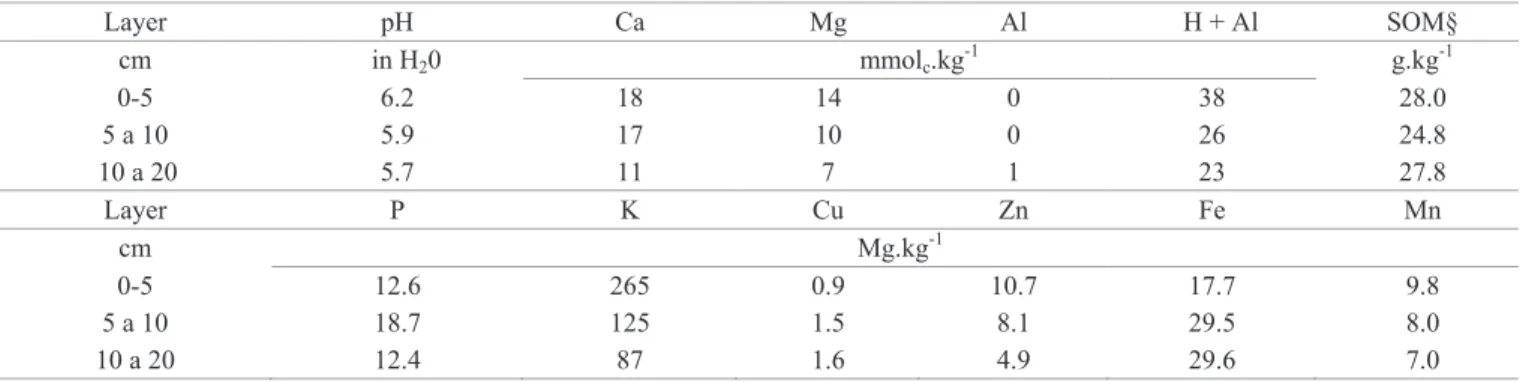
The soil is classified as a clay loam (kaolinitic, thermic Typic Haplorthox) acidic soil (Embrapa, 2006). Before the deployment of the field trial, in May 2014, chemical analyzes were performed at a depth of 0-0.05, 0.05-0.10 and 0.10-0.20 m to characterize the experimental area (Table 1). The chemical analyzes were performed according to the methodology proposed by Claessen (1997). The soil pH was determined in a 0.01 mol.L–1 CaCl
2
suspension (1:2.5 soil/solution). Exchangeable Ca, Mg, and Al
were extracted with neutral 1 mol.L–1 KCl in a 1:10 soil/solution
ratio and determined by titration with a 0.025 mol.L–1 NaOH
solution. Phosphorus and exchangeable K were extracted with a Mehlich 1 extracting solution (0.05 M HCl in 0.0125 M H2SO4).
The extracts were calorimetrically analyzed for P, and flame photometry was used to analyze K. The base saturation values were calculated using the results of for exchangeable bases and total acidity at pH 7.0 (H + Al). Micronutrients were determined in Mehlich 1 extract by atomic absorption, and organic matter was determined by the method of Walkley and Black.
Table 1. Chemical soil attributes from the experimental area before the beginning of the trials. Santo Antônio de Goiás, Goiás, Brazil, growing season 2014.
Layer pH Ca Mg Al H + Al SOM§
cm in H20 mmolc.kg-1 g.kg-1
0-5 6.2 18 14 0 38 28.0
5 a 10 5.9 17 10 0 26 24.8
10 a 20 5.7 11 7 1 23 27.8
Layer P K Cu Zn Fe Mn
cm Mg.kg-1
0-5 12.6 265 0.9 10.7 17.7 9.8
5 a 10 18.7 125 1.5 8.1 29.5 8.0
10 a 20 12.4 87 1.6 4.9 29.6 7.0
§ SOM – soil organic matter.
The experimental design was in a randomized block scheme and treatments consisted of the six seed lots of common bean with four replications. Each plot consisted of six five-meters-long rows, with a useful area of four central rows, disregarding 0.5 m from the ends of each row. A space of one meter among plots was used.
The experimental area has been cultivated in crop-livestock and no-tillage system (NTS), with crop rotation program including soybean, maize and brachiaria (summer), and common bean (winter). The previous crop in the area was maize. The field trials were fertilized according to soil analysis, complemented by a topdressing fertilization in all plots with 60.kg ha-1 of N as urea
when the treatment one (Lot 1) reached the V4 vegetative stage (four trifoliate leaves). Other cultural practices were performed according to the recommendations for the crop to keep the area free of weeds, diseases and insects (Santos et al., 2006). The
sowing was performed manually on May 20th, 2014 at 0.50 m
row spacing and a population of 240,000 plants.ha-1. A sprinkler
irrigation system was used as needed. In the management of water it was used three crop coefficients (Kc), divided into four periods between emergence and harvest. In the vegetative stage the value of 0.4 was used. For the reproductive phase two values of Kc were used, the initial 0.7 to 1.0, and in the final phase of maturation these values were reversed, ie
initial 1.0 and final 0.7. Thus, control of irrigation considering the depth of root system exploitation of 0.2 m was initiated with the available water capacity (AWC) at its maximum, subtracting, successively, the value of crop evapotranspiration until the total water reached the minimum limit of 40% of AWC (Doorenbos and Pruitt, 1976).
Seedling emergence occurred at nine days after sowing for treatment one (Lot 1) and three days later for the treatment six (Lot 6). After emergence, the plots were thinned manually
to reach a homogeneous plant stand of 220.000 plants.ha-1,
eliminating the germination variation and assuring just the vigor differences among treatments. The usable area of the
plots was harvested on August 21st, also manually, followed
by mechanized thresher. The harvested common bean grains were weighed, transformed to kg.ha-1 and yield expressed
on a 13% basis of water content. Water content (WC) was
determined by the oven method, drying two seed subsamples of 20 g from each seed lot at 105 °C ± 3 °C for 24 h, followed by weighing (Brasil, 2009), with results expressed as percentage.
by regression analysis, and for grain yield, the results were analyzed by regression analysis.
Results and Discussion
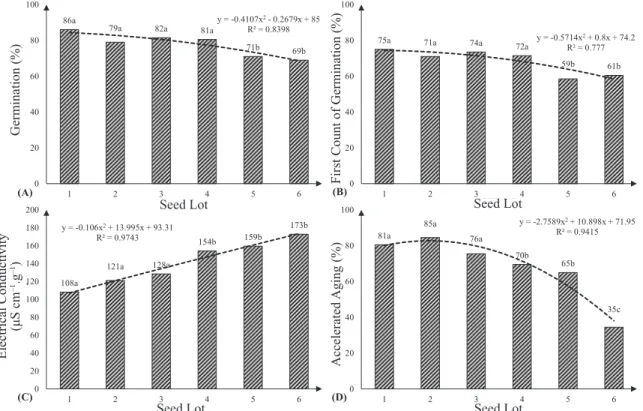
The results of seed vigor potential are presented in Figure 1. In the way the seed lots were produced, using seed mixtures, the Seed Lots 1 to 4 kept the same level of germination results (Figure 1A), from 86% to 79%, however, Seed Lots 5 and 6 were inferior of this group, reaching a band from 71% to 69% germination. This is an important data to be analyzed, because differences in germination could directly affect the final plant population of any crop and consequently affect the grain yield.
Therefore, for the purpose of this experiment it had not influence, considering that the plots were thinned manually and reached a homogeneous plant population of 220.000 plants.ha-1.
The seed vigor was evaluated by the physiological tests of first count of germination (Figure 1B), electrical conductivity (Figure 1C) and accelerated aging (Figure 1D). The results from first count of germination were very similar to the germination results, with Seed Lots 1 to 4 as the most vigorous ones. The other vigor tests could at least divide the
seed lots in two groups, Seed Lots 1 to 3 with high vigor
and Seed Lots 4 to 6 with low vigor. Those differences were expected considering the way the treatments were composed, using different combinations of high and low vigor seeds.
Figure 1. Physiological potential of common bean seed, “Perola” variety, according to the seed vigor level: Seed Lot 1 (highest level); Seed Lot 6 (lowest level): (A) Germination (%); (B) First Count of Germination (%); (C) Electrical Conductivity (μS cm–1.g–1); (D) Accelerated Aging (%).
86a
79a 82a 81a
71b 69b y = -0.4107x2-0.2679x + 85
R² = 0.8398
0 20 40 60 80 100
1 2 3 4 5 6
Ger m ian tio n (% ) Seed Lot
75a 71a 74a 72a
59b 61b y = -0.5714x2+ 0.8x + 74.2
R² = 0.777
0 20 40 60 80 100
1 2 3 4 5 6
Fir st Co un t o f G er m ia nti on (%) Seed Lot 108a 121a 128a 154b 159b 173b y = -0.106x2+ 13.995x + 93.31
R² = 0.9743
0 20 40 60 80 100 120 140 160 180 200
1 2 3 4 5 6
Electr ical C on du ctiv ity (µS.cm -1.g -1) Seed Lot
81a 85a 76a 70b
65b
35c y = -2.7589x2+ 10.898x + 71.95
R² = 0.9415
0 20 40 60 80 100
1 2 3 4 5 6
A cc eler ated A gin g (%) Seed Lot (A) (C) (D) (B)
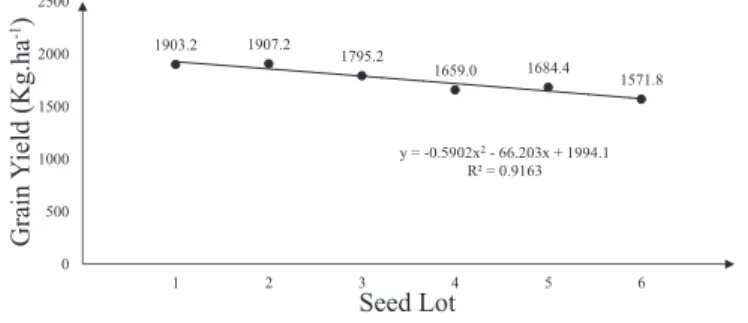
The main result of this research work is related to the grain yield obtained in each treatment. Those data area presented in Figure 2. As expected different results among the imposed treatments were found even between seed lots belonging to the same seed vigor level, as illustrated in Figure 1. There were two different levels of grain yield, one including Seed
Lots 1 to 3, higher vigor seed lots, and one including seed
lots 4 to 6, lower vigor seed lots. The differences between the higher result, mean grain yield of 1.903,2 kg.ha-1, to the lower
result, mean grain yield of 1.571,8 kg.ha-1, represents yield
losses of around 20% from one vigor group to another. In a more detailed analysis, even inside the high seed vigor lots group, it was possible to see tendencies of grain yield losses. Those differences were between 5% and 10%, and shows that slight differences, on seed vigor could affect crop success. Similar results were found by Hofs et al. (2004), Melo et al. (2006) and Mielerzski et al. (2008) for rice, Dias et al. (2010), Mondo et al. (2012), Mondo et al. (2013a) and Mondo
Germination (%)
First Count of Germination (%)
Accelerated Aging (%) Electrical Conductivity (μS cm –1.g –1)
Seed Lot Seed Lot
et al. (2013b) for maize, and Vanzolini and Carvalho (2002), Kolchinski et al. (2005), Kolchinski et al. (2006), Schuch et al. (2009) and Dias et al. (2011) for soybean.
Another interesting result, important to quality control programs and seed quality evaluation, is that the germination and first count of germination were not detailed enough to segregate the seed lots by vigor level and reflect the grain yield potential. Complementary, seed vigor tests, as electrical conductivity and accelerated aging, were crucial and should be included in quality control programs of common bean seeds.
1903.2 1907.2 1795.2
1659.0 1684.4 1571.8
y = -0.5902x2-66.203x + 1994.1
R² = 0.9163
0 500 1000 1500 2000 2500
0 1 2 3 4 5 6 7
Gr
ain
Yield
(k
g
ha
-1)
Seed Lot
Figure 2. Grain yield of common bean, “Perola” variety, from seed lots differing in seed vigor. Seed Lot 1 (highest level); Seed Lot 6 (lowest level).
Conclusions
Seed vigor affects common bean grain yield; the use of low vigor seeds results in grain yield reductions of up to 20%.
References
ANDRADE, F.H.; ABBATE, P.E. Response of maize and soybean to variability in stand uniformity. Agronomy Journal, v.97, n.4, p.1263–1269, 2005. https://dl.sciencesocieties.org/publications/aj/abstracts/97/4/1263
AZEVEDO, J.A.; SILVA, E.M.; RODRIGUES, G.C.; GOMES, A.C. Produtividade do feijão de inverno influenciada por irrigação, densidade de plantio e adubação em solo de Cerrado. Planaltina, Embrapa Cerrados, 2008. 3p. http://www.infoteca.cnptia.embrapa.br/handle/doc/571897
BRASIL. Ministério da Agricultura, Pecuária e Abastecimento. Regras para
análise de sementes.Ministério da Agricultura, Pecuária e Abastecimento.
Secretaria de Defesa Agropecuária. Brasília: MAPA/ACS, 2009. 395p. http:// www.agricultura.gov.br/arq_editor/file/2946_regras_analise__sementes.pdf
CLAESSEN, M.E.C. Manual de métodos de análise de solo. 2ª ed. Rio de Janeiro, EMBRAPA-CNPS. (EMBRAPA-CNPS. Documentos, 1). 1997. 212p. https://www.agencia.cnptia.embrapa.br/Repositorio/ Manual+de+Metodos_000fzvhotqk02wx5ok0q43a0ram31wtr.pdf
DIAS, M.A.N.; MONDO, V.H.V.; CICERO, S.M. Maize seed vigor and weed competition. Journal of Seed Science, v.32, n.2, p.93-101, 2010. http://www. scielo.br/scielo.php?script=sci_arttext&pid=S0101-31222010000200011
DIAS, M.A.N.; PINTO, T.L.F.; MONDO, V.H.V.; CICERO, S.M.; PEDRINI, L.G. Direct effects of soybean seed vigor on weed competition. Journal of Seed Science, v.33, n.2, p.346-351, 2011. http://www.scielo.br/ scielo.php?script=sci_arttext&pid=S0101-31222011000200017
DIDONET, A.D. Ecofisiologia e rendimento potencial do feijoeiro. In: DEL PELOSO, M.J.; MELO, L.C. (Eds.) Potencial de rendimento da cultura do feijoeiro comum. Santo Antônio de Goiás, Embrapa Arroz e Feijão, 2005, p.9-37.
DOORENBOS, J.; PRUITT, W.O. Crop and water requirements. Rome, FAO. (FAO Irrigation and Drainage Paper n. 24). 1976. 179p.
EGLI, D.B. Relationship of uniformity of soybean seedling emergence to yield. Journal of Seed Technology, v.17, n.1, p. 22-28, 1993.
EMBRAPA. Centro Nacional de Pesquisa de Solos. Sistema Brasileiro de Classificação de Solos. 2 ed. Rio de Janeiro, Embrapa Solos. 2006. 306p.
HAMPTON, J.G. What is seed quality? Seed Science and Technology, v.30, p.1–10. 2002. http://cat.inist.fr/?aModele=afficheN&cpsidt=13659037
HOFS, A.; SCHUCH, L.O.B.; PESKE, S.T.; BARROS, A.C.S.A. Emergência e crescimento de plântulas de arroz em resposta à qualidade fisiológica de sementes. Journal of Seed Science, v.26, n.1, p.92-97, 2004. http://www. scielo.br/pdf/%0D/rbs/v26n1/a14v26n1.pdf
KAPPES, C.; ARF, O.; FERREIRA, J.P.; PORTUGAL, J.R.; ALCALDE, A.M.; ARF, M.V.; VILELA, R.G. Physiological quality of seeds and growth of bean seedlings in relation to pre-harvest paraquat applications. Pesquisa Agropecuária Tropical, v.42, n.1, p.9-18. 2012. http://www.scielo.br/scielo. php?script=sci_arttext&pid=S1983-40632012000100002
KOLCHINSKI, E.M.; SCHUCH, L.O.B.; PESKE, S.T. Seeds vigor and intra-specific compettion in soybean. Ciência Rural, v.35, n.6, p.1248-1256, 2005. http://www.scielo.br/scielo.php?script=sci_ arttext&pid=S010384782005000600004&lng=en&nrm=iso
KOLCHINSKI, E.M.; SCHUCH, L.O.B.; PESKE, S.T. Early growth of soybean plants in relation to seeds vigor. Revista Brasileira de Agrociência,
v.12, n.2, p.163-166, 2006. http://www.ufpel.tche.br/faem/agrociencia/ v12n2/artigo07.htm
KOTTEK, M.; GRIESER, J.; BECK, C.; RUDOLF, B.; RUBEL, F. World map of the Köppen-Geiger climate classification updated. Meteorologische Zeitschrift, v.15, n.3, p.259-263, 2006.
LIU, W.; TOLLENAAR, M.; STEWART, G.; DEEN, W. Within-row plant spacing variability does not affect maize yield. Agronomy Journal,
v.96, n.1, p.275–280, 2004a. https://dl.sciencesocieties.org/publications/aj/ abstracts/96/1/275
LIU, W.; TOLLENAAR, M.; STEWART, G.; DEEN, W. response of maize
grain yield to spatial and temporal variability in emergence. Crop Science,
v.44, n.3, p.847–854, 2004b. https://dl.sciencesocieties.org/publications/cs/ abstracts/44/3/847
MELO, P.C.S.; ANUNCIAÇÃO FILHO, C.J.; OLIVEIRA, F.J.; BASTOS, G.Q.; TABOSA, J.N.; SANTOS, V.F.; MELO, M.R.C.S. Selection of genotypes of salinity tolerant rice during the vegetative phase. Ciência Rural,
v.36, n.1, p.58-64, 2006. http://www.scielo.br/pdf/cr/v36n1/a09v36n1.pdf
MEROTTO-JÚNIOR, A.; SANGOI, L.; ENDER, M.; GUIDOLIN, A.F.; HAVERROTH, H.S. Uneven emergence reduces maize grain yield. Ciência Rural, v.29, n.4, p.595-601, 1999. http://www.scielo.br/pdf/cr/v29n4/ a04v29n4.pdf
Seed Lot
Grain
Yield (Kg.ha
MIELERZSKI, F.; SCHUCH, L.O.B.; PESKE, S.T.; PANOZZO, L.E.; PESKE, F.B.; CARVALHO, R.R. Field performance of isolated plants of hybrid rice in function of the seed physiological quality. Journal of Seed Science, v.30, n.3, p.86-94, 2008. http://www.scielo.br/pdf/rbs/v30n3/18.pdf
MONDO, V.H.V.; CICERO, S.M.; DOURADO-NETO, D.; PUPIM, T.L; DIAS, M.A.N. Maize seed vigor and plant performance. Journal of Seed Science, v.34, n.1, p.143-155, 2012. http://www.scielo.br/scielo. php?script=sci_arttext&pid=S0101-31222012000100018
MONDO, V.H.V.; CICERO, S.M.; DOURADO-NETO, D.; PUPIM, T.L; DIAS, M.A.N. Effect of seed vigor on intraspecific competition and grain yield in maize. Agronomy Journal, v.105, n.1, p.222-228, 2013a. https:// dl.sciencesocieties.org/publications/aj/abstracts/105/1/222
MONDO, V.H.V.; CICERO, S.M.; DOURADO-NETO, D.; PUPIM, T.L; DIAS, M.A.N. Seed vigor and initial growth of maize crop. Journal of Seed Science, v.35, n.1, p.64-69, 2013b. http://www.scielo.br/scielo. php?script=sci_arttext&pid=S2317-15372013000100009
MONDO, V.H.V.; DIAS, M.A.N.; CICERO, S.M. Maize seed
vigor and its effects on crop cultivation cycle. Revista de Agricultura,
v.90, n.2, p.168-178, 2015. http://www.fealq.org.br/ojs/index.php/ revistadeagricultura/article/view/178
POMMEL, B.; MOURAUX, D.; CAPPELLEN, O.; LEDENT, J.F. Influence of delayed emergence and canopy skips on the growth and development of maize plants: a plant scale approach with CERES-Maize. European Journal of Agronomy, v.16, p.263-277, 2002. http://www.sciencedirect.com/science/ article/pii/S1161030101001307
SCHUCH, L.O.B.; NEDEL, J.L.; ASSIS, F.N.; MAIA, M.S. Seed vigor and growth analysis of black oats. Scientia Agricola, v.57, n.2, p.305-312, 2000. http://www.scielo.br/scielo.php?pid=S0103-90162000000200018&script=sci_arttext
SCHUCH , L.O.B.; KOLCHINSKI, E.M.; FINATTO, J.A. Seed
physiological quality and individual plants performance in soybean. Journal of Seed Science, v.31, n.1, p.144-149, 2009. http://www.scielo.br/pdf/rbs/ v31n1/a16v31n1.pdf
SANTOS, A.B.; STONE, L.F.; VIEIRA, N.R.A. A cultura do arroz no Brasil. 2ª. Ed. Santo Antônio de Goiás, GO. Embrapa Arroz e Feijão. 2006. 1000p.
SILVA, S.C.; HEINEMANN, A.B.; PAZ, R.L.F.; AMORIM, A.O. Informações meteorológicas para pesquisa e planejamento agrícola, referentes ao ano de 2009, do município de Santo Antônio de Goiás, GO. Santo Antônio de Goiás, Embrapa Arroz e Feijão. (EMBRAPA, CNPAF. Documentos, 256). 2010. 32p. http://www.cnpaf.embrapa.br/publicacoes/ index.php/documentos/article/view/Doc.%20298
TOLLENAAR, M.; DEEN, W.; ECHARTE, L.; LIU, W. Effect of crowding stress on dry matter accumulation and harvest index. Agronomy Journal,
v.98, n.4, p.930–937, 2006. https://dl.sciencesocieties.org/publications/aj/ abstracts/98/4/930