R E S E A R C H
Open Access
Melittin induces in vitro death of
Leishmania (Leishmania) infantum
by
triggering the cellular innate immune
response
Andreia Vieira Pereira
1, Gustavo de Barros
1, Erika Gracielle Pinto
2,3, Andre Gustavo Tempone
2,
Ricardo de Oliveira Orsi
4,5, Lucilene Delazari dos Santos
1,5, Sueli Calvi
1,5, Rui Seabra Ferreira Jr
1,5,
Daniel Carvalho Pimenta
6and Benedito Barraviera
1,5*Abstract
Background:Apis melliferavenom, which has already been recommended as an alternative anti-inflammatory treatment, may be also considered an important source of candidate molecules for biotechnological and biomedical uses, such as the treatment of parasitic diseases.
Methods:Africanized honeybee venom fromApis melliferawas fractionated by RP-C18-HPLC and the obtained melittin was incubated with promastigotes and intracellular amastigotes ofLeishmania (L.) infantum.Cytotoxicity to mice peritoneal macrophages was evaluated through mitochondrial oxidative activity. The production of anti- and pro-inflammatory cytokines, NO and H2O2by macrophages was determined.
Results:Promastigotes and intracellular amastigotes were susceptible to melittin (IC5028.3μg.mL−1and 1.4μg.mL−1,
respectively), but also showed mammalian cell cytotoxicity with an IC50value of 5.7μg.mL−1. Uninfected macrophages
treated with melittin increased the production of IL-10, TNF-α, NO and H2O2. Infected melittin-treated macrophages increased IL-12 production, but decreased the levels of IL-10, TNF-α, NO and H2O2.
Conclusions:The results showed that melittin acts in vitro against promastigotes and intracellular amastigotes of
Leishmania (L.) infantum. Furthermore, they can act indirectly on intracellular amastigotes through a macrophage immunomodulatory effect.
Keywords:Melittin,Apis mellifera,Leishmania, Leishmaniasis, Peptides, Toxins, Antiparasitic, Cytokines
Background
In developing countries, neglected parasitic diseases have resulted in high mortality and morbidity, especially in tropical regions. Leishmaniasis remains an important neglected tropical disease that affects 12 million people in 98 countries with 20,000 to 40,000 deaths due to visceral leishmaniasis (VL) annually [1, 2]. VL is a poten-tially fatal disease that has emerged as an important
opportunistic condition in HIV-infected patients [3]. Its treatment is not only challenging and long, but also offers a limited arsenal of drugs, most of which are toxic including antimonials, amphotericin B, pentamidine and miltefosine [4]. The need for new treatments is crucial.
Discovering new in vitro hit compounds might be considered relatively easier than crossing the animal-to-human barrier, which is still a great challenge to drug discovery programs. Bridging this gap between clinical and basic research must be encouraged by health professionals in order to discover effective treatments, especially for neglected diseases [5]. The search to develop alternative compounds, either of natural or synthetic origin, effective for both medical therapy and
* Correspondence:[email protected]
1Graduate Program in Tropical Diseases, Botucatu Medical School, São Paulo
State University (UNESP–Univ Estadual Paulista), Botucatu, SP, Brazil 5Center for the Study of Venoms and Venomous Animals (CEVAP), São Paulo
State University (UNESP–Univ Estadual Paulista), Rua José Barbosa de Barros, 1780, 18610-307 Botucatu, SP, Brazil
Full list of author information is available at the end of the article
chemoprophylaxis, should be carefully considered [6]. Likewise,Apis melliferavenom may provide an important source of candidate molecules for application against parasitic diseases, even though it has already been recom-mended as an anti-inflammatory treatment [7–9].
Melittin, the major component ofApis melliferavenom, is a cytolytic peptide that may adopt different aggregation states and conformations depending on its concentration. Some of its biological effects include a surfactant action and the ability to interact and enlarge leukocytes and mast cells by presenting detergent-like effects [10–13]. In addition to its antibacterial, antifungal, antiviral and anti-inflammatory properties, melittin also promotes the induction of histamine release [13]. In relation to its antiprotozoal effect, this peptide affects the viability and ultrastructure of trypanosomatids, including amasti-gotes, at concentrations approximately 100 times lower than that in mammalian cells [7]. Since Leishmania can exhibit apoptosis induced by antimicrobial peptides, melittin may follow the same path and then modulate cell death [14]. Acylated synthetic cecropin A-melittin hybrid appeared to be safe and effective for treating canine leishmaniasis [15]. In this context, the present study aimed to evaluate for the first time the effect of melittin as a leishmanicidal agent against L. infantum intracellular amastigotes. Therefore, we investigated the production of pro- and anti-inflammatory cytokines as well as oxygen and nitrogen metabolites in order to assess whether this peptide would directly act on parasites, or if it would modulate the immune response.
Methods Venom collection
Venom from Apis mellifera Africanized honeybees (AHBs), aged between 30 and 40 days, was extracted by electrical stimulation, twice per week, from December 2010 to June 2011. The apiaries are located at the Nucleus of Teaching Science and Technology in Rational Apiculture (NECTAR) of the School of Veterinary Medicine and Animal Husbandry, UNESP, located on the Edgardia Experimental Farm, Botucatu, SP, Brazil, with the following geographic coordinates: 22°49′ South (latitude); 48°24′West (longitude) and average altitude of 623 m [16, 17].
Isolation and purification of melittin by high performance reversed-phase liquid chromatography (RP-HPLC)
The isolation and purification of melittin was conducted by RP-HPLC employing a Shimadzu 20A Proeminence binary HPLC system and C18 column. The lyophilized whole venom was solubilized in 0.1 % (v/v) trifluoroace-tic acid at the concentration of 1 mg.mL−1. The samples
were centrifuged and the supernatant was separated for chromatographic analysis. For fractioning, a two-solvent
system was utilized: (A) H2O: Trifluoroacetic acid
(TFA) (1:1000) and (B) acetonitrile (ACN):H2O:TFA
(900:100:1). The elution was performed at a constant flow of 3.5 mL.min−1 under a linear gradient of B
(5–60 %) for 15 min and the elution was monitored at 214 nm. The peptide elution was analyzed by mass spectrometry [16, 18].
Mass spectrometry
LC-MS analyses were performed using an electrospray-ion trap-time of flight (ESI-IT-TOF) (Shymadzu Co., Japan) mass spectrometer equipped with a binary ultra-fast liquid chromatography system (UFLC) (20A Prom-inence, Shimadzu Co., Japan). Samples were dried, suspended in water/formic acid (0.99/0.01, v/v) and loaded in a C18 column (Shimadzu-pack XR-ODS, 2.2 μm; 100 × 3 mm) in a binary solvent system: (A2)
water/formic acid (FA) (999/1, v/v) and (B2) ACN/water/
FA (900/99/1, v/v/v). The column was eluted at a constant flow rate of 0.2 mL.min−1 with a 0 to 100 %
gradient of solvent B2 for 20 min. The eluates were
monitored by a Shimadzu SPD-M20A PDA detector before introduction into the mass spectrometer, in which the spray voltage was kept at 4.5 kV, the capillary voltage at 1.76 kV and the temperature at 200 °C. MS spectra were acquired under positive mode and collected in the 80 to 2000m/z range. Instrument control, data acquisi-tion, and data processing were performed with LabSolu-tions (LCMSsolution 3.60.361 version, Shimadzu). Direct mass spectrometric analyses were performed in an ESI-IT-TOF as described above. Samples were dried and suspended in 0.1 % FA by positive mode electrospray ionization (ESI+). The fractions were manually injected in a Rheodyne injector, at a flow rate 50μL/min, in 50 % B2. Instrument control, data acquisition, and data
pro-cessing were performed with LabSolutions (LCMSsolu-tion 3.60.361 version, Shimadzu). Complementary mass spectrometric analyses were performed in a Shimadzu Axima MALDI-TOF/TOF instrument, under positive ionization mode and employingα-cyano as matrix.
Experimental animals
the Guide for the Care and Use of Laboratory Animals from the National Academy of Sciences. This study was approved on 07/28/2011 by the Ethics Committee on Animal Experimentation of the Botucatu Medical School, São Paulo State University (UNESP), Botucatu, SP, Brazil, under protocol number CEEA 8932011.
Parasites and macrophages
Promastigotes of L. infantum (MHOM/BR/1972/LD) were maintained in M-199 medium supplemented with 10 % fetal bovine serum (FBS) and 0.25 % hemin at 24 ° C. The amastigote forms were obtained by differential centrifugation of the spleen from infected hamsters. The macrophages were collected from peritoneal cavity of BALB/c mice by washing in RPMI-1640 medium supple-mented with 10 % fetal bovine serum and maintained at 37 °C at a tension of 5 % CO2[19].
Determination ofin vitroantileishmanial activity
To determine the 50 % inhibitory concentration (IC50)
against the promastigote forms of L. (L.) infantum, cells were counted in a Neubauer hemocytometer and seeded at 1 × 10⁶ cells per well in 96-well microplates. The melittin and whole venom were dissolved in PBS and tested at 100 μg.mL−1 for melittin and 300 μg.mL−1 for whole
venom with final respective doses of 0.04 μg.mL−1
and 0.14 μg.mL−1 [19]. Miltefosine was used as a
standard drug and PBS as a negative control. The viability was determined by the colorimetric method of MTT [3- (4,5- dimetthythiazol-2-yl) – 2,5 diphe-nyltetiazoliumbromide] [20].
To determine the 50 % inhibitory concentration (IC50)
against intracellular amastigotes of L. infantum, mice peritoneal macrophages were incubated in a 1:10 ratio of macrophages to amastigotes. Test compounds were incubated with infected macrophages for 120 h. Subse-quently, the cells were observed through a light micro-scope. Miltefosine was used as the standard control drug. Parasite burden was determined by the number of infected macrophages out of 500 cells [21].
Cytotoxicity against peritoneal cells
Peritoneal macrophages were incubated with whole venom and melittin, serially diluted from an initial con-centration of 100μg.mL−1for melittin and of 300μg.mL −1for whole venom, for 48 h at a temperature of 37 °C
in a 5 % CO2incubator. Miltefosine was utilized as the
standard drug. The viability of cells was determined by the MTT assay [22].
Quantification of cytokines
Macrophages were incubated with promastigote forms of L. infantum. The infection process was similar to that displayed by the amastigote forms. Melittin was
dissolved in PBS, being added at 0.70, 1.47 and 2.50 μg/mL. The supernatants were retrieved at 24, 48 and 72 h and maintained at −80 °C. We chose
72 h as the maximum period for evaluating levels of cytokines since their production is reduced or even lost in longer periods. Subsequently, the cytokines IL-12, IL-10, TGF-β and TNF-α were measured utilizing the Quantikine® HS kit (R&D Systems), according to the manufacturer’s instructions [19].
Determination of nitric oxide production
The nitric oxide production (NO) was evaluated in supernatants that had been retrieved as previously described, by measuring nitrites (NO2−) and nitrates
(NO3−). Nitrite was dosed by the Griess reaction [23].
The results were read in an ELISA reader utilizing a 540 nm filter and compared with a blank solution constituted by the Griess reaction. All measurements were performed in triplicate. The results were expressed in micromoles of NO/8 × 104 cells, starting from a standard curve established in each assay, composed of known molar concentrations of NO2−, varying from 200
to 0.39μM.
Determination of hydrogen peroxide production
The production of hydrogen peroxide (H2O2) was
deter-mined according to the method described by Pick and Keisari [24] and adapted by Pick and Mizel [25]. In sum-mary, the monolayers of macrophages were treated with red phenol buffer solution containing 140 mM of NaCl, 10 mM of phosphate buffer, 5.5 mM of dextrose, 0.56 mM of red phenol and 0.01 mg.mL−1of strong root
peroxidase type II (Sigma Chemical Co, USA) at pH 7. The plates were incubated at a temperature of 37 °C, in a 5 % CO2incubator for 4 h, and the reaction was
inter-rupted by the addition of 0.01 mL of 1 M NaOH. The absorbance was determined by an ELISA automatic reader (MD 5000, Dynatech Laboratories Inc., USA), with a 620 nm filter, using a blank solution constituted by phenol red and 1 M NaOH. All the measurements were performed in triplicate, and the results of H2O2
levels were expressed in nanomoles of H2O2/8 × 104
cells, starting from a standard curve established in each assay, constituted from known molar concentrations of H2O2in phenol buffer. Under our experimental conditions,
the curve was constructed with H2O2 concentrations
of 0.5, 1.0, 2.0, 4.0 and 8 nM.
Statistical analysis
analyzed by the test of Mann–Whitney. The entire analysis was performed by the software GraphPad Prism® Version 5.01 (GraphPad Software Inc., USA). For all the statistical tests, the significance level was considered p< 0.05 [26].
Results
Melittin purification
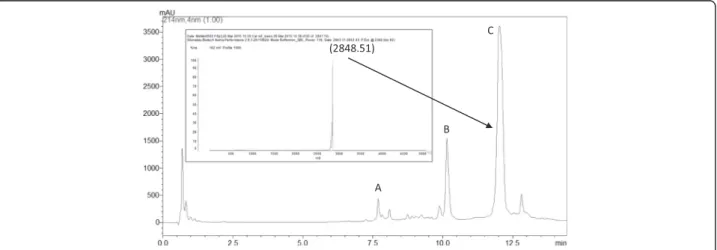
Melittin was purified from Africanized honeybee (AHB) whole venom via reversed-phase liquid chromatography, as previously described [16–18]. Fig. 1 presents the chromatographic profile of whole venom, identifying the venom major peaks, namely: apamin (A), phospholipase A2 (B) and melittin (C). Peak C was analyzed by mass
spectrometry (Fig. 1, inset) and demonstrated to contain pure melittin.
Antileishmanial activity and macrophage cytotoxicity
Table 1 displays the viability ofLeishmaniapromastigotes and mammalian cytotoxicity of cells challenged with whole venom, melittin and standard drugs. Melittin was active against Leishmaniapromastigotes showing an IC50
value of 28.29 μg.mL−1(95 % confidence interval = 23.97
to 33.39μg.mL−1) after 48 h. The crude venom showed an
IC50value of 87μg.mL−1(95 % confidence interval = 76.91
to 99.22 μg.mL−1); miltefosine was used as the standard
drug and demonstrated an IC50 value of 6.69 μg.mL−1
(95 % confidence interval = 6.29 to 7.11 μg.mL−1). The
statistical difference among the IC50 values of melittin,
whole venom and miltefosine was significant (p< 0.05). Melittin also demonstrated cytotoxicity to mammalian cells showing an IC50value of 5.73μg.mL−1(95 %
confi-dence interval = 5.08 to 6.44 μg.mL−1), while the whole
venom showed an IC50 value of 27.59 μg.mL−1 (95 %
confidence interval = 20.63 to 36.90 μg.mL−1), differing
significantly from melittin (p< 0.05). Miltefosine was also
used as standard drug presenting an IC50 value of
49.72 μg.mL−1 (95 % confidence interval = 39.85 to
63.98μg.mL−1) in mammalian cells.
The activity of melittin against the amastigotes was investigated using peritoneal macrophages as host cells. The results showed an IC50 value of 1.4 μg.mL−1.
Although melittin was able to eliminate 100 % of intra-cellular amastigotes at 2.5 μg.mL−1, a morphological
alteration of host cells could be observed when com-pared to control group. However, in the concentration of 0.7 μg.mL−1, melittin induced no toxicity to
macro-phages, but no considerable treatment could be de-tected. Miltefosine was used as the standard drug and showed an IC50 value of 6.87 μg.mL−1. Considering the
selectivity index of melittin, which was determined using the mammalian cytotoxicity by the activity against intracellular amastigotes, we demonstrated a value of 4, confirming a higher toxic effect to Leishmania than to mammalian cells.
Melittin effects on IL-12 and TNF-αlevels
Melittin was incubated at non-toxic concentrations with non-infected and infected macrophages while still pre-senting an anti-amastigote effect. This concentration was assayed for quantifying anti-inflammatory (IL-10 and TGF-β) and pro-inflammatory cytokines (IL-12 and TNF-α). In Fig. 2, we demonstrate the effect of melittin on IL-12 production. The IL-12 production levels by macrophages of the control group, which was signifi-cantly (p< 0.05) higher than the group of untreated infected macrophages. No significant difference was detected in IL-12 production between uninfected and melittin-treated macrophages. But it also could be noted that by decreasing melittin concentrations, the IL-12 production levels dropped. Infected macro-phages treated with melittin produced increased levels
Fig. 1Chromatographic profile of whole venom from Africanized honeybees obtained by reversed-phase liquid chromatography indicating its major components: (a) apamin, (b) phospholipase A2and (c) melittin. Inset: MALDI-TOF/MS profile of melittin (peak C). The m/z value is typed
of IL-12 when compared to untreated cells. A time-dependent production could be observed in longer incubation periods (72 h).
The TNF-α production was also determined after melittin treatment. Figure 3 shows that uninfected mac-rophages, independent of melittin presence, produced significant levels of TNF-α in a time-dependent manner. After 72 h of incubation, uninfected cells produced higher amounts of TNF-α (p< 0.05) when compared to infected cells. A significant (p< 0.05) reduction of TNF-α levels was observed when the infected cells were treated with 2.5μg.mL−1of melittin.
Despite the observation of non-significant differences (p< 0.10), infected macrophages treated with melittin at 1.47 and 0.7μg.mL−1demonstrated a slight increase in
TNF-αproduction.
Melittin effects on IL-10 and TGF-β
Elevated levels of IL-10 were produced by uninfected mac-rophages treated with melittin, particularly at 1.47μg.mL−1
after the 24-h incubation (p< 0.05). In Fig. 4, infected melittin-treated macrophages demonstrated a significant decrease of IL-10 levels in a concentration-independent manner (p< 0.05). TGF-β levels showed no variation among all groups (data not shown).
Melittin effects on NO and H2O2
In Figs. 5 and 6, it was demonstrated that melittin did not alter levels of either NO or H2O2 in uninfected
macrophages. Conversely, infected macrophages treated with melittin showed reduced NO and H2O2levels when
compared to untreated macrophages (p< 0.05).
Discussion
Peptides derived from animal toxins represent an inexhaustible source of candidate compounds for drug discovery and design, resulting in a reduced probability of drug resistance through a rapid elimination of microor-ganisms [7]. Adadeet al. [7] evaluated the effect of natural melittin against epimastigote, trypomastigote and amasti-gote forms of T. cruzi;the peptide was able to affect the growth, viability and ultrastructure of amastigotes at concentrations 15- to 100-fold smaller than the toxic concentrations. These effects were also observed in other microorganisms [27]. According to Klocek and Seelig [28] melittin, at 8 and 14 μg/mL, demonstrated cytotoxicity to hamster ovary cells (CHO) and also to glycosaminoglycan-deficient cells (CHO-745), respect-ively. Similarly, Maher and McClean [29] investigated the cytotoxicity of melittin against HT29 intestinal
Fig. 2Determination of IL-12 concentration (pg.mL−1) in the
supernatant of uninfected macrophages (n) and infected macrophages (i) after melittin treatment (0, 0.7, 1.47 and 2.5μg.mL−1) at 24, 48 and 72 h. Data are presented as mean of three independent measurements. *p< 0.05 for infected cells versus non-infected cells (24, 48 and 72 h) without melittin addition.●p< 0.05, for 24 h treatment with 2.5 versus
0.7μg.mL−1melittin of non-infected cells
Fig. 3Determination of TNF-αconcentration (pg.mL−1) in the supernatant of uninfected macrophages (n) and infected macrophages (i) after melittin treatment (0, 0.7, 1.47 and 2.5μg.mL−1) at 24, 48 and 72 h. Data are presented as mean of three independent measurements. *p< 0.05 for 72 h infect cells versus 24, 48 and 72 h non-infected cells, without melittin addition.●p< 0.05, for 24 h treatment with 0.7μg.mL−1 melittin versus non-infected cells.∆p< 0.05 for 24, 48 and 72 h treatment with 2.5μg.mL−1melittin versus infected non-treated cells
Table 1Antileishmanial and mammalian cytotoxicity of whole venom and melittin
IC50(μg.mL−1) (95 % CI)
L.(L.)infantum Cytotoxicity (macrophages)
promastigotes amastigotes
Crude venom 87.0 (76.91 to 99.22) n.d. 27.59 (20.63 to 36.90)
Melittin 28.29 (23.97 to 33.39) 1.40 (1.21 to 1.63) 5.73 (5.08 to 6.44)
Miltefosine 6.69 (6.29 to 7.11) 6.87 (4.71 to 10.01) 49.72 (39.85 to 63.98)
epithelial cells and Caco-2, with respective IC50 values
of 3.4 μg.mL−1 and 5.2 μg.mL−1. Despite the absence
in the literature of an in vitro toxicity of natural melittin to macrophages, our results corroborated previously published studies.
Our data demonstrated that melittin was approxi-mately 3-fold more effective against Leishmania infantum promastigotes than the whole venom. Diaz-Achirica et al. [30] evaluated the activity of melittin against Leishmania donovani promastigotes and dem-onstrated an IC50 value of 0.87 μg.mL−1, causing
damage to the plasma membrane of the parasite. In our study, Leishmania infantum promastigotes were
about 32-fold more resistant than L. donovani
reported above.
For decades, the effect of animal toxins on the immune system has been extensively investigated. It has been known that these toxins have the capacity to modulate the innate and adaptive immune re-sponses [31–33]. In addition, the balance between the host and parasite factors that control the activation/ deactivation of macrophages determines the outcome of the infected cells. Macrophages are the major effector cells responsible for elimination of parasites, which can be activated by distinct signals leading to their development into functionally distinct subsets with different disease outcomes. Thus, appropriate activation of macrophages is crucial for eliminating the intracellular pathogen [34]. Immune response in leishmaniasis was clearly described in the murine model as a Th2 response in active disease and a Th1 response during the elimination of infection and cure. In humans, the dichotomy is not well established when compared to the murine model, and disease progression is determined by the changing cytokine profile. Our results showed that melittin stimulated the production of interleukin IL-12 in a time- and dose-dependent manner. On the other hand, the infection diminished the levels of this cytokine, whereas melittin treatment stimulated IL-12 produc-tion at its 50 % inhibitory concentraproduc-tion. These re-sults suggest that melittin may eliminate the parasite via an indirect effect, by modulating pro-inflammatory interleukin 12. Other studies have shown that IL-12 plays a role in protecting the host during Leish-mania infection by promoting a Th1 response and controlling the parasitic replication [35–37]. Our data
Fig. 5Determination of NO levels in the supernatant of uninfected macrophages (n) and infected macrophages (i) after melittin treatment (0, 0.7, 1.47 and 2.5μg.mL−1) at 24, 48 and 72 h. Data are presented as mean of three independent measurements.*p< 0.05 for infected cells versus non-infected cells (24, 48 and 72 h) without melittin addition. All treated infected cells (24, 48 and 72 h; 0, 0.7, 1.47 and 2.5μg.mL−1) are statistically different (p< 0.05) of the corresponding non-treated cells
Fig. 4Determination of IL-10 concentration (pg.mL−1) in the
supernatant of uninfected macrophages (n) and infected macrophages (i) after melittin treatment (0, 0.7, 1.47 and 2.5μg.mL−1) at 24, 48 and 72 h. Data are presented as mean of three independent measurements.●p< 0.05, for 48 and 72 h treatment with
2.5μg.mL−1 melittin versus non-infected cells.∆ p< 0.05 for 24 h treatment with 2.5μg.mL−1melittin versus non-infected non-treated cells. All treated infected cells (24, 48 and 72 h; 0, 0.7, 1.47 and 2.5 μg.mL−1) were statistically different (p< 0.05) of the corresponding non-treated cells
Fig. 6Determination of H2O2levels in the supernatant of
have also shown that melittin eliminated the intracel-lular amastigotes with an IC50 value about 20-fold
smaller than that needed for the extracellular promas-tigotes, suggesting the participation of macrophages in its lethal effect.
TNF-α is a pro-inflammatory cytokine involved in the activation of macrophages and, together with IFN-γ, contributes to antiparasitic activity [38]. Al-though in our study melittin induced a significant decrease of TNF-α levels in infected macrophages, an effective antileishmanial activity was observed after melittin treatment in macrophages. Considering that an excess of TNF-α in the spleen has been described to contribute to a progressive cellular damage and also immunological dysfunction [39, 40], the observed downregulation of TNF-α induced by melittin could be a possible advantage to a future experimental study.
The cytokines IL-10 and TGF-β have been in-volved in homeostatic mechanisms of leishmaniasis by limiting the tissue damage caused by excessive inflammation. However, elevated levels of these cyto-kines have also been ascribed to the persistence of the infection [41]. It has also been reported that patients with active VL present high serum IL-10 levels prior to treatment, indicating their association with disease persistence [42, 43]. According to our results, the interaction of melittin with infected macrophages, decreased the IL-10 production when compared to untreated cells. Taken together, these findings suggest that the antiparasitic activity (of melittin) may also be ascribed to the upregulation of IL-12 levels and the downregulation of IL-10 levels, resulting in a reduced in vitro infection. Conversely, melittin did not exert an effect on TGF-β levels, and augmented the production of IL-10 in uninfected macrophages. These results are in agreement with the observations of Lapara and Kelly [44], who verified an increase in IL-10 production in macro-phages infected by Leishmania.
Nitric oxide (NO) and hydrogen peroxide (H2O2)
perform a fundamental role in the defense of macro-phages [45–47]. In our assays, elevated levels of NO and H2O2 were found in Leishmania-infected macrophages,
but upon treatment with melittin, a strong inhibition of these metabolites was observed. These observations corroborates Kwonet al.[48] and Moonet al.[49], who demonstrated the capacity of melittin to inhibit NO production. The elimination of intracellular amastigotes via an NO-independent pathway has also been described by Costa-Silva et al.[50]. The authors demonstrated the antileishmanial activity of a natural phenylpropanoid dimer onL. donovanimacrophage infection, with similar diminutions in IL-10 levels.
Conclusions
The results showed that melittin exerts in vitro activ-ity against Leishmania (L.) infantum promastigotes and intracellular amastigotes and can act indirectly on intracellular amastigotes through a macrophage im-munomodulatory effect.
Ethics committee approval
The present study was approved by the Ethics Committee on Animal Experimentation of the Botucatu Medical School, São Paulo State University (UNESP), Botucatu, SP, Brazil, under protocol number CEEA 8932011 on 07/28/ 2011. Moreover, animal procedures were performed in agreement with the Guide for the Care and Use of Labora-tory Animals from the National Academy of Sciences.
Competing interests
The authors declare that they have no competing interests.
Authors’contributions
AVP, AGT, ROO, EGP, DCP, LDS, SAC and GACB conceived, designed and performed the experiments; DCP, EGP, AGT, RSF Jr. and BB analyzed the results and wrote the paper. All authors read and approved the final manuscript.
Acknowledgments
The authors would like to thank the State of São Paulo Research Foundation (FAPESP, proc. n. 2011/23236-4 and n. 2009/53846-9), the National Council for Scientific and Technological Development (CNPq, proc. n. 563582/ 2010-3), the Coordination for the Improvement of Higher Education Personnel (CAPES, AUXPE Toxinologia 1219/2011, proc. n. 23038.000823/2011-21 and AUXPE proc. n. 23038.005536/2012-31) and FINEP (protocol number 01.12.0450.01). DCP (306066/2011-4), RSFJr and AGT are CNPq research fellows.
Author details 1
Graduate Program in Tropical Diseases, Botucatu Medical School, São Paulo State University (UNESP–Univ Estadual Paulista), Botucatu, SP, Brazil. 2
Department of Parasitology, Adolfo Lutz Institute, São Paulo, SP, Brazil. 3Laboratory of Protozoology, Institute for Tropical Medicine, University of São
Paulo (USP), São Paulo, SP, Brazil.4Department of Animal Production, School of Veterinary Medicine and Animal Husbandry, São Paulo State University (UNESP–Univ Estadual Paulista), Botucatu, SP, Brazil.5Center for the Study of Venoms and Venomous Animals (CEVAP), São Paulo State University (UNESP
–Univ Estadual Paulista), Rua José Barbosa de Barros, 1780, 18610-307 Botucatu, SP, Brazil.6Laboratory of Biochemistry and Biophysics, Butantan Institute, São Paulo, SP, Brazil.
Received: 7 August 2015 Accepted: 4 January 2016
References
1. Alvar J, Vélez ID, Bern C, Herrero M, Desjeux P, Cano J, et al. Leishmaniasis worldwide and global estimates of its incidence. PLoS One. 2012;7(5): e35671. doi:10.1371/journal.pone.0035671.
2. Allahverdiyev AM, Abamor ES, Bagirova M, Baydar SY, Ates SC, Kaya F, et al. Investigation of antileishmanial activities of Tio2@Ag nanoparticles on biological properties ofL. tropicaandL. infantumparasites,in vitro. Exp Parasitol. 2013;135(1):55–63.
3. Cota GF, de Sousa MR, Demarqui FN, Rabello A. The diagnostic accuracy of serologic and molecular methods for detecting visceral leishmaniasis in HIV infected patients: meta-analysis. PLoS Negl Trop Dis. 2012;6(5):e1665. doi:10.1371/journal.pntd.0001665.
5. Ferreira AS, Barraviera B, Barraviera SR, Abbade LP, Caramori CA, Ferreira Junior RS. A success in toxinology translational research in Brazil: bridging the gap. Toxicon. 2013;69:50–4.
6. Marques N, Cabral S, Sá R, Coelho F, Oliveira J, da Cunha JG S, et al. Leishmaniose visceral e infecção por vírus da imunodeficiência humana na era da terapêutica anti-retrovírica de alta eficácia. Acta Med Port. 2007;20:291–8. 7. Adade CM, Chagas GS, Souto-Padrón T.Apis melliferavenom induces
different cell death pathways inTrypanosoma cruzi. Parasitology. 2012;139(11):1444–61.
8. Chen L, Chen W, Yang H, Lai R. A novel bioactive peptide from wasp venom. J Venom Res. 2010;1:43–7.
9. Carter V, Underhill A, Baber I, Sylla L, Baby M, Larget-Thiery I, et al. Killer bee molecules: antimicrobial peptides as effector molecules to target sporogonic stages ofPlasmodium. PLoS Pathog. 2013;9(11): e1003790. doi:10.1371/journal.ppat.1003790.
10. Jacobs T, Bruhn H, Gaworski I, Fleischer B, Leippe M. NK-lysin and its shortened analog NK-2 exhibit potent activities againstTrypanosoma cruzi. Antimicrob Agents Chemother. 2003;47(2):607–13.
11. Conlon JM, Kolodziejek J, Nowotny N. Antimicrobial peptides from ranid frogs: taxonomic and phylogenetic markers and a potential source of new therapeutic agents. Biochim Biophys Acta. 2004;1696(1):1–14.
12. Ferre R, Melo MN, Correia AD, Feliu L, Bardají E, Planas M, et al. Synergistic effects of the membrane actions of cecropin-melittin antimicrobial hybrid peptide BP100. Biophys J. 2009;96(5):1815–27.
13. Stromstedt AA, Wessman P, Ringstad L, Edwards K, Malmsten M. Effect of lipid headgroup composition on the interaction between melittin and lipid bilayers. J Colloid Interface Sci. 2007;311(1):59–69.
14. Kulkarni MM, McMaster WR, Kamysz W, McGwire BS. Antimicrobial peptide-induced apoptotic death ofLeishmaniaresults from calcium-dependent, caspase-independent mitochondrial toxicity. J Biol Chem. 2009;284(23):15496–504.
15. Alberola J, Rodríguez A, Francino O, Roura X, Rivas L, Andreu D. Safety and efficacy of antimicrobial peptides against naturally acquired Leishmaniasis. Antimicrob Agents Chemother. 2004;48(2):641–3.
16. Ferrreira Junior RS, Sciani JM, Marques-Porto R, Lourenço Junior A, Orsi RO, Barraviera B, et al. Africanized honey bee (Apis mellifera) venom profiling: seasonal variation of melittin and phospholipase A2 levels. Toxicon. 2010;56(3):355–62.
17. Santos LD, Pieroni M, Menegasso ARS, Pinto JRAS, Palma MS. A new scenario of bioprospecting of Hymenoptera venoms through proteomic approach. J Venom Anim Toxins incl Trop Dis. 2011;17(3):364–77. 18. Sciani JM, Marques-Porto R, Lourenço Junior A, Orsi RO, Ferreira Junior RS,
Barraviera B, et al. Identification of a novel melittin isoform from Africanized Apis melliferavenom. Peptides. 2010;31(8):1473–9.
19. Cezário GAC, de Oliveira LR, Peresi E, Nicolete VC, Polettini J, de Lima CR, et al. Analysis of the expression of toll-like receptors 2 and 4 and cytokine production during experimentalLeishmania chagasiinfection. Mem Inst Oswaldo Cruz. 2011;106(5):573–83.
20. Tempone AG, Pimenta DC, Lebrun I, Sartorelli P, Taniwaki NN, de Andrade HF J, et al. Antileishmanial and antitrypanosomal activity of bufadienolides isolated from the toadRhinella jimiparotoid macrogland secretion. Toxicon. 2008;52(1):13–21.
21. Reimão JQ, Colombo FA, Pereira-Chioccola VL, Tempone AG.In vitro and experimental therapeutic studies of the calcium channel blocker bepridil: detection of viableLeishmania(L.)chagasiby real-time PCR. Exp Parasitol. 2011;128(2):111–5.
22. Tada H, Shiho O, Kuroshima K, Koyama M, Tsukamoto M. An improved colorimetric assay for interleukin 2. J Immunol Methods. 1986;93(2):157–65. 23. Griess P. Bemerkungen zu der abhandlung der HH. Weselsky und Benedikt,
Ueber einige Azoverbindungen. Ber Dtsch Chem Ges. 1879;12(1):426–8. 24. Pick E, Keisari Y. A simple colorimetric method for the measurement of
hydrogen peroxide produced by cells in culture. J Immunol Methods. 1980;38(1–2):161–70.
25. Pick E, Mizel D. Rapid microassays for the measurement of superoxide and hydrogen peroxide production by macrophages in culture using an automatic enzyme immunoassay reader. J Immunol Methods. 1981;46(2):211–26.
26. Zar JH. Biostatistical analysis. 5th ed. Upper Saddle River, New Jersey: Pearson Prentice Hall; 2010. p. 944.
27. Bechinger B, Lohner K. Detergent-like actions of linear amphipathic cationic antimicrobial peptides. Biochim Biophys Acta. 2006;1758(9):1529–39.
28. Klocek G, Seelig J. Melittin interaction with sulfated cell surface sugars. Biochemistry. 2008;47(9):2841–9.
29. Maher S, McClean S. Investigation of the cytotoxicity of eukaryotic and prokaryotic antimicrobial peptides in intestinal epithelial cellsin vitro. Biochem Pharmacol. 2006;71(9):1289–98.
30. Díaz-Achirica P, Ubach J, Guinea A, Andreu D, Rivas L. The plasma membrane ofLeishmania donovanipromastigotes is the main target for CA(1–8)M(1–18), a synthetic cecropin A-melittin hybrid peptide. Biochem J. 1998;330(Pt 1):453–60.
31. Petricevich VL, Teixeira CF, Tambourgi DV, Gutiérrez JM. Increments in serum cytokine and nitric oxide levels in mice injected withBothrops asper andBothrops jararacasnake venoms. Toxicon. 2000;38(9):1253–66. 32. Pérez-Santos JL, Talamás-Rohana P.In vitroindomethacin administration
upregulates interleukin-12 production and polarizes the immune response towards a Th1 type in susceptible BALB/c mice infected withLeishmania mexicana. Parasite Immunol. 2001;23(11):599–606.
33. Passero LF, Laurenti MD, Tomokane TY, Corbett CE, Toyama MH. The effect of phospholipase A2 fromCrotalus durissus collilineatusonLeishmania (Leishmania)amazonensisinfection. Parasitol Res. 2008;102(5):1025–33. 34. Mukbel RM, Patten Jr C, Gibson K, Ghosh M, Petersen C, Jones DE.
Macrophage killing ofLeishmania amazonensisamastigotes requires both nitric oxide and superoxide. Am J Trop Med Hyg. 2007;76(4):669–75. 35. Hernandez-Pando R, Orozco H, Arriaga K, Sampieri A, Larriva-Sahd J,
Madrid-Marina V. Analysis of the local kinetics and localization of interleukin-1 alpha, tumour necrosis factor-alpha and transforming growth factor-beta, during the course of experimental pulmonary tuberculosis. Immunology. 1997;90(4):607–17.
36. Watford WT, Hissong BD, Bream JH, Kanno Y, Muul L, O’Shea JJ. Signaling by IL-12 and IL-23 and the immunoregulatory roles of STAT4. Immunol Rev. 2004;202:139–56.
37. Cummings HE, Tuladhar R, Satoskar AR. Cytokines and their STATs in cutaneous and visceral leishmaniasis. J Biomed Biotechnol. 2010;2010: 294389. doi:10.1155/2010/294389.
38. Coelho-Castelo AAM, Trombone APF, Rocha CD, Lorenzi JCC. Resposta imune a doenças infecciosas. Medicina (Ribeirão Preto). 2009;42(2):127–42. 39. Robak T, Gladalska A, Stepien H. The tumour necrosis factor family of
receptors/ligands in the serum of patients with rheumatoid arthritis. Eur Cytokine Netw. 1998;9(2):145–54.
40. Bradley JR. TNF-mediated inflammatory disease. J Pathol. 2008;214(2):149–60. 41. Belkaid Y, Hoffmann KF, Mendez S, Kamhawi S, Udey MC, Wynn TA, et al.
The role of interleukin (IL)-10 in the persistence ofLeishmania majorin the skin after healing and the therapeutic potential of anti-IL-10 receptor antibody for sterile cure. J Exp Med. 2001;194(10):1497–506. 42. Ansari NA, Saluja S, Salotra P. Elevated levels of interferon-gamma,
interleukin-10, and interleukin-8 during active disease in Indian kala azar. Clin Immunol. 2006;119(3):339–45.
43. Verma S, Kumar R, Katara GK, Singh LC, Negi NS, Ramesh V, et al. Quantification of parasite load in clinical samples of leishmaniasis patients: IL-10 level correlates with parasite load in visceral leishmaniasis. PLoS One. 2010;5(4):e10107. doi:10.1371/journal.pone.0010107.
44. Lapara NJ, Kelly BL. Suppression of LPS-induced inflammatory responses in macrophages infected withLeishmania. J Inflamm (Lond). 2010;7(1):8. 45. Bogdan C. The function of nitric oxide in the immune system. In: Mayer B,
editor. Nitric Oxide. Berlin: Springer; 2000. p. 443–92.
46. Tripathi P, Tripathi P, Kashyap L, Singh V. The role of nitric oxide in inflammatory reactions. FEMS Immunol Med Microbiol. 2007;51(3):443–52. 47. Barros GAC, Pereira AV, Barros LC, Lourenço Jr A, Calvi SA, Santos LD, et al. In vitroactivity of phospholipase A2and of peptides fromCrotalus durissus
terrificusvenom against amastigote and promastigote forms ofLeishmania (L.) infantum chagasi. J Venom Anim Toxins incl Trop Dis. 2015;21:48. 48. Kwon YB, Kang MS, Kim HW, Ham TW, Yim YK, Jeong SH, et al.
Antinociceptive effects of bee venom acupuncture (apipuncture) in rodent animal models: a comparative study of acupoint versus non-acupoint stimulation. Acupunct Electrother Res. 2001;26(1–2):59–68.
49. Moon DO, Park SY, Lee KJ, Heo MS, Kim KC, Kim MO, et al. Bee venom and melittin reduce proinflammatory mediators in lipopolysaccharide-stimulated BV2 microglia. Int Immunopharmacol. 2007;7(8):1092–101.