Performance of flood-irrigated
rice as affected by residual rice straw
1Amauri Nelson Beutler2, Matheus Martins Ferreira2, Maicon Zambeli2, Fernando Sintra Fulaneti2, Leandro Galon3
INTRODUCTION
Rice ranks second in cereal production worldwide, and it is one of the most widely consumed food items (FAO 2014). Brazil is the ninth largest rice producer, being the largest one outside Asia (FAO 2014). The Rio Grande do Sul state accounts for 71 % of the Brazilian national production, and flood irrigation is preferred to rainfed upland rice, because of higher yields (Conab 2017).
ABSTRACT
RESUMO
Brazil, one of the largest cultivated areas in the world, has 31.8 million hectares planted under a no-tillage farming system, corresponding to more than half of the land used to grow annual crops (Febrapdp 2014). In the Rio Grande do Sul state, more than 80 % of agricultural land employs the no-tillage system, with upland crops such as soybean and maize predominating, due to the easy adaptation and management of this system. However, a high organic acid production may occur in flood-irrigated
1. Manuscript received in Mar./2017 and accepted for publication in Jun./2017 (http://dx.doi.org/10.1590/1983-40632016v4746078). 2. Universidade Federal do Pampa, Itaqui, RS, Brazil. E-mails: [email protected], [email protected],
Rice is an economically important and widely consumed cereal that achieves high yields under flood-irrigated cultivation. However, the amount of residual straw from the previous year may influence its growth and yield. This study evaluated the performance of flood-irrigated rice as affected by residual rice straw, in a greenhouse. A completely randomized design, in a 5 x 4 x 2 factorial scheme, with four replications, was used.
Treatments were obtained from a combination of five rice straw
amounts (0 t ha-1, 5 t ha-1, 10 t ha-1, 20 t ha-1 and 40 t ha-1), four
application times (3, 2, 1 and 0 months before sowing) and two straw application methods (on the surface and incorporated
into the soil). The number of panicles and shoot dry mass do
not increase when residual straw remains on the soil surface. When the straw is incorporated into the soil on the sowing day, the number of panicles and the shoot dry mass increased by 20 % and 14 %, respectively, if compared to when it was added three months before. The addition of residual rice straw on the surface or incorporated into the soil resulted in a higher yield for flood-irrigated rice grains, when compared to the absence of straw. At 40 t ha-1 of residual rice straw, added at three months
before sowing, there was a higher mass yield of rice grains, if compared to the lower amounts of straw.
KEYWORDS: Oryza sativa; no-tillage system; crop residues.
Desempenho de arroz irrigado por inundação afetado por palha residual de arroz
O arroz é uma cultura de importância econômica e alimentar que atinge elevada produtividade em cultivos irrigados por inundação. No entanto, a quantidade de palha residual do cultivo anterior pode influenciar no seu crescimento e produtividade. Objetivou-se avaliar o desempenho de arroz irrigado por inundação, em casa-de-vegetação, afetado por palha residual de arroz. O delineamento experimental foi inteiramente casualizado, em esquema fatorial 5 x 4 x 2, com quatro repetições. Foram combinadas cinco quantidades de palha (0 t ha-1,
5 t ha-1, 10 t ha-1, 20 t ha-1 e 40 t ha-1), quatro épocas de aplicação
(3, 2, 1 e 0 meses antes da semeadura) e duas formas de adição da palha (superficial e incorporada ao solo). O número de panículas e a massa seca da parte aérea não aumentam quando a palha residual permanece na superfície do solo, porém, são 20 % e 14 % superiores, respectivamente, na média das quantidades de palha, quando a palha é incorporada ao solo no dia da semeadura, em comparação com a incorporação três meses antes. A adição de palha residual de arroz, superficial ou incorporada ao solo, promoveu maior produção de massa de grãos de arroz irrigado, em relação à ausência de palha. Na dose de 40 t ha-1 de palha de arroz residual, adicionada aos três meses
antes da semeadura, ocorreu maior produção de massa de grãos de arroz, em relação às quantidades inferiores de palha.
247 Performance of flood-irrigated rice as affected by residual rice straw
rice fields with crop residues, limiting growth and yield (Johnson et al. 2006) and reducing germination, root growth, seedling mass and height, with more pronounced effects in the initial growth phase (Sousa & Bortolon 2002). This is one of the reasons for using the conventional tillage system, with soil preparation, to accelerate the decomposition of rice straw, considered harmful in excessive amounts.
When large amounts of organic acids are produced under no-tillage, toxicity may cause less root growth and nutrient absorption (Camargo et al. 2001, Schmidt et al. 2007), including N, P, K, Ca and Mg (Sousa & Bortolon 2002), resulting in lower plant mass and height (Köpp et al. 2008). Furthermore, there is a reduction in the mass of irrigated rice grains grown in pots with applications of more than 6.5 t ha-1 of straw (Camargo et al. 1995). These authors found a 5 % decline in rice grain yield with the application of 20 t ha-1 of rice straw incorporated into soil, in pots with stagnant water, whose fractioning accelerates decomposition by providing a greater contact between microorganisms and the straw. More marked effects occurred with the application of 40 t ha-1 of incorporated straw, reducing rice grain yield by 45.8 %.
Growing rice in unstructured paddies generally results in surface water flow that dilutes the effect of the organic acids produced by straw in anaerobic decomposition, as a function of their transport and dispersal (Swarowsky et al. 2006). In a field experiment with low water circulation on the soil surface, adding up to 24.5 t ha-1 of residual rice straw on the surface did not significantly reduce irrigated rice yield (Beutler et al. 2012).
Iron toxicity is influenced by straw availability for decomposition and may occur during flooding. Fe2+ concentration in the soil solution increases until
reaching a maximum at approximately two weeks after flooding, depending on the amount of soil organic matter (Doran et al. 2006, Sousa et al. 2009, Kögel-Knabner et al. 2010).
Conclusive studies on the effect of residual rice straw on irrigated rice yield are scarce, requiring a substantial preparation from producers to accelerate decomposition and reduce the amount of straw, in order to mitigate the possible negative effects on grain yield.
Our hypothesis is that the addition of residual straw affects flood-irrigated rice grain yield. Thus, this study aimed to assess the performance of
flood-irrigated rice, as affected by residual rice straw, in a greenhouse.
MATERIAL AND METHODS
The experiment was conducted in the 2013/2014 growing season, in pots placed in a greenhouse with transparent shading screen, in Itaqui, Rio Grande do Sul state, Brazil (29º12’28”S, 56º18’28”W and altitude of 64 m). The climate is humid subtropical, with no dry season and hot summers, categorized as Cfa, according to the Köppen classification (Peel et al. 2007).
For the experiment, a Haplic Plinthosol (Embrapa 2013) was collected (0-20 cm layer), air dried and sieved (4 mm mesh). The soil exhibited the following chemical properties: pH (H2O) = 5.1; P = 12.6 mg dm-³; K = 0.15 cmol
c dm
-³; Ca = 2.7 cmol
c dm
-³; Mg = 0.7 cmolc dm-³; Al = 0.6 cmol
c dm
-³; base saturation = 50 %; organic matter = 1.6 %. The organic matter content was determined using the Walkley-Black method, extractable P by Mehlich-1, pH in the 1:1 soil:water solution and K, Ca, Mg and Al as described by Tedesco et al. (1995).
The experiment used a completely randomized design, in a 5 x 4 x 2 factorial scheme, with four replications, consisting of 7.5-L pots (6 L of soil pot-1), totaling 160 pots. Treatments were obtained by a combination of five rice straw dry masses (0 t ha-1, 5 t ha-1, 10 t ha-1, 20 t ha-1 and 40 t ha-1), four application times (3, 2, 1 and 0 months before rice sowing) and two straw application methods (on the soil surface and incorporated and homogenized with all the soil in the pots). The rice straw was collected on the soil surface, immediately after harvesting the 2012/2013 crop, oven dried at 65 ºC until constant mass, ground into fractions smaller than 10 cm in length and stored in a dry area until the beginning of the experiment.
All the pots were filled with soil before sowing and remained under the same environmental conditions, exposed to sun and rain in the greenhouse, until sowing. In treatments with incorporated straw, the soil was removed from the pots and dried in the sun for one day, to allow the straw to mix with the soil, given that the pots were not perforated.
and K were applied to all the pots at 3 months before sowing, in order to homogenize the recommended fertilizer with the soil in the pots, given that it would be impossible to homogenize N, P and K with the soil at the time of rice sowing, in treatments with straw on the surface. The amount of fertilizer used was five times the recommended level at field.
On November 10 (2013), eight IRGA 424 rice cultivar seeds were sowed per pot, in a central transverse line, at a depth of 3 cm. Thinning was conducted 20 days later, leaving two equidistant plants per pot. On the same day (stage V3/V4), 75 mg kg-1 of N were applied in the form of urea and, the next day, the pots were flooded until a water level of 4 cm above the soil surface was reached, which was maintained constant until the rice harvest. In the panicle differentiation stage (R0), at 40 days after sowing, 75 mg kg-1 of N, in the form of urea, were applied once again. The pots were rotated twice a week, from the side to the center and vice versa, during the rice growing season.
The harvest occurred in March 2014. The plants were cut on the soil surface and the number of panicles per pot, 100-grain mass, rice grain mass per pot with 13 % of humidity and plant dry mass per pot were evaluated.
The data were submitted to analysis of variance, in order to determine the significance of the individual factors and their interactions (p < 0.05). When the F-test showed a significant
effect, the regression equations were adjusted for the quantitative factors.
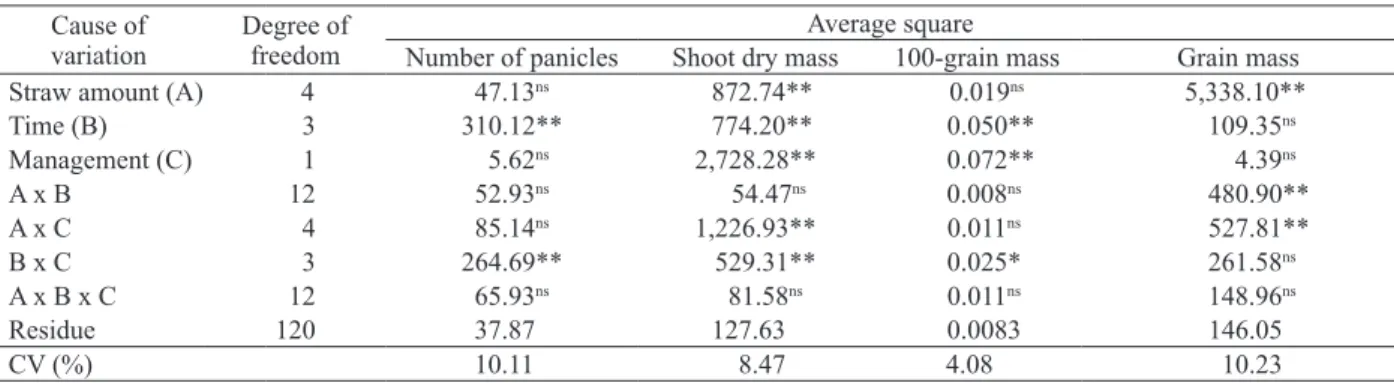
The number of panicles and shoot dry mass were not influenced by the interaction between the amounts and times of residual rice straw surface application (Table 1).
The number of panicles and shoot dry mass did not increase when residual straw remained on the soil surface, and were 20 % and 14 % higher, respectively, for the average amounts of straw applied, when straw was incorporated into the soil on the sowing day, if compared to when it was added 3 months before (Figures 1a and 1c). On the other hand, the 100-grain mass exhibited the opposite behavior, with a 5 % higher value when straw was incorporated at 3 months before sowing, if compared to the day of sowing (Figure 1b).
Thus, the lower number of panicles was partially compensated by the higher 100-grain mass. Incorporating the straw accelerates the residue decomposition, changing the dynamics of nitrogen (N) and releasing larger amounts to the plants in the soil solution, when compared to the surface application of straw (Linquist et al. 2006) or in the absence of it (Linquist et al. 2006, Knoblauch et al. 2014). As such, Linquist et al. (2006) recommend the application of a lower dose of N in irrigated rice when straw is incorporated.
With respect to the application time, studies showed the immobilization of N when straw is applied and incorporated with less than 30 days before flooding (Knoblauch et al. 2014). This may not have occurred in the present study, since the number of panicles and shoot dry mas were higher
**,* and ns: significant at 1 %, 5 % and not significant, respectively.
Cause of
variation Degree of freedom Number of panicles Shoot dry massAverage square100-grain mass Grain mass Straw amount (A) 4 47.13ns 872.74** 0.019ns 5,338.10**
Time (B) 3 310.12** 774.20** 0.050** 109.35ns
Management (C) 1 5.62ns 2,728.28** 0.072** 4.39ns
A x B 12 52.93ns 54.47ns 0.008ns 480.90**
A x C 4 85.14ns 1,226.93** 0.011ns 527.81**
B x C 3 264.69** 529.31** 0.025* 261.58ns
A x B x C 12 65.93ns 81.58ns 0.011ns 148.96ns
Residue 120 37.87 127.63 0.0083 146.05
CV (%) 10.11 8.47 4.08 10.23
Table 1. Analysis of variance to determine the effect of straw amount (0 t ha-1, 5 t ha-1, 10 t ha-1, 20 t ha-1 and 40 t ha-1), time (3, 2, 1
249 Performance of flood-irrigated rice as affected by residual rice straw
the N immobilization and N application via urea at 20 days after emergence, what increased the N availability for rice. In a similar study, Linquist et al. (2006) found no N immobilization with the application and incorporation of 7 t ha-1 of rice straw in soil with 3.4 % of organic matter. In their study, the application of N reduced the immobilization and stimulated the mineralization and absorption of N by rice, which were higher when straw was added.
Another factor that may have contributed to the lower number of panicles and shoot dry mass with the early straw incorporation is the exposure of soil to environmental conditions and wetting and drying cycles. This may have favored N losses by ammonia (NH3) volatilization. In addition, when temporary soil flooding occurs, NO3- is used by microorganisms as electron acceptors during the organic matter decomposition, resulting in losses of
Figure 1. Number of panicles pot-1 (a), 100-grain mass (b) and shoot dry mass (c), for the IRGA 424 rice cultivar, as a function of
the straw application period before sowing.
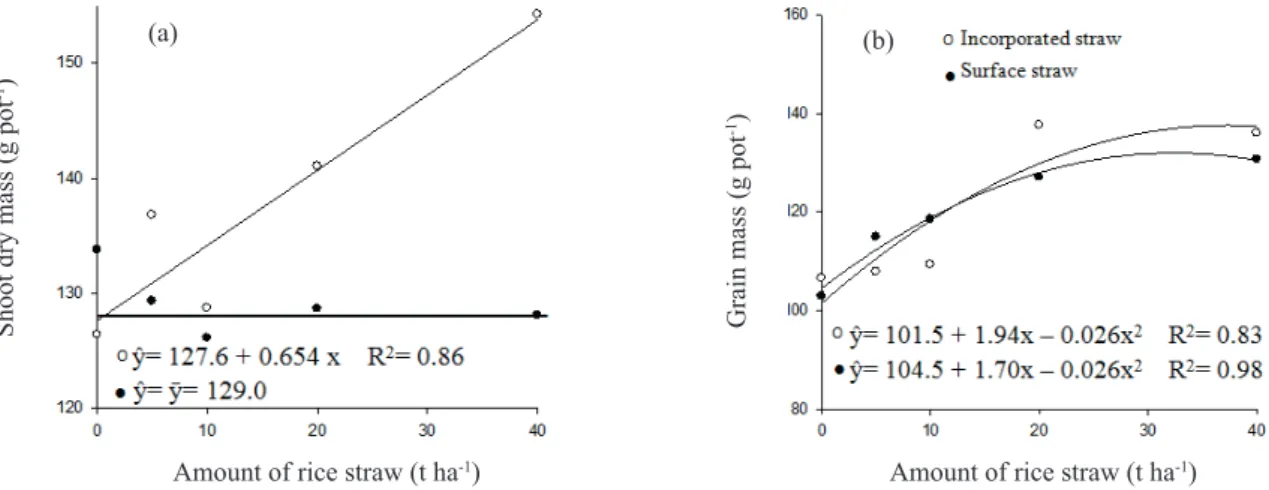
Figure 2. IRGA 424 rice cultivar shoot dry mass (a) and grain mass (b), as a function of the amounts of straw added.
when the straw was incorporated at the sowing day, and larger amounts of straw resulted in a greater shoot dry mass production (Figure 2a). The results obtained in this study may be due to the low soil organic matter content (1.6 %), which decreased
Shoot dry mass (g pot
-1)
Grain mass (g pot
-1)
Amount of rice straw (t ha-1)
Amount of rice straw (t ha-1)
(a) (b)
Months before sowing Months before sowing
Shoot dry mass (g pot
-1)
100-grain mass (g)
Number of panicles pot
-1
(a)
resulted in faster decomposition, when compared to surface-applied straw. In addition, the amount of mineral N was higher for treatments with straw applied in off-season flooded rice, if compared to soil without straw (Linquist et al. 2006). Massoni et al. (2013) observed a rise in mineral N at the beginning of the off-season, but the amount of N at the end of 164 days was the same as at the beginning.
The increased amount of surface-applied straw did not affect the rice shoot dry mass (Figure 2a). However, when straw was incorporated into the soil, the shoot dry mass increased linearly by 20 %, from 0 t ha-1 to 40 t ha-1 of residual straw applied (Figure 2a).
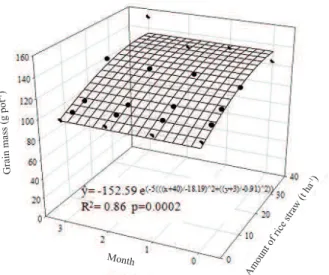
The rice grain mass increased with the application of up to 20 t ha-1 of rice straw, independently of the time it was added before sowing (Figure 3). However, under field conditions, the amount of residual rice at sowing is less than 10 t ha-1 (Beutler et al. 2012 and 2014). On the other hand, when growing rice in these same conditions, mainly on the western border of the Rio Grande do Sul state, the amount of soil organic matter may be higher than that found in the present study (Boeni et al. 2010, Beutler et al. 2012 and 2014). Moreover, smaller amounts of straw may have a harmful effect, since there is already a high soil organic matter content, which intensifies the deleterious impact of residual straw, as a function of the larger amount of organic residue available for decomposition. This explains the response of rice to the increasing amounts of residual straw up to 37.3 t ha-1 and 32.7 t ha-1, respectively in the incorporated and surface applications (Figure 2b), and the better rice response when 40 t ha-1 were applied at 3 months before sowing (Figure 3).
Several studies have reported the harmful effects of straw excess on flooded rice (Camargo et al. 2001, Johnson et al. 2006, Schmidt et al. 2007). These effects can be minimized when straw is applied before sowing (3 months, in the case of the present study), thereby allowing a partial decomposition of residues and a decrease in the amount of straw by the time of rice sowing.
Rice grain yield showed a quadratic response with the increase in the rice straw dose, with maximum yield estimated at 37.3 t ha-1 and 32.7 t ha-1, rising by 35 % and 26 %, respectively with straw incorporation and surface application,
present on the soil surface before rice sowing (Beutler et al. 2014), grain yield was 8 % and 7 % higher, respectively with straw incorporation and surface application, when compared to the treatment without straw. Camargo et al. (1995) found a 2 % increase in rice grain yield with the addition of 6.5 t ha-1 of rice straw incorporated into the soil and a 5 % decline with 20 t ha-1. It is important to note that their soil had a high initial organic matter content (10.5 %). In a field study, Beutler et al. (2012 and 2014) found no change in irrigated rice grain yield, as a function of the amount of residual rice straw added up to 24.6 t ha-1 and 11.2 t ha-1, respectively in 2011 and 2012. Linquist et al. (2006) reported a greater yield when straw remained in the soil, if compared to soil with no straw. The different results and benefits of rice straw observed in the present study may be due to the low initial soil organic matter content (1.6 %), a value below that found in some rice paddies on the western border of the Rio Grande do Sul state (Boeni et al. 2010, Beutler et al. 2012 and 2014).
The toxic effect of organic acids did not compromise the rice grain growth and yield, since increasing amounts of straw resulted in greater yield and the number of panicles and rice dry mass were higher when straw was incorporated at the sowing day. Given that straw releases organic acids that are toxic to rice (Camargo et al. 1995, Bohnen et al. 2005, Angeles et al. 2006, Johnson et al. 2006,
Figure 3. Gaussian response surface for the IRGA 424 rice cultivar grain mass, as a function of months before sowing and amounts of rice straw added.
Grain mass (g pot -1)
Amount of rice straw (t ha
-1)
251 Performance of flood-irrigated rice as affected by residual rice straw
Knoblauch et al. 2014), a decline in rice growth and grain yield was expected with higher levels of straw, when compared to its absence. This may have not occurred because of the low organic matter content, if compared to that reported by Camargo et al. 1995, where grain yield decreased.
Thus, both the amount of straw and soil management influence the growth and yield of rice grains. However, these effects may be dependent on the initial soil organic matter content, and this factor should be considered in future studies involving residual rice straw. According to the results obtained in the present study, it can be inferred that, in soil with low organic matter content, the rice residual straw may increase grain yield, independently of soil preparation to accelerate the decomposition of any remaining straw.
CONCLUSIONS
1. The number of panicles and shoot dry mass of rice do not change when residual straw remains on the soil surface;
2. When the straw is incorporated into the soil at the
sowing day, the number of panicles increases by 20 % and the shoot dry mass by 14 %, if compared to when it is added 3 months before.
3. The addition of residual rice straw on the surface or incorporated into the soil results in a higher flood-irrigated rice grain yield, when compared to the absence of straw, under greenhouse conditions, using soil with initially low organic matter content; 4. Adding 40 t ha-1 of residual rice straw to the soil
results in a greater grain yield, when it is applied at 3 months before sowing. At lower amounts of straw, yield increases too, but there is no interaction between the amount of straw and application time on yield.
ACKNOWLEDGMENTS
The authors thank the Conselho Nacional de Desenvolvimento Científico e Tecnológico (CNPq) and Fundação de Amparo à Pesquisa do Estado do Rio Grande do Sul (FAPERGS), for financing and supporting this study.
REFERENCES
ANGELES, O. R. et al. Soil solution sampling for organic acids in rice paddy soils. Soil Science Society of America
Journal, v. 70, n. 1, p. 48-70, 2006.
BEUTLER, A. N. et al. Manejo do solo, palha residual e produtividade de arroz irrigado por inundação. Semina:
Ciências Agrárias, v. 35, n. 3, p. 1153-1162, 2014.
BEUTLER, A. N. et al. Propriedades físicas do solo e produtividade de arroz irrigado em diferentes sistemas de manejo. Revista Brasileira de Ciência do Solo, v. 36, n. 5,
p. 1601-1607, 2012.
BOENI, M. et al. Evolução da fertilidade dos solos
cultivados com arroz irrigado no Rio Grande do Sul.
Cachoeirinha: IRGA, 2010. (Boletim técnico, 8).
BOHNEN, H. et al.Ácidos orgânicos na solução de um Gleissolo sob diferentes sistemas de cultivo com arroz irrigado. Revista Brasileira de Ciência do Solo, v. 29, n. 3,
p. 475-480, 2005.
CAMARGO, F. A. O. et al. Aspectos fisiológicos e caracterização da toxidez de ácidos orgânicos voláteis em plantas. Ciência Rural, v. 31, n. 3, p. 523-529, 2001.
CAMARGO, F. A. O. et al. Incorporação de palha de arroz em um Gleissolo e efeitos no rendimento da cultura do arroz irrigado. Pesquisa Agropecuária Brasileira, v. 30,
n. 7, p. 983-987, 1995.
COMPANIA NACIONAL DE ABASTECIMENTO (Conab). Acompanhamento da safra brasileira de grãos
2016/2017: 9º levantamento. 2017. Available at: <http://
www.conab.gov.br/conteudos. php?a=1253>. Access on: 21 Jun., 2017.
DORAN, G. et al. The impact of rice plant roots on the reducing conditions in flooded rice soils. Chemosphere, v. 63, n. 11, p. 1892-1902, 2006.
E M P R E S A B R A S I L E I R A D E P E S Q U I S A AGROPECUÁRIA (Embrapa). Centro Nacional de Pesquisa em Solos. Sistema brasileiro de classificação de
solos.3. ed. Rio de Janeiro: Embrapa Solos, 2013.
FEDERAÇÃO BRASILEIRA DE PLANTIO DIRETO NA PALHA (Febrapdp). Evolução da área de plantio
direto no Brasil. 2014. Available at: <http://www.febrapdp.
org.br/ download/PD_Brasil_2013.I.pdf>. Access on: 29 Sep., 2016.
FOOD AND AGRICULTURE ORGANIZATION OF THE UNITED NATIONS (FAO). FaoStat. 2014. Available
at: <http://faostat.fao.org/site/339/defaut.aspx>. Access on: 13 Oct., 2016.
JOHNSON, S. E. et al. Faster anaerobic decomposition of a brittle straw rice mutant: implications for residue management. Soil Biology & Biochemistry, v. 38, n. 7,
p. 1880-1892, 2006.
KNOBLAUCH, R. et al. Rice straw incorporated just before soil flooding increases acetic acid formation and decreases available nitrogen. Revista Brasileira de Ciência
KÖPP, M. M. et al. Evaluation of rice genotypes under propionate stress. Communications in Soil Science and
Plant Analysis, v. 39, n. 9/10, p. 1375-1384, 2008.
LINQUIST, B. A. et al. Winter straw and water management effects on soil nitrogen dynamics in California rice systems.
Agronomy Journal, v. 98, n. 4, p. 1050-1059, 2006.
MASSONI, P. F. S. et al. Nutrientes do solo influenciados por diferentes manejos da palha após a colheita do arroz irrigado. Revista Ciência Agronômica, v. 44, n. 2, p.
205-214, 2013.
PEEL, M. C. et al. Updated world map of the Köppen-Geiger climate classification.Hydrology and Earth System
Sciences, v. 11, n. 5, p. 1633-1644, 2007.
PONNAMPERUMA, F. N. Straw as a source of nutrients for wetland rice. In: BANTA, S. (Ed.). Organic matter
and rice. Manila: International Rice Research Institute,
1984. p. 118-136.
p. 720-726, 2007.
SOUSA, R. O. et al. Química de solos alagados. In: MELO, V. F.; ALLEONI, L. R. F. (Eds.). Química e mineralogia
do solo: parte II - aplicações. Viçosa: Sociedade Brasileira
de Ciência do Solo, 2009. p. 485-528.
SOUSA, R. O.; BORTOLON, L. Crescimento radicular e da parte aérea do arroz (Oryza sativa L.) e absorção
de nutrientes, em solução nutritiva com diferentes concentrações de ácido acético. Revista Brasileira de
Agrociência, v. 8, n. 3, p. 231-235, 2002.
SWAROWSKY, A. et al. Concentração de nutrientes na solução do solo sob diferentes manejos do arroz irrigado.
Revista Brasileira de Engenharia Agrícola e Ambiental,
v. 10, n. 2, p. 344-351, 2006.
TEDESCO, M. J. et al. Análises de solo, plantas e outros
materiais. 2. ed. Porto Alegre: Universidade Federal do