INSTITUTE OF TECHNOLOGY
POST-GRADUATE PROGRAM IN ELECTRICAL ENGINEERING
DENIS LIMA DO ROSÁRIO
CROSS-LAYER OPTIMIZATIONS FOR
MULTIMEDIA DISTRIBUTION OVER WIRELESS
MULTIMEDIA SENSOR NETWORKS AND FLYING
AD-HOC NETWORKS WITH QUALITY OF
EXPERIENCE SUPPORT
TD 04/2014
FEDERAL UNIVERSITY OF PARÁ INSTITUTE OF TECHNOLOGY POST-GRADUATE PROGRAM IN
ELECTRICAL ENGINEERING
UNIVERSITY OF BERN FACULTY OF SCIENCES
INSTITUTE OF COMPUTER SCIENCES AND APPLIED MATHEMATICS
DENIS LIMA DO ROSÁRIO
CROSS-LAYER OPTIMIZATIONS FOR MULTIMEDIA
DISTRIBUTION OVER WIRELESS MULTIMEDIA SENSOR
NETWORKS AND FLYING AD-HOC NETWORKS WITH
QUALITY OF EXPERIENCE SUPPORT
PhD thesis submitted to the Examining Board to obtain a joint-supervision PhD de-gree by the Federal University of Pará and the University of Bern
Advisor: Professor Dr. Eduardo Coelho Cerqueira
Co-Advisor: Professor Dr. Torsten Ingo Braun
Rosário, Denis Lima do , 1986-
Cross-layer optimizations for multimedia distribution over wireless multimedia sensor networks and flying ad-hoc networks with
quality of experience support / Denis Lima do Rosário. - 2014.
Orientador: Eduardo Coelho Cerqueira; Coorientador: Torsten Ingo Braun.
Tese (Doutorado) - Universidade Federal do Pará, Instituto de Tecnologia, Programa de Pós-Graduação em Engenharia Elétrica, Belém, 2014.
1. Sistemas multimídia. 2. Redes de sensores. 3. Redes ad hoc ( redes de computadores). 4. Comunicações digitais. I. Título.
CROSS-LAYER OPTIMIZATIONS FOR
MULTIMEDIA DISTRIBUTION OVER WIRELESS
MULTIMEDIA SENSOR NETWORKS AND FLYING
AD-HOC NETWORKS WITH QUALITY OF
EXPERIENCE SUPPORT
Inauguraldissertation
der Philosophisch-naturwissenschaftlichen Fakultät der Universität Bern
vorgelegt von
Denis Lima do Rosário von Brazil
Leiter der Arbeit:
Professor Dr. Eduardo Coelho Cerqueira Federal University of Pará
Professor Dr. Torsten Braun
MULTIMEDIA DISTRIBUTION OVER WIRELESS
MULTIMEDIA SENSOR NETWORKS AND FLYING
AD-HOC NETWORKS WITH QUALITY OF
EXPERIENCE SUPPORT
Inauguraldissertation
der Philosophisch-naturwissenschaftlichen Fakultät der Universität Bern
vorgelegt von
Denis Lima do Rosário von Brazil
Leiter der Arbeit:
Professor Dr. Eduardo Coelho Cerqueira Federal University of Pará
Professor Dr. Torsten Braun
Institut für Informatik und angewandte Mathematik
Von der Philosophisch-naturwissenschaftlichen Fakultät angenommen.
Bern, 16.7.2014 Der Dekan:
FEDERAL UNIVERSITY OF PARÁ INSTITUTE OF TECHNOLOGY POST-GRADUATE PROGRAM IN
ELECTRICAL ENGINEERING
UNIVERSITY OF BERN FACULTY OF SCIENCES
INSTITUTE OF COMPUTER SCIENCES AND APPLIED MATHEMATICS
CROSS-LAYER OPTIMIZATIONS FOR MULTIMEDIA DISTRIBUTION OVER WIRELESS MULTIMEDIA SENSOR NETWORKS AND FLYING AD-HOC NETWORKS WITH QUALITY OF EXPERIENCE SUPPORT
DENIS LIMA DO ROSÁRIO
This PhD thesis was considered as appropriate and accepted in its final version to obtain the joint-supervision PhD degree in Electrical Engineering, Area of Concentration in Applied Computing by the Post-graduate Program of Electrical Engineering of the Federal University of Pará, as well as in Computer Science by the Institute of Computer Sciences and Applied Mathematics of University of Bern.
Aproved at: __/__/____
PhD Thesis Examination-Board
Prof. Professor Dr. Eduardo Coelho Cerqueira (Federal University of Pará – Advisor)
Prof. Professor Dr. Torsten Ingo Braun (University of Bern – Co-Advisor)
(Federal University of Paraná – Member of the Jury)
Prof. Dr. Augusto José Venâncio Neto
(Federal University of Rio Grande do Norte – Member of the Jury)
Analyzed:
Prof. Dr. Evaldo Gonçalves Pelaes
Coordinator of the Post-graduate Program in Electrical Engineering at UFPA
Prof. Dr. Silvio Decurtins
Firstly, thank God, because he is the responsible for everything that happens in my life.
Secondly, I would like to thank my family, especially to my parents, José Ev-eraldo do Rosário and Waldeci Rosário, and also to my sisters, Danielle and Denise do Rosário. Although we stayed far away during my PhD, they always encourage me to continue and finish my studies. For my parents and sisters, I will translate my acknowl-edgements for them to Portuguese. Em especial para os meus pais e irmãs irei traduzir meus agradecimentos para português: “Gostaria de agradecer a minha família, especial-mente aos meus pais, José Everaldo do Rosário e Waldeci Rosário, bem como para as minhas irmãs, Danielle e Denise do Rosário. Embora tenhamos ficado longe durante boa parte do meu doutorado, vocês sempre me incentivaram a continuar meus estudos e sem o incentivo de vocês não seria possível terminar. Amo vocês!”
Next, I would like to express a deep gratitude to Hilda Rosa Freitas (in the near future Mrs. Hilda Rosário :)). Although we stayed far away during my visiting researcher at University of Bern, Switzerland, we never stayed far away mentally. She always gave me support and encouragement during the difficult moments of this thesis. Finally, without her patience, encouragement, and support, I could never tolerate to stay in Bern and also I could never finish this work.
community.
I would also thank Aldri Santos for his contribution for this thesis and for the uncountable Skype meetings that we had together discussing.
I would like to thank all Federal University of Pará (Brazil) and the University of Bern (Switzerland) employees that were responsible for the establishment of the co-operation agreement for the joint-supervision of doctoral theses between UFPA and the University of Bern. In special, I would like to thank Prof. Eduardo Cerqueira, Leila Assef Mendes, and Emmanuel Tourinho from UFPA, and also to Prof. Torsten Braun, Zoe Ghielmetti, and Dr. Silvio Decurtins from University of Bern, which made a lot of effort to establish the contract to provide me the joint-supervision PhD degree.
I would like to thank CNPq and University of Bern by their financial resources allocated during my PhD.
I would like to express my appreciation to Rodrigo Costa, Claudio Silva, Helder Paranese, Tales Mousinho, and Philipe Terroso for their implementation efforts that con-tributed significantly to the results presented in this work. Their efforts were made in the context of their Bachelor or Master works.
I would like to thank my colleges from UFPA and University of Bern for sharing of knowledge and mainly for the great moments spent together, namely Thiêgo Maciel, Roberto Sato, Kássio Machado, André Riker, Zhongliang Zhao, Zan Li, Carlos Anastasi-ades, and Desi. I also would like to thank my friend Cloudo Luis by encouragement and support during my PhD period.
Abstract of the PhD thesis presented to UFPA and University of Bern as a partial fulfilment to obtain the joint-supervision PhD degree in Electrical Engineering by the
Post-graduate Program of Electrical Engineering of the Federal University of Par, as well as in Computer Science by the Institute of Computer Sciences and Applied
Mathematics of University of Bern.
Cross-layer Optimizations for Multimedia
Distribution over Wireless Multimedia Sensor
Networks and Flying Ad-Hoc Networks with
Quality of Experience Support
Advisor: Professor Dr. Eduardo Coelho Cerqueira Co-advisor: Professor Dr. Torsten Ingo Braun
Keywords: Energy-efficiency; FANETs; Reliability; Robustness; Scalability; QoE support; and WMSNs.
in order to continue to operate despite dynamic topologies during multimedia transmis-sion. Finally, understanding user satisfaction on watching a video sequence is becoming a key requirement for delivery of multimedia content with QoE support. With this goal in mind, solutions involving multimedia transmissions must take into account the video characteristics to improve video quality delivery.
Resumo da tese de doutorado apresentada à UFPA e à Universidade de Berna como um cumprimento parcial para obtenção do grau de doutor com dupla titulação em Engenharia Elétrica pelo Programa de Pós-Graduação de Engenharia Elétrica da Universidade Federal do Pará, bem como em Ciência da Computação pela do Instituto
de Ciências da Computação e Matemática Aplicada da Universidade de Berna.
Otimizações em Múltiplas Camada para
Distribuição Multimídia em Redes de Sensores
Sem Fio Multimídia e Redes Ad-Hoc Formadas
por VANTs com Suporte à Qualidade de
Experiência
Orientador: Professor Dr. Eduardo Coelho Cerqueira Co-orientador: Professor Dr. Torsten Ingo Braun
Palavras-chave: Confiabilidade; Eficiência energética; Escalabilidade; FANETs; suporte à QoE; Robustez; e RSSFM.
da rede, a fim de protegê-los. Além disso, o conteúdo multimídia devem ser transmi-tidos a partir de um determinado nó de origem para um nó de destino através de nós intermediários com alta confiabilidade em um cenário de grande escala. O serviço de roteamento deve lidar com topologias dinâmicas causadas por falha de um nó ou a mo-bilidade do mesmo, bem como as mudanças no canal sem fio, a fim de continuar a operar mesmo em casos de mudanças de topologia durante a transmissão multimídia. Por fim, o mapeamento da satisfação do usuário ao assistir um determinado vídeo está se tornando um requisito fundamental para a entrega de conteúdos multimídia com suporte à QoE. Com estes objetivos em mente, soluções envolvendo transmissões multimídia deve levar em conta as características de vídeo e do usuário para melhorar a entrega de vídeo com qualidade assegurada.
1 Introduction . . . p. 1 1.1 Overview . . . p. 1
1.2 Problem Statement . . . p. 3
1.2.1 Scalability . . . p. 3
1.2.2 Unreliable Nature of Wireless Channels . . . p. 4
1.2.3 Robustness . . . p. 4
1.2.4 Energy-efficiency . . . p. 5
1.2.5 QoE Requirements . . . p. 5
1.2.6 Buffer Control . . . p. 6
1.3 Thesis Contributions . . . p. 6
1.3.1 Application-Level Packet Redundancy Mechanism . . . p. 7
1.3.2 Hierarchical Routing Protocol for Static Wireless Multimedia Sensor
Net-works Scenarios . . . p. 7
1.3.3 Opportunistic Routing Protocol for Multimedia Flying Ad-Hoc Network
Scenarios . . . p. 8
1.4 Thesis Outline . . . p. 9
2 Related Work . . . p. 11 2.1 Video Characteristics . . . p. 11
2.1.1 Spatial or Intra-frame Compression . . . p. 12
2.1.3 Group of pictures (GoP) . . . p. 16
2.2 Error Correction Schemes . . . p. 17
2.2.1 Automatic Repeat Request Schemes . . . p. 18
2.2.2 Link-layer Forward Error Correction Schemes . . . p. 18
2.2.3 Packet-Level Redundancy Mechanisms . . . p. 19
2.3 Routing Protocols for Static WMSNs . . . p. 22
2.3.1 Low-Energy Adaptive Clustering Hierarchy for WSNs . . . p. 22
2.3.2 Hierarchical Routing Algorithm for WMSNs . . . p. 23
2.3.3 Multi-path Routing for WMSNs . . . p. 24
2.3.4 Ant-based Hierarchical Routing Algorithm for WMSNs . . . p. 24
2.3.5 Final Considerations of Different Hierarchical Routing Protocols for WMSN
Scenarios . . . p. 25
2.4 Opportunistic Routing Protocols for Multimedia FANET Scenarios . . . p. 26
2.4.1 Beacon-based OR Protocols . . . p. 26
2.4.2 Beaconless OR Protocols . . . p. 27
2.4.3 Final Considerations of Existing OR Protocols for Multimedia FANET
Scenarios . . . p. 29
3 QoE-aware Packet-Level Redundancy Mechanism . . . p. 31 3.1 Motivation . . . p. 32
3.2 Problem Statement . . . p. 32
3.3 QoE-aware Packet Redundancy Mechanism Description and Operation
Prin-ciples . . . p. 33
3.4 Summary . . . p. 36
4 A Multi-hop Hierarchical Routing Protocol for Efficient Video
Com-munication . . . p. 37 4.1 Motivation . . . p. 38
4.2 Network Model . . . p. 40
4.3 Problem Statement . . . p. 42
4.4 MEVI Design and Operation Principles . . . p. 42
4.4.2.1 Operational Modes: Normal or Event Mode . . . p. 47
4.4.2.2 Node-disjoint Multiple Route Discovery . . . p. 49
4.4.2.3 Video-aware Multimedia Transmission . . . p. 55
4.5 Summary . . . p. 57
5 A Cross-layer Link quality and Geographical-aware beaconless OR
protocol . . . p. 59 5.1 Motivation . . . p. 60
5.2 Network Model . . . p. 62
5.3 Problem Statement . . . p. 64
5.4 XLinGO Design and Operation Principles . . . p. 64
5.4.1 Contention-based Forwarding Mode . . . p. 65
5.4.1.1 Complexity and Overhead Analysis of the Contention-based Forwarding
Mode Algorithm . . . p. 69
5.4.1.2 Metrics for the Contention-based Forwarding Mode . . . p. 70
5.4.1.3 Contention-based Forwarding Mode Example . . . p. 77
5.4.2 Persistent Route Mode . . . p. 77
5.4.2.1 Recovery Mechanism for the Persistent Route Mode . . . p. 78
5.4.2.2 Complexity and Overhead Analysis of the Persistent Route Mode
Algo-rithm . . . p. 81
5.5 Summary . . . p. 81
6 Performance Evaluation . . . p. 83 6.1 Mobile MultiMedia Wireless Sensor Network (M3WSN) OMNeT++
Frame-work . . . p. 84
6.2 Performance Metrics . . . p. 87
6.2.1 Video Quality Assessment . . . p. 87
6.2.2 Energy-Efficiency Assessment . . . p. 89
6.3 Performance Evaluation of the MEVI Protocol over Static WMSN Scenarios p. 89
6.3.1 Simulation Scenarios . . . p. 90
6.3.2.1 Scalability Assessment . . . p. 94
6.3.2.2 Reliability Assessment . . . p. 100
6.3.2.3 Energy-efficiency Assessment . . . p. 102
6.3.3 Summary . . . p. 103
6.4 Performance Evaluation of the QoE-aware Redundancy Mechanism . . . p. 104
6.4.1 Simulation Scenarios . . . p. 104
6.4.2 Simulation-Based Result Analysis . . . p. 106
6.4.2.1 QoE-aware Redundancy Mechanism Parameters Definition . . . p. 107
6.4.2.2 Simulation Results for Scenario 1 . . . p. 110
6.4.2.3 Simulation Results for Scenario 2 . . . p. 111
6.4.3 Summary . . . p. 116
6.5 Performance Evaluation of the XLinGO Protocol over Multimedia FANET
Scenarios . . . p. 116
6.5.1 Simulation Scenarios . . . p. 116
6.5.2 Simulation-Based Result Analysis . . . p. 120
6.5.2.1 XLinGO Parameters under Conditions of Scenario 1 . . . p. 120
6.5.2.2 Impact of Transient and Permanent Node Failures under Conditions of
Scenario 1 . . . p. 123
6.5.2.3 Impact of the Mechanism to Recover from Route Failures under
Condi-tions of Scenario 1 . . . p. 126
6.5.2.4 Impact of Node Mobility and Number of Video Flows under Conditions
of Scenario 2 . . . p. 128
6.5.2.5 Signalling Overhead Evaluation under Conditions of Scenario 1 . . . p. 132
6.5.2.6 Subjective Video Quality Evaluation . . . p. 132
6.5.3 Summary . . . p. 135
6.6 Performance Evaluation Summary . . . p. 136
7 Conclusions and Outlook . . . p. 139 7.1 Main Contributions and Thesis Summary . . . p. 140
7.2 Outlook . . . p. 144
WMSNs Wireless Multimedia Sensor Networks FANETs Flying Ad-Hoc Networks
IoT Internet of Things
BS Base Station
UAVs Unmanned Aerial Vehicles QoE Quality of Experience LQE Link Quality Estimator PRR Packet Reception Ratio
RSSI Received Signal Strength Indicator SNR Signal to Noise Ratio
LQI Link Quality Indicator WSNs Wireless Sensor Networks
QoE-aware redundancy QoE-aware Packet-Level Redundancy Mechanism
MEVI video-aware Multi-hop and multi-path hierarchical routing pro-tocol for Efficient VIdeo transmission for static WMSN sce-narios
OR Opportunistic Routing
XLinGO Cross-layer Link quality and Geographical-aware beaconless OR protocol for multimedia FANET scenarios
codec Coder-decoders
MPEG Moving Picture Experts Group DCT Discrete Cosine Transform I-Frames Intra-coded frames
P-Frames Predictive coded frames
ARQ Automatic Repeat Request FEC Forward Error Correction
EC Erasure Coding
ECC Error Correcting Code
BCH Bose-Hocquenghem-Chaudhuri
RS Reed-Solomon
DGR Directional Geographical Routing
SR Sensing Relevance
FL-FEC Forward-looking Forward Error Correction AHECM Adaptive Hybrid Error Correction Model
RTT Round-Trip Time
LEACH Low-Energy Adaptive Clustering Hierarchy
CH Cluster Heads
TDMA Time Division Multiple Access
PEMuR Power Efficient Multimedia Routing protocol SHPER Scalable Hierarchical Power Efficient Routing
ARCH Adaptive Reliable Routing Based on a Cluster Hierarchy for WMSNs
EEQAR Energy Efficiency QoS Assurance Routing in WMSNs AOMDV Ad-hoc On-demand Multi-path Distance Vector protocol S-AOMDV Ad-hoc On-Demand Multipath distance Vector routing for
MWSNs
EEPMQR Energy Efficient Prioritized Multipath QoS Routing ASAR Ant-based Service-Aware Routing algorithm for WMSNs AMRA Ant-based Mobile Routing Architecture
TAP Topology Abstracting Protocol MABR Mobile Ants-Based Routing StPF Straight Packet Forwarding DFD Dynamic Forwarding Delay BLR Beaconless Routing protocol
BOSS Beaconless On-demand geographic routing Strategy
RTS Request to Send
EBGR Energy-efficient Beaconless Geographic Routing EAOR Energy Aware Opportunistic Routing protocol MRR Multipath Routeless Routing protocol
FIFO First In First Out
SN Source Node
EO Event Occurrence
MT Multimedia Transmission
RD Route Discovery
SA Send Aggregate packets
MR Multimedia Request
LQ Link Quality
PQ Path Quality
PPA Positive Progress Area NPA Negative Progress Area ACK acknowledgment message PSNR Peak Signal to Noise Ratio
MSE Mean Squared Error
SSIM Structural Similarity Index Metric VQM Video Quality Metric
MOS Mean Opinion Score
QoS Quality of Service
M3WSN Mobile MultiMedia Wireless Sensor Network Framework
FoV Field of view
VQMT Video Quality Measurement Tool
ITU-T International Telecommunication Union - Telecommunication Standardization Sector
SS Single Stimulus
DS Double Stimulus
EQI Energy-Quality Index
QCIF Quarter Common Intermediate Format CIF Common Intermediate Format
List of Symbol
MGoP Distance between successive P-frames NGoP The distance between adjacent I-frames K A set of coded packets
npkts A set of original video packets
r Number of redundant packets created by the redundancy mechanism, where r =K−npkts
X1 Number of P-frames that need packet redundancy
p Relative frame position within the GoP
n Number of nodes in the network, n=|V| i Individual identity, where 1 <i < n
G(V, E) Graph representing the routing topology
V Set of the nodes in the network topology
E Set of the edges connecting nodes
vi A given node with an individual node identity i
ej Edge j connecting two nodes within the radio range of each other, were
1 < j < m
w(ej) Weight value for each ej, were w(ej)min < w(ej) < w(ej)max w(ej)min Minimal weight value for a given link ej
w(ej)max Maximum weight value for a given link ej
Q Queue for a given node vi, where 0 < Q <Qmax Qmax Maximum queue capacity
Qlength Current queue length
P Battery for a given node vi, where P0 < P < Pmax P0 Initial battery power
Pmax Maximum battery power
Prx Power required to receive a packet
Psense Power required either to retrieve a video frame or to sense physical scalar
sensor measurements
SNi A subset of nodes vi used to transmit physical scalar sensor data
mea-surements
CNi A subset of nodes vi used to transmit multimedia data DN Destination Node
PSN,DN A path connecting any pair of SN and DN via multipleCNi
adv Advertisement period during the intra-cluster communication
slotk A set of time-slots for the intra-cluster communication, were 1< k <nslot
tslot time-slot duration
nslot Number of time-slots in each superframe
R Total amount of time for intra- and inter-cluster communications candidateid Candidate CNi identifier
LQIavg Exponential average for the LQI perceived in the lastw beacons w The window size of the exponential average
candidateList CNk candidate list
o Size of candidateList
type It is used to identify the message type. RERQ messages are marked with the value equal to 1
srcaddr Source address for a given RREQ or RREP message destaddr Destination address for a given RREQ or RREP message RREQseq RREQ sequence number
routeid Route identifier
HC Number of hops for a given RREQ message
DL Number of disconnected links for a given RREQ message
CL Number of connected links for a given RREQ message
type It is used to identify the message type. RERQ messages are marked with the value equal to 2
RREPseq RREQ sequence number
LQIbad LQI threshold used to define a disconnected link
LQIgood LQI threshold used to define a connected link
ωenergy Energy relevance used to compute the LQ
ωLQE Link quality relevance used to compute the LQ ωHC Hop count relevance used to compute the LQ
LQImax Maximum value for LQI
φCL Coefficient used to give priority to the number of connected links when
computing the PQ
φDL Coefficient used to give priority to the number of disconnected links when
computing the PQ
φenergy Coefficient used to give priority to energy when computing the PQ
φLQE Coefficient used to give priority to link quality when computing the PQ
PQmin Minimal PQ value to consider a given path as a reliable alternative path
N Number of paths
N(vi) Subset of neighbours within the radio range of a given node vi t A given time
Pv Power required to move with a certain speed svi Node moving speed
dir Node moving direction
smin Minimum speed limit smax Maximum speed limit F Forwarding node
pktid Packet identifier DF Dmax Maximum DFD value RNi Possible relay nodes
Eth Energy threshold used to indicate the total amount of energy required to
transmit packets and to move
Etx Total amount of energy required to transmit a given set of packets Ev Total amount of energy required to move at a certain speed
ΦLQE Coefficient used to give priority to the link quality to compute the DFD
Φprogress Coefficient used to give priority to the progress when computing the DFD
Φenergy Coefficient used to give priority to the energy when computing the DFD
Φqueue Coefficient used to give priority to the queue length when computing the
DFD
linkQuality Link quality calculation part of the DFD function progress Progress calculation part of the DFD function energy Energy calculation part of the DFD function queueLength Queue length calculation part of the DFD function
w(ej)bad Threshold used to define that a given link ej provides multimedia
dissem-ination with poor quality level
w(ej)good Threshold used to define that a given link ej provides multimedia
dissem-ination with good quality level
X Parameter to determine the center of the sigmoid output
c Coefficient to regulate the slope or "growth rate"
P(RNi, DN) Geographical advance of a given RNi towards the DN P1(RNi) Projection of the distance travelled from SN to anyRNi P2(RNi) Projection of line RNi-RNi′ onto lineSN-DN
nF low Number of video flows
dataRatein Packets per second required for each video flow
rateout Packets per second that a given node is transmitting Qt+1 Predicted queue size
V Direction of the camera for FoV definition
θ Angle of view for FoV definition
d Depth of view for FoV definition
∆SSIM Video quality achieved normalized with a number of hops
List of Algorithms
Figure 1 WMSN and Multimedia FANET Application Scenario . . . 2
Figure 2 Thesis Contributions Overview . . . 6
Figure 3 Example of Video Coding and Encoding in a Wireless Network . . . 12
Figure 4 Transform Coding, Quantization and Run-length Coding . . . 13
Figure 5 Complexity Level for Different Video Frames . . . 14
Figure 6 Motion Level for Different Video Frames . . . 15
Figure 7 Group of Pictures Structure . . . 16
Figure 8 Different Strategies for Error Correction . . . 18
Figure 9 Packet-level Redundancy Mechanism . . . 19
Figure 10 Cluster-based Network Architecture . . . 22
Figure 11 Forwarding Area for BLR . . . 28
Figure 13 QoE-aware Redundancy Mechanism Overview . . . 33
Figure 14 QoE-aware Redundancy Mechanism Example . . . 36
Figure 15 Hierarchical Network Architecture for Static WMSNs . . . 38
Figure 16 Network Model for Static WMSNs . . . 41
Figure 17 Superframe Structure . . . 43
Figure 18 Intra-cluster Communication Structure . . . 43
Figure 19 Activity Diagram for Inter-Cluster Communication . . . 48
Figure 20 Inter-Cluster Communication Structure . . . 49
Figure 21 Route Request Message . . . 50
Figure 22 Route Reply Message . . . 50
Figure 23 Multi-Path Route Discovery . . . 51
Figure 24 Network Configuration and Results for Reception Regions Evaluation . 53
Figure 25 Activity diagram for Video-aware Multimedia Transmission . . . 56
Figure 26 Load Balancing Scheme Used by MEVI . . . 56
Figure 27 Multimedia FANET Deployed in an Emergency Situation . . . 60
Figure 28 XLinGO Network Model . . . 63
Figure 31 Contention-based Forwarding Mode Overview . . . 69
Figure 32 DFD Values for Different progress and linkQuality Values Following the Eq. 5.2 with Φqueue = 0, ΦLQE = 0.5, and Φprogress = 0.5 . . . 71
Figure 33 Irregular Radio Range (left) and Resultant PRR Distribution (right) . . 72
Figure 34 Network Configuration and Results for Video Quality Evaluation . . . 73
Figure 35 Example of an Exponential Distribution . . . 74
Figure 36 Definition of Progress with Potential RNi . . . 75
Figure 37 Queue Length Monitoring . . . 76
Figure 38 Routing Example with XLinGO in Contention-based Forwarding Mode 78
Figure 39 Time Diagram of the Mechanism Employed to Recover from Route Fail-ures . . . 81
Figure 40 M3WSN Framework Architecture . . . 85
Figure 41 Sensing Range and Object Detection . . . 86
Figure 42 Video Transmission Procedure . . . 87
Figure 43 Simulation Topology for Different Hierarchical Routing Protocols for Static WMSN Scenarios . . . 92
Figure 44 Network Stack for the Performance Evaluation of Different Hierarchical Routing Protocol for Static WMSN Scenarios . . . 92
Scenario 1 . . . 95
Figure 46 Video Quality Level According to the Distance Between SN and DN for Scenario 2 . . . 96
Figure 47 SSIM in Colour Scale for Each Node that Composes Scenarios 1 and 2 97
Figure 48 Frame number 266 from Container Video Sequence Transmitted from a Given Node via Different Hierarchical Routing Protocols . . . 99
Figure 49 SSIM for all Frames that Composes the Container Video Sequence Trans-mitted by a Specific Node under Conditions of Scenario 1 . . . 99
Figure 50 SSIM According to Different P QValue . . . 100
Figure 51 Video Quality Level According to the Number of Hops for Scenario 2 . 101
Figure 52 Frame number 257 from Container Video Sequence Transmitted from a Given Node via Different Hierarchical Routing Protocols . . . 102
Figure 53 Network Lifetime . . . 103
Figure 54 EQI According to the Number of Hops for Scenario 2 . . . 103
Figure 55 Network Stack for the Performance Evaluation of Different Redundancy Mechanisms . . . 106
Figure 56 Possible Configurations for the QoE-aware Redundancy Mechanism . . . 108
Figure 57 SSIM According to the Distance for Different Configurations of the QoE-aware Redundancy Mechanism . . . 109
Figure 58 Video Quality Level According to the Distance Between SN and DN for Scenario 1 . . . 110
Figure 61 Energy Consumption According to the Number of Hops for Scenario 2 113
Figure 62 EQI According to the Number of Hops for Scenario 2 . . . 114
Figure 63 SSIM for all the Frames that Composes the Hall Video Sequence Trans-mitted by a Specific Node under Conditions of Scenario 2 . . . 114
Figure 64 Frame Number 258 for the Hall Video Sequence Transmitted for a Given Node with Different Redundancy Mechanisms for Scenario 2 . . . 115
Figure 65 Snapshots of the Selected Videos . . . 119
Figure 66 Network Stack for the Performance Evaluation of Different Beaconless OR Protocol for Multimedia FANETs . . . 119
Figure 67 Video Quality Level for Different XLinGO Coefficient Combinations . . 122
Figure 68 Impact of Redundancy Mechanism for Different Beaconless OR Proto-cols . . . 122
Figure 69 Network Topology Composed of 30 Static Nodes . . . 123
Figure 70 Video Quality in Presence of Transient Node Failures with LIV E Value of 2 and Different Number of Nodes . . . 125
Figure 71 Video Quality in Presence of Permanent Node Failures withLIV E Value
of 2 and Different Number of Nodes . . . 125
Figure 72 SSIM for All Frames for the Compose the Hall andU AV1 Video Sequence Transmitted by a Specific SN under Conditions of Scenario 1 with Tran-sient Node Failures . . . 127
Failures . . . 128
Figure 74 Video Quality for a Scenario with a Different Number of Multimedia SN, Moving Speed, and Videos with Different Motion and Complexity Levels 130
Figure 75 Frame Loss Ratio for Videos Transmitted in a Scenario with smax equals
to 20m/s and with 2 Simultaneous Video Flows Transmissions . . . 131
Figure 76 Number of Dropped Packets at Intermediate Buffers for a Scenario with Different Number of Multimedia Source Nodes and Moving Speeds . . . . 131
Figure 77 Signalling Overhead for a Scenario with Different Number of Multimedia Source Nodes and Moving Speeds . . . 133
Figure 78 Subjective Video Quality Evaluation . . . 133
Figure 79 Frame Number 143 from UAV Video Sequence Transmitted from a Given Node via Different Beaconless OR for Scenario 2 . . . 134
Figure 80 SSIM for All Frames for the Compose the U AV1 Video Sequence Trans-mitted by a SpecificSN . . . 135
Table 2 Comparison Between Different Routing Protocols for WMSNs . . . 26
Table 3 Comparison Between Each OR Protocols for FANETs . . . 30
Table 4 Routing Table Example . . . 54
Table 5 MOS Scale According to ITU-R BT.500-11 Recommendations [141] . . . . 89
Table 6 Simulation Parameters for Different Hierarchical Routing Protocols . . . . 91
Table 7 Comparison Among Different Hierarchical Routing Protocols Based on Conducted Simulation Experiments . . . 104
Table 8 Simulation Parameters for Different Packet Redundancy Mechanisms . . 105
Table 9 Possible Configurations for the QoE-aware Redundancy Mechanism . . . . 107
Table 10 Comparison Among Different Packet Redundancy Mechanisms Based on Conducted Simulation Experiments . . . 116
Table 11 Simulation Parameters for Different Beaconless OR Protocols . . . 117
CHAPTER 1
Introduction
This chapter briefly introduces the key concepts about Wireless Multimedia Sen-sor Networks (WMSNs) and Flying Ad-Hoc Networks (FANETs), portrays the fundamen-tal challenges faced in the different parts of the thesis, summarizes the essential contribu-tions, and outlines the course of the subsequent chapters.
1.1
Overview
The proliferation of multimedia content and the demand for new audio or video services in Internet of Things (IoT) applications [1–3] have fostered the development of a new era based on multimedia information. Those applications allowed the evolution of WMSNs [4–7] and also FANETs [8–10]. Those networks enable a large class of scenarios in both civilian and military areas, which require visual and audio information, such as, environmental monitoring, intruder detection, video surveillance, safety & security, smart parking, traffic control, natural disaster recovery, smart cities, and other IoT applications. Multimedia content in those applications has the potential to enhance the level of collected information compared to simple scalar data. For instance, it enables the end user or end system to take appropriate actions and be aware of the environmental conditions based on rich visual information.
2 1 Introduction
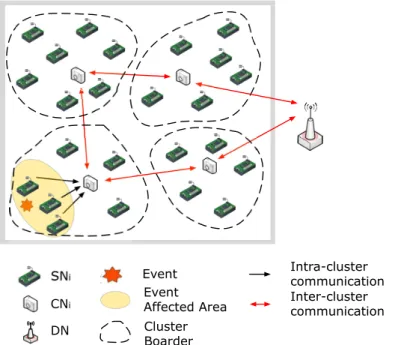
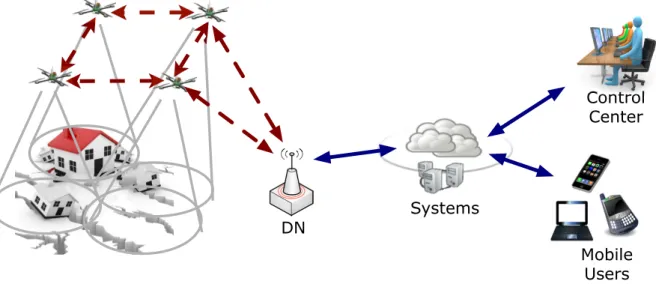
Sight Machine, and others. In this context, physical scalar sensor data can be used to predict event occurrence, by means of existing models or methods defined by an expert [14]. On the other hand, multimedia content in such applications gives support to the end-users (or systems) to visually verify the real impact of events, and be aware of what is happening in the environment with the aid of rich visual information [15, 16].
Mobile Users BS
Control Center
CH 3 CH
3 CH
3
CH 3
Systems BS
Figure 1: WMSN and Multimedia FANET Application Scenario
Let us consider a WMSN application that relies on fixed network infrastructure to accurately monitor a part of a river with fast velocity and a high water levels. Such application can be composed of a set of nodes sensing the river flow by means of physical scalar measurements, and also by using another set of nodes collecting multimedia data in the case of an event occurrence [17–20]. As soon as an event occurs, it might be interesting to see whether additional objects, such as wood or thrash, are floating on the river surface. This is because these objects might affect the behaviour of the river, in particular when they block the normal river flow, and thus the river dams up.
from the hazardous area, enabling humans in the control center to be aware of what is happening in the environment, as well as take action based on rich visual information.
In this context, live multimedia services require real-time video transmissions with a low frame loss rate, tolerable end-to-end delay, and jitter to support video dissemination with Quality of Experience (QoE) support. Multimedia content should be delivered with, at least, a minimum video quality level from the user’s point-of-view [21, 22]. Further, frames with different priorities compose a compressed video, and from a human’s experi-ence, the loss of high priority frames causes severe video distortions. Thus, a key principle in a QoE-aware approach is the transmission of high priority frames (protect them) with a minimum packet loss, as well as network overhead.
Moreover, the routing service must find a set of reliable routes between the source and the destination nodes via multiple forwarding nodes with a minimal overhead. The protocol must prevent the selection of forwarding nodes with heavy traffic load or low residual energy. It also has to adapt to topology changes and be aware of QoE require-ments in order to recover or maintain the video quality with acceptable level, providing robustness under scenarios with topology changes.
1.2
Problem Statement
In this thesis, we focus only on optimizing video transmission over multi-hop wireless ad-hoc networks. We addressed several challenges in the context of WMSN and multimedia FANET communication in order to provide multimedia dissemination with QoE assurance, scalability, reliability, energy-efficiency, and also load balancing. Our contributions tackle issues relating to the following problem domains.
1.2.1 Scalability
4 1 Introduction
1.2.2 Unreliable Nature of Wireless Channels
Low-power radios cause links unreliable and unpredictable, because they are very sensitive to noise, interference, and multipath distortion. In this context, Link Quality Estimator (LQE) is a fundamental building block in the design of routing protocols for WMSN and multimedia FANET scenarios, since a reliable routing protocol must consider the LQE as a metric to help in the selection of high quality routes for multimedia dissemi-nation. In this way, the accuracy of the LQE greatly impacts the efficiency and reliability of the routing protocol [23].
LQE can be classified as either hardware-based or software-based. Most of software-based LQEs either count or approximate the Packet Reception Ratio (PRR), as well as the average number of packet transmissions or re-transmissions. However, software-based LQEs include overhead and delay to estimate the link quality for a given link. On the other hand, hardware-based LQEs, such as Received Signal Strength Indica-tor (RSSI), Signal to Noise Ratio (SNR), and Link Quality IndicaIndica-tor (LQI), are directly read from the radio transceiver (e.g., the CC2420) upon the reception of a packet, making calculation of LQE less time and resource consuming.
1.2.3 Robustness
The routing protocol must cope with dynamic topologies caused by node failure or mobility, as well as wireless channel changes, in order to continue to operate despite dynamic topologies during multimedia transmission [24]. Hence, reliable and robust mul-timedia transmissions in wireless networks are challenging tasks, due to the time-varying characteristics of low-power wireless links, node failure and mobility, and also wireless interference [25].
In the fault tolerance domain, whenever a node cannot forward its data packets towards the sink, it can benefit from an available alternative route to deliver its data packets, even if node or link failures happen. Through this mechanism, as long as an alternative path is available from the pair of source and destination node, data forwarding can be continued without any interruption even in the case of path failure [26].
The routing protocol must have mechanisms to detect and recover from route failures, which can be periodically route reconstruction or transmitting acknowledgment messages. For the latter one, whenever a certain number of consecutive packets are not acknowledged, the routing protocol must consider the route as broken, remove the failed node from the neighbour table, and re-establish the route. In this way, it is possible to cope with route failures, as well as continue operating even in the presence of dynamic topologies caused by node failures or mobility [27].
of wireless channel errors. Hence, error correction schemes must be used to deal with wireless transmission errors in real-time multimedia applications, and also to enhance their resilience and robustness [28].
1.2.4 Energy-efficiency
Similar to Wireless Sensor Networks (WSNs), energy consumption is also prime concern in WMSNs and FANETs, which consist of battery-powered nodes with limited energy resources. In this way, the development of energy-efficient communication proto-cols is one of the main goals to increase network lifetime. The nodes consume energy in tasks such as sensing, communication, data processing, and also movements. Data communication involves both data transmission and reception. We consider sensing as collecting physical measurements data from any scalar sensor, and also retrieving video frames from camera sensors. The energy cost for node movements depends on the moving speed.
Nodes equipped with rechargeable battery or solar power is the best way of over-coming energy drawbacks [29]. For instance, a permanent 24/7 solar-operated network for fire detection and localization has been installed in the Asturias region in the north of Spain [30], where nodes are permanently attached to trees to continuously measure temperature and humidity conditions to detect fire. However, equipping all network nodes with renewable energy sources may not be feasible, or at least, not appropriate. Hence, mechanisms have been developed to extend network lifetime, especially by design-ing energy-conservdesign-ing communication protocols on the MAC and routdesign-ing layer.
In this context, the routing protocol must reduce message overhead required for route discovery and cluster formation. Therefore, multimedia transmission in WMSNs should be based on either the query-driven or the event-driven model, which reduces energy consumption required to both retrieve video frames and to transmit multimedia packets. For instance, we can trigger the multimedia transmission based on the sensing relevance [31, 32]. This is because periodic multimedia transmission involves the delivery of irrelevant multimedia content when there is not any event occurrence, causing wasteful expenditure of energy and bandwidth [25]. Route discovery must prevent the selection of relay nodes with low residual energy, to avoid route failures. Finally, source nodes may also avoid adding redundant packets for low-priority packets, reducing local energy consumption and indirectly preserving energy of intermediate nodes [7].
1.2.5 QoE Requirements
6 1 Introduction
delivered with, at least, a minimum video quality level from the user’s point-of-view [33].
Understanding users’ satisfaction on watching a video sequence is becoming a key requirement for delivery of multimedia content with QoE support [34–36]. With this goal in mind, solutions involving multimedia transmissions must take into account the video characteristics to improve video quality. Moreover, users’ experience must be measured and integrated into networking components to enhance the overall performance of multimedia systems, and also to provide QoE-awareness.
1.2.6 Buffer Control
Multimedia dissemination usually involves a set of nodes transmitting multiple video flows simultaneously. This scenario leads to a higher degree of network congestion, buffer overflow, and packet loss ratio, which reduces the quality level of the delivered video flows [37].
In this context, the routing protocol must prevent the selection of relay nodes with heavy traffic load, while avoiding route failure, queue congestions, packet loss, delay, and jitter. Moreover, as soon as intermediate nodes on a given path detect buffer overflow, the queue policy algorithm must discard less relevant packets, reducing the impact on the quality of the received video from the users’ perspective [38]. The source node can also react to congestion by avoiding transmission of less relevant packets.
1.3
Thesis Contributions
In this thesis, we introduce novel mechanisms and protocols in different layers of communication stack of three nodes involved in a communication process, which provide multimedia dissemination with QoE assurance, scalability, reliability, energy-efficiency, and also load balancing. More specifically, Figure 2 schematically indicates the contri-butions of this thesis, and also depicts the protocol stacks of three nodes involved in the communication process: a source node, an intermediate node, and a destination node.
Source Node Intermediate Node Destination Node Physical
Application
Transport
MAC Routing
Wireless ad-hoc network
QoE-aware redundancy
Physical MAC Routing
Physical Application
Transport
MAC Routing
Robust and Reliable
Routing Drop mechsnism Robust and Reliable Routing
1.3.1 Application-Level Packet Redundancy Mechanism
The compressed multimedia streams are vulnerable to transmission errors due to the predictive nature of coding standards. Moreover, solutions involving multimedia transmission must take into account the video characteristics based on users’ experience to support the delivery of high quality live video sequences, and to increase users’ satisfaction on watching a given video, as well as to provide QoE-awareness.
Error correction schemes deal with wireless transmission errors in real-time mul-timedia applications to enhance their resilience and robustness. Among the existing error control schemes to handle packet losses in real-time multimedia communication, application-level redundancy mechanisms offer a suitable solution to provide video deliv-ery with quality level assurance, without adding delay and considering end-to-end routes [39]. Hence, multimedia content must be delivered to the destination node with minimal quality level support from the user’s perspective, while, at the same time, the network overhead must be reduced.
With the introduction of the QoE-aware Packet-Level Redundancy Mechanism (QoE-aware redundancy) in Chapter 3, we reduce the impact of the unreliable and lossy nature of wireless environment to disseminate live multimedia content. It considers the frame priority based on users’ perspective to add redundant packets, and thus protects them during losses or link error periods. In this way, we reduce the number of redundant packets (overhead) to save network resources, such as bandwidth, while keeping the video quality level high. We also reduce the local energy consumption and indirectly preserving energy of intermediate nodes, since we add redundant packets only to priority frames.
1.3.2 Hierarchical Routing Protocol for Static Wireless
Multime-dia Sensor Networks Scenarios
Routing protocols can be classified into flat, location-based and hierarchical ar-chitectures [25]. For WMSN applications, where it is possible to rely on a fixed network infrastructure, hierarchical network architectures with heterogeneous nodes have proved to be more beneficial than flat architectures in terms of lower energy consumption, greater functionality, better scalability, and reliability. In this context, the advantages of using a hierarchical architecture with heterogeneous nodes are as follows: i) nodes have differ-ent roles or functionalities to reduce energy consumption; ii) some nodes perform data aggregation, avoiding unnecessary data transmission; and iii) a set of nodes may turn-off the radio after transmitting their data packets, and as a result, reduce their energy consumption and avoid communication conflicts, such as interferences and congestions [4, 5, 7].
8 1 Introduction
multimedia content over WMSN scenarios with reliability and quality level support.
MEVI relies on cluster formation with low overhead, providing scalability, and also energy-efficiency. It finds multiple node-disjoint paths, and evaluates each possible path by means of cross-layer end-to-end link quality estimation, supporting multimedia transmissions with reliability and scalability. We also combined frame relevance with a multi-path scheme to schedule multimedia dissemination, enabling load balancing, as well as increasing the video quality level from the user’s perspective. Finally, MEVI takes into account either the query-driven or the event-driven model to start multimedia transmission. More specifically, it triggers video transmissions according to sensed data, supporting energy-efficiency for multimedia transmissions.
1.3.3 Opportunistic Routing Protocol for Multimedia Flying
Ad-Hoc Network Scenarios
Protocols that rely on end-to-end routes and also on a fixed network infrastructure cannot be used as soon as the standard fixed network infrastructure are not available due to some natural disaster. This is because to deploy a fixed network infrastructure takes time, and thus multimedia FANET appears as a feasible solution. Moreover, end-to-end routes might be subject to frequent interruptions or may not exist at all times in case of node mobility or wireless channel variations, such as experienced in FANET scenarios. In this context, Opportunistic Routing (OR) does not require a stable end-to-end connection from the source to the destination, and the packets are forwarded even during topology changes. This is because OR improves communication performance by exploiting the broadcast nature and spatial diversity of the wireless medium, and nodes forward the packet to the destination based on a hop-by-hop routing decisions.
We contribute to the research field of OR for multimedia transmission over FANET scenarios by introducing the cross-layer link quality and geographical-aware bea-conless OR protocol for multimedia FANET scenarios (XLinGO), which we describe in detail in Chapter 5. XLinGO provides efficient multimedia dissemination with reliability, robustness, load balancing, as well as QoE assurance.
1.4
Thesis Outline
The remainder chapters of this thesis are structured as follows.
• Chapter 2 outlines the most significant related work about application-level packet redundancy mechanism, hierarchical routing, as well as OR. We also describe their drawbacks to provide scalability, reliability, energy-efficiency, load balancing, and also the transmission of multimedia content with quality level support from the users’ perspective.
• Chapter 3 discusses our motivations and contributions toward an application-level packet redundancy mechanism.
• Chapter 4 describes our proposed hierarchical routing protocol for static WMSNs, the MEVI protocol.
• Chapter 5 presents our contributions on OR for multimedia dissemination over FANETs, the XLinGO protocol.
• Chapter 6 introduces the simulation environment, the metrics used to evaluate our contributions, the performance evaluation, and analyses the achieved results.
11
CHAPTER 2
Related Work
In this chapter, we give an overview of the important and significant existing work in the field of this thesis. We divided this chapter in a way such that each section corresponds to one of the main three contributions of this thesis.
We start with Section 2.1 reviews the main concepts and definitions needed to understand the video characteristics. Hereafter, Section 2.2 discussing error correction schemes to handle packet loss in real time video transmissions. Among the existing error correction schemes, we describe the state-of-the-art for packet-level redundancy mecha-nisms, and their main drawbacks to achieve resilient, robust, and reliable video trans-missions with minimal overhead. Section 2.3 discusses the research field of hierarchical routing protocols for static WMSN scenarios. We categorize the existing approaches with their advantages and drawbacks compared to our contributions in this field, and conclude the section by giving an outlook about future trends and developments. In Section 2.4, we give a comprehensive overview of existing OR protocol multimedia FANET scenarios, on which we build upon for designing our beaconless OR strategy.
2.1
Video Characteristics
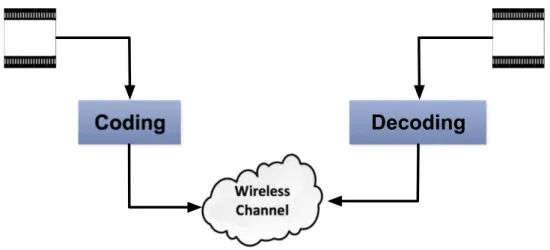
Figure 3 shows a generic example for video coding and decoding in a wireless net-work. At the sender side, the codec (coder-decoder) encodes the video provided by either a live source camera or stored video repository before transmitting it. Thus, the encod-ing process removes redundant information and converts the video into an intermediate format (bitstream) so that it can be distributed through the network. The intermediate format is a set of bits created by the encoder in accordance with well-defined standards, such as Moving Picture Experts Group (MPEG) or H.264 [42]. Video coding standards specify the bitstream format and the decoding process for a given video sequence, where each flow starts with a sequence header, followed by a GoP header, and then by one or more coded frames. At the receiver side, the codec decodes the received data, and converts it from an intermediate format to a video sequence [43].
!"#$%$&&
'()**$%
Coding
Decoding
Figure 3: Example of Video Coding and Encoding in a Wireless Network
Both video coding and transmission processes have an impact on the final video quality at the receiver side [44]. Although, this thesis only focuses on optimising the video transmission over multi-hop wireless ad-hoc networks, it is necessary to discuss video characteristics from the user perspective to understand how video characteristics affect the video quality. Hierarchical video coding schemes, such as MPEG or H.264, convert and compress a video signal into a series of pictures or frames. In this way, the encoder significantly compresses the video, allowing the transmission only of differences between consecutive frames [45].
2.1.1 Spatial or Intra-frame Compression
2.1 Video Characteristics 13
Image Samples
Transform Coefficients
Quantization, zig-zag scan, Run-length coding DCT
Figure 4: Transform Coding, Quantization and Run-length Coding
Intra-frame compression uses Discrete Cosine Transform (DCT) derived from still image compression to extract signals into a sum of cosine functions. This is because spatial compression performs frequency analysis in a given frame to find the dominant frequencies, which is carried out by converting frames to the frequency domain by means of transform techniques [47]. The DCT result is pre-multiplied by the quantisation scale code and divided by the element-wise quantisation matrix. The processed result usually generates a matrix with values primarily in the upper left-hand corner. The zigzag ordering groups all non-zero values. This basic intra-frame compression greatly reduces the size of the data storage.
Figure 5 illustrates the complexity level for different video sequences downloaded from a well-known video source library [48]. Figures 5(a) and 5(d) show a given frame from the Flower and Hall video sequences, respectively. Furthermore, macroblocks can be observed in both frames, which are the basic unit for video frame compression. Each macroblock divides each frame into small blocks for further handling, and uses the YUV system, i.e., a common used colour space that takes account of human perceptions when encoding an image or a video. It was initially used in the H.261 standard, and nowadays it is the basis for all previous and current video-coding standards.
values. It can be seen that the Hall frame has more macroblocks with a colour closer to white, which explains the higher number of coefficient values in 5(b) than in Figure 5(e).
Figures 5(c) and 5(f) show the horizontal and vertical DCT coefficients from two specific macroblocks from Figures 5(b) and 5(e), respectively. In the matrix containing the coefficients of a given macroblock, frequency increases from the left to the right and from the top to the bottom. On the basis of these observations, MPEG saves the coefficients in a vector with an ascending order of frequency.
Hence, coefficients with higher frequencies and values closer to zero cannot be transmitted without affecting the level of video quality. In this way, spatial compression reduces the number of bits required to represent a given video frame. However, spatial compression rates provided by the DCT transform changes, since it depends on the fre-quency of the image. For example, the Hall frame in Figure 5(b) has lower coefficient values for higher frequencies than the coefficients of the Flower frame in Figure 5(e). Hence, by calculating the number of DCT coefficients, it is possible to infer the spatial compression rate for a given video.
(a) Hall Video Frame with Mac-roblocks Division
(b) DCT Coefficients for Each Macroblocks for the Hall Frame
(c) A Single Macroblocks of the Hall Video Frame
(d) Flower Video Frame with Macroblocks Division
(e) DCT Coefficients for Each Macroblocks for the Flower Frame
(f) A Single Macroblocks of the Flower Video Frame
Figure 5: Complexity Level for Different Video Frames
2.1.2 Temporal or Inter-frame Compression
2.1 Video Characteristics 15
causes the differences between different video frames. Thus, the video frame size is reduced by removing the unnecessary parts in the related video frames, and also by only encoding the motion parts. Hence, it is possible to transmit only the differences between the frames.
For instance, it is possible to obtain the frame-difference, as shown in Figure 6(c), by extracting the motion difference from the News frames 1 and 2 [48], i.e., denoted as frame #2 - frame #1. The black portion represents the common parts in both frames, and the other parts represent the variation between them. Thus, it is possible to reconstruct the frame #2 based on the frame #1 and the frame-difference.
In a similar way, Figure 6(f) shows the frame-difference obtained by extracting the motion difference from Figures 6(d) and 6(e). First of all, it is possible to observe that Figure 6(f) has fewer parts in black than Figure 6(c), suggesting that this video has higher level of motion. Second, the rate of time compression is lower for videos with a high motion level. Third, with motion compensation, only the filtered video frame is stored instead of the original frame, which reduces the video size, since the filtered video frame contains less information. To decode a given video, the motion vector search algorithm must match the motion part in the previous reference video frame to decode the current video frame. The algorithm for locating the motion part is the key part of video coding.
(a) Frame #1 from News Video Sequence
(b) Frame #2 from News Video Sequence
(c) Motion Difference for Frame #1 and #2 from News Video Se-quence
(d) Frame #1 from Football Video Sequence
(e) Frame #2 from Football Video Sequence
(f) Motion Difference for Frame #1 and #2 from Football Video Sequence
2.1.3 Group of pictures (GoP)
A given video sequence contains a series of video frames, and each frame in-cludes information about the whole picture. MPEG/h.264 employs a hierarchical struc-ture composed of 3 types of frames, namely, Intra-coded frames (I-Frames), Predictive coded frames (P-Frames), and Bi-directionally predictive coded frames (B-Frames) [49]. The macroblock from I-, P-, and B-frames uses spatial compression. On the other hand, temporal compression is only applied to the macroblocks from the P- and B-frames. The macroblocks of the P-frames use as reference the macroblocks from the previous I- or P-frames, as shown in Figure 7. The macroblocks of the B-frames use as reference the macroblocks of previous or future I- or P-frames [50].
M
N GoP
Figure 7: Group of Pictures Structure
These frames are arranged into sequences called Group of Pictures (GoP). A GoP contains all the information required to decode a given video sequence within a period of time, which can be used for optimization procedure. An important factor of MPEG encoding is the GoP size, which indicates the frequency of I-frames in a given video. Each GoP includes an I-frame and all the subsequent P- and B-frames leading up to the next I-frame, as shown in Figure 7. For example, a GoP length of 10 frames means a GoP that starts with an I-frame, followed by a sequence of 9 P- or B-frames. For each GoP,
MGoP represents the distance between successive P-frames, andNGoP defines the distance
between adjacent I-frames. As a result, this structure is flexible, and the frame types and their location within the GoP can be adjusted to the encoding type. Hence, the MPEG/h.264 standard provides a hierarchically GoP structured, and some frames are more important than others. In this way, a packet loss has different impact depending on the user’s perspective.
The frequency of the I-frames in the compressed video defines the size and quality of a video stream. The video bit rate can be reduced by decreasing the frequency of the I-frames when encoding a given video, also degrades the video quality. On the other hand, more I-frames should be added during the encoding process, whenever a higher video quality level is required, and this results in a video with higher video bit rates.
2.2 Error Correction Schemes 17
coded without any reference to other frames. In addition, it is known as the key frame for a GoP, since it provides the reference point for decoding a received video stream, i.e., it serves as a reference for all the other frames. It might use spatial compression, and not temporal compression. By removing spatial redundancy, the size of the encoded frame is reduced, and predictions can be used at the decoder to reconstruct the frame. The size of the I-frame is usually higher than the P- or B-frames, since it is the least compressible.
frames predict the frame that has to be coded from the previous I-frame or P-frame by using temporal compression, i.e., unlike the preceding I- or P-Frame, P-P-frames contain changes of the actual frame. P-frames provide a higher rate of compression than I-Frames, typically 20 – 70 % the size of an I-frame. Finally, B-frames consider both the previous and the next I-frame or P-frame as their reference points for motion compensation. In this way, B-frames provide further compression, typically 5 – 40 % the size of an associated I-frame [51].
As a result of the hierarchical structure of MPEG/h.264, packet loss might affect the level of the video quality in different ways, depending on the lost information [52]. The loss of an I-frame affects the other B- or P-frames within the same GoP. Thus, errors propagate in other frames until a new I-frame reaches the receiver. In the case of a P-frame lost, the error propagates in the remaining P- and B-P-frames in a GoP. In addition, P-frames that appear earlier in the GoP cause impairments over a longer period, since subsequent frames are directly or indirectly impaired until the decoder receives the next I-frame. Finally, in the case of B-frame loss, the error does not propagate, since B-frames are not used as a reference-point for the other frames [53]. It is important to notice that not all packets are equal or have the same degree of importance. Hence, we can use this information to perform optimization procedures, such as human/QoE-aware packet redundancy schemes.
2.2
Error Correction Schemes
Source 1 2 3 4 5 Destination
...
Source 1 2 3 4 5 Destination
...
Source 1 2 3 4 5 Destination
... Corrupted pkt
is corrected
FEC
ARQ
Packet-level Redundancy
Data packet Ack Retransmission
Figure 8: Different Strategies for Error Correction
2.2.1 Automatic Repeat Request Schemes
ARQ mechanisms can be used either in the application or data on link layers. ARQ mechanisms achieve robust video transmission by re-transmitting packets that fail to reach the destination node or arrive in a damaged state. In this way, the sender has to re-transmit a given packet when it does not receive an acknowledgement from the destination node on time, due to packet loss. The sender must also retransmit a given packet when it receives a retransmission request from the destination, due to the arrival of erroneous packets [54]. In the example of Figure 8, node 3 does not receive the acknowledgement from node 4, and thus it retransmitted the packet. However, the ARQ mechanism introduces overhead, delay, energy consumption costs, and also requires an end-to-end bidirectional channel. In addition, when a packet arrives late at the destination node, it misses the playback deadline and can be considered as a lost packet.
2.2.2 Link-layer Forward Error Correction Schemes
2.2 Error Correction Schemes 19
on the amount and structure of the redundancy. In the example of Figure 8, node 4 uses redundant information to correct errors, and thus it transmits the packet to node 5 correctly. The two most widely-used schemes in FEC are block codes, such as Bose-Hocquenghem-Chaudhuri (BCH) and Reed-Solomon (RS) codes, as well as convolutional codes [55]. However, error recovery by correction codes may add complexity to source and intermediate nodes without success guarantees. FEC schemes are also highly susceptible to burst losses, which are very common in wireless channels.
2.2.3 Packet-Level Redundancy Mechanisms
Erasure coding is an error control scheme for packet-level FEC to handle losses at the application layer in real-time communications. Figure 9 shows how EC is applied to a set of video packets that have to be transmitted to the destination node. Packet-level FEC creates (K − npkts) redundant packets at the application layer, to protect a set of npkts original video packets. The decoder recovers the set of npkts original video packets
by receiving any npkts packets out of the K coded packets. The redundant packets are
used to reconstruct a corresponding video frame, which can be considered as a lost frame in a scenario that does not add redundant packets. Hence, the packet-level redundancy mechanism provides robust and reliable multimedia dissemination over unreliable wireless channel. Moreover, this scheme does not introduce jitter problems, since there is no acknowledgment mechanism. Encoding Decoding n k k' n Wireless Channel X X X Pkt1 Pkt1 Pkt1 Pkt2 Pkt3 Pkt4 Pkt5 Red1 Red2 Red3 Red4 Red1 Red2 Red3 Red4 Pkt1 Pkt2 Pkt3 Pkt4 Pkt5 Pkt1 Pkt2 Pkt3 Pkt4 Pkt5
Figure 9: Packet-level Redundancy Mechanism
suitable solution to provide video delivery with quality level assurance, as well as without adding delay and considering end-to-end reverse channel.
In this context, Sarisaray-Boluk et al. [57] presented an error compensation technique, which uses packet redundancy and multi-path transmission. The redundancy mechanism employs a modified version of a wavelets based error concealment algorithm, and then the source transmits the image through diverse paths to improve perceptual quality of the received image at the destination. In this way, multiple paths facilitate load balancing, bandwidth aggregation, and fast packet delivery.
Yang el al. [58] proposed a cross-layer approach to enable reliable block trans-fer of variable-length coded data in WMSNs. This scheme combines FEC techniques at the physical layer, transport, and application layers. More specifically, this work ap-plied symmetrical reversible variable-length codes at the application layer, the recursive systemic convolutional codes at the physical layer, and generating redundant packets, cor-responding to the transport layer FEC technique. Redundant packets are utilized as soft information in the decoding process, overcoming packet loss in multi-hop transmissions. In this way, it not only provides strong bit error correcting capability to the variable-length coded data, but also it is capable of overcoming packet loss.
Chen et al. [59] combined multipath routes with packet redundancy in a protocol called Directional Geographical Routing (DGR). DGR implements a redundancy scheme proposed in [60], where K - npkts redundant packets are generated to protect npkts data
packets of a given video frame. In this way, DGR tackles the unreliability of wireless links to deliver video content with quality level assurance.
Costa et al. [31] introduced the idea of compute the Sensing Relevance (SR) of source nodes, since source nodes may have different importance for the monitoring func-tions of the applicafunc-tions according to the monitoring requirements and the current sensors poses. For instance, in intrusion detection systems, some source nodes may be monitoring highly critical areas, demanding prioritized transmissions to the sink. Hence, the differen-tiation of the monitoring relevancy of source nodes may be exploited to optimize network operation in different ways. The SR values are assigned to each source node according to the significance of the retrieved visual data for the application and available monitoring resources in the source nodes, which is represented by a numeric value referred as SR index. The significance of the retrieved visual data is used to classify each source node in a group of relevance, e.g., a numeric index between 0 and 4. In addition, the available monitoring resources of the nodes can be camera resolution, processing resources, and coding algorithms. Later, Costa et al. [61] explored the SR to assure transmissions with high reliability by adding redundant packets only to most relevant source nodes for the application. On the other hand, packets from low-relevant source nodes are transmitted without packet redundancy, saving energy over the network with potential low impact to the overall monitoring quality.
2.2 Error Correction Schemes 21
mechanism encodesnpktspackets with (K -npkts) redundant packets to form a block with K packets at the sender. Then, the mechanism can tolerate the loss of (K - npkts)
packets in networks and recover the K packets from the FEC block at the receiver. The proposed redundancy mechanism recovers not only the lost packet from its block, but also the previous block from the recovered packet. Thereupon, the FL-FEC mechanism can recover another lost packet from the previous block just recovered, until all lost packets are recovered at the receiver. More specifically, the mechanism selects non-continuous source packets in previous blocks to generate packet redundancy within the current block. Hence, the FL-FEC mechanism can efficiently work against burst packet loss.
Later, Tsai et al. [63] combined ARQ and FEC mechanisms into an adap-tive HARQ mechanism, called the Adapadap-tive Hybrid Error Correction Model (AHECM). AHECM finds appropriate parameters, i.e., maximum retransmission threshold and packet redundancy, to avoid network congestion and also reduce the number of redundant pack-ets by predicting the effective packet loss rate. More specifically, AHECM collects meta-information about the average packet loss rate, the average Round-Trip Time (RTT), and the available bandwidth at the receiver. As soon as the meta-information changes due to channel or network conditions, the AHECM makes the receiver send the meta-information to the sender in order to adjust parameters of the AHECM. Hence, the AHECM at the sender chooses the appropriate redundancy for different video frame types when the sender transmits video streaming to the receiver over wireless networks. With information about the average RTT and tolerable end-to-end delay provided by the receiver, the AHECM at the sender finds the maximum retransmission time and retransmits the lost packet to the receiver in time to reduce the packet redundancy. With information about the aver-age packet loss rate and the available bandwidth provided by the receiver, the AHECM at the sender calculates the appropriate parameter to avoid network congestion and the unnecessary packet redundancy.

![Figure 34: Network Configuration and Results for Video Quality Evaluation For the case where the link quality w(e j ) ranges between w(e j ) bad and w(e j ) good , the linkQuality value is computed in the interval [0, 1] based on an exponential distribu-ti](https://thumb-eu.123doks.com/thumbv2/123dok_br/16259891.715018/106.892.163.778.526.796/network-configuration-results-quality-evaluation-linkquality-computed-exponential.webp)